
Edward Aspinall
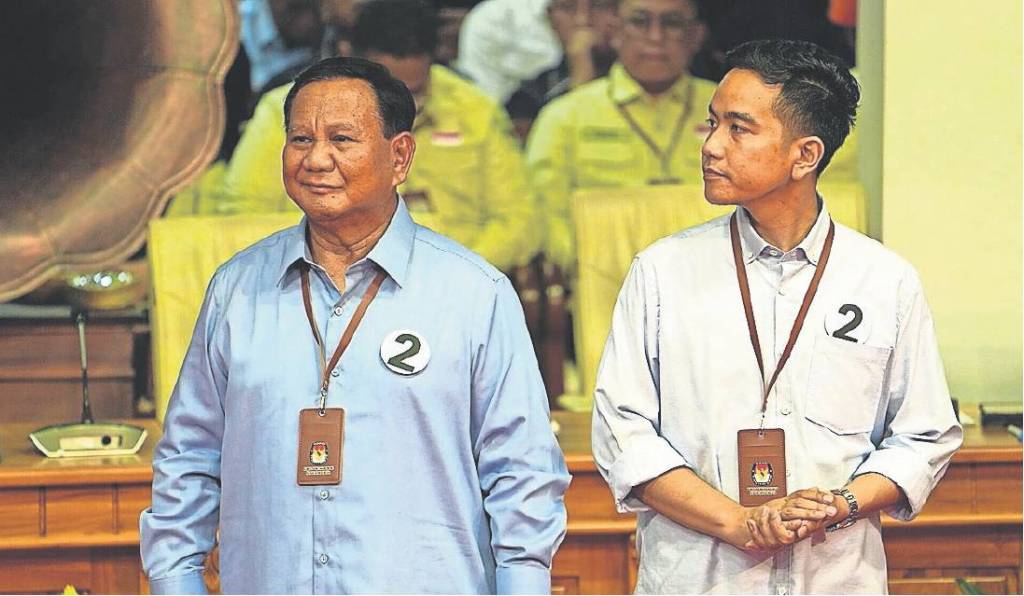
Indonesia’s political mystery of the year – which candidate Joko ‘‘Jokowi’’ Widodo would back in February’s election – was solved in October when a court ruling opened the way for the president’s 36-year-old son, Gibran Rakabuming Raka, to stand as the running mate of Defence Minister Prabowo Subianto.
As well as setting up a dynastic succession of sorts, the pairing was the culmination of a reconciliation between two former rivals.
More important, the decision brings into focus the weakening of core democratic institutions under Jokowi’s presidency.
Jokowi’s rejection of Ganjar Pranowo, from his own PDI-P party, in favour of a ticket uniting Gibran with Prabowo signalled the tightening grip of dynasties on Indonesian politics and the weakening of parties.
The controversial Constitutional Court decision that cleared the way for Gibran to run was a sad coda to the story of a once great institution. In the years after its founding in 2003, the court was widely viewed as an important check on the executive and a major achievement of Indonesia’s reformasi movement.
But the decision to allow Gibran to run was a blatant exercise in political favouritism. The court essentially amended a legal clause prohibiting candidates under 40 from running by writing an exception – for candidates with experience as heads of regions – which was tailor-made for Gibran, the mayor of Surakarta, the central Java town where his father also began his political career.
Adding an element of farce, the court decision overruled a finding handed down that day, following intervention by the chief justice, who happened to be Jokowi’s brother-in-law.
Other key checking institutions have suffered a similar fate under Jokowi. The Corruption Eradication Agency (KPK), once a beacon of independence and probity in a tainted law enforcement landscape, has increasingly become an instrument of the executive. Under Jokowi, the KPK has played a major role in prosecuting senior politicians in ways that consolidate the president’s coalition.
More worrying are signs the integrity of Indonesia’s elections may be threatened. Most observers agree on a democratic decline since Jokowi was elected in 2014.
His presidency has featured increased use of coercion against government opponents – notably Islamists, but also liberal critics – targeted intervention in political parties, selective use of criminal prosecutions against bothersome coalition partners and reactivation of the military in civilian life.
Yet, there was long a consensus among observers that, no matter how problematic aspects of Indonesian democracy became, the open and competitive character of elections remained untouched.
That consensus is now challenged. Stories are accumulating of petty steps by bureaucrats and security officials in Indonesia’s regions to obstruct Prabowo’s opponents and mobilise in favour of him and Gibran.
While these stories still need to be treated with caution, and are not unprecedented in democratic Indonesia, such interventions have, in the past, mainly affected local elections.
Adding to the unease is that 271 of Indonesia’s regional government heads, including governors in many of the most populous provinces, are central government appointees rather than elected politicians – at least until regional elections late next year.
A Prabowo-Gibran victory appears the most likely outcome in 2024’s presidential election.
Jokowi’s tacit endorsement counts for a lot. The president remains extremely popular, with approval ratings of about 75 per cent. Many Indonesians appreciate his Suharto-lite focus on economic development without the most authoritarian elements of Suharto’s rule, supplemented by growing allocations of social assistance.
This is why Prabowo has reinvented himself as Jokowi’s No.1 public admirer and courted his son as his running mate.
Their pairing puts Prabowo, a man with a deeply authoritarian past, closer to the presidency. He was once Suharto’s son-in-law and the leader of a hardline faction of the military during the final years of that regime.
Observers of Indonesian politics debate whether Prabowo’s experience of compromise as a minister under Jokowi might have tempered his authoritarian instincts.
Under Jokowi, Prabowo has largely ditched the fiery populist rhetoric with which he tried to win the presidency in 2014 and 2019.
Regardless, it does not bode well for Indonesia that a new president with an authoritarian pedigree is likely to take office after his predecessor oversaw the capture of previously independent control institutions, transformed the state apparatus into an instrument to pursue political advantage and narrowed the space for opposition.
Edward Aspinall is professor of politics and head of the Department of Political and Social Change at the Coral Bell School of Asia Pacific Affairs, The Australian National University. This article is part of a series from East Asia Forum (www. eastasiaforum.org) at the Crawford School of Public Policy in the ANU’s College of Asia and the Pacific.
 Australia West Papua Association Adelaide