
18 March 2026 /
The headquarters of the Papuan movement organisation West Papua National Committee (KNPB) in Jayapura, Papua Province, were attacked by a drone in the early hours of 16 March 2026 at approximately 04:16 am. The drone reportedly dropped an explosive device which detonated in the office courtyard whilst several KNPB members and officials were asleep inside the building. The incident follows a previous arson attack against the same office on 17 January 2026, indicating an emerging pattern of intimidation against the political activists and human rights defenders in West Papua.
The KNPB is a non-violent civil resistance movement in West Papua, which has been organising West Papua-wide mass protests for self-determination through a political referendum for more than ten years. Their members have committed to non-violent protest by organising peaceful demonstrations and political discussions.
According to information documented by local human rights activists, an unidentified drone is believed to have dropped an explosive device into the courtyard of the KNPB headquarters in the Kambolker area in Waena, a sub-district of Jayapura City. The device reportedly exploded approximately two metres from the main office building and near the boundary wall separating the compound from a residential area.
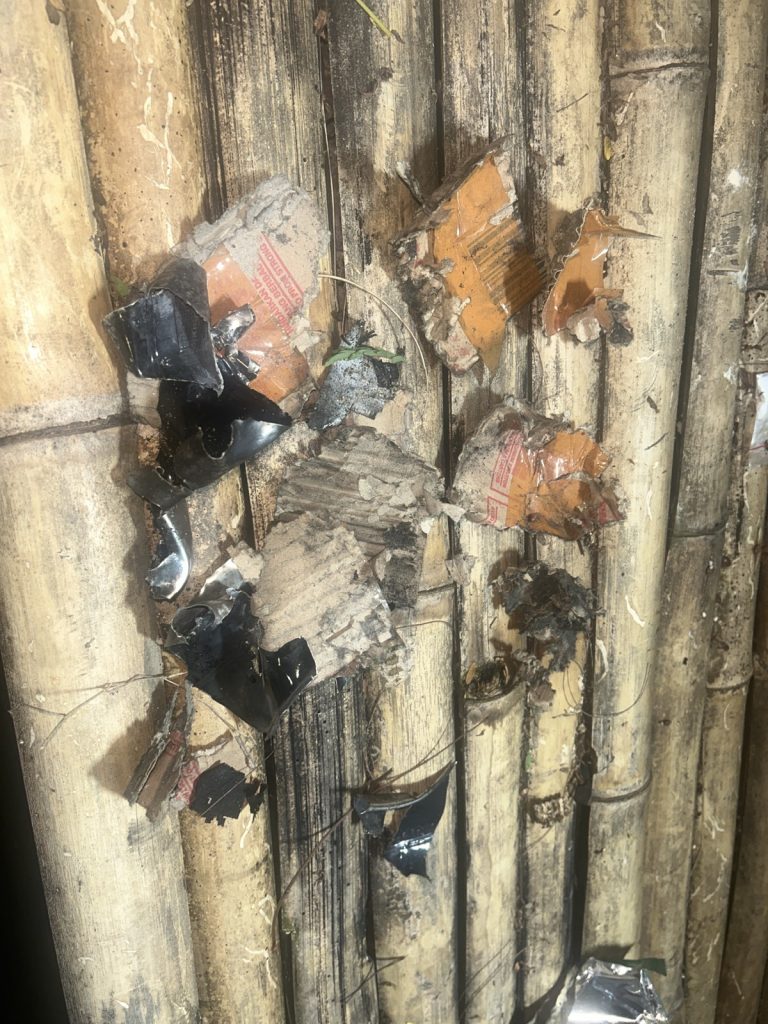
The loud explosion abruptly awakened KNPB members sleeping inside the office and caused panic among occupants and nearby residents. Several residents reportedly left their homes and gathered at the scene. Following the incident, local human rights activists conducted preliminary documentation, including photographing the crime scene and collecting visible fragments believed to be components of the explosive device. The impact of the detonation in the courtyard of the KNPB office was still visible on the following day, illustrating the force of the blast and the potential lethality of the attack (see photos below, source: independent HRD).
Given that multiple individuals were present inside the building at the time, the incident posed a serious and immediate threat to life and physical integrity. The attack also significantly undermined the sense of safety of civil society actors operating in Jayapura City and more broadly in the Papuan provinces.
Fragments believed to be part of the explosive device, including black metal plates suspected to be bomb casing, cardboard fragments, small screws and bolts.
Previous arson attack in January 2026
The drone attack follows a prior attack on the same office on 17 January 2026 at approximately 3:16 am. During that incident, unknown perpetrators allegedly poured petrol on the office walls and set them alight. KNPB members who were asleep at the time awoke upon noticing flames and were able to extinguish the fire manually, preventing the blaze from spreading further. Witnesses reported that the perpetrators fled the scene in a black Toyota Avanza vehicle waiting nearby.
Evidence documented after the arson attempt reportedly included traces of petrol on the office wall, a container wrapped in duct tape, plastic sheeting, and a grey handkerchief (see photos below, source: independent HRD).
Pattern of intimidation against civil society organisations
These two incidents appear to form part of a broader pattern of intimidation targeting civil society organisations, journalists, and human rights defenders in Indonesia. On 12 March 2026, Mr Andrie Yunus, Deputy Coordinator of the Commission for the Disappeared and Victims of Violence (KontraS), was attacked with acid by unidentified perpetrators whilst riding a motorcycle on Jalan Salemba I–Talang, Central Jakarta. The issue has also reached alarming levels in the Papuan provinces. Previous attacks in the region include a Molotov cocktail attack against the office of the independent media outlet JUBI in October 2024.
The reported use of drone technology to deliver an explosive device suggests a relatively high level of planning and operational capability. Such methods heighten concerns regarding the security for organisations engaged in critical journalism, human rights advocacy and community mobilisation. At the time of writing, no official investigation had publicly identified the perpetrators or established a motive. Civil society actors have called for a transparent, independent, and comprehensive investigation into the alleged attacks.
Human rights analysis
The bombing and earlier arson attempt potentially engage multiple human rights protections under international and Indonesian law. Attacks against civil society organisations threaten the right to security of person, the right to freedom of association and peaceful assembly and the right to freedom of expression. These right are enshrined in International Covenant on Civil and Political Rights (ICCPR), to which Indonesia is a party.
States have a positive obligation not only to refrain from violating human rights but also to protect individuals and organisations from harm by third parties. Failure to prevent, investigate, and prosecute repeated attacks may raise concerns regarding state compliance with its duty of due diligence. Such incidents may also contribute to a climate of fear that restricts civic space and undermines democratic participation in the Papuan provinces.
Drone attack on 16 March 2026
Arson attack on 17 January 2026
Detailed Case Data
Location: Kampung Waena, Heram, Jayapura City, Papua, Indonesia (-2.5932318, 140.6339916)Kamwolker area, Waena
Region: Indonesia, Papua, Jayapura, Heram
Total number of victims: few
| # | Number of Victims | Name, Details | Gender | Age | Group Affiliation | Violations |
| 1. | few | diverse | unknown | Indigenous Peoples | freedom of assembly, freedom of expression, intimidation |
Period of incident: 16/03/2026 – 16/03/2026
Perpetrator: Other
Issues: indigenous peoples ————————————————————————————————
 Australia West Papua Association Adelaide