Acid attack against human rights defender Andrie Yunus in Central Jakarta

17 March 2026 / 3 minutes of reading

On 12 March 2026, Mr Andrie Yunus, Deputy Coordinator of the Commission for the Disappeared and Victims of Violence (KontraS), was attacked with acid by unidentified perpetrators whilst riding a motorcycle on Jalan Salemba I–Talang, Central Jakarta. The attack caused serious injuries affecting various body parts, including his face, eyes, chest, and hands. Mr Yunus was subsequently admitted to Cipto Mangunkusumo Hospital (RSCM) in Jakarta, where he remains under specialised medical care.

Earlier that evening, Mr Andrie Yunus had attended and recorded a podcast discussion on “Remilitarisation and Judicial Review in Indonesia” at the offices of the Indonesian Legal Aid Foundation (YLBHI). After leaving the premises, he travelled by motorcycle through Central Jakarta. According to CCTV analysis and witness statements, the suspected perpetrators had followed Mr Yunus on two motorcycles after he had left the YLBHI office.

At approximately 11:30 pm, the suspects were observed waiting near a petrol station and a fast-food outlet in Cikini, before resuming surveillance as the victim continued his journey. Shortly thereafter, at around 23:37 pm, the perpetrators approached him on their motorcycle from the opposite direction on Jalan Talang. While passing Mr Yunus, the person sitting in the back splashed a corrosive substance believed to be acid directly at his face and upper body. The victim fell from his motorcycle and screamed for assistance. Residents nearby provided immediate aid and arranged his transfer for emergency medical treatment.

Police later confirmed that the perpetrators split up after the attack, travelling towards different areas including Ragunan, Kalibata, and Bogor. Investigators analysed footage from approximately 86 CCTV cameras across Jakarta in an effort to reconstruct the suspects’ movements. Evidence recovered from the scene reportedly includes a purple tumbler-type container believed to have contained the acid, as well as other items such as a helmet suspected to belong to one of the attackers.

Investigation and developments

The Jakarta Metropolitan Police elevated the case from preliminary investigation to a formal criminal inquiry aimed at identifying suspects, citing indications of premeditation, coordination, and surveillance prior to the attack. Authorities believe the perpetrators monitored the victim’s daily routines and selected the timing and location strategically.

Civil society organisations, legal experts, and members of the Advocacy Team for Democracy have characterised the attack as an attempted premediated murder, emphasising similarities with previous attacks on activists in Indonesia, including the acid attack against anti-corruption investigator Novel Baswedan (2017) and the poisoning murder of HRD Munir Said Thalib (2004). They raised concerns that investigations in such cases historically failed to identify or prosecute alleged masterminds.

Indonesia’s President reportedly instructed the National Police Chief to ensure a professional, transparent, and professional investigation, while parliamentary oversight bodies pledged to monitor progress. The United Nations human rights leadership publicly expressed grave concern over the attack, emphasising the obligation of the State to protect human rights defenders and hold perpetrators accountable.

Human rights analysis

The acid attack constitutes a grave violation of the rights to life, security of person, and freedom from cruel, inhuman or degrading treatment, as well as a direct attack on the legitimate work of a human rights defender. The apparent premeditation, use of dangerous corrosive substances, and coordinated surveillance strongly indicate that the act may qualify as attempted premeditated murder under Indonesian criminal law.

Moreover, the attack reflects a broader pattern of intimidation and violence against civil society actors in Indonesia, raising concerns regarding impunity, inadequate HRD protection mechanisms, and potential involvement or tolerance by elements linked to state institutions. The failure to conduct an effective investigation could further undermine public trust in the rule of law and Indonesia’s democratic commitments.

Under international law, Indonesia has a positive obligation to prevent, investigate, punish, and provide remedies for attacks against human rights defenders, particularly when such acts may be linked to their advocacy work. The targeting of Mr Andrie Yunus following his involvement in sensitive issues, including security sector legislation and past protest investigations, suggests a possible retaliatory motive aimed at silencing dissenting voices.

Detailed Case Data
Location: Jl. Salemba I No.8A, RT.3/RW.6, Kenari, Kec. Senen, Kota Jakarta Pusat, Daerah Khusus Ibukota Jakarta 10320, Indonesia (-6.1988339, 106.8492458) 
Region: Indonesia, Jakarta
Total number of victims: 1

#Number of VictimsName, DetailsGenderAgeGroup AffiliationViolations
1.Andrie Yunus

diverseadult Human Rights Defender (HRD)right to life, torture

Period of incident: 12/03/2026 – 12/03/2026
Perpetrator: , Other
Issues: human rights defenders

————————————–

Drone attack on the office of Papuan movement organisation KNPB in Jayapura

18 March 2026 /

The headquarters of the Papuan movement organisation West Papua National Committee (KNPB) in Jayapura, Papua Province, were attacked by a drone in the early hours of 16 March 2026 at approximately 04:16 am. The drone reportedly dropped an explosive device which detonated in the office courtyard whilst several KNPB members and officials were asleep inside the building. The incident follows a previous arson attack against the same office on 17 January 2026, indicating an emerging pattern of intimidation against the political activists and human rights defenders in West Papua.

The KNPB is a non-violent civil resistance movement in West Papua, which has been organising West Papua-wide mass protests for self-determination through a political referendum for more than ten years. Their members have committed to non-violent protest by organising peaceful demonstrations and political discussions.

According to information documented by local human rights activists, an unidentified drone is believed to have dropped an explosive device into the courtyard of the KNPB headquarters in the Kambolker area in Waena, a sub-district of Jayapura City. The device reportedly exploded approximately two metres from the main office building and near the boundary wall separating the compound from a residential area.

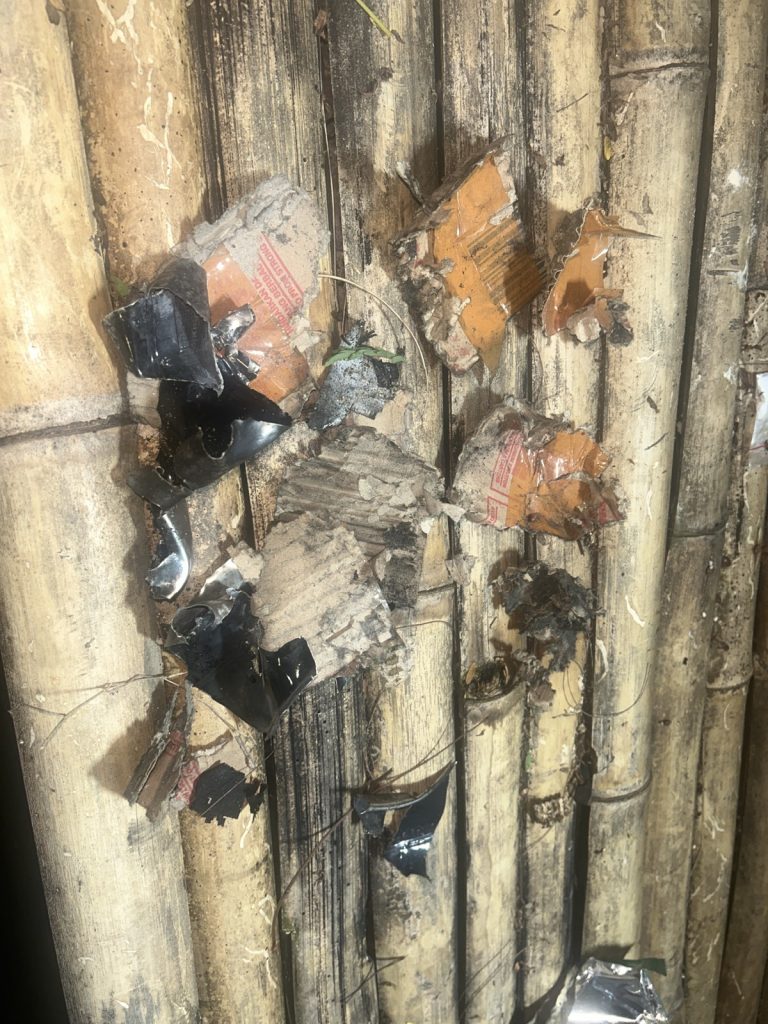
The loud explosion abruptly awakened KNPB members sleeping inside the office and caused panic among occupants and nearby residents. Several residents reportedly left their homes and gathered at the scene. Following the incident, local human rights activists conducted preliminary documentation, including photographing the crime scene and collecting visible fragments believed to be components of the explosive device. The impact of the detonation in the courtyard of the KNPB office was still visible on the following day, illustrating the force of the blast and the potential lethality of the attack (see photos below, source: independent HRD).

Given that multiple individuals were present inside the building at the time, the incident posed a serious and immediate threat to life and physical integrity. The attack also significantly undermined the sense of safety of civil society actors operating in Jayapura City and more broadly in the Papuan provinces.

Fragments believed to be part of the explosive device, including black metal plates suspected to be bomb casing, cardboard fragments, small screws and bolts.

Previous arson attack in January 2026

The drone attack follows a prior attack on the same office on 17 January 2026 at approximately 3:16 am. During that incident, unknown perpetrators allegedly poured petrol on the office walls and set them alight. KNPB members who were asleep at the time awoke upon noticing flames and were able to extinguish the fire manually, preventing the blaze from spreading further. Witnesses reported that the perpetrators fled the scene in a black Toyota Avanza vehicle waiting nearby.

Evidence documented after the arson attempt reportedly included traces of petrol on the office wall, a container wrapped in duct tape, plastic sheeting, and a grey handkerchief (see photos below, source: independent HRD).

Pattern of intimidation against civil society organisations

These two incidents appear to form part of a broader pattern of intimidation targeting civil society organisations, journalists, and human rights defenders in Indonesia. On 12 March 2026, Mr Andrie Yunus, Deputy Coordinator of the Commission for the Disappeared and Victims of Violence (KontraS), was attacked with acid by unidentified perpetrators whilst riding a motorcycle on Jalan Salemba I–Talang, Central Jakarta. The issue has also reached alarming levels in the Papuan provinces. Previous attacks in the region include a Molotov cocktail attack against the office of the independent media outlet JUBI in October 2024.

The reported use of drone technology to deliver an explosive device suggests a relatively high level of planning and operational capability. Such methods heighten concerns regarding the security for organisations engaged in critical journalism, human rights advocacy and community mobilisation. At the time of writing, no official investigation had publicly identified the perpetrators or established a motive. Civil society actors have called for a transparent, independent, and comprehensive investigation into the alleged attacks.

Human rights analysis

The bombing and earlier arson attempt potentially engage multiple human rights protections under international and Indonesian law. Attacks against civil society organisations threaten the right to security of person, the right to freedom of association and peaceful assembly and the right to freedom of expression. These right are enshrined in International Covenant on Civil and Political Rights (ICCPR), to which Indonesia is a party.

States have a positive obligation not only to refrain from violating human rights but also to protect individuals and organisations from harm by third parties. Failure to prevent, investigate, and prosecute repeated attacks may raise concerns regarding state compliance with its duty of due diligence. Such incidents may also contribute to a climate of fear that restricts civic space and undermines democratic participation in the Papuan provinces.

Drone attack on 16 March 2026

Arson attack on 17 January 2026

Detailed Case Data
Location: Kampung Waena, Heram, Jayapura City, Papua, Indonesia (-2.5932318, 140.6339916)Kamwolker area, Waena
Region: Indonesia, Papua, Jayapura, Heram
Total number of victims: few

#Number of VictimsName, DetailsGenderAgeGroup AffiliationViolations
1.few 

diverseunknown Indigenous Peoplesfreedom of assembly, freedom of expression, intimidation

Period of incident: 16/03/2026 – 16/03/2026
Perpetrator: Other
Issues: indigenous peoples ————————————————————————————————

Malind Indigenous People Defend Their Customary Land Rights Under Intimidation

March 6, 2026 in Animha Reading Time: 4 mins read

0

Author: Aida Ulim – Editor: Arjuna Pademme

Jayapura, Jubi – The struggle of the Malind indigenous people in Merauke Regency, South Papua, to defend their customary lands and forests from government land clearing projects for plantation and agricultural investment has not been easy. They have faced intimidation and pressure from the military.

Andreas Mahuse, a Malind indigenous person, said that the community there experienced pressure from the military following the forest clearing. Around a thousand military personnel were stationed in Ilwayab District, Merauke Regency.

According to him, a number of mistakes were made by the central government, provincial government, and Merauke Regency Government in implementing investment projects in the Malind community’s customary territory.

“The first is the taking of customary land since 2024 without the consent and notification of the indigenous community,” said Andreas Mahuse after the Malind indigenous community filed a lawsuit with the Jayapura State Administrative Court (PTUN Jayapura) in Waena, Jayapura City, Papua, on Thursday (March 5, 2026).

He said there had never been any dialogue or negotiation between the government or the company and the indigenous community regarding land ownership status and the planned transfer of land to the company.

“There should have been a meeting with us, the indigenous people, to discuss who owns this land and whether or not the community agreed to its use. However, such a process never occurred,” he said.

Andreas Mahuse stated that the lawsuit filed with the Jayapura Administrative Court (PTUN) was also part of the Malind indigenous people’s efforts to defend their customary land.

The lawsuit was filed by five representatives of the Malind indigenous people: Simon Petrus Balagaize, Sinta Gebze, Andreas Mahuze, Liborius Kodai Moiwend, and Kanisius Dagil, under case number 9/G/LH/2026/PTUN Jayapura.

The Malind indigenous people are challenging the Merauke Regent’s Decree Number 100.3.3.2/1105/2025 concerning the environmental feasibility permit for the construction of a 135-kilometer road for the National Strategic Project (PSN).

“[This lawsuit] is a form of struggle to defend customary land and forests from the government’s National Strategic Project (PSN) for rice paddy development,” said Andreas Mahuse.

Andreas Mahuse explained that the 135-kilometer road, part of the rice paddy development project, was forcibly constructed without the community’s consent.

The road stretches from Wanam Village, Ilwayab District, passing through several villages and reaching Muting District.

“The villages [through which the road construction passes] include Wanam, Wogikel, Salamepe, Nakias, Tagaepe, Ilhalik, Kapdel, and Solo Village. This project also crosses several districts, namely Ilwayab, Ngguti, and Muting Districts,” he said.

The indigenous community ultimately filed the lawsuit, alleging administrative errors in the project. Forest clearing for road construction began in September 2024, but the environmental permit document was only issued in September 2025.

“This is a very serious state administrative error for us indigenous people,” he said.

Furthermore, Mahuse continued, the indigenous community has never seen important documents such as the Environmental Impact Analysis (AMDAL) or the technical development planning documents.

The project is also considered to have the potential to damage the indigenous community’s culture, as it has changed the community’s lifestyle, which has traditionally relied on sago as a staple food, replacing it with rice.

“This is not only an environmental issue, but also a violation of the indigenous community’s cultural rights,” said Andreas Mahuse.

Another representative of the Malind indigenous community, Sinta Gebze from Wanam Village, said the company entered their customary territory without the community’s permission, with a large military escort, which has made the community afraid to resist directly.

According to her, some residents have experienced violence from security forces. They were beaten, resulting in injuries, and some were even paralyzed.

“Furthermore, I experienced intimidation while at a place of worship. I was picked up at the church door. I asked them, ‘What did I do wrong? I was just defending my land rights,'” said Sinta Gebze.

He said the company’s activities continue day and night, and the indigenous people have been unable to stop the clearing of their forests and gardens.

“The community has been demanding compensation for the cleared crops since 2024, but there has been no response from the company,” said Sinta Gebze.

Another Malind indigenous community member, Simon Petrus Balagaize, said the project has also sparked social conflict among the indigenous people, as some accepted the company’s offer, while others refused. The conflict culminated in violence and the burning of the homes of residents who opposed the project.

“Initially, the project was carried out by PT Jhonlin Group, then by other companies, but these companies denied their involvement,” said Simon Petrus Balagaize.

He said that most of the Malind’s customary territory has now been divided into various company concessions. Of the approximately two million hectares of customary territory, the majority has been included in company concessions or designated as production forest areas.

“The last remaining forest is our habitat, along with cassowaries, birds-of-paradise, and many other animals. There’s also sago, our staple food,” he said.

The Malind indigenous people, according to Balagaize, do not oppose development. Instead, they want to be respected as owners of their customary land. For indigenous people, the forest is a living space that provides all their needs.

“For us, the forest is heaven; God has provided everything there. That’s why we defend our forest. Customary land does not belong to the village head, the traditional chief, or the government, but to the clan, passed down from generation to generation,” he said.

He stated that if any clan holding customary rights disagrees, the customary land cannot be relinquished. Balagaize called for solidarity and support for the Malind indigenous people’s struggle to defend their customary land and forest. (*)

Intimidation against indigenous leader in connection with the planned construction of Indonesian military headquarters in Biak

14 January 2026 / 4 minutes of reading

Between 30 November and 9 December 2025, a series of intimidation and surveillance incidents were reportedly directed against Mr Apolos Sroyer, Chair of the Biak Customary Council and Chief of the Biak Tribe, in the Biak–Supiori Regency, Papua province. The acts are allegedly linked to his peaceful leadership of indigenous opposition to the planned construction of new military (TNI) headquarters. The actions by military officials may amount to violations of the rights of indigenous peoples, including intimidation and interference with legitimate customary leadership.

Mr Apolos Sroyer is a long-standing indigenous leader and a founder of the Papuan Customary Council (2001). He is the Chief of the Biak Tribe for the 2017–2029 period. He has led non-violent efforts to protect customary lands, resolve land and social disputes through customary justice, and prevent state encroachment on indigenous territories without consent.

Between 2018 and 2024, the Indonesian Government advanced plans to construct military headquarters and battalion facilities within the customary territory of Biak–Supiori Regency. Indigenous communities consistently rejected these plans, citing threats to their living space, cultural survival, and security, and the absence of Free, Prior, and Informed Consent (FPIC). Human rights observers expressed concerns that the formation of three new Indonesian Military battalions in Biak, Supiori, and Waropen has the potential to create human rights violations.

Escalation and military deployment

In November–December 2025, approximately 1,200–1,750 TNI personnel were reportedly deployed to Biak–Supiori Regency, occupying schools and public facilities. This large-scale military presence revived collective trauma linked to the past Military Operations Zone (DOM) period and intensified fear among indigenous communities. The three battalions are Territorial Development Battalion units, which are prepared to implement food security projects, and conduct infrastructure development.

On 5 December 2025, a customary meeting was held in the Ababiadi Village Office, South Supiori District, attended by the Biak Customary Council and representatives of 13 clans. The meeting formally declared rejection of the planned construction of military headquarters on their customary land, reaffirming that the project violated FPIC and endangered the survival of the Biak indigenous people. Despite this, the local district military commander reportedly announced plans to proceed with eviction on 9 December 2025.

Following the customary rejection, Mr Apolos Sroyer repeatedly became the target of intimidation. On 30 November 2025, unidentified officials visited his home without prior notice, followed the same night by drone surveillance reportedly conducted for several hours. On 9 December 2025, intelligence vehicles allegedly followed Mr Sroyer while he was in Jayapura. Meanwhile, TNI members reportedly attempted to create division between indigenous clans and coerce the community into accepting the military project. These actions created a credible climate of fear, raising concerns about possible physical harm, constant surveillance, and the risk of criminalisation of a legitimate indigenous leader.

Impact on indigenous communities

The planned military construction and associated intimidation have had severe impacts on the affected indigenous communities in Biak, including the threatened seizure of customary land and restriction of access to land, sea, and gardens, deepening collective trauma, and the risk of cultural destruction. Community members emphasise that the land concerned is not empty land, but integral to their identity, livelihood, and spiritual life.

Biak indigenous leaders and customary authorities have publicly stated that they reject the presence of military bases on indigenous territories. Customary rights cannot be relinquished without collective customary deliberation.

Human rights analysis

The reported acts may amount to violations of the right to security of person, freedom from intimidation, the rights of indigenous peoples to land and self-determination, and the obligation of the state to obtain FPIC before undertaking projects affecting indigenous territories as enshrined in the International Covenant on Civil and Political Rights (ICCPR), the International Covenant on Economic, Social, and Cultural Rights (ICESCR), and the UN Declaration on the Rights of Indigenous Peoples. The intimidation of a customary leader for peacefully exercising his mandate raises serious concerns about reprisals against human rights defenders.

Customary meeting in the Ababiadi Village, South Supiori District, attended by the Biak Customary Council and representatives of 13 clans on 5 December 2025

Detailed Case Data
Location: Biak, Papua, Indonesia (-1.0381022, 135.9800848) 
Region: Indonesia, Papua, Biak Numfor
Total number of victims: dozens

#Number of VictimsName, DetailsGenderAgeGroup AffiliationViolations
1.Apolos Sroyer

maleadult Human Rights Defender (HRD), Indigenous Peoplesintimidation
2.dozens 

Indigenous Peoplesintimidation

Period of incident: 30/11/2025 – 09/12/2025
Perpetrator: , Indonesian Military (TNI)
Issues: business, human rights and FPIC, human rights defenders, indigenous peoples

Indonesia’s election to the UN Human Rights Council was not due to human rights progress

January 10, 2026 in Press Release Reading Time: 3 mins read

0

Author: Jubi Admin – Editor: Arjuna Pademme

Jayapura, Jubi – Amnesty International Indonesia stated that Indonesia’s election as President of the United Nations Human Rights Council (UNHRC) was not due to human rights progress at home or abroad.

Amnesty International Indonesia’s Executive Director, Usman Hamid, said the Minister of Human Rights’ boast that Indonesia “succeeded in winning” the position of President of the UNHRC because of the “Ministry of Human Rights” was a false boast that was not based on the facts.

He said the position rotates according to region around the world. This year it is the Asia Pacific region’s turn. Coincidentally, Indonesia is the sole candidate for this rotating position.

“So it’s not accurate to say that Indonesia achieved this position because it ‘seized’ it, let alone because of the Ministry of Human Rights. It’s also not accurate to say that this position was achieved because of progress on human rights at home or abroad,” said Usman Hamid in a written press release on Friday evening (January 9, 2026).

According to Usman, Indonesia’s domestic human rights reputation has actually worsened. In 2025, more than 5,000 people were arrested for demonstrations, and 283 human rights defenders were attacked.

Ironically, the Ministry of Human Rights tends to justify human rights violations. Most recently, the Minister of Human Rights even praised the drafters of the new Criminal Procedure Code (KUHAP), which clearly threatens human rights.

Indonesia’s international human rights reputation is weak. Indonesia tends to reject recommendations from the Human Rights Council to improve the human rights situation. “In 2022, for example, Indonesia rejected 59 of the 269 recommendations in the Universal Periodic Review (UPR),” he said.

He said these two situations create an irony: as President of the Human Rights Council, Indonesia will lead the review of member states’ human rights in the Universal Periodic Review (UPR), especially since Indonesia will also be the object of the UPR review.

Furthermore, Usman continued, Indonesia’s UPR reports often differ from reality. In 2022, Indonesia only reported on Papua from the perspective of infrastructure and welfare, without mentioning the ongoing violence against civilians there.

Indonesia has shown little commitment to human rights and often advocates for permissive approaches such as dialogue or consensus with countries suspected of human rights violations.

He cited an example in 2022, after a report by the UN High Commissioner for Human Rights concluded that human rights violations in Xinjiang, China, potentially constituted crimes against humanity.

At that time, Indonesia rejected a motion to discuss the report, arguing that it would “not yield meaningful progress” because the proposal “did not receive the consent and support of the countries concerned.”

“This rejection contributed to the failure of the motion by a narrow margin, 19 votes against to 17 in favor, and 11 abstentions. “Indonesia also has a poor track record in granting access to UN special rapporteurs to visit Indonesia to examine the human rights situation,” he said.

Furthermore, in 2023, Indonesia rejected a request from the Special Rapporteur on the Independence of the Judiciary to visit Indonesia. That year, Indonesia rejected a request from the UN Special Rapporteur on Slavery, and in 2024, Indonesia rejected a request from the UN Special Rapporteur on Truth, Justice, and Reparations.

Usman said, therefore, through the position of President of the Human Rights Council, we can test Indonesia’s seriousness by seeing whether Indonesia actively encourages members of the Human Rights Council, including Indonesia, to agree on firm action regarding alleged human rights violations, accepts the recommendations made, and facilitates requests for official visits from independent experts and UN special rapporteurs.

According to him, the position of President of the UN Human Rights Council will mean nothing to Indonesia and is merely a matter of pride without alignment of human rights concerns in its foreign and domestic policies.

Previously, Indonesia was elected President of the UN Human Rights Council on Thursday, January 8, 2026. The office of President of the Council is held by the Permanent Representative Indonesian Ambassador to the United Nations in Geneva, Sidharto Reza Suryodipuro, replaces the previous official, Jurg Lauber of Switzerland.

This is Indonesia’s first presidency of the UN Human Rights Council since its establishment 20 years ago.

As president of the UN Human Rights Council for a one-year term, Sidharto will preside over the proceedings of the forum, which is based in Geneva, Switzerland.

The Indonesian ambassador will preside over three sessions of the UN Human Rights Council, scheduled for late February, June, and September 2026.

He will also oversee the review of the human rights records of Council member states, known as the Universal Periodic Review (UPR).

Sidharto stated that Indonesia has been a strong supporter of the UN Human Rights Council since its inception 20 years ago, as well as of its predecessor, the UN Commission on Human Rights.

“Our decision to move forward is rooted in the 1945 Constitution and in line with the purposes and principles of the UN Charter, which mandates Indonesia to contribute to world peace based on freedom, peace, and social justice,” he told the attendees. delegation. (*)

IPWP Statement: West Papua at COP30

As COP30 begins in Belém, Brazil, we the undersigned express our profound concern over the intensifying deforestation currently occurring in West Papua, Indonesia. 

West Papua has been under Indonesian control since a controversial 1969 process, “the Act of Free Choice”, which saw 1026 West Papuans vote for integration into Indonesia under conditions of intimidation and violence. In 2019, the Act of Free Choice was described by the UK Government as “utterly flawed”. The number of West Papuans killed since Indonesian rule began has been estimated at between 100,000 and 540,000, while a state-backed ‘transmigration’ policy which has relocated more than 800,000 Indonesians to West Papua has likely made the indigenous population a minority.

Indonesian governance in West Papua is characterised by corruption, violation of Indigenous land rights, and widespread deforestation. 71% of the decrease in West Papua’s forest cover has occurred since 2011. Given that the territory contains over half of the world’s third largest rainforest, protecting this unique environment is critical to the preservation of a habitable planet. West Papua is also home to a number of extremely destructive industrial projects. Since 1988, US company Freeport McMoran has operated the world’s largest and most toxic gold mine in the Mimika Regency, which dumps over 200,000 tonnes of toxic tailings into the local Aikwa river system daily. 

More recent deforestation in West Papua has concentrated in agribusiness initiatives as well as mining. In 2024, a government-designated National Strategic Project (PSN) was launched in the southeastern Regency of Merauke, dedicated to sugarcane and rice production. Spanning more than three million hectares in total, the Merauke PSN has been described by conservation news service Mongabay as the largest deforestation project in human history. Upon completion, the PSN will release 782.45 million additional tonnes of CO2, more than doubling Indonesia’s existing yearly CO2 emissions. Much of the Merauke landscape is covered by Melaleuca paperbark trees, which store up to 381 tons of carbon per hectare. This makes the Merauke rainforest a denser CO2 sink than the Amazon rainforest.

As is often the case in West Papua, the Merauke mega-project appears to have been launched without consultation with indigenous West Papuans, deepening an already widespread sense of disenfranchisement and marginalisation. Industrial policy in West Papua is marked by a consistent violation of Free, Prior, and Informed Consent (FPIC). In another example of this trend, a 2018 investigation into the Tanah Merah mega-plantation in Boven Digoel revealed that all seven of the permits for oil palm concessions had been falsified.

We observe that industrial development is one of the major drivers of violence and internal displacement in West Papua. According to data compiled by human rights defenders on the ground, a total of 102,966 West Papuans were currently displaced as of October 2025. 

This interplay between deforestation and displacement is perhaps clearest in Intan Jaya Regency, where an area of forest the size of Jakarta is currently being cleared for the development of the Wabu Block gold mine. A 2022 Amnesty International report described construction at Wabu Block as having resulted in a ‘clear escalation’ in militarisation, including beatings, restrictions on free movement, extrajudicial killings, and a greatly increased number of military checkpoints. 

Intan Jaya has been a site of intense conflict and multiple human rights abuses in 2025, as construction on the Wabu Block has accelerated. On October 15th, fifteen civilians were massacred during an Indonesian military raid on Soanggama Village. A similar atrocity was committed in May 2025, when up to fifteen West Papuans were killed or disappeared in Sugapa district. The victims of this massacre included a minor, a 75-year-old, and two women, one of whom was buried by Indonesian soldiers in a shallow grave. In March, a series of aerial military bombardments destroyed a number of villages in Intan Jaya, prompting hundreds of civilians to flee.

We express our deep concern that Indonesia’s programme of deforestation in West Papua, is incompatible with UN’s sustainable development goals, as well as the Tropical Forest Forever Facility set to be launched at COP30. 

We urge leaders at COP to protect the natural environment of the unique rainforest of West Papua. Specifically, we urge leaders to support the Green State Vision developed by the United Liberation Movement for West Papua (ULMWP) for an environmentally just and sustainable West Papua. 

Alex Sobel, MP, UK, Labour Party, IPWP Chair
Carles Puigdemont, MEP, Catalonia (Spanish State), Junts, IPWP Vice-Chair
Gorka Elejabarrieta, Senator, Basque Country (Spanish State), EH Bildu, IPWP Vice-Chair

Matthew Wale MP, Leader of the Opposition, Solomon Islands, IPWP Vice-Chair
Lord Lexden OBE, UK, Conservative
Rt. Reverend Lord Harries of Pentregarth, UK, Crossbench
Maggie Chapman MSP, Scotland (UK), Scottish Greens
Ross Greer MSP, Scotland (UK), Scottish Greens 
Jeremy Corbyn, MP, UK, Your Party

Baroness Nathalie Bennett of Manor Castle, UK, Green Party
Nadia Whittome, MP, UK, Labour Party

Fatal free lunch

November 20, 2025

Indonesia’s free meals for kids program has left thousands of youngsters with food poisoning, and returned the country to the bad old days of military influence.

“All power flows from the barrel of a gun,” said Mao Zedong. His aphorism may have been right a century ago in China, but not in modern Indonesia. In the nation next door, power comes subtly via unarmed brigadiers in boardrooms. The riflemen are there, but out of sight.

Professional corporations with genuine jobs to fill normally advertise for the best certified and experienced applicants to stay innovative and competitive. Patronage appointments kill such management essentials.

Meat and veggie buyers, cooks, hygiene inspectors, nutritionists, quality controllers, agricultural advisors – there are scores of positions with Makan Bergizi Gratis (MBG) the free meals for kiddies’ programme.

The venture is to stop stunting through malnutrition – a most worthwhile goal – so standards should be high.

They’re not. Much of the work is being done by young guys hired to kill but employed to care. No surprise that more than 10,000 children have reportedly been gripped by food poisoning,

Dirty kitchens, food left to the flies, delivery delays, and hands and workbenches unwashed – the list is extensive and the blame clear: kitchens are no place for enlistees.

Video grabs of screaming students on classroom floors, fouled by vomit and diarrhoea, have ensured widespread coverage and demands that the program be shut until fixed.

That won’t happen, because the initiator of this stench is President Prabowo Subianto, 74, who swept into power last year on the promise of free tucker. It remains his flagship policy, and to stall would show defeat – difficult for an ageing authoritarian who knows he knows best.

The goal is 75 million meals a week through 1,400 kitchens by the end of this year – the cost A$10 billion.

Next year, the budget is expected to blow out threefold. Economists fear health and education money boxes will get raided and services suffer, though not the military, which is on an international weapons-buying spree.

By 2027, the MBG could gallop past A$27 billion, overtaking the defence allocation of A$18 billion.

It shows what goes wrong when a voter-grabbing policy first scribbled on a restaurant receipt isn’t backed by thought-throughs on infrastructure and planning. The public gets fed up with delays in implementing promised change – but here’s a good reason why patience is prudent.

When Prabowo won the election last year and flaunted his pledge, the applause was worthy of a footy win, though players knew there were too few cooks and bottle washers and a dearth of commercial kitchens.

The solution? Conscript the army.

Soldiers who joined for adventure, a uniform, a haircut and the chance to shoot dissidents in Papua found themselves scrubbing food trays.

Corruption has reportedly flooded the fractured system as a tsunami of unchecked government cash swirls around the dishes of cold soup and burned rice. The service is a continuous rush; no time for audits.

The policy of employing the military in civic affairs was refined by the Republic’s second president, former army general Soeharto. When he was overthrown in 1998 by students preaching democracy, dwifungsi (two functions) was also ditched. Now it’s back with Prabowo, also a former general and Soeharto’s former son-in-law.

There are already ten departments and industries where the military rules. They’ve also seized 3.7 million hectares of private palm-oil plantations and handed them to a state-owned company.

The Kuala Lumpur-based youth NGO World Order Lab voiced its concerns: “Partisan loyalty has increasingly dictated appointments, often sidelining professional qualifications in leadership. This is no accident but a calculated strategy of power consolidation, which signals that loyalty and political stability outweigh technocratic competence.

Patronage appointments undermine the crucial link between responsibility and expertise, leaving critical programs in the hands of those unprepared to manage them.”

The military is getting bigger, spreading wider and digging deeper. Orwell’s Big Brother was a wimp when measured against the Indonesian military’s ambitions.

Expect uniforms everywhere. Regional commands will be doubled to cover most of the archipelago’s 38 provinces. One hundred ’territorial development’ battalions will deploy units in 7,285 kecamatan (districts) within five years.

This isn’t secret stuff – the Defence Ministry published a full-page explanatory ad in the Kompas newspaper. The headline read Bukan Lagi Sekadar Militer: Pertahanan Rakyat Gaya Indonesia (No longer just the military: Indonesian-style people’s defence). No need for a catchy title – it’s an order.

It listed plans to enlarge battalions specialising in health and agriculture between now and 2030, claiming these have expanded and transformed “people’s defence based on prosperity and cross-sector collaboration”. The reasoning here is impenetrable.

The ad was published  “to counter public perception that these actions represent militarisation.” The public’s perception has been clear – so have the commentators.

Veteran Bloomberg Asian affairs columnist Karishma Vaswani warned: “The military’s increased influence (is) potentially enabling human rights violations and corruption.

“(The Kompas ad) was an attempt to normalise the presence of soldiers and generals in everyday life, potentially giving them the kind of influence they had during the Soeharto era…. an outsized role in politics and governance.

“A rejuvenation of the military’s power will reinforce (Prabowo’s) image as a leader who cannot rule without the assistance of the army.”

The Tentara Nasional Indonesia (TNI – Indonesian armed forces) has embedded itself in the national legend for almost eight decades, starting with guerrilla heroes routing the returning Dutch colonialists in the late 1940s.

Through its untouchable status, the TNI has boosted incomes and officers’ salaries by running foundations, factories and co-ops. Men in khaki moved off parade grounds onto the boards of banks, insurance companies, and even big retailers.

Soldiers are supposedly prohibited from business activities, though this is widely overlooked. The TNI is proposing a law change so Army wives can run village kiosks, though the real reason is to legitimise jobs for officers in civil businesses.

Perceptive readers of Pearls and Irritations would have foreseen that Indonesia was sliding into the black pit of military control when a story was published of MPs in fatigues at a post-election boot camp.

The few who still uphold democracy were dismayed; others saw it as a chance for selfies of giggling pols flashing thumbs-up. They should have been down.

The views expressed in this article may or may not reflect those of Pearls and Irritations.

Duncan Graham

Duncan Graham has been a journalist for more than 40 years in print, radio and TV. He is the author of People Next Door (UWA Press). He is now writing for the English language media in Indonesia from within Indonesia. Duncan Graham has an MPhil degree, a Walkley Award, two Human Rights Commission awards and other prizes for his radio, TV and print journalism in Australia. He lives in East Java.

The World’s Largest Deforestation Project

Douglas Gerrard

Share on BlueskyShare on FacebookEmailPrint

In the West Papuan regency of Merauke, close to the border with Papua New Guinea, Indonesia is rapidly clearing land in the world’s largest ever deforestation project: three million hectares for sugarcane and rice production. Within three years, Indonesia plans to convert an expanse of forest roughly the size of Belgium into profitable monoculture. The ambition and destructiveness of the development distinguish it from previous mining or agribusiness initiatives in West Papua, which has been under Indonesian occupation since the 1960s. 

At a ground-breaking ceremony in June 2024, Indonesia’s then president, Joko Widodo, described Merauke as Indonesia’s future ‘food barn’. He also touted the potential of converting sugarcane into bioethanol fuel. (On the Raja Ampat islands meanwhile, Papuan activists are fighting plans to exploit nickel reserves for electric vehicle batteries.)

Since formalising its control of West Papua in a fraudulent 1969 referendum, Indonesia has carried out genocidal military assaults – up to a quarter of West Papuans have been killed under occupation – and ‘transmigration’ settlement programmes that have reduced the Indigenous population to a minority. 

In the nine months since he took office, Indonesia’s new president, Prabowo Subianto, has both restarted the transmigration programme and accelarated deforestation in West Papua. Widodo designated Merauke a ‘National Strategic Project’ (PSN), giving the state eminent domain powers to expel civilians. Fifty thousand Indigenous Papuans face displacement over the project’s lifespan; already, people are finding vast tracts of their customary land have been closed to them, with wooden stakes signalling the expropriation by the Indonesian military.

The human costs of the PSN, while severe, are eclipsed by its possible environmental consequences. The destruction of Merauke is set to release over 780 million additional tons of CO2 into the atmosphere, more than doubling Indonesia’s yearly emissions and leading to irreversible ecosystem collapse in one of the world’s most biodiverse regions. Officials have pressed on with the development while trying to conceal its impact. The energy minister, Bahlil Lahadalia, in charge of parcelling out land to developers, has claimed there is ‘no forest in the middle of Merauke … only eucalyptus, swamps and savannahs’. But though the sago and paperbark mangroves that cover much of the Merauke landscape may appear sparse from above, they store up to 381 tons of carbon per hectare – a higher concentration than the Amazon rainforest. 

The PSN is not Indonesia’s first attempt to convert Merauke into profitable farmland. In the 2010s, huge swathes of the rainforest were razed to make way for a palm oil mega-project, the Merauke Integrated Food and Energy Estate (MIFEE). It has been described by one researcher as effecting an ‘ecologically-induced genocide’ of the Marind tribe, whose gardens and hunting grounds also extend into the territory now threatened by the PSN. As their forest recedes, the Marind are forced to rely on remittances from the corporations that have seized their land. Rice and instant noodles are replacing traditional sago cultivation. 

In her book In the Shadow of the Palms, Sophie Chao describes the warping effects that MIFEE has had on both the environment and the Marind worldview. Before palm oil arrived, the forest provided a rich network of relationships between people, plants and animals. Under the monocrop regime, everything is ‘abu-abu’ – grey, uncertain. In a new documentaryabout Merauke, a Yei tribesman describes the transformation of his land in similarly alienated terms: ‘Before, when I went there [to the forest], I could catch deer, pigs, fish … Now it’s like I’m half dead.’

MIFEE was intended not only to boost Indonesia’s food security, but also to make it a net exporter of rice and palm oil – to ‘feed Indonesia, then the world’. The profit motive is harder to identify in the Merauke PSN. Its advocates have instead emphasised national self-sufficiency, partly in response to the precarity of global supply chains exposed by the Covid pandemic. Even a staunch rightwinger like Prabowo can sound like an anti-colonial nationalist when discussing the project: ‘How can a country be independent if it cannot feed its people?’ he asked in 2023, when he was defence minister. 

During Indonesia’s three decades of dictatorship under Suharto (Prabowo’s father-in-law), more than a third of its national revenue came from West Papua, much of it from the world’s largest gold mine, which was operated until 2017 by the US company Freeport McMoran. But while the Freeport mine primarily enriched foreign and domestic elites, the Merauke PSN is designed to insulate ordinary Indonesians from food and energy shocks – caused by a climate crisis that the PSN will drastically worsen. Both ventures aimed to secure the future of the regime, though in different ways. West Papua has gone from being Indonesia’s gold mine to its larder.

Where private interests are involved in the PSN, the principal beneficiaries are not foreign corporations but politically connected Indonesian entrepreneurs. Co-ordinating the project is the palm oil magnate Andi Syamsuddin Arsyad, also known as Haji Isam (or the ‘new poster boy of Indonesia’s oligarchy’). Isam owns the Jhonlin Group, which has bought two thousand excavators from a Chinese company to begin the deforestation. His cousin, Amran Sulaiman, is the agriculture minister. 

The military role in the development of the PSN goes far beyond their normal land-grabbing and security remit. Following a large recruitment drive in Java, more than three thousand additional troops have been deployed to Merauke, where they are directly engaged in felling and crop cultivation. Instagram posts show fresh-faced soldiers playing at farmers, ineptly watering crops or operating Isam’s excavators. 

Sulaiman has insisted that ‘the military support is there because of a lack of manpower’ – but while most of the soldiers deployed to Merauke may be new recruits, photographs have also surfaced of some sporting the insignia of Yonif Raiders, an elite combat unit notorious among West Papuans for their brutality. In August 2022, a troop of Raiders murdered four Papuan villagers and dumped their dismembered bodies in a local river. Such atrocities are commonplace in the West Papuan highlands, where the armed resistance movement is strongest and international scrutiny all but non-existent. 

Merauke is a lowlands region, which may be one reason the PSN hasn’t yet been met with violence from its opponents. Nonetheless, resistance has been immediate and widespread: there have been mass protests throughout West Papua, while a coalition of NGOs and Indigenous groups has drawn the UN’s attention to the project. A UN fact-finding mission has long been a demand of the United Liberation Movement for West Papua (ULMWP), a proto-governmental organisation uniting the three most significant independence factions, operating under the stewardship of the exiled leader Benny Wenda (I have worked with them). 

While the forces arrayed against the ULMWP are forbidding – not least a decades-long ban on foreign media that has kept West Papua from international attention – the climate crisis gives their liberation struggle a global dimension. The New Guinea rainforest is the world’s third largest, after the Amazon and the Congo. Uniquely, tribal struggles for land rights in West Papua form part of a wider revolutionary movement that seeks to replace military-corporate domination with Indigenous sovereignty and a ‘green state’. Wenda has urged environmental activists to ‘accept climate catastrophe or fight for a free West Papua’. Merauke will determine their choice. 

Indonesia on Watchlist as President Prabowo’s Government Crushes Civic Freedoms

  • Violent arrests and attacks on protesters by security forces
  • Journalists and human rights defenders intimidated with surveillance and threats
  • Quick expansion of repressive laws sidestepping democracy

Johannesburg, 30 July 2025 – Indonesia is added to CIVICUS Monitor Watchlist amid widespread state intimidation, legal manipulation, and violent crackdowns on dissent, pushing civic space to a precarious point. Nine months into President Prabowo Subianto’s administration, dozens of activists have been attacked, intimidated or arrested. Authorities have crushed protests with violence, harassed human rights groups and journalists, and introduced restrictive legal revisions.

The CIVICUS Monitor currently rates Indonesia as “obstructed”, indicating serious challenges to the freedoms of expression, peaceful assembly, and association. Indonesia joins Kenya, El Salvador, Serbia, Turkey, and the United States on the latest Watchlist of countries where there has been a notable decline in the state of civic freedoms.

“Speaking out is becoming a dangerous act in Indonesia’s tightening environment,” said Josef Benedict, CIVICUS Monitor Asia researcher. “Anyone who criticises the government is being forced into silence through fear, violence, and intimidation.”

Silencing Human Rights Defenders and Stifling Protests

In the first six months of 2025, more than 100 human rights defenders have faced arrest, criminalisation, intimidation, or physical attacks, according to civil society. This includes land and environmental activists, student organisers, academics, labour advocates, and anti-corruption campaigners.

The crackdown is particularly evident at protests. In March, police and military units violently dispersed public demonstrations opposing military law revisions, which dramatically expanded military influence over civilian life and weakened oversight. Security forces assaulted several journalists covering the protests and forced them to erase footage of police violations.

During a peaceful protest on International Labor Day, police arrested 14 people, including paramedics, and physically assaulted 13 of them, resulting in serious injuries. No one was held accountable. Security forces also deployed tear gas and water cannons on demonstrators without provocation.

In Papua, police met student-led demonstrations in April with tear gas, arrests, and assaults. In May, police violently shut down a peaceful protest at Cenderawasih University (UNCEN) over rising tuition fees.

Authorities targeted the Commission for the Disappeared and Victims of Violence (KontraS), a leading human rights group, with sustained harassment and surveillance from March to May. Intimidation tactics included attempted break-ins at its Jakarta office, unknown vehicles loitering outside its premises, and calls flooding its lines including from a number allegedly linked to intelligence services.

Independent journalism faces growing hostility and intimidation too. One journalist from the critical Tempo outlet received a severed pig’s head in the mail, was doxxed, and her relatives received online harassment and threats. Parliament also introduced a new regulation in March requiring foreign journalists to obtain police clearance prior to reporting inside Indonesia.

“In Indonesia today, human rights defenders, protesters, and journalists are being treated like enemies of the state. Even paramedics at protests risk being beaten by security forces. This isn’t just a failure to protect people’s rights. It reinforces the climate of impunity in the country,” said Benedict. “This is how civic space, including press freedom and the right to protest, dies. Not in one dramatic moment, but in a hundred acts of intimidation and retaliation.”

Besides the military law revisions, legislative proposals for the Criminal Procedure Code (KUHAP) and the National Police Law could further empower law enforcement agencies without strengthening accountability mechanisms or protecting victims’ rights.

Moreover, in June, the government entered a wiretapping agreement with four major telecommunications operators, dramatically increasing risks of mass surveillance and arbitrary data collection. Authorities also continue to wield the Electronic Information and Transactions Law to stifle online dissent.

“The pace and secrecy of these new repressive revisions show that Indonesia’s government is sidestepping democratic processes,” said Benedict. “These legal changes are designed to consolidate power, not safeguard citizens.”

The Prabowo government must stop targeting activists and hold those involved in attacks against them to account. It must ensure that legal revisions passed meet international laws and standards. The processes must be transparent and include participation of civil society.

Adding Indonesia to the CIVICUS Monitor watchlist reflects warnings civil society groups in Indonesia have been flagging on dwindling civic freedoms since Prabowo took office. The international community must call out these blatant violations, demand progress on civic freedoms, and stand in solidarity with civil society,” said Nadine Sherani from KontraS.

The CIVICUS Monitor highlights countries with notable declines in civic freedoms, based on analysis from research partners, grassroots activists, and human rights defenders. CIVICUS Monitor currently rates Indonesia’s civic space as “obstructed”, indicating serious challenges to the freedoms of expression, peaceful assembly, and association

NOTES TO THE EDITOR:

On Indonesia’s civic space rating of Obstructed:

This rating is typically given to countries where civic space is heavily contested by power holders, who impose a combination of legal and practical constraints on the full enjoyment of fundamental rights (see full description of ratings). See Frequently Asked Questions about the Watchlist here.

There are a total of 35 countries in the world with this rating (see all).

About the CIVICUS Monitor Watchlist:

The new watchlist is released by the CIVICUS Monitor, an online platform that tracks the latest developments to civic freedoms, including the freedoms of expression, association and peaceful assembly, across 198 countries and territories.

The ratings are categorised as either ‘closed,’ ‘repressed,’ ‘obstructed,’ ‘narrowed’ or ‘open,’ based on a methodology that combines several data sources on the freedoms of association, peaceful assembly and expression.

Over twenty organisations collaborate to provide an evidence base for action to improve civic space on all continents.

For more information or to arrange an interview, please contact: media@civicus.org

Security members recorded pressuring indigenous community in Beoga to pay social funds

By Documentation Centre / 1 August 2025 

On 17 July 2025, members of the Indonesian security forces, including the Beoga Police Chief and personnel from the Indonesian Armed Forces (TNI), were captured on video engaging in the illegal collection of community funds from village heads in Beoga District, Puncak Regency, Central Papua Province. The recording (see video below, source: independent HRD) reveals a police officer, apparently in command, orchestrating and directing the unlawful redistribution of BLT (Direct Cash Assistance) funds, including orders to transfer money to armed personnel. The total amount allegedly extorted from all nine villages in the district is estimated at Rp. 450,000,000 (approx. € 24,000).

The 90-second recording, reportedly made on 17 July 2025, shows armed TNI officers and a high-ranking police officer addressing several village heads about the distribution of Direct Cash Assistance (BLT) funds. During the conversation, the officer suggests that part of the funds should be handed over to personnel from the TNI task force, Koramil, and Polsek as a form of “security” compensation. His statements imply an orchestrated and coercive appropriation of public aid funds by security forces.

In the exchange, one village head confirms that such a process had occurred previously and volunteers to facilitate the distribution. Another village leader, dressed in a red shirt, expresses concern and requests that the funds first be presented to traditional leaders for oversight. The police officer disregards the concern and insists that the handover be completed swiftly. The environment of the exchange, taking place in the presence of fully armed and uniformed personnel, added an element of intimidation.

Following the incident, community members reported that security forces forcibly collected Rp. 50,000,000 from nine villages. The total amount allegedly extorted reached Rp. 450,000,000. From 17 to 22 July 2025, the Papua Justice and Human Integrity Foundation (YKKMP) received complaints from residents, describing the incident as extortion under duress by members of the security apparatus.

On 22 July 2025, the Papua Coalition for Law Enforcement and Human Rights (KPH HAM Papua), comprising several civil society organisations, issued a Press Release in Jayapura, calling for a thorough investigation and for those responsible within the police and military forces to be held legally accountable.

The following day, 23 July 2025, KPH HAM Papua addressed official complaints to the Attorney General of Indonesia, the Papua High Prosecutor, and the Nabire District Prosecutor. They demanded legal proceedings against the alleged perpetrators for the misuse of social aid funds, illegal levies, and abuse of power carried out under the guise of state authority.

Human rights analysis

This incident constitutes a serious violation of economic and social rights, particularly the right to social protection as enshrined under Article 9 of the International Covenant on Economic, Social and Cultural Rights (ICESCR), to which Indonesia is a State Party. The direct coercion of civilian representatives under military and police presence represents a blatant abuse of power and an infringement on the principle of free and informed access to state-sponsored social assistance.

The use of military force and full armament during civil aid distribution also violates the principle of civil-military distinction and may amount to state-led intimidation and coercion of indigenous populations, contravening protections outlined in United Nations Declaration on the Rights of Indigenous Peoples (UNDRIP), particularly Article 21 and Article 22.

Moreover, this case indicates a potential pattern of corruption, intimidation, and militarisation of public administration in West Papua, exacerbating the vulnerability of conflict-affected communities and undermining lawful governance and local autonomy.

Video showing TNI officers and a police chief addressing village leaders in Beoga District, Puncak Regency, on 17 July 2025

Detailed Case Data
Location: 5CPF+2RP, Unnamed Road, Nungai, Beoga, Kabupaten Puncak, Papua 98972, Indonesia (-3.8149074, 137.4245889) Beoga District
Region: Indonesia, Central Papua, Puncak, Beoga
Total number of victims: hundreds

#Number of VictimsName, DetailsGenderAgeGroup AffiliationViolations
1.hundreds 

diverseunknown Indigenous Peoples

Period of incident: 17/07/2025 – 17/07/2025
Perpetrator: , Indonesian Security Forces

Perpetrator details: Beoga Police Chief and personnel from the Indonesian Armed Forces (TNI)

Issues: indigenous peoples

———————————————

analysis

The events at PT PMP raise serious concerns under Indonesian labour law and international human rights standards, particularly ILO Convention No. 87 (Freedom of Association) and No. 98 (Right to Organise and Collective Bargaining), as well as the right to just and favourable conditions of work under Article 7 of the International Covenant on Economic, Social and Cultural Rights (ICESCR), to which Indonesia is a State Party.

The alleged non-payment of BPJS contributions and inadequate severance pay fall short of the protections guaranteed under Indonesian Law No. 13/2003 on Manpower and subsequent amendments. Moreover, the imposition of excessively long working hours without clear consent or renegotiation of contracts, especially without due consultation with the affected workers or their representatives, may amount to exploitative labour conditions and breach standards for decent work.

Detailed Case Data
Location: 5F8J+8VV, Istikem, Moskona Barat, Teluk Bintuni Regency, West Papua 98455, Indonesia (-1.834134, 132.4821843) PT. Putera Manunggal Perkasa
Region: Indonesia, Southwest Papua, South Sorong
Total number of victims: dozens

#Number of VictimsName, DetailsGenderAgeGroup AffiliationViolations
1.dozens 

diverseunknown Labourer

Period of incident: 01/06/2025 – 31/07/2025
Perpetrator: Private Company

Perpetrator details: PT Putera Manunggal Perkasa (PT PMP)

Issues: business, human rights and FPIC ——————————————————