Wamena, Jubi – The Kuyawage Truth Seeking Team, which consists of six representatives of community organizations including women leaders, youth leaders, church leaders, and students, as well as representatives of the Nduga Administration, investigates the alleged shootings and abductions of civilians and minors by joint Indonesian Military (TNI) and Police forces.
Nduga’s women leader and rights activist Ragga Kogeya said that ever since the hostage-taking of New Zealand pilot Philip Mark Mehrtens by the West Papua National Liberation Army (TPNPB) on February 7, 2023, the TNI and Police have been conducting military operations in Kuyawage, Lanny Jaya Regency, Mountainous Papua Province.
“As a result, civilians fled to the forest, including children. They become victims of military violence,” she said during a press conference in Wamena, Jayawijaya, on Saturday, April 15, 2023.
Kogeya said the Kuyawage Truth Seeking Team had recorded the victims of military violence. “A minor named Parena Karunggu (16) was shot in the back of the waist, and the bullet is still lodged in the body,” she said.
Wity Unue (17) suffered torture and died in detention. Preson Gwijangge (15) is still in military custody but his whereabouts is not yet known by the family.
Ependak Karunggu (15) was tortured, while Cerita Telenggen (25), Kejar Murib (15), and Oumeka Tabuni (28) are still in detention but their whereabouts are unknown.
“Those children are not part of the TPNPB, they are students. We are disappointed with the TNI and Police because they have also falsified one of the victim’s identities, namely Wity Unue, who is 17 years old but was made 31 years old,” she said.
Kogeya also asked the TNI and Police to immediately report to the victim’s family regarding the whereabouts of their children. “So the families know whether they are still alive or have been killed,” she said.
Kogeya also hopes that the President, the Minister of Law and Human Rights, the TNI commander, and the police chief immediately withdraw organic and non-organic troops from all of Papua, especially Nduga and Kuyawage.
She also asked the local governments namely Nduga, Lanny Jaya, and Puncak administrations to ensure the security of civilians.
Meanwhile, Deputy Chairman I of the Nduga People Council Alimi Gwijangge said that many civilians fell victims in the military operation of the TNI and Police.
“We have found a lot of evidence. The council have seen a lot. We need to negotiate with the police chief and the military command in Nduga,” he said. (*)
On Saturday the 15 April there was a clash between the Free Papua Movement (TPNPB)and the Indonesian security forces (TNI) in the Nduga District. The Security forces were searching for New Zealand pilot Phillip Mehrtens, who has been held by the TPNPB since the 7 February.
Although a bit unclear at the present stage, statements from authorities indicate that one security force member was killed, four injured and a number of TNI missing. The TPNPB said at least 6 security force members were killed.
Joe Collins of AWPA said, “because of the incident there is real concern for civilians in the area and for the pilot Phillip Mehrtens himself , if the military continue operations to rescue him. The military have put their forces on high alert or operation “Battle Standby .”
Collins said “ also, statement from officials about the situation are not helpful and can only lead to further escalation of violence leading to the security forces conducting more sweeping operations in the area.”
The Indonesian Vice President Ma’ruf Amin urged members of the National Police (Polri) and Indonesian Defense Forces (TNI) to take a firm stand against armed criminal groups (KKB) in Papua (Antara News).
Adm. Yudo Margono, commander of the Indonesian Armed Forces (TNI) said that the military “would do away with its “soft approach” in dealing with the rebel group” (Benar News).
Collins said, “it must come as a great surprise to West Papuans that the security forces have been using a soft approach to their operations in West Papua. The situation is getting worst with arrests of peaceful demonstrators , military operations causing deaths amongst civilians and creating large numbers if internal refugees.
The security forces and Jakarta should listen to the Civil Society Coalition for Security Sector Reform who urged President Joko “Jokowi” Widodo to pursue a peaceful dialogue in the government’s effort to free the New Zealand pilot Philip Mark Marthens.
The coalition also urged the government to stop military operations in relation to the effort to find the pilot and in handling conflicts in Papua in general. “The President and the House of Representatives must stop combat operations and other militaristic approaches to handling the security situation in Papua,” a representative from Papua Itu Kita, Michael Himan wrote in a written statement, on Tuesday, April 18. Papua Itu Kita is one of the many human rights watchdogs joined in the coalition. Other members include the Indonesian Legal Aid Association (PBHI), YLBHI, KontraS, and Walhi.
Joe Collins said, “ The Australia Government has a real blind spot when it comes to the situation in West Papua. Rarely do we see any mention of the West Papua issue from Foreign affairs yet it is the one issue that could cause major friction between Australia and Indonesia and we are involved. Australia supplies training and arms to the Indonesian security forces. Time for Australia to encourage Jakarta to allow the United Nations High Commissioner for Human Rights to visit the territory to investigate the ongoing human rights abuses.”
The long-running conflict in West Papua has slipped from the headlines in recent times as other regional issues took precedence in many newsrooms. But this week it’s back on the news agenda – so what’s going on there?
Separatists in Indonesia’s Papua region say they have killed nine Indonesian soldiers in an ambush, as the Indonesian military (the TNI) continues to search for kidnapped New Zealand pilot Philip Mehrtens.
Mehrtens was detained by members of the West Papua National Liberation Army after he landed at an isolated airstrip in Nduga district in February.
The plane, carrying five passengers, was scheduled to pick up 15 construction workers building a health centre in the small town of Paro, after a group of separatist rebels reportedly threatened to kill them.
The plan to evacuate the workers angered the rebels, who responded by setting fire to the plane, and seizing the pilot.
Shortly afterwards two battalions of the Jakarta-based Unit 81 counter-terrorism squad were sent to Timika, a city on Papua’s south coast. Unit 81 has traditionally been the military group which spearheads operations against rebel groups throughout the country.
Indonesian military spokesman Julius Widjojono said soldiers were searching at a number of sites, and despite weather problems they believe they are close to finding the pilot.
The West Papua National Liberation Army has previously demanded that Indonesia recognise Papuan independence in return for the pilot’s release.
They are also demanding a face-to-face meeting with Indonesian President Joko Widodo, to discuss concerns over the continued presence of the Indonesian Army in the troubled province.
“The United Nations and the New Zealand government have an obligation to push Indonesia to stop the military operation,” rebel spokesman Sebby Sambom has said. Top of Form
Other demands include more arms and ammunition, along with a $US5 million ransom for the kidnapped Kiwi.
Background
When Indonesia gained its independence from the Netherlands in 1949, the Dutch government retained control over the territory of West New Guinea. From 1949 until 1961 the Indonesian government sought to “recover” West New Guinea (later known as West Irian or West Papua), arguing that the territory, a part of the former Netherlands East Indies, rightfully belonged with Indonesia.
In late 1961, after repeated and unsuccessful attempts to secure its goals through the United Nations, Indonesia’s President Sukarno declared a military mobilisation, and threatened to invade West New Guinea. In Washington, the Kennedy administration, fearing that US opposition to Indonesian demands might push the country toward Communism, organised talks between the Netherlands and Indonesia designed to avert military action.
The talks led to the New York Agreement in 1962, which gave Indonesia control of West New Guinea (then renamed West Irian) Jakarta agreed to hold an independence referendum within seven years. Once in control, Indonesia’s security services set about stamping out any calls for independence.
Over six weeks from July to August 1969, the UN oversaw the “Act of Free Choice.” Under the New York Agreement all adult Papuans had the right to participate in an act of self-determination to be carried out in accordance with international practice. That did not occur – instead Indonesian authorities selected 1022 West Papuans to vote publicly and unanimously in favour of integration with Indonesia.
Despite significant evidence that Indonesia had failed to meet its international obligations, in November 1969 the United Nations “took note” of the “Act of Free Choice” and its results, thereby lending support of the world body to Indonesia’s annexation.
By the time of the vote, the West Papuan nationalist movement was already well established under the leadership of Nicolaas Jouwe and Theys Eluay, who sought to establish an independent state called West Papua.
West Papuan leaders, including Eluay and Moses Werror, declared the establishment of the Free Papua Movement in 1965, which called directly for independence from Indonesia.
The independence movement has continued the struggle for decades, enduring several military crackdowns, with widespread human rights abuses reported on several occasions.
In the 1990s, the West Papua separatist movement underwent a significant transformation, shifting from armed struggle to non-violent resistance. This was due in part to the influence of the international human rights community, which began to shine a light on the abuses taking place in West Papua.
In 1998, Indonesia’s President Suharto was forced to resign, and his successor, BJ Habibie, implemented a range of democratic reforms, including granting West Papua a degree of autonomy. However, many West Papuans felt that this was not enough, and in 2000, a group of West Papuan leaders, including Theys Eluay, launched the Papua Presidium Council, which called for independence through peaceful means.
West Papua has had a special autonomous status since 2001. Since June 2022, it has been divided into five provinces.
However, the Indonesian government has been reluctant to grant West Papua full independence, and the region remains one of the poorest and most conflict-ridden in Indonesia.
In recent years, the West Papua separatist movement has gained renewed international attention, with activists calling for a peaceful resolution to the conflict and for greater autonomy for the region.
What’s next ?
Following the rebel ambush three of Indonesia’s most senior military leaders are now in West Papua to evaluate the situation, including the newly installed head of the Indonesian Military (the TNI) commander Admiral Yudo Margono.
The Admiral has previously turned down New Zealand’s offer of assistance in the recovery of the kidnapped pilot. New Zealand Ambassador to Indonesia Kevin Burnett had reportedly offered assistance during a visit to the TNI headquarters in Cilangkap, east of Jakarta.
“He offered to help, but I am still able to complete (the rescue).” Yudo told reporters.
Prior to the offer Indonesian media had reported that New Zealand diplomats had gone to Papua to monitor the negotiation process.
Yudo also told reporters the operation to find and release the kidnapped pilot was a “law enforcement” operation, rather than a military one.
The TNI had pulled out of some highland regions in West Papua last year, hoping to project a softer profile.
Following Mr Mehrtens’ kidnapping, the West Papua Liberation Army issued a statement saying they would now target “all foreigners: the US, EU, Australians and New Zealanders”.
As spokesman said those countries had supported Indonesia’s rule by sending weapons and training soldiers over past decades.
The rebels are also critical of countries in the region ignoring their plight in the long-running conflict, and also for allowing the sham referendum in 1969 to go ahead in the first place.
With the arrival of Indonesia’s top brass, and the subsequent re-assessment of the conflict, the kidnap of a Kiwi pilot may prove a turning point in the West Papua story.
Banner Image : Manokwri Harbour, West Papua / image Axel Drainville
One month ago extraordinary scenes emerged from the remote province of West Papua, Indonesia.
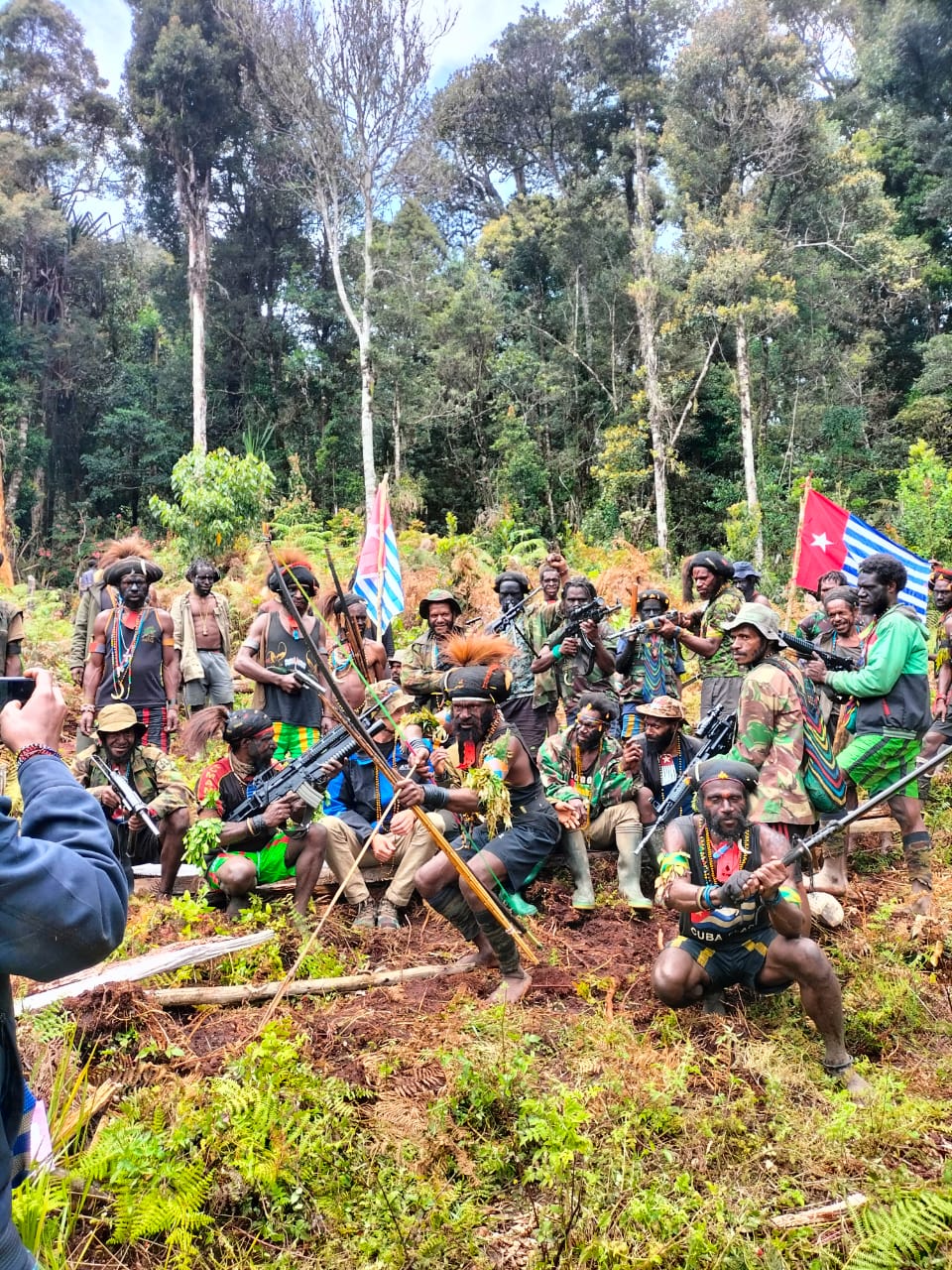
Images showed New Zealand pilot Phil Mehrtens in the rainforest, surrounded by rarely seen Papuan independence fighters wielding rifles and bows and arrows.
Their commander Egianus Kogoya, just 24 years old, filmed himself in the cockpit of Mehrtens’s plane railing against foreign nations’ support for Indonesia, which has occupied Papua since invading in 1962, demanding Indonesia withdraw and grant Papua its independence. He then burnt the plane before disappearing with Mehrtens into the jungle.
In videos released from the event, Kogoya, and his group, the West Papuan National Liberation Army (TPNPB), also challenged western nations’ military aid to Indonesian forces in a conflict that has claimed the lives of between 100,000 to 500,000 Papuans.
TPNPB spokesperson Akouboo Douw highlighted one outside player in particular: The U.K.
“Britain has its own record with West Papua and is part of the ongoing genocide in West Papua,” Douw said, pointing to “Britain’s training of Indonesian forces involved in extrajudicial killings of Papuan people.”
Captured New Zealand pilot Phil Mehrtens surrounded by Papua independence fighters armed with rifles and bows and arrows. Photo: courtesy of TPNPB
The British government claims not to aid rights violations in Papua. However, a Southeast Asia Globe investigation found evidence of an often murky defence relationship between the U.K. and Indonesia that has directly fed into the conflict.
Through a freedom of information request filed with the British government, Globe obtained documents that detail a secretive collaboration between the arms industries of both countries to deepen the Indonesian military capacity. A review of social media posts from Indonesian special forces members reveals British sniper rifles are now being used by Papua-based units long accused of waging repressive campaigns.
Members of these units often train at the Jakarta Centre for Law Enforcement Cooperation (JCLEC), a counter-terrorism programme that receives regular payments and professional support from the U.K., according to government data reviewed by the Globe.
Britain’s Metropolitan Police is the leading provider of programmes at the centre, while the British Foreign Commonwealth and Development Office (FCDO) is its second largest financial donor behind Australia. The centre trains members of special forces accused of massacres and other rights violations in Papua.
At least three of these forces make up Damai Cartenz, the anti-terrorism task force currently most active in Papua. Including another unit known as the Yonif Raiders 315 Garuda – nicknamed “Satan’s Troops” for their brutality – the task force has been accused of gross human rights violations against Papuan civilians in sweeping operations since 2021.Hostage Phil Mehrtens repeats the TPNPB’s demands for Papuan independence one month on from his capture by Egianus Kogoya on 10 March 2023. Video: courtesy of TPNPB
Indonesian authorities have stated that if negotiations with Kogoya fail they will send in such special units to rescue Mehrtens.
Shrouded in secrecy: U.K. Government meetings with Indonesian military
The U.K. has been actively courting Indonesia’s military market since at least February 2018, when the Department for International Trade (DIT) highlighted the nation as a priority for Britain’s “Indo-Pacific tilt” with the U.K. arms industry a major beneficiary.
U.K. Minister for Defence Procurement Guto Bebb visited Jakarta on 11 April 2018, for three days supposedly to hold meetings with major weapons manufacturers including Airbus Defence, Leonardo and jet engine producer Rolls Royce, according to Transparency International data.
The meetings were to “discuss defence issues in Indonesia”. However, the MOD, responding to a freedom of information request by the Globe, revealed these meetings never actually happened. Those that did end up taking place were never updated onto the government’s own transparency data records at the time and now details of Bebb’s trip to Jakarta have been removed from records entirely.
The heavily redacted information request reveals Bebb actually met with four major Indonesian state-owned weapons manufacturers, including PT Pindad, the leading supplier of weapons and ammunition for the Indonesian military, including the small arms used by all units active across West Papua. Other weapons companies in attendance were Indonesia’s national aerospace, shipbuilding and communications intelligence companies.
The MOD said this meeting was attended by senior government, military and arms industry representatives and followed a “defence trade mission” on 12-15 March 2018 set up by the British Embassy in Jakarta and the DIT’s Defence and Security Organisation.
Thirteen U.K. weapons companies attended the trade mission, but the MOD refused to reveal their names.
This trade mission, the first of its kind, led to a joint arms industry conference. U.K. weapons firms “presented their capabilities” there, focusing on collaboration and partnership with Indonesian state-owned weapons companies.
The information request also revealed that in a lunch meeting in April, Bebb responded that he was “very keen” to see such ventures and saw a “bright and exciting future for U.K.-Indonesian collaboration on capability development and delivery.”
In 2018, the year of these meetings, government weapons export data shows the U.K. authorised weapons export licences to Indonesia valued at $75.9 million (£64.2 million).
This included $242 million in “ML4” category weapons, such as grenades, bombs and missiles. It also covered $38 million for “ML10” category weapons including military aircraft, helicopters and drones.
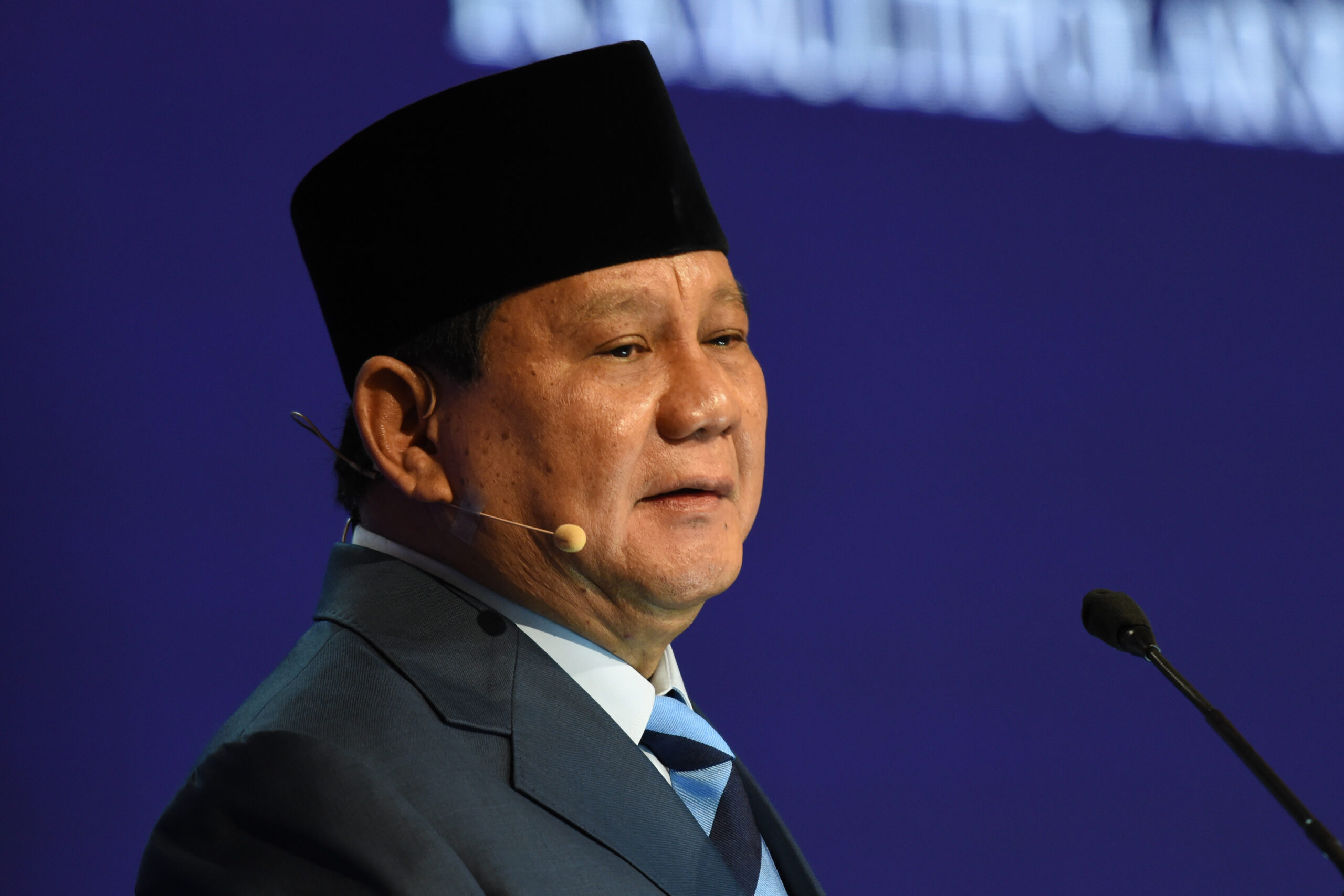
By 2021, British exports to Indonesia fell to $53 million (£45 million), a reflection of considerable growth in the country’s domestic arms manufacturing at the behest of Defence Minister Prabowo Subianto.
Indonesia’s Defence Minister Prabowo Subianto has spurred strong domestic growth in Indonesia. Photo: Roslan Rahman/AFP
Still, TPNPB spokesperson Douw said the arms trade remains “a big problem” for the group.
“We ask Britain to cut military ties with Indonesia and to stop exporting military hardware to Indonesia, and instead bring this critical humanitarian issue to the UN Security Council,” Douw told the Globe.
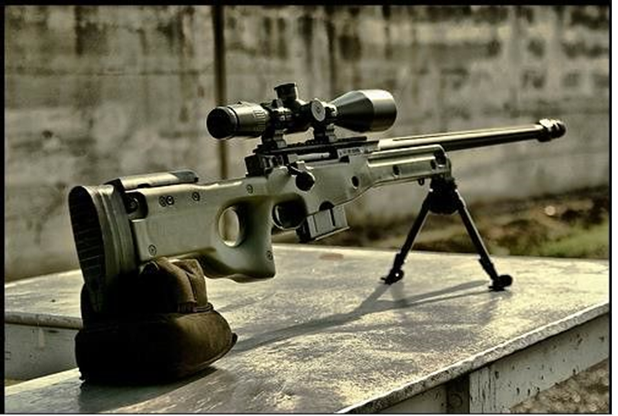
The U.K. government refused to reveal which weapons companies benefited from the spike in arms deals to Indonesia. However, Globe used social media to trace weapons from at least two British sniper rifle companies being used in Papua: Accuracy International and Steel Core Design.
British sniper rifles in West Papua
Despite U.K. government claims from November 2020 that it “will not grant an export licence [of weapons to Indonesia] where there is a clear risk of them being used for internal repression”, the three known units of Damai Cartenz are known to use top-grade sniper rifles from these British firms as mainstay weapons.
Besides the Yonif Raiders, these units include BRIMOB, a special forces police unit implicated in a number of massacres in Papua, and Detachment 88, a counter-terrorism group that Britain helped to develop.
BRIMOB has a history of accused extrajudicial killings of Papuan civilians. On 27 February, BRIMOB members fired on Papuan civilians in Wamena, capital of the Highland Papua province, killing twelve Papuans protesting the alleged attempted abduction of a young Papuan girl.
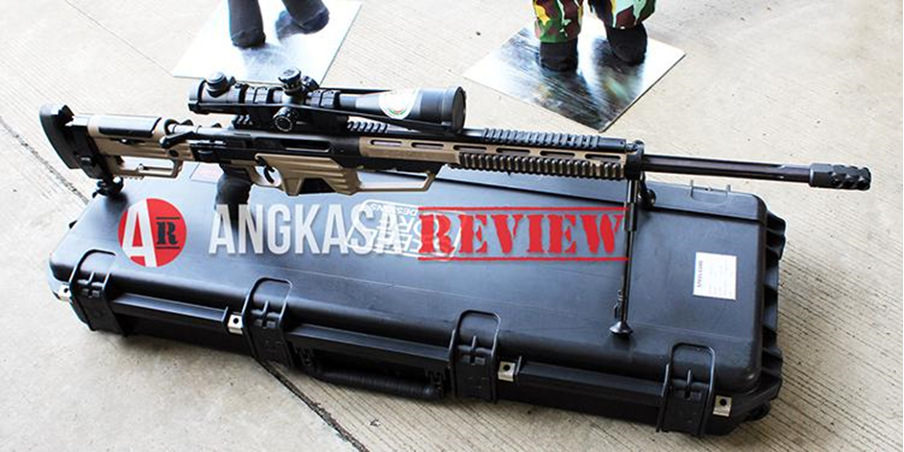
Steel Core Cyclone sniper rifle at defence exhibition on 25 August 2018, by Angaska Review. Photo: supplied
“BRIMOB and [Detachment] 88 are considered the most evil troops by Papuan civil society,” said Yones Douw, Papuan human rights activist. “There are always human rights violations wherever these two units carry out military operations in the land of Papua.” Weapons export data shows the U.K. government authorised three licences for 556 sniper rifles to Indonesia in 2018 alone. In August 2018, Indonesian authorities showed off such rifles and other weapons at an international exhibition at an Airforce base in Java.
The Accuracy International L96. Photo: supplied
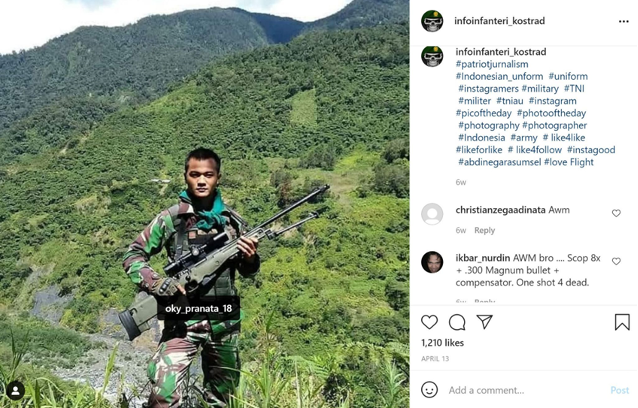
The Globe traced two soldiers from Yonif 315 posting images of British rifles on Instagram, where many Indonesian military personnel regularly post about their weapons training, deployments to Papua and nationalist sentiment.
One of these publicly accessible accounts, infoinfanteri_kostrad, posted a photo of a soldier in a mountainous forested region on 13 April, posing with an Accuracy International rifle.
On his personal Instagram account, the soldier posted the same photograph. Weeks later, he added another post with his location tagged as Puncak Jaya, a hotspot of the conflict in the central highlands of West Papua.
Another military account regularly tagged by soldiers in their posts is indonesia.militer. This profile re-posted a photo of another soldier also using an Accuracy International rifle. His personal Instagram also showed photos of him using the British gun.
A video one of the soldiers posted on 27 April, 2021 confirms he is part of Yonif 315 Garuda. In the comments section he responds ‘kab.mimika’ to another soldier who asked which region he was deployed to, using a shorthand reference for the Mimika Regency – an area bordering the conflict region of Puncak.
Indonesian military account displaying an Indonesian soldier with an AI L96, later deployed to Papua. Photo: screenshot from Instagram/supplied
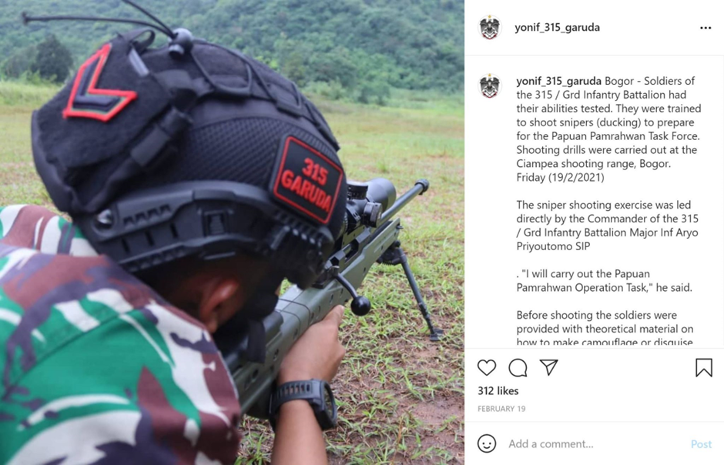
The unit Yonif Raiders 315 Garuda also uses Instagram, where it posted a soldier with the group’s emblem on his helmet using an Accuracy International rifle. The post states unit members are “being trained with the weapon “to prepare for the Papuan Pamrahwan Task Force” and practice “techniques for executing targets”.
The Yonif Raiders gained the name Satan’s Troops during Indonesia’s violent campaign in East Timor in the 1990s. They became notorious for excessive violence and disregard for human rights. During Indonesia’s occupation of Timor Leste, Amnesty International estimates more than 200,000 Timorese were killed.
“On one hand Britain talks about democracy and human rights in Ukraine, but on the other they’re supplying weapons to Indonesia who massacre Papuans,” said Benny Wenda, leader of the Free West Papua Campaign.
“Britain needs to review the funding of this organisation. Directly or indirectly, British taxpayer’s money is used to fund the killing and torture of innocent people.”
The Yonif Raider practicing with the AI L96 for the Papuan task force. Photo: screenshot from Instagram/supplied
When reached for comment, the British DIT held that its exports to Indonesia were conducted ethically.
“The U.K. is a leading advocate for human rights, operating one of the most transparent export licensing systems in the world and rigorously assess every export application,” the department stated. “We will continue encouraging all states to uphold international human rights obligations, and keep all export licences under careful and continual review.”
U.K. funding the JCLEC
In 2020 the government denied providing any training to Papua-based units when responding to a parliamentary question challenging Britain’s human rights record in Papua.
However, when asked for a list of Indonesian police trained by Britain they admitted they don’t keep data on who Britain trains at JCLEC, so cannot know if Indonesians trained go on to serve in Papua or not.
The centre was established in 2004, two years after the Bali bombings, to aid international police cooperation in dealing with terrorism in Indonesia and across Southeast Asia. It’s now renowned for creating Detachment 88. Though heralded by some as a success story in countering radical Islamic groups in the archipelago, the unit has also garnered controversy for regularly killing suspects.
“Densus were trained by Australia, America and Britain. It was supposed to be training to fight jihadis and terrorists, but in fact it’s used against Papuan civilians” said Wenda, using another name for the unit.
The JCLEC is required by Indonesian law to publish annual accounts. However, since 2019 following the West Papua Uprising, it removed them from its website, making it impossible to determine exactly how much foreign funding it receives.
The Globe analysed the U.K.’s FCDO data for spending over £25,000 over the past 13 years and found 69 payments to the JCLEC Foundation totalling $17.1 million (£14.1 million). A reporter reached out by phone and email to ask about the payments but received no response.
Britain also provided 59 training programs in 2018 alone, more than any other nation, with the Metropolitan Police of London delivering the majority. Only Australia provides more financial support to the Jakarta centre, according to available information.
In 2018, British High Commissioner to Singapore Scott Wightman said Britain “was a critical part of the JCLEC process that transformed Detachment 88 into an effective counter-terrorism force. Since 2015 hundreds of arrests in Indonesia have been made by officers who used skills learned on U.K. training at JCLEC.”
Indonesian military operations since 2018 have left an estimated 100,000 Papuan civilians displaced according to the UN Special Rapporteur for Human Rights. With increasing deployments of troops to the region and an increasingly coordinated and ambitious TPNPB this situation shows little sign of abating.
The Indonesian National Police and Army did not respond to requests for comment.
“Britain has standing moral obligations to West Papua” Douw said, highlighting how West Papuans fought alongside Britain and the Allies in World War II. “Papuans need Britain to be part of the resolution of this conflict, not to contribute to Indonesia’s o
The country’s government has focused on containing, rather than resolving, a crisis with roots in a dubious referendum.
Hipolitus Wangge
Hipolitus Wangge Researcher,
Australian National University.
Published On 14 Mar 2023 14 Mar 2023
It has been over a month since an armed group abducted Phillip Merthens, a New Zealand-born pilot, on February 7, 2023, in Indonesia’s Nduga, West Papua. The group is the West Papua Liberation Army. Known by the acronym TPNPB, it’s an armed wing of the Papua Liberation Movement (OPM).
As local media reported, TPNPB, led by Egianus Kogoya, a local commander, stormed the Susi Air small plane after it landed, set it afire and took the pilot hostage. TPNPB then brought him to its stronghold area where it would use him as its “political leverage”. The military and police still have no clue where TPNPB is hiding the pilot, mostly due to terrain difficulties.
However, the military has swept into villages to gain information about the armed group’s whereabouts. Intimidated, some Papuans have fled their villages in Nduga and Lanny Jaya regencies. Following the kidnapping, a deadly riot erupted, and most recently, armed confrontations between the group and the security forces have killed both civilians and soldiers in Yahukimo and Puncak regencies.
It’s clear from all of this that there is no end in sight for the intensified hostilities that have plagued West Papua over the past six years. Yet the reality is that none of this is surprising.
To understand this increasing escalation, it’s vital to look at the failures of successive Indonesian governments in responding to the crisis.
The central government focuses more on addressing the effects than the causes of the conflict. Its counterinsurgency policies — whether development programs, a special autonomy for the region or out-and-out military operations — are aimed at reducing Indigenous discontent and violent attacks from the TPNPB to controllable levels. There has not been a sincere political process between the central government, Indigenous Papuans, and nationalist groups in West Papua.
That’s why these policies have met with distrust among Indigenous Papuans, even as the TPNPB armed group has developed more deadly capacity to attack civilians and security forces.
It is worth remembering that the roots of the conflict aren’t new and have been building up since the 1960s.
Since becoming part of Indonesia through a widely criticised referendum called the Act of Free Choice in 1969, the western half of the island of New Guinea and Indonesia’s easternmost region, commonly referred to as West Papua, has barely enjoyed stability. This disputed referendum — when the military handpicked less than one per cent of the West Papuan population to vote for integration with Indonesia under the threat of violence — set a precedent for how the Indonesian state disregards Papuans’ interests.
From the 1970s to the 1990s, the Indonesian government settled hundreds of thousands of people from other parts of the country in West Papua through the transmigration program, aiming to forcibly change the region’s demography and control the region, even as the government also embarked on military operations. The result: A decline in the number of Indigenous Papuans on their own land, numerous deaths, and massive displacement.
Because of these measures, Papuan identity — as distinct from Indonesia — emerged not from cultural, religious and physical differences but rather from racial discrimination by the state, combined with Indigenous Papuans’ past and contemporary grievances.
The conflict has led to both a non-violent movement and an armed struggle to defend Papuans’ identity and rights.
When Joko Widodo became Indonesia’s president in 2014, there was hope for a resolution to the crisis. He released a handful of Papuan political prisoners and vowed to address the 2014 Paniai human rights abuse case, relating to an incident where the Indonesian army fired on hundreds of Papuan protesters, killed four teenagers, and wounded more than a dozen others in highland Papua. A promise to open West Papua to foreign journalists was seen by many as another sign of Widodo’s goodwill.
However, the commitment to address the conflict fell apart in the waning days of his first administration.
Under Widodo’s second administration since 2019, Papuan grievances have intensified. Instead of the root causes of the conflict, the state has focused chiefly on development and infrastructure programmes, including the Trans Papua highway that’s under construction in some regencies in West Papua, a food estate, a special economic zone, strategic tourism areas and palm oil plantations.
The main beneficiaries of these initiatives are mostly nonindigenous Papuans residing in coastal and urban areas. Indigenous Papuans, particularly those living in highland areas, barely reap the benefits of development projects. Instead, they live in constant fear and trauma due to escalated violence. Hundreds to thousands of civilians are caught in the crossfire and suffer displacement and other human rights violations every time armed confrontation breaks out between security forces and TPNPB.
In 2019, racial slurs directed at Papuan students triggered peaceful demonstrations that then turned violent across Papua. Rather than acknowledging and resolving such deep-seated racism and discrimination towards Papuans, Indonesia in 2021 revised the special autonomy for the region first introduced in 2001, for another 20 years. It has also divided the region into six provinces. This top-down set of policies — implemented without wide-ranging consultations with Papuans and their representatives — reflects a desperate strategy aimed at containing the conflict rather than resolving it and exposes the failures of the central government.
Meanwhile, TPNPB has consistently rejected state policies, including economic activities, in highland Papua. The group has warned against the continuing operations of commercial flights and has even shot a handful of planes flying across highland areas. It has demanded that non-Papuan civilians leave conflict zones. The recent kidnapping of the pilot suggests that the TPNPB believes its previous warnings have fallen on deaf ears.
But the conflict and its escalation also highlight the unresolved transgenerational trauma that Papuans continue to endure. This, reinforced by the availability of relatively sophisticated weapons — accessed by TPNPB from illegal trade with the military and police as well as illicit supplies from Papua New Guinea, Thailand, and the Philippines — has facilitated armed campaigns since 2018 in Nduga, the poorest regency in Indonesia.
Indeed, TPNPB has recruited its members mostly by capitalising on the deep grievances of Papuan youth. I know, because as a local volunteer in 2019, I spoke to a handful of Nduga’s displaced children interested in joining the armed group because of deep-seated trauma and hardships living in uncertain conditions. They were barely receiving a proper education in their districts and were enthusiastic about meeting teachers and studying at an emergency school built by local humanitarian volunteers. Yet the Indonesian government has systematically failed to recognise and address transgenerational trauma among armed conflict-affected victims in Papua, particularly the children. This contrasts starkly with its massive deradicalisation programmes elsewhere in the country.
At the same time, TPNPB has modified its fighting capacity to intensify armed attacks against the state and civilians. Financial support from its sympathisers has also increased. Its organisational structure has been modernised, with Papuan youth occupying key positions. Lastly, its use of social media to counter government narratives by exposing the state’s power abuses has grown more sophisticated.
In short, Indonesia’s relationship with Papuans appears set to only get worse.
It doesn’t have to be that way. A lesson from armed conflicts in the deep south of Thailand and in Mindanao in the southern Philippines is that the presence of credible and trusted individuals or groups is crucial to initiate peace talks. That’s an element missing in the Papua conflict.
The capture of the pilot is only symptomatic of this trust gap. It’s a deficit that is only deepening, and the Indonesian government has no one but itself to blame.
The views expressed in this article are the author’s own and do not necessarily reflect Al Jazeera’s editorial stance.
Hipolitus Wangge is a researcher at the Australian National University. Hipolitus’ research centres on ethno-political conflicts in Southeast Asia and the Indonesian foreign policy in the Pacific region. His work has appeared in Publius: The Journal of Federalism, Pacific Review, Contemporary Southeast Asia, the Journal of Current Southeast Asia Affairs, Middle East-Asia Project, the Diplomat, East Asia Forum, New Mandala, Radio New Zealand, and the Jakarta Post.
Jayapura, Jubi – The shooting between the West Papua National Liberation Army (TPNPB) and Indonesian Military (TNI) and police in Pamebut Village, Yugumoak District, Puncak Regency, Central Papua Province on March 3, 2023 killed a woman named Tarina Murib. A total of eight other residents were also injured by gunfire.
One of the shooting victims, a woman named Nerce Telenggen, told the chronology of the event. Telenggen said she and Tarina Murib woke up at around 5:00 a.m Papua time. “Upon waking up, I lit a fire in the stove while Tarina went out of the house,” said Telenggen.
A few moments after Tarina Murib left, Nerce Telenggen heard a gunshot. Tarina Murib entered the house already wounded by the gunshot and Nerce Telenggen immediately embraced her.
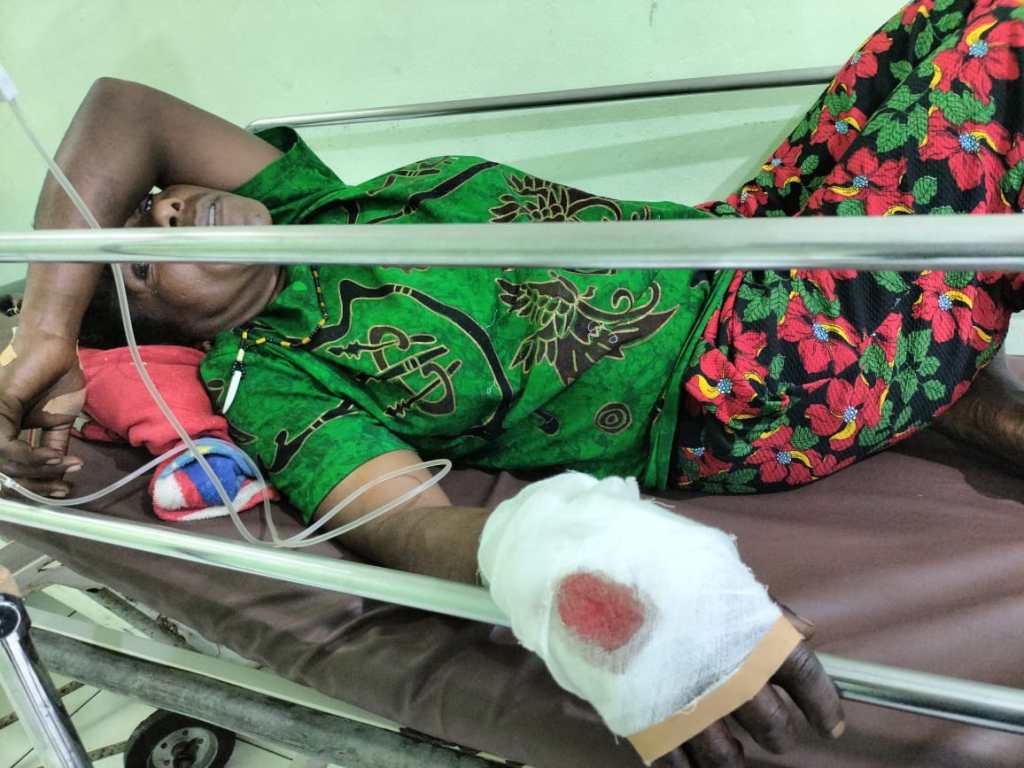
“She was hit first, then she went back into the honai [traditional Papuan house]. I immediately hugged her and then there was another shot landed into my right hand. When I was about to turn around, it turned out that the left back of my stomach was bleeding too,” said Nerce Telenggen.
Nerce Telenggen then grabbed her children. “I gathered them all, six of us were in the honai,” he said.
After telling the children to stay inside the house, Telenggen went out. “I called out ‘in the name of Jesus’ in a big voice. The security forces looked afraid, their weapons were pointing upwards,” said Telenggen.
At that time Telenggen did not see any members of the TPNPB. The security forces called Telenggen to come closer. “They called me and asked me to bring out all the children,” she said.
“They gave us water and wafers. I took the wafer, gave it to my children, and they ate,” she said.
Telenggen said she was questioned by the security forces. They asked if Telenggen knew where Kalenak Murib and the other TPNPB members lived. “I told them they lived far away from us. Even if they come, at most they would just pass quickly,” she said.
Telenggen told the security forces she wanted to go to Gigobak Village in Sinak District to be treated at the hospital. She took her children with her and walked towards Gigobak Village. “We walked slowly and I prayed all the way, hoping we could reach the hospital,” she said.
On March 6, spokesperson of the XVII/Cenderawasih Military Command Col. Kav Herman Taryaman said the resident who died in the event was shot by TPNPB members. He added that a soldier of the Raider 303/Setia Sampai Mati Infantry Battalion from West Java also died in the firefight in Pamebut Village.
Herman explained that the firefight began after TPNPB shot a civilian named Tarina Murib in Pamebut Village. He said TNI officers tried to evacuate the victim to the health center but were instead blocked and shot by the TPNPB.
“The incident resulted in Chief Pvt. JM being shot and eventually a firefight broke out. JM was successfully evacuated to the Sinak Health Center but was declared dead by the medical team,” Herman said.
On the other hand, leader of the TPNPB Sinak Area Command Brig. Gen. Kalenak Murib denied the TNI’s statement. He said the TNI was the one who shot civilians.
“We denied the statement saying TPNPB shot civilians. We have never shot civilians or burned people’s houses. The shooting of civilians was carried out by TNI soldiers when they tried to chase us,” he said.
Separately, executive director of Amnesty International Indonesia Usman Hamid called on the security forces to thoroughly investigate the shooting that killed Tarina Murib and injured eight other civilians.
“Do not draw conclusions before there is a thorough investigation in accordance with applicable procedures,” Usman told Jubi via WhatsApp message service on Wednesday, March 8, 2023. (*)
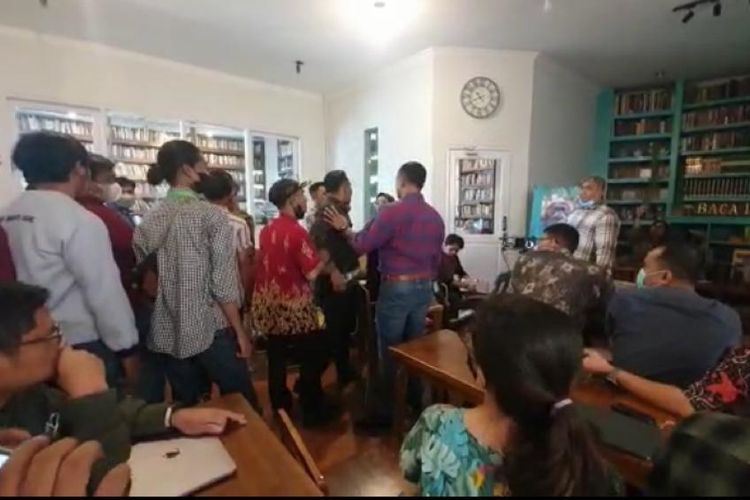
Pontianak Hendra Cipta (contributor), Jakarta — Four unidentified individuals attempted to close down a discussion on endangered Tapanuli orangutans threatened by a hydroelectric dam project in North Sumatra that was being held by the conservation group Satya Bumi and several civil society organisations (CSO) in Tebet, South Jakarta, on Thursday morning, March 9.
Society of Indonesian Environmental Journalists (SIEJ) General Chairperson Joni Aswira said that the four people arrived without warning at the event. Moreover one of them was very angry, snapping at people, and asked that the discussion be closed down.
“The committee managed to calm them down, but the person concerned continued to insist that the discussion not be continued and slammed chairs around emotionally”, said Aswira in a press release received by Kompas.com on Thursday afternoon.
Aswira explained that men claimed to be from the Salemba area in Central Jakarta but without explaining which organisation he came from.
The tense situation continued for around 15 minutes, and finally started to subside after the organising committee took them downstairs to hold a dialogue and explain the context of the event.
“The perpetrators did not accept this, and in the end the committee summoned a security officer. As of 12 noon the discussion was still continuing”, said Aswira.
Aswira explained that the discussion on the Tapanuli orangutans was in response to a collaborative report by five national media not long ago that took up the threat posed by a hydroelectric power plant (PLTA) in the natural landscape of Batang Toru district of South Tapanuli, North Sumatra.
A number of problems with the project were revealed in the collaborative report. Aside from the threat to the area and the orangutans’ habitat, the dam is being built near a tectonic fault line.
“There has already been many incidents of landslide disasters that have killed people, including workers in the area”, said Aswira.
In addition to this, the Supreme Audit Agency (BPK) has found a number of irregularities in the dam project, which it is claimed will provide clean energy, that could potentially give rise to state losses.
“The SIEJ or Society of Indonesian Environmental Journalists deplores the attempt to close down the discussion held by Satya Bumi and these CSOs. [It was] a public discussion to respond to a collaborative media report that the SIEJ initiated, it should not have been faced with actions or efforts to close it down”, said Aswira.
According to Aswira, discussions represent a dialectic in the democratic world. For those who disagree, they should prioritise a dialogue approach. Because freedom of opinion and expression are protected by the constitution.
“If the closure of discussions is allowed, then this will threaten democracy. The government is obliged to protect the rights of its citizens to express and opinion”, Aswira concluded.
[Translated by James Balowski. The original title of the article was “4 Orang Tak Dikenal Datangi dan Bubarkan Acara Diskusi soal Orangutan di Jakarta”.]
The Indonesian state is causing a renewed humanitarian crisis in occupied West Papua. A 35-year-old woman has been murdered and mutilated by the Indonesian military in Puncak Regency, and villages and churches have been emptied as thousands more soldiers have been deployed in the area. Indonesia must urgently draw back their troops to allow civilians to return home in peace.
The murdered woman, Ms Tarina Murib, was found by local residents on March 4th. She was naked and her head was cut off and missing. A number of civilians, including a baby, were also shot during the military raid. A bullet hit one-year-old Aniton Kulua in the head, while his mother Daisina Alom was shot in the shoulder.
My people are terrified and traumatised by years of military operations. Fearing more violence, many have been forced to leave their homes and flee into the bush, adding to the 60,000-100,000 West Papuans who have been displaced by Indonesian military buildup since 2018. Those displaced have largely been unable to return home due to soldiers’ continued occupation of their villages, churches, and schools. They have little access to healthcare. They cannot tend their crops or gardens. Displacement is ethnic cleansing, the gradual eradication of the West Papuan way of life. As the Indonesian occupation forces my people to flee, they exploit their ancestral lands to build mega-projects like the Trans Papua Highway and the Wabu Block gold mine.
The situation in West Papua is escalating dramatically due to Indonesia’s response to the TPNPB’s abduction of pilot Phillip Mehrtens. Indonesian troops have already massacred ten indigenous Papuan civilians in Wamena. Now, they have committed crimes against humanity in Puncak. I have stated clearly that Mr. Mehrtens must be immediately and unconditionally released, and the ULMWP are working in the background with local people to try and secure his safe return. But the world must understand that he is being used as propaganda by Indonesia to strengthen their military control over West Papua.
Tarina Murib’s brutal murder is reminiscient of the four West Papuans that were tortured, murdered, and dismembered by Indonesian soldiers last August. But Murib was not a combatant, not even a male: she was a mother. Indonesia is clearly demonstrating the brutal and racist character of their occupation.
The abduction of pilot Phillip Mehrtens has focused the attention of the international community on West Papua. They must not look away now, as we are massacred, mutilated, and displaced by Indonesia’s genocidal occupation.
Benny Wenda President ULMWP Provisional Government
Agats, Papua (ANTARA) – A Trigana Air plane was shot at by members of an armed Papuan separatist group on Saturday, according to Jayapura Police chief, Adjunct Senior Commissioner Fredrickus W.A. Maclarimboen.
The shooting occurred shortly after the plane took off from Dekai Airport in Yahukimo district, Papua Pegunungan province, Maclarimboen told ANTARA.
He, however, did not provide any details on the impact of the shooting on the aircraft.
ANTARA has reported earlier that over the past few years, armed Papuan groups have often employed hit-and-run tactics against Indonesian security personnel and mounted acts of terror against civilians in the districts of Intan Jaya, Nduga, and Puncak to trigger fear among the people.
The targets of such acts of terror have included construction workers, motorcycle taxi (ojek) drivers, teachers, students, street food vendors, and also civilian aircraft.
On December 2, 2018, a group of armed Papuan rebels brutally killed 31 workers from PT Istaka Karya who were engaged in the Trans Papua project in Kali Yigi and Kali Aurak in Yigi sub-district, Nduga district.
The same day, armed attackers also killed a soldier, identified as Handoko, and injured two other security personnel, Sugeng and Wahyu.
Such acts of violence continued to occur in 2021, 2022, and 2023.
On January 6, 2021, at least 10 armed separatists vandalized and torched a Quest Kodiak aircraft belonging to Mission Aviation Fellowship (MAF) on the Pagamba village airstrip.
On February 8, 2021, a 32-year-old man was shot at close range in Bilogai village, Sugapa sub-district.
The victim, identified by his initials as RNR, sustained gunshot wounds on the face and right shoulder and was taken to Timika Public Hospital in Mimika district on February 9.
In a separate incident on February 9, a motorcycle taxi (ojek) driver was fatally stabbed by 6 armed Papuans.
On April 8, 2021, several armed Papuan separatists opened fire at a kiosk in Julukoma village, Beoga sub-district, Puncak district.
The shooting resulted in the death of a Beoga public elementary school teacher, identified as Oktovianus Rayo.
After killing Rayo, the armed attackers torched 3 classrooms at Beoga public senior high school.
On April 9, 2021, armed separatists fatally shot another teacher, Yonatan Randen, in the chest.
On April 25, 2021, Papuan separatists operating in Beoga ambushed State Intelligence Agency (Papua) chief, I Gusti Putu Danny Karya Nugraha, and several security personnel during their visit to Dambet village.
On March 2, 2022, several members of an armed Papuan group operating in Beoga sub-district, Puncak district, killed 8 Palaparing Timur Telematika (PTT) workers, who were repairing a base transceiver station (BTS) tower belonging to state-owned telecommunications operator Telkomsel.
The workers were identified as B, R, BN, BT, J, E, S, and PD, while another worker, identified by his initials as NS, survived the deadly assault, according to Papua Police spokesperson, Senior Commissioner Ahmad Kamal.
This year, a group of armed Papuan separatists attacked a civilian aircraft owned by Susi Air on February 7.
They burned the plane at Paro Airfield, Nduga district, and captured its pilot, Captain Philip Mark Marthens, according to the National Police’s (Polri’s) public relations division head, Inspector General Dedi Prasetyo.

 Australia West Papua Association Adelaide