Coalition Suspects Yasinta Moiwend Controversy Is Linked to Ongoing Court Proceedings

Jayapura, Jubi – The Papua Coalition for Law Enforcement and Human Rights has suggested that Yasinta Moiwend’s recent objections to her inclusion in the documentary film Pig Feast: Colonialism in Our Time may be connected to an ongoing legal case before the Jayapura Administrative Court (PTUN).

Previously, five representatives of the Malind Indigenous community, including Yasinta Moiwend, filed a lawsuit challenging Merauke Regent Decree No. 100.3.3.2/1105/2025.
The decree concerns the environmental feasibility approval for the construction of a 135-kilometer access road as part of a food security project initiated by Indonesia’s Ministry of Defense.

The case was registered with the Jayapura Administrative Court under Case Number 9/G/LH/2026/PTUN Jayapura on March 5, 2026.

The Papua Coalition for Law Enforcement and Human Rights, which is part of the legal team assisting the plaintiffs, stated that lawyers serving on the Merauke Solidarity Advocacy Team, acting as legal counsel for Yasinta Moiwend, cannot be subjected to criminal or civil liability for carrying out their professional duties.

“Yasinta Moiwend is a client of the Merauke Solidarity Advocacy Team, which is currently representing her in proceedings before the Jayapura Administrative Court,” the coalition said in a written press release issued on Wednesday (June 3, 2026).

According to the coalition, the advocacy team has been assisting Moiwend and four other Indigenous representatives in their lawsuit against the Regent of Merauke.

During the proceedings, Indonesia’s Minister of Defense entered the case as an intervening defendant. This was marked by the submission of the intervening defendant’s response to the panel of judges overseeing Case Number 9/G/LH/2026/PTUN JPR, which was filed on May 18, 2026.

The Ministry of Defense’s involvement came after the Merauke Solidarity Advocacy Team and the legal team representing the Merauke Regent had reached the rejoinder stage of proceedings.

The coalition stated that while the advocacy team was preparing its response to the Ministry of Defense’s submission, the public was surprised by the circulation of a video in which Yasinta Moiwend questioned the use of footage featuring her in the documentary Pig Feast: Colonialism in Our Time.

In the same video, Moiwend also stated that she would not travel to Jayapura to attend court hearings in the case.

“Taken together, these developments indicate that those who recorded and disseminated the video were clearly targeting the legal proceedings currently underway at the Jayapura Administrative Court,” the coalition stated.

The coalition further argued that because one of the statements in the video directly referred to the PTUN proceedings, the individuals who recorded and publicized the video had violated professional ethics by failing to coordinate with the Merauke Solidarity Advocacy Team, which remains Yasinta Moiwend’s legal representative.

“What is even more unusual is that, without any revocation of the power of attorney, the Director of LBH Papua Merauke was later reported to the Metro Jaya Police. In fact, the Merauke Solidarity Advocacy Team continues to hold legal authority as Yasinta Moiwend’s counsel in Case Number 9/G/LH/2026/PTUN JPR,” the coalition wrote.

The coalition argued that the police report against one of the leaders of an advocacy institution that is part of the Merauke Solidarity Advocacy Team contradicts Article 16 of Law No. 18 of 2003 on Advocates, which provides that advocates cannot be prosecuted civilly or criminally while carrying out their professional duties in good faith on behalf of their clients in court proceedings.

Based on that provision, the coalition stated that allegations made by Yasinta Moiwend against a member of the advocacy team, as well as actions taken by lawyers assisting her in filing reports with police authorities, should be reviewed by Indonesia’s advocate organizations in accordance with professional ethics procedures outlined in Article 8 of the Advocates Law.

The coalition also invoked Article 100 of Law No. 39 of 1999 on Human Rights in calling on the Papua representative office of Indonesia’s Judicial Commission to monitor the professionalism of the panel of judges handling Case Number 9/G/LH/2026/PTUN JPR.

The coalition urged the panel of judges at the Jayapura Administrative Court to conduct the proceedings professionally and impartially. It also reminded the Regent of Merauke and Indonesia’s Minister of Defense, who are defendants in the case, not to use the Yasinta Moiwend controversy to influence or gain an advantage in the ongoing legal proceedings.

In addition, the coalition called on the National Police Chief to instruct the Metro Jaya Regional Police to observe legal protections afforded to advocates and legal aid providers under Article 16 of Law No. 18 of 2003 on Advocates and Article 11 of Law No. 16 of 2011 on Legal Aid in relation to the Yasinta Moiwend case.

The coalition further urged the Honorary Council of Indonesia’s advocate organizations to immediately investigate alleged violations of the legal profession’s code of ethics related to the case.

The Papua Coalition for Law Enforcement and Human Rights, which provides legal assistance to the Malind Indigenous community, includes LBH Papua, PAHAM Papua, ALDP, KPKC Synod of the Land of Papua, JPIC OFM Papua, Elsham Papua, Yadupa, the Indonesian Legal Aid Foundation, LBH Papua Merauke, LBH Papua Sorong Office, KontraS Papua, and Tong Pu Ruang Aman. (*)

Nuevaterra Mambor 

‘Pig Feast’: a test case for alternative media, Papua, and Indonesian democracy 

BY HELLENA SOUISA

11 JUNE 2026 

This may be the most controversial film in Indonesia right now.

After being screened offline at nearly 2,000 locations across Indonesia and abroad, the documentary Pig Feast: Colonialism in Our Time (Pesta Babi: Kolonialisme di Zaman Kita) was officially released online on May 22.

Within just 14 days of release, Pig Feast had already been viewed more than 13 million times on the YouTube channel JubiTV.

Jubi is a West Papua-based media outlet and one of the documentary’s production collaborators, alongside Greenpeace Indonesia, Watchdoc, Koperasi Indonesia Baru, Pusaka Bentala Rakyat, and LBH Papua Merauke.

The title Pig Feast (Pesta Babi) is taken from a tradition of the Muyu people in West Papua known as Awon Atatbon. This is a customary ritual involving pigs as social and cultural symbols used to mark the continuity and preservation of Papua’s forests and natural environment.

The 90-minute film, directed by Dandhy Dwi Laksono and Cypri Jehan Paju Dale, is set in South Papua. It follows Indigenous communities resisting the loss of their land and livelihoods due to a government-backed National Strategic Project (Proyek Strategis Nasional, or PSN).

The documentary argues that Indonesia’s food estate project is merely a cover for a large-scale bioethanol venture benefiting particular groups, while exposing the broader web of political and economic interests behind it, including alleged military involvement.

Filling the information drought on Papua

There are several reasons that may explain the widespread public enthusiasm for independently organised community screenings and discussions of Pig Feast at thousands of locations across Indonesia and abroad, as well as its millions of YouTube views.

First and foremost is the information and content the film offers about what is happening in Papua. It describes it as the world’s largest ongoing deforestation project carried out in the name of a PSN, the clearing of 2.5 million hectares of tropical rainforest, and the displacement of 107,000 people, all taking place amid continuing armed conflict in the region.

Second, it is no secret that the ownership structure of Indonesia’s mainstream media, particularly broadcast media, which is controlled by a small group of conglomerates, has affected the diversity of its content.

Because of this ownership structure and the entanglement of political and economic interests behind it, the content of Indonesia’s mainstream television media, as I have previously written, tends to be uniform, elite-centric, Jakarta-centric, Java-centric, and urban-centric.

As a result, there is little or no space for the voices of marginalised groups, communities outside Java, or critical issues that do not generate significant advertising revenue, such as environmental conservation, human rights abuses, and attacks on environmental defenders.

This means that information from and about Papua is rarely seen on mainstream national broadcast media screens. Meanwhile, in the digital sphere, we also know there have previously been attempts to shut down internet access in Papua.

Against this backdrop, Pig Feast, which offers in-depth and comprehensive information about the issues faced by Papuans, emerges to fill the void and address the drought of crucial information about Papua.

Even in an era when media consumption and distribution patterns are increasingly governed by algorithms, Pig Feast’s grassroots community screening model has managed to overcome the dominance of those algorithms.

It is therefore important to view Pig Feast as a success story for alternative media, which Downing, and Hackett and Carroll, define as media that are ‘progressive, explicitly opposed to particular axes of domination (corporate capitalism, heterosexism, racism, state authoritarianism) and openly assume a stance of advocacy rather than pseudo-objectivity, experiment with new aesthetic styles, and address issues marginalised in hegemonic media.’

Pig Feast, like most of Laksono’s documentaries, rarely includes interviews with authorities.

The aim is to balance narratives in the public sphere by giving a platform to communities whose voices are nearly absent from mainstream media.

By doing so, the filmmaker rejects the notion of giving equal voice to those who perpetuate injustice, and critiques the idea of journalistic ‘objectivity,’ which is often seen as serving entrenched commercial or political interests that maintain relations of domination.

This is both a reminder and a reaffirmation of the role and principles of alternative media.

Screenings disrupted, branded ‘foreign agents,’ and reported to police

Because of the issues raised in Pig Feast, including the names and institutions mentioned in the film, the documentary has been met with intense backlash.

Ekspedisi Indonesia Baru, one of the documentary’s production collaborators, reported that of more than 2,000 screenings held so far, at least 50 had been dispersed, cancelled, or subjected to intimidation.

The reasons varied, ranging from claims that the ‘title is provocative,’ and the need to ‘maintain public order’ and ‘anticipate security concerns,’ to allegations of ‘failure to coordinate permits.’

Some screenings were also accused of ‘not possessing a Film Censorship Pass Certificate (STLS) from the Indonesian Film Censorship Board,’ even though Pig Feast, as a film with a ‘non-commercial purpose’, falls into an exempt category.

Off-screen, director Dandhy Laksono has also become the target of black campaigns on social media, where he has been labelled a ‘foreign agent’ and ‘provocateur’.

Most recently, Laksono and LBH Papua Merauke director John Teddy Wakum were reported to the Jakarta Metropolitan Police by one of the figures featured in the documentary, Yasinta Moiwend.

Before filing the report, Moiwend, who in Pig Feast firmly rejected the PSN and criticised the government, later appeared to reverse her stance and express support for the project through social media posts.

Moiwend said she objected to her face being shown in the documentary and subsequently, while also demanding that screenings of the film be stopped.

However, members of Moiwend’s family viewed her sudden change of attitude and police report as suspicious, suspecting that she acted under pressure and intimidation from certain parties.

A new chapter for Pig Feast: a test for Papua, alternative media, and democracy

Efforts to drag the film’s director and one of its collaborators into legal proceedings, following waves of intimidation, repression, screening dispersals, disinformation, and accusations of being ‘foreign agents’, amount to a test on three fronts at once.

First, this is a test for future information and reporting about Papua. What Pig Feast is experiencing recalls the case of Indonesian human rights defenders Fatia Maulidyanti and Haris Azhar in 2023 and 2024.

Both were charged after being reported for defamation by then Coordinating Minister for Maritime Affairs and Investment Luhut Binsar Panjaitan over a video in which Azhar and Maulidyanti discussed research by nine civil society organisations alleging Panjaitan’s involvement in mining businesses and military operations in Papua.

Although the court eventually acquitted Azhar and Maulidyanti, the recurring pattern of criminalising the messengers of Papua-related information, while leaving the substance of the information itself untouched, represents an attempt to obscure problems in Papua that deserve national attention.

Second, this is also a test for future collaborative work between alternative media and civil society. What Laksono and Wakum are experiencing, like Azhar and Maulidyanti, creates a chilling effect not only for those who amplify marginalised voices, but also for the marginalised voices themselves and for issues neglected by mainstream media, particularly civil society perspectives confronting elite dominance.

Third, this new chapter in the story of Pig Feast is ultimately also a test for democracy itself. Can Indonesia be a democracy where freedom of expression and opinion are guaranteed, and where diversity of information, sustained in part by alternative media, remains a crucial pillar of its society?

Malind Indigenous People Defend Their Customary Land Rights Under Intimidation

March 6, 2026 in Animha Reading Time: 4 mins read

0

Author: Aida Ulim – Editor: Arjuna Pademme

Jayapura, Jubi – The struggle of the Malind indigenous people in Merauke Regency, South Papua, to defend their customary lands and forests from government land clearing projects for plantation and agricultural investment has not been easy. They have faced intimidation and pressure from the military.

Andreas Mahuse, a Malind indigenous person, said that the community there experienced pressure from the military following the forest clearing. Around a thousand military personnel were stationed in Ilwayab District, Merauke Regency.

According to him, a number of mistakes were made by the central government, provincial government, and Merauke Regency Government in implementing investment projects in the Malind community’s customary territory.

“The first is the taking of customary land since 2024 without the consent and notification of the indigenous community,” said Andreas Mahuse after the Malind indigenous community filed a lawsuit with the Jayapura State Administrative Court (PTUN Jayapura) in Waena, Jayapura City, Papua, on Thursday (March 5, 2026).

He said there had never been any dialogue or negotiation between the government or the company and the indigenous community regarding land ownership status and the planned transfer of land to the company.

“There should have been a meeting with us, the indigenous people, to discuss who owns this land and whether or not the community agreed to its use. However, such a process never occurred,” he said.

Andreas Mahuse stated that the lawsuit filed with the Jayapura Administrative Court (PTUN) was also part of the Malind indigenous people’s efforts to defend their customary land.

The lawsuit was filed by five representatives of the Malind indigenous people: Simon Petrus Balagaize, Sinta Gebze, Andreas Mahuze, Liborius Kodai Moiwend, and Kanisius Dagil, under case number 9/G/LH/2026/PTUN Jayapura.

The Malind indigenous people are challenging the Merauke Regent’s Decree Number 100.3.3.2/1105/2025 concerning the environmental feasibility permit for the construction of a 135-kilometer road for the National Strategic Project (PSN).

“[This lawsuit] is a form of struggle to defend customary land and forests from the government’s National Strategic Project (PSN) for rice paddy development,” said Andreas Mahuse.

Andreas Mahuse explained that the 135-kilometer road, part of the rice paddy development project, was forcibly constructed without the community’s consent.

The road stretches from Wanam Village, Ilwayab District, passing through several villages and reaching Muting District.

“The villages [through which the road construction passes] include Wanam, Wogikel, Salamepe, Nakias, Tagaepe, Ilhalik, Kapdel, and Solo Village. This project also crosses several districts, namely Ilwayab, Ngguti, and Muting Districts,” he said.

The indigenous community ultimately filed the lawsuit, alleging administrative errors in the project. Forest clearing for road construction began in September 2024, but the environmental permit document was only issued in September 2025.

“This is a very serious state administrative error for us indigenous people,” he said.

Furthermore, Mahuse continued, the indigenous community has never seen important documents such as the Environmental Impact Analysis (AMDAL) or the technical development planning documents.

The project is also considered to have the potential to damage the indigenous community’s culture, as it has changed the community’s lifestyle, which has traditionally relied on sago as a staple food, replacing it with rice.

“This is not only an environmental issue, but also a violation of the indigenous community’s cultural rights,” said Andreas Mahuse.

Another representative of the Malind indigenous community, Sinta Gebze from Wanam Village, said the company entered their customary territory without the community’s permission, with a large military escort, which has made the community afraid to resist directly.

According to her, some residents have experienced violence from security forces. They were beaten, resulting in injuries, and some were even paralyzed.

“Furthermore, I experienced intimidation while at a place of worship. I was picked up at the church door. I asked them, ‘What did I do wrong? I was just defending my land rights,'” said Sinta Gebze.

He said the company’s activities continue day and night, and the indigenous people have been unable to stop the clearing of their forests and gardens.

“The community has been demanding compensation for the cleared crops since 2024, but there has been no response from the company,” said Sinta Gebze.

Another Malind indigenous community member, Simon Petrus Balagaize, said the project has also sparked social conflict among the indigenous people, as some accepted the company’s offer, while others refused. The conflict culminated in violence and the burning of the homes of residents who opposed the project.

“Initially, the project was carried out by PT Jhonlin Group, then by other companies, but these companies denied their involvement,” said Simon Petrus Balagaize.

He said that most of the Malind’s customary territory has now been divided into various company concessions. Of the approximately two million hectares of customary territory, the majority has been included in company concessions or designated as production forest areas.

“The last remaining forest is our habitat, along with cassowaries, birds-of-paradise, and many other animals. There’s also sago, our staple food,” he said.

The Malind indigenous people, according to Balagaize, do not oppose development. Instead, they want to be respected as owners of their customary land. For indigenous people, the forest is a living space that provides all their needs.

“For us, the forest is heaven; God has provided everything there. That’s why we defend our forest. Customary land does not belong to the village head, the traditional chief, or the government, but to the clan, passed down from generation to generation,” he said.

He stated that if any clan holding customary rights disagrees, the customary land cannot be relinquished. Balagaize called for solidarity and support for the Malind indigenous people’s struggle to defend their customary land and forest. (*)

IPWP Statement: West Papua at COP30

As COP30 begins in Belém, Brazil, we the undersigned express our profound concern over the intensifying deforestation currently occurring in West Papua, Indonesia. 

West Papua has been under Indonesian control since a controversial 1969 process, “the Act of Free Choice”, which saw 1026 West Papuans vote for integration into Indonesia under conditions of intimidation and violence. In 2019, the Act of Free Choice was described by the UK Government as “utterly flawed”. The number of West Papuans killed since Indonesian rule began has been estimated at between 100,000 and 540,000, while a state-backed ‘transmigration’ policy which has relocated more than 800,000 Indonesians to West Papua has likely made the indigenous population a minority.

Indonesian governance in West Papua is characterised by corruption, violation of Indigenous land rights, and widespread deforestation. 71% of the decrease in West Papua’s forest cover has occurred since 2011. Given that the territory contains over half of the world’s third largest rainforest, protecting this unique environment is critical to the preservation of a habitable planet. West Papua is also home to a number of extremely destructive industrial projects. Since 1988, US company Freeport McMoran has operated the world’s largest and most toxic gold mine in the Mimika Regency, which dumps over 200,000 tonnes of toxic tailings into the local Aikwa river system daily. 

More recent deforestation in West Papua has concentrated in agribusiness initiatives as well as mining. In 2024, a government-designated National Strategic Project (PSN) was launched in the southeastern Regency of Merauke, dedicated to sugarcane and rice production. Spanning more than three million hectares in total, the Merauke PSN has been described by conservation news service Mongabay as the largest deforestation project in human history. Upon completion, the PSN will release 782.45 million additional tonnes of CO2, more than doubling Indonesia’s existing yearly CO2 emissions. Much of the Merauke landscape is covered by Melaleuca paperbark trees, which store up to 381 tons of carbon per hectare. This makes the Merauke rainforest a denser CO2 sink than the Amazon rainforest.

As is often the case in West Papua, the Merauke mega-project appears to have been launched without consultation with indigenous West Papuans, deepening an already widespread sense of disenfranchisement and marginalisation. Industrial policy in West Papua is marked by a consistent violation of Free, Prior, and Informed Consent (FPIC). In another example of this trend, a 2018 investigation into the Tanah Merah mega-plantation in Boven Digoel revealed that all seven of the permits for oil palm concessions had been falsified.

We observe that industrial development is one of the major drivers of violence and internal displacement in West Papua. According to data compiled by human rights defenders on the ground, a total of 102,966 West Papuans were currently displaced as of October 2025. 

This interplay between deforestation and displacement is perhaps clearest in Intan Jaya Regency, where an area of forest the size of Jakarta is currently being cleared for the development of the Wabu Block gold mine. A 2022 Amnesty International report described construction at Wabu Block as having resulted in a ‘clear escalation’ in militarisation, including beatings, restrictions on free movement, extrajudicial killings, and a greatly increased number of military checkpoints. 

Intan Jaya has been a site of intense conflict and multiple human rights abuses in 2025, as construction on the Wabu Block has accelerated. On October 15th, fifteen civilians were massacred during an Indonesian military raid on Soanggama Village. A similar atrocity was committed in May 2025, when up to fifteen West Papuans were killed or disappeared in Sugapa district. The victims of this massacre included a minor, a 75-year-old, and two women, one of whom was buried by Indonesian soldiers in a shallow grave. In March, a series of aerial military bombardments destroyed a number of villages in Intan Jaya, prompting hundreds of civilians to flee.

We express our deep concern that Indonesia’s programme of deforestation in West Papua, is incompatible with UN’s sustainable development goals, as well as the Tropical Forest Forever Facility set to be launched at COP30. 

We urge leaders at COP to protect the natural environment of the unique rainforest of West Papua. Specifically, we urge leaders to support the Green State Vision developed by the United Liberation Movement for West Papua (ULMWP) for an environmentally just and sustainable West Papua. 

Alex Sobel, MP, UK, Labour Party, IPWP Chair
Carles Puigdemont, MEP, Catalonia (Spanish State), Junts, IPWP Vice-Chair
Gorka Elejabarrieta, Senator, Basque Country (Spanish State), EH Bildu, IPWP Vice-Chair

Matthew Wale MP, Leader of the Opposition, Solomon Islands, IPWP Vice-Chair
Lord Lexden OBE, UK, Conservative
Rt. Reverend Lord Harries of Pentregarth, UK, Crossbench
Maggie Chapman MSP, Scotland (UK), Scottish Greens
Ross Greer MSP, Scotland (UK), Scottish Greens 
Jeremy Corbyn, MP, UK, Your Party

Baroness Nathalie Bennett of Manor Castle, UK, Green Party
Nadia Whittome, MP, UK, Labour Party

Summary notes on speakers at World Habitat Day at Yitpi Yartapuultiku Port Adelaide, 6 October 2025

STRONG FOCUS ON COP, CLIMATE and UNIFIED STRENGTH OF INDIGENOUS PEOPLES

This event was organised by The Australian West Papua Association (SA) (AWPA) supported by Conservation Council of SA and Pacific Islands Council of SA PICSA

The Free Family Event was a community fair – a number of organisations had stalls and presences including:

  • Asian Australians for Climate Solutions
  • AWPA – environment and political info
  • XRSA – flyers, free badges, write climate solutions on our whiteboard – about 8 XR members assisted
  • Face painting
  • Kid’s activities – focusing on tree kangaroos
  • Fijian and Papua New guinea dancers – organised by Tukini Tavui (Fiji) CEO PICSA
  • Hindmarsh Greens
  • Fusion Party
  • Sea Shepherd
  • Food trucks

 Channel 9 came to film the dancers

The evening event had about 120 people attending (including more XR members and friends joining) – a good showing in the auditorium. Uncle Moogy welcomed us to country with stories about water sources and connections across country through groundwater.

Chairing the session: Koteka Wenda … the advertised chair was not available but young West Papuan activist-in-exile Koteka Wenda stood in: setting a unifying and gracious tone of welcome, and speaking of her own upbringing and connection to country.

Speakers: all were intensely political and focused on indigenous justice and justice for country. There was a strong focus on the Pacific peoples and on COP31, and the wider interests of millions of first nations peoples.

Arabella Douglas – from Currie Country South-East Queensland/ northern NSW .

Topics:

  • Recent appeals to the International Court of Justice on compensation for climate damage, and on recognition of Palestine.
  • Strong interest by (so-called) Pacific nations in Aust bid to hold COP31 in Adelaide,
  • The stance of Pacific nations in leading the approach on climate.
  • History of the greater land mass of SAHUL (New Guinea and Australia were once joined and still share bird and animal and plant species, long history of connection and trading,
  • Severe impact of climate – and moves to create unified climate solutions: examples: plant mangroves as sea-protection, and to close down the many extractive industries
  • Impacts of climate risk on indigenous people here – opportunities to join with Pacifika peoples. Examples of injustice – poor management of northern rivers.
  • Drawbacks – Fed monies received for Native Title compensations and restitutions have conditions so that they cannot be used to sue the Fed Govt.
  • Opportunities for appeals to the ICJ (Int Court of Justice) over climate crisis impacts as a violation of human rights. Want to get problems such as Algal Bloom and damage to Murray-Darling basin onto the COP agenda.
  • Opportunity for Australia to have a seat on the UN Security Council (although the 5 permanent-seat nations have rights of veto)

Note on ICJ: https://www.crikey.com.au/2025/07/30/international-court-justice-australia-pabai-pabai-torrest-strait-climate-change/

  1. Uncles Pabai and Paul of Torres Strait raised a case in the Aust courts, alleging the government had failed to meaningfully address climate change.
  2. Students from the University of the South Pacific took a case to the ICJ in 2019 to advise on the obligations of governments to address climate change under international law

Ali (Kenny) Mirin – West Papuan writer and advocate … topics:

  • West Papua is arguably the world’s most biodiverse and most threatened region
  • Illegal logging, multi-national corporations, military protection … impacts for people: restrict access to forests and food sources – + hunting, medicine
  • Destruction of place-identification markers such as large trees – these mark boundaries between tribes and overstepping boundaries leads to inter-tribal conflicts – there are no written records – instead a story-telling system and a land-place/moiety system
  • Major corp: MIFEE (Merauke Integrated Food and Energy Estate)  – land grab … https://www.etan.org/news/2011/mifee.htm  world’s largest deforestation for sugar cane .. clearing of native mangrove, sago, paperbark, wetland destruction, incursion of roads, multi species of frogs, high elevations, fragmented habitats … add climate impacts increased temp and rainfall.
  • 50,000 – 60,000 internally displaced people due to Indonesian Military
  • Media censorship and communication difficulties – PNG has more than 800 languages.

Rowena – Samoan woman   now living in Adelaide … topics

  • Pacifika peoples have contributed least to climate change but have the most serious impacts – example – nuclear waste dump flooded by rising sea levels
  • Repressions with all the usual methods – forbidden to use language, students confined to dormitories.
  • Climate justice is indistinguishable from land justice.
  • The Australian government claims to protect pacific “family” but at the same time rewards and supports “those who would destroy us”.
  • Habitat protection needed
  • Solution to climate catastrophe is to Speak the Truth
  • People in Aust do not know where Samoa is
  • People in the Pacific do not know where Adelaide is “is it near Perth?” … but they know it when you say “It’s the place with the Santos HQ”.

Tiani Adamson (Wildlife Conservationist and Young South Australian of the Year 2024)

  • Tiani came from the northern Cape York peninsula – her people were forcibly relocated to Darwin. She is now based in Adelaide.
  • Focuses research on islands – 5% of landmass, > 20% of biodiversity, extreme speciation due to isolation, but vulnerability to introduced ferals.
  • Island and indigenous decision making is more community based, long term and not based on a 4 year election cycle.
  • Australian native food businesses are less than 5% owned by indigenous people
  • Need to nourish land and sea  – and at the same time each other.

Who is clearing Indonesia’s forests — and why?

  • Most tropical countries are experiencing record-high deforestation rates, but in Indonesia, forest loss is slowing.
  • But nearly half of the forest cleared in 2024 can’t be linked to an identifiable driver, raising red flags about speculative land clearing, regulatory blind spots and delayed environmental harm.
  • Land is often cleared but not immediately used; research shows that nearly half of deforested lands in Indonesia remain idle for more than five years.
  • Experts say these trends signal regulatory failure, as the government issues permits widely and concession holders face few consequences for clearing forest and abandoning the land, creating a cycle of destruction without accountability.

JAKARTA — While most tropical countries experienced record-high deforestation rates in 2024, Indonesia’s forest loss is slowing, bucking a global trend.

But beneath the headline figures lies a troubling mystery: Nearly half of the forest cleared last year can’t be linked to any identifiable driver, raising red flags about speculative land clearing, regulatory blind spots and delayed environmental harm.

This uncertainty complicates supply chain accountability under laws like the EU Deforestation Regulation, and raises questions about who’s really clearing Indonesia’s forests — and why.

In 2024, Indonesia lost 242,000 hectares (598,000 acres) of primary forest, down 14% from 279,000 hectares (689,000 acres) in 2023, according to an analysis by TheTreeMap, a technology consultancy behind the Nusantara Atlas forest monitoring platform.

Annual Deforestation in Indonesia (2001-2024). Image courtesy of TheTreeMap.

TheTreeMap used satellite and time-series imagery to attribute deforestation to known drivers. They are logging (18%), industrial oil palm (13%), pulpwood/timber plantations (6%), mining (5%), food estate projects (3%) and fires (2.3%).

Together, these drivers explain just 47.3% of Indonesia’s 2024 primary forest loss — leaving the majority unattributed, which experts say reflects both data limitations and deeper governance failures.

What explains this gap in attribution? A likely reason is that land is cleared but not immediately used.

A study published in 2024 in the journal Proceedings of the National Academy of Sciences (PNAS) found that nearly half of all deforested land in Indonesia remained idle for at least five years — meaning it wasn’t converted to plantations, agriculture or any observable land use.

These areas are often eventually converted to agriculture — usually oil palm — but the long delay obscures who cleared the land and why, TheTreeMap noted.

There are many examples of these across Indonesia, said Timer Manurung, the director of the environmental NGO Auriga Nusantara.

In Riau and Bengkulu provinces on the island of Sumatra, for example, natural forests in some selective logging concessions have been cleared, and yet the permit owners seem to have abandoned the concessions.

As a result, oil palm investors moved in years later and began planting, Timer said.

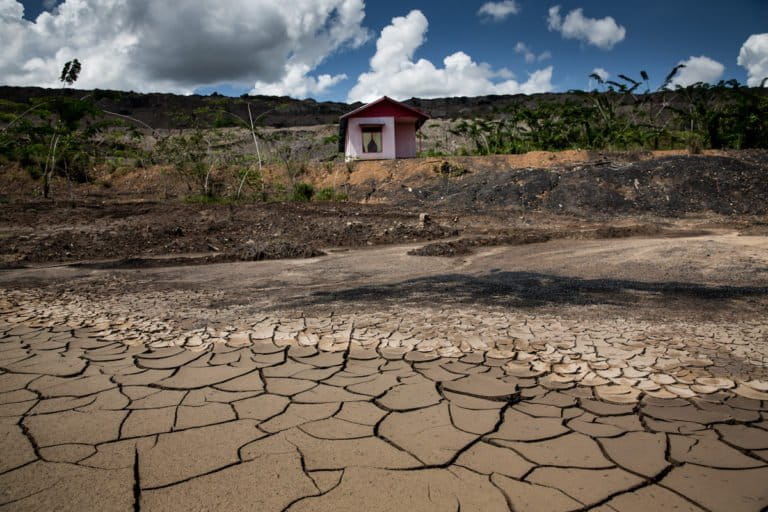
A lone house is left standing at an abandoned village after a nearby mining concession degrades the surrounding environment. Image by Kemal Jufri/Greenpeace.

The deeper roots of idle land

While nearly half of Indonesia’s primary forest loss in 2024 remains unexplained, experts say this absence of clear attribution is not simply a data gap — it may be a warning sign of deeper governance issues.

One leading explanation is speculative clearing, when companies clear forests without immediately converting the land to plantations or infrastructure. According to Arief Wijaya, managing director of World Resources Institute (WRI) Indonesia, this pattern has persisted since the 1990s, when companies obtained forestry or plantation permits, extracted valuable timber and left the land idle. In many cases, this was deliberate: either a lack of capital to proceed or part of a long-term land banking strategy.

These behaviors point to regulatory failure, as the issue of abandoned land is closely tied to the “reckless issuance of permits” by the government, said Boy Jerry Even Sembiring, the director of the Riau chapter of the country’s largest green group, Walhi.

Concession holders face few consequences for clearing forest and abandoning the land, creating a cycle of destruction without accountability. The result is a patchwork of degraded forestland, legal ambiguity and lost oversight — fertile ground for future land conflict, encroachment, opportunistic development and fires.

In an effort to address this, Indonesia’s Ministry of Forestry earlier this year revoked 18 inactive forestry concessions covering more than 526,000 hectares (1.3 million acres). Minister Raja Juli Antoni framed the move as part of a broader push to reclaim unproductive concessions and reassert state control over idle forestland.

But Arief warned that the recent revocations barely scratch the surface.

“If we look at the broader picture, this land speculation has been happening for over 30 years,” he told Mongabay.

Without a systematic approach to identify, map and resolve the status of idle lands, the problem will persist — quietly fueling environmental degradation, sparking community conflict and undermining efforts to clean up supply chains, Arief said.

Once land is cleared and left idle, communities often move in and begin farming, sometimes triggering future land disputes, especially when the land is later contested by concession holders or targeted for development, he added.

Idle land is also prone to fires, activists say.

Boy of Walhi Riau said abandoned lands consistently burn during the dry season.

“After being cleared, they [idle lands] often burn, yet there’s no proper accountability or follow-up review process for these incidents,” he said.

Burning within Tesso Nilo National Park.
Between 2001 and 2021, Indonesia lost more than 28 million hectares (69 million acres) of forest. However, since peaking in 2016, forest loss in Indonesia has continued to decline. Image by Rhett A. Butler/Mongabay.

Turning idle land into opportunity

Therefore, Arief called on the government to come up with a targeted and comprehensive strategy.

The first order of action is to map where the idle lands are and identify their owners and jurisdictions. If during the mapping it turns out that communities have already controlled the land and conflicts have emerged, then the government needs to resolve the conflicts first, Arief said.

After that, the government and other stakeholders should develop a plan for how to use these lands — whether through rehabilitation, community use or reallocation, he said.

One option is to mandate the rehabilitation of the idle lands, if they are located within concessions.

Yuliusman, the director of Walhi South Sumatra, said concession owners need to be held responsible for the land they control, including when these lands are cleared and burned.

That’s why the government needs to make land ownership data available to the public so landowners can be held accountable, he said.

Another option is to grant communities rights to manage these idle lands through the social forestry scheme.

The program, initiated by President Prabowo Subianto’s predecessor, former President Joko Widodo, is one of the largest socioenvironmental experiments of its kind, aiming to reallocate 12.7 million hectares (31.4 million acres) of state forest to local communities and give them the legal standing to manage their forests.

By granting social forestry permits to communities with a clear business plan, the government could empower small farmers while bolstering food security at the same time, Arief said.

This aligns with the platform of Prabowo, who has prioritized achieving both food and energy self-sufficiency as cornerstones of his administration, he added.

Since his election campaign in late 2023 and early 2024, Prabowo has emphasized the need for Indonesia to achieve sovereignty in these critical sectors to bolster economic resilience and national security.

In December 2024, Minister Raja Juli announced the government had identified 20 million hectares (50 million acres) of forest area for potential conversion into “food and energy estates.”

The announcement raised concerns over new deforestation, especially if the areas include intact forests. But Arief said the plan could be positive — if those hectares are truly idle lands that have already been cleared and remain unproductive.

“If we already know there are 20 million hectares of low-productivity land, and we have a food security program, then we can map which crops are suitable — maybe some areas for rice paddies, others for water conservation, others for energy,” he said. “That’s where we need a road map.”

Recognizing the rights of communities to manage their lands could also help prevent fires, according to Rod Taylor, the global director of WRI’s forests program.

“I think some of the success in Indonesia [in mitigating fires] can be put down to really good collaboration between companies and communities, to not only prepare for big fires and a lot of enforcement of no burning laws, but also really fast response mechanism to spot and take action against fires before they can spread too far,” he said.

Having a road map that puts community rights at the forefront is also critical to resolving lingering land conflicts, said Timer of Auriga Nusantara.

It’s also necessary to address Indonesia’s deep-rooted structural injustice in land ownership. Today, 68% of the country’s land is controlled by just 1% of the population, as the state prioritizes concessions to large corporations over community land rights.

These large-scale infrastructure and resource extraction projects have pushed marginalized groups such as farmers, Indigenous communities and fisherfolk off of their lands.

Between 2015 and 2024, more than 3,200 agrarian conflicts broke out across 7.4 million hectares of land (18.3 million acres) — affecting 1.8 million households.

Timer warned against using the existence of idle land as a pretext to expand industrial agriculture, which he said would only deepen Indonesia’s land conflicts.

“We must avoid justifying the planting of monoculture commodities on deforested land in the name of ‘what’s already happened,’” he said. “If these areas must be converted, then they should be turned into social forestry zones — and owned by local communities, not corporations.”

Citation:

Parker, D., Tosiani, A., Yazid, M., Sari, I. L., Kartika, T., Kustiyo, … Hansen, M. C. (2024). Land in limbo: Nearly one third of Indonesia’s cleared old-growth forests left idle. Proceedings of the National Academy of Sciences, 121(28). doi:10.1073/pnas.2318029121

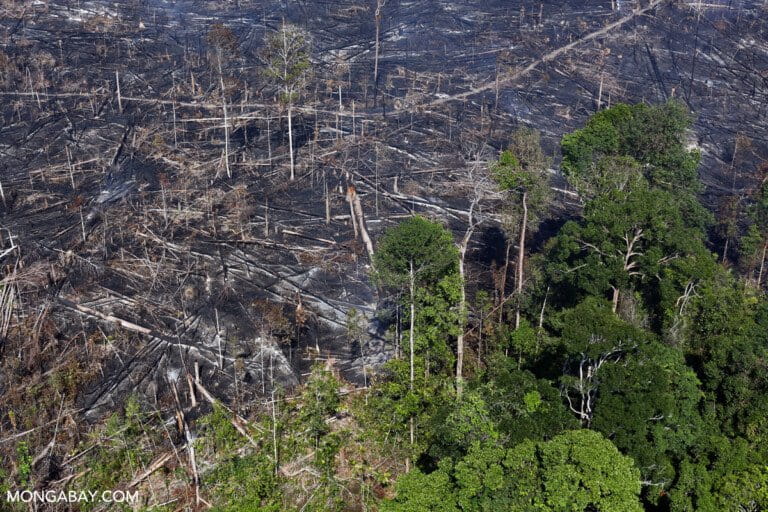
Banner image: Peatlands destruction in Riau, 2014. While Indonesia has in the past been a major carbon emitter due to land-use change, deforestation, forest fires and peatland destruction, the recent decline in deforestation is seen as a positive sign. Image by Rhett A. Butler/Mongabay.

The World’s Largest Deforestation Project

Douglas Gerrard

Share on BlueskyShare on FacebookEmailPrint

In the West Papuan regency of Merauke, close to the border with Papua New Guinea, Indonesia is rapidly clearing land in the world’s largest ever deforestation project: three million hectares for sugarcane and rice production. Within three years, Indonesia plans to convert an expanse of forest roughly the size of Belgium into profitable monoculture. The ambition and destructiveness of the development distinguish it from previous mining or agribusiness initiatives in West Papua, which has been under Indonesian occupation since the 1960s. 

At a ground-breaking ceremony in June 2024, Indonesia’s then president, Joko Widodo, described Merauke as Indonesia’s future ‘food barn’. He also touted the potential of converting sugarcane into bioethanol fuel. (On the Raja Ampat islands meanwhile, Papuan activists are fighting plans to exploit nickel reserves for electric vehicle batteries.)

Since formalising its control of West Papua in a fraudulent 1969 referendum, Indonesia has carried out genocidal military assaults – up to a quarter of West Papuans have been killed under occupation – and ‘transmigration’ settlement programmes that have reduced the Indigenous population to a minority. 

In the nine months since he took office, Indonesia’s new president, Prabowo Subianto, has both restarted the transmigration programme and accelarated deforestation in West Papua. Widodo designated Merauke a ‘National Strategic Project’ (PSN), giving the state eminent domain powers to expel civilians. Fifty thousand Indigenous Papuans face displacement over the project’s lifespan; already, people are finding vast tracts of their customary land have been closed to them, with wooden stakes signalling the expropriation by the Indonesian military.

The human costs of the PSN, while severe, are eclipsed by its possible environmental consequences. The destruction of Merauke is set to release over 780 million additional tons of CO2 into the atmosphere, more than doubling Indonesia’s yearly emissions and leading to irreversible ecosystem collapse in one of the world’s most biodiverse regions. Officials have pressed on with the development while trying to conceal its impact. The energy minister, Bahlil Lahadalia, in charge of parcelling out land to developers, has claimed there is ‘no forest in the middle of Merauke … only eucalyptus, swamps and savannahs’. But though the sago and paperbark mangroves that cover much of the Merauke landscape may appear sparse from above, they store up to 381 tons of carbon per hectare – a higher concentration than the Amazon rainforest. 

The PSN is not Indonesia’s first attempt to convert Merauke into profitable farmland. In the 2010s, huge swathes of the rainforest were razed to make way for a palm oil mega-project, the Merauke Integrated Food and Energy Estate (MIFEE). It has been described by one researcher as effecting an ‘ecologically-induced genocide’ of the Marind tribe, whose gardens and hunting grounds also extend into the territory now threatened by the PSN. As their forest recedes, the Marind are forced to rely on remittances from the corporations that have seized their land. Rice and instant noodles are replacing traditional sago cultivation. 

In her book In the Shadow of the Palms, Sophie Chao describes the warping effects that MIFEE has had on both the environment and the Marind worldview. Before palm oil arrived, the forest provided a rich network of relationships between people, plants and animals. Under the monocrop regime, everything is ‘abu-abu’ – grey, uncertain. In a new documentaryabout Merauke, a Yei tribesman describes the transformation of his land in similarly alienated terms: ‘Before, when I went there [to the forest], I could catch deer, pigs, fish … Now it’s like I’m half dead.’

MIFEE was intended not only to boost Indonesia’s food security, but also to make it a net exporter of rice and palm oil – to ‘feed Indonesia, then the world’. The profit motive is harder to identify in the Merauke PSN. Its advocates have instead emphasised national self-sufficiency, partly in response to the precarity of global supply chains exposed by the Covid pandemic. Even a staunch rightwinger like Prabowo can sound like an anti-colonial nationalist when discussing the project: ‘How can a country be independent if it cannot feed its people?’ he asked in 2023, when he was defence minister. 

During Indonesia’s three decades of dictatorship under Suharto (Prabowo’s father-in-law), more than a third of its national revenue came from West Papua, much of it from the world’s largest gold mine, which was operated until 2017 by the US company Freeport McMoran. But while the Freeport mine primarily enriched foreign and domestic elites, the Merauke PSN is designed to insulate ordinary Indonesians from food and energy shocks – caused by a climate crisis that the PSN will drastically worsen. Both ventures aimed to secure the future of the regime, though in different ways. West Papua has gone from being Indonesia’s gold mine to its larder.

Where private interests are involved in the PSN, the principal beneficiaries are not foreign corporations but politically connected Indonesian entrepreneurs. Co-ordinating the project is the palm oil magnate Andi Syamsuddin Arsyad, also known as Haji Isam (or the ‘new poster boy of Indonesia’s oligarchy’). Isam owns the Jhonlin Group, which has bought two thousand excavators from a Chinese company to begin the deforestation. His cousin, Amran Sulaiman, is the agriculture minister. 

The military role in the development of the PSN goes far beyond their normal land-grabbing and security remit. Following a large recruitment drive in Java, more than three thousand additional troops have been deployed to Merauke, where they are directly engaged in felling and crop cultivation. Instagram posts show fresh-faced soldiers playing at farmers, ineptly watering crops or operating Isam’s excavators. 

Sulaiman has insisted that ‘the military support is there because of a lack of manpower’ – but while most of the soldiers deployed to Merauke may be new recruits, photographs have also surfaced of some sporting the insignia of Yonif Raiders, an elite combat unit notorious among West Papuans for their brutality. In August 2022, a troop of Raiders murdered four Papuan villagers and dumped their dismembered bodies in a local river. Such atrocities are commonplace in the West Papuan highlands, where the armed resistance movement is strongest and international scrutiny all but non-existent. 

Merauke is a lowlands region, which may be one reason the PSN hasn’t yet been met with violence from its opponents. Nonetheless, resistance has been immediate and widespread: there have been mass protests throughout West Papua, while a coalition of NGOs and Indigenous groups has drawn the UN’s attention to the project. A UN fact-finding mission has long been a demand of the United Liberation Movement for West Papua (ULMWP), a proto-governmental organisation uniting the three most significant independence factions, operating under the stewardship of the exiled leader Benny Wenda (I have worked with them). 

While the forces arrayed against the ULMWP are forbidding – not least a decades-long ban on foreign media that has kept West Papua from international attention – the climate crisis gives their liberation struggle a global dimension. The New Guinea rainforest is the world’s third largest, after the Amazon and the Congo. Uniquely, tribal struggles for land rights in West Papua form part of a wider revolutionary movement that seeks to replace military-corporate domination with Indigenous sovereignty and a ‘green state’. Wenda has urged environmental activists to ‘accept climate catastrophe or fight for a free West Papua’. Merauke will determine their choice. 

New Gecko Project documentary exposes the dark reality of Indonesia’s Strategic National Project in Merauke

Human Rights News / IndonesiaWest Papua / 17 July 2025 

A new documentary reveals the devastating impact of Indonesia’s National Strategic Project (PSN) in Merauke, Papua Selatan Province, exposing how large-scale agricultural expansion under the guise of national food security results in the systematic violation of indigenous rights and environmental degradation. The project aims to convert at least 1.6 million hectares of indigenous Malind territory into rice fields and sugarcane plantations, backed by heavy equipment and military presence. Indigenous communities report land seizures without giving their free, prior informed consent (FPIC), while military forces secure the project areas, underscoring the militarisation of development in West Papua.

The film highlights growing resistance from indigenous Malind communities, who reject all forms of corporate investment on their customary lands. In March 2025, over 250 participants at the ‘Merauke Solidarity’ forum condemned the PSN as a corporate-driven initiative that disregards indigenous rights and causes irreversible environmental harm. The project has already triggered deforestation, water contamination, and loss of livelihoods. A government decree has allowed the conversion of more than 13,000 hectares of forest, including protected areas and peatlands, raising serious concerns about Indonesia’s climate commitments.

Despite widespread protests and criticism, government officials, including President Prabowo Subianto, continue to promote the Merauke food estate as a modern agricultural hub. The project aligns with broader patterns of repression across West Papua, where opposition is met with violence and intimidation. Since August 2024, demonstrations against PSN and transmigration have faced heavy-handed crackdowns, reflecting a national strategy that prioritises economic interests over indigenous survival.

The documentary serves as a timely and urgent record of these developments, revealing the complex interplay between state power, corporate interests, and indigenous resistance. It underscores the need for international scrutiny and intervention, warning that the unchecked expansion of PSN projects will exacerbate land conflicts, environmental destruction, and cultural extinction in West Papua.


Not waving, drowning – Indonesia may lose warming battle

T

This is the way the world ends, not with a bang but a flooding: With apologies to T. S. Eliot

By Duncan Graham 11/7/25

Every year the UN runs a Climate Change Conference – the next is scheduled for November in Brazil. High on the agenda will be the plight of Pacific Islanders seeing their homes drown. There’s an equally pressing need close by, but the solutions seem doomed.

Indonesian authorities provide useful information for travellers checking if they’ve got to the right place: alongside the destination name is its height above sea level.

Surabaya, the capital of East Java, advertises it’s just two metres higher than the nearby waves. The Republic’s second-biggest city is a vital transport hub, a humid home to ten million and a trading and naval centre for more than a thousand years.

How many more is the figure to fear.

For the waters are rising and the beaches are drowning, most strikingly in the capital Jakarta 780km west along the coast of the Java Sea. It’s disappearing faster than any other city in the world, according to a BBC report:

“North Jakarta has sunk 2.5 metres in 10 years and is continuing to sink by as much as 25 centimetres a year in some parts, which is more than double the global average for coastal megacities.”

Global warming is a factor but the other culprits are illegal drilling for groundwater and excavating foundations for high-rise towers and a web of toll roads. Despite the predictions the rattle of pneumatic drills, the slurp of concrete pours and the nodding of dinosaur construction cranes continues day and night.

The BBC’s depressing information was broadcast seven years ago; horizontal lines drawn by shack owners on their timber walls to measure the rise are now invisible under the brown soup of plastics, nappies, cans and other trash that passes for water.

Lab-coated scientists taking samples to prove the pollutants are extreme would need extra protection because corrosives rot clothing.

So, what to do?

The last president Joko ‘Jokowi’ Widodo decided the solution was to move. He reckoned the right place to raise a memorial to his foresight was 1200 km north-east of the descending capital. The first building rising above the greenery has been the palace.

This is East Kalimantan province on the island of Borneo, the biggest in the sprawling 17,000-island archipelago where orangutans once outnumbered their human relatives. That was before the timber cutters and palm-oil planters arrived to turn the pristine into profit.

Java is five times smaller than Borneo but immeasurably more important – the political, administrative and cultural centre of the Republic and home to more than 158 million. It’s the world’s most densely populated island and super-fertile, though much of the landscape is mountainous.

The proverb rindu kampung halaman means more than just a longing for home. It embraces family, community, culture, local language and history. For the Javanese, these magnets of birthplace exercise a powerful pull.

So the four million bureaucrats and their families who call Jakarta their place are not dashing to shift to East Kalimantan with its different climate and culture – now grandly titled Ibu Kota Nusantara, the Mother City of the Outer Islands.

Despite their city’s mess, many workers will need more than subsidies and promises of promotion to get them to move, particularly if they have partners and kids embedded in schools, sports and friendships.

All this along with a disinterest in tipping more money into the Jokowi ego monument is why his successor, President Prabowo Subianto, is pondering other ways to keep Jakarta residents above water.

The current favourite is the Great Wall of Java, already on the list of strategic projects in the 2025-2029 National Medium-Term Development Plan, though there are still no blueprints.

As a former military man before being cashiered in 1998, Prabowo sees rising seas as an invasion, so the best defence is fortification.

There are lessons from military history he needs to heed. The collapse of the French Maginot Line in 1940 showed that barricades are only as strong as their weak spots and there’ll be many as seas surge and waves undermine the president’s bulwark.

Like Canute, he can shout orders. But king tides only obey the pull of the moon.

So far, estimates of Great Wall measurements and costs are still being splashed around conference tables, but the best published stab is 500km and A$122 billion over two decades. That’s twice the current estimated cost of Jokowi’s IKN.

The figures are certain to rise faster than sea levels. The money will have to be drained from state budgets as the project is unlikely to attract even Chinese investors reportedly propping up IKN. How do you earn money from a venture trying to tame nature?

One idea is to build “a livable seawall that has residential and commercial zones, essentially turning the whole structure into a kind of floating city”. Swimming would be a required skill for buyers.

The omens aren’t good. Earlier attempts to build Jakarta dykes failed. One collapsed in 2007, five years after construction – no defence against a storm that took 80 lives.

_The Jakarta Post_ is not a cheerleader for the Prabowo plan: “Simply put, we don’t have enough money or possess the knowledge or experience to build the Java seawall… We could end up with another unfinished massive construction by the end of the current presidential term, only this time at sea.”

Maybe delegates to the UN Climate Change Conference will offer fresh solutions. Otherwise like Shelley’s Ozymandias, Prabowo’s mighty works will remind future generations how we lost the battle against global warming.

The views expressed in this article may or may not reflect those of Pearls and Irritations.

Duncan Graham

Duncan Graham has been a journalist for more than 40 years in print, radio and TV. He is the author of People Next Door (UWA Press). He is now writing for the English language media in Indonesia from within Indonesia. Duncan Graham has an MPhil degree, a Walkley Award, two Human Rights Commission awards and other prizes for his radio, TV and print journalism in Australia. He lives in East Java.

China isn’t the main culprit in Indonesia’s dirty nickel boom

Muhammad Zulfikar Rakhmat

This article is sourced from The Lowy Institue’s The Interpreter first published 4/7/25

While Chinese firms capitalise on the country’s resources, the
social and environmental damage lies squarely with Jakarta.

Smoke rises from Weda Bay Industrial Park, a major nickel processing and smelting hub in Central Halmahera, on 13 April 2025 (Yasuyoshi Chiba/AFP/Getty Images)

Smoke rises from Weda Bay Industrial Park, a major nickel processing and smelting hub in Central Halmahera, on 13 April 2025 (Yasuyoshi Chiba/AFP/Getty Images)

Published 4 Jul 2025 


The destruction of Indonesia’s rainforests and reefs in the name of green energy is a tragedy, but not one that can be pinned solely on China.

Yes, China has played a central and highly visible role in Indonesia’s nickel boom. It is the largest consumer of Indonesian nickel, the primary financier behind smelters and industrial parks, and a dominant foreign actor influencing how extraction unfolds. But Chinese companies do not force their way into Indonesia’s forests – they are merely capitalising on the rules, and loopholes, established by the Indonesian state.

To understand how the world’s largest nickel reserves are being transformed into sacrifice zones, we must begin with a critical truth: the rush to exploit these resources is not driven solely by foreign demand, but by domestic politics and governance choices made in Jakarta.

While Chinese firms certainly profit from this permissive and often corrupt environment, it is Indonesian authorities who enable and perpetuate it.

It is Indonesia that grants mining permits – often through processes vulnerable to corruption. It is Indonesia that oversees (or fails to oversee) environmental and labour assessments. It is Indonesia that silences youth activists and sidelines Indigenous communities when they speak out against these projects. While Chinese firms certainly profit from this permissive and often corrupt environment, it is Indonesian authorities who enable and perpetuate it.

A recent case from Raja Ampat, a remote archipelago in West Papua, underscores the stakes of Indonesia’s nickel rush. Last month, Indigenous youth disrupted a mining summit in Jakarta, holding signs reading “Nickel Mines Destroy Lives”. Their viral protest, under the hashtag #SaveRajaAmpat, drew attention to the threat that nickel extraction poses to their home. Several protesters were detained.

Raja Ampat, renowned for its marine biodiversity and Indigenous communities, is already reeling from the impacts of nickel mining. Of the four companies licensed to operate in the region, PT Anugerah Surya Pratama – linked to China’s Vansun Group – cleared protected forests and polluted the sea around Manuran Island. Indonesia’s Ministry of Environment confirmed these violations. Only after public outcry did the government revoke the permit, but by then, much of the damage had already been done.

MOROWALI, CENTRAL SULAWESI, INDONESIA - AUGUST 01: Employees in traffic during the working shift change near Indonesia Morowali Industrial Park (IMIP), that consists of around 77,000 local workers and around 6,000 Chinese workers on August 1, 2023 in Morowali, Central Sulawesi, Indonesia. The global demand for the raw material nickel, a key component in batteries - especially those used in electric vehicles (EVs) - is growing rapidly. Estimates from the U.S. Geological Survey (USGS) showed that global nicke
Workers at the Indonesia Morowali Industrial Park sit in traffic after a shift change at the nickel processing hub (Ulet Ifansasti/Getty Images)

The mining boom is not confined to far-flung Papua. In Central Sulawesi, Morowali has become the beating heart of Indonesia’s nickel processing industry. The Indonesia Morowali Industrial Park (IMIP), largely financed and constructed by Chinese companies such as Tsingshan Holding Group, stands as a flagship Belt and Road project. But its meteoric rise has come at an enormous cost: air and water pollution, deforestation, and rising greenhouse gas emissions in what was once promoted as a “green” zone.

The social toll is just as severe. Labour conditions at IMIP have raised alarms, with reports of long hours, meagre pay, poor safety standards, and frequent accidents. Tensions between Chinese and Indonesian workers have flared into violence on multiple occasions. Yet despite these concerns, the park continues to expand. The economic incentives for all parties are simply too great, and regulatory enforcement is often undermined by corruption. Indonesia’s 2020 ban on nickel ore exports – intended to promote domestic value-added processing – successfully attracted foreign capital. But the regulatory framework governing labour rights, environmental protections, and community engagement has failed to keep pace.

A similar pattern has taken root in Weda Bay, Halmahera. There, vast industrial complexes built by Chinese and French firms have reshaped the landscape. Forests have been razed, rivers contaminated, and traditional livelihoods upended. Promises of economic opportunity have been hollowed out as locals report being excluded from decision-making and witnessing a growing divide between investors and communities.

No labour abuses, environmental violations, or community displacements occur without institutional neglect – often compounded by corruption.

Indonesia’s failures are not isolated – they are systemic. Environmental impact assessments are routinely manipulated, labour standards poorly enforced, and Indigenous voices sidelined. Corruption facilitates these breaches, creating an environment where compliance is optional. The most powerful investors – Chinese state-linked enterprises among them – adapt accordingly.

Still, this does not absolve China. As the global leader in battery production and the architect of the Belt and Road Initiative, China has committed to making its development model “green and sustainable”. Yet it continues to finance and profit from operations that destroy ecosystems, exploit labour, and marginalise communities. What Beijing would never tolerate on its own soil – clear-cutting protected forests or operating in unsafe conditions – it enables abroad.

If China truly intends to lead the global energy transition, it must hold its companies accountable. This means refusing to finance environmentally destructive projects, setting higher standards for overseas operations, and enforcing consequences for corporate misconduct – not just when global outcry forces its hand.

But ultimately, the responsibility lies with Indonesia. No Chinese company can operate in Indonesia without state approval. No labour abuses, environmental violations, or community displacements occur without institutional neglect – often compounded by corruption. If Indonesia hopes to be seen as a responsible steward of its natural wealth, it must overhaul how mining projects are licensed, monitored, and enforced. It must empower Indigenous peoples and protect workers with the same urgency it grants mining permits.

Indonesia’s nickel boom is a test of the country’s ability to balance economic growth with sustainable governance. From Raja Ampat to Morowali, the impact of unchecked mining is evident – forests are cleared, labour is exploited, and communities are displaced.

We cannot place the blame squarely on China. But we must acknowledge that Indonesia’s governance – and the corruption within it – ultimately sets the terms.