
Papua Annexation Day rally in Bali harassed, forcibly dispersed by police

Suara Papua – May 2, 2024

Elisa Sekenyap, Jayapura — A peaceful demonstration by Papuan students in Balinese provincial capital of Denpasar on Wednesday May 1 to commemorate the day Papua was annexed into the Unitary State of the Republic of Indonesia (NKRI) has been blocked and repressed by police.

Earlier, according to the notification letter submitted to police, the protesters planned to gather at the Renon Field eastern parking area then hold a long-march to the location of the action at the American Consulate in Denpasar.

The plan however was not realised because officers from the Bali regional police (Polda) and the Denpasar city municipal police

(Polresta) rushed to intercept the protesters, who were then forced to disperse at exactly 12 noon.

Chronology of incident

Field coordinator Derimon Kepno said that the Papuan students had been gathering at the eastern parking area since 6.30 am after moving off from the Papua dormitory and several other locations in the city.

“At 8.50 am the protesters began a long-march towards the action point at the American Consulate in Denpasar. At 9.15 am they were intercepted and repressed by police.”

“At that time we were hemmed in and forced to disperse. The live recording on Facebook was also suddenly cut, because the network was interrupted. The Bali Polda and Denpasar Polresta deployed around 480 personnel just to stop the mass action, but we also insisted on going to the American Consulate, because before the action we had already sent a letter notifying [police about] the action”, explained Kepno.

At that moment, said Kepno, representatives from the Legal Aid Foundation (LBH) and Papua Student Alliance (AMP) met with the authorities to hold negotiations, but they reached a dead end and police remained determined to disperse the protesters.

“At 10.20 am the Bali LBH and AMP representatives negotiated with the police, but the police did not respond well and the police instead forbade the demonstrators from taking the protest to the action point at the American Consulate. Next we had a second negotiation but the authorities only gave us time for an action until 12 noon”.

“At 11.15 am the crowd was surrounded and the space [allowed] for the action was isolated so in the end comrades decided to change the method of action. So they put up posters on the side of the road so that the public could see them, because previously we were isolated.”

“Finally at 12.15 pm, comrades read out a statement. When we read out our statement, Brimob [paramilitary Mobile Brigade], Dalmas [crowd control unit] and a police water canon arrived at the location of the action. We knew that this was a way of upsetting our psychology, so we remained calm and read our statement”, he concluded.

Papuan student’s statement

AMP General Chairperson Jeeno Dogomo, as the person responsible for the action, said that Indonesia’s position in the land of Papua over the last 61 years is illegal.

Dogomo said this started on May 1, 1963, because the United States, the United Nations, the Netherlands and Indonesia had an interest in the land of Papua. “The handover of West Papua to Indonesia was without the knowledge of the Papuan people, therefore we declare this illegal”, asserted Dogomo.

He said that the annexation of the Papua region into the NKRI was carried out through a series of military operations in the context of thwarting the state of West Papua that was declared on December 1, 1961.

The declaration of the state of West Papua was organised by the representative political institution of the Papuan nation, namely Nieuw Guinea Raad (the New Guinea Council, NGR) with the approval of the Dutch royal government, which at that time occupied the Papua region in accordance with UN Resolution Number 1514.

However nineteen days later Indonesia’s founding president Sukarno issued  the Trikora (the Triple Commands of the People) declaration at the Yogyakarta Northern Square which called for: (1) Disbanding the Dutch-made puppet state (2) Raising the red-and-white flag throughout the Land of Papua and (3) A national mobilisation to seize West Irian (as Papua was then called).

“Today’s situation is that the Papuan people are facing a situation of systematic and structured repression, intimidation and murder by the state after special autonomy was imposed in 2001. As a result, a prolonged conflict continues to occur where the TNI [Indonesian military] and Polri [national police] indiscriminately accuse civilians [of being separatists]”, he said.

Therefore, said Dogomo, they reject Indonesia’s presence in the land of Papua over the last 61 years and make the following demands.

– For 61 years Indonesia’s position in Papua has been illegal.

– Fully investigate the perpetrators of the torture of three civilians in Puncak regency, Papua.

– Audit Freeport’s assets and provide severance pay to its workers.

– Audit mine reserves and environmental damage.

– Withdraw all organic and non-organic TNI and Polri from the land of West Papua.

– Stop engineering conflicts throughout West Papua.

– Provide access to foreign journalists and provide information throughout West Papua.

– Investigate, arrest, prosecute and imprison human rights violators during Freeport McMoran’s presence in West Papua.

– Provide the right to self-determination a democratic solution for the West Papuan people.

Notes

Although it is widely held that West Papua declared independence from Indonesia on December 1, 1961, this actually marks the date when the Morning Star flag was first raised alongside the Dutch flag in an officially sanctioned ceremony in Jayapura, then called Hollandia. The first declaration of independence actually took place on July 1, 1971 when the Free Papua Organisation (OPM) unilaterally proclaimed West Papua as an independent democratic republic.

Operation Trikora was an Indonesian military operation aimed at harassing and forcing the Dutch out of Netherlands New Guinea (West

Papua) in 1961-62 rather than one intended to suppress a nascent independence movement.

[Translated by James Balowski. Abridged slightly due to repetition. The original title of the article was “Aparat Hadang dan Represi Aksi Demo Damai Mahasiswa Papua di Bali”.]

The Papuan Police sent the Cartenz Peace Operations Task Force to Intan Jaya

These tactical and technical steps were taken in an effort to comprehensively handle the capital city of Intan Jaya after the TPNPB-OPM attack

May 3, 2024 in Political, Legal and Security Affairs

  0

Author: Alexander Loen – Editor: Alberth Yomo

Jayapura, Jubi – A total of 20 Cartenz Peace Operation Task Force personnel were sent to Intan Jaya Regency, Central Papua Province following the attack on the Homeyo Police Station on April 30 2024 which resulted in the death of a teenager named Alexsander Parapak. Not only that, this Task Force will also investigate the burning of the Inpres Pogapa Elementary School building on Wednesday 1 May 2024, and the attempted attack on Koramil 1705-05/Homeyo on 2 May 2024 by an armed group suspected of being the West Papua National Liberation Army Free Papua Organization or TPNPB -OPM. This was conveyed by the Head of the Papua Regional Police, Inspector General Mathius Fakhiri in Jayapura City, Friday (5/5/2024).

“We hope today can be calmer. I am also trying today to be able to add additional personnel assistance and our helicopter can land safely because yesterday it couldn’t come in. “So today we are adding strength to take action,” said Fakhiri.

Fakhiri said that if additional personnel had arrived at Intan Jaya, his party would take tactical and technical steps in comprehensive handling of Sugapa, the capital of Intan Jaya. With the hope that in the future there will be no more disturbances.

“Our helicopter is under maintenance and the other is in Boven Digoel. Our personnel have also been shifted there. “When we arrive there, we will immediately take security measures together with the Intan Jaya Police,” he stressed.

Police Chief Fakhiri admitted that he had received reports that in Intan Jaya there had been disturbances in security and order (kamtibmas) such as shootings. Government services will certainly be disrupted and paralyzed. However, he asked the government to continue providing services to the community.

“The only survivors are Polri and TNI personnel and the task force assigned there. “Meanwhile, other civil servants chose to leave to protect themselves,” he said.

Commander of the Joint Regional Defense Command (Kogabwilhan) III, Lieutenant General TNI Richard T.H. Tampubolon said the joint TNI-Polri apparatus had succeeded in cracking down on the TPNPB-OPM movement in Intan Jaya. “TPNPB has disturbed security and tried to control the Homeyo area for three days in a row, causing fear among the local community, some people even fled to protect themselves,” said Richard.

According to Richard, the armed disturbances and arson carried out by TPNPB also paralyzed community activities in the area. “Today the TNI-Polri security forces have succeeded in carrying out an action against the TPNPB group in the Homeyo District area,” he stressed.

Richard said the joint TNI-Polri apparatus assigned to Intan Jaya involved the Habema TNI Operations Command (KOOPS TNI) unit and the Nanggala Damai Cartenz Task Force. The results obtained from this operation are that the Homeyo District is gradually recovering from TPNPB’s sporadic actions.

He assessed that control of security is very meaningful for the smooth and conducive situation in the lives of local people in carrying out their daily lives and activities. “The firm crackdown operation against OPM in the Homeyo District area is an effort to create regional security that will support all processes of accelerating Papua’s development,” he said.

Komnas TPNPB spokesperson Sebby Sambom in a written release said that TPNPB Region VIII Intan Jaya troops managed to shoot 4 members of the Indonesian military and burn down an elementary school building on May 1 2024. “TPNPB-OPM Kodap VIII Intan Jaya Brigadier General Undius Kogoya is responsible for the deaths of 4 “TNI-Polri members and an empty back car,” said Sambom.

According to Sambom, the shooting incident occurred at 12.05 WIT afternoon in Enarotali Regency, precisely in Bibida Village. The incident started when members of the TNI-Polri entered without permission so we shot them. We hope that we don’t blame the people of Enarotali.

“We are also ready to carry out operations in Enarotali, Deiyai, Dogiyai and Nabire districts, these 4 areas are the TPNPB-OPM operational areas. “We convey this because Prabowo Subianto and top Indonesian military officials have agreed to discuss law enforcement, so before sending TNI-Polri troops, prepare the coffins of your members’ bodies and then send them,” he stressed. (*)

Deforestation in Indonesia Spiked Last Year, but Resources Analyst Sees Better Overall TrendA data analysis shows Indonesia had a 27% increase in primary forest loss in 2023

By Associated Press

April 28, 2024, at 10:06 p.m.

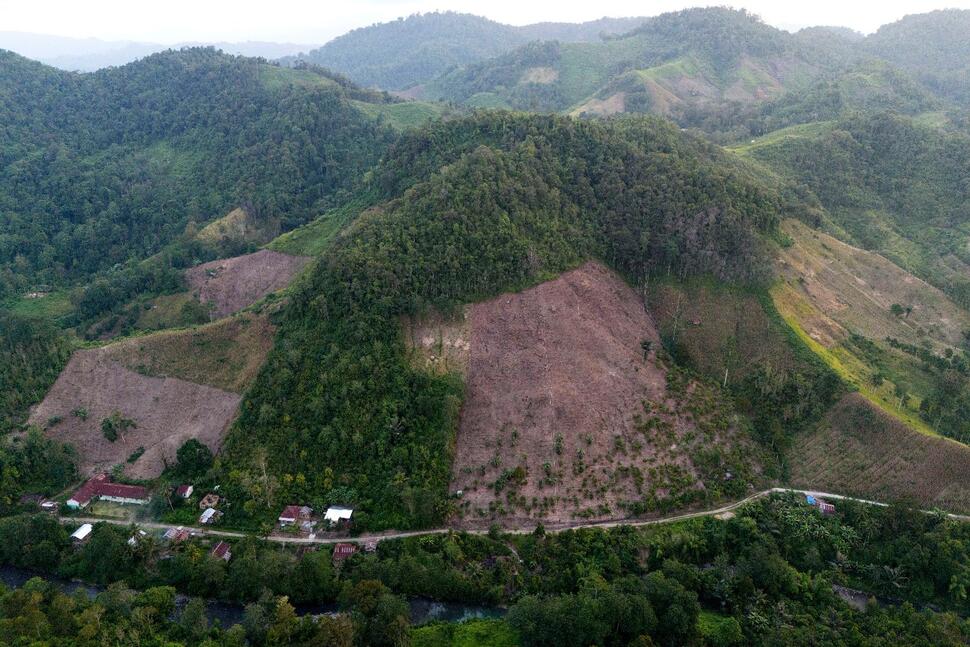
JAKARTA, Indonesia (AP) — From trees felled in protected national parks to massive swaths of jungle razed for palm oil and paper plantations, Indonesia had a 27% uptick in primary forest loss in 2023 from the previous year, according to a World Resources Institute analysis of deforestation data. But the loss is still seen as historically low compared to the 2010s, it said.

“Deforestation has been declining from six or so years ago, when there were peak rates,” said Rod Taylor, global director of the forests program at WRI. “It’s good news and commendable for Indonesia.”

But others saw cause for concern in the uptick, and tied some of the more recent deforestation to the world’s appetite for mining Indonesia’s vast deposits of nickel, which is critical for the green energy transition.

The latest data from the University of Maryland’s Global Land Analysis and Discovery laboratory was shared on Global Forest Watch — a platform run by WRI that provides data, technology and tools for monitoring the world’s forests.

A vast tropical archipelago stretching across the equator, Indonesia is home to the world’s third-largest rainforest, with a variety of endangered wildlife and plants, including orangutans, elephants and giant forest flowers. Some live nowhere else.

Since 1950, more than 74 million hectares (285,715 square miles) of Indonesian rainforest — an area twice the size of Germany — have been logged, burned or degraded for development of palm oil, paper and rubber plantations, nickel mining and other commodities, according to Global Forest Watch. Indonesia is the biggest producer of palm oil, one of the largest exporters of coal and a top producer of pulp for paper. It also exports oil and gas, rubber, tin and other resources.

Expansion of industrial plantations occurred in several locations adjacent to existing palm oil tree and pulp and paper plantations on the tropical islands of Kalimantan and West Papua, according to the analysis.

The Indonesian Ministry of Environment and Forestry said the expansion occurred in concessions granted before the current administration took office in 2014.

The Indonesian Ministry of Environment and Forestry did not respond to questions and a request for comment sent by The Associated Press.

Global Forest Watch’s data on Indonesia’s loss of primary forests — which are old-growth forests typically high in stored carbon and rich in biodiversity — are higher than the official Indonesian statistics. That’s because much of the primary forest loss in Indonesia, according to the analysis, is within areas that Indonesia classifies as secondary forest — areas that have regenerated through largely natural processes after human actions such as agriculture clearing or timber harvest. Secondary forests typically have reduced capacity for storing carbon than primary forests.

Deforestation linked to the mining industry occurred in Sumatra, Sulawesi, Mlauku and Kalimantan, according to the analysis.

Indonesia has the world’s largest reserves of nickel — a critical material for electric vehicles, solar panels and other goods needed for the green energy transition. And part of this deforestation can be directly linked to the expansion of Indonesia’s nickel industry, said Timer Manurung, director of Auriga Nusantara, a nongovernmental conservation organization based in Indonesia.

Manurung said it’s not clear exactly how much of Indonesia deforestation is due to mining. But he called it a “significant driver,” and said the government’s rapid development of the country’s mining and nickel industry — including more than 20 new smelters to process the nickel ore — is “repeating Indonesia’s oil palm and pulpwood mistakes” of increasing deforestation.

But Taylor noted that deforestation done on a massive scale seems to be shrinking, compared to the past.

In the 2010s there was gargantuan oil palm, timber and large-scale plantation expansion across Indonesia. Research in the Nature Climate Change journal found that the deforestation rate doubled to approximately 2 million hectares per year during 2004-2014.

In 2023, primary forest loss in patches greater than 100 hectares made up just 15% of the loss, according to the analysis.

Taylor attributes this lack of large-scale deforestation patches to the reputational risks that companies face if they are found to be razing trees. In recent decades nongovernmental organizations, consumers and governments — including the European Union — have pushed for companies to move away from deforestation practices.

In 2018 Indonesian President Joko Widodo put a three-year freeze on new permits for palm oil plantations. And the rate of deforestation slowed between 2021-2022, according to government data.

But small-scale primary forest loss was still prevalent throughout the country, including within several protected areas such as Tesso Nilo National Park and Rawa Singkil Wildlife Reserve on the island of Sumatra. Both areas are home to critically endangered animals such as tigers and elephants.

A wetter than usual El Nino — which usually leads to less rainfall and higher temperatures that can cause rapid spread of fires set to clear land for agriculture — contributed to a quieter than expected fire season, Taylor said. So did investments made by the Indonesian government in fire prevention capabilities, as well as efforts to suppress fire by local communities.

During Indonesia’s last El Nino in 2015-2016, fires intentionally started to clear land for agriculture rapidly spread, sending haze across Southeast Asia. Several Indonesian provinces declared states of emergencies, respiratory illnesses spiked and thousands of Indonesians had to flee their homes.

“The good news in Indonesia is that the fire prevention measures are much more sophisticated than they were in years past,” said Taylor. “It’s really making a difference.”

___ Associated Press climate and environmental coverage receives support from several private foundations. See more about AP’s climate initiative here. The AP is solely responsible for all content.–