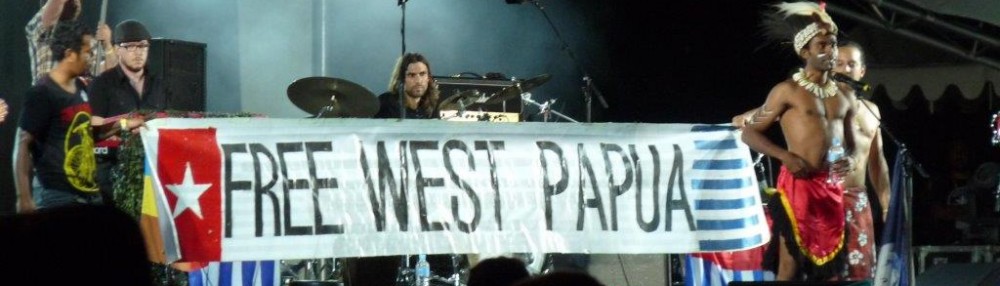
What ye sow ye reap

Dani tribe Warriors. May 15, 2012 The Baliem Valley, Indonesian, New Guinea

There’s nothing profound about the Biblical quote; variations are embedded in many religions and cultures.

So it needs no prophet, seer or conman to make this prediction: After a war like the current one in Gaza has cooled, the survivors will be bent on revenge.

The ancient tragedy is underway just next door in Papua, bleeding now and for years to come as the hate goes on.

Canberra expresses its horror at the Middle East conflict 14,000 km distant and calls for peace, but looks away from what’s happening in the neighbourhood just 250 km to the north.

Last year the late NZ journalist John McBeth reported that Papua independence leader Egianus Kogoya’s determination to fight for freedom started after his father, Daniel Yudas Kagoya was killed by Indonesian troops.

Many in his group of armed partisans have become guerrillas for the same reasons.

They’re now old enough to confront those they blame for the slaughter of their parents, relatives and friends and the destruction of their homes and livelihoods; so they’ve started killing and are getting killed.

The ore-rich province with the world’s fifth largest gold mine reserves has been a simmering low-level civil war zone since Jakarta took over the western part of New Guinea from the Dutch colonists. That was in 1969 following a staged ‘referendum’ using 1,025 hand-picked voters who unanimously supported integration.

One estimate has half a million indigenous Papuans dying in the past half-century through starvation and resisting Indonesian control.

No one knows if the figure is correct as journalists are banned. Thousands of soldiers from across the archipelago are in Papua. How many is not publicised, though last year it was reported that ‘an additional 2,355 military members’ had been deployed.

The conflict shows no signs of lessening. In 2014 when President Joko ‘Jokowi’ Widodo took office he told the Australian media he intended to give Papua “special attention”.

It was benignly assumed that this meant peace talks because Jokowi was not a gung-ho militarist but a civilian, his wife Iriana had been named after the island’s old title and his visits were regular and friendly.

However his “special attention” was infrastructure, not independence: Roads, health services and education – all necessary, but secondary to the self-rule the rebels demanded. Pacifying the insurgents and listening to their emotional concerns wasn’t on the agenda.

In 2022, Jokowi started carving up the territory confusing locals and outsiders by amplifying bureaucracy and control. The four new provinces are Papua Selatan (South Papua), Papua Tengah (Central Papua), Papua Pegunungan (Mountain Papua) and Papua Barat Daya (South-West Papua).

For this story, we’ll use ‘Papua’ to cover all. The population of 4.4 million is largely Melanesian and Christian. However transmigration programmes bringing in poor farmers from Java who are mainly Muslim, has been diluting the indigenous population for decades.

Jokowi’s predecessor, former general Susilo Bambang Yudhoyono said he’d “take quick and appropriate steps to deal with Papua” after violent clashes. His ‘solution’ was force. More died but little changed.

At the time the SMHreported that “(SBY’s) money and good intentions were squandered by corruption, cronyism and bureaucratic dysfunction.”

After a decade in office, Jokowi’s legacy is “a better armed, better resourced, more coordinated pro-independence insurgency,” according to a Jakarta research group the Institute for Policy Analysis of Conflict. 

“(There are) higher civilian casualties; and the failure after a year to secure the release of a New Zealand pilot held hostage by the guerrillas.”

(Phillip Mehrtens, then 37, was seized on 7 February last year and his Cessna used for ferrying construction workers and owned by an Indonesian company was torched. It’s believed he’s still alive.)

The IPAC report said Jakarta’s approaches can be characterised as: “Get them to like us”, “Hit them without mercy”, “Divide and rule”, “Give them money”, “End their isolation” and very occasionally, “Talk to them”.

It recommends that “(Jokowi’s) successor needs to radically change course.” But that’s Prabowo Subianto a general who served in Papua before being cashiered for insubordination in 1998 and fleeing to exile in Jordan.

In his new leadership role he’s offered to send a peacekeeping force to Gaza if there’s a ceasefire.

The idea is saturated in irony: Indonesia has no relationship with Israel. All remnants of Jewish life during the Dutch era – including cemeteries – have been trashed. Most troops are Muslims, and Prabowo has allegedly committed human rights abuses on the island last century.

Veteran Australian journalist Hamish McDonald, author of Demokrasi: Indonesia in the 21st Century has written that in 1984 Prabowo “led troops from Kopassus, the army’s Special Forces Command, across the border into Papua New Guinea to search for fighters from the Free Papua Movement Organisasi Papua Merdeka – OPM.

“In 1996, he led a Kopassus operation to free World Wildlife Fund hostages taken by the OPM. The mission was controversial because soldiers travelled via a white helicopter previously used by Red Cross negotiators”

Indonesia is still far from winning the hearts and minds of its Papuan citizens or erasing its image as a ruthless neo-colonial power. It’s treating the OPM much as the Dutch handled the Javanese partisans during three centuries of European rule – split, discredit, threaten, arrest, kill.

That didn’t work and Indonesia is now an independent republic, largely because the Western world – including Australia, turned against the colonials and demanded change. Weapons and money were denied to a Netherlands weakened by World War II.

That’s unlikely to happen in Papua in the lifetimes of our readers. The mines are too rich and involve influential international players. Indonesia is the world’s fourth-largest nation with more Muslims than any other country.

Australia speaks strongly about human rights but does little; there’s a deep reluctance to advocate a break in the circle of violence in Papua and infuriate Jakarta.

Much like the situation with Jerusalem and the Gaza war.

Consider making a donation to support independent journalism

Pearls and Irritations relies totally on donations from its readers. We are independent and we don’t accept financial support from governments, their agencies or vested interests such as fossil fuel and arms manufacturing companies. We do not accept advertising, nor do we have a paywall.

Please consider a donation to help Pearls and Irritations extend its voice and reach.

Duncan Graham

Duncan Graham has been a journalist for more than 40 years in print, radio and TV. He is the author of People Next Door (UWA Press). He is now writing for the English language media in Indonesia from within Indonesia.
Duncan Graham has an MPhil degree, a Walkley Award, two Human Rights Commission awards and other prizes for his radio, TV and print journalism in Australia. He lives in East Java.
Related

Four killed, hundreds flee as Indonesian military battles Papuan fighters

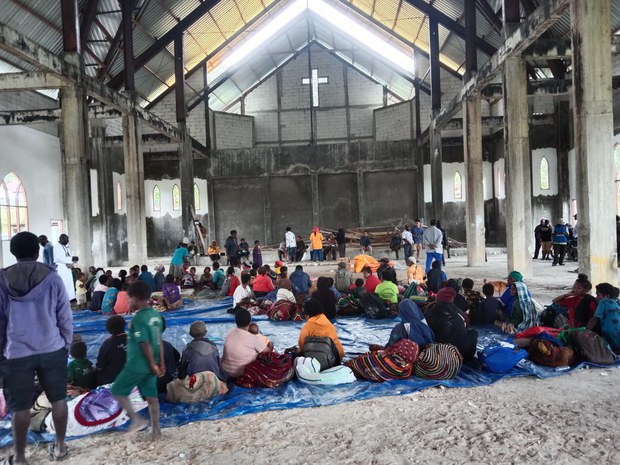
Hundreds of residents in Indonesia’s restive Papua region have sought shelter in a church after clashes between security forces and West Papua independence fighters left two insurgents, a soldier and a civilian dead.

Fighting flared in Paniai regency in Central Papua province after the West Papua National Liberation Army (TPNPB), part of the Free Papua Movement (OPM), burned a public minivan and killed its driver last week, the military said in a statement.

Two-hundred-and-fifty civilians fled the latest clash, the military said, but a local human rights activist told BenarNews at least twice the number have sought refuge.

As at last October, 76,228 refugees from the ongoing conflict were displaced in the Papuan provinces, the Papua Legal Aid Institute has reported, from a total population of 5.6 million people.

The violent conflict in the western half of New Guinea island is estimated to have cost hundreds-of-thousand of mainly Papuan lives since the 1960s, with the Indonesian government and independence groups accusing each other of serious human rights abuses.

Military forces pursued the TPNPB into the Bibida district of Paniai on Friday, resulting in a deadly firefight on Monday that killed two combatants, according to military spokesperson Lt. Col. Yogi Nugroho.

Residents of Bibida district requested assistance from security forces to temporarily relocate to Madi Church in the neighboring East Paniai district, he said.

“The people of Bibida have never accepted the presence of the OPM in their area due to their arbitrary actions and cruel acts, such as forcibly taking crops, livestock, and even some young girls,” Yogi told BenarNews.

TPNPB spokesperson Sebby Sambom has denied the group committed any criminal acts in Bibida that led to the displacement of residents.

“That’s not true. That’s the Indonesian military and police propaganda,” he told BenarNews.

A human rights and church activist in Papua, Yones Douw, accused the presence of government troops in Bibida of fueling fear among Papuans and causing them to flee.

Douw also said the number of displaced residents was 574, not 250 as stated by the military.

“I asked the people of Bibida directly, and they said that it was not true. They [TPNPB] have never stolen crops, and they have never killed livestock,” Douw told BenarNews, adding they usually bought local produce from residents.

“The TPNPB-OPM allowed them to evacuate because Bibida would be used as a battleground,” he added.

Yogi said according to security forces’ observations, insurgents seeking to destabilize Bibida had taken positions in the forest and nearby regions.

“Therefore, if there are people moving into the Bibida forest, they can be confirmed as sympathizers or members of the OPM,” he said.

Security forces on Friday retook Bibida, which had been under TPNPB-OPM control, Yogi said.

One of the slain Liberation Army members was identified as Danis Murib, a deserter from the Indonesian military who had abandoned his post in April.

“Yes, he was a former active member of the Indonesian military who joined the TPNPB four months ago,” Sambom told BenarNews.

On Saturday, the TPNPB shot dead a government soldier, identified as Hendrik Fonataba, in the neighboring Puncak regency, Yogi said.

In 1963, Indonesian forces invaded Papua – like Indonesia, a former Dutch colony – and annexed the region.

Papua was incorporated into Indonesia in 1969 after a United Nations-sponsored referendum, which locals and activists have decried as a sham because it involved only about 1,000 people. However, the U.N. accepted the result endorsing Jakarta’s rule.

The Indonesian Defense Ministry said last month it had requested a bigger budget to buy high-tech weapons that can “detect or retaliate” against Papuan groups who know the region’s terrain better. 

Human rights activists criticized the ministry proposal, arguing it would escalate violence and lead to more civilians being caught in the crossfire in the mineral-rich but underdeveloped region.

Indonesia’s carbon crisis: will Islam get dirty hands?

Nahdlatul Ulama (NU)(revival of the scholars) is Indonesia and the world’s largest Islamic organisation claiming almost 100 million members. If it digs coal it could become mega-rich. How dirty work marries with sending souls to paradise only Allah knows.

President Joko ’Jokowi’ Widodo has four months left in office, enough time to sow division before handing the job on to the elected former cashiered general Prabowo Subianto.

In May, Jokowi signed a decree letting religious groups apply to be the first shovel in the ore for special mining concessions. Not quite a gift from the gods as the Republic is supposed to be monotheistic, but pretty close.

This allows him to make good on an old promise to religious groups to take over mining concessions to raise funds. What the hell has coarse commerce got to do with matters of faith?

One answer: Politics, or as The Jakarta Post described it clumsily because pig meat is taboo to Muslims, “halal-certified state-sponsored pork barrelling”.

It added: “The government has come out with one of the most ridiculous policies in the history of this nation … It’s now up to the country’s largest Muslim organisation to back out on moral grounds.”

But will the lure of lucre prevail over Islam’s obligations to be honest, fair and righteous?

NU supported the Prabowo ticket in the February presidential election as did Jokowi who was constitutionally barred from taking a third five-year term.

Instead, he engineered for his eldest son Gibran Rakabuming to contest as number two. He’s now Vice-President elect.

The lead-up to the inauguration is a time to settle debts and cement alliances. If enough minor parties join the Prabowo-Gibran winning team, opposition will be left to NGOs.

Most are poor and poorly equipped to do more than their narrow roles, like advocating for human rights.

The churches have already knocked back Jokowi’s offer saying that fossil fuels are not their job and they’re better at consulting holy books than mining manuals. The mosques are dithering.

Second behind NU is Muhammadiyah (followers of Muhammad) with 60 million members. It tends to attract the better-educated middle class.

At present it’s pondering the Jokowi offer, but observers reckon nothing will happen as the gift has been pegged only for the NU.

The six government-approved religions, Islam, Protestantism, Catholicism, Hinduism, Buddhism and Confucianism have charity wings. They run schools, hospitals, clinics and retirement homes principally for their members and could probably improve their work with mining profits.

But supping with this devil will need a long-arm excavator.

Investment Minister Bahlil Lahadalia was reported as saying the handout was “in return to their past services during and after the country’s struggle for independence … you are investing for the hereafter.” That’s something most religions have been doing for millennia.

The government says any faith group that accepts the deal has to run the show themselves. This means they can’t flog off a mining permit or farm out business to an established company, even though it has the gear and expertise.

That rule crimps expectations of the beneficiaries only needing bigger truck parks and tips to take Haulpaks of rupiah.

A few right-wing congregations believe the earth is for exploitation; the rest take a more environmentally conscious position accepting that despoiling nature is not part of any Deity’s plan.

The better read will know that most responsible nations are moving away from fossil fuels to renewable energy sources.

Indonesia is the world’s largest coal exporter and third biggest producer; to the distress of those worried about global warming it shows no sign of slowing down; the compound annual growth rate has been seven per cent since 2019. This year it expects to produce 710 million tonnes.

There are precedents for Jokowi’s generosity though unfair and distressing.

Last century then president Soeharto gave forestry concessions. Tens of thousands of hectares of virgin growth mainly in Kalimantan (Borneo island) to relatives and mates, particularly army generals, establishing vast business enterprises.

Many wield enormous power today and are part of the oligarchy. We’ve yet to hear how the profiteers feel about sharing their spoils with the pious.

Consider making a donation to support independent journalism

Pearls and Irritations relies totally on donations from its readers. We are independent and we don’t accept financial support from governments, their agencies or vested interests such as fossil fuel and arms manufacturing companies. We do not accept advertising, nor do we have a paywall.

Please consider a donation to help Pearls and Irritations extend its voice and reach.

Duncan Graham

Duncan Graham has been a journalist for more than 40 years in print, radio and TV. He is the author of People Next Door (UWA Press). He is now writing for the English language media in Indonesia from within Indonesia.
Duncan Graham has an MPhil degree, a Walkley Award, two Human Rights Commission awards and other prizes for his radio, TV and print journalism in Australia. He lives in East Java.