The United Liberation Movement for West Papua (ULMWP) and Kanak and Socialist National Liberation Front (FLNKS) held a momentous meeting today in the European Parliament, bringing their shared struggle against foreign occupation to the heart of Europe.
The meeting, entitled ‘Anti-Colonial Struggle in the Pacific’, was hosted by Basque Country MEP Pernando Barrena (EH Bildu, The Left). ULMWP Interim President Benny Wenda addressed the meeting, along with Senator Robert Xowie from the FLNKS, Gorka Elejabarrieta (EH Bildu), former Catalan President Carles Puigdemont (Junts), and ILWP legal advisor Tim Hansen.
Attendees heard about the historic bond between the ULMWP and FLNKS, the ongoinghumanitarian crises in both territories, the EU-Indonesia free trade agreement, and the strength of both parties’ case for self-determination under International Law.
Demonstrations took place across all seven regions of West Papua over the past two days in support of the meeting (video and pictures below).
Christian Solidarity International’s statement against expanded land exploitation and military occupation provokes reaction from government of Indonesia
GENEVA, SWITZERLAND, March 28, 2025 /EINPresswire.com/ — The indigenous peoples of West Papua face renewed threats to their land rights, Christian Solidarity International (CSI) warned at the United Nations Human Rights Council in Geneva on March 28.
In an oral statement delivered during the 58th Session, CSI’s Abigail McDougal recalled that since assuming office last fall, Indonesian President Prabowo Subianto had announced a revival of the government’s transmigration program to settle non-indigenous people in the province of West Papua. In addition, he had authorized the creation of two million hectares of new rice and sugar plantations, and a 50 percent increase in production capacity at the region’s Tangguh liquid natural gas facility.
“These projects threaten not only the third largest rainforest in the world and one of the most biodiverse regions on the planet, but also the land that the indigenous peoples of West Papua call home,” CSI’s Deputy Director of Public Policy and Communications stated. According to Amnesty International, the resulting environmental degradation would pose an “existential threat to the people of West Papua.”
—
“These projects threaten not only the third largest rainforest in the world and one of the most biodiverse regions on the planet, but also the land that the indigenous peoples of West Papua call home.”
Abi McDouga
—
The planned projects would entail an increased military presence in West Papua, which has been subjected to military occupation for decades. This “is particularly concerning,” McDougal said, “as Indonesia’s parliament last week amended the country’s military law, removing checks on the military’s power.”
West Papua is the easternmost region of modern-day Indonesia. While Indonesia is the largest Muslim-majority country in the world, the indigenous peoples of West Papua are almost completely Christian
West Papua was made a colony of the Netherlands in 1898, and was administered separately from Dutch-ruled Indonesia. It was only handed over to Indonesia in 1962, thirteen years after Indonesia became independent. This decision provoked widespread protests and an independence movement that continues until today.
With more than 79,000 West Papuans already internally displaced by military operations, protecting Papuans’ land ownership is an urgent imperative, McDougal said.
The UN’s 2021 Durban Declaration and Program of Action on combatting racism calls on states “to ensure that indigenous peoples are able to retain ownership of their lands and of those natural resources to which they are entitled under domestic law,” she recalled.
“Christian Solidarity International calls on the government of Indonesia to halt its transmigration program in West Papua, protect indigenous land rights, and allow international rights monitors to enter the region,” McDougal concluded.
The Indonesian delegation responded to CSI’s statement during the general debate, stating that they “reject the allegation that the Indonesian people in the six provinces of Papua are subjected to…discrimination” and pledging to “continue dialogue with all stakeholders, including with the local communities, to ensure their voices are heard.”
Reacting to the Indonesian delegation’s reply, CSI’s Director for Public Advocacy, Joel Veldkamp, said, “There could not be a greater contrast between the Indonesian government’s assurances at the Human Rights Council, and what we hear from our friends in West Papua – that Indonesian government-led projects cause them to fear for the very survival of their people.”
“We reiterate our call to the government of Indonesia to halt its destructive campaigns in West Papua.”
About CSI
Christian Solidarity International is an international human rights group campaigning for religious liberty and human dignity.
Video
Joel Veldkamp Christian Solidarity International +41 76 258 15 74 email us here
CSI at the UN: Indonesia must protect indigenous land rights in West Papua
Owing to its violent political history, West Papua’s vibrant human past has long been ignored.
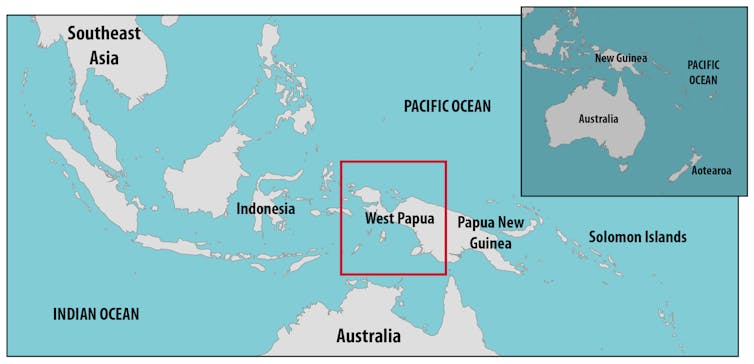
Unlike its neighbour, the independent country of Papua New Guinea, West Papua’s cultural history is poorly understood. But now, for the first time, we have recorded this history in detail, shedding light on 50 millennia of untold stories of social change.
By examining the territory’s archaeology, anthropology and linguistics, our new book fits together the missing puzzle pieces in Australasia’s human history. The book is the first to celebrate West Papua’s deep past, involving authors from West Papua itself, as well as Indonesia, Australasia and beyond.
The new evidence shows West Papua is central to understanding how humans moved from Eurasia into the Australasian region, how they adapted to challenging new environments, independently developed agriculture, exchanged genes and languages, and traded exquisitely crafted objects.
Archaeological evidence shows that people migrating from Eurasia into the Australasian region came through West Papua. Dylan Gaffney, CC BY-SA
Early seafaring and adaptation
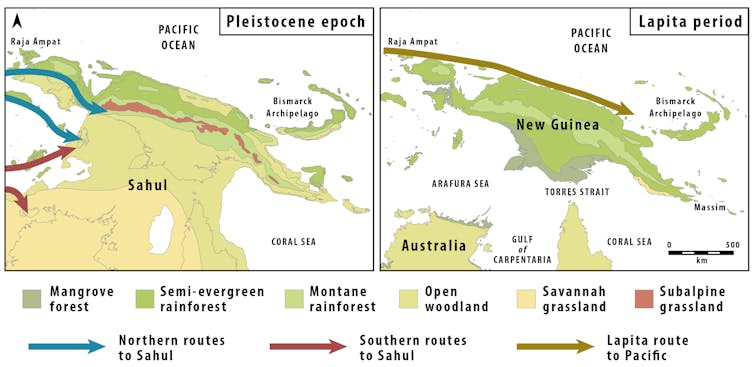
During the Pleistocene epoch (2.5 million to 12,000 years ago), West Papua was connected to Australia in a massive continent called Sahul.
Archaeological evidence from the limestone chamber of Mololo Cave shows some of the first people to settle Sahul arrived on the shores of present-day West Papua. There they quickly adapted to a host of new ecologies.
What do you need to know about this election?
The precise date of arrival of the first seafaring groups on Sahul is debated. However, a tree resin artefact from Mololo has been radiocarbon dated to show this happened more than 50,000 years ago.
Genetic analyses support this early arrival time to Sahul. Our work suggests these earliest seafarers crossed along the northern route, one of two passages through the Indonesian islands.
Human dispersal to West Papua during the Pleistocene epoch (about 50,000 years ago) and during the Lapita period (more than 3,000 years ago). Dylan Gaffney, CC BY-SA
Interestingly, the first migrants carried with them the genetic legacy of intermarriages between our species, Homo sapiens, and the Denisovans, a now extinct species of hominins that lived in eastern Asia. Geneticists currently dispute whether these encounters took place in Southeast Asia, along a northerly or southerly route to Sahul, or even in Sahul itself.
In the same way modern European populations retain about 2% of Neanderthal ancestry, many West Papuans retain about 3% of Denisovan heritage.
As the Earth warmed at the end of the Pleistocene, rising seas split Sahul apart. The large savannah plains that joined West Papua and Papua New Guinea to Australia were submerged around 8,000 years ago. Much of West Papua’s southern and western coastlines became islands.
Social transformations during the past 10,000 years
As environments changed, so did people’s cuisine and culture.
We know from sites in Papua New Guinea that people developed their own agricultural systems between 10,000 and 6,000 years ago, at a similar time to innovations in Asia and the Americas. However, agricultural systems were not universally adopted across the island.
New chemical evidence from human tooth enamel in West Papua shows people retained a wide variety of diets, from fish and shellfish to forest plants and marsupials.
One of the key unanswered questions in West Papua’s history is when cultivation emerged and how it spread into other regions, including Southeast Asia. Taro, bananas, yams and sago were all initially cultivated in New Guinea and have become important staple crops around the world.
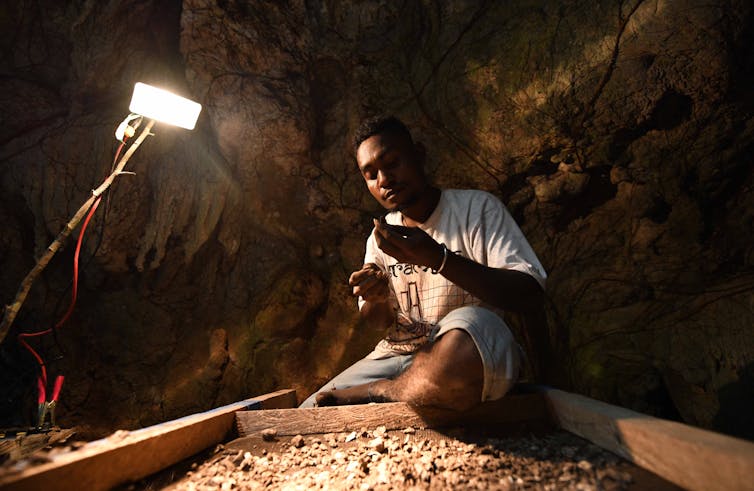
Moses Dialom, an archaeological fieldwork collaborator from the Raja Ampat Islands, examines excavated artefacts at Mololo Cave. Tristan Russell, CC BY-SA
The arrival of pottery, some 3,000 years ago, represents movements of new people to the Pacific. These are best illustrated by iconic Lapita pottery, recorded by archaeologists from Papua New Guinea all the way to Samoa and Tonga.
Lapita pottery makers spoke Austronesian languages, which became the ancestors of today’s Polynesian languages, including Māori.
New pottery discoveries from Mololo Cave suggest the ancestors of Lapita pottery makers existed somewhere around West Papua. Finding the location of these ancestral Lapita settlements is a major priority for archaeological research in the territory.
Rock paintings provide evidence of social change in West Papua. Tristan Russell, CC BY-SA
Other evidence for social transformations includes rock paintings and even bronze axes. The latter were imported all the way from mainland Southeast Asia to West Papua around 2,000 years ago. Metal working was not practised in West Papua at this time and chemical analyses show some of these artefacts were made in northern Vietnam.
At all times in the past, people had a rich and complex material culture. But only a small fraction of these objects survive for archaeologists to study, especially in humid tropical conditions.
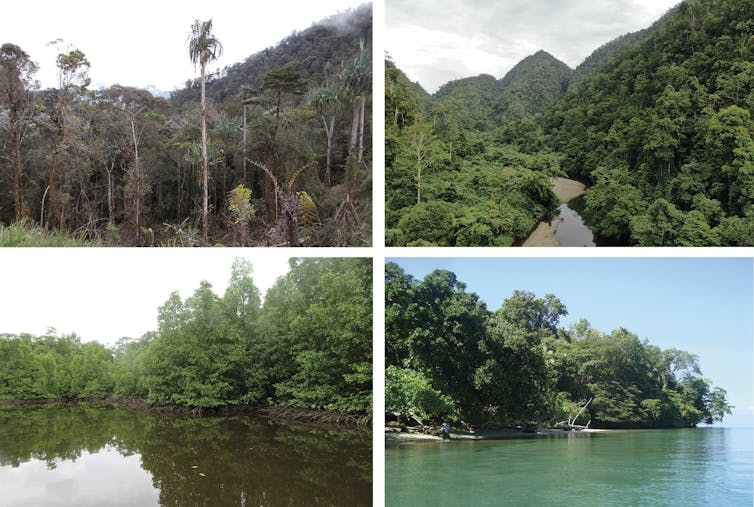
People settled diverse environments around West Papua, including montane cloud forests (upper left), lowland rainforests (upper right), mangrove swamps (lower left) and coastal beaches (lower right). Dylan Gaffney, CC BY-SA
Living traditions and the movement of objects
From the early 1800s, when West Papua was part of the Dutch East Indies, colonial administrators, scientists and explorers exported tonnes of West Papuan artefacts to European museums. Sometimes the objects were traded or gifted, other times stolen outright.
In the early 1900s, many objects were also burned by missionaries who saw Indigenous material culture as evidence of paganism. The West Papuan objects that now inhabit museums in Europe, America, Australia and New Zealand are connections between modern people and their ancestral traditions.
Sometimes these objects represent people’s direct ancestors. Major work is currently underway to connect West Papuans with these collections and to repatriate some of these objects to museums in West Papua. Unfortunately, funding remains a central issue for these museums.
Many West Papuans continue to produce and use wooden carvings, string bags and shell ornaments. Anthropologists have described how people are actively reconfiguring their material culture, especially given the presence of new synthetic materials and a cash economy.
A montage of images showing West Papuan archaeologists in the field. (A) Klementin Fairyo, left, is setting up a new excavation. (B) Martinus Tekege excavating pottery. (C) Sonya Kawer with wartime archaeology. (D) Abdul Razak Macap, right, sieving for archaeological artefacts at Mololo Cave. Klementin Fairyo, Martinus Tekege, Sonya Kawer, Abdul Razak Macap, CC BY-SA
Despite our new findings, West Papua remains an enigma for researchers. It has a land area twice the size of Aotearoa New Zealand, but there are fewer than ten known archaeological sites that have been radiocarbon dated.
By contrast, Aotearoa has thousands of dated sites. This means West Papua is the least well researched part of the Pacific and there is much more work to be done. Crucially, Papuan scholars need to be at the heart of this research.
Widespread protests in Indonesia erupted across the country in response to the government’s controversial revision of the 2004 Indonesian Armed Forces Law. Student-led demonstrations in various cities have been met with forceful responses from security forces, raising serious concerns about police violence, the stifling of civil society participation, and the erosion of democratic freedoms in Indonesia.
The proposed amendments to the law, which were ratified by Indonesia’s House of Representatives in March 2025, significantly expand the military’s role in civilian governance. These revisions allow active military personnel to occupy key positions in government ministries, the judiciary, and other civilian institutions, a move that activists argue undermines the country’s young democracy. Furthermore, the changes include a shift towards a more significant military influence on civilian affairs, which critics claim is reminiscent of Indonesia’s authoritarian past under the “New Order” regime of former dictator Suharto.
Protests against the law have been widespread, with students leading the charge in cities such as Jakarta, Surabaya, Malang, and Sukabumi. Many protesters have taken to the streets dressed in black, with banners reading “Return the military to the barracks” and “Watch out! New ‘New Order’ is right before our eyes.” Activists argue that the amendments are a direct threat to the progress Indonesia has made since the fall of Suharto’s military dictatorship in 1998. Human Rights Watch senior researcher Andreas Harsono voiced concerns that the law’s passage without proper public consultation further signals a regression in Indonesia’s democratic trajectory.
The protests, while largely peaceful, have been met with violent responses from security forces. In Malang, East Java, clashes broke out when police deployed riot squads and water cannons to disperse crowds. Several students were injured, and at least eight journalists were reportedly assaulted while documenting the protests. Similar scenes unfolded in other cities, with police using force to break up demonstrations, leading to injuries, detentions, and allegations of human rights abuses (see video below, source: Instagram). Notably, in Sukabumi, police detained several students and accused them of instigating violence.
Beyond physical violence, there have been instances of intimidation aimed at protest leaders. In Yogyakarta, a threatening banner was placed near a university campus, targeting one of the student leaders. This intimidation, both physical and digital, signals an alarming trend of suppressing dissent and limiting space for civil society to engage in political processes.
One of the most pressing concerns raised by activists is the government’s failure to adequately consult with the public or allow space for meaningful civil society participation in the amendment process. Critics argue that the law was rushed through parliament without sufficient debate and that the military’s increasing involvement in civilian affairs will undermine Indonesia’s democratic foundations. Furthermore, the law could open the door to greater military influence in sectors unrelated to defence, including business and governance, echoing the tactics used during the New Order era.
While the government, including Defense Minister Sjafrie Sjamsoeddin, insists that the reforms are necessary to adapt to changing global military dynamics, activists and students argue that these changes endanger fundamental democratic principles. They fear the expansion of the military’s role in civilian governance may reduce the space for free expression, undermine civilian supremacy, and set back the country’s progress toward democracy.
The Indonesian government’s handling of the crisis—especially its treatment of protesters and the military’s expanding role in government—poses a significant challenge to the nation’s democracy. The events of recent weeks underscore the urgent need for reform, transparency, and respect for human rights, particularly in the context of any changes to laws that impact the nation’s future governance. Following the hasty amendment of the law and the increasing role of the military in civilian matters, there is an urgent need to also revise Military Court Law 31/1997, so that TNI members can be tried in civilian courts if they are accused of having committed violent acts against civilian victims.
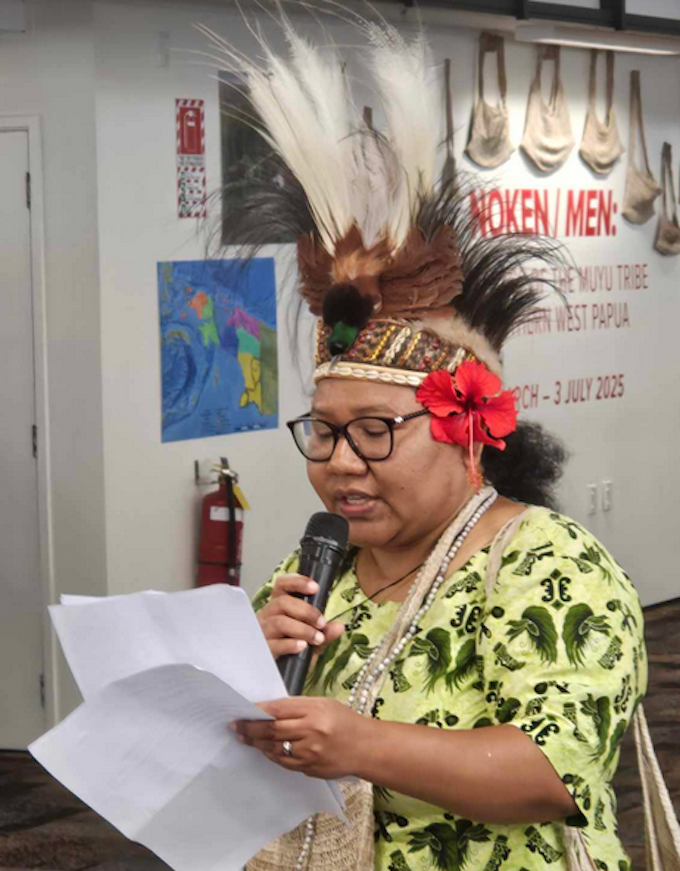
A West Papuan doctoral candidate has warned that indigenous noken-weaving practices back in her homeland are under threat with the world’s biggest deforestation project.
About 60 people turned up for the opening of her “Noken/Men: String Bags of the Muyu Tribe of Southern West Papua” exhibition by Veronika T Kanem at Auckland University today and were treated to traditional songs and dances by a group of West Papuan students from Auckland and Hamilton.
The three-month exhibition focuses on the noken — known as “men” — of the Muyu tribe from southern West Papua and their weaving cultural practices.
It is based on Kanem’s research, which explores the socio-cultural significance of the noken/men among the Muyu people, her father’s tribe.
“Indigenous communities in southern Papua are facing the world’s biggest deforestation project underway in West Papua as Indonesia looks to establish 2 million hectares of sugarcane and palm oil plantations in the Papua region,” she said.
West Papua has the third-largest intact rainforest on earth and indigenous communities are being forced off their land by this project and by military.
The ancient traditions of noken-weaving are under threat.
Natural fibres, tree bark Noken — called bilum in neighbouring Papua New Guinea — are finely woven or knotted string bags made from various natural fibres of plants and tree bark.
“Noken contains social and cultural significance for West Papuans because this string bag is often used in cultural ceremonies, bride wealth payments, child initiation into adulthood, and gifts,” Kanem said.
“This string bag has different names depending on the region, language and dialect of local tribes. For the Muyu — my father’s tribe — in Southern West Papua, they call it ‘men’.
In West Papua, noken symbolises a woman’s womb or a source of life because this string bag is often used to load tubers, garden harvests, piglets, and babies.
“My research examines the Muyu people’s connection to their land, forest, and noken weaving,” said Kanem.
“Muyu women harvest the genemo (Gnetum gnemon) tree’s inner fibres to make noken, and gift-giving noken is a way to establish and maintain relationships from the Muyu to their family members, relatives and outsiders.
“Drawing on the Melanesian and Indigenous research approaches, this research formed noken weaving as a methodology, a research method, and a metaphor based on the Muyu tribe’s knowledge and ways of doing things.”
Hosting pride Welcoming the guests, Associate Professor Gordon Nanau, head of Pacific Studies, congratulated Kanem on the exhibition and said the university was proud to be hosting such excellent Melanesian research.
Professor Yvonne Underhill-Sem, Kanem’s primary supervisor, was also among the many speakers, including Kolokesa Māhina-Tuai of Lagi Maama, and Daren Kamali of Creative New
The exhibition provides insights into the refined artistry, craft and making of noken/men string bags, personal stories, and their functions.
An 11 minute documentary on the weaving process and examples of noken from Waropko, Upkim, Merauke, Asmat, Wamena, Nabire and Paniai was also screened, and a booklet is expected to be launched soon.
More than 250 members of Indigenous and local communities gathered in Indonesia’s Merauke district to demand an end to government-backed projects of strategic national importance, or PSN, which they say have displaced them, fueled violence, and stripped them of their rights.
PSN projects, including food estates, plantations and industrial developments, have triggered land conflicts affecting 103,000 families and 1 million hectares (2.5 million acres) of land, with Indigenous communities reporting forced evictions, violence and deforestation, particularly in the Papua region.
In Merauke itself, the government plans to clear 3 million hectares (7.4 million acres) for rice and sugarcane plantations, despite Indigenous protests; some community members, like Vincen Kwipalo, face threats and violence for refusing to sell their ancestral land, as clan divisions deepen.
Officials have offered no concrete solutions, with a senior government researcher warning that continued PSN expansion in Papua could escalate socioecological conflicts, further fueling resentment toward Jakarta and potentially leading to large-scale unrest.
JAKARTA — Hundreds of Indigenous people and civil society groups in Indonesia are demanding an end to government projects that have seized their lands, fueled violence, and stripped them of their rights.
In the second week of March, more than 250 members of Indigenous and local communities affected by projects classified as being of strategic national importance, or PSN, gathered in Merauke, a district in Indonesia’s Papua region bordering Papua New Guinea.
Over four days, attendees shared their experiences of displacement and suffering caused by PSN projects, which include roads, dams, power plants, industrial estates and plantations.
The communities represented at the dialogue included those impacted by food estate projects in the provinces of North Sumatra, Central Kalimantan, Papua and South Papua; the Rempang Eco City project in the Riau Islands province; the Nusantara capital city (IKN) project in East Kalimantan; the Poco Leok geothermal project in East Nusa Tenggara; extractive industries related to biofuel in Jambi; various projects in West Papua; and the expansion of oil palm plantations across the wider Papua region.
Some community members have been displaced from their ancestral lands. Others, who continue fighting for their land rights, face violence at the hands of the military and police.
According to the Agrarian Reform Consortium (KPA), there were 154 PSN-related conflicts from 2020 to 2024, affecting 103,000 families and 1 million hectares (2.5 million acres) of land. The National Commission on Human Rights (Komnas HAM) received 114 complaints related to PSN between 2020 and 2023, including allegations of forced evictions, violence against protesters, labor abuses, environmental degradation, and attacks on journalists.
With PSN projects continuing, affected communities at the Merauke dialogue, facilitated by the NGO Pusaka, issued a declaration on March 14, calling for the projects’ termination in front of government officials.
“We demand the complete cessation of National Strategic Projects and other so-called national interest projects that clearly sacrifice the people,” the declaration read in part. “The perpetrators of state-corporate crimes must return all stolen wealth to the people and immediately restore their health and living spaces in all areas sacrificed in the name of national interest.”
Pusaka director Franky Samperante said the “Merauke solidarity declaration” marks the beginning of resistance to the destruction of communities and their living spaces.
“Our next task is to strengthen the Merauke solidarity movement and continue rejecting and resisting PSN and other so-called national interest projects that blatantly sacrifice the people,” he said.
History of PSN
The PSN framework was formalized during the administration of former president Joko Widodo, in office from 2014-2024. His government prioritized infrastructure development as a key driver of economic growth, issuing a regulation in 2016 that outlined a list of priority projects to be developed under the PSN framework. The main benefit to developers of such a designation is eminent domain: the government can invoke this power to take private property for public use, ostensibly to fast-track development, but often at the cost of people’s rights and environmental and social impacts.
Between 2016 and 2024, the government initiated 233 PSN projects, with a total investment value of around $378 billion.
When Prabowo Subianto took office as president in 2024, he continued and expanded the PSN program. His administration retained 48 ongoing projects from the previous administration, while adding 29 new projects, increasing the total PSN count to 77 projects. The new projects focus on food security, energy sovereignty, water infrastructure, and mining and industrial downstreaming.
The awarding of PSN designation to various projects has drawn criticism for bypassing regulatory hurdles, fast-tracking approvals, limiting oversight, and granting the government eminent domain rights to evict entire communities. Many projects primarily benefit large corporations and politically connected businesses rather than local communities, despite the government claims that they drive economic
Food estate
One example is the food estate project in Merauke, where agribusiness giants have secured vast concessions, often at the expense of Indigenous land rights. Carried over from the previous administration, the project aims to clear 3 million hectares (7.4 million acres) of land in Merauke — two-thirds of it for rice fields and the rest for sugarcane plantations — an area 45 times the size of Jakarta.
From the start, Indigenous Papuans living in the project area have protested, saying they were never properly informed or consulted. Many say they fear for their safety due to the heavy military presence and pressure from fellow community members who had already sold their land to developers.
Vincen Kwipalo, a 67-year-old Indigenous man from the Kwipalo clan of the Yei tribe, has been vocal in opposing the project, as the planned concessions overlap with his clan’s ancestral lands.
“We are not selling our customary land. The forests and hamlets owned by the clan are not large. We want to manage them ourselves for our livelihoods and food sources, for our children and grandchildren,” he said.
Vincen said that on Dec. 11, 2024, he was confronted at his home by five machete-wielding men who verbally assaulted him, calling his family “stupid.” He called the police, and the attackers fled when officers arrived.
The next morning, a larger group returned with machetes, threatening to kill him. The situation deescalated only after the village chief intervened.
Vincen said he suspects the attackers were from a neighboring clan that’s been embroiled in a land dispute with his clan. He said this clan had already sold their customary land to a sugarcane developer for around 300,000 rupiah ($18) per hectare — the same offer made to Vincen’s family, which they refused.
Vincen’s wife, Alowisia Kwerkujai, has stood by his side throughout the ordeal. For her, the forest is the source of their life.
The 1,400-hectare (3,460-acre) customary forest claimed by the Kwipalo clan is a thriving ecosystem that’s home to towering trees and diverse wildlife such as cassowaries, wallabies, parrots and eagles. It provides food, materials for daily needs, and is a source of income through rubber and teak plantations.
“That’s why I won’t give the land to the company,” Alowisia said as quoted by BBC Indonesia. “Where would we go? I am a mother raising children, and this land is for them.”
Disappearing forests
Despite the opposition from Indigenous peoples, the food estate project is moving ahead.
As of January 2025, 7,147 hectares (17,660 acres) of forest and savanna had been cleared in Tanah Miring district for the sugarcane project, while 4,543 hectares (11,226 acres) of forest and mangrove had been cleared for the rice-related infrastructure, such as roads and a port, in Ilwayab district, according to data from Pusaka.
Senior officials have claimed there are no forests being cleared.
“There’s no forest in the middle of Merauke,” said the country’s energy minister, Bahlil Lahadalia, who’s in charge of a government task force that manages the project. “There’s only eucalyptus [trees], swamps and savannas.”
However, a spatial analysis by TheTreeMap shows that the ecosystems cleared for the rice project are mostly Melaleuca swamp forests, which are dominated by paperbark trees (Melaleuca leucadendron). These forests are unique ecosystems that appear sparse but are rich in biodiversity and store large amounts of carbon.
A 2016 study in Australia found that Melaleuca forests there store between 210 and 381 tons of carbon per hectare — higher even than the Amazon Rainforest on a per-hectare basis.
“However, Melaleuca forests are often overlooked because, unlike dense rainforests, they are less diverse and have more open structures,” TheTreeMap wrote in a blog post. “These characteristics are sometimes mistaken for signs of degradation, leading to misconceptions that Melaleuca forests are degraded ecosystems, which are not worthy of conservation.”
The construction of a new road for the rice project will further threaten these ecosystems, it added.
Direct plea
During the Merauke dialogue, Vincen addressed government officials in attendance, including the Deputy minister of human rights, Mugiyanto Sipin.
He described how the arrival of the sugarcane plantation project under the PSN scheme had torn apart the social fabric of his community, with families and clans who refuse to sell their land being pressured, intimidated and pitted against each other.
“Sir, can you guarantee my safety if I get killed in the forest?” Vincen asked Mugiyanto as reported by BBC Indonesia. “The government doesn’t see what’s happening. Forget about Jakarta — even the local government here isn’t paying attention to how we are being pushed to fight one another.”
He also made a direct plea to President Prabowo.
“Mr. President, you see the development happening, but you don’t see that we, the Indigenous people, are being forced into conflict — into bloodshed,” Vincen said. “Where else can we seek legal protection?”
Despite growing evidence of human rights violations, Mugiyanto offered no concrete solutions beyond saying he would relay the concerns to higher authorities.
If left unchecked, PSN projects like the Merauke food estate are a “ticking time bomb” waiting to explode, warned Cahyo Pamungkas, a senior researcher at Indonesia’s National Research and Innovation Agency (BRIN).
In Merauke, the food estate project could further escalate tensions, deepening resentment of Papuans toward Jakarta, he said.
If ignored, these warnings foreshadow a crisis unlike any in Indonesia’s history, with “an escalation of socioecological chaos,” warned affected community members in their declaration.
Citation:
Tran, D. B., & Dargusch, P. (2016). Melaleuca forests in Australia have globally significant carbon stocks. Forest Ecology and Management, 375, 230-237. doi:10.1016/j.foreco.2016.05.028
Banner image: Local and Indigenous communities affected by PSN projects in Indonesia gathered to read a declaration calling for the halt of PSN projects in Merauke on March 14, 2025. Image courtesy of YLBHI.
TEMPO.CO, Jakarta – The Masyarakat Adat, or indigenous people, of Yoboi village of Papua are adopting new ways to turn their native sago palms into high-value products, reducing processing time from several days to only five hours and opening doors to wider markets.
Papua has the second largest sago palm plantations in Indonesia, but customary sago processing remains largely manual and time-consuming, resulting in low-grade products that offer limited benefits to local livelihoods and food security.
Now, however, members of the Masyarakat Adat Yoboi can process sago into value-added products that meet food safety standards by using a small-scale sago processing unit, built through the support of a project jointly implemented by the Ministry of Agriculture and the Food and Agriculture Organization of the United Nations (FAO), and now owned by the community. FAO and Analisis Papua Strategis (APS) have trained 30 community members to sustainably operate the units and diversify sago-derivative products.
“With the sago processing machine unit, Yoboi people have become economically independent. It is the right solution for us in Yoboi, who have large sago forest areas in Jayapura,” said Sefanya Walli, Head of the Yoboi Adat Village, in a written statement released by the UN Indonesia.
Sago, a sacred staple for Masyarakat Adat, has been considered an alternative source of carbohydrates to help ensure food security and diversity.
However, efforts remain necessary for sago products to be accepted and consumed by the wider population, said Elvyrisma Nainggolan, Chair of the Plantation Products Marketing Group, Directorate General of Plantations, Ministry of Agriculture of the Republic of Indonesia.
“Sago-producing village groups play an important role, and they need to be empowered so they can process sago into flour, which can then be turned into sago-based cakes and even noodles, like in Yoboi. That way, it is hoped that Masyarakat Adat Yoboi’s sago derivatives could become more widespread in markets across the archipelago and even go global in the future,” said Elvyrisma.
community’s sago-based products and connect them with potential buyers, distributors, and market actors, FAO, Masyarakat Adat Yosiba (Yoboi, Simforo, and Babrongko), and Analisis Papua Strategis launched today the first Sago Festival in Yoboi, Jayapura.
During the festival, women and other members of the Masyarakat Adat Yoboi presented live demonstrations of their sago-based dishes, such as noodles and rice analogs, showcasing their market potential. A business networking session allowed community members, small and medium sago entrepreneurs, market actors, and cooperatives to be connected and leverage business potential and opportunities. Over 100 people participated in this festival, including members of Masyarakat Adat, business representatives, and the public of Jayapura.
Head of Papua Province Plantation and Livestock Agency, Matheus Philep Koibur, expressed his appreciation toward the Sago Festival for showcasing the high potential of sago commodities to meet food needs, environmental preservation, and economic improvement of the community.
“The Sago Festival has opened up a big room to promote our sago to industry players who can then turn them into high-value products. Moreover, it is hoped that people of other sago-producing districts are motivated to follow the footsteps of Masyarakat Adat Yoboi,” said Matheus.
TEMPO.CO, Jakarta – Twenty-two Indonesian civil society organizations have sent a letter to European Union Commissioners to express their concerns over the worsening condition of Papua’s rainforests. The region faces the threat of the deforestation of 2 million hectares of forest, alongside increasing risks to the Indigenous Malind and Yei communities.
The letter was addressed to Teresa Ribera, Executive Vice President for a Clean, Fair, and Competitive Transition; Kaja Kallas, High Representative for Foreign Affairs and Security Policy and Vice President of the European Commission; Jessica Roswall, Commissioner for Environment, Water Resilience, and the Competitive Circular Economy; Jozef Síkela, Commissioner for International Partnerships; and Maroš Šefovi, Commissioner for Trade and Economic Security, Interinstitutional Relations, and Transparency.
According to the press release received today, March 4, the civil society organizations urge the European Commission to seriously consider the deforestation crisis and threats to Indigenous rights in Papua as part of its country risk assessment within the European Union Deforestation Regulation (EUDR) benchmarking system. Under this scheme, the EU will classify countries or regions as low, standard, or high risk for deforestation and human rights violations, with classifications to be determined before June 30, 2025.
Article 29 of the EUDR states that the risk assessment must take into account deforestation rates and agricultural land expansion. Furthermore, Article 29(4)(d) requires the European Commission to consider the existence of laws protecting human rights, Indigenous rights, anti-corruption measures, and transparency in data necessary to comply with the EUDR.
“We urge the European Commission to ensure that Article 29(4)(d) is applied consistently and strictly across all countries and regions, including West Papua. Without a rigorous approach to forest and Indigenous rights protection, the EUDR framework risks failing to achieve its goal of preventing deforestation and human rights violations in global supply chains,” said Andi Muttaqien, Executive Director of Satya Bumi, in the press release.
A report previously submitted to the European Commission in 2024—supported by more than 30 Indonesian civil society organizations—clearly outlined how the expansion of large-scale plantations in Papua threatens both ecosystem sustainability and the rights of Indigenous communities who depend on the forests. Papua holds one of the largest remaining reserves of natural forests designated for plantation industries in Indonesia, covering more than 2 million hectares, 1.9 million of which are allocated solely for palm oil and timber commodities.
For this reason, the organizations urging the European Union to ensure that the risk classification under the EUDR benchmarking scheme reflects the vulnerability of Papua to deforestation, aligning with the realities on the ground.
Franky Samperante, Director of the Pusaka Bentala Rakyat Foundation, emphasized that forest clearing in Papua clearly violates the rights of Indigenous communities living within and around plantation concessions, particularly the Malind and Yei peoples.
“The European Union must consider the destruction of livelihoods, the economic dispossession, and the social fragmentation occurring in several districts in South Papua, including the intimidation by military and police forces. Europe’s clean consumption should not only be free from deforestation but also free from the destruction of human dignity,” he said.
The large-scale deforestation project in Papua designates 1.5 million hectares for rice fields and 500,000 hectares for sugarcane plantations. Although these two commodities are not included in the EUDR, there is a risk that timber from forest clearing could enter the European market. Furthermore, deforestation potential should be assessed based on the total forest area cleared—not just the seven commodities covered by the EUDR.
Research conducted by Satya Bumi and others shows that the maximum sustainable plantation area for oil palm in Indonesia, based on the country’s Environmental Carrying Capacity, is 18.1 million hectares. Currently, Indonesia’s oil palm plantations cover 17.7 million hectares. With President-elect Prabowo Subianto’s ambition to open 20 million hectares of land for food and energy plantations, Papua—Indonesia’s largest remaining natural forest—faces the risk of rapid deforestation.
“Papua is a distinctive region and its protection is crucial. Our modeling results indicate that the cap for oil palm development in Papua is 290,837 hectares. Currently, oil palm plantation development has reached 290,659 hectares, meaning it has already reached the cap. The EU Commission should carefully assess this situation when considering benchmarking”, said Giorgio Budi Indrarto, Deputy Director of Yayasan MADANI Berkelanjutan, in the same release.
The European Commission must maximize the use of the EUDR to halt deforestation and protect Indigenous communities. This letter specifically calls on the EU to:
Prioritize the risk of deforestation in Papua related to food and energy plantations, including the lack of community involvement, which constitutes a potential human rights violation.
Request the UN Human Rights Council and other relevant bodies to investigate whether the situation in West Papua constitutes a violation of Indonesia’s international human rights obligations.
Support Indonesia in finding sustainable ways to enhance food and energy security, including increasing agricultural productivity on existing land, reducing food waste, and prioritizing the use of degraded land for expansion.
As Indonesian President Prabowo Subianto steers his giant nation closer to China it’s worth recalling Paul Keating three decades ago: “No country is more important to Australia than Indonesia.”
His successors nod and offer warm words, but no longer hear their prophet. Caught up in domestic policies and trying to dodge the Trump Martian machine, we’re ignoring the neighbour.
We’re in Asia geographically, but not there culturally or politically. Their harbours are close; we want their shelter, but they’re indifferent. Updating the chart is urgent.
The US President trashes international alliances like Aussie bogans beat up Bali bars. We now fear Big Bro won’t rush to sort out bullies on a faraway playground with fewer folk than Texas.
An SOS might be triggered by real or imagined Beijing threats – like those this month involving the reported shooting of flares near an Australian surveillance jet over the South China Sea, and Chinese naval live-fire exercises in the east Indian Ocean.
The warships were 280 nautical miles from Tassie, but close enough to churn paranoia and a rush to check the ANZUS Treaty text.
The Cold War alliance “binds Australia, (NZ) and the US to consult on mutual threats, and, in accordance with our respective constitutional processes, to act to meet common dangers”.
It was signed when Trump was a pre-schooler. Now a septuagenarian, he’s showing no respect for last-century deals done for a different time and world.
In 1952, when ANZUS was born, Indonesia was run by the mercurial Sukarno dabbling with democracy, but settling for autocracy. Its population of 72 million was three years into formal independence after more than three centuries of Duch colonialism.
It threatened to go Communist; the three Western nations panicked and knocked-up ANZUS.
Since then, the Republic’s numbers have quadrupled; it’s the world’s fourth-largest state with more Muslims than anywhere else and is destroying democracy. Last year, its economic growth rate topped 5% against our 1.1%.
Although just next door, we can’t bother to learn their culture and language and understand their beliefs and values – all essential if we hope to get close.
It also has a new right-wing president. Prabowo Subianto, 73, a disgraced former general, is turning his nation into a military fantasy, parading his ministers in fatigues, forcing them to sleep under canvas. If this demeaning wasn’t real, it would be hilarious.
Prabowo is rubbishing ballots for wasting time and money; better select than elect. He’s told local journos to “prioritise the interests of the nation… a responsible press should know what constitutes the national interest”.
Opposition is stirring. Though so far poorly organised, the potential for mass strife is ever present, largely ignored by the Australian media though not by Pearls & Irritations. Water-cannons have already hosedIndonesia Gelap (Dark Indonesia) demos in Surabaya.
Prabowo’s popular policy of free lunches for schoolkids has funding and admin hassles. About 32,000 extra workers are needed to cook and deliver. They won’t be trained at the nation’s many hospitality colleges but at Universitas Pertahanan, the Defence University, where military staff can teach the loading of woks and the arming of trays.
The corruption curse terrifying investors still froths and bubbles. This month, seven suspects were arrested in an alleged $19 billion graft case at the government’s oil company, Pertamina.
Prabowo has said he wants to forgive convicted corruptors provided they secretly return the money – an idea that’s probably illegal.
Back to Keating last century; his bromance with Suharto was consummated with the Australia–Indonesia Agreement for Maintaining Securitylaid in 1995. The plan was fine, but Keating’s partner was already losing control after almost 30 years of despotic rule.
One report claimed Suharto was impressed by the PM, “telling his advisers he admired the Australian’s patriotism and praising his readiness to promote an Australia more engaged with its region”.
However, he was not engaged with the wong cilik – the ordinary folk whose multitudes can destroy the elite. Keating and his crew, high in their five-star hotels and embassy briefings, couldn’t sniff the winds of change billowing through the crowded kampongs far below.
Your correspondent and other Westerners were regularly cornered by intense youth and wrung dry for fresh news. The Oz motorcade howled through the intersections where masked students sold smudged photocopies of banned international magazines exposing Suharto’s kleptocracy and brutality.
Keating must have known the pact was one-sided, his counterpart rotten. Why did he ignore this villainy? He’s been contacted for comment, but hasn’t replied.
The document was shredded in 1999 after Suharto fell and Australia helped East Timor through the referendum. A shamed nation lost its pride; trust in Down Under has never recovered – and vicky-verky.
A 2021 Lowy Institute poll showed only 13% of Indonesians want Australia as a “preferred partner”. The figure for Japan, a brutal occupying force in the 1940s, was 46%.
Now Prabowo has put Indonesia into BRICS, “the China-backed bloc of emerging economies” – Brazil, Russia, India and South Africa plus Egypt, Ethiopia, Iran and the UAE.
It’s in opposition to the G7: France, the US, the UK, Germany, Japan, Italy and the EU.
Australia is in neither club though ranking as the 12th largest economy in the world, ahead of Canada which is in G7. We’re not even in ASEAN, the impotent 10-member Association of Southeast Asian Nations. Indonesian wags call it NATO – No Action Talk Only.
The latest paperwork is the Australia‑Indonesia Defence Co-operation Agreement driven and signed last August by Deputy PM Richard Marles who saw a happy marriage. Prabowo doused arousal with cold water saying Indonesia would not “be involved in any geopolitical or military alliances or groupings” begging the question: Why did he sign?
We also have the Indonesia-Australia Comprehensive Economic Partnership, a 2020 pact that promised much, but has delivered little in trade and less in influence. Its track to success has been potholed as predicted, with no one keen to repair it except with platitudes.
Some know our grains make noodles, our forests burn, koalas are cute and many shops close early. That’s about it. Korean pop is fun.
James Curran, professor of modern history at Sydney University, wrote that Keating “not only wanted to bury the old fears of Indonesia; he was looking ahead to the possibility of a new threat, in the form of a potentially more aggressive China”.
“He was doing what any prudent leader should do – thinking broadly about the nation’s geopolitical future and preparing for any worst-case scenario.”
That scenario is here and now – engineered by Trump. If Canberra has a Plan B, it’s secret.
Three years ago the Lowy Institute’s Dr Stephen Grenville — formerly with the International Monetary Fund in Jakarta — wrote:
“Indonesia is more important to us than we are to them, and this will become truer as their relative economic weight increases. It’s hard to imagine an Indonesian president reciprocating Keating’s ‘no country is more important to Australia than Indonesia’.”
In Indonesia, civic space remains rated as ‘obstructed’ in the latest People Power Under Attack reportpublished in December 2024. Among the main concerns are the use of restrictive laws, including defamation provisions against human rights defenders and journalists as well as harassment and threats against them. The authorities have criminalised Papuan activists for their peaceful expression, while protests across Indonesia have been met with arbitrary arrests and excessive force from the police
During President Prabowo Subianto’s first 100 days in office, he had indicated a commitment to a conditional release of Papuan political activists in detention as part of a larger amnesty programme. However, human rights groups have raised concerns about Prabowo’s seriousness in protecting freedom of expression and opinion. There are also concerns about the ongoing impunity for human rights violations by the security forces, dealing with past serious crimes and the restrictions on civic freedoms.
There were nationwide student protests at the end of February 2025 against President Prabowo’s budget cuts , marking a key test of his leadership. The “Dark Indonesia” (#IndonesiaGelap) rally saw hundreds of students from leading universities carrying banners as they gathered outside the presidential palace in central Jakarta, many clad in black. Similar protests drawing thousands of students have taken place in other parts of the country, including Surabaya, Bali, Medan and Yogyakarta.
In recent months, a woman protester was jailed for opposing a palm oil mill while a protest against a hike in tax was forcibly dispersed. Protesters in Papua, including students, faced suppression and arrests for their activism. An environmental expert is facing a lawsuit and harassment for testifying in court while a punk band has had to apologise and withdraw a song on police corruption. Commemorations of a historic day in Papua were targeted with police repression. A Papuan human rights defender faced intimidation and an environmental activist was attacked, while the investigation by the national human rights body into the case of human rights defender Munir is facing challenges……………………………………







 Australia West Papua Association Adelaide