Fight for Climate Justice! Free West Papua!

On the Global Day of Action for Climate Justice, the Merdeka West Papua Support Network joins all climate justice activists worldwide and stands together at a pivotal moment in our shared pursuit of a sustainable, healthy and better planet and future.

Central to this movement is the essential recognition and urgent reminder that climate justice cannot be achieved while lands are occupied, Indigenous Peoples are oppressed, and fundamental human rights are trampled upon.

The demand for climate justice is particularly stark in West Papua, a region abundant in ecological diversity and cultural heritage, yet marred by the grips of exploitation and occupation.

Occupied West Papua

Indigenous peoples in West Papua suffer from a never-ending string of human rights abuses, stemming from decades of political and economic conflict that have loomed over the region since the 1960’s. 

In a sham referendum ironically called “The Act of Free Choice” (1969), the military orchestrated the formal annexation of West Papua into Indonesia—a move widely condemned for its lack of legitimacy and considered an illegal land grab. This so-called plebiscite involved a minuscule fraction of the West Papuan populace handpicked by the military to vote for integration with Indonesia under duress, facing the threat of violence.

Subsequent decades saw the Indonesian government forcibly changing the region’s demography through its transmigration program. The government drew thousands of people from other parts of the country to become settlers in the area, which resulted in a dwindling population of Indigenous Papuans on their ancestral lands, death tolls, and massive displacement.

A Culture of Impunity and Widespread Human Rights Violations

According to reports, patterns of violations continue to differ from other parts of Indonesia strongly showing the highest cases of extrajudicial killings, arbitrary arrests, and criminalization.

Persistent attacks against human rights, Indigenous Peoples and environmental defenders and political activists contiue.  For instance, Papuan activist Victor Yeimo faced an extended sentence and three university students were convicted of treason.

Furthermore, a culture of impunity abounds and allows those in power to evade accountability for enforced disappearance and extra-judicial killings. Case in point: Despite fatally shooting Papuan men Eden Bebari and Ronny Wandik in 2020, military members not only received light sentences but were later acquitted this year.

The violence and legal dead-ends are usually justified by associating the slain victims with freedom fighters. As of September 2023, armed clashes and operations by security forces led to the internal displacement of a total of 76,228 people, predominantly Indigenous Papuans.

West Papua’s Integral Role in Battling the Climate Crisis

The state forest in West Papua spans a staggering 38.15 million hectares (94.27 million acres). Together with Papua New Guinea, it stands as the third-largest repository of ancestral tropical forests globally, trailing behind only the Amazon and the Congo.

Unfortunately, roughly 8.13 million hectares (20.09 million acres) of customary forests in Papua are controlled by companies and investors, a reality facilitated by the government and, essentially, protected by the military. Thus, the ancestral forests endure repetitive and reckless logging, without concern for environmental impacts.

The ongoing deforestation contradicts the claims of the current administration, led by Jokowi government, professing support for forest conservation efforts. The government prioritizes bolstering ties with foreign investors and multinational companies, rather than engaging and consulting with indigenous people—who rightfully hold custodianship and possess the knowledge needed to safeguard the forest.

The exact numbers vary, but recent research shows that nearly half of the Earth’s land is under the governance of indigenous communities, supporting roughly 80% of the planet’s biodiversity. This underscores the effective role of indigenous communities as longstanding defenders of nature across generations.

Moreover, the forests situated on indigenous territories globally store a total of 37.7 billion tons of carbon, significantly contributing to stabilizing the Earth’s climate. In West Papua, specifically, a remarkable array of diverse and unique ecosystems exists—from glaciers, alpine meadows, cloud forests, and karst lakes, to savannahs, mangrove forests, coral reefs, and more.

Urgent Need for Solidarity and Action

The tropical forests of West Papua embody both ecological wonders and untapped potential in combating climate change. However, their boundless capabilities remain suppressed amid the grip of military fascism and corporate greed. Only with the liberation of West Papua can we unlock the region’s true potential, leveraging its capacity to safeguard biodiversity, and forge a sustainable future for generations.

Upholding the West Papuan’s and all Indigenous Peoples right to self-determination means taking bold actions for sustainable environmental stewardship. By confronting the systemic injustices faced by indigenous communities and the imperialist encroachment of rich countries over indigenous land and resources, we can address intrinsic link between climate justice, human rights, and liberation.

The liberation of West Papua is a global imperative in our shared pursuit of justice. As we mark this Global Day of Action for Climate Justice, let us recommit ourselves to amplify our call: Climate Justice is Indigenous Justice! Papua Merdeka!

Stop the attacks on indigenous peoples!

Fight for our rights to self-determination!

Free West Papua!
Presidential hopeful Anies Baswedan embraces political Islam: A benefit or blunder?

CNN Indonesia – December 15, 2023

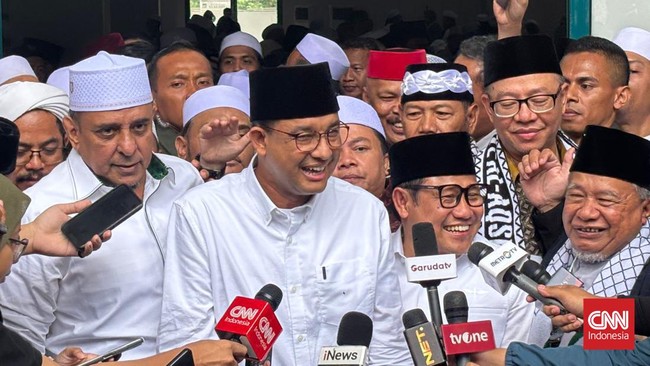
Jakarta — Presidential election ticket number 1, Anies Baswedan and Muhaimin Iskandar (AMIN) have hooked in Islamic groups and religious leaders in the 2024 presidential election contest.

AMIN National Campaign Team (Timnas) Co-Captain Yusuf Martak has said that former Jakarta governor Baswedan and running mate National Awakening Party (PKB) Chairperson Iskandar have signed an integrity pact with the Ijtima Ulama (an assembly if Islamic clerics) forum.

In addition to this, not long ago AMIN also received support from Ustaz (Islamic cleric) Abdul Somad — who openly denigrates non-Muslims as heretics and has been banned from at least six countries — following a meeting with Baswedan in Riau.

AMIN’s move to embrace Islamic political groups, particularly by signing the integrity pack, has been highlighted by non-government organisations (NGOs). The Commission for Missing Persons and Victims of Violence

(Kontras) for example believes that this contradicts AMIN’s vision and mission and its narrative on freedom of expression and the resolution of past gross human rights violations.

The reason being that under the pact AMIN is required to pursue a number of things, one of which is a moral (akhlak) revolution to “protect society from being undermined by life styles and damaging ideas that conflict with decency and other norms that apply in Indonesian society and conflict with [the state ideology of] Pancasila”.

In addition to this, AMIN is also required to consistently implement Provisional People’s Consultative Assembly (MPRS) Decree Number XXV/1966 (TAP MPRS) on the prohibition against spreading Marxist, Leninist and communist ideas. Yet this decree is seen as the cause of discrimination and restrictions against the victims of the 1995-96 mass killings.

Careful calculation

Andalas University political observer Asrinaldi is convinced that AMIN has carefully calculated the benefits and consequences of signing the integrity pact.

Asrinaldi says that there are many points in the pact that conflict with moderate and liberal Islamic groups who have a high level of respect for civil liberties. AMIN could well lose mass support from this segment.

On the other hand, said Asrinaldi, support from conservative Islamic groups will strengthen.

“The issue of LGBTQ [Lesbian, Gay, Bisexual, Transgender and Queer], the issue of deviance, sexual orientation, is of concern to the Islamic community and perhaps it will be of more value for the AMIN ticket [to get support from conservative groups and political Islam]”, Asrinaldi told CNN Indonesia on Thursday December 15.

“AMIN is very confident that this will be able to boost his electability, this is of course its commitment in order to be able get support from Islamic groups”, he continued.

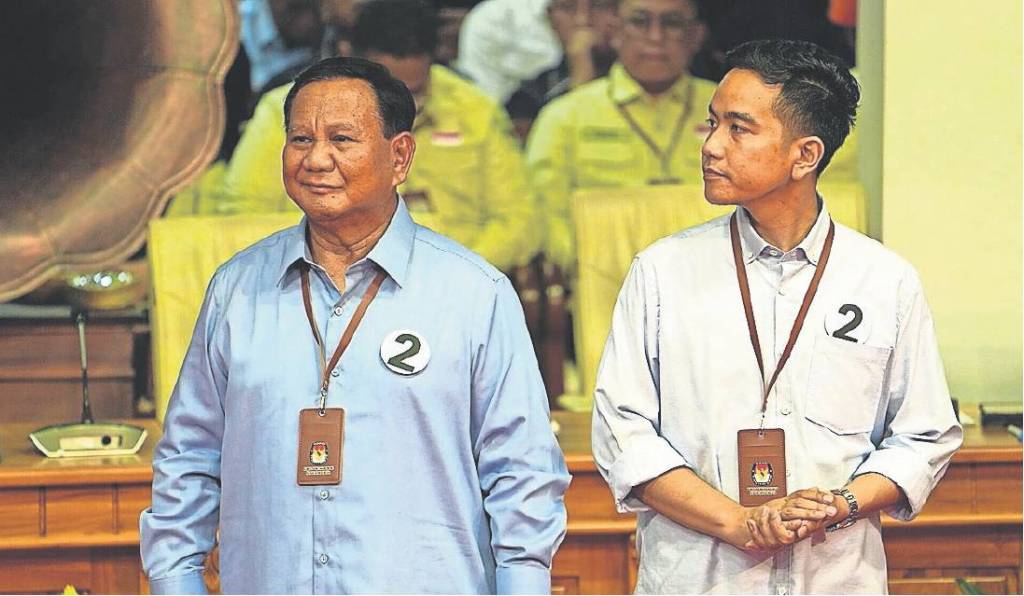
Moreover, said Asrinaldi, many of these Islamic political groups are disappointed with Greater Indonesia Movement Party (Gerindra) Chairperson Prabowo Subianto following the 2019 presidential elections, who is running as presidential ticket number 2 along with vice presidential candidate President Joko “Jokowi” Widodo’s eldest son Gibran Rakabuming Raka.

For the record, the integrity pact signed by AMIN no longer includes the sentence “protecting society from being undermined by life styles and damaging ideas that conflict with decency and other norms that apply in Indonesian society such as LGBTQ+ [Lesbian, Gay, Bisexual, Transgender, Queer Plus], prostitution, gambling, liquor, drugs and other social diseases”.

The point on a moral revolution was changed to read: “Carrying out a moral revolution in all sectors of life to build a nation that is religious, responsible and honest (berakhlakul karimah) for the sake of making Indonesia pious and blessed by protecting the society from being undermined by lifestyles and damaging ideas that conflict with decency and other norms that apply in Indonesian society or conflict with Pancasila”.

Disappointed with Prabowo

Many Islamic political groups supported Prabowo in the 2019 elections when he faced off against Widodo. These groups even held demonstrations in front of the Election Supervisory Board (Bawaslu) in Jakarta on May

21-22 because they could not accept that had Prabowo lost the election.

During these often violent actions, nine people were killed.

Following this however, Prabowo joined Widodo’s cabinet by accepting the position of Defense Minister. Asrinaldi says it was this that disappointed the Islamic groups that had supported him and would potentially not support Prabowo if he ran for the presidency again.

“The Ulama [Islamic clerics] are more supportive of AMIN, this position is because Prabowo is identified with Jokowi in the 2024 elections. This will be a benefit for AMIN”, he said.

Asrinaldi concedes that in several regions the conservative Islamic groups and the Islamic clerics are split between Baswedan and Prabowo.

Although Asrinaldi is convinced that the number is not great.

“This is usual yeah, because of course there are ulama that were historically in the past were close to Prabowo and are communicating [with him] to this day”, he said.

“I think this polarisation will also occur in East Java but won’t be a problem, but generally of course they supports Anies more, yes, in the context of ulama support”, he added.

Exposit Strategic political analyst Arif Susanto meanwhile is convinced that the move taken by AMIN in hooking in conservative Islamic groups is a realistic one if the AMIN ticket wants reach the second round of the presidential election.

Susanto explained that AMIN’s move may indeed undermine votes from moderate and liberal Islamic groups. Nevertheless, there are also many moderate Islamic groups that would still be in agreement with the narrative of several points in the Ijtima Ulama integrity pact, especially in relation to LGBTQ.

However, said Susanto, it should be recognised that these groups are nto very significant in garnering votes, because they are still smaller in number than the conservative groups.

In addition to this, the conservative Islamic groups also tend to be more loyal in determining voters’ choices in presidential elections, compared with moderate and liberal Islamic groups. So, he said, grabbing the vote of conservative Islamic groups is more profitable.

“So these contradictions can be explained if indeed the target is what I think is realistic. The initial target is to get into the second round”, said Susanto.

Susanto stated that AMIN must indeed take a position of attracting the voter base that is its priority. According to Susanto, it would be difficult if AMIN wants to hook in two different groups at once.

He said that the groups around PKB and its constituent base the moderate Islamic mass organisation Nahdlatul Ulama (NU) are not united in supporting AMIN because their electoral support is split due to Coordinating Minister for Security, Politics and Legal Affairs Mahfud MD, the vice presidential candidate running under ticket number 3 who has strong ties with NU.

Moreover, AMIN is also backed by the conservative Islamic based Justice and Prosperity Party (PKS). Therefore according to Susanto, it makes more sense if AMIN plays a narrative that is in line with the PKS and conservative Islamic groups if it wants to garner votes.

“The strength of this group is that they’re loyal. In an election what is clear is that the contestation will be won by the larger base of support. This is beneficial. Because they have loyalty”, Susanto explained. (yla/pmg)

Editor’s note: This article was corrected on December 15 at 0.30 am to add an explanation on the points about the moral revolution in the integrity pact and the changes made to the original pact submitted by the Ijtima Ulama forum.

[Translated by James Balowski. The original title of the article was “Kelompok Islam Politik di Barisan AMIN, Perkuat atau Blunder?”.]

Source:

https://www.cnnindonesia.com/nasional/20231215095304-617-1037588/kelompok-islam-politik-di-barisan-amin-perkuat-atau-blunder —————————————————————

Poll race highlights fears for Indonesian democracy

Edward Aspinall

Indonesia’s political mystery of the year – which candidate Joko ‘‘Jokowi’’ Widodo would back in February’s election – was solved in October when a court ruling opened the way for the president’s 36-year-old son, Gibran Rakabuming Raka, to stand as the running mate of Defence Minister Prabowo Subianto.

As well as setting up a dynastic succession of sorts, the pairing was the culmination of a reconciliation between two former rivals.

More important, the decision brings into focus the weakening of core democratic institutions under Jokowi’s presidency.

Jokowi’s rejection of Ganjar Pranowo, from his own PDI-P party, in favour of a ticket uniting Gibran with Prabowo signalled the tightening grip of dynasties on Indonesian politics and the weakening of parties.

The controversial Constitutional Court decision that cleared the way for Gibran to run was a sad coda to the story of a once great institution. In the years after its founding in 2003, the court was widely viewed as an important check on the executive and a major achievement of Indonesia’s reformasi movement.

But the decision to allow Gibran to run was a blatant exercise in political favouritism. The court essentially amended a legal clause prohibiting candidates under 40 from running by writing an exception – for candidates with experience as heads of regions – which was tailor-made for Gibran, the mayor of Surakarta, the central Java town where his father also began his political career.

Adding an element of farce, the court decision overruled a finding handed down that day, following intervention by the chief justice, who happened to be Jokowi’s brother-in-law.

Other key checking institutions have suffered a similar fate under Jokowi. The Corruption Eradication Agency (KPK), once a beacon of independence and probity in a tainted law enforcement landscape, has increasingly become an instrument of the executive. Under Jokowi, the KPK has played a major role in prosecuting senior politicians in ways that consolidate the president’s coalition.

More worrying are signs the integrity of Indonesia’s elections may be threatened. Most observers agree on a democratic decline since Jokowi was elected in 2014.

His presidency has featured increased use of coercion against government opponents – notably Islamists, but also liberal critics – targeted intervention in political parties, selective use of criminal prosecutions against bothersome coalition partners and reactivation of the military in civilian life.

Yet, there was long a consensus among observers that, no matter how problematic aspects of Indonesian democracy became, the open and competitive character of elections remained untouched.

That consensus is now challenged. Stories are accumulating of petty steps by bureaucrats and security officials in Indonesia’s regions to obstruct Prabowo’s opponents and mobilise in favour of him and Gibran.

While these stories still need to be treated with caution, and are not unprecedented in democratic Indonesia, such interventions have, in the past, mainly affected local elections.

Adding to the unease is that 271 of Indonesia’s regional government heads, including governors in many of the most populous provinces, are central government appointees rather than elected politicians – at least until regional elections late next year.

A Prabowo-Gibran victory appears the most likely outcome in 2024’s presidential election.

Jokowi’s tacit endorsement counts for a lot. The president remains extremely popular, with approval ratings of about 75 per cent. Many Indonesians appreciate his Suharto-lite focus on economic development without the most authoritarian elements of Suharto’s rule, supplemented by growing allocations of social assistance.

This is why Prabowo has reinvented himself as Jokowi’s No.1 public admirer and courted his son as his running mate.

Their pairing puts Prabowo, a man with a deeply authoritarian past, closer to the presidency. He was once Suharto’s son-in-law and the leader of a hardline faction of the military during the final years of that regime.

Observers of Indonesian politics debate whether Prabowo’s experience of compromise as a minister under Jokowi might have tempered his authoritarian instincts.

Under Jokowi, Prabowo has largely ditched the fiery populist rhetoric with which he tried to win the presidency in 2014 and 2019.

Regardless, it does not bode well for Indonesia that a new president with an authoritarian pedigree is likely to take office after his predecessor oversaw the capture of previously independent control institutions, transformed the state apparatus into an instrument to pursue political advantage and narrowed the space for opposition.

Edward Aspinall is professor of politics and head of the Department of Political and Social Change at the Coral Bell School of Asia Pacific Affairs, The Australian National University. This article is part of a series from East Asia Forum (www. eastasiaforum.org) at the Crawford School of Public Policy in the ANU’s College of Asia and the Pacific.

US names 2 Indonesians as ‘perpetrators’ of rights abuses

BenarNews staff
2023.12.08

Washington

The U.S. State Department named two Indonesians – including a candidate for the House of Representatives in next year’s election – among its international list of “perpetrators of human rights abuses” on Friday.

The list, released to mark the 75th Anniversary of the Universal Declaration of Human Rights on Dec. 10, named Hartomo, a former military officer who is seeking office in the Feb. 14 election, and Terbit Rencana Perangin-Angin, a former regent of Langkat in North Sumatra province.

Hartomo, who goes by one name, “is being designated for his involvement in gross violations of human rights, namely extrajudicial killing,” the State Department said.

He held the highest rank, lieutenant colonel, of a group of soldiers accused of killing Theys Eluay, chairman of the Papua Presidium Council, in November 2001, according to media reports.

Human Rights Watch reported that the soldiers were convicted in 2003, but Hartomo was later promoted to head up the nation’s military intelligence agency. https://www.hrw.org/news/2018/01/26/us-should-not-be-rehabilitating-indonesias-abusive-special-forces

A member of former President Susilo Bambang Yudhoyono’s Democratic Party, Hartomo is seeking to represent Central Java in the legislature.

Lt. Col. Hartomo (left), Capt. Rionardo, 1st Sgt. Asrisal and Pvt. Achmad Zulfahmi hear the indictment against them at the Surabaya Military Court in Indonesia, Jan. 3, 2003. [AFP]

Terbit Rencana “is being designated for his involvement in gross violations of human rights, namely the forced labor of boys and men,” the news release said.

In May 2022, 10 soldiers were named as suspects in the alleged torture deaths of at least six people who had been kept in two cage-like rooms in Terbit Rencana’s house in North Sumatra province. https://www.benarnews.org/english/news/indonesian/cage-probe-05232022151449.html

The iron-barred rooms were discovered four months earlier when the Corruption Eradication Agency searched the house and found 27 people inside the cells. Terbit Rencana, who was arrested at that time, said his residence housed drug addicts who were undergoing rehabilitation.

Police said 656 people had been held in the two cages since 2010.

————-

Indonesia excerpt  from  https://www.state.gov/promoting-accountability-in-support-of-the-75th-anniversary-of-the-universal-declaration-of-human-rights/

Promoting Accountability in Support of the 75th Anniversary of the Universal Declaration of Human Rights
FACT SHEET

OFFICE OF THE SPOKESPERSON

DECEMBER 8, 2023

On Human Rights Day and the 75th Anniversary of the Universal Declaration of Human Rights, the Department of State, in coordination with the Departments of the Treasury and Homeland Security, is taking actions to promote accountability for perpetrators of human rights abuses.  State is taking steps to impose visa restrictions on four individuals pursuant to Section 7031(c) of the Annual Appropriations Act, 11 individuals pursuant to Section 212(a)(3)(C) of the Immigration and Nationality Act, designating one People’s Republic of China (PRC) individual pursuant to the Uyghur Human Rights Policy Act (UHRPA), and designating two ISIS-DRC leaders pursuant to Executive Order (E.O.) 13224, as amended. On Human Rights Day and the 75th Anniversary of the Universal Declaration of Human Rights, the Department of State, in coordination with the Departments of the Treasury and Homeland Security, is taking actions to promote accountability for perpetrators of human rights abuses.  State is taking steps to impose visa restrictions on four individuals pursuant to Section 7031(c) of the Annual Appropriations Act, 11 individuals pursuant to Section 212(a)(3)(C) of the Immigration and Nationality Act, designating one People’s Republic of China (PRC) individual pursuant to the Uyghur Human Rights Policy Act (UHRPA), and designating two ISIS-DRC leaders pursuant to Executive Order (E.O.) 13224, as amended.  Treasury is designating 20 individuals pursuant to E.O. 13818, which builds upon and implements the Global Magnitsky Human Rights Accountability Act, as well as E.O. 13667E.O. 13413 as amended by E.O. 13671, and E.O. 13664.  These actions also implement the Presidential Memorandum on Promoting Accountability for Conflict-Related Sexual Violence.  Homeland Security is also adding three PRC-based companies to the Uyghur Forced Labor Protection Act (UFLPA) Entity list.

….

Indonesia

State is designating two individuals pursuant to Section 7031(c).

Terbit Rencana Pergangin-Angin, Former Regent of Langkat, Indonesia. He is being designated for his involvement in gross violations of human rights, namely the forced labor of boys and men.

Hartomo, Former Official of the Indonesian National Armed Forces. He is being designated for his involvement in gross violations of human rights, namely extrajudicial killing.

———————– — etanetanetanetanetanetanetanetanetanetanetanetan Support ETAN. Donate now: https://www.paypal.com/paypalme/etan009 John M. Miller etan@igc.orgCoordinator, East Timor and Indonesia Action Network (ETAN)PO Box 1663, NY, NY 10035-1663 USAPhone: (917)690-4391 www.etan.orgTwitter/Instagram: @etan009 Send a blank e-mail message to info@etan.org to for information on other ETAN electronic resources on East Timor and Indonesia etanetanetanetanetanetanetanetanetanetanetanetan

Indonesia has third highest level of money politics in the world:

Research

CNN Indonesia – November 30, 2023

Jakarta — Jakarta Syarif Hidayatullah State Islamic University (UIN) political science professor Burhanuddin Muhtadi says that Indonesia is one of the countries with the highest level of money politics in the world.

According to Muhtadi, Indonesia is only outdone by two countries in Africa, namely Uganda and Benin. Muhtadi made this statement during his inauguration speech as professor of political science at the Jakarta UIN on Wednesday November 29.

“This makes Indonesia the country with the third highest level of money politics in the world. Only being outdone by Uganda and Benin”, he said.

Muhtadi said this was revealed from the results of research he conducted during the last two presidential elections in 2014 and 2019. The result was that around 33 percent or 62 million out of a total of 187 million voters included on the permanent voter list (DPT) were involved in the practice of buying and selling votes.

This was also revealed in data from his scientific research project titled “Votes For Sale: Clientelism, Democratic Deficit, and Institution”, which was released during his inauguration.

Muhtadi added that the voters that were mostly targeted were sympathisers of political parties which account for some 15 percent.

Meanwhile the remaining 85 percent were not targeted as they are considered unreliable because they are “floating” or swing voters.

“They are reluctant to target floating voters because they are seen as accepting the packages offered but their electoral choice cannot be guaranteed”, he said.

Muhtadi said that although money politics only contributes to 10 percent of the vote, this number is considered quite effective especially in the context of legislative elections and when competing with fellow candidates from the same party.

“The 10 percent figure can be the determining factor in winning. The average margin of victory to defeat a rival is only 1.6 percent. So, [the figure of 10 percent] can make the differences between a candidate winning or losing”, he said. (thr/bmw)

[Translated by James Balowski. The original title of the article was

“Pakar: Politik Uang di Indonesia Tertinggi Ketiga di Dunia”.]