Pesta Babi film showing in Adelaide 20th June 2026

The Australia West Papua Association SA

 cordially invite you to a free screening of the new Environmental film

PESTA BABI : Colonialism in our time

to be held on Saturday 20th June at 6p.m. at the Conservation Council SA  

The Exchange  55 exchange Place Adelaide.

It is a full length film of 90 minutes to be followed by  Q& A time after for a further 30 minutes  

Pesta Babi : Colonialism in our time   has become so popular in Indonesia and abroad that

On May 14 alone, organizers recorded around 130 simultaneous viewing locations.

There were over 30 attempts by then Indonesia security forces  to close it down.

Rather than relying on commercial cinemas or subscription platforms, the documentary is circulated free of charge. Any community able to gather at least 10 people can organize a screening and receive the film directly from its producers. Since its release in March, screenings have spread rapidly across the country.

It had become so popular that some enterprising ( thieving ) people in Indonesia cloned the internet address of the film and sold it for $10 for a viewing.

To maximize the films viewing audience  on 22nd May the film was made free to view on You tube and it went viral with over 2,459,508 downloads on that day.  

We expect that as the film is free and highly popular that we will need to have several showings of the film .

The Event Cinema at The Exchange has seating for 155 .

If that books out we will release details  of additional showings   

Pesta Babi – Colonialism in our time, by Dandhy Laksono:

Synopsis of the film:

Yasinta Moiwend, a Marind Anim woman in Merauke, was startled when, on a quiet morning, a massive ship docked at her village pier. The vessel carried hundreds of excavators under escort by military forces, sent to Papua for a National Strategic Project for food production, palm-based biodiesel, and sugarcane bioethanol.

Vincen Kwipalo, from the Yei community, was likewise shocked when his clan’s land was suddenly marked with a sign reading: ‘Property of the Indonesian Army’. Only later did he learn that the land had been seized for the construction of a military battalion headquarters, at the very moment when sugarcane, a plantation company, was also encroaching on his ancestral forest.

‘Pig Feast’ combines detailed field recordings with in-depth research to examine the power structures behind the operation. It exposes how government and corporate entities—collaborating with military and religious groups—advance international and national goals of ‘food security’ and ‘energy transition’ at the expense of Indigenous communities and landscapes.

The documentary illustrates the networks of Indonesian elites, oligarchs, and multinational corporations that benefit from the project, providing a vivid depiction of the political ecology of Indonesian governance in Papua. ‘Pig Feast’ serves as a record of colonialism that remains intact today.

About the director: 

Dandhy Dwi Laksono is an Indonesian activist, investigative journalist, and filmmaker. He is known for his critical documentaries which look at how political and business interests collude to undermine democracy, infringe on human rights and destroy vulnerable natural and social environments in Indonesia. Born in East Java, Dandhy Laksono majored in International Relations at Padjadjaran University in Bandung, West Java, before founding the research-based documentary and audio-visual production house Watchdoc.


To book ticket click on

https://events.humanitix.com/pesta-babi-colonialism-in-our-time?_

link to the official trailer   3mins  https://www.youtube.com/watch?v=A-pPemC8m_

Central Papua: grenade dropped in front of Catholic church injures four worshippers  

by Mathias Hariyadi. 05/18/2026, 18.52

——————————————

https://www.asianews.it/news-en/Central-Papua%3A-grenade-dropped-in-front-of-Catholic-church-injures-four-worshippers-65467.html

The blast occurred in the courtyard of St Paul’s Church, Intan Jaya Regency, shortly after Sunday Mass. The injured are all civilians from the local community. Indonesian authorities have not yet clarified the origin of the device, delivered by a drone, nor identified those responsible. Meanwhile, fighting between separatists and Indonesian forces intensifies.

Jayapura (AsiaNews) – An explosive device, likely dropped by a drone, exploded yesterday, 17 May, in the courtyard of St Paul’s Nabuni Mbamogo Catholic Church, in the remote Intan Jaya region of Central Papua, injuring four civilians who were leaving the place of worship after Sunday Mass.

The area is part of Bilogai Parish, Sugapa District. Many worshippers were still gathered outside the church when the attack occurred.

According to local media outlet Suara Papua, the four victims – Pit Pogau (30), Robert Nabelau (35), Pius Pogau and Piter Nabelau were hit by shrapnel, which embedded in the bodies of the first two. All four were in the church courtyard at the time of the attack.

Bilogai Parish’s pastoral team, led by Father Yanuarius Yance Yogi, head of the Moni Puncak Deanery, immediately evacuated the injured. Two were taken to the Bilogai Regional Hospital in Sugapa District, for medical treatment.

According to initial reports, a second grenade, presumably dropped by drone, was found on the same day in the courtyard of St Pete’s Mbamogo Church.

So far, neither the Indonesian police nor the Indonesian military have released official statements regarding the origin of the device or the perpetrators of the attack.

The use of drones to drop explosives is nothing new in Central Papua, where fighting between Indonesian security forces and Papuan separatist groups has intensified in recent years.

Similar incidents have already been reported in Intan Jaya and Puncak Jaya regencies, two of the most unstable areas in the region. Indonesian-held Papua remains one of the most militarised and difficult to reach areas in the country.

For decades, pro-independence movements have denounced discrimination, repression, and human rights violations by Indonesian authorities, while the Indonesian government considers Papuan armed groups to be terrorist organisations.

In the past few years, religious communities have increasingly found themselves caught up in the violent conflict. The Catholic Church, deeply rooted among Papua’s indigenous peoples, has repeatedly called for peaceful dialogue and an end to military operations that target civilians.

‘They’re wiping us out’: Church leader warns about young West Papuans killed in escalating conflict

https://www.rnz.co.nz/news/pacific/595281/they-re-wiping-us-out-church-leader-warns-about-young-west-papuans-killed-in-escalating-conflict

Johnny Blades, RNZ Pacific senior journalist 

A West Papuan church leader has warned that ongoing killings of young Papuans allegedly by Indonesian security forces have the hallmark of genocide.

Since the start of the year there’s been no stop to violent incidents in Indonesian-ruled Papua region – known internationally as West Papua.

Indonesia’s government blames recent violence on armed, pro-independence West Papuan fighters.

However, human rights defenders say the violence is escalating violence, and the young, indigenous people of West Papua are in the firing line.

Escalation

Last week a 17-year old Papuan girl was killed as a result of a military operation reportedly targeting civilian mining camps in Tembagapura.

Also last week, several Papuan high school students were shot when tensions flared at a graduation parade through the town of Kobakma in Papua’s central highlands. Police had objected to them wearing the Papuan Morning Star Flag a symbol of the Independence Movement.

Last month, Indonesia’s National Commission on Human Rights (Komnas HAM) said it was investigating a shooting incident that left up to twelve Papuan civilians dead as the result of an Indonesian military operation in Kembru district. According to human rights researchers, a 5-year old girl and a 77-year old woman were among the dead.

Komnas HAM’s commissioner for monitoring and investigation Saurlin Siagian said it was difficult to ascertain the exact ages of each victim in the Kembru incident, but he told RNZ Pacific that two pregnant women were among those killed.

Earlier in April, five people, including a 12-year old boy, were shot dead in Dogiyai regency in an alleged retaliatory attack by police after a policeman was killed.

The list goes on, stretching back to January – dozens of people reported dead, dozens more people injured and many more people displaced from their villages.

Pattern

The head of the human rights and justice department of the GIDI Evangelical Church of Indonesia in Papua, Pastor Jimi Koirewa, said there was a disturbing pattern to these attacks.

“The children are being killed, the women are being killed. That is a part of genocide, because the women will give birth to babies, the kids, the children, the youth, they are the future of Papua, and killing them is part of a genocide. They’re wiping us out. There will be no more people there standing in Papua. The old people will die gradually,” Koirewa told RNZ Pacific.

Indonesia’s Foreign Affairs Ministry declined to comment on the pastor’s claim. It said it could not discuss recent incidents while investigations are underway. However, the Human Rights Minister in Jakarta, Natalius Pigai, has admitted the situation is a serious concern.

After a violent year in 2025, when Komnas HAM which recorded 97 violent incidents and armed conflicts in Papua, the situation has deteriorated further this year.

Pigai noted that the country’s independent human rights body has identified 26 cases of violence in Papua from January to April 2026.

“Based on records from both domestic and international sources, there is an escalation. In just under a month, no fewer than 20 people died in 5 incidents in Dogiyai, Yahukimo, Puncak Papua, Timika, and Tembagapura,” Pigai said in a statement on Sunday.

Pigai claimed the government was continuing to seek a peaceful solution that can address the root causes of the conflict.

For the past several years Indonesian security forces in Papua have been engaged in conflict with ‘armed criminal groups’, their label for Papuan pro-independence fighters within the wider OPM Free West Papua Movement.

Lack of justice: ‘Shooting the people’

Pastor Koirewa said the Indonesian military forces had been amassing in large numbers in recent months.

“There’s so much military deployment coming into Papua and the reason, they said, is they want to get rid of the rebels, OPM, that’s what they call rebels. They said that they want to get rid of the OPM so that development can happen, the government can come and build the land,” Koirewa said.

“But when they come in, they are not shooting the combatant, the OPM, but they are shooting the people. So I see that the it’s escalating.”

Koirewa said police rarely investigated the violent incidents thoroughly, leaving Papuan communities mistrustful of the justice system. The GIDI church has raised its concern with the upsurge in violence.

“Our church, we have no influence in Jakarta at all. We already made some communications through the formal way to Jakarta, yeah, through the our parliament, let them know what is happening, but Jakarta is not responding. They don’t care.

“They just come in with their programme, and they don’t care at all. That’s why the church now is looking for aid outside of our country,” Koirewa said, adding that the aid they sought is for internally displaced people and Papuan schools.

Displacement

Jakarta has been promoting major agri-business projects in Papua provinces – including oil palm, rice and sugarcane – as well as large scale mining and forestry projects in the interior.

The government argues that increasing development and economic activity raises the standard of living for everyone in Papua.

“Which part of Papua are they developing? Why are the Papuans still the poorest among the whole Indonesian population. They have been for with us about more than 60 years. And why are the Papuans still the Papuans still in poverty?” Koirewa said.

“We see that there has been no output at all. They will only bring more non-Papuans in to take over our land.”

Koirewa said changing demographics due to Indonesian transmigration added to the sense that Papuans were being out numbered in their homeland and facing a bleak future.

“There’s no hope,” he said.

The displacement of Papuan villagers is also a factor, with the latest Internally Displaced Persons update from Human Rights Monitor group saying over 107,000 West Papuans remain displaced by armed conflict.

—————————————————

Tapol. 2025 West Papua Freedom of Expression and Assembly Full Report

07 May 2026

Prabowo has been in power as President of Indonesia since October 2024, and the marks of his regime have been increasingly felt across civil society. The atmosphere has turned colder, with greater power going to the security services, a tightening of laws that criminalise dissent, a return of New Order-esque policies, and a sense that the civil rights fought for during the period known as Reformasi are being eroded away.

TAPOL’s latest 2025 West Papua Freedom of Expression and Assembly Report saw the following major trends developing last year compared with 2024:

  • More provinces were affected by incidents than in 2024.
  • 24.2 per cent increase in intimidation and harassment incidents, including torture and killings. 
  • 14.3 per cent increase in incidents of arbitrary arrests.

The report shows in numbers that:

  • In total, 14 provinces had incidents regarding Freedom of Expression and Assembly in West Papua in 2025, 4 more than in 2024. Papua remains the province with the largest number of incidents, followed by Central Papua and then South Sulawesi. Unlike in previous years, the number of incidents wasn’t as concentrated in Papua Province, but was more widely distributed across West Papua and Indonesia, with a noticeable hotspot being South Sulawesi, which is the first time that a province outside of the West Papua region has appeared in the top three. 
  • With regard to perpetrators, security force personnel, including police, carryed out or were involved in  the majority of incidents, which together cover around 65 per cent of reported incidents. This is consistent with levels seen in previous years. The high number of cases committed by unknown perpetrators, which made up 15.6% of all incidents, has been a cause of concern during 2025, and points to a large number of intimidation incidents where no actor involved could be identified. Moreover, companies have come into more and more conflict with local indigenous communities that are speaking up to protect their land, explaining companies” relatively strong involvement in silencing local protests against their plans and intimidating local leaders in order to compel communities into acquiescence. They made up 5.2% of all incidents.
  • The majority of those affected is consistent with previous years, but does also include attempts at intimidating Komnas HAM personnel, who ended up being shot at by the TPNPB. The total impact on all campaign groups on West Papua hit 42 per cent of all incidents, which is lower than previous years, as students were the single group that ended up being the most affected in 2025, covering 29.1% of incidents and bearing the brunt of intimidatory activities in particular, as well as dispersal events. Intimidatory actions against individuals and smaller groups shows a return to the proclivity towards these sorts of tactics in 2023, which contrasts to the election year of 2024, but also the climate of fear that Prabowo seeks to create against those who might oppose his policies. 

We can discern certain important trends from the data we have collected and analysed:

  • Firstly, there has been a general trend since 2023 of strong-arm and targeted arrest tactics to create a climate of fear, with 2025 showing a continuation of this pattern in West Papua. 2024 was somewhat anomalous due to the fact that it was a general election year. There has been a noticeable downturn in mass protest events in West Papua (and those arrested in them), which shows the dire atmosphere of free expression that these conditions are creating.
  • Secondly, mirroring Prabowo’s desire to intensify PSNs throughout West Papua during his term as President, there has been a noticeable uptick of intimidation, arrests or attack incidents against those speaking up for indigenous communities affected by these policies. This shows an intensification of tactics that began in 2024.
  • Thirdly, intimidation targeted at Papuans across Indonesia has meant the greater geographic spread of incidents recorded this year across the country. Whilst there were no international incidents recorded this year, the fact that a province outside of West Papua (that of South Sulawesi) managed to get into the top three of provinces affected by incidents this year shows a definite increased frequency and proportion of overall events now occurring outside of the region.

Check out the full report by clicking on the link below.

ENDS

Themes

Freedom of Expression & Association

Justice

Militarism

Police

Political Prisoners

West Papua

Type

Report

2025 TAPOL West Papua Freedom of Expression and Assembly Report_0.pdf

https://tapol.org/sites/default/files/2025%20TAPOL%20West%20Papua%20Freedom%20of%20Expression%20and%20Assembly%20Report_0.pdf

——————————————-

Interim President: Genocide continues as Indonesia massacres ten West Papuans 

May 11, 2026 in Statement

Summary of events from May 1st to May 10th 2026: 

  • Five West Papuans were killed by the Indonesian military in Mimika;
  • Four Papuans were killed by the Indonesian military in Puncak;
  • Indonesian police killed a Papuan civilian in Dogiyai;
  • Indonesian security forces shot and injured seven Papuan students in Mamberano Tengah for painting the Morning Star on their clothes.
    ______________________________________

While the world looks away, genocide continues in West Papua.

Indonesian security forces have committed a series of new mass killings over the past ten days, executing at least ten Papuans and shooting many more.

According to on-the-ground reports from the TPNPB and humanitarian defenders, the Indonesian military conducted a sweeping operation in a gold panning area in Tembagapura, Timika Regency, spanning from the evening of May 7th to the morning of May 8th. Five civilian gold miners were shot dead during the operations, while a toddler was reportedly injured and is in critical condition. One of the victims, 17-year-old Nalince Wamang, was hoping to raise money to fund her university studies.

At the same time, military operations conducted in Omukia District, Puncak Regency between May 1st and May 6th resulted in the deaths of at least four Papuan civilians – all murdered by Indonesian troops. According to Human Rights Monitor, the victims were as follows:

  • Ms Tarling Wanimbo, 20, shot whilst searching for food in her family’s garden.
  • Mrs Naena Murib, 31, shot dead whilst gardening. 
  • Mr Bebison Murib, 19, shot dead during the operations
  • Mr Amukiamen Magay, 41, shot dead during the operations.

Earlier, on May 5th, the military shot seven West Papuan students, ranging in age from 17 to 24, during a graduation parade in Kobakma, Mamberamo Tengah Regency. One, 18-year-old Yali Elabi, remains in hospital in critical condition. The only “crime” these students had committed was painting the Morning Star on their clothes. Indonesia fears our flag so much they will shoot our children for flying it.

Indonesia’s ten days of bloodshed then continued yesterday (May 10th), as the police executed yet another Papuan civilian in Dogiyai, Mr Nopison Tebai.

Massacres have become normal in West Papua. The latest killings by the Indonesian colonial occupiers occurred in the wake of recent massacres in Dogiyai and Kembru, Puncak Regency. Thirty-seven West Papuans have now been killed by Indonesian security forces in 2026 – evidence of a serious escalation in Indonesian militarisation. We must also remember that this figure doesn’t include the many civilians who will die of hunger or disease in the bush after being forcibly displaced by military operations.

Tembagapura is in the dead zone surrounding the Freeport mine, the biggest and most toxic gold mine on earth. The forests there have been destroyed, the water is poisoned, the fish are all dead, and the basin of the Ajkwa river has been transformed into a huge grey wasteland. As a result, West Papuans who once hunted there have been forced to pan for gold just to survive.

Those who were killed in Tembagapura suffered three times – first they lost their lands, then their livelihoods, and finally their lives.

This new wave of brutality is a result of Indonesia’s increased military deployment in West Papua. At least 110 new battalions have been formed in West Papua since the election of Prabowo Subianto as Indonesian President in 2024, bringing tens of thousands of additional soldiers to the highlands and villages.

These troops are not in West Papua to protect civilians or preserve Indonesia’s ‘sovereignty’. They are there to protect Indonesia’s investments: to defend the Wabu Block, the Freeport Mine, and the South Papua National Strategic Project (PSN), the biggest deforestation project in human history. The government deliberately creates violence and chaos to feed their troops and the industrial projects they serve.

On behalf of the ULMWP and the Pacific people of West Papua, I demand the immediate expulsion of Indonesia from the Pacific Islands Forum (PIF) and Melanesian Spearhead Group (MSG). Indonesia currently sits as a dialogue partner in PIF and an Associate Member of the MSG. If their positions are not reviewed following these massacres, the Pacific will be complicit in the genocide of its West Papuan neighbours.

Pacific leaders must ask themselves: will you allow this to happen in your backyard? Will you close your eyes as West Papuans are slaughtered? Future generations will judge your actions at this critical moment.

Benny Wenda
Interim President
ULMWP

—————————————-

West Papuan graduation parade turns violent after police object to Morning Star symbol

9 May 2026 Johnny Blades, RNZ Pacific senior journalist

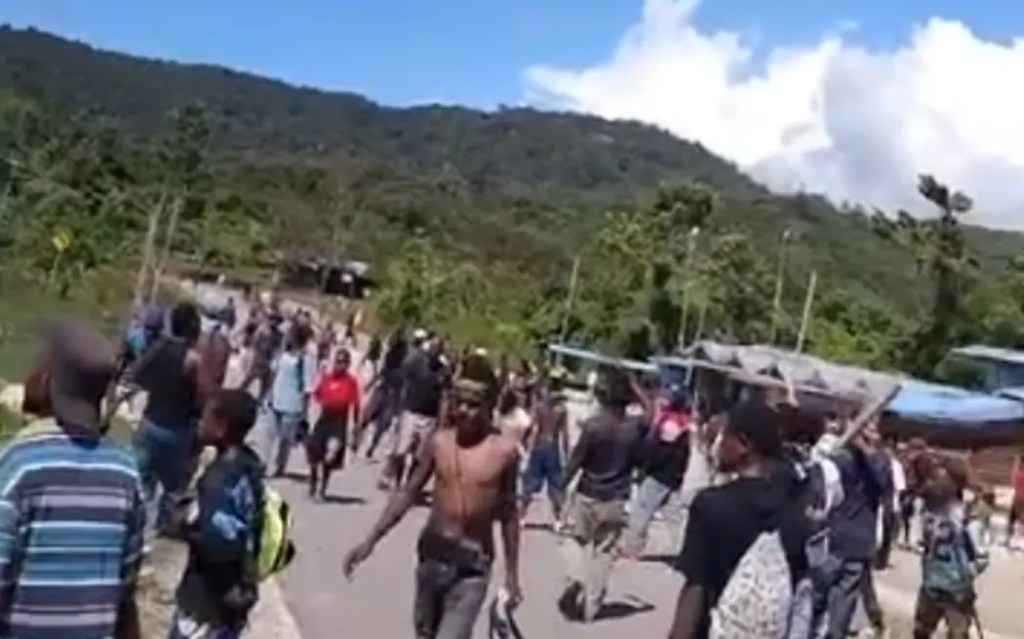
Video footage obtained by human rights researchers shows a crowd of angry Papuans throwing stones towards police infrastructure. The sound of gun shots follows. Photo: Screengrab / Human Rights Monitor

Indonesian authorities say investigations are underway into an incident in West Papua when a number of people were allegedly injured after police fired shots amid a student graduation event.

Reports from West Papua say seven people sustained injuries when tensions flared at a parade by senior high school graduates through the town of Kobakma in Mamberamo Tengah Regency of Papua’s central highlands on Monday (5 May).

The situation reportedly escalated after local people watching the parade, objected to attempts by police officers to stop graduates displaying the West Papuan nationalist Morning Star flag.

Brandishing the flag, or painting school uniforms and personal accessories with a Morning Star symbol, is relatively common across West Papua on graduation day – despite the flag being effectively outlawed by Indonesia.

Video footage obtained by human rights researchers shows a crowd of angry Papuans throwing stones towards police infrastructure. The sound of gun shots follows.

According to Human Rights Monitor, seven West Papuans – including some students – were injured from being shot. The seven were aged between 17 and 24 years old.

Local police said their officers tried to persuade the students not to display the Morning Star, but they were ignored and the situation developed into unrest. Police said that in response they dispersed the crowd using tear gas and fired warning shots into the air.

According to police, a number of people were injured, including police personnel. Security forces, including military, are patrolling the area after the melee briefly descended into rioting and looting at the at Kobakma’s central market.

A spokesperson at the Indonesian Embassy in New Zealand told RNZ Pacific that information it had gathered about the incident indicated the students’ parade had been “infiltrated by another group that provoked to create discord related to an unfortunate incident that happened in the area on the previous day”.

“Local authorities in close relations with civic groups, including church authorities and traditional leaders, are currently trying to conduct a thorough investigation regarding the incident that happens.”

The spokesperson said national and local authorities would focus their efforts to avoid any further “unfortunate similar incidents” happen in the future.

Papua Monitor Q1 2026: No de-escalation as military operations drive new displacement

1) Papua Monitor Q1 2026: No de-escalation as military operations drive new displacement

Human Rights NewsReports / IndonesiaWest Papua / 8 May 2026 

This 11-page report lists cases and developments including human rights violations and their patterns; developments in the armed conflict and its impact on civilians; significant political shifts in Indonesia affecting West Papua; and international responses and initiatives.

Download Quarterly Report PDF

Summary

Human rights

The human rights situation between January and March 2026 remains dire. The reporting period was characterised by a significant rise in documented cases of arbitrary detention and torture. There are two major patterns in this trend. First, HRM observed a significant rise in arbitrary detentions in conflict zones, particularly in the Dekai District of Yahukimo Regency. Yahukimo has already become the top hotspot of armed violence throughout 2025 with 35 armed clashes, and ten such incidents between January and March 2026. Security forces targeted indigenous Papuans, mostly young adults, including females and minors. Most of them were released the following day without being charged. Intensified patrols and raids further contribute to this trend, with security forces applying interrogation methods that violate Indonesian criminal procedure and human rights law.

Second, a significant number of these arbitrary detentions were reportedly accompanied by torture. Officials used coercive and violent measures to extract information about the West Papua National Liberation Army (TPNPB) or to force confessions from detainees. These developments took place alongside ongoing military operations in the regencies Intan Jaya and Puncak, reportedly involving battle drones, mortars and air strikes in civilian populated areas across the central highlands. As a result, the number of internally displaced persons continues to rise (see section on Conflict below).

Indigenous communities are more than ever at risk of losing their land as a result of ruthless economic development projects and the expansion of security force infrastructure in West Papua. In the South Papua Province, the Strategic National Project (PSN) for the development of more than 2 million hectares of sugar cane and rice is rapidly being implemented by the military, while legal efforts and protests by customary landowners are ongoing. Since late 2024, a growing body of evidence has documented serious procedural violations, the dismantling of indigenous land rights, incidents of violence against community members who resist, and the systematic exclusion of affected communities from decision-making processes.

In the Biak Numfor Regency of Papua Province, state agencies have launched a systematic land-grabbing campaign across the regencies of Biak Numfor, Supiori, and Waropen. In the Impewer area of East Biak District, a major land dispute has erupted over plans to construct the headquarters for Infantry Battalion TP 858/MSB. The Warbon Indigenous Community of Saukobye Village in North Biak faces a separate but related threat from the planned construction of a national spaceport by the National Research and Innovation Agency (BRIN). 

Various incidents during the reporting period illustrate the shortcomings in Indonesia’s legal system. Many court decisions in West Papua often appear to be politically motivated rather than being based on criminal procedure, evidence and facts at court. Moreover, high impunity for state agents has caused the loss of trust in the law enforcement system among many Indonesians. This trust is even lower in the Papuan Provinces, as a recent incident illustrates. On 2 February 2026, Second Brigadier Fernando Alexander Aufa, one of the convicted officers involved in the killing of Tobis Silak in August 2024, was seen walking freely in Wamena. The incident raised serious concerns that Officer Aufa may have been released despite a five-year imprisonment sentence. Despite constant setbacks, NGOs pursued efforts to push for an accountability process for cases of human rights violations through lobby meetings with political stakeholders such as the Regional Representative Council in Jakarta in February 2026.

Various documented cases between January and March 2026 highlight the systemic failures in the healthcare system in West Papua. Issues of concern reportedly includ the misuse of public health infrastructure, the absence of basic services in geographically isolated communities, the prioritisation of administrative procedures over emergency care, and the compounding impact of armed conflict on health services. In this regard, Southwest Papua Senator Paul Finsen Mayor interrupted a Regional Representatives Council (DPD) plenary meeting in Jakarta on 14 January 2026 to deliver a pointed message from the Papuan people. Senator Mayor spoke out against the Indonesian government’s plans to establish new territorial development battalions in West Papua, emphasising that basic services rather than military infrastructure should be the priority for the special autonomous region.  

Conflict

There is no sign of de-escalation in sight. The Indonesian government kept deploying additional military personnel to remote areas across West Papua, fueling armed conflict and triggering more internal displacements.  An unknown number of indigenous Papuans were internally displaced due to armed conflict incidents and subsequent raids in the Boven Digoel Regency in February 2026.

The military operations in the central highlands reportedly involved the use of battle drones, mortars and air raids in civilian populated areas, violating principles of distinction between combatants and non-combatants. Recurring armed violence and heavy military presence have resulted in the cessation of daily activities and paralysation of health and education services across conflict-affected regencies. Such patterns cause fear among local communities and encourage the civilian population to flee to safer areas. As of 27 March 2026, armed conflict and military operations in West Papua have resulted in the internal displacement of more than 107,039 civilians across multiple regencies.

In response to escalating militarisation, civil society groups across West Papua have mobilised in peaceful protests, demanding an end to military operations and the withdrawal of non-organic troops. Between late October and early November 2025, demonstrations had already taken place in Nabire, Enarotali, Sugapa, and Jayapura. Further protests against the rising militarisation in West Papua occurred in the regencies Pegunungan Bintang, Intan Jaya and Yahukimo in January 2026. Another protest took place in the Nabire Regency in February 2026. While civil society groups, church leaders, and human rights organisations are united in calling for an immediate halt to military operations, demilitarisation, and meaningful engagement in a peaceful dialogue, the central government shows no signs of refraining from a security-based approach in West Papua.

HRM documented 35 armed attacks and clashes throughout the first quarter of 2026, a smaller number than that of the fourth quarter of 2025, counting 41 clashes. The majority of armed hostilities during the reporting period occurred in Yahukimo, with 10 armed clashes and attacks, followed by the Puncak Regency with 6 armed clashes. Armed hostilities were also documented from the regencies of Intan Jaya, Nabire, Puncak, and Mimika. Isolated incidents of armed violence occurred in the regencies Tambrauw, Maybrat, Paniai, Nduga, Boven Digoel, Tolikara, and Dogiyai.

HRM counted 13 civilians killed and 4 injured by the TPNPB. Meanwhile, 5 civilians were killed, and 4 were wounded by security force members during armed clashes or counter-insurgency operations. Concerning the combatants, 9 security force members were killed, and 2 were injured during this period. In contrast, the TPNPB reportedly lost 5 combatants, with 4 guerrilla fighters being injured during armed clashes.

Comprehensive data on armed conflict violence in West Papua is available in the HRM Annual Report 2025, published in March 2026.

Political developments

On 2 January 2026, Indonesia enacted its new Criminal Code (KUHP) and Criminal Procedure Code (KUHAP), prompting a coalition of civil society organisations to declare an “Indonesian legal emergency.” The new law has drawn sharp criticism from legal experts, human rights defenders, and historians. Among the most troubling provisions in the new KUHP are restrictions on freedom of expression and assembly. The code also increases the maximum punishment for treason from life imprisonment to the death penalty. Perhaps most alarming, Article 622 explicitly repeals key provisions of Law Number 26/2000 on Human Rights Courts, effectively eliminating criminal accountability for gross human rights violations.  

On 13 and 14 January 2026, Indonesian Vice President Gibran Rakabuming Raka visited West Papua to review development projects, beginning in Biak Numfor before travelling to Wamena, where he played in a friendly football match, met with regional leaders and community figures, and engaged with local coffee farmers and creative economy practitioners. His planned second-day visit to Yahukimo Regency was cancelled following intelligence assessments that identified armed group movements in the area. The TPNPB had fired shots at an aircraft in the region and issued a threat to kill the VP if he travelled to Yahukimo.

On 6 February 2026, President Prabowo and Australian PM Anthony Albanese signed a bilateral defence treaty, first announced in Nov 2025, signalling deepening security cooperation. The Prime Minister announced several new initiatives to further enhance the bilateral security relationship, including supporting the development of joint defence training facilities in Indonesia, establishing a new embedded position for a senior Indonesian military officer in the Australian Defence Force, and building ties between future military leaders through the expansion of the Junior Leaders’ Forum Military Education Exchange. On 12 March 2026, Defence Minister Sjafrie Sjamsoeddin announced plans, alongside Australia, to pursue separate trilateral security arrangements with Japan and Papua New Guinea.

In February 2026, the Indonesian government and Freeport-McMoRan (FCX) signed a Memorandum of Understanding (MoU) to extend the mining permit for the Grasberg complex in the Mimika Regency, Central Papua Province, beyond 2041. The agreement secured a 12% additional stake for Indonesia by 2041 and includes a ~$20 billion investment to sustain long-term operations.

International developments

On 20 February 2026, various Special Rapporteurs oft he UN Human Rights Council issued a formal communication to the Indonesian Government concerning the draft Presidential Regulation (“Regulation”) on the Duties of the Indonesian National Army in Combating Terrorist Acts. The UN experts represent the view that the manner in which the Regulation would expand the role of the military in countering terrorism in peacetime would bring serious risks to human rights, the rule of law, and Indonesian civil society.

Christian Solidarity International (CSI) called on the Indonesian government to grant international observers access to West Papua, warning that ongoing military operations in the region are driving a mounting humanitarian crisis. Speaking in an oral statement at the UN Human Rights Council in Geneva on 25 March 2026, CSI expressed concerns over the increasing number of indigenous Papuans who have been internally displaced by the armed conflict. According to CSI, the military operations are closely linked to large-scale resource extraction projects involving nickel, gold, and industrial plantations. CSI is calling on the government to facilitate a visit by the UN High Commissioner for Human Rights and to extend invitations to relevant UN special procedures.

CSI’s statement echoed calls made at a UN Human Rights Council side event on 4 March 2026, hosted by the World Council of Churches (WCC), which was also attended by a representative of the Indonesian government. The WCC urged the Indonesian government to “extend invitations to the Special Procedures of the Human Rights Council and to facilitate a visit by the High Commissioner for Human Rights.”

A new documentary, Pesta Babi (Pig Feast), premiered at the West Papua Forum in Auckland on 7 March 2026. The documentary highlights the devastating impact of Indonesian development projects on indigenous Papuan communities.

Download Quarterly Report PDF

Papua prelate’s Indonesian food project stance sparks moral crisis 

Support for state-backed development puts Church at odds with Indigenous Catholics defending ancestral land

By Ryan Dagur Published: April 20, 2026 06:12 AM GMT

For decades, the Catholic Church has presented itself as a moral ally of Indigenous peoples.

From Laudato Si’, in which Pope Francis defended ancestral lands, to Vatican endorsements of the UN Declaration on the Rights of Indigenous Peoples, the Church has framed the protection of Indigenous communities as a matter of justice, dignity and faith.

That global moral posture makes what is now unfolding in Papua deeply unsettling.

In Indonesia’s easternmost region, a senior Catholic leader is facing fierce opposition from his own congregation for supporting a government-backed food mega-project that threatens Indigenous land.

The controversy erupted after Archbishop Petrus Canisius Mandagi of Merauke warned that Catholics protesting the project would “perish.” His comment ignited outrage among Papuan Catholics and exposed a profound contradiction between the Church’s teachings and its actions on the ground.

In Papua — a region long scarred by land dispossession, militarization and resource extraction — the Church’s stance is never merely theological. It is political, moral and deeply consequential.

Mandagi’s words force an unavoidable question: Will the Church in Papua live up to its global teachings by standing with Indigenous communities defending their ancestral land, or will it align itself with state power and corporate interests under the banner of development and food security?

The archbishop’s remarks were delivered during a church inauguration Mass on April 6, in response to peaceful weekly protests led by lay Catholics opposing his support for a massive food estate designated by Jakarta as a national strategic project.

“God destroys those who do not respect places of worship,” Mandagi told them.

For many Papuan Catholics, the statement felt less like spiritual guidance than a threat — one issued from the pulpit against those invoking their faith to defend their land and livelihoods.

The backlash was immediate. Expressions of pain and anger flooded social media as lay Catholics accused the archbishop of silencing dissent rather than shepherding his flock.

Yet the furor did not arise overnight. Since 2024, Mandagi’s vocal endorsement of the project has prompted sustained protests demanding that he withdraw his support and apologize.

Rather than easing tensions, his latest remarks have widened the rift, transforming internal disagreement into an open moral confrontation.

At the heart of the dispute is a government food project that aims to clear up to 3 million hectares of land in Merauke — two-thirds for sugarcane and the rest for rice. The administration of Prabowo Subianto has presented the initiative as essential to Indonesia’s food sovereignty.

But the land is far from empty. It is the ancestral territory of the Malind, Maklew, Khimaima and Yei peoples — forested wetlands where life depends on sago groves, rivers and seasonal hunting.

More than 50,000 Indigenous residents across 40 villages are expected to be affected. Deforestation is already underway. By the end of 2025, nearly 6,000 hectares had been cleared for rice cultivation, while sugarcane plantations destroyed more than 15,000 hectares in early 2026 alone.

Each hectare lost represents not only environmental damage but also the erosion of Indigenous food systems, culture and collective memory.

While urban Catholic youth stage demonstrations inside churches, Indigenous communities have mounted their own form of resistance.

Across Merauke, villagers have planted red crosses — salib merah — on land earmarked for clearing, asserting ownership and erecting a spiritual barrier against destruction.

The symbolism is striking: Catholic imagery deployed by Indigenous people themselves, yet without the backing of the Church’s hierarchy.

Rather than listening to these concerns, Mandagi has suggested that protesters are being manipulated by vested interests. What has been conspicuously absent is any public acknowledgment of the harm the project poses to his own congregants.

His background — he is not Papuan, but from North Sulawesi — has further fueled criticism, prompting growing calls for the Vatican to appoint an Indigenous Papuan archbishop.

These demands are not merely symbolic. In recent years, Papuan-born bishops have emerged as some of the strongest moral voices opposing land grabs and militarization.

Bishop Bernardus Bofitwos Baru of Timika, for example, has repeatedly described food estate projects as existential threats to Indigenous communities. 

His stance aligns closely with Papua’s Protestant churches, which have long opposed land dispossession. In February, the Communion of Churches in Indonesia — which includes 105 denominations — formally condemned land seizures carried out in the name of food security at the conclusion of its assembly session in Merauke.

The controversy also recalls the failure of an earlier mega-project: the Merauke Integrated Food and Energy Estate, launched in 2010 and eventually abandoned after widespread displacement and ecological damage.

At the time, under Archbishop Nicolaus Adi Seputra, the archdiocese’s Justice, Peace and Integrity of Creation office actively supported community resistance.

The contrast with Mandagi’s leadership is stark. Shortly after his appointment, in January 2021, he signed a memorandum of understanding with a palm oil company linked to the controversial Korindo Group to renovate a seminary — without meaningful consultation with local communities.

The dangers posed by the current project extend far beyond land loss.

In 2025, Indonesia’s National Human Rights Commission identified at least five areas of concern: land rights, environmental health, food security, participation in decision-making and personal security.

Militarization is the most acute threat. Troops have been deployed to secure project sites, with military posts established near Indigenous villages.

In 2025, a battalion was stationed inside a company concession on the ancestral land of the Kwipalo clan from the Yei tribal group without consent. When villagers blocked excavators, they faced police reports and threats of criminal charges.

The United Nations has also raised the alarm. In March 2025, nine UN special rapporteurs warned Indonesia of alleged land grabbing, forced evictions, deforestation and military repression linked to the project.

The pattern is familiar: sweeping promises of food security, land acquisition enforced by armed force and the displacement of Indigenous peoples — echoing colonial plantation models rather than participatory development.

It is here that the Church in Papua stands at a crossroads.

One path prioritizes harmony with state power, reframes Indigenous resistance as disorder and recasts dispossession as progress — risking the erosion of decades of moral authority.

The other is grounded in Catholic social teaching: standing with communities whose land, culture and survival are under threat.

The Papuan Catholics who protest week after week are not enemies of the Church. They are its conscience

The question is whether the Church hierarchy will heed that call — or allow the words uttered from the pulpit to define its legacy.

*The views expressed in this article are those of the author and do not necessarily reflect the official editorial position of UCA News.

Dispossession, violence, and resistance: The human rights crisis around the Merauke National Strategic Project

Human Rights News / IndonesiaWest Papua / 15 April 2026 

In the forests and villages of Merauke Regency, South Papua Province, a quiet but intensifying crisis is unfolding. Indonesia’s National Strategic Project (Proyek Strategis Nasional, or PSN), an ambitious state-backed programme encompassing rice field development, a 135-kilometre access road, sugarcane plantations for bioethanol, and food self-sufficiency schemes, is colliding with the lives, lands, and rights of the Malind and other indigenous Papuan groups who have inhabited this region for generations.

Since late 2024, a growing body of evidence has documented serious procedural violations, the dismantling of indigenous land rights, incidents of violence against community members who resist, and the systematic exclusion of affected communities from decision-making processes. Legal challenges are now working their way through the Indonesian courts, while civil society organisations, churches, and human rights advocates have raised increasingly urgent calls for the government to halt the project and respect its obligations under national and international law.

The situation in Merauke is a stark illustration of the human costs of large-scale development projects that are pursued without adequate legal safeguards, meaningful community participation, or respect for indigenous rights. The communities who have lived in and stewarded these forests for generations are not opposed to development as such; they are opposed to development that destroys their homes, eliminates their food sources, and is imposed upon them without consultation or consent.

This article summarises the key developments from early 2026 and sets out the principal human rights concerns arising from the implementation of the PSN in Merauke.

Background: What is the Merauke PSN?

The Merauke PSN is a cluster of large-scale development programmes formally designated as National Strategic Projects under the administration of President Prabowo Subianto for the 2024–2029 term. The centrepiece is the construction of a 135-kilometre road connecting Wanam Village in Ilwayab District to Selauw Village in Muting District, intended to serve as infrastructure for a food and energy security programme.

The PSN includes a rice field development programme in Ilwayab District, implemented by Indonesia’s Ministry of Defence in collaboration with PT Jhonlin Group, a company owned by South Kalimantan entrepreneur Andi Syamsuddin Arsyad (widely known as Haji Isam). Other important components of the project are the sugarcane cultivation for bioethanol, a biogas project, and an agricultural land optimisation scheme. The programmes covers land in three regencies of south Papua Province, namely Merauke, Boven Digoel, and Mappi.

According to Suara Papua and Yamenadi, hundreds of excavators arrived at the Merauke port on 13 March 2026. (see video below, source: independent HRD) Reports suggest PT Jhonlin Group intends to bring additional of 2,000 excavators to the region to accelerate the programme. The scale of the operation signals the government’s determination to press forward regardless of ongoing legal challenges and community opposition.

Procedural violations: Building without a permit

One of the most legally significant findings to emerge from investigations by civil society groups is that the construction of the 135-kilometre road began approximately one year before the required environmental permit was issued.

According to the Merauke Solidarity legal advocacy team, land clearing for the road began in September 2024. The Environmental Impact Assessment (EIA) decision (Merauke Regent’s Decree No. 100.3.3.2/1105/2025) was only issued in September 2025. This means that for roughly twelve months, construction proceeded without any valid environmental authorisation, a clear violation of Article 22(1) of Law No. 32 of 2009 on Environmental Protection and Management. Legal advocates argue that the permit effectively sought to retroactively legitimise activities that had already taken place illegally.

The Papua Human Rights Coalition, in a statement published on 18 March 2026, further noted that the absence of an EIA also means the project proceeded without a valid business licence, since under Article 24 of Law No. 6 of 2023 on Job Creation, the EIA serves as the mandatory basis for determining environmental feasibility prior to any licence being granted. The coalition argues that the project may therefore have violated Article 109 of the same law, which sets out environmental offences.

Advocates have also raised concerns about the financial implications of these procedural irregularities. According to the lawyers, the delayed issuance of the permit is suspected of being designed to allow state budget funds to reimburse private parties who had been financing construction costs. This practice raises potential corruption concerns. According to records from the Pusaka Bentala Rakyat Foundation cited in the same report, land clearing had by that point covered 56 kilometres of the planned route.

Reclassification of 486,939 hectares forest without consent

In January 2026, further alarm was raised when two decisions issued by the Minister of Forestry (Decrees No. 591 and No. 430 of 2025) came to the attention of civil society groups. These decisions reclassify 486,939 hectares of forest area in South Papua Province as non-forest land, intended to support the national food, energy, and water self-sufficiency programmes.

Critically, the decisions were never made public. However, the Merauke Solidarity Advocacy team was able to obtain copies by filing a formal public information request, receiving the documents on 13 January 2026. The affected indigenous communities in Merauke and Boven Digoel Regencies were neither informed nor consulted. The communities’ formal administrative objection, filed on 10 February 2026.

The free, prior and informed consent (FPIC) principle ensures that indigenous communities be meaningfully consulted before decisions affecting their lands are made. It is not only enshrined in international human rights law, but also in Indonesian law, including Articles 43 and 44 of Law No. 2 of 2021 on Special Autonomy, Article 6 of Law No. 39 of 1999 on Human Rights, and Constitutional Court Decision No. 35/PUU-X/2012, which confirms that customary forests are not state forests.

The consequences for affected communities are profound. Among those acutely affected is the Wambon Kenemopte tribe of Boven Digoel, whose eight clans had submitted a formal application for recognition of their customary forest as early as September 2023, with assistance from the Pusaka Foundation. While they were still working to fulfil the documentation requirements requested by the Ministry of Forestry, the Minister issued the reclassification decree, changing the status of their forest to non-forest land earmarked for oil palm cultivation.

On 10 February 2026, twelve representatives of indigenous communities from Boven Digoel and Merauke lodged a formal administrative appeal against the two ministerial decisions, demanding their revocation and calling for concrete steps towards the recognition of indigenous Papuan land rights.

Violence against the Kamuyen Clan: A community under attack

Among the most disturbing developments in early 2026 have been the attacks on Esau Kamuyen, head of the Kamuyen clan in Nakias Village, Ngguti District, and his family. The Kamuyen clan is one of several clans in Merauke whose customary land falls within the planned route of the 135-kilometre road. Unlike some neighbouring clans, Esau Kamuyen has consistently refused to relinquish his community’s land.

As far back as 8 October 2025, the Kamuyen clan erected red crosses on their territory as a traditional symbol of prohibition (see photo on top, source: independent HRD), blocking access to their customary land and demanding a halt to all activities by PT Jhonlin Group, which had already begun clearing the forest. According to investigations by LBH Papua Merauke, the clan’s forest had been forcibly cleared by contractors despite their explicit objections.

The attacks on the family began on 23 January 2026. A group of people reportedly set fire to a temporary forest shelter used as a resting place (see top left photo below, source: independent HRD). Mr Norton Kamuyen, was struck with the blunt side of a machete and threatened. The following night, on 24 January, a larger group, believed to include residents from Yodom Village and Nakias Village, mounted a more serious attack on Mr Esau Kamuyen’s home. The attackers were armed with axes, machetes, spears, arrows, and air rifles. Arrows and spears were fired at the house; one spear became lodged in the wall.

Outnumbered, Mr Kamuyen and his family fled their home to seek refuge in another village. The attackers entered the house, ransacked and damaged household property, and stole the motorbike (see photos above, source: independent HRD). The motorcycle was later found in another village. The violence was followed by threats of further assault and murder delivered via text messages, as well as a written declaration from several customary leaders affiliated with the attacking group threatening further action if authorities and other parties did not meet their demands within 72 hours.

Solidarity Merauke’s investigations suggest the attackers are residents from four villages who hold opposing views to the Kamuyen clan on the question of releasing customary land for the road construction. Civil society groups attribute the violence directly to the pressures generated by the PSN and the approaches taken by the project’s implementers to secure land access.

On 14 February 2026, accompanied by LBH Papua Merauke, Mr Esau Kamuyen formally filed a police report (reference number LP/B/39/II/2026/SPKT/Res Merauke/Polda Papua). However, the intimidations did not end there. On 3 March 2026, members of the Kamuyen clan patrolling their territory discovered that the red crosses had been removed by unknown persons and replaced with a piece of wood wrapped in yellow palm fronds resembling a traditional ritual object from the Marind community. LBH Papua Merauke characterised this act as part of a systematic effort to undermine the Kamuyen clan’s resistance and provoke intra-community conflict.

Legal challenges

Following the mounting pressure, indigenous communities and their legal representatives have pursued an active legal strategy, filing challenges at multiple levels of Indonesia’s administrative and judicial system. On 5 March 2026, five representatives of the Malind indigenous community filed a lawsuit at the Administrative Court (PTUN) in Jayapura, formally challenging the environmental feasibility permit for the 135-kilometre road. The plaintiffs represent the Balagaize, Mahuze, Moyuwend, Basik-Basik, and Gebze clans. The case is registered under number 9/G/LH/2026/PTUN Jayapura.

The filing was accompanied by a solidarity demonstration at the court in Jayapura’s Waena district, where the plaintiffs were joined by students and civil society representatives. Before entering the court building, the plaintiffs held a traditional prayer ceremony during which they daubed their bodies in white clay as a symbol of grief over the destruction of their ancestral forests.

The first hearing took place on 31 March 2026.  A second hearing followed on 14 April 2026, at which judges requested amendments and clarifications to the lawsuit, including strengthening arguments around climate change impacts. The road construction was confirmed to still be ongoing at the time of the hearings. A next hearing was scheduled for 21 April 2026. The Papua Human Rights Coalition, in a statement published 18 March 2026, urged President Prabowo and the Minister of Defence to halt all construction pending the court’s ruling on environmental feasibility.

At the national level, civil society groups have also initiated a judicial review at the Constitutional Court (Mahkamah Konstitusi), challenging provisions in the Job Creation Law that facilitate PSN designation and implementation.

Voices of resistance: Church, civil society, and indigenous communities

The resistance to the Merauke PSN has drawn support from a broad coalition of actors beyond the directly affected communities. In late January and early February 2026, the Indonesian Council of Churches (PGI) held its Full Workers’ Council (MPL) session in Merauke, providing a prominent platform for community voices. Following the session, PGI General Chair Rev Jacklevyn Manuputty issued a statement strongly condemning military expansion and PSN implementation in Papua, describing these as tools of state oppression and a continuation of internal colonialism. The PGI further called for an end to militarism and authoritarianism, and urged President Prabowo to engage in dialogue with affected communities.

LBH Papua Merauke and the Merauke Solidarity Group welcomed the PGI statement, calling on President Prabowo to halt the PSN and withdraw security forces from project sites in Wanam and other locations, noting that the presence of armed TNI personnel has generated fear among communities already under pressure.


Alleged destruction of property and intimidation of a Papuan Pastor amid escalating security operations in Dekai, Yahukimo Regency

19 March 2026 / 5 minutes of reading

Between 12 December 2025 and February 2026, a series of incidents of alleged shooting, vandalism, robbery, intimidation and continued harassment were reported at the home of Rev. Victor Kobak in Jalan Gunung, Dekai District, Yahukimo Regency, Papua Pegunungan province. Rev Kobak leads the Evanhastia congregation, belonging to the Evangelical Church in Indonesia (GIDI). The events occurred in the context of security force raids in response to the deteriorating security situation in the Yahukimo Regency. Authorities reacted with intensified military deployments, restrictions on civilian activities and a series of reported arbitrary arrests in Dekai Town. Rev Kobak reportedly suffered material losses, psychological distress and ongoing intimidation, while the wider community experienced heightened fear and insecurity linked to escalating armed conflict dynamics in the area.

Security forces came to Rev Kobak’s house, opening fire at his house, damaging parts of the property, and seizing personnel belongings. On 12 December 2025 joint security forces reportedly opened fire at the house belonging to Rev. Victor Kobak. Bullets struck walls and roof sections at both the front and rear of the building, causing structural damage and material losses. On 22 January 2026, security personnel again entered Rev Kobak’s house without showing a warrant and devastated the interior. The doors were kicked in and damaged. After the house search, personal belongings were missing. On 31 January 2026, security force personnel again came to Rev Kobak’s house, dismantling parts of the house and removing items, including his Starlink communication equipment, four sleeping bags or mats, and work-related equipment. Four doors were dismantled.

Following the circulation of video documentation of the incidents, Rev. Kobak received anonymous threatening phone calls and hostile social media posts in February 2026. The acts of intimidation included attempts to stigmatise him as a member of the West Papua National Liberation Army (TPNPB) in social media posts. These actions increased fear for the safety of the Rev Kobak and his family.

Deteriorating security situation and series of arbitrary detentions in Dekai

The harassments and intimidation of Rev Kobak occurred amid a significant escalation of security operations across Yahukimo Regency in early 2026, particularly in the Dekai District. Reports indicate the establishment of additional security presence, expanded patrols and increased surveillance of civilian movement. Statements by security officials during meetings with business operators on 17 February 2026 suggested that civilians remaining in public spaces beyond designated curfew hours could be warned, detained overnight or otherwise subjected to enforcement measures. Such policies reportedly contributed to fears of arbitrary detention, racial profiling and collective stigmatisation of indigenous Papuans as potential supporters or members of armed groups.

The deteriorating situation also had humanitarian consequences. Healthcare workers at the Yahukimo Regional General Hospital and community health centres publicly stated on 20 February 2026 that they felt unsafe while performing their duties amid the presence of armed personnel near medical facilities. They demanded explicit security guarantees from both Indonesian security forces and armed Papuan groups, emphasising their neutral humanitarian role protected under International Humanitarian Law. Reports further indicated temporary closures of healthcare facilities and disruptions to essential services due to security fears, affecting civilian access to medical treatment.

Church leaders similarly expressed alarm at the militarisation of civilian spaces. On 21 February 2026, Rev. Atias Matuan, Chair of the Yahukimo Churches’ Fellowship (PGGY), urged security forces not to station personnel at hospitals, warning that their presence had traumatised patients and undermined public trust in essential services. These developments reflect a broader climate of insecurity in which civilian institutions such as churches, schools and healthcare facilities have become increasingly entangled in conflict dynamics.

Human rights analysis

The reported shooting at a civilian residence, vandalism and removal of property raise concerns regarding arbitrary interference with the home and unlawful destruction of civilian objects, particularly if conducted by state security forces without lawful basis or judicial oversight. Such conduct violates the right to privacy, family life and property, as well as abuses of authority under domestic criminal law.

The intimidation of a religious leader and the dissemination of personal identity data without consent may amount to harassment of a human rights defender and interference with freedom of religion, expression and association. In conflict-affected contexts, religious figures often play key humanitarian and mediation roles; targeting them risks undermining civilian protection mechanisms and community resilience.

More broadly, the imposition of curfews combined with threats of detention for civilians present in public spaces may engage international human rights standards relating to freedom of movement and protection from arbitrary arrest or detention. Where security operations result in the closure of hospitals or intimidation of healthcare workers, this may also violate obligations to respect and protect medical personnel and ensure access to essential services.

Under International Humanitarian Law applicable to non-international armed conflicts, parties must distinguish between civilians and combatants, respect the neutrality of medical personnel and religious institutions, and refrain from pillage or destruction of civilian property unless imperatively required by military necessity. The reported developments in Dekai suggest a shrinking humanitarian space and increasing risks to civilians not directly participating in hostilities.

On 31 January 2026, security personnel again searched Rev Kobak’s house without warrant and devastated the interior

On 12 December 2025 joint security forces reportedly opened fire at the house belonging to Rev. Victor Kobak. The bullets struck walls and the roof.

Social media post accusing Rev Kobak of affiliation with the West Papua National Liberation Army (TPNPB)

Detailed Case Data
Location: Dekai, Yahukimo regency, Highland Papua, Indonesia (-4.8638158, 139.4837298) 
Region: Indonesia, Highland Papua, Yahukimo, Dekai
Total number of victims: 1

#Number of VictimsName, DetailsGenderAgeGroup AffiliationViolations
1.Victor Kobak

maleadult Indigenous Peoplescriminalisation, intimidation

Period of incident: 12/12/2025 – 11/03/2026
Perpetrator: , Indonesian Security Forces
Issues: indigenous peoples, security force violence