A Policy for a Story Indonesia Keeps Hidden: Analyzing the Papua Conflict

“I have to yell out to the world. Because if I do not, we are weakening. The indigenous will be wiped out”, says one West Papuan highlander fighting for independence.

BYJASMINE NAURAH SABRINA

JULY 7, 2024

“I have to yell out to the world. Because if I do not, we are weakening. The indigenous will be wiped out”, says one West Papuan highlander fighting for independence (ABC News In-depth,2020).  The  Papua  conflict  has  been  ongoing  for  far too long. According to Lembaga Ilmu Pengetahuan  Indonesia  (LIPI)  (2011),  it  all  started  in  1969  when,  under  the  New  York Agreement on Papua, the Dutch agreed to transfer Papua or Dutch New Guinea to Indonesia subject to a referendum. It was argued that the 1969 Act of Free Choice (AFC) or Penentuan Pendapat Rakyat (Pepera) had indicated foul play that was done by the Indonesian government, violating the “one man, one vote” content of the agreement. This then created a sort of discontentment among the Papuans and the Indonesian government. It all started as a protest for a redo. However, rather than being resolved, the conflict only grew from there.

Human  rights  violations  committed  by  the Indonesian government and state security forces towards the Papuans, and especially the West Papuans, aren’t getting the scrutiny they deserve. The Categories of violations include the right to life, the right to freedom of expression, and the right not to be tortured. Even now, in a notable-aware society, the list of controversial cases is not ending. In 2022, the list of human rights violations in Papua increased from the years before. Most cases are related to the suppression of freedom of expression and the rejection of oil palm plantations. Civilian casualties were more than 300 people, including women and children! Worse, 34 of these horrific cases involve the authorities and state officials, and even 4 are armed conflicts involving the military and the Tentara Pembebasan Nasional Papua Barat-Organisasi Papua Merdeka (TPNPB). (Laia, 2023)

It doesn’t stop there. Recently, #AllEyesOnPapua has been trending throughout all social media platforms as a nod to the #AllEyesOnRafah campaign. The Papua campaign brings awareness to the tribal forests by clear-cutting inside oil palm concessions. The four companies in Boven Digoel and Sorong are planning to overlap and destroy indigenous tribes’ land by establishing an area twice the size of Indonesia’s capital, Jakarta, plantations. This is indeed an act of cruelty! What’s even crueler is that the concessions form a project called the Tanah Merah mega plantation, which sits on an immense block of primary rainforest twice the size of New York City. This project is run by several companies owned by unknown investors, hiding behind anonymously held firms in the Middle East. This means foreigners. Foreigners with corporate secrecy,  which  Indonesia’s  corrupted  bureaucracy  played  a  part  in.  Yayasan  Penguatan Partisipasi, Inisiatif, dan Kemitraan Masyarakat Sipil Indonesia (YAPPIKA) stated that the Papuans consider the government and state authorities to be supportive of capital owners and foreign companies, compared to the indigenous and native Papuans(Gradiyanto, 2021). They argue using production being controlled by said foreigners. The question Papuans wished the government would answer is, “Where should we go?”. (Jong, 2024)

Even in their own homes, they are unsafe and unsatisfied. Papuan political and economic unrest has arisen due to controversy over social infrastructure development. This writer argues that  the  failure  of  development  programs,  especially  in  the  fields  of education, health, and community  empowerment  in  Papua,  creates  dissatisfaction  with the Indonesian government. Even as essential as access to markets is limited, thereby limiting the development of agricultural products (Raweyai, 2001). Furthermore, more than 244.000 children at the Sekolah Dasar level, more than 224.000 at the Sekolah Menengah Pertama level, and more than 151 thousand at the Sekolah Menengah Atas level did not attend school, and the shortage of more than 20 thousand teachers throughout Papua (Hutasoit, 2023) are educational issues that need addressing. Unsurprisingly, Papua is the poorest province in Indonesia, with a low human development index (Pahlevi, 2023).

And  as  an  Indonesian  writer,  it  is  profoundly  saddening  to  witness  such  complex atrocities happening in the nation. It’s saddening to witness a fellow Indonesian feel exploited and say, “I feel like all they want from us is our riches, our land. But not us” (ABC News In-depth, 2020). The Papuans felt they were victims of injustice and wished for independence from Indonesia. Their wish is then fought by themselves, forming the Organisasi Papua Merdeka (OPM) or the Free Papua Movement. The Tentara Nasional Indonesia (TNI) returned to using OPM  as  an  umbrella  name  for the terrorist separatist and armed criminal groups of Papua. According to the Kepala Pusat Penerangan TNI Mayor Jenderal Nugraha Gumilar, the change of terms is for society to be made aware that the OPM are soldiers and combatants who have the right to become victims in armed conflict (Yunus, 2024). It must be highlighted that, indeed, the OPM is not a peaceful or non-violent movement. In 2023, OPM formally stated that it was responsible for the burning of school buildings and shooting down planes in Bintang Mountains, Papua (BBC, 2023).

Some argue that the Papua conflict is a problem of violence, terrorism, separatism, or even criminals. However, if this is merely a problem of violence, this only means a problem of intentional use of physical force or power against another person that either results in injury, death, or psychological harm (UNHRC, n.d.). And if it is merely a problem of violence, what differentiates it from the acts of violence done in other areas? In Yogyakarta, there are many cases of violence done by a group of Klitih (Nurhadi, 2021). As the state’s capital, Jakarta has seen quite a lot of violence. And so, this writer does not think of the Papua conflict as a problem of violence.

This writer believes that the root problem of the Papua conflict is inequity and injustice. Therefore, this policy brief aims to eliminate violence and bring justice and equity. Peace does not mean no disputes, but at least with peace, long overdue justice is finally served. A few efforts have been made to resolve the Papua conflict and build the pathway to peace, one of which is through the making of Undang-Undang Otonomi Khusus Papua dan Pembentukan Daerah Otonom Baru (DOB) as a state law:

“This law regulates the addition and amendment of several articles in Law Number 21 of 2001 as amended by Law Number 35 of 2008. The authority of Papua Province includes authority in all fields of government, except for authority in the fields of foreign policy, defense and security, monetary and fiscal, religion, and justice as well as certain authorities  in  other  fields  determined  in  accordance with the provisions of laws and regulations. The regional government of Papua Province consists of the Regional Government of Papua Province and the Papuan People’s Representative Council (DPRP). The  DPRP  consists  of  members  elected in general elections and appointed from the indigenous Papuan element.” (BPK, 2021)

However, this is not enough. This writer argues that through recent cases, it is evident that  the  conflict has not been resolved and has not calmed, even with the policy of special autonomy. Therefore,   through   this   policy   brief,   this   writer   would   like   to   propose recommendations to the Indonesian government to transform or resolve the Papua conflict.

Since the beginning, Sukarno’s policy regarding Papua has been clear, namely, incorporating the territory into Indonesian territory, as with the adjacent former Dutch lands. This then creates a bond between people, known as nationalism. According to Britannica (2019), nationalism is an ideology based on the premise that the individual’s loyalty and devotion to the nation-state surpass other individual or group interests. In simple terms, nationalism means an individual’s love for a particular nation-state. However, nationalism could not be the only answer to such a complex conflict. Nationalism only works if Papua is treated in equity as the other areas of the nation. Nationalism only works if Papuans are considered part of the nation, not only Papuan land but also Papuan people!

The Papua conflict is cultural as much as it is political. Therefore, this writer urges the government to carry out a dialogue. To do so, the primary stakeholders need to be identified. Rather than hold a regular discussion between two parties, this writer believes that by involving experts who can provide comparative examples or options of solutions. As the involved parties are the Indonesian government and Papua as a province, the two are unable to think clearly and objectively,  thus  unable  to  think  outside  the  box.  It  would  be  better  if  the  two  invited professionals could present new ideas with tangible evidence in a dialogue. For example, ask a professional  and  expert  in  land  disputes to provide a menu of solutions by saying, “Oh, in Mexico,  they  divide  the  land  into  two!”  or  “In  Japan,  they  made skyscrapers to move the indigenous!”. Given a menu of solutions, the two parties can choose from a selection. This writer also believes it would be ideal if the state or government here works as a participant rather than a facilitator, which means there needs to be another independent dialogue facilitator to ensure objectivity and fairness in the discussion.

For all human rights violations and cases of violence that occur between the TNI, OPM, and even Papuans, perpetrators must go through all the processes of law in conflict resolution. And official supervision from the Indonesian government must be maintained to prevent repetition.

These  approaches  must  be  done continuously and, indeed, until solutions by Papuan needs are met. As it is understood, the root cause of the conflict is inequity, so to truly resolve the dispute, Papuan problems need to be treated and paid the same as the other Indonesian provinces. Even so, Papuan issues are not one for all. The mountains of Papua must have conditions that are different from those of the coastal Papua, so various problems must be addressed. Hence, this writer recommends that the Indonesian government change its standards, especially in making state laws. Instead of equality, highlighting equity is much more critical. Asymmetrical standards and regulations customized to each area of the nation will make everyone feel involved. That is when true nationalism takes place.

The Papua conflict is complex, involving almost every aspect of life, including culture. Cases of human rights violations, indigenous people’s eviction, and inequity pushed the Papuans to fight for freedom, thus creating the Organisasi Papua Merdeka. To transform and resolve the conflict   between   the   Papuan   organization   and  the   Indonesian   government,   this   writer recommends a well-structured dialogue, prevention of repetition, and a fight for equity rather than merely continuing the special autonomy policy.

A nation without nationalism is merely a territory with people. However, nationalism could only work if a nation truly treats all of its people and territory in equity.

Jasmine Naurah

 Sabrina Jasmine Naurah Sabrina is undergoing her undergraduate studies at Universitas Gadjah Mada. Jasmine is a lifelong learner of global politics and international relations. She is incredibly passionate about film and literature. She is, therefore, dedicated to further exploring and expressing opinions through writing. —————————————————————
International tribunal demands end to Indonesia’s ‘cold genocide’ in West Papua  

The “Permanent Peoples’ Tribunal on State and Environmental Violence in West Papua” took place last month at Queen Mary University of London.

A panel of tribunal experts heard evidence from numerous international NGOs and local civil society organisations as well as testimonies from individuals who have witnessed human rights violations and environmental destruction.

The Tribunal stated that the Indonesian state has forcibly taken Indigenous Papuan lands through racial discrimination, leading to cultural loss and violent repression, including unlawful detention, extrajudicial killings, displacement, and environmental degradation. It urged the international community, particularly the UN, to respond urgently to the situation in Papua.

The Permanent Peoples’ Tribunal (PPT) is a public opinion tribunal based on the Universal Declaration of the Rights of Peoples (Algiers, 1976) and on all the instruments of  international law; the various chapters of the PPT have sought to struggle against impunity and to promote respect for human rights, access to justice and the re-appropriation of the human rights instruments; the PPT is able to adjudicate flagrant, systemic and systematic violations of the rights  of peoples;

It combined legal scholars, right-defending NGOs, and West Papuans in exile, with eye-witnesses from West Papua connecting via online calls. These tribunals examine international law, but cannot enforce their judgement. The Indonesian state is accused of the following, 

The Indonesian state is accused of taking the ancestral land of the Indigenous Papuan people against their will, employing racial discrimination which leads to the loss of culture, traditions and Indigenous knowledge, erases their history and subsumes them into the Indonesian national narrative. 

The Indonesian state is accused of violent repression, including unlawful detention, extra-judicial killing, and population displacement in West Papua as a means of furthering industrial development.

The Indonesian state is accused of organised environmental degradation, including the destruction of eco-systems, contamination of land, the poisoning of rivers and their tributaries and of providing the permits, concessions and legal structure of non-compliance for national and foreign companies to invest in West Papua in a way that encourages environmental degradation.

The Indonesian state is accused of colluding with national and foreign companies to cause environmental degradation, population displacement and sustain violent repression in West Papua.

The panel of experts comprised of Teresa Almeida Cravo (Portugal), Donna Andrews (South Africa), Daniel Feierstein (Argentina), Marina Forti (Italy), Larry Lohmann (UK), Nello Rossi (Italy), and Solomon Yeo (Solomon Islands), according to the website of Queen Mary University of London

The territory of West Papua refers to the Western half of the island of New Guinea, partitioned as a result of European colonial settlement. West Papuans, an Indigenous Melanesian people, have been engaged in a struggle for their right to self-determination since colonisation by the Netherlands in 1898.

Responding to the final statement of the Permanent Peoples’ Tribunal on Papua in London, Amnesty International Indonesia’s executive director Usman Hamid said:

“The final statement truly mirrors the deteriorating developments in Papua. Their historic findings signal the depth of human rights violations and environmental destruction in the region.

“The tribunal is a great start to paving the way to justice in Papua and we hope that it serves as an opportunity for the international community to stand in solidarity with the people of Papua, to acknowledge their suffering and to support their fight for human rights.

“The Indonesian authorities have continuously failed to end the conflict that keeps claiming more civilian lives in the region. It is therefore essential for authorities to evaluate its military operations and business activities by corporate actors to ensure the recovery and the protection of human rights in Papua.

“This arduous path of justice for Papuans must end. It is high time for the international community to call on the Indonesian authorities to end the long-established violence.”

Shooting of human rights defender shows increasing threats in Papua

Amnesty International  Indonesia July 18, 2024

Responding to the shooting of Yan Christian Warinussy, a senior lawyer and human rights defender in the province of West Papua, Amnesty International Indonesia’s executive director Usman Hamid said:

“This heinous act is not only a violation of Yan Christian Warinussy’s right to bodily integrity but also an alarming attack on the principles of justice and human rights in Papua.

“Yan Christian Warinussy has long been a steadfast defender of human rights in Papua, tirelessly working to ensure justice and equality for all. His advocacy has been instrumental in bringing to light numerous human rights violations and in providing legal assistance to those most vulnerable.

“This attack is a reprehensible attempt to silence a courageous voice and to instil fear in those who fight for justice.

“We call on the authorities to promptly conduct an effective, thorough and impartial investigation into this attack and to bring the perpetrators to justice in fair trials.

“The government must take immediate and decisive action to protect human rights defenders and to ensure that perpetrators who have committed such acts of violence are brought to justice.”

Background

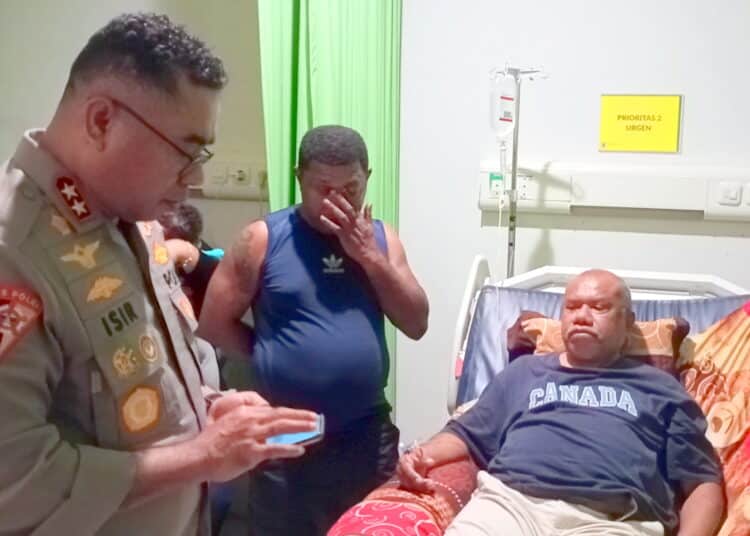
Yan Christian Warinussy, a senior lawyer and human rights activist in Papua, was shot by an unidentified person in Manokwari, West Papua province on Wednesday 17 July.

According to his driver, cited by some local media, the shooting occurred after Warinussy had just withdrawn money from an ATM kiosk on the roadside. Previously he attended a corruption trial involving some local state auditors at the Manokwari anti-corruption court.

He survived and was taken to hospital to get medical treatment. The doctor managed to remove an air rifle bullet projectile from his chest. Local police said they were investigating and attempting to find the suspected shooter.

Warinussy is known as a lawyer and human rights defender in Papua because of his dedication to advocating for the rights of the Papuan people. He leads the Research Institute for Legal Aid Assessment and Development (LP3BH) in Manokwari.

He has received various national and international awards for his human rights work, including the John Humphrey Freedom Award in 2005. This award recognized his efforts in exposing gross human rights violations in West Papua and defending the rights of the marginalized, despite facing repeated intimidation and threats. (*)

————————————————

Court rejects Papua journalist Victor Mambor’s appeal over bomb attack

Jubi Papua – July 9, 2024

Jayapura – Zakarias Talaty, the sole judge at the Jayapura District Court, has rejected a pretrial motion on behalf of senior Papuan journalist Victor Mambor against an Order to Stop Investigation (SP3) issued by the North Jayapura Sectoral Police (Polsek) on the grounds that the SP3 was legitimate due to the lack of witnesses who saw the bomb attack on Mambor’s home in March 2023.

Papua Human Rights Lawyers Association (PAHAM Papua) Director Gustaf R. Kawer said that the Papua Regional Police should take the Molotov bomb terror attack seriously by involving the Detachment 88 counter-terrorism unit.

“Not ‘trivialising’ it by allowing the investigators at the Polsek level to handle such a serious case, because the quality of investigators and the minimal equipment has an impacted on the conclusion that there was a lack of witnesses who saw the incident”, Kawer said as quoted in a press release received by Jubi on Tuesday July 9.

Kawer said that the bomb attack against Victor Mambor is a serious matter, because it is categorised as a special criminal offense regulated under the Anti-Terrorism Law and the Law on Firearms and Ammunition Owners.

“The police must take it seriously, because it involves the safety of people and the general public”, he said.

The lack of seriousness by the police in handling the case through to the issuance of the SP3, he continued, was repeated by Judge Talapatty in rejecting the pretrial motion without considering the documentary evidence and witnesses that were presented by the plaintiff.

Under the criminal law process, the party authorised to conduct investigations and criminal investigations, to find evidence in a crime is the police, who are given a mandate under the Police Law and the Criminal Procedural Code (KUHAP), not the victim or person who reports a crime, the victim’s family or third parties such as non-government organisations (NGOs).

“It’s very strange if the burden of proof is placed on the victim or reporter [of the crime]”, said Kawer.

According to Kawer, the pretrial ruling will clearly set a bad precedent for solving cases of terror against journalists, never mind with a Molotov bomb attack which had a serious impact on the victim and the general public.

The attack was carried out in the city of Jayapura, an area which in terms of uncovering the case should be very easy to do if the police work “supernaturally”.

“This case is certainly a mystery for senior journalists Victor Mambor who is the victim and the general public, how are these cases going to be uncovered if the police and judges treat it as ‘trivial’? The general public and press people, of course need police and judges ‘who work supernaturally’ so that in the future terror bombs like this can be uncovered”, he said.

Related

[Translated by James Balowski. Abridged slightly due to repetition. The original title of the article was “Praperadilan SP3 Ditolak, PAHAM Papua: Ini Perkara Serius”.]

Source: https://jubi.id/rilis-pers/2024/praperadilan-sp3-ditolak-paham-papua-ini-perkara-serius/

TPNPB Kodap XXXV Bintang Timur Claims to Burn School Buildings and Teachers’ Housing in Okbab Pegunungan Bintang

July 16, 2024 in Politics, Law and Security

0

Author: Admin Jubi – Editor: Edho Sinaga

One of the school rooms that was burned in Okbab – Jubi/Dok Warga

Jayapura, Jubi – The West Papua National Liberation Army (TPNPB) from the XXXV Bintang Timur Regional Defense Command (Kodap), Pegunungan Bintang, has reportedly burned down the Okbab Junior High School and Senior High School buildings as well as teachers’ housing in Okbab District, Pegunungan Bintang Regency, Papua Pegunungan Province, on Saturday (13/7/2024).

TPNPB spokesperson, Sebby Sambom, confirmed that the KOMNAS TPNPB headquarters had received an official report from the TPNPB Commander of Kodap XXXV Bintang Timur, Brigadier General Ananias Ati Mimin, and his troops. They conveyed this information on Sunday (14/7/2024) that all junior high school, senior high school buildings, and teachers’ housing in Borban Village, Okbab District, Pegunungan Bintang Regency, had been burned down on Saturday, July 13, 2024.

“TPNPB Kodap XXXV Bintang Timur has announced to the President of Indonesia since December 5, 2021 that they will burn down all school buildings in our operational area,” said Sambom.

Sebby Sambom stated that the Indonesian version of education in Papua is destroying the cultural, historical, and ideological values ​​of the Papuan people who fought for independence from Indonesia. According to him, students are forced to memorize the Constitution of the Republic of Indonesia and Indonesian heroes, which he considers an attempt to make the young generation of Papua stupid.

“It’s time for schools to be burned, government buildings to be burned. It’s time for Papuans to think about fighting for Papuan independence. Later, after independence, we will build better schools, hospitals, and government buildings in West Papua,” he said

Smoke was seen rising from the junior high and high school buildings and teachers’ housing in Borban village, Okbab district, Pegunungan Bintang regency, Papua Pegunungan province on Saturday (13/7/2024). Jubi/Doc Warga. 

Sambom also appealed to all students and college students throughout Indonesia to return to Papua and fight for Papuan independence. He added that after independence, all students and college students will be sent abroad to pursue better education using Papua’s own state funds.

Meanwhile, the Head of the Cartenz 2024 Peace Operation, Brigadier General Faizal Ramadhani, confirmed that the Armed Group had acted up again by burning down a school building and an elementary school office in Borban Village, Okbab District, Pegunungan Bintang Regency, on Friday (12/7/2024).

“We deeply regret this incident. This action not only harms children and teachers, but also damages the future of our young generation,” he said.

Brigadier General Faizal emphasized that the burning of this school was an extraordinary crime that must be dealt with firmly. Security forces will continue to make maximum efforts to arrest and punish the perpetrators of this crime.

In line with this statement, the Head of the Public Relations Task Force for the Cartenz-2024 Peace Operation, Senior Commissioner Bayu Suseno also strongly condemned the actions of the Armed Group. He stated that the burning of schools by the KKB was very inhumane and could not be tolerated.

“We will tighten security in conflict-prone areas and try to provide a sense of security to the community. We will not allow such heinous acts to destroy the enthusiasm of Papuan children to learn,” he said.

The burning of schools by the TPNPB adds to the long list of violence carried out by the group, which continues to disturb the community and disrupt security stability in Papua. The government and security forces continue to strive to overcome this security disturbance and restore conditions in the affected areas so that the community can return to their activities in peace.

“The community is expected to remain vigilant and report any suspicious activity to the authorities,” said Senior Commissioner Bayu Suseno.

One of the residents of Okbab District who witnessed the incident in Borban Village reported that the fire at the Okbab Junior High School and Senior High School buildings and the teachers’ housing was allegedly carried out by the TPNPB Kodap XXXV Bintang Timur group at 10:15 a.m. Papua time. This incident resulted in seven junior high school classes, six teachers’ houses, and three rooms at the Okbab Senior High School burning down.

“It is true that the junior high school, senior high school, and teachers’ housing burned down. “In SMA Negeri 1 Okbab there were 3 classrooms, the SMA Negeri Okbab office, 4 buildings burned down, textbooks burned down, and various other important documents,” said the resident when confirmed by Jubi. (*)

TNI officers hosts study activity for Central Papua children  

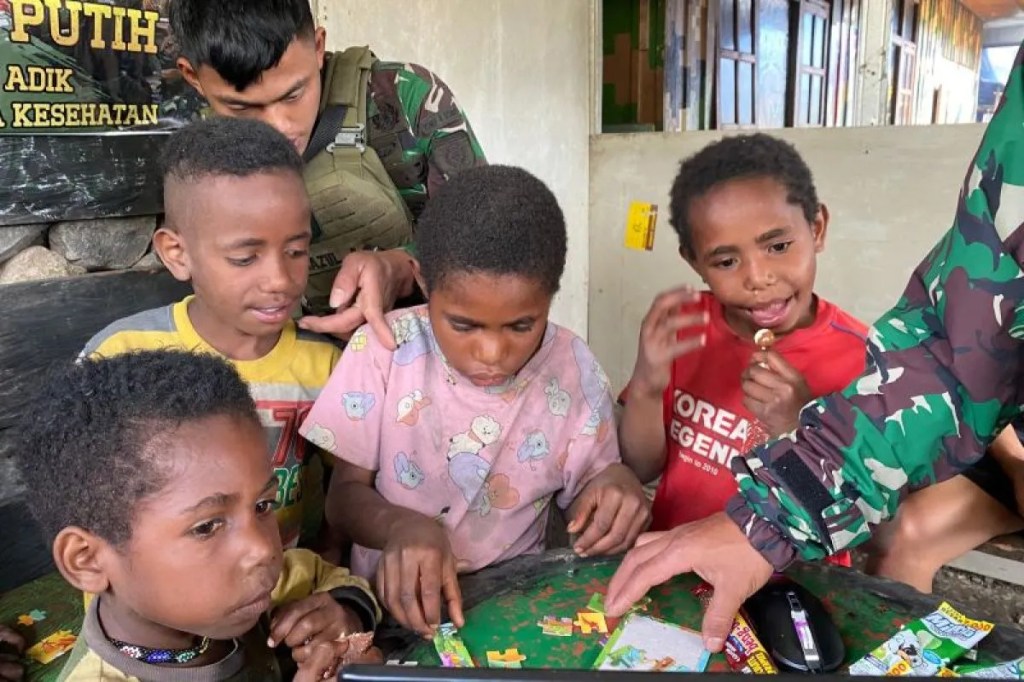
Children of Kago village participating in the “Smart Papua” study activity organized by officers of the Indonesian Armed Forces (TNI’s) Raider Infantry Battalion 323/Buaya Putih Kostrad task force stationed at the Koper Post in Puncak District, Central Papua, Saturday (July 13, 2024). ANTARA/HO-Koops Habema/nbl.

July 14, 2024 18:40 GMT+700 Bandung, West Java (ANTARA) – The Indonesian Armed Forces (TNI) has organized a “Smart Papua” study activity for primary school children of Kago village, in Puncak District, Central Papua while maintaining security in the region.

The community service was organized by officers of the TNI’s Raider Infantry Battalion 323/Buaya Putih Kostrad task force, operating under the command of the Habema Operational Command, stationed at the Koper Post in the village.

“The initiative of the 323 Task Force to organize the Smart Papua program at Koper Post reflects TNI’s commitment to providing basic needs, primarily education service for school-age children, to accelerate the development in Papua,” TNI’s Habema operational commander, Brigadier General Lucky Avianto, said in a press statement issued on Sunday.

Koper Post commander, First Lieutenant Anggun, personally invited primary school children in Kago village to take part in the activity organized by his unit on Saturday (July 13).

He noted the local children’s enthusiasm to flock to the activity, which he felt thankful for.

Apart from teaching school lessons, the TNI officers also taught children about respecting parents and their peers, as well as reminding them about the importance of ethics in a community.

Meanwhile, a local student, Lukas Tinal said he is happy to attend the learning activity by the TNI. “Thank you, ‘Uncle Soldier’. We enjoyed studying at the Kostrad 323 post. God bless you,” he remarked.

TNI’s humane approach in Papua is consistent with Presidential Instruction No. 9 of 2020 on the Acceleration of Welfare Development in Papua, which mandates the military to engage with local figures and strategic groups to promote regional development.

It also aligns with the soft power strategy devised by TNI commander General Agus Subiyanto to address Papua issues.

Habema Operational Command, a joint military-police task force, was set up earlier this year to optimize joint security operations in Papua to prevent local conflicts and neutralize the threat posed by armed Papuan groups, especially the Free Papua Movement (OPM).