
Coalition Suspects Yasinta Moiwend Controversy Is Linked to Ongoing Court Proceedings

Jayapura, Jubi – The Papua Coalition for Law Enforcement and Human Rights has suggested that Yasinta Moiwend’s recent objections to her inclusion in the documentary film Pig Feast: Colonialism in Our Time may be connected to an ongoing legal case before the Jayapura Administrative Court (PTUN).

Previously, five representatives of the Malind Indigenous community, including Yasinta Moiwend, filed a lawsuit challenging Merauke Regent Decree No. 100.3.3.2/1105/2025.
The decree concerns the environmental feasibility approval for the construction of a 135-kilometer access road as part of a food security project initiated by Indonesia’s Ministry of Defense.

The case was registered with the Jayapura Administrative Court under Case Number 9/G/LH/2026/PTUN Jayapura on March 5, 2026.

The Papua Coalition for Law Enforcement and Human Rights, which is part of the legal team assisting the plaintiffs, stated that lawyers serving on the Merauke Solidarity Advocacy Team, acting as legal counsel for Yasinta Moiwend, cannot be subjected to criminal or civil liability for carrying out their professional duties.

“Yasinta Moiwend is a client of the Merauke Solidarity Advocacy Team, which is currently representing her in proceedings before the Jayapura Administrative Court,” the coalition said in a written press release issued on Wednesday (June 3, 2026).

According to the coalition, the advocacy team has been assisting Moiwend and four other Indigenous representatives in their lawsuit against the Regent of Merauke.

During the proceedings, Indonesia’s Minister of Defense entered the case as an intervening defendant. This was marked by the submission of the intervening defendant’s response to the panel of judges overseeing Case Number 9/G/LH/2026/PTUN JPR, which was filed on May 18, 2026.

The Ministry of Defense’s involvement came after the Merauke Solidarity Advocacy Team and the legal team representing the Merauke Regent had reached the rejoinder stage of proceedings.

The coalition stated that while the advocacy team was preparing its response to the Ministry of Defense’s submission, the public was surprised by the circulation of a video in which Yasinta Moiwend questioned the use of footage featuring her in the documentary Pig Feast: Colonialism in Our Time.

In the same video, Moiwend also stated that she would not travel to Jayapura to attend court hearings in the case.

“Taken together, these developments indicate that those who recorded and disseminated the video were clearly targeting the legal proceedings currently underway at the Jayapura Administrative Court,” the coalition stated.

The coalition further argued that because one of the statements in the video directly referred to the PTUN proceedings, the individuals who recorded and publicized the video had violated professional ethics by failing to coordinate with the Merauke Solidarity Advocacy Team, which remains Yasinta Moiwend’s legal representative.

“What is even more unusual is that, without any revocation of the power of attorney, the Director of LBH Papua Merauke was later reported to the Metro Jaya Police. In fact, the Merauke Solidarity Advocacy Team continues to hold legal authority as Yasinta Moiwend’s counsel in Case Number 9/G/LH/2026/PTUN JPR,” the coalition wrote.

The coalition argued that the police report against one of the leaders of an advocacy institution that is part of the Merauke Solidarity Advocacy Team contradicts Article 16 of Law No. 18 of 2003 on Advocates, which provides that advocates cannot be prosecuted civilly or criminally while carrying out their professional duties in good faith on behalf of their clients in court proceedings.

Based on that provision, the coalition stated that allegations made by Yasinta Moiwend against a member of the advocacy team, as well as actions taken by lawyers assisting her in filing reports with police authorities, should be reviewed by Indonesia’s advocate organizations in accordance with professional ethics procedures outlined in Article 8 of the Advocates Law.

The coalition also invoked Article 100 of Law No. 39 of 1999 on Human Rights in calling on the Papua representative office of Indonesia’s Judicial Commission to monitor the professionalism of the panel of judges handling Case Number 9/G/LH/2026/PTUN JPR.

The coalition urged the panel of judges at the Jayapura Administrative Court to conduct the proceedings professionally and impartially. It also reminded the Regent of Merauke and Indonesia’s Minister of Defense, who are defendants in the case, not to use the Yasinta Moiwend controversy to influence or gain an advantage in the ongoing legal proceedings.

In addition, the coalition called on the National Police Chief to instruct the Metro Jaya Regional Police to observe legal protections afforded to advocates and legal aid providers under Article 16 of Law No. 18 of 2003 on Advocates and Article 11 of Law No. 16 of 2011 on Legal Aid in relation to the Yasinta Moiwend case.

The coalition further urged the Honorary Council of Indonesia’s advocate organizations to immediately investigate alleged violations of the legal profession’s code of ethics related to the case.

The Papua Coalition for Law Enforcement and Human Rights, which provides legal assistance to the Malind Indigenous community, includes LBH Papua, PAHAM Papua, ALDP, KPKC Synod of the Land of Papua, JPIC OFM Papua, Elsham Papua, Yadupa, the Indonesian Legal Aid Foundation, LBH Papua Merauke, LBH Papua Sorong Office, KontraS Papua, and Tong Pu Ruang Aman. (*)

Nuevaterra Mambor 
Malind Indigenous People Defend Their Customary Land Rights Under Intimidation

March 6, 2026 in Animha Reading Time: 4 mins read

0

Author: Aida Ulim – Editor: Arjuna Pademme

Jayapura, Jubi – The struggle of the Malind indigenous people in Merauke Regency, South Papua, to defend their customary lands and forests from government land clearing projects for plantation and agricultural investment has not been easy. They have faced intimidation and pressure from the military.

Andreas Mahuse, a Malind indigenous person, said that the community there experienced pressure from the military following the forest clearing. Around a thousand military personnel were stationed in Ilwayab District, Merauke Regency.

According to him, a number of mistakes were made by the central government, provincial government, and Merauke Regency Government in implementing investment projects in the Malind community’s customary territory.

“The first is the taking of customary land since 2024 without the consent and notification of the indigenous community,” said Andreas Mahuse after the Malind indigenous community filed a lawsuit with the Jayapura State Administrative Court (PTUN Jayapura) in Waena, Jayapura City, Papua, on Thursday (March 5, 2026).

He said there had never been any dialogue or negotiation between the government or the company and the indigenous community regarding land ownership status and the planned transfer of land to the company.

“There should have been a meeting with us, the indigenous people, to discuss who owns this land and whether or not the community agreed to its use. However, such a process never occurred,” he said.

Andreas Mahuse stated that the lawsuit filed with the Jayapura Administrative Court (PTUN) was also part of the Malind indigenous people’s efforts to defend their customary land.

The lawsuit was filed by five representatives of the Malind indigenous people: Simon Petrus Balagaize, Sinta Gebze, Andreas Mahuze, Liborius Kodai Moiwend, and Kanisius Dagil, under case number 9/G/LH/2026/PTUN Jayapura.

The Malind indigenous people are challenging the Merauke Regent’s Decree Number 100.3.3.2/1105/2025 concerning the environmental feasibility permit for the construction of a 135-kilometer road for the National Strategic Project (PSN).

“[This lawsuit] is a form of struggle to defend customary land and forests from the government’s National Strategic Project (PSN) for rice paddy development,” said Andreas Mahuse.

Andreas Mahuse explained that the 135-kilometer road, part of the rice paddy development project, was forcibly constructed without the community’s consent.

The road stretches from Wanam Village, Ilwayab District, passing through several villages and reaching Muting District.

“The villages [through which the road construction passes] include Wanam, Wogikel, Salamepe, Nakias, Tagaepe, Ilhalik, Kapdel, and Solo Village. This project also crosses several districts, namely Ilwayab, Ngguti, and Muting Districts,” he said.

The indigenous community ultimately filed the lawsuit, alleging administrative errors in the project. Forest clearing for road construction began in September 2024, but the environmental permit document was only issued in September 2025.

“This is a very serious state administrative error for us indigenous people,” he said.

Furthermore, Mahuse continued, the indigenous community has never seen important documents such as the Environmental Impact Analysis (AMDAL) or the technical development planning documents.

The project is also considered to have the potential to damage the indigenous community’s culture, as it has changed the community’s lifestyle, which has traditionally relied on sago as a staple food, replacing it with rice.

“This is not only an environmental issue, but also a violation of the indigenous community’s cultural rights,” said Andreas Mahuse.

Another representative of the Malind indigenous community, Sinta Gebze from Wanam Village, said the company entered their customary territory without the community’s permission, with a large military escort, which has made the community afraid to resist directly.

According to her, some residents have experienced violence from security forces. They were beaten, resulting in injuries, and some were even paralyzed.

“Furthermore, I experienced intimidation while at a place of worship. I was picked up at the church door. I asked them, ‘What did I do wrong? I was just defending my land rights,'” said Sinta Gebze.

He said the company’s activities continue day and night, and the indigenous people have been unable to stop the clearing of their forests and gardens.

“The community has been demanding compensation for the cleared crops since 2024, but there has been no response from the company,” said Sinta Gebze.

Another Malind indigenous community member, Simon Petrus Balagaize, said the project has also sparked social conflict among the indigenous people, as some accepted the company’s offer, while others refused. The conflict culminated in violence and the burning of the homes of residents who opposed the project.

“Initially, the project was carried out by PT Jhonlin Group, then by other companies, but these companies denied their involvement,” said Simon Petrus Balagaize.

He said that most of the Malind’s customary territory has now been divided into various company concessions. Of the approximately two million hectares of customary territory, the majority has been included in company concessions or designated as production forest areas.

“The last remaining forest is our habitat, along with cassowaries, birds-of-paradise, and many other animals. There’s also sago, our staple food,” he said.

The Malind indigenous people, according to Balagaize, do not oppose development. Instead, they want to be respected as owners of their customary land. For indigenous people, the forest is a living space that provides all their needs.

“For us, the forest is heaven; God has provided everything there. That’s why we defend our forest. Customary land does not belong to the village head, the traditional chief, or the government, but to the clan, passed down from generation to generation,” he said.

He stated that if any clan holding customary rights disagrees, the customary land cannot be relinquished. Balagaize called for solidarity and support for the Malind indigenous people’s struggle to defend their customary land and forest. (*)

Red cloth and paint: Papuan indigenous people’s efforts to protect the world’s lungs

March 6, 2026 in Domberai, Environment Reading Time: 4 mins read

0

Author: Gamaliel Kaliele – Editor: Angela Flassy

Indigenous people mark trees in the forest as boundaries of their customary areas – Jubi/Gamaliel

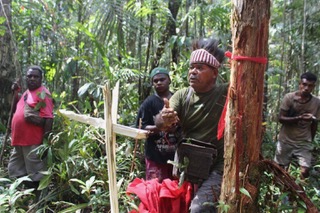
Teminabuan, Jubi – Indigenous elders, women, and youth, along with Jubi journalists, walked through the Kordaimahkrah, Sun, Mondarmbe, and Nimadaduk forests in Konda District, South Sorong Regency, Southwest Papua. They carried red cloth and paint to mark the forest’s trees as customary territory boundaries, based on natural landmarks such as large trees, rivers, and mountains that have long served as boundaries for customary rights between clans, Wednesday (March 4, 2026).

The forest they have long protected is under threat from the expansion of the palm oil company PT Anugerah Sakti Internusa (ASI), which holds a concession of approximately 37,000 hectares in the Konda and Teminabuan Districts. Of these, 14,000 hectares are located on the customary lands of these indigenous people.

Yance Mondar, a community leader from Nakna Village, stated that through this action, the indigenous people of Konda District are sending a strong message to companies and the government that customary forests are not investment-free areas and that these lands have a history, ownership, and life that cannot be replaced with money or promises of development.

“We reject oil palm, not because we don’t want development, but because oil palm will destroy the forests that have long been part of our lives and beliefs,” he said.

“If the forest disappears, our livelihoods will also disappear, and our ancestral heritage will also disappear,” he said.

The South Sorong Regency Government revoked the plantation business permit of PT Anugerah Sakti Internusa (ASI) on May 20, 2021, through South Sorong Regent Decree No. 025/104/BSS/V/2021. The reason was that when PT ASI obtained the permit, it failed to comply with the obligations stipulated in the IUP, such as the indigenous community’s failure to consent to the company’s acquisition of customary land and forest. PT ASI’s lawsuit was filed with the State Administrative Court (PTUN) and the Supreme Court, and the indigenous community won.

Despite the legal standing, PT ASI has recently continued its efforts to obtain the indigenous community’s permit by conducting outreach campaigns, as happened three weeks ago. While state apparatus is being used to threaten indigenous communities, the communities continue to strive to protect tropical forests, which are the lungs of the entire world.

Jubi journalists embarked on a long journey on foot through the wilderness from the nearest village early in the morning, without vehicles and without communication.

The only guides were the traditional elders who had lived alongside the forest since childhood.

The deeper they went into the jungle, the denser and quieter the atmosphere became. Large trees towered tall, some exceeding one meter in diameter and estimated to have been living for hundreds of years. The thick canopy allowed only a thin layer of sunlight to penetrate the forest floor. Giant tree roots spread through the damp soil, while the sounds of birds and wildlife could occasionally be heard in the distance.

“For us, the indigenous people of Konda District, this forest is more than just a natural expanse; every large tree, small river, and mountain ridge marks the boundaries of our customary territory,” said Mondar.

These boundaries are not written on national maps, but live in the collective memory of the indigenous people.

During the journey, dozens of indigenous people gathered to perform a ritual and then planted traditional stakes to mark the boundaries of their customary rights.

Yance Mondar said the forest patrols and the installation of customary stakes were carried out to protect the area from the threat of oil palm plantation expansion.

“We surveyed and created these customary markers because a company and several other parties are planning to let in oil palm plantations. So we are also afraid and must protect our customary land,” he said.

He said the community is worried that if the forest area is cleared for oil palm plantations, they will lose their living space.

“If oil palm plantations come in, they will destroy our small forest. Where will we live? Where will we hunt? Where will we farm? So, we can’t give up these rights if this area is cultivated for oil palm, then where will our lives be?” said Yance Mondar.

The forest patrol attended by Jubi journalists involved various clans, including Mondar, Kareth, Sarus, Sianggo, Karet, and Kemeray. They included traditional elders, women, and even youth.

Red cloth and red paint marked large trees as symbols of customary prohibitions.

Throughout their reporting journey, Jubi journalists also found signs of wildlife: wild boar tracks were visible in the damp soil, while the sounds of cassowaries and birds of paradise could be heard from within the forest.

“This forest is also a habitat for various animals such as cuscuses, tree kangaroos, deer, and various species of native birds,” said Grice Mondar, standing, pointing to the dense expanse of large trees surrounding him.

He explained that the forest is a primary food source for indigenous communities who still depend on nature.

“In this forest, wild boars, cassowaries, laulau, kangaroos, cuscuses, maleo, deer, and many other wild animals live here. So, our extended family rejects the oil palm plantation,” he said.

Besides being a hunting ground, the forest also serves as a living space for indigenous women. They collect various medicinal plants and craft materials from the forest for their families’ needs.

Mama Fransina Sianggo explained that various household needs come from nature. “This forest barrel is used for medicinal purposes when a family member is sick. We also collect mat leaves and grass to make noken (traditional bamboo baskets) and mats for the family’s needs,” she said.

Yulian Kareth, an Afsya traditional leader who participated in the forest patrol, emphasized that the indigenous people will not hand over their territory to any company, because this forest is not empty land; it has its owners.

“So, we will always reject oil palm,” he asserted.

The forest is their home, their source of life, and a spiritual space that connects them to their ancestors. Therefore, planting customary stakes in the forest is not only a symbol of territorial boundaries, but also a form of resistance by indigenous peoples to maintain their identity, culture, and the future of their generations as the lungs of the world. (*)