Indonesia’s Constitutional Court has issued a landmark ruling prohibiting active police officers from holding civilian government positions. Still, the implementation of the decision has sparked controversial discussions as thousands of police officers remain in posts across ministries and state agencies.
Constitutional Court Decision Number 114/PUU-XXIII/2025, delivered on 13 November 2025, struck down provisions that had allowed active members of the Indonesian National Police (INP) to occupy civilian positions through assignments from the National Police Chief. The ruling mandates that police officers must resign or retire before taking up positions outside the police structure.
Thousands of police officers in civilian roles
The scale of police placement in civilian positions has expanded dramatically in recent years. According to official data, 4,351 police officers held positions outside the National Police in 2025, including 1,184 officers at senior ranks. This represents a significant increase from 2,822 officers in 2024 and 3,424 in 2023.
High-ranking officers occupy prominent positions across government, including secretary-general positions at multiple ministries, inspector-general posts, and leadership of agencies such as the National Counterterrorism Agency. In March 2025 alone, the National Police Chief issued six telegrams assigning 25 high-ranking and mid-ranking officers to various ministries and institutions.
As of late November, only one officer had been withdrawn from a civilian position. National Police Chief General, Listyo Sigit Prabowo, recalled Inspector General Raden Prabowo Argo Yuwono from the Ministry of Cooperatives and Small and Medium Enterprises on 20 November 2025, describing it as demonstrating commitment to the ruling.
Concerns over selective compliance
Constitutional law experts and civil society observers have demanded to fully implement the decision. Currently, the government appears to be “cherry picking” which Constitutional Court decisions to follow, implementing only those that serve its interests while ignoring rulings with significant public importance.
Observers note that Constitutional Court decisions are final and binding, taking immediate effect. Police analyst Bambang Rukminto warned that continued delay represents an unconstitutional practice and undermines the rule of law. The placement of officers in civilian roles has continued year after year due to weak oversight by Parliament’s Commission III, which handles law enforcement matters.
Rights and governance implications
The Constitutional Court’s decision followed a petition from advocate Syamsul Jahidin and student Christian Adrianus Sihite, who argued that the practice violated citizens’ constitutional rights to fair access to employment. With approximately 7.46 million job seekers in Indonesia as of August 2025, civilian positions occupied by active police officers reduce opportunities for qualified civilians to obtain government posts.
The practice of positioning active police officers in prominent civilian positions creates significant conflicts of interest. Civil observers argue that the placement serves as a tool of political control, allowing those in power to extend influence across government agencies while compromising police independence. They warned that official non-compliance with court rulings undermines legal culture and public respect for the law. Without mechanisms to enforce compliance with Constitutional Court decisions, the independence and accountability of Indonesia’s judiciary are at stake.
Path forward uncertain
The National Police has formed a working group to review the Constitutional Court decision, but no timeline has been announced for withdrawing officers from civilian positions. Some officials have suggested that certain agencies with law enforcement functions, such as the National Narcotics Agency and National Counterterrorism Agency, may still require police personnel.
Parliament’s Commission III has established a working committee on police reform that will provide recommendations for revising the Police Law to align with the Constitutional Court ruling. However, critics note that the same parliamentary body failed to exercise adequate oversight as the practice expanded over the past decade.
As debate continues, civil society groups emphasize that the Constitutional Court’s ruling represents an opportunity to restore the police force to its constitutional mandate of protecting and serving the community while ensuring fair access to public employment for all citizens.
The rationale for the new allowance was that legislators in the current term [2024-2029] were not receiving government housing, unlike in previous years, and were therefore entitled to compensation. This was further justified by the fact that many legislators are not from Jakarta and have to pay for accommodation when they are in town. The previously existing DPR housing complex where they received free accommodation was decommissioned in 2024 due to quality complaints from residents.
The allowance announcement led to outrage for many reasons. First, the amount of Rp50 million was seen as outrageously high—much more than what ‘ordinary Indonesians’ earn—and a poor use of taxpayers’ money. This was further exacerbated by a viral moment in which Kadir gave a nonsensical calculation for how the Rp50million amount had been determined, defended it as being insufficient to find suitable accommodation in the vicinity of the legislative complex. He claimed that around Rp78million would be required every month and so legislators would still be out-of-pocket.
While a charitable interpretation would be that Kadir misspoke, the fact that his calculations were wildly incorrect led to ridicule and undermined the rationale of the allowance. Responding to pressure, Deputy House Speaker Sufmi Dasco Ahmad clarified on 26 August 2025 that the allowance would only be applicable for one year, from October 2024-October 2025, and that it could only to be used for housing, dismissing claims that it was a salary increase. However, this explanation has done little to address the underlying concerns that prompted public anger in the first place.
So, what do these protests say about current attitudes towards politicians, their work and their lifestyles in Indonesia? Following on from the recent One Piece flag phenomenon, the critiques that have unfolded reflect much deeper issues regarding Indonesians’ perceptions of politicians. Not only are they seen as out of touch with the concerns of everyday people but also the decisions they make about government spending are made without transparency and accountability.
The housing allowance: is it justified?
One reason the new Rp50 million (AUD4,700) monthly housing allowance was such a shock to Indonesians is that it stands in stark contrast to the minimum wage rate (Upah Minimum Regional, UMR) for Jakarta, which currently sits at Rp5,396,791 (approximately AUD500) per month. As the minimum wage is government-sanctioned, the fact that another government body came out so publicly with wildly different calculations for housing, let alone other costs associated with surviving in Jakarta, hit a raw nerve.
There have also been calls for more transparency on how the DPR decided on the allowance amount in the first place. Defending the decision, House Speaker Puan Maharani said that the determination was thoroughly evaluated and took into account ‘the conditions and prices in Jakarta.’ A cursory scan of property websites in Indonesia such as rumah123 and lamudi.co.id, list a wide range of accommodation available for rent around the Senayan area which surrounds the legislative complex. Yes, the area is central and highly desirable, but fully-furnished 2-bedroom apartments can still be found for under Rp10 million per month. Considerably larger houses at the low-end of the price spectrum can be found for Rp20 million per month.
Of course, there are other neighbourhoods close by that offer comparable options at significantly lower prices. The previous accommodation for DPR members was in Kalibata, a neighbourhood around 10 kilometres away from the DPR offices. This does beg the question of how legislators landed on the allowance sum of Rp50million per month in the first place, and whether politicians’ entitlements are too high.
Indonesia Corruption Watch (ICW) and the Indonesian Institute have framed the debate in terms of what politicians already earn, highlighting that their compensation is already generous and their accommodation should not be further subsidised with public funds. In the aftermath of the announcement, several politicians have made public their earnings. Puan Maharani and Dasco Ahmad have both stated that their take home pay is around Rp100 million per month (AUD9,381), including base wages, allowances and higher duty benefits.
But the Indonesian Forum for Budget Transparency (Forum Indonesia untuk Transparansi Anggaran (Fitra) has claimed it to be closer to Rp230million(AUD21,578). For reference, the Central Statistics Agency (Badan Pusat Statistik, BPS), put the average monthly salary for managers in Jakarta at Rp14,329,826 (AUD1,341) (August 2024).
With politicians’ salaries way above average pay rates in Jakarta, politicians have been accused of being unworthy of such high salaries and out of touch with the concerns of everyday Indonesians.
The public response of some politicians has added further fuel to the fire. Accused of being out of touch, KBR.ID have called the situation an ‘empathy test‘ for politicians, which several seem to have failed. Project Multatulicompiled a list of quotes which exemplified the haughty retorts of politicians.
In some choice examples, PDI-P member Deddy Sitorus was quoted as saying that comparing legislators to becak drivers or workers is a ‘logical fallacy’, while Nasdem member Ahmad Sitori stated that people calling for the dissolution of the DPR ‘are the dumbest people in the world.’ Nasdem member Nafa Urbach refuted criticism of the housing allowance, arguing that due to traffic her commute to the DPR from outer suburb Bintaro was ‘’extreme” (luar biasa) so she needed the allowance to live closer to work. Kompas, in a sly lampooning of this argument, calculated that by taking public transportation and walking she could be at work within 35 minutes.
Online discourse criticising the decision has drawn much from ideas about the appropriate use of public funds and that, as taxpayers, Indonesians should have a say in how politicians are compensated. Much has been made about Indonesia’s economic situation which led to drastic cross-sectoral funding cuts earlier in 2025, including to the education and health budgets, and regional fund transfers. In an economic context where the government has been forced to take drastic measures and promote ‘efficiency’ within the national budget, a high additional allowance for lawmakers seems like a poor use of already limited funds.
Attempts to silence criticism have further angered the public. Reminiscent of the political debate surrounding flying the One Piece flag on Indonesia’s national day, the Deputy Minister for Communication and Digital, Angga Raka Prabowo, called on social media platforms TikTok and Meta to assist with deplatforming ‘provocative content.’ In their attempts to mediate online channels, places where citizens can post their political complaints and critique government policies, politicians have only intensified the perception they believe that they should be above criticism.
Questioning the position of politicians
The protests and commentary on the housing allowance, both online and offline, reflect a revived spotlight on debate about the role of politicians and public expectations of them.
While the announcement of the housing allowance provided an impetus for outrage, the issues subsequently discussed are reflective of a much deeper dissatisfaction with the way the government is run. These August 2025 protests are part of a more recent history of protests stemming from the Dark Indonesia (Indonesia Gelap) movement, which aimed to highlight a plethora political complaints.
One of the fundamental reasons that the housing allowance has triggered anger is related to public perceptions of politicians and their role as representatives of citizens’ interests. Arguments that since politicians’ salaries are funded by public money, they should be beholden to the public fuels these complaints.
Indonesians are used to politicians falling short of expectations, evidenced by the high number of politicians embroiled in the corruption scandals flooding national news. But the housing allowance was particularly jarring because people could directly compare it to what they earn themselves.
This has opened the floodgates for a more intense focus on politicians’ salaries and, more importantly, whether they are worthy of them. Here, the argument is that if politicians do not understand what it is like to live as an ordinary person in Indonesia, how can they possibly represent ordinary people’s interests?
These complaints are not new. They reflect a long-existing divide between political elites and everyone else within Indonesian society. But with increasing social media commentary and debate, Indonesians are better able to connect across grievances and mobilise, both online and offline. The call for accountability and increasingly vocal demands that politicians answer to the public are reflective of an rising sense of dissatisfaction with the status quo, which, if not resolved, might lead to an ever-rising number of protests in the future.Analysis, Policies, Politics
Most tropical countries are experiencing record-high deforestation rates, but in Indonesia, forest loss is slowing.
But nearly half of the forest cleared in 2024 can’t be linked to an identifiable driver, raising red flags about speculative land clearing, regulatory blind spots and delayed environmental harm.
Land is often cleared but not immediately used; research shows that nearly half of deforested lands in Indonesia remain idle for more than five years.
Experts say these trends signal regulatory failure, as the government issues permits widely and concession holders face few consequences for clearing forest and abandoning the land, creating a cycle of destruction without accountability.
JAKARTA — While most tropical countries experienced record-high deforestation rates in 2024, Indonesia’s forest loss is slowing, bucking a global trend.
But beneath the headline figures lies a troubling mystery: Nearly half of the forest cleared last year can’t be linked to any identifiable driver, raising red flags about speculative land clearing, regulatory blind spots and delayed environmental harm.
This uncertainty complicates supply chain accountability under laws like the EU Deforestation Regulation, and raises questions about who’s really clearing Indonesia’s forests — and why.
In 2024, Indonesia lost 242,000 hectares (598,000 acres) of primary forest, down 14% from 279,000 hectares (689,000 acres) in 2023, according to an analysis by TheTreeMap, a technology consultancy behind the Nusantara Atlas forest monitoring platform.
Annual Deforestation in Indonesia (2001-2024). Image courtesy of TheTreeMap.
TheTreeMap used satellite and time-series imagery to attribute deforestation to known drivers. They are logging (18%), industrial oil palm (13%), pulpwood/timber plantations (6%), mining (5%), food estate projects (3%) and fires (2.3%).
Together, these drivers explain just 47.3% of Indonesia’s 2024 primary forest loss — leaving the majority unattributed, which experts say reflects both data limitations and deeper governance failures.
What explains this gap in attribution? A likely reason is that land is cleared but not immediately used.
A study published in 2024 in the journal Proceedings of the National Academy of Sciences (PNAS) found that nearly half of all deforested land in Indonesia remained idle for at least five years — meaning it wasn’t converted to plantations, agriculture or any observable land use.
These areas are often eventually converted to agriculture — usually oil palm — but the long delay obscures who cleared the land and why, TheTreeMap noted.
There are many examples of these across Indonesia, said Timer Manurung, the director of the environmental NGO Auriga Nusantara.
In Riau and Bengkulu provinces on the island of Sumatra, for example, natural forests in some selective logging concessions have been cleared, and yet the permit owners seem to have abandoned the concessions.
As a result, oil palm investors moved in years later and began planting, Timer said.
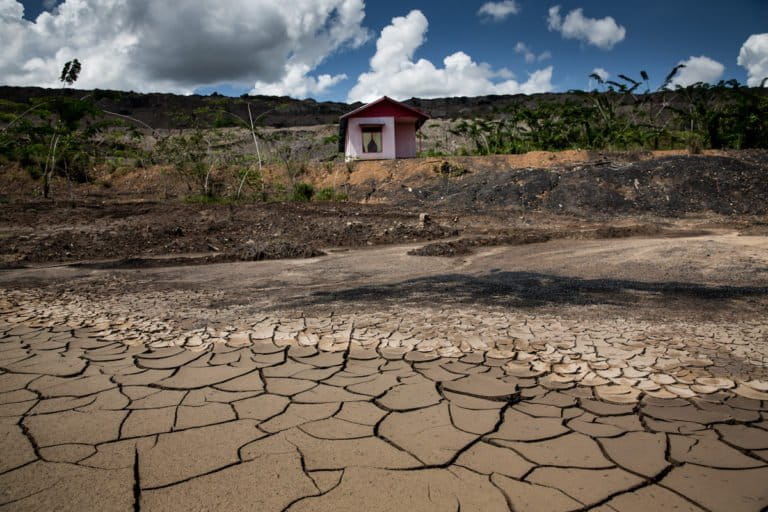
A lone house is left standing at an abandoned village after a nearby mining concession degrades the surrounding environment. Image by Kemal Jufri/Greenpeace.
The deeper roots of idle land
While nearly half of Indonesia’s primary forest loss in 2024 remains unexplained, experts say this absence of clear attribution is not simply a data gap — it may be a warning sign of deeper governance issues.
One leading explanation is speculative clearing, when companies clear forests without immediately converting the land to plantations or infrastructure. According to Arief Wijaya, managing director of World Resources Institute (WRI) Indonesia, this pattern has persisted since the 1990s, when companies obtained forestry or plantation permits, extracted valuable timber and left the land idle. In many cases, this was deliberate: either a lack of capital to proceed or part of a long-term land banking strategy.
These behaviors point to regulatory failure, as the issue of abandoned land is closely tied to the “reckless issuance of permits” by the government, said Boy Jerry Even Sembiring, the director of the Riau chapter of the country’s largest green group, Walhi.
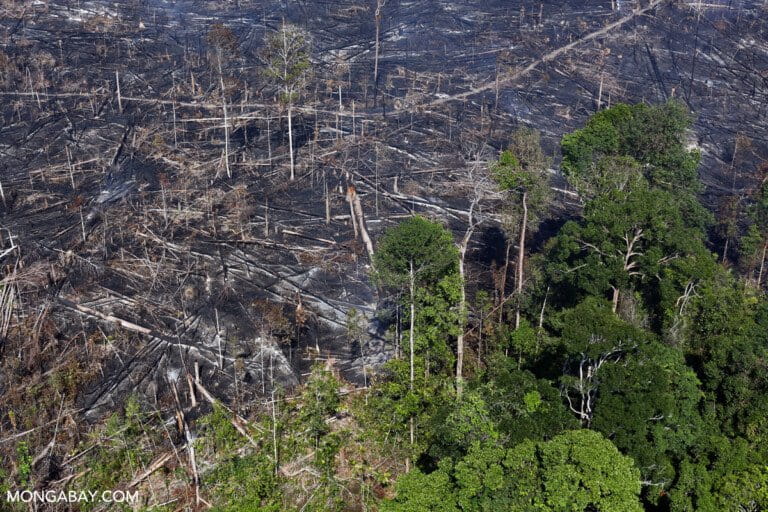
Concession holders face few consequences for clearing forest and abandoning the land, creating a cycle of destruction without accountability. The result is a patchwork of degraded forestland, legal ambiguity and lost oversight — fertile ground for future land conflict, encroachment, opportunistic development and fires.
In an effort to address this, Indonesia’s Ministry of Forestry earlier this year revoked 18 inactive forestry concessions covering more than 526,000 hectares (1.3 million acres). Minister Raja Juli Antoni framed the move as part of a broader push to reclaim unproductive concessions and reassert state control over idle forestland.
But Arief warned that the recent revocations barely scratch the surface.
“If we look at the broader picture, this land speculation has been happening for over 30 years,” he told Mongabay.
Without a systematic approach to identify, map and resolve the status of idle lands, the problem will persist — quietly fueling environmental degradation, sparking community conflict and undermining efforts to clean up supply chains, Arief said.
Once land is cleared and left idle, communities often move in and begin farming, sometimes triggering future land disputes, especially when the land is later contested by concession holders or targeted for development, he added.
Idle land is also prone to fires, activists say.
Boy of Walhi Riau said abandoned lands consistently burn during the dry season.
“After being cleared, they [idle lands] often burn, yet there’s no proper accountability or follow-up review process for these incidents,” he said.
Between 2001 and 2021, Indonesia lost more than 28 million hectares (69 million acres) of forest. However, since peaking in 2016, forest loss in Indonesia has continued to decline. Image by Rhett A. Butler/Mongabay.
Turning idle land into opportunity
Therefore, Arief called on the government to come up with a targeted and comprehensive strategy.
The first order of action is to map where the idle lands are and identify their owners and jurisdictions. If during the mapping it turns out that communities have already controlled the land and conflicts have emerged, then the government needs to resolve the conflicts first, Arief said.
After that, the government and other stakeholders should develop a plan for how to use these lands — whether through rehabilitation, community use or reallocation, he said.
One option is to mandate the rehabilitation of the idle lands, if they are located within concessions.
Yuliusman, the director of Walhi South Sumatra, said concession owners need to be held responsible for the land they control, including when these lands are cleared and burned.
That’s why the government needs to make land ownership data available to the public so landowners can be held accountable, he said.
Another option is to grant communities rights to manage these idle lands through the social forestry scheme.
The program, initiated by President Prabowo Subianto’s predecessor, former President Joko Widodo, is one of the largest socioenvironmental experiments of its kind, aiming to reallocate 12.7 million hectares (31.4 million acres) of state forest to local communities and give them the legal standing to manage their forests.
By granting social forestry permits to communities with a clear business plan, the government could empower small farmers while bolstering food security at the same time, Arief said.
This aligns with the platform of Prabowo, who has prioritized achieving both food and energy self-sufficiency as cornerstones of his administration, he added.
Since his election campaign in late 2023 and early 2024, Prabowo has emphasized the need for Indonesia to achieve sovereignty in these critical sectors to bolster economic resilience and national security.
In December 2024, Minister Raja Juli announced the government had identified 20 million hectares (50 million acres) of forest area for potential conversion into “food and energy estates.”
The announcement raised concerns over new deforestation, especially if the areas include intact forests. But Arief said the plan could be positive — if those hectares are truly idle lands that have already been cleared and remain unproductive.
“If we already know there are 20 million hectares of low-productivity land, and we have a food security program, then we can map which crops are suitable — maybe some areas for rice paddies, others for water conservation, others for energy,” he said. “That’s where we need a road map.”
Recognizing the rights of communities to manage their lands could also help prevent fires, according to Rod Taylor, the global director of WRI’s forests program.
“I think some of the success in Indonesia [in mitigating fires] can be put down to really good collaboration between companies and communities, to not only prepare for big fires and a lot of enforcement of no burning laws, but also really fast response mechanism to spot and take action against fires before they can spread too far,” he said.
Having a road map that puts community rights at the forefront is also critical to resolving lingering land conflicts, said Timer of Auriga Nusantara.
It’s also necessary to address Indonesia’s deep-rooted structural injustice in land ownership. Today, 68% of the country’s land is controlled by just 1% of the population, as the state prioritizes concessions to large corporations over community land rights.
These large-scale infrastructure and resource extraction projects have pushed marginalized groups such as farmers, Indigenous communities and fisherfolk off of their lands.
Between 2015 and 2024, more than 3,200 agrarian conflicts broke out across 7.4 million hectares of land (18.3 million acres) — affecting 1.8 million households.
Timer warned against using the existence of idle land as a pretext to expand industrial agriculture, which he said would only deepen Indonesia’s land conflicts.
“We must avoid justifying the planting of monoculture commodities on deforested land in the name of ‘what’s already happened,’” he said. “If these areas must be converted, then they should be turned into social forestry zones — and owned by local communities, not corporations.”
Citation:
Parker, D., Tosiani, A., Yazid, M., Sari, I. L., Kartika, T., Kustiyo, … Hansen, M. C. (2024). Land in limbo: Nearly one third of Indonesia’s cleared old-growth forests left idle. Proceedings of the National Academy of Sciences, 121(28). doi:10.1073/pnas.2318029121
Banner image: Peatlands destruction in Riau, 2014. While Indonesia has in the past been a major carbon emitter due to land-use change, deforestation, forest fires and peatland destruction, the recent decline in deforestation is seen as a positive sign. Image by Rhett A. Butler/Mongabay.
On 17 July 2025, members of the Indonesian security forces, including the Beoga Police Chief and personnel from the Indonesian Armed Forces (TNI), were captured on video engaging in the illegal collection of community funds from village heads in Beoga District, Puncak Regency, Central Papua Province. The recording (see video below, source: independent HRD) reveals a police officer, apparently in command, orchestrating and directing the unlawful redistribution of BLT (Direct Cash Assistance) funds, including orders to transfer money to armed personnel. The total amount allegedly extorted from all nine villages in the district is estimated at Rp. 450,000,000 (approx. € 24,000).
The 90-second recording, reportedly made on 17 July 2025, shows armed TNI officers and a high-ranking police officer addressing several village heads about the distribution of Direct Cash Assistance (BLT) funds. During the conversation, the officer suggests that part of the funds should be handed over to personnel from the TNI task force, Koramil, and Polsek as a form of “security” compensation. His statements imply an orchestrated and coercive appropriation of public aid funds by security forces.
In the exchange, one village head confirms that such a process had occurred previously and volunteers to facilitate the distribution. Another village leader, dressed in a red shirt, expresses concern and requests that the funds first be presented to traditional leaders for oversight. The police officer disregards the concern and insists that the handover be completed swiftly. The environment of the exchange, taking place in the presence of fully armed and uniformed personnel, added an element of intimidation.
The following day, 23 July 2025, KPH HAM Papua addressed official complaints to the Attorney General of Indonesia, the Papua High Prosecutor, and the Nabire District Prosecutor. They demanded legal proceedings against the alleged perpetrators for the misuse of social aid funds, illegal levies, and abuse of power carried out under the guise of state authority.
Human rights analysis
This incident constitutes a serious violation of economic and social rights, particularly the right to social protection as enshrined under Article 9 of the International Covenant on Economic, Social and Cultural Rights (ICESCR), to which Indonesia is a State Party. The direct coercion of civilian representatives under military and police presence represents a blatant abuse of power and an infringement on the principle of free and informed access to state-sponsored social assistance.
The use of military force and full armament during civil aid distribution also violates the principle of civil-military distinction and may amount to state-led intimidation and coercion of indigenous populations, contravening protections outlined in United Nations Declaration on the Rights of Indigenous Peoples (UNDRIP), particularly Article 21 and Article 22.
Moreover, this case indicates a potential pattern of corruption, intimidation, and militarisation of public administration in West Papua, exacerbating the vulnerability of conflict-affected communities and undermining lawful governance and local autonomy.
Video showing TNI officers and a police chief addressing village leaders in Beoga District, Puncak Regency, on 17 July 2025
Period of incident: 17/07/2025 – 17/07/2025 Perpetrator: , Indonesian Security Forces
Perpetrator details: Beoga Police Chief and personnel from the Indonesian Armed Forces (TNI)
Issues: indigenous peoples
———————————————
analysis
The events at PT PMP raise serious concerns under Indonesian labour law and international human rights standards, particularly ILO Convention No. 87 (Freedom of Association) and No. 98 (Right to Organise and Collective Bargaining), as well as the right to just and favourable conditions of work under Article 7 of the International Covenant on Economic, Social and Cultural Rights (ICESCR), to which Indonesia is a State Party.
The alleged non-payment of BPJS contributions and inadequate severance pay fall short of the protections guaranteed under Indonesian Law No. 13/2003 on Manpower and subsequent amendments. Moreover, the imposition of excessively long working hours without clear consent or renegotiation of contracts, especially without due consultation with the affected workers or their representatives, may amount to exploitative labour conditions and breach standards for decent work.



 Australia West Papua Association Adelaide