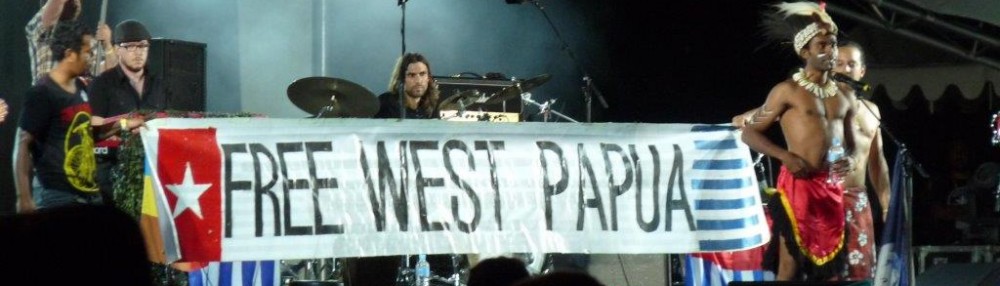
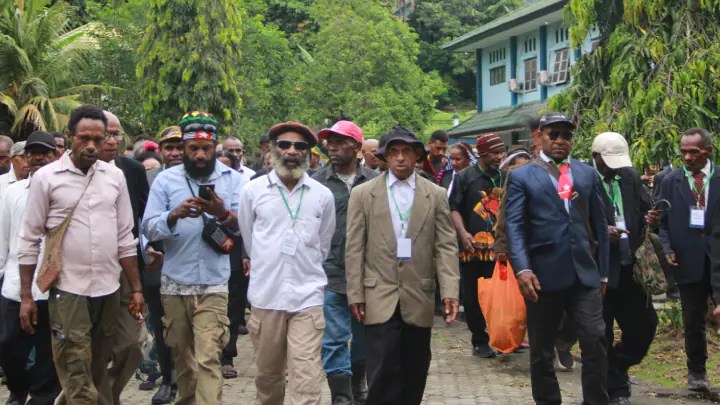
INDONESIA: CRACKDOWN ON PROTESTS, STIFLING OF EXPRESSION AND REPRESSION IN PAPUA CONTINUES IN PRABOWO’S FIRST FOUR MONTHS IN POWER

In Indonesia, civic space remains rated as ‘obstructed’ in the latest People Power Under Attack reportpublished in December 2024. Among the main concerns are the use of restrictive laws, including defamation provisions against human rights defenders and journalists as well as harassment and threats against them. The authorities have criminalised Papuan activists for their peaceful expression, while protests across Indonesia have been met with arbitrary arrests and excessive force from the police

During President Prabowo Subianto’s first 100 days in office, he had indicated a commitment to a conditional release of Papuan political activists in detention as part of a larger amnesty programme. However, human rights groups have raised concerns about Prabowo’s seriousness in protecting freedom of expression and opinion. There are also concerns about the ongoing impunity for human rights violations by the security forces, dealing with past serious crimes and the restrictions on civic freedoms.

There were nationwide student protests at the end of February 2025 against President Prabowo’s budget cuts , marking a key test of his leadership. The “Dark Indonesia” (#IndonesiaGelap) rally saw hundreds of students from leading universities carrying banners as they gathered outside the presidential palace in central Jakarta, many clad in black. Similar protests drawing thousands of students have taken place in other parts of the country, including Surabaya, Bali, Medan and Yogyakarta.

In recent months, a woman protester was jailed for opposing a palm oil mill while a protest against a hike in tax was forcibly dispersed. Protesters in Papua, including students, faced suppression and arrests for their activism. An environmental expert is facing a lawsuit and harassment for testifying in court while a punk band has had to apologise and withdraw a song on police corruption. Commemorations of a historic day in Papua were targeted with police repression. A Papuan human rights defender faced intimidation and an environmental activist was attacked, while the investigation by the national human rights body into the case of human rights defender Munir is facing challenges……………………………………

https://monitor.civicus.org/explore/indonesia-crackdown-on-protests-stifling-of-expression-and-repression-in-papua-continues-in-prabowos-first-four-months-in-power/

——————————————

Militarization in West Papua: the disrupted life of indigenous peoples

Jayapura (Agenzia Fides) – The sudden occupation of forest areas and villages of indigenous peoples by the massive deployment of military units in the Indonesian region of Papua is becoming a constant that marks the life of an entire region with its human and natural heritage. 

This is what happened to the inhabitants of five villages in the Oksop district (in central Papua, in the territory of the diocese of Jayapura), who fled to other areas, such as the neighboring Oksibil district, at the end of November due to the deployment of military units. “The presence of the military in the Oksop district has caused fear and insecurity in the community. Various actions by the military, such as setting up posts in churches and using public facilities without permission, have further aggravated the situation,” says Father Alexandro Rangga (OFM), Friar Minor and Director of the “Justice, Peace and Integrity of Creation” Commission in Papua. 

According to the Franciscan Commission, 300 people have been displaced to other villages, while many are hiding in the forests. “The fundamental problem in Papua is the way in which the Indonesian central government pursues national projects with a military approach. 

In addition, the massive presence of the military also brings with it activities promoted by the military itself, with conflicts of interest and operations on the edge of legality,” notes the Franciscan. As an official statement from the Diocese of Jayapura confirms, “the security situation in Oksop district remains unfavorable.” Indeed, “the refugees are reluctant to return to their home villages because they are afraid.” The presence of more and more troops – three troops were sent between January 13 and 15, 2025 alone – has increased tensions.

 “The displaced people have had traumatic experiences when they had to leave their homes,” reports the Franciscan. In response to this emergency, the Church of Jayapura and the Justice, Peace and Integrity of Creation Commission are calling on the government to “withdraw the armed forces from Oksop district and open a space for dialogue to find a peaceful solution” and, in the meantime, “provide adequate humanitarian assistance to the refugees.” The path of dialogue, says the Franciscan, “is the only way to end the violence and create a sustainable peace in Papua.

” Assessing the overall situation, Father Rannga notes that “the situation has worsened in recent years.” “Although the Indonesian government has moved from a ‘security’ approach to one that speaks of ‘welfare’ on a verbal level, in reality soldiers are still being deployed to carry out all kinds of programs on the ground,” he explains. 

“This is worrying because people have already had a long and traumatic experience with the military. In total, there are between 60,000 and 100,000 internally displaced people in Papua, mainly from Maybrat, Kiwirok and Intan Jaya.” In addition, the Indonesian government “has been creating food plantations in West Papua since 2020 (often for palm oil plantations, editor’s note) without obtaining the consent of the indigenous peoples, who feel cheated of their land: they use the local authorities or the army to take over the land by force, and this approach leads to clashes and discontent,” he continues. 

“As the Commission for Justice, Peace and the Integrity of Creation, we have drawn the attention of the UN Committee on Economic, Social and Cultural Rights (CESCR) to these problems: ancestral ownership of land, inequalities between indigenous Papuans and migrants, access to health and education facilities,” said the religious. Tensions in the area date back to the controversial 1969 referendum that incorporated Papua into the Republic of Indonesia, inaugurating a long period of progressive impoverishment and marginalization of the indigenous Papuans. 

The rise of separatist armed groups (such as the West Papuan National Liberation Army (TPN-PB), the armed wing of the Papua Liberation Movement) sparked a low-intensity conflict that forced thousands of people to flee and further complicated life in a region already characterized by underdevelopment. In addition, projects to exploit Papua’s enormous natural wealth (palm oil, copper, gold, timber, natural gas) do not benefit the indigenous population, who instead bear the negative impacts such as land destruction, contamination of water sources and the resulting health problems. 

In the meantime, the internal migration program (“Transmigrasi”) promoted by Jakarta changed the demographic composition of Papua, weakening the socioeconomic status of indigenous Papuans and limiting their employment opportunities. Locals complain that they have “become foreigners in their own country”. (PA) (Agenzia Fides, 17/1/2024)

Church leaders slam Indonesian forces’ denial of Papua refugees

Around 327 people remain displaced, many others hiding in forests in Oksop district, they say

Church officials in Indonesia have rejected Indonesian security forces’ claims of normalcy in a conflict zone in Papua, expressing concerns about the situation of displaced people and their safety.

The Church leaders said the security situation in the five villages in Oksop district is not yet normal, according to reports from pastoral officers of the Church in the field.

Bishop Yanuarius Theofilus Matopai You of Jayapura, based in Papua, and Father Alexandro Rangga of the Franciscans’ Justice, Peace, and Integrity of Creation Commission Papua expressed the Church’s concerns in a statement.

“As of today, an estimated 327 people remain displaced, with many others choosing to hide in the forest,” they said in their Jan. 17 statement.

It refuted the security forces’ claim in the media that residents who were displaced because of the conflict had returned to their villages.

Security forces spokesperson Yusuf Sutejo told the media that people have returned and are “carrying out normal activities in four villages. Only Mimin village is still under the supervision of security forces.”

Bishop You said they have detailed data on the number of displaced people, including by gender, age, and village of origin.

“However, for the safety of the displaced people, we cannot share this data with the public,” he explained.

The Church leaders said the security claims raise “deep concern,” and hence, “the Catholic Church felt compelled to clarify the real situation.”

Father Rangga said they want the joint security forces to withdraw from the Oksop district.

“The presence of troops is increasing. The deployment of additional troops on Jan. 13-15, 2025, has only increased the community’s anxiety,” he said.

The Church leaders said the security forces setting up their posts inside church compounds and using community facilities without permission worsened the situation.

Father Rangga told UCA News that residents of the five affected villages fled the area due to the increasing presence of security forces since late November last year.

“Fear of armed conflict prompted them to flee to safer places,” he said.

The security forces are targeting members of the West Papua National Liberation Army, which is allegedly working to free Papua from Indonesian control.

The renewed violence has displaced hundreds.

A displaced person from Atenar village, who did not want to be named because of security concerns, said he witnessed security forces setting up posts in community properties in his village as well as neighboring Mimin village.

“They dismantled an Evangelical church to make a fire pit. Church facilities are regularly used as security posts,” he said.

He also reported hearing gunshots day and night. “We don’t know whether they are shooting at their opponents or not,” he added.

The Catholic Church has urged the Indonesian government to form an independent team to investigate the causes of the conflict and ensure accountability for human rights violations.

“Firstly, withdraw military troops from Oksop district and open up space for dialogue to find a peaceful solution,” they said.

Indonesian Government Enters a New Phase in the Occupation of West Papua

  BY PAUL GREGOIRE PUBLISHED ON 3 JAN 2025 

United Liberation Movement for West Papua provisional government interim president Benny Wenda warns that since Indonesian president Prabowo Subianto took office in October, he’s been proven right in having remarked, after the politician’s last February election, that his coming marks the return of “the ghost of Suharto”: the brutal dictator who ruled over the nation for three decades.

Wenda, an exiled West Papuan leader, outlined in a 16 December statement that at that moment the Indonesian forces were carrying out ethnic cleansing in multiple regencies, as thousands of West Papuans were being forced out of their villages and into the bush by soldiers. 

The entire regency of Oksop had been emptied, with over 1,200 West Papuans displaced since an escalation began in Nduga regency in 2018.

Prabowo coming to top office has a particular foreboding for the West Papuans, who’ve been occupied by Indonesia since 1963, as over his military career – which spanned from 1970 to 1998 and saw rise him to the position of general, as well as mainly serve in Kopassus (special forces) – the current president perpetrated multiple alleged atrocities across East Timor and West Papua.

According to Wenda, the incumbent Indonesian president can “never clean the blood from his hands for his crimes as a general in West Papua and East Timor” and he further makes clear that Prabowo’s acts since taking office reveal that he is set on “creating a new regime of brutality” in the country of his birth.

Enhancing the occupation

“Foreign governments should not be fooled by Prabowo’s PR campaign,” Wenda made certain in mid-December. “He is desperately seeking international legitimacy through his international tour, empty environmental pledges and the amnesty offered to various prisoners, including eighteen West Papuans and the remaining imprisoned members of the Bali Nine.”

Former Indonesian president Suharto ruled over the Southeast Asian nation with an iron fist from 1967 until 1998.

In the years prior to his officially taking office, General Suharto oversaw the mass murder of up to 1 million local Communists, he further rigged the 1969 referendum on self-determination for West Papua, so it failed and he invaded East Timor in 1975.

Wenda maintains that the proof Prabowo is something of an apparition of Suharto is that he’s set about forging “mass displacement, increased militarisation” and “increased deforestation” in the Melanesian region of West Papua. And he’s further restarted the transmigration program of the Suharto days, which involves Indonesians being moved to West Papua to populate the region.

As Wenda advised in 2015, the initial transmigration program resulted in West Papuans, who made up 96 percent of the population in 1971, only comprising 49 percent of those living in their own homelands at that current time.

Wenda considers the “occupation was entering a new phase”, when former Indonesian president Joko Widodo split the region of West Papua into five provinces in mid-2022. And the West Papuan leader advises that Prabowo is set to establish separate military commands in each province, which will provide “a new, more thorough and far-reaching system of occupation”.

West Papua was previously split into two regions, which the West Papuan people did not recognise, as these and the current five provinces are actually Indonesian administrative zones.

“By establishing new administrative divisions, Indonesia creates the pretext for new military posts and checkpoints,” Wenda underscores. “The result is the deployment of thousands more soldiers, curfews, arbitrary arrests and human rights abuses. West Papua is under martial law.”

Ecocide on a formidable scale

Prabowo paid his first official visit to West Papua as president in November, visiting the Merauke district in South Papua province, which is the site of the world’s largest deforestation project, with clearing beginning in mid-2024, and it will eventually comprise of 2 million deforested hectares turned into giant sugarcane plantations, via the destruction of forests, wetlands and grasslands.

Five consortiums, including Indonesian and foreign companies, are involved in the project, with the first seedlings having been planted in July. And despite promises that the megaproject would not harm existing forests, these areas are being torn down regardless. And part of this deforestation includes the razing of forest that had previously been declared protected by the government.

A similar program was established in Merauke district in 2011, by Widodo’s predecessor president Susilo Bambang Yudhoyono, who established rice and sugarcane plantations in the region, aiming to turn it into a “future breadbasket for Indonesia”. However, the plan was a failure, and the project was rather used as a cover to establish hazardous palm oil and pulpwood plantations.

“It is not a coincidence Prabowo has announced a new transmigration program at the same time as their ecocidal deforestation regime intensifies,” Wenda said in a November 2024 statement. “These twin agenda represent the two sides of Indonesian colonialism in West Papua: exploitation and settlement.”

Wenda added that Jakarta is only interested in West Papuan land and resources, and in exchange, Indonesia has killed at least half a million West Papuans since 1963. And while the occupying nation is funding other projects via the profits it’s been making on West Papuan palm oil, gold and natural gas, the West Papuan provinces are the poorest in the Southeast Asian nation.

Independence is still key

The 1962 New York Agreement involved the Netherlands, West Papua’s former colonial rulers, signing over the region to Indonesia. A brief United Nations administrative period was to be followed by Jakarta assuming control of the region on 1 May 1963. And part of the agreement was that West Papuans undertake the Act of Free Choice, or a 1969 referendum on self-determination.

So, if the West Papuans didn’t vote to become an autonomous nation, then Indonesian administration would continue.

However, the UN brokered referendum is now referred to as the Act of No Choice, as it only involved 1,026 West Papuans, handpicked by Indonesia. And under threat of violence, all of these men voted to stick with their colonial oppressors.

Wenda presented The People’s Petition to the UN Human Rights High Commissioner in January 2019, which calls for a new internationally supervised vote on self-determination for the people of West Papua, and it included the signatures of 1.8 million West Papuans, or 70 percent of the Indigenous population.

The exiled West Papuan leader further announced the formation of the West Papua provisional government on 1 December 2020, which involved the establishment of entire departments of government with heads of staff appointed on the ground in the Melanesian province, and Wenda was also named the president of the body.

But with the coming of Prabowo and the recent developments in West Papua, it appears the West Papuan struggle is about to intensify at the same time as the movement for independence becomes increasingly more prominent on the global stage.

“Every element of West Papua is being systematically destroyed: our land, our people, our Melanesian culture identity,” Wenda said in November, in response to the recommencement of Indonesia’s transmigration program and the massive environment devastation in Merauke.

“This is why it is not enough to speak about the Act of No Choice in 1969: the violation of our self-determination is continuous, renewed with every new settlement program, police crackdown, or ecocidal development.”

PAUL GREGOIRE

Paul Gregoire is a Sydney-based journalist and writer. He’s the winner of the 2021 NSW Council for Civil Liberties Award For Excellence In Civil Liberties Journalism. Prior to Sydney Criminal Lawyers®, Paul wrote for VICE and was the news editor at Sydney’s City Hub.

Conflict escalation in Intan Jaya comes with civilian casualties and further internal displacement

Human Rights Monitor

CasesHuman Rights News / IndonesiaWest Papua / 15 November 2024 

The Indonesian military continues to intensify its operations in West Papua, leading lately to increased displacement of indigenous communities and severe human rights abuses. Recent reports from the conflict-ridden region of Intan Jaya in Papua province have raised serious concerns about the safety of civilians caught in the crossfire between the Indonesian National Army (TNI) and the West Papua National Liberation Army (TPNPB). Reports also indicate that the military has seized land belonging to the Moni Tribe in Intan Jaya Regency, without the consent or agreement of the indigenous community. The land, located in Silatugapa Village, is intended for the construction of a new military battalion. This move has sparked outrage among local communities and human rights organisations. The Moni Tribe, like many other indigenous groups in Papua, relies heavily on the forest for their livelihoods and cultural practices. The military’s presence in the area could severely restrict their access to vital resources and traditional lands.

Since 18 October 2024, the Indonesian military has been engaged in a counterattack against the TPNPB Kodap VIII Intan Jaya troops in Sugapa District. While there were no reported casualties on either side during the initial clashes, the situation has escalated, leading to casualties and significant civilian displacement and further potential human rights violations. Civilians in Titigi, Eknemba, and Ndugisiga Villages have fled to the forest due to the deployment of military troops in their areas. Schools have been closed, and civilian homes and infrastructure have been damaged by gunfire. The operation have been ongoing until at least 25 October.

On 1 November 2024, an incident occurred when a 27-year-old civilian, Justinus Sani, was shot by the TNI in the village of Joparu. The shooting, allegedly carried out with a sniper rifle from a distance of 400 meters, left Sani injured.The military has also been accused of using excessive force, arbitrary arrests, torture, and extrajudicial killings. In addition, the establishment of military posts in civilian areas has disrupted the daily lives of communities and limited their freedom of movement.

Human rights organisations have expressed deep concern over the ongoing conflict and the escalating human rights abuses. Civilians, including women, children, and the elderly, have been caught in the crossfire, with many suffering from injuries, displacement, and even death.

Local communities and human rights organisations have called on the Indonesian government to immediately cease military operations in Papua, respect the rights of indigenous communities, and hold perpetrators of human rights abuses accountable. They have also urged the international community to increase pressure on the Indonesian government to address the crisis in Papua. Key recommendations include:

Independent Investigation: A thorough investigation into the civilian casualties, conducted by impartial authorities.

Transparency: Public disclosure of the number of military personnel deployed to Papua and the legal basis for their operations.

Adherence to International Law: Strict adherence to international humanitarian law and human rights law.

Peaceful Dialogue: The facilitation of dialogue between the government and the TPNPB to find a peaceful solution.

Photos of victim Justinus Sani

Indonesia: Survey warning on Papua mega project appears to go unheeded

Indigenous Papuans from Merauke in eastern Indonesia protest against plans to convert indigenous and conservation lands into sugar cane plantations and rice fields, Oct. 16, 2024.

Land clearance was underway even before the feasibility study was completed.

Stephen Wright for RFA 2024.11.13

Indonesia’s plan to convert over 5 million acres of conservation and indigenous lands into agriculture will cause long-term damage to the environment, create conflict and add to greenhouse gas emissions, according to a feasibility study document for the Papua region mega-project.

The 96-page presentation reviewed by Radio Free Asia was drawn up by Sucofindo, the Indonesian government’s inspection and land surveying company. Dated July 4, it analyzes the risks and benefits of the sugar cane and rice estate in Merauke regency on Indonesia’s border with Papua New Guinea and outlines a feasibility study that was to be completed by mid-August.

Though replete with warnings that “comprehensive” environmental impact assessments should take place before any land is cleared, the feasibility process appears to have been a box-ticking exercise. Sucofindo did not respond to questions from RFA, a news service affiliated with BenarNews, about the document.

Even before the study was completed, then-President Joko “Jokowi” Widodo participated in a ceremony in Merauke on July 23 that marked the first sugar cane planting on land cleared of forest for the food estate, the government said in a statement. Jokowi’s decade-long presidency ended last month.

In late July, dozens of excavators shipped by boat were unloaded in the Ilyawab district of Merauke where they destroyed villages and cleared forests and wetlands for rice fields, according to a report by civil society organization Pusaka. 

Hipolitus Wangge, an Indonesian politics researcher at Australian National University, told RFA the feasibility study document does not provide new information about the agricultural plans. But it makes it clear, he said, that in government there is “no specific response on how the state deals with indigenous concerns” and their consequences.

The plan to convert as much as 5.7 million acres of forest, wetland and savannah into rice farms, sugarcane plantations and related infrastructure in the conflict-prone Papua region is part of the government’s ambitions to achieve food and energy self-sufficiency. Previous efforts in the nation of 270 million people have fallen short of expectations.

Echoing government and military statements, Sucofindo said increasingly extreme climate change and the risk of international conflict are reasons why Indonesia should reduce reliance on food imports.

Taken together, the sugarcane and rice projects represent at least a fifth of a 10,000 square km (38,600 square mile) lowland area known as the TransFly that spans Indonesia and Papua New Guinea and which conservationists say is an already under-threat conservation treasure.

Indonesia’s military has a leading role in the 2.47 million acre rice plan while the government has courted investors for the sugar cane and related bioethanol projects.

The likelihood of conflict with indigenous Papuans or of significant and long-term environmental damage applies in about 80% of the area targeted for development, according to Sucofindo’s analysis.

The project’s “issues and challenges,” Sucofindo said, include “deforestation and biodiversity loss, destruction of flora and fauna habitats and loss of species.”

It warns of long-term land degradation and erosion as well as water pollution and reduced water availability during the dry season caused by deforestation.

Sucofindo said indigenous communities in Merauke rely on forests for livelihoods and land conversion will threaten their cultural survival. It repeatedly warns of the risk of conflict, which it says could stem from evictions and relocation.

“Evictions have the potential to destabilize social and economic conditions,” Sucofindo said in its presentation.

If the entire area planned for development is cleared, it would add about 392 million tons of carbon to the atmosphere in net terms, according to Sucofindo.

That’s about equal to half of the additional carbon emitted by Indonesia’s fire catastrophe in 2015 when hundreds of thousands of acres of peatlands drained for pulpwood and oil palm plantations burned for months. 

Indonesia’s contribution to emissions that raise the average global temperature is significantly worsened by a combination of peatland fires and deforestation. Carbon stored in its globally important tropical forests is released when cut down for palm oil, pulpwood and other plantations.

In a speech on Monday to the annual United Nations climate conference, Indonesia’s climate envoy, a brother of recently inaugurated president Prabowo Subianto, said the new administration has a long-term goal to restore forests to 31.3 million acres severely degraded by fires in 2015 and earlier massive burnings in the 1980s and 1990s.

Indonesia’s government has made the same promise in previous years including in its official progress report on its national contribution to achieving the Paris Agreement goal of keeping the rise in average global temperature to below 2 degrees Celsius.

“President Prabowo has approved in principle a program of massive reforestation to these 12.7 million hectares in a biodiverse manner,” envoy Hashim Djojohadikusumo said during the livestreamed speech from Baku, Azerbaijan. “We will soon embark on this program.”

Prabowo’s government has announced plans to encourage outsiders to migrate to Merauke and other parts of Indonesia’s easternmost region, state media reported this month.

Critics said such large-scale movements of people would further marginalize indigenous Papuans in their own lands and exacerbate conflict that has simmered since Indonesia took control of the region in the late 1960s.

Firebombing of news organization in Indonesia’s Papua region condemned as assault on ‘media freedom’

Indonesian police have failed to solve previous attacks on Papuan media workers in recent years.

 Pizaro Gozali Idrus 2024.10.16 Jakarta

An attack on the editorial office of Papua-based media outlet Jubi on Wednesday using Molotov cocktails set fire to vehicles but resulted in no casualties, Indonesian police said.

The latest targeting of journalists in the Indonesian province has been condemned by human rights groups as a renewed assault on media freedom, after previous attacks remained unsolved by police.

Jubi is owned by Victor Mambor, who is a Jayapura-based stringer for BenarNews.

Heram Sectoral Police Chief Inspector Bernadus Ick confirmed an investigation is underway.

“These were indeed Molotov cocktails thrown at the Jubi editorial office,” Bernadus said in a press release, adding that forensic analysis of the materials used in the bombs is underway.

Jubi’s editor-in-chief, Jean Bisay, said the attackers on a motorcycle threw incendiary devices from the road in front of the Jubi office in Jayapura, igniting a fire between two parked vehicles. 

“The flames briefly engulfed the front of both vehicles before being extinguished by two Jubi employees and several eyewitnesses,” Bisay told BenarNews.

Witnesses told BenarNews the assailants had passed by the Jubi premises several times on Tuesday evening, stopping to observe the office, before departing and returning at 3:15 a.m. to throw two objects.

They said two individuals, who were dressed in black and on a motorcycle, appeared panicked and struggled to start their getaway vehicle when trying to flee. 

The Jayapura-based Independent Journalists Alliance (AJI), led by Lucky Ireeuw, said in a statement to BenarNews it “considers this terror a serious threat to media freedom in Papua.”

“The terror faced by Jubi and journalists in Papua has occurred repeatedly but remains unresolved to this day,” he added.

AJI’s 2023 annual report on the state of Indonesia’s media detailed 89 attacks against journalists and media organizations last year, the highest number in a decade.

In January 2023, Mambor, a veteran reporter known for covering rights abuses in heavily militarized Papua, said he was targeted in a bomb attack outside his home in Jayapura. No one was injured in the explosion.

Reporters Without Borders’ annual World Press Freedom Index 2024said the Indonesian military “carefully prevent the media from covering their use of force to suppress separatist protests in the three provinces that make up Papua, which continues to be an information blackhole where journalists cannot work.”

Gustaf Kawer, director of the Papua Human Rights Lawyers Association (PAHAM), urged the police to apprehend the individuals responsible and warned that otherwise it could lead to similar attacks. 

“If left unsolved, the public will wonder who is behind it. Are they outsiders or part of the authorities? I believe it is essential to clarify the perpetrators to prevent future incidents and ensure that the press can operate freely,” he said.

Frits Ramandey, head of the Papua Provincial Human Rights Commission, who also visited the crime scene, said similar incidents targeted local journalists in  2021 and 2023.

“If this is not addressed, the police will be complicit in allowing terror to occur everywhere,” he said

Papua, a region at the far-eastern end of Indonesia, has been the site of armed conflict for decades, driven by a desire for independence among some of its citizens. In 1963, Indonesian forces invaded Papua, which was also a former Dutch colony, and subsequently annexed the region. 

Papua was officially incorporated into Indonesia in 1969 following a United Nations-sponsored referendum. However, many locals and activists have condemned this referendum as a sham, as it involved only about 1,000 participants. 

Despite these concerns, the U.N. accepted the results, endorsing Jakarta’s governance of the region.

Come in now Indonesian democracy, your time is up

By Duncan Graham 

Oct 31, 2024

It took less than a week for the reality to be exposed. Even Deputy PM Richard Marles must now acknowledge that the nation next door he praises for its moderation and democracy is now a military dictatorship and a serious threat.

Proof absolute was presented on Friday, five days after his inauguration, when new Indonesian President Prabowo Subianto issued orders. His 48-member ministry together with 59 vice ministers, and five heads of state agencies had to present themselves in US-style camouflage uniforms at the army’s training camp at Magelang in Central Java.

Three days of exercises, parades and marches followed as the ministers moved like confused conscripts to martial music, camped in 120 tents and shuffled into lines.

They obeyed orders screamed by swaggering officers who in a real democracy are supposed to be subservient to the voters and their elected representatives. They were flown to the site packed in the sides of a Hercules that landed at Adi Sucipto Air Force Base in Yogyakarta.

In the 1970s as a young recruit, Prabowo trained at the camp south-east of Jakarta. In a speech to the rigid ranks, he said: “I prioritise working together as a team. We will have coordination in Magelang. I think it will bring many benefits.”

Indonesia brags of its 300 ethnic and religious groups speaking 200 distinct languages and dialects spread across more than 17,000 islands but all have been dissolved into sameness with the Magelang circus.

In my-way-or-the-highway threats Prabowo has shown that although he was cashiered in 1998 for disobeying orders and his troops disappearing dissident students before fleeing to exile in Jordan, he’s now back in total charge and with the biggest bureaucracy in the Republic’s history.

Two of his predecessors – second president Soeharto (Prabowo’s previous father-in-law) and sixth president Susilo Bambang Yudhoyono – were former generals but never showed such a blatant way to stamp authority and crush civilian rule.

If there was any disquiet expressed by the ministers snapping selfies of their adventures – particularly those like civilian Vice President Gibran Rakabuming who normally abhor strutters and foot-stampers – it was well hidden.

Instead, TV news footage showed the supposedly elected individuals behaving more like giggling pre-teens allowed a few days away from Mummy.

Before the ‘red and white (the colours of the Indonesian flag) retreat’ Indonesian law expert Professor Tim Lindsey of Melbourne Uni  wrote: “It is clear enough that Prabowo has no enthusiasm for democracy. He has said, for example, that it is ‘very, very tiring’ and ‘very, very messy and costly’.

“Many activists now speak openly of their fear of being targeted and intimidated by government trolls or even the intelligence agencies.”

Opposition in Parliament is negligible as Prabowo has about 80 per cent of members in his coalition.

By the weekend the regiment of polis had received drill training that had nothing to do with running departments in finance, education, health, religion and all other matters of state.

More appropriately, they got “sessions on anti-corruption, development planning, budget structuring, and bureaucratic planning.” It is not known whether these courses were delivered by soldiers trained in ethics and professional administration apart from their everyday skills in stripping down AK-47s,

Despite their uniforms, fatigues, gaiters and big combat boots – everything apart from rifles – many were too old, better used to fighting head colds and unfit to have ever been sought for military service. That included the plump president who has just turned 73.

“I am not here to make you militaristic; that’s a misconception. Many governments and corporations have adopted the military way,” he reportedly said without naming states and corporations that eschew consultation and consensus.

Russia, North Korea and Hungary come to mind.

Journalists were not allowed to ask questions. “The core values are discipline and loyalty—not to me, but to the Indonesian nation and people,” Prabowo added. Why such pledges needed the respondents to be in battledress was not explained.

In a Trump-style comment clearly at odds with the observable facts from streaming TV, Prabowo’s PR man Hasan Nasbi reportedly explained “This activity in Magelang is to galvanise the ministers – this is not militarism. This is for togetherness.”

PM Anthony Albanese’s decision to stay in Australia with his King rather than attend Prabowo’s inauguration was correct. His presence in Jakarta would have been seen as endorsing authoritarianism to the point of fascism. Sending Defence Minister Marles was the right tactic.

Duncan Graham

Duncan Graham has been a journalist for more than 40 years in print, radio and TV. He is the author of People Next Door (UWA Press). He is now writing for the English language media in Indonesia from within Indonesia.
Duncan Graham has an MPhil degree, a Walkley Award, two Human Rights Commission awards and other prizes for his radio, TV and print journalism in Australia. He lives in East Java.

Indonesian Military Establishes Five New Battalions for Papua Security

Bella Evanglista Mikaputri   

October 3, 2024 | 3:05 am

Jakarta. The Indonesian Military has established five new infantry battalions to be deployed in conflict-prone areas of Papua, Armed Forces Commander General Agus Subiyanto announced on WednesdayThe primary mission of these battalions is to maintain security and support the government’s development efforts in the eastern region of Indonesia.“We have inaugurated five battalions to be stationed in vulnerable areas of Papua. Their goal is to assist the government in accelerating development and improving the prosperity of the Papuan people,” Agus said during a press briefing in Jakarta.These ground forces will help secure major government projects, such as the food security program covering over 1,000 hectares of crops in Merauke Regency, and key road construction projects across Papua.

The newly established units are:

  • Ksatria Yuddha Kentsuwri 801st Infantry Battalion for Keerom Regency,
  • Wimane Mambe Jaya 802nd Infantry Battalion for Sarmi Regency,
  • Nduka Adyatma Yuddha 803rd Infantry Battalion for Boven Digoel Regency,
  • Dharma Bhakti Asasta Yudha 804th Infantry Battalion for Merauke Regency, and
  • Ksatria Satya Waninggap 805th Infantry Battalion for Sorong Regency.

In recent years, Papua has seen an escalation in insurgent activity, with sporadic attacks on both civilian and military targets. The Free Papua Movement (OPM) has been responsible for abductions and killings, particularly targeting construction workers involved in key infrastructure projects aimed at improving connectivity in the region.

A notable incident involved the abduction of New Zealand pilot Philip Mark Mehrtens, who was held hostage by an OPM rebel group for nearly 20 months before being released last month.

West Papuan independence advocate seeks New Zealand support against ‘genocide and ecocide”

West Papuan independence advocate Octo Mote is in Aotearoa to win support for independence for West Papua, which has been ruled by Indonesia for over 60 years.

Mote is the vice-president of the United Liberation Movement for West Papua (ULMWP), and is being hosted in New Zealand by the Green Party, which Mote said had always been a hero for West Papua.

ULMWP president Benny Wenda has alleged more than 500,000 Papuans have been killed since the occupation, and millions of acres of ancestral forests, rivers and mountains have been destroyed or polluted for “corporate profit”.


The struggle for West Papuans

“Being born a West Papuan, you are already an enemy of the nation,” Mote said.

“The greatest challenge we are facing right now is we are facing the colonial power who live next to us.”

If West Papuans spoke up about what was happening, they were considered separatists, Mote said, regardless of whether they were journalists, intellectuals, public servants or even high-ranking Indonesian generals.

“When our students on the ground speak of justice, they’re beaten up, put in jail and [they – Indonesians] kill so many of them,” Mote said.

Mote is a former journalist and said, while he was working, he witnessed Indonesian forces openly fire at students who were peacefully demonstrating their rights.

“We are in a very dangerous situation right now. When our people try to defend their land, the Indonesian government ignores them and they just take the land without recognising we are landowners,” he said.


The ecocide of West Papua

The ecology in West Papua was being damaged by mining, deforestation, and oil and gas extraction. Mote said Indonesia wanted to “wipe them from the land and control their natural resources”.

He said he was trying to educate the world that defending West Papua meant defending the world, especially small islands in the Pacific.

West Papua is the western half of the island of New Guinea, bordering the independent nation of Papua New Guinea. New Guinea has the third-largest rainforest after the Amazon and Congo and is crucial for climate change mitigation as they sequester and store carbon.

Mote said the continued deforestation of New Guinea, which West Papuan leaders were trying to stop, would greatly impact the small island countries in the Pacific, which were among the most vulnerable to climate change.

Mote also said their customary council in West Papua had already considered the impacts of climate change on small island nations and, given West Papua’s abundance of land, they said by having sovereignty they would be able to both protect the land and support Pacific Islanders who needed to migrate from their home islands.

In 2021 West Papuan leaders pledged to make ecocide a serious crime and this week Vanuatu, Fiji and Samoa submitted a court proposal to the International Criminal Court to recognise ecocide as a crime.


Support from local Indonesians

Mote said there were Indonesians who supported the indigenous rights movement for West Papuans. He said there were both NGOs and a Papuan Peace Network founded by West Papuan peace campaigner Neles Tebay.

“There is a movement growing among the academics and among the well-educated people who have read the realities, among those who are also victims of the capital investors, especially in Indonesia when they introduced the omnibus law.”

The omnibus law was passed in 2020 as part of the president’s goals to increase investment and industrialisation in Indonesia. The law was protested because of concerns it would be harmful for workers due to changes in working conditions, and the environment because it would allow for increased deforestation.

He said there was an “awakening” especially in the younger generations who were more open-minded and connected to the world, who could see it both as a humanitarian and an environmental issue.


The ‘transfer’ of West Papua to Indonesia

“The Dutch [traded] us like a cow,” Mote said.

The former Dutch colony was passed over to Indonesia in 1963 but ULMWP calls it an invasion.

From 1957, the Soviet Union had been supplying arms to Indonesia and, during that period, the Indonesian Communist Party had become the largest political party in the country.

The US government urged the Dutch government to give West Papua to Indonesia in an attempt to appease the communist-friendly Indonesian government as part of a US drive to stop the spread of communism in Southeast Asia.

The US engineered a meeting between both countries, which resulted in the New York Agreement, giving control of West Papua to the UN in 1962 and then Indonesia a year later.

The New York Agreement stipulated that the population of West Papua were entitled to an act of self-determination.


The ‘act of no choice’

This decolonisation agreement was titled the 1969 Act of Free Choice, which is referred to as “the act of no choice” by pro-independence activists.

Mote said they witnessed, “how the UN allowed Indonesia to cut us into pieces, and they didn’t say anything when Indonesia manipulated our right for self-determination.”

The manipulation Mote refers to is for the Act of Free Choice. Instead of a national referendum, the Indonesian military hand-picked 1,025 West Papuan “representatives” to vote on behalf of the 816,000 people. The representatives were allegedly threatened, bribed and some were held at gunpoint to ensure a unanimous vote.

Leaders of the West Papuan independence movement assert that this wasn’t a real opportunity to exercise self-determination as it was manipulated. However, it was accepted by the UN.


Pacific support at UN General Assembly

Mote has came to Aotearoa after the 53rd Pacific Island Leaders Forum meeting in Tonga and has come to discuss plans over the next five years. Mote hopes to gain support to take what he calls the “slow-motion genocide” of West Papua back to the UN General Assembly.

“In that meeting we formulated how we can help really push self-determination as the main issue in the Pacific Islands,” Mote said.

Mote said there was focus on self-determination of West Papua, Kanaky/New Caledonia and Tahiti. He also said the focus was on what he described as the current colonisation issue with capitalists and global powers having vested interests in the Pacific region.

The movement got it to the UN General Assembly in 2018, so Mote said it was achievable. In 2018 Pacific solidarity was shown as the Republic of the Marshall Islands, Tuvalu and the Republic of Vanuatu all spoke out in support of West Papua.

They affirmed the need for the matter to be returned to the United Nations, and the Solomon Islands voiced its concerns over human rights abuses and violations.


What needs to be done

He said in the next five years Pacific nations needed to firstly make the Indonesian government accountable for its actions in West Papua. He also said President Joko Widodo should be held accountable for his involvement.

Mote said New Zealand was the strongest Pacific nation that would be able to push for the human rights and environmental issues happening, especially as he alleged Australia always backed Indonesian policies.

He said he was looking to New Zealand to speak up about atrocities taking place in West Papua and was particularly looking for support from the Greens, Labour and Te Pāti Māori for political support.

The coalition government announced a plan of action on July 30 this year, which set a new goal of $6 billion in annual two-way trade with Indonesia by 2029.

“New Zealand is strongly committed to our partnership with Indonesia,” Foreign Affairs Minister Winston said then.

“There is much more we can and should be doing together.”

———————————————————————