Indonesian police face pressure to implement Constitutional Court ruling banning officers from civilian posts

Human Rights News / Indonesia / 21 November 2025 

Indonesia’s Constitutional Court has issued a landmark ruling prohibiting active police officers from holding civilian government positions. Still, the implementation of the decision has sparked controversial discussions as thousands of police officers remain in posts across ministries and state agencies.

Constitutional Court Decision Number 114/PUU-XXIII/2025, delivered on 13 November 2025, struck down provisions that had allowed active members of the Indonesian National Police (INP) to occupy civilian positions through assignments from the National Police Chief. The ruling mandates that police officers must resign or retire before taking up positions outside the police structure.

Thousands of police officers in civilian roles

The scale of police placement in civilian positions has expanded dramatically in recent years. According to official data, 4,351 police officers held positions outside the National Police in 2025, including 1,184 officers at senior ranks. This represents a significant increase from 2,822 officers in 2024 and 3,424 in 2023.

High-ranking officers occupy prominent positions across government, including secretary-general positions at multiple ministries, inspector-general posts, and leadership of agencies such as the National Counterterrorism Agency. In March 2025 alone, the National Police Chief issued six telegrams assigning 25 high-ranking and mid-ranking officers to various ministries and institutions.

Conflicting government responses

The implementation of the ruling has been complicated by contradictory statements from government officials. Minister of Law Supratman Andi Agtas stated that officers already serving in civilian posts would not be required to resign, arguing the ruling applies only to future appointments. Meanwhile, Minister of Administrative Reform and Bureaucratic Reform Rini Widyantini emphasizedthat the government must respect the decision and that officers “must resign or retire.”

As of late November, only one officer had been withdrawn from a civilian position. National Police Chief General, Listyo Sigit Prabowo, recalled Inspector General Raden Prabowo Argo Yuwono from the Ministry of Cooperatives and Small and Medium Enterprises on 20 November 2025, describing it as demonstrating commitment to the ruling.

Concerns over selective compliance

Constitutional law experts and civil society observers have demanded to fully implement the decision. Currently, the government appears to be “cherry picking” which Constitutional Court decisions to follow, implementing only those that serve its interests while ignoring rulings with significant public importance.

Observers note that Constitutional Court decisions are final and binding, taking immediate effect. Police analyst Bambang Rukminto warned that continued delay represents an unconstitutional practice and undermines the rule of law. The placement of officers in civilian roles has continued year after year due to weak oversight by Parliament’s Commission III, which handles law enforcement matters.

Rights and governance implications

The Constitutional Court’s decision followed a petition from advocate Syamsul Jahidin and student Christian Adrianus Sihite, who argued that the practice violated citizens’ constitutional rights to fair access to employment. With approximately 7.46 million job seekers in Indonesia as of August 2025, civilian positions occupied by active police officers reduce opportunities for qualified civilians to obtain government posts.

The practice of positioning active police officers in prominent civilian positions creates significant conflicts of interest. Civil observers argue that the placement serves as a tool of political control, allowing those in power to extend influence across government agencies while compromising police independence. They warned that official non-compliance with court rulings undermines legal culture and public respect for the law. Without mechanisms to enforce compliance with Constitutional Court decisions, the independence and accountability of Indonesia’s judiciary are at stake.

Path forward uncertain

The National Police has formed a working group to review the Constitutional Court decision, but no timeline has been announced for withdrawing officers from civilian positions. Some officials have suggested that certain agencies with law enforcement functions, such as the National Narcotics Agency and National Counterterrorism Agency, may still require police personnel.

Parliament’s Commission III has established a working committee on police reform that will provide recommendations for revising the Police Law to align with the Constitutional Court ruling. However, critics note that the same parliamentary body failed to exercise adequate oversight as the practice expanded over the past decade.

As debate continues, civil society groups emphasize that the Constitutional Court’s ruling represents an opportunity to restore the police force to its constitutional mandate of protecting and serving the community while ensuring fair access to public employment for all citizens.

Fatal free lunch

November 20, 2025

Indonesia’s free meals for kids program has left thousands of youngsters with food poisoning, and returned the country to the bad old days of military influence.

“All power flows from the barrel of a gun,” said Mao Zedong. His aphorism may have been right a century ago in China, but not in modern Indonesia. In the nation next door, power comes subtly via unarmed brigadiers in boardrooms. The riflemen are there, but out of sight.

Professional corporations with genuine jobs to fill normally advertise for the best certified and experienced applicants to stay innovative and competitive. Patronage appointments kill such management essentials.

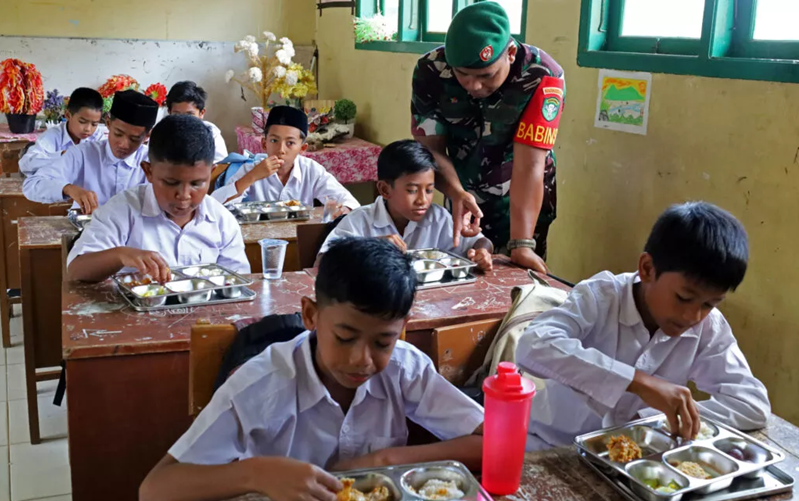
Meat and veggie buyers, cooks, hygiene inspectors, nutritionists, quality controllers, agricultural advisors – there are scores of positions with Makan Bergizi Gratis (MBG) the free meals for kiddies’ programme.

The venture is to stop stunting through malnutrition – a most worthwhile goal – so standards should be high.

They’re not. Much of the work is being done by young guys hired to kill but employed to care. No surprise that more than 10,000 children have reportedly been gripped by food poisoning,

Dirty kitchens, food left to the flies, delivery delays, and hands and workbenches unwashed – the list is extensive and the blame clear: kitchens are no place for enlistees.

Video grabs of screaming students on classroom floors, fouled by vomit and diarrhoea, have ensured widespread coverage and demands that the program be shut until fixed.

That won’t happen, because the initiator of this stench is President Prabowo Subianto, 74, who swept into power last year on the promise of free tucker. It remains his flagship policy, and to stall would show defeat – difficult for an ageing authoritarian who knows he knows best.

The goal is 75 million meals a week through 1,400 kitchens by the end of this year – the cost A$10 billion.

Next year, the budget is expected to blow out threefold. Economists fear health and education money boxes will get raided and services suffer, though not the military, which is on an international weapons-buying spree.

By 2027, the MBG could gallop past A$27 billion, overtaking the defence allocation of A$18 billion.

It shows what goes wrong when a voter-grabbing policy first scribbled on a restaurant receipt isn’t backed by thought-throughs on infrastructure and planning. The public gets fed up with delays in implementing promised change – but here’s a good reason why patience is prudent.

When Prabowo won the election last year and flaunted his pledge, the applause was worthy of a footy win, though players knew there were too few cooks and bottle washers and a dearth of commercial kitchens.

The solution? Conscript the army.

Soldiers who joined for adventure, a uniform, a haircut and the chance to shoot dissidents in Papua found themselves scrubbing food trays.

Corruption has reportedly flooded the fractured system as a tsunami of unchecked government cash swirls around the dishes of cold soup and burned rice. The service is a continuous rush; no time for audits.

The policy of employing the military in civic affairs was refined by the Republic’s second president, former army general Soeharto. When he was overthrown in 1998 by students preaching democracy, dwifungsi (two functions) was also ditched. Now it’s back with Prabowo, also a former general and Soeharto’s former son-in-law.

There are already ten departments and industries where the military rules. They’ve also seized 3.7 million hectares of private palm-oil plantations and handed them to a state-owned company.

The Kuala Lumpur-based youth NGO World Order Lab voiced its concerns: “Partisan loyalty has increasingly dictated appointments, often sidelining professional qualifications in leadership. This is no accident but a calculated strategy of power consolidation, which signals that loyalty and political stability outweigh technocratic competence.

Patronage appointments undermine the crucial link between responsibility and expertise, leaving critical programs in the hands of those unprepared to manage them.”

The military is getting bigger, spreading wider and digging deeper. Orwell’s Big Brother was a wimp when measured against the Indonesian military’s ambitions.

Expect uniforms everywhere. Regional commands will be doubled to cover most of the archipelago’s 38 provinces. One hundred ’territorial development’ battalions will deploy units in 7,285 kecamatan (districts) within five years.

This isn’t secret stuff – the Defence Ministry published a full-page explanatory ad in the Kompas newspaper. The headline read Bukan Lagi Sekadar Militer: Pertahanan Rakyat Gaya Indonesia (No longer just the military: Indonesian-style people’s defence). No need for a catchy title – it’s an order.

It listed plans to enlarge battalions specialising in health and agriculture between now and 2030, claiming these have expanded and transformed “people’s defence based on prosperity and cross-sector collaboration”. The reasoning here is impenetrable.

The ad was published  “to counter public perception that these actions represent militarisation.” The public’s perception has been clear – so have the commentators.

Veteran Bloomberg Asian affairs columnist Karishma Vaswani warned: “The military’s increased influence (is) potentially enabling human rights violations and corruption.

“(The Kompas ad) was an attempt to normalise the presence of soldiers and generals in everyday life, potentially giving them the kind of influence they had during the Soeharto era…. an outsized role in politics and governance.

“A rejuvenation of the military’s power will reinforce (Prabowo’s) image as a leader who cannot rule without the assistance of the army.”

The Tentara Nasional Indonesia (TNI – Indonesian armed forces) has embedded itself in the national legend for almost eight decades, starting with guerrilla heroes routing the returning Dutch colonialists in the late 1940s.

Through its untouchable status, the TNI has boosted incomes and officers’ salaries by running foundations, factories and co-ops. Men in khaki moved off parade grounds onto the boards of banks, insurance companies, and even big retailers.

Soldiers are supposedly prohibited from business activities, though this is widely overlooked. The TNI is proposing a law change so Army wives can run village kiosks, though the real reason is to legitimise jobs for officers in civil businesses.

Perceptive readers of Pearls and Irritations would have foreseen that Indonesia was sliding into the black pit of military control when a story was published of MPs in fatigues at a post-election boot camp.

The few who still uphold democracy were dismayed; others saw it as a chance for selfies of giggling pols flashing thumbs-up. They should have been down.

The views expressed in this article may or may not reflect those of Pearls and Irritations.

Duncan Graham

Duncan Graham has been a journalist for more than 40 years in print, radio and TV. He is the author of People Next Door (UWA Press). He is now writing for the English language media in Indonesia from within Indonesia. Duncan Graham has an MPhil degree, a Walkley Award, two Human Rights Commission awards and other prizes for his radio, TV and print journalism in Australia. He lives in East Java.

Rising militarism 

In the wake of looting and rioting in late August, President Prabowo Subianto deployed more than 75,000 Indonesian Military (TNI) soldiers to secure areas in and around Jakarta.

Editorial board (The Jakarta Post) Jakarta Fri, September 19, 2025 

Political developments in the past few weeks have not been very kind to the concept of civilian supremacy in the country. In the wake of looting and rioting that took place in late August, President Prabowo Subianto agreed to the deployment of more than 75,000 soldiers from the Indonesian Military (TNI) to secure areas within and around Jakarta.  It could have been a bigger display of military might, as security authorities proposed the deployment of more than 100,000 troops in the city. The troops’ deployment may have been the largest in the capital city since 1998, when soldiers in armored vehicles patrolled the streets following civil unrest that ended with the resignation of then-president Soeharto. 

Also in response to the unrest in August, President Prabowo sacked coordinating minister for political and security affairs Budi Gunawan after serving only 10 months in office, convinced that the former police general had failed to coordinate a proper response to handle the protests and street violence.

To replace Budi, on Wednesday President Prabowo inaugurated Djamari Chaniago, his senior at the military academy who in the late 1990s served as commander of the Army Strategic Reserves Command (Kostrad). 

The appointment of Djamari is only the latest in a series of decisions allowing both active and retired military generals to take charge of civilian institutions.  In May this year, then-finance minister Sri Mulyani Indrawati appointed Djaka Budhi Utama, a retired lieutenant general who was once found guilty of kidnapping human rights activists, as head of the Customs and Excise Directorate General.  Later in July, another Army officer Maj. Gen. Ahmad Rizal Ramdhani was appointed as president director of the State Logistics Agency (Bulog), in charge of one of the most crucial agencies involved in food security.

Other than packing civilian institutions with military generals, President Prabowo has also designed policies that allow military officers to have leading positions in their execution. In the food security program, the plan is to have thousands of soldiers deployed in the country’s remote regions to work on lands that will produce rice and other staple foods.  Currently, TNI soldiers are taking leading roles in a forestry task force that is expected to seize lands illegally occupied or used by palm oil companies.  Plans are also afoot to expand the military presence outside of Java, including the deployment of the Army’s Special Forces (Kopassus) to far-flung regions. 

This certainly looks like an aberration in a civilian-led democracy like Indonesia. But the reality today is that this expansion of the military’s role in politics could find its legal justification in the revised TNI Law, which was passed without much fanfare in March this year.


The revised law increases the number of state institutions to which military officers can be appointed without having to retire early from the service from 10 to 14. The new legislation also expands the TNI’s non-combat operations and extends sitting officers’ retirement age. When the Constitutional Court (MK) read its ruling on Wednesday to uphold the legality of the revised TNI Law, the court’s judges were up against insurmountable odds.  It was difficult for them to turn the tide in a political atmosphere that was already welcoming the increased presence of the military in civilian affairs. And with soldiers still patrolling the streets as the court was hearing the case, it was as if the panel of judges was staring down the barrel.

But it is unfair to pin our hopes on the court to save this nation from rising militarism. 

 The job of ensuring civilian supremacy should be in the hands of politicians both in the executive and legislative branches of the government, it is they who should devise rules mandating that the primary role of the military is national defense.

Indonesia remembers the coming of democracy, 27 years later

2YJG244 Lima, Peru. 14th Nov, 2024. Prabowo Subianto, President of the Republic of Indonesia, on an official visit to Peru. This visit, within the framework of the APEC Peru 2024 Economic Leaders Week (AELW), consists of a meeting between the Heads of State, of a protocolary nature with the signing of bilateral instruments. Credit: Fotoholica Press Agency/Alamy Live News

The shadow of Soeharto’s past now seems to loom over the nation, threatening the civilian supremacy we fought so hard to establish.

Last Wednesday marked the 27th anniversary of a pivotal moment in Indonesian history. On 21 May 1998, the nation demonstrated its collective power by forcing Soeharto to end his 32-year authoritarian rule.

This milestone achievement, which The Jakarta Post recorded in its memorable headline “I QUIT”, paved the way for Indonesia to become the world’s third-largest democracy in less than a decade. However, the shadow of Soeharto’s past now seems to loom over the nation, threatening the civilian supremacy we fought so hard to establish.

Just one year after Soeharto’s fall from grace, Indonesia surprised the world with its first democratic elections, which were held in a free and peaceful manner. This commitment to democracy deepened in 2004 with the adoption of direct presidential elections, followed a year later by direct regional head elections.

Indonesia stands as a remarkable example, likely the only predominantly Muslim nation that has consistently proven Islam’s compatibility with even the most sophisticated democratic systems. In many other Islamic nations, democracy remains fragile or is even suppressed in the name of religion.

Indonesia now confronts the danger of a complete reversal in its democratic trajectory. While in 1998, the military was largely seen as the primary cause of political and economic instability, a growing number of civilians now view the Indonesian Military (TNI) as a potential saviour amid rising frustration with civilian governments at both central and regional levels.

However, the public must remember that any return of the military to public life should be for limited and ad hoc purposes. We must acknowledge that Indonesia’s largely Army-centric military currently faces no significant external security or defence threats. As an archipelagic nation, the Navy and Air Force should naturally play more strategic roles.

It is unrealistic to expect the military to simply remain in their barracks when they have little to do. So, what is a solution that upholds the strict principle of civilian supremacy while being acceptable to all?

The public is increasingly weary of seemingly rampant abuses of power by state officials and political elites. They are also fed up with the corrupt and abusive behaviour of the police. Consequently, many desire the military to step out of the barracks and reengage in social-political affairs.

President Prabowo Subianto, a former son-in-law of Soeharto, has repeatedly pledged to strictly abide by the Constitution, including upholding democracy. We trust the president’s commitment, and we believe his government will be stable, given that his ruling coalition controls more than 80% of the House of Representatives.

The end of Soeharto’s regime remains an unforgettable event for Prabowo, as just three months after the former’s resignation, Prabowo himself was dismissed from the military. Furthermore, Prabowo has often been linked to atrocities, including the abduction of government critics, although his case was never brought to justice.

The sweeping reforms removed the military’s privileges, recognising that Soeharto had used the institution to cling to power. In 2004, the House of Representatives passed the TNI Law, primarily outlining its duties for external security and defence, with tight restrictions on military personnel holding civilian positions.

However, in February this year, the House endorsed a revision of this law that allows the military to reclaim some of its old power. The government insists that the revised TNI Law only focuses on three main issues: expanding military operations other than war, increasing civilian posts that can be held by active TNI personnel and changing soldiers’ mandatory retirement age. This assurance, however, has not been enough to quell public scepticism.

After nearly three decades, there are convincing signs of the state’s temptation to revert to the Soeharto era, when stability was the currency. The election of Prabowo, in particular, has clearly become a significant moment for the military to potentially regain lucrative power in social-political affairs.

Twenty-seven years ago, Soeharto stepped down after nationwide protests. May the day serve as a clarion call to the nation, reminding us all that we must never abandon the vibrant tapestry of democracy which was woven with our blood and tears.

Republished from The Jakarta Post, 21 May 2025

The views expressed in this article may or may not reflect those of Pearls and Irritations.

Indonesia’s revised military law: Growing protests and concerns over democracy and human rights

Human Rights News / Indonesia / 27 March 2025 

Widespread protests in Indonesia erupted across the country in response to the government’s controversial revision of the 2004 Indonesian Armed Forces Law. Student-led demonstrations in various cities have been met with forceful responses from security forces, raising serious concerns about police violence, the stifling of civil society participation, and the erosion of democratic freedoms in Indonesia.

The proposed amendments to the law, which were ratified by Indonesia’s House of Representatives in March 2025, significantly expand the military’s role in civilian governance. These revisions allow active military personnel to occupy key positions in government ministries, the judiciary, and other civilian institutions, a move that activists argue undermines the country’s young democracy. Furthermore, the changes include a shift towards a more significant military influence on civilian affairs, which critics claim is reminiscent of Indonesia’s authoritarian past under the “New Order” regime of former dictator Suharto.

Protests against the law have been widespread, with students leading the charge in cities such as Jakarta, Surabaya, Malang, and Sukabumi. Many protesters have taken to the streets dressed in black, with banners reading “Return the military to the barracks” and “Watch out! New ‘New Order’ is right before our eyes.” Activists argue that the amendments are a direct threat to the progress Indonesia has made since the fall of Suharto’s military dictatorship in 1998. Human Rights Watch senior researcher Andreas Harsono voiced concerns that the law’s passage without proper public consultation further signals a regression in Indonesia’s democratic trajectory.

The protests, while largely peaceful, have been met with violent responses from security forces. In Malang, East Java, clashes broke out when police deployed riot squads and water cannons to disperse crowds. Several students were injured, and at least eight journalists were reportedly assaulted while documenting the protests. Similar scenes unfolded in other cities, with police using force to break up demonstrations, leading to injuries, detentions, and allegations of human rights abuses (see video below, source: Instagram). Notably, in Sukabumi, police detained several students and accused them of instigating violence.

Beyond physical violence, there have been instances of intimidation aimed at protest leaders. In Yogyakarta, a threatening banner was placed near a university campus, targeting one of the student leaders. This intimidation, both physical and digital, signals an alarming trend of suppressing dissent and limiting space for civil society to engage in political processes.

One of the most pressing concerns raised by activists is the government’s failure to adequately consult with the public or allow space for meaningful civil society participation in the amendment process. Critics argue that the law was rushed through parliament without sufficient debate and that the military’s increasing involvement in civilian affairs will undermine Indonesia’s democratic foundations. Furthermore, the law could open the door to greater military influence in sectors unrelated to defence, including business and governance, echoing the tactics used during the New Order era.

While the government, including Defense Minister Sjafrie Sjamsoeddin, insists that the reforms are necessary to adapt to changing global military dynamics, activists and students argue that these changes endanger fundamental democratic principles. They fear the expansion of the military’s role in civilian governance may reduce the space for free expression, undermine civilian supremacy, and set back the country’s progress toward democracy.

The Indonesian government’s handling of the crisis—especially its treatment of protesters and the military’s expanding role in government—poses a significant challenge to the nation’s democracy. The events of recent weeks underscore the urgent need for reform, transparency, and respect for human rights, particularly in the context of any changes to laws that impact the nation’s future governance. Following the hasty amendment of the law and the increasing role of the military in civilian matters, there is an urgent need to also revise Military Court Law 31/1997, so that TNI members can be tried in civilian courts if they are accused of having committed violent acts against civilian victims.

Free meals threatened – and threatening 

2Y9P3KF Sumedang Regency, West Java, Indonesia. 11th Oct, 2024. Elementary school students eat during a trial of the free lunch program at Sirahcai Elementary School, Sumedang Regency, West Java. Free lunch is the mainstay program of Indonesia president and vice president-elect PRABOWO SUBIANTO and GIBRAN RAKABUMING RAKA. This program will run from early 2025. (Credit Image: © Dimas Rachmatsyah/ZUMA Press Wire) EDITORIAL USAGE ONLY! Not for Commercial USAGE!

By Duncan Graham 

Feb 17, 2025

Before the 18th century Enlightenment, church and state in Europe were one. In Indonesia, fears that Islam will infiltrate civic affairs go back to the founding of the Republic. Instead, the threats are not from the mosques, but the military.

The nation with more Muslims than any other state is constitutionally secular, but it’s heading towards a stratocracy.

Since becoming the eighth president, Prabowo Subianto has been bringing khaki into national and regional public offices following the policy of second President Suharto from the last century.

Prabowo’s former father-in-law called it Dwifungsi – two functions. It was widely discredited and grossly inefficient. Unelected generals had reserved seats in the Parliament; lesser ranks were posted to run departments where they had few wanted skills.

Suharto was a former general. Likewise Prabowo, though his history is ignominious; in 1998 he was cashiered for disobeying orders. He fled to exile in Jordan, but he’s now back imposing his military fantasies and undermining democracy.

He’s even forced his overstocked 109-strong ministry (13 are women) into fatigues and humiliating parades. Like Donald Trump, he plans to scrap the awkward and costly elections and bring back appointments. As in the US, these jobs would go to mates, rellies and donors.

The policy in the world’s fourth-largest country isn’t confined to setting up regional military centres; it’s also putting lower ranks into menial jobs, delivering LPG gas bottles to the poor and lunches to school kids. This isn’t assuaging hunger, but creating fear in West Papua.

About 5000 soldiers from other provinces have been hunting tribesmen demanding independence; a low-level guerilla war has been underway in the mountains and jungles for about 50 years.

Civilian families in the occupied province hate being shadowed by armed men and are wary of their intentions, for one of their tactics is torture. Now they’re dishing out food.

The imagination flares: What better way to subdue dissidents than by poisoning their food? There’s no evidence that’s happening, but the fear is real. Who couldn’t have foreseen the reaction?

The lunch box program comes from a promise last year by Prabowo during the presidential election campaign, which he won. Makan Bergizi Gratis (MBG free nutritious meals) was poorly planned and is now being badly executed.

The Papuans’ distrust has been reinforced by the story of 40 students from a school in Central Java throwing up after gulping down free meals. Indonesian media reports claimed dozens had fallen ill in North Kalimantan. Poor hygiene has been blamed.

MBG is a worthy bid to curb stunting that cripples about 20% of the next generation. (The Australian figure is 2.3%.)

Lousy diets plus poor access to services, particularly in remote regions, are blamed by UNICEF for the tragedy. Two of five children under five don’t get basic food groups.

Other factors: Pregnant mums need top-quality tucker. Anything less lets in infections that stunt the babe’s growth in the womb. Six per cent of newborns are underweight.

With these figures it’s clear education on pregnancy and child rearing is as important as free food. A whole-of-problem strategy is needed.

The original budget allocation of Rp 15,000 ($1.50) for an MBG meal was slashed by Prabowo to Rp 10,000 – a sum too small for wholesome ingredients, cooking and delivery. So the armed forces have been recruited, distressing a society where trust is as short as protein.

“The people of Papua are complaining and rejecting the free nutritious food for school children because the food is provided by the TNI (Army) and Polri (police),” local religious leader Wenior Pakage told the media.

“They’re afraid for their children that they’ll be murdered with poison, resulting in an extermination. The community wants the program scrapped and the funds transferred to pay school fees so students can obtain knowledge for free.”

Hundreds of kids in uniform reportedly left classes and protested in the streets of Yahukimo Regency, waving banners rejecting MBG. The story can’t be independently verified because the foreign media is banned from Papua.

Schooling is compulsory nationally and supposedly gratis, but fees for registration, books, uniforms, teacher gratuities, funds for new buildings and other imposts are common. They’re usually masked as “donations” and vary from school to school.

The money to make learning free is here in abundance, literally underfoot. Papua is where Croesus took a breather and stayed.

The western half of the island of New Guinea has a population of around four million. The indigenous people are nominally Christian; the newcomers are mainly Muslim. They’ve migrated from Java, contractors and miners to work on the Grasberg opencut and underground copper and gold mines, among the largest in the world.

This joint venture between the Indonesian Government and the US company Freeport has a workforce of more than 30,000. In 2023, it reportedly generated a net income of US$3.16 billion.

Prabowo is no cheerleader for democracy and reportedly wants funds “redirected to public welfare projects, including providing free meals for schoolchildren”. Who’d think the savings might go elsewhere in a country shot through with corruption?

The MBG idea seems worthwhile, but its implementation has hit many snags apart from Papua fear and Central Java food poisoning. Unpalatable meals and insufficient funds are also among the complaints.

Project head Dadan Hindayana wants  an extra US$6.11 billion just to reach a quarter of the target of 83 million by the end of 2025.

Prabowo’s reputation with the wong cilik (the masses) rides on making the MBG work and the scheme permanent. This can’t be done on dollar a day meals without using bad food and the military as waiters.

To do good, the president’s kitchen needs cleanliness, a new menu and professional caterers. Any tariff shake-up will mean less money for the army.

For a pseudo-military man who has been out of the bang-bang business for 27 years, but still sees it as the way to go, a massive makeover might seem indigestible. But it’s doomed without a huger cash uplift.

That may come from savings elsewhere, though nothing specific. One suggestion is for the meals to be cut to one a week  an idea horrifying nutritionists.

“It should be for five days to match the nutritional adequacy measure,” said expert Tengku Syahdana. “If for one day, the needs can’t be met.”

Duncan Graham 

Duncan Graham has been a journalist for more than 40 years in print, radio and TV. He is the author of People Next Door (UWA Press). He is now writing for the English language media in Indonesia from within Indonesia. Duncan Graham has an MPhil degree, a Walkley Award, two Human Rights Commission awards and other prizes for his radio, TV and print journalism in Australia. He lives in East Java.

The return of militarism 

We have reasons to worry about expanding the roles of the military beyond its domain as defender of the nation against external threats. Editorial board (The Jakarta Post) Jakarta Thu, February 13, 2025

the return

Cabinet retreat cartoon (JP/T. Sutanto)

President Prabowo Subianto has once again displayed his penchant for military figures filling strategic posts within his government with the recent appointment of Maj. Gen. Novi Helmy Prasetya as the new president director of the State Logistics Agency (Bulog). State-Owned Enterprises (SOEs) Minister Erick Thohir gave no compelling reasons for the choice of an active military officer for the civilian post other than a vague reference to the “revitalization of Bulog management” and the “changing perspectives” of the agency. But further stoking confusion, the Indonesian Military (TNI) announced on Monday that Novi had been promoted on Jan. 31 to the three-star job of commanding general of the TNI Academy, in a decree that was signed over a week before he was named the new Bulog chief. TNI spokesperson Maj. Gen. Hariyanto said on Tuesday that Novi’s appointment as Bulog chief was part of a “deal for a strategic partnership in food security between the agency and the military” and because “the SOEs Ministry sees Novi as having a chain of command that can support the delivery of food security programs”. Whatever the reasons behind Novi’s assignment to Bulog, the appointment is legally flawed and sends yet another message of the return of the TNI’s dual function, just like during the New Order, at the expense of civilian supremacy. The New Order regime was marked by significant economic growth, but also widespread human rights abuses and suppression of political freedoms.


The prevailing 2004 TNI Law says that military officers may only occupy civilian positions after they have been discharged from duty. Under this law, those who remain in active service can be seconded to certain positions in seven state institutions overseeing defense, security or intelligence and to the Search and Rescue Agency, the National Narcotics Agency (BNN) or the Supreme Court, which manages military courts.

We recall during the COVID-19 pandemic the government resorted to military deployment to assist with contact tracing efforts and health protocol enforcement or to run emergency hospitals for treating COVID patients. But that was in line with the law, which outlines 14 types of operations other than war that justify TNI participation, such as disasters and humanitarian missions. Prabowo, a former Army general himself, might want Bulog to adopt military-like discipline and focus and a clear chain of command while playing a leading role in food security. Novi is not the first man in uniform to lead Bulog, anyway, as police general Budi Waseso once led the agency in 2018-2023. Indeed, Prabowo’s presidency has seen a growing presence of the military in the government. Many of his picks for ministerial, deputy ministerial and state agency head posts are people with a military background.

He even brought members of his bloated cabinet to a military-like bootcamp at the beginning of his presidency as his way of instilling discipline. Later this month the same military-style retreat will be organized for new governors, mayors, regents and their deputies. Ironically, the public has faith in the TNI, as seen in various opinion polls that consistently rank the military as the most trusted national institution. From having the military running much of his flagship free meals program for schoolchildren to ordering the TNI to form 100 special battalions that will be assigned to farming, fisheries and animal husbandry, Prabowo’s government personifies the return of the military to civilian affairs. He might see the military style of government as more helpful to cut through the sclerotic bureaucracy in order to get things done, but we have reasons to worry about expanding the roles of the military beyond its domain as defender of the nation against external threats. It is hard to hold the military accountable given its lack of transparency and its culture of impunity, particularly when it comes to violence committed by soldiers against civilians.  We cannot dismiss concerns that the TNI’s increasing involvement in civilian affairs may pave the way for a potential return to authoritarian rule.

Come in now Indonesian democracy, your time is up

By Duncan Graham 

Oct 31, 2024

It took less than a week for the reality to be exposed. Even Deputy PM Richard Marles must now acknowledge that the nation next door he praises for its moderation and democracy is now a military dictatorship and a serious threat.

Proof absolute was presented on Friday, five days after his inauguration, when new Indonesian President Prabowo Subianto issued orders. His 48-member ministry together with 59 vice ministers, and five heads of state agencies had to present themselves in US-style camouflage uniforms at the army’s training camp at Magelang in Central Java.

Three days of exercises, parades and marches followed as the ministers moved like confused conscripts to martial music, camped in 120 tents and shuffled into lines.

They obeyed orders screamed by swaggering officers who in a real democracy are supposed to be subservient to the voters and their elected representatives. They were flown to the site packed in the sides of a Hercules that landed at Adi Sucipto Air Force Base in Yogyakarta.

In the 1970s as a young recruit, Prabowo trained at the camp south-east of Jakarta. In a speech to the rigid ranks, he said: “I prioritise working together as a team. We will have coordination in Magelang. I think it will bring many benefits.”

Indonesia brags of its 300 ethnic and religious groups speaking 200 distinct languages and dialects spread across more than 17,000 islands but all have been dissolved into sameness with the Magelang circus.

In my-way-or-the-highway threats Prabowo has shown that although he was cashiered in 1998 for disobeying orders and his troops disappearing dissident students before fleeing to exile in Jordan, he’s now back in total charge and with the biggest bureaucracy in the Republic’s history.

Two of his predecessors – second president Soeharto (Prabowo’s previous father-in-law) and sixth president Susilo Bambang Yudhoyono – were former generals but never showed such a blatant way to stamp authority and crush civilian rule.

If there was any disquiet expressed by the ministers snapping selfies of their adventures – particularly those like civilian Vice President Gibran Rakabuming who normally abhor strutters and foot-stampers – it was well hidden.

Instead, TV news footage showed the supposedly elected individuals behaving more like giggling pre-teens allowed a few days away from Mummy.

Before the ‘red and white (the colours of the Indonesian flag) retreat’ Indonesian law expert Professor Tim Lindsey of Melbourne Uni  wrote: “It is clear enough that Prabowo has no enthusiasm for democracy. He has said, for example, that it is ‘very, very tiring’ and ‘very, very messy and costly’.

“Many activists now speak openly of their fear of being targeted and intimidated by government trolls or even the intelligence agencies.”

Opposition in Parliament is negligible as Prabowo has about 80 per cent of members in his coalition.

By the weekend the regiment of polis had received drill training that had nothing to do with running departments in finance, education, health, religion and all other matters of state.

More appropriately, they got “sessions on anti-corruption, development planning, budget structuring, and bureaucratic planning.” It is not known whether these courses were delivered by soldiers trained in ethics and professional administration apart from their everyday skills in stripping down AK-47s,

Despite their uniforms, fatigues, gaiters and big combat boots – everything apart from rifles – many were too old, better used to fighting head colds and unfit to have ever been sought for military service. That included the plump president who has just turned 73.

“I am not here to make you militaristic; that’s a misconception. Many governments and corporations have adopted the military way,” he reportedly said without naming states and corporations that eschew consultation and consensus.

Russia, North Korea and Hungary come to mind.

Journalists were not allowed to ask questions. “The core values are discipline and loyalty—not to me, but to the Indonesian nation and people,” Prabowo added. Why such pledges needed the respondents to be in battledress was not explained.

In a Trump-style comment clearly at odds with the observable facts from streaming TV, Prabowo’s PR man Hasan Nasbi reportedly explained “This activity in Magelang is to galvanise the ministers – this is not militarism. This is for togetherness.”

PM Anthony Albanese’s decision to stay in Australia with his King rather than attend Prabowo’s inauguration was correct. His presence in Jakarta would have been seen as endorsing authoritarianism to the point of fascism. Sending Defence Minister Marles was the right tactic.

Duncan Graham

Duncan Graham has been a journalist for more than 40 years in print, radio and TV. He is the author of People Next Door (UWA Press). He is now writing for the English language media in Indonesia from within Indonesia.
Duncan Graham has an MPhil degree, a Walkley Award, two Human Rights Commission awards and other prizes for his radio, TV and print journalism in Australia. He lives in East Java.

Indonesian Military Establishes Five New Battalions for Papua Security

Bella Evanglista Mikaputri   

October 3, 2024 | 3:05 am

Jakarta. The Indonesian Military has established five new infantry battalions to be deployed in conflict-prone areas of Papua, Armed Forces Commander General Agus Subiyanto announced on WednesdayThe primary mission of these battalions is to maintain security and support the government’s development efforts in the eastern region of Indonesia.“We have inaugurated five battalions to be stationed in vulnerable areas of Papua. Their goal is to assist the government in accelerating development and improving the prosperity of the Papuan people,” Agus said during a press briefing in Jakarta.These ground forces will help secure major government projects, such as the food security program covering over 1,000 hectares of crops in Merauke Regency, and key road construction projects across Papua.

The newly established units are:

  • Ksatria Yuddha Kentsuwri 801st Infantry Battalion for Keerom Regency,
  • Wimane Mambe Jaya 802nd Infantry Battalion for Sarmi Regency,
  • Nduka Adyatma Yuddha 803rd Infantry Battalion for Boven Digoel Regency,
  • Dharma Bhakti Asasta Yudha 804th Infantry Battalion for Merauke Regency, and
  • Ksatria Satya Waninggap 805th Infantry Battalion for Sorong Regency.

In recent years, Papua has seen an escalation in insurgent activity, with sporadic attacks on both civilian and military targets. The Free Papua Movement (OPM) has been responsible for abductions and killings, particularly targeting construction workers involved in key infrastructure projects aimed at improving connectivity in the region.

A notable incident involved the abduction of New Zealand pilot Philip Mark Mehrtens, who was held hostage by an OPM rebel group for nearly 20 months before being released last month.

A conservation treasure is threatened by Indonesian plans for food security

Military-led project also risks stirring resentment in the easternmost Papua region, researchers say.

Stephen Wright

 for RFA 2024.10.02 Bangkok

Indonesia’s military is taking a leading role in plans to convert more than 2 million hectares of wetlands and savannah into rice farms and sugarcane plantations in a part of conflict-prone Papua that conservationists say is an environmental treasure.

The military’s involvement has added to perceptions that it is increasingly intruding into civilian areas in Indonesia and prompted a warning that it would bring bloodshed to Merauke, a regency in South Papua province slated to become a giant food estate. 

It’s an area of easternmost Indonesia that has largely avoided violence during the decades-long armed conflict between Indonesia and indigenous Papuans seeking their own state. 

The plans are part of the government’s ambitions for the nation of 270 million people to achieve food and energy self-sufficiency. They highlight the tension globally between the push for economic development in lower-income countries and protection of the diminishing number of pristine ecosystems.

Taken together, the sugarcane and rice projects for Merauke represent at least a fifth of a 10,000-square-kilometer (38,600-square-mile) lowland known as the TransFly, which spans Indonesia and Papua New Guinea. Its name comes from the Fly River – a squiggle on the otherwise straight line on the map that marks the border of the two countries on New Guinea island. 

The great expanse of wetlands, grasslands and pockets of tropical rainforest in the south of the island is “globally outstanding,” said Eric Wikramanayake, a conservation biologist who wrote about its significance for a book on conservation regions in Asia.

Researchers say it is home to half of the bird species found in New Guinea including about 80 that exist nowhere else and other endemic animals such as the pig-nosed turtle and cat-like carnivorous marsupials.

The World Wildlife Fund (WWF) has called it a “global treasure” and a proposed World Heritage listing says no other place in the region compares to it, including the famous Kakadu national park in northern Australia.  

“If you were to convert a lot of the TransFly into agriculture then it’s going to change the conservation assessment, it will make it much more threatened,” Wikramanayake said.

“There is going to be some impact and those impacts, it’s like opening the can of worms” in paving the way for further development, he said.  

For Ahmad Rizal Ramdhani, the major-general who heads Indonesia’s National Food Security Taskforce, the area targeted for development is swamps that should be converted to agriculture to realize their “extraordinary” fertile potential.

He told a 40-minute-long podcast with state broadcaster Radio Indonesia in August that the 1 million-hectare rice component of the agricultural plans was being funded by the government and overseen by the military and agriculture ministry. The sugar cane plantations and a related bioethanol industry are funded by private investors, he said.

Wearing an indigenous Papuan headdress, Ramdhani said he envisioned that Papuans would ask “Mr. TNI” – the initials of the name for the Indonesian military – for help with cultivating their customary lands. 

Sacred and conservation areas would be protected and the land would remain in the ownership of indigenous Papuans, he said.

“To the people of Papua, especially those in Merauke, there is no need to worry and doubt, there is no need to be afraid,” Ramdhani said.

In seemingly contradictory remarks, Ramdhani said the conversion to rice paddy needed to be carried out in three years to ensure food security, but rice would also be exported – to Pacific island countries and Australia because it’s too expensive to send it to Java, Indonesia’s most populated island. 

Analysis of land-use maps shows areas designated for rice overlap with conservation areas, indigenous sacred places and ancestral trails and hunting grounds, said Franky Samperante, director of Indonesian civil society organization Pusaka. 

Pusaka said in a report in September that more than 200 excavators had begun clearing wetlands, customary forests and other lands belonging to the Malind Makleuw indigenous people in Ilwayab, Merauke. 

Members of the community protested against the rice project during a Sept. 24 reception for Indonesian officials, video shows. 

Women with faces caked in white mud to symbolize grief wore cardboard signs around their necks that said “We reject the Jhonlin Group company” – an Indonesian conglomerate that is reportedly a key part of the agricultural projects.

Earlier government and military-led attempts to develop agriculture in Merauke, including in the last decade, led to land grabs and other problems.

‘Risk of resentment’

The military’s leadership of the rice program adds to perceptions it is increasingly intruding into civilian areas, according to three Indonesian security researchers.

The large agricultural projects could fuel pro-independence sentiment and grievances over environmental destruction, said military analyst Raden Mokhamad Luthfi at Al Azhar University Indonesia.

“There’s a real risk that the project could spark new resentment from OPM [Organisasi Papua Merdeka-Free Papua Movement], who may view it as further evidence of inequality, injustice, and environmental harm faced by Papuans,” he told BenarNews.

Justification for the military’s role in the Merauke project, Luthfi said, is based on the concept of food security outlined in Indonesia’s 2015 defense white paper. 

Officers at the army staff college perceived a security threat from possible food shortages in the future caused by climate change and population growth, he said. However, the white paper also said food security efforts should be led by civilian ministries.

Hipolitus Wangge, a researcher at Australian National University, said the military had silenced discontent among Papuans during a failed program last decade to make Merauke into a major center of food production.

“We should expect more discontent, even bloodshed in Merauke in the next five years,” he told Radio Free Asia.