West Papua political representatives put on notice following arrests 

Andrew Mathieson – August 8, 2025 National indigenous times

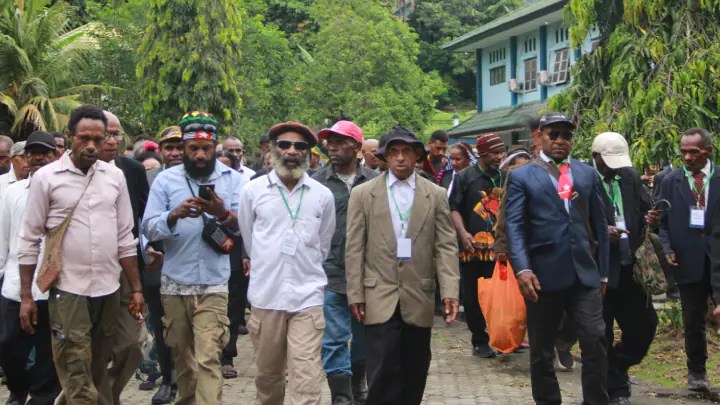
Indonesian forces in West Papua have arrested 42 Papuan liberation activists, including a prominent 74-year-old tribal chief, during an independence separatist meeting.

Police detained all of the activists, who spent one night in jail before they were placed under house arrest for the next eight months, to curb the opportunities of further assembly together.

Tribal chief John Wenggi was arrested at his Waropen residence in the Papua province of Indonesia during the political meeting.

Wenggi was reportedly later beaten in custody, according to West Papua sources.

He was returned to his own residence last week for house arrest and is said to currently be on an intravenous (IV) drip from his injuries sustained in custody.

United Liberation Movement for West Papua leader and chairman, Benny Wenda, denounced the arrests on Wednesday, specifically taking aim at the alleged targeted beating of Mr Wenggi.

The arrests follows ongoing reports of violent clashes between the Indonesian military and West Papua civilians.

“On behalf of the people of West Papua (independence movement), I condemn the arrest of the 42 United Liberation Movement for West Papua representatives last week by the Indonesian police,” Mr Wenda said.

“Indonesia has proven once again that fundamental human rights do not exist in West Papua.

“What possible justification is there for this vicious repression?

“Under international law, the United Liberation Movement for West Papua has the right to assembly and to peacefully advocate for democracy in our own land.

“This was a private political meeting held in the home of a widely-respected West Papuan Elder.

“I call on international non-government organisations and solidarity groups to pressure your governments to condemn these arrests and to call for the release of all remaining Papuan political prisoners.”

Indonesia’s latest crackdown on the West Papuan political movement is seen as a further response to the United Liberation Movement for West Papua’s Legislative Council’s first plenary session – a deliberative assembly to mark the region’s unrecognised provisional government – a month earlier in July.

Indonesia, in the same week of the arrests, released six unnamed West Papuan political prisoners on Friday after they were granted clemency among 1,778 other inmates following an earlier announcement from the nation’s President, Prabowo Subianto, to pardon approximately 44,000 detainees fighting against the state.

West Papua’s historic meeting of more than 2000 members had been inaugurated to its Legislative Council across West Papua’s six customary, historic regions – as opposed to the six different provinces the Indonesian administration imposed on West Papua.

Those moves have sparked Indonesian House of Representative MP Oleh Soleh to deliver a warning that a “new wave of repression” would target West Papua while also calling the United Liberation Movement for West Papua nothing more than a “political criminal group”.

“These groups that disrupt the Unitary State of the Republic of Indonesia, groups that will disrupt unity, must be resolved immediately and effectively without problems or casualties because this is a burning fire,” Mr Soleah said.

“If this continues, it will certainly be dangerous.”

Mr Wenda said the words are a clear threat to all “peaceful activities” of the United Liberation Movement for West Papua-backed provisional government.

The United Liberation Movement for West Papua chairman, who lives in exile in the United Kingdom, has urged West Papuans to protect other high-profile independence leaders on the ground, naming West Papua Prime Minister Edison Waromi and West Papua Legislative Council Chair Buchtar Tabuni as crucial in its struggle towards independence.

“I call on our allied legal, political, and solidarity groups to do all they can to protect United Liberation Movement for West Papua representatives from arrest and/or imprisonment,” Mr Wenda said.

“They are at serious risk as Indonesia intensifies its crackdown.”

West Papua’s head of state, President Jacob Rumbiak, is reportedly exiled in Australia.

Mr Wenda has reportedly told Indonesia the United Liberation Movement for West Papua is the legitimate representatives of West Papuans to act on behalf of its Indigenous peoples.

“The strategy that has been formulated in the Indonesian parliament and by the Indonesian police is now coming to fruition,” he said.

“But in their desperation to destroy United Liberation Movement for West Papua’s peaceful mission for liberation, Indonesia shows just how weak their hold on West Papua truly is.

“The United Liberation Movement for West Papua now has roots in every city, every town, and village throughout West Papua.

“We are a government-in-waiting and are ready to engage with the world.

“Indonesia is terrified of our growing strength.

“Indonesia must realise that no number of arrests will crush the West Papuan desire for independence.”

Despite Mr Wenda adding “we are already prisoners in our land“, in concession to Indonesia, the United Liberation Movement for West Papua is inviting President Prabowo to meet to discuss an internationally mediated referendum on independence.

“Ultimately, this is the only true path to a peaceful resolution in West Papua,” he said.

——————————————-
The West Papuan Legislative Council Has Held Its Inaugural Meeting in Jayapura

BY PAUL GREGOIRE PUBLISHED ON 17 JUL 2025 

The 5 July 2025 inauguration of the West Papuan Legislative Council in West Papua’s Jayapura City “marked the rebirth of the West Papuan state”, remarked United Liberation Movement West Papua president Benny Wenda in a 10 July 2025 statement, adding that the globe  “should respect” that it has “fulfilled all international requirements to be recognised as a government-in-waiting”.

According to reports, 350 members were inaugurated into the West Papuan Legislative Council on 5 July, along with thousands of regional council members, to represent the Indigenous peoples of the land across the seven customary regions that the ULMWP government recognises in West Papua: not the six provinces that the colonial Indonesian administration has imposed upon the region.

The establishment of the West Papuan government-in-waiting is the latest stage in a heightened push by the West Papuan liberation movement began with the September 2017 presentation of the West Papuan People’s Petition to the United Nations General Assembly, prior to the December 2020 founding of a provisional government and subsequent establishing of infrastructure on the ground.

These bounds towards independence, however, have also seen an intensification of Indonesian military attacks on occupied West Papuans, which began on villages in Nduga Regency, and continues to the present day, while the inauguration of alleged habitual war crimes perpetrator Prabowo Subianto as Indonesian president last year neither bodes well for the Melanesian region.

But as ULMWP Legislative Council chair Buchtar Tabuni led thousands of West Papuans, who’d just attended the first session of the West Papuan Legislative Council held in Jayapura City, in a procession through the main streets of one of the nation of West Papua’s largest cities, the message was clear: West Papua now has a government-in-waiting, and it does not want to wait too long.

A nation-in-waiting

“We have now completed our internal structure, implementing democracy even before winning independence,” said ULMWP president Benny Wenda, who currently lives in exile. “The world should respect the fact that we have fulfilled all international requirements to be recognised as a government-in-waiting,”

“We have our own provisional government, cabinet, laws, constitution and Green State Vision for a liberated West Papua,” the president-in-waiting continued, as he noted the commitment an independent West Papua has made to becoming a truly green state. “We also have a network of diplomatic representatives around the world, ready to engage with international diplomats.”

In the lead up to the Netherland colonisers 1962 departure, the West New Guinea Council, which was made up of West Papuans, celebrated their nation’s coming independence on 1 December 1961, Wenda recalled, with the raising of the Morning Star flag, and diplomats from the UK, France, Papua New Guinea, Australia and the Netherlands all bore witness to the ceremony.

As Wenda explains the roll out of the Legislative Council finishes the process of actualising an entire Indigenous government on the ground, which commenced with the first meeting of the West Papuan congress in November 2023.

This finishes the establishment of the legislative framework for an independent West Papua, as well as produces a body to legitimise this point on the global stage.

“With the 2020 provisional government, we built a legitimate governance structure and declared Indonesian presence in West Papua to be illegal,” Wenda underscored. 

“With this inauguration, we have deepened our sovereignty on the ground. The ULMWP is now present at every level of West Papuan life.”

Never any choice

As it was leaving West Papua, the Netherlands handed control of the territory to the United Nations, as per the 1962 New York Agreement, and then in May 1963, it passed on interim administration to Indonesia, another country that had been colonised by the Dutch, who’d left in 1949. This handover was done on the basis that Jakarta let the West Papuans hold a referendum on independence.

Indonesia then held the 1969 UN-brokered “Act of Free Choice”, which saw the Indonesian military select 1,026 West Papuans to take part in, and via threat of gunpoint, they all voted to remain with Jakarta. So, the New York Agreement was never honoured, a fraud vote occurred and the 1.8 million West Papuans, or 70 percent of the population, who signed the petition, want a real referendum.

Since 1 May 1963, Jakarta has killed over half a million West Papuans, and, as Indonesia has been running a transmigration program into the Melanesian region since the 1970s, the 90 percent of the population that the locals, the West Papuans, had made up at that time, has now dropped down to comprising of less than 50 percent of the people living in the region.

The attacks on villages and displacement of local West Papuans has picked up since 2018, and this has been accompanied by the construction of the Trans-Papua Road project, which is a highway needlessly being rolled out that harms the West Papuan landscape and people. The attacks on people in the highlands and coastal regions across the nation of West Papua continue to this day.

The real choice awaits

Former Kopassus general and now Indonesian president Prabowo has a notorious reputation for the brutal manner in which he carried out operations in the former colony of East Timor and the continuing colony of West Papua.

Under the new president’s watch, the aerial bombing of West Papuan villages has heightened recently and the world’s largest act of deforestation is being committed on West Papuan soil in the name of sugarcane farming.

But so too has the West Papuan Legislative Council just met for the first time under Prabowo’s watch, and Wenda points out that for the United Liberation Movement of West Papua to be recognised as legitimate on the international stage has precedent, and he raised the Vanuatu People’s provisional government and the Palestine Liberation Organisation as examples of this.

ULMWP Legislative Council chair Tabuni said a fortnight ago that the 5 July plenary council meeting was an “historical milestone” that involved “the formation of a legitimate and representative legislative structure”, which has “strengthened the foundation of our government, as a nation ready for sovereignty”.

“The ULMWP is ready to play that role,” Wenda underscored. “We are ready to take our seat at the table, to help find a diplomatic political solution to the West Papuan issue through international political mechanisms.”

 PAUL GREGOIRE 

Paul Gregoire is a Sydney-based journalist and writer. He’s the winner of the 2021 NSW Council for Civil Liberties Award For Excellence In Civil Liberties Journalism. Prior to Sydney Criminal Lawyers®, Paul wrote for VICE and was the news editor at Sydney’s City Hub.

————————————-

Don’t surrender’ to Indonesian pressure over West Papua, Bomanak warns MSG 

By APR editor –  June 26, 2025

Asia Pacific Report

A West Papuan independence movement leader has warned the Melanesian Spearhead Group after its 23rd leaders summit in Suva, Fiji, to not give in to a “neocolonial trade in betrayal and abandonment” over West Papua.

While endorsing and acknowledging the “unconditional support” of Melanesian people to the West Papuan cause for decolonisation, OPM chair and commander Jeffrey P Bomanak
spoke against “surrendering” to Indonesia which was carrying out a policy of “bank cheque diplomacy” in a bid to destroy solidarity.

Fiji Prime Minister Sitiveni Rabuka took over the chairmanship of the MSG this week from his Vanuatu counterpart Jotham Napat and vowed to build on the hard work and success that had been laid before it.

He said he would not take the responsibility of chairmanship lightly, especially as they were confronted with an increasingly fragmented global landscape that demanded more from them.

PNG Prime Minister James Marape called on MSG member states to put West Papua and Kanaky New Caledonia back on the agenda for full MSG membership.

Marape said that while high-level dialogue with Indonesia over West Papua and France about New Caledonia must continue, it was culturally “un-Melanesian” not to give them a seat at the table.

West Papua currently holds observer status in the MSG, which includes Papua New Guinea, Solomon Islands, Vanuatu, and Fiji — and Indonesia as an associate member.

PNG ‘subtle shift’
PNG recognises the West Papuan region as five provinces of Indonesia, making Marape’s remarks in Suva a “subtle shift that may unsettle Jakarta”, reports Gorethy Kenneth in the PNG Post-Courier.

West Papuans have waged a long-standing Melanesian struggle for independence from Indonesia since 1969.

The MSG resolved to send separate letters of concern to the French and Indonesian presidents.

In a statement, Bomanak thanked the Melanesians of Fiji, Papua New Guinea, Solomon Islands, Vanuatu and the Kanak and Socialist National Liberation Front (FLNKS) of Kanaky New Caledonia for “unconditionally support[ing] your West Papuan brothers and sisters, subjected to dispossession, enslavement, genocide, ethnocide, infanticide, and ethnic cleansing, [as] the noblest of acts.”

“We will never forget these Melanesian brothers and sisters who remain faithfully loyal to our cultural identity no matter how many decades is our war of liberation and no matter how many bags of gold and silver Indonesia offers for the betrayal of ancestral kinship.

“When the late [Vanuatu Prime Minister] Father Walter Lini declared, ‘Melanesia is not free unless West Papua is free,”’ he was setting the benchmark for leadership and loyalty across the entire group of Melanesian nations.

“Father Lini was not talking about a timeframe of five months, or five years, or five decades.

“Father Lini was talking about an illegal invasion and military occupation of West Papua by a barbaric nation wanting West Papua’s gold and forests and willing to exterminate all of us for this wealth.

‘Noble declaration’
“That this noble declaration of kinship and loyalty now has a commercial value that can be bought and sold like a commodity by those without Father Lini’s courage and leadership, and betrayed for cheap materialism, is an act of historic infamy that will be recorded by Melanesian historians and taught in all our nations’ universities long after West Papua is liberated.”

Bomanak was condemning the decision of the MSG to regard the “West Papua problem” as an internal issue for Indonesia.

“The illegal occupation of West Papua and the genocide of West Papuans is not an internal issue to be solved by the barbaric occupier.

“Indonesia’s position as an associate member of MSG is a form of colonial corruption of the Melanesian people.

“We will continue to fight without MSG because the struggle for independence and sovereignty is our fundamental right of the Papuan people’s granted by God.

“Every member of MSG can recommend to the United Nations that West Papua deserves the same right of liberation and nation-state sovereignty that was achieved without compromise by Timor-Leste — the other nation illegally invaded by Indonesia and also subjected to genocide.”

Bomanak said the MSG’s remarks stood in stark contrast to Father Lini’s solidarity with West Papua and were “tantamount to sharing in the destruction of West Papua”.

‘Blood money’
It was also collaborating in the “extermination of West Papuans for economic benefit, for Batik Largesse. Blood money!”

The Papua ‘problem’ was not a human rights problem but a problem of the Papuan people’s political right for independence and sovereignty based on international law and the right to self-determination.

It was an international problem that had not been resolved.

“In fact, to say it is simply a ‘problem’ ignores the fate of the genocide of 500,000 victims.”

Bomanak said MSG leaders should make clear recommendations to the Indonesian government to resolve the “Papua problem” at the international level based on UN procedures and involving the demilitarisation of West Papua with all Indonesian defence and security forces “leaving the land they invaded and unlawfully occupied.”

Indonesia’s position as an associate member in the MSG was a systematic new colonialisation by Indonesia in the home of the Melanesian people.

Indonesia well understood the weaknesses of each Melanesian leader and “carries out bank cheque diplomacy accordingly to destroy the solidarity so profoundly declared by the late Father Walter Lini.”

“No surrender!” —————————————-

ULMWP & FLNKS hold historic meeting in European Parliament

March 27, 2025 in News

The United Liberation Movement for West Papua (ULMWP) and Kanak and Socialist National Liberation Front (FLNKS) held a momentous meeting today in the European Parliament, bringing their shared struggle against foreign occupation to the heart of Europe.

The meeting, entitled ‘Anti-Colonial Struggle in the Pacific’, was hosted by Basque Country MEP Pernando Barrena (EH Bildu, The Left). ULMWP Interim President Benny Wenda addressed the meeting, along with Senator Robert Xowie from the FLNKS, Gorka Elejabarrieta (EH Bildu), former Catalan President Carles Puigdemont (Junts), and ILWP legal advisor Tim Hansen.

Attendees heard about the historic bond between the ULMWP and FLNKS, the ongoing humanitarian crises in both territories, the EU-Indonesia free trade agreement, and the strength of both parties’ case for self-determination under International Law.

Demonstrations took place across all seven regions of West Papua over the past two days in support of the meeting (video and pictures below).

KNPB: Papuans have been victims of Indonesian militarism since 1963

Aryo Wisanggeni

Last updated: January 29, 2025 2:35 pm

Author: Larius Kogoya

Editor: Aryo Wisanggeni G

Jayapura, Jubi – The Papuan people have continued to be victims of militarism practices carried out by the Indonesian government since 1963. This was stated by the First Chairman of the West Papua National Committee, Warius Sampari Wetipo at a national seminar entitled “Realizing the Spirit of People’s Resistance for the Right to Self-Determination for the West Papuan People” which took place in Makassar City, South Sulawesi Province, on Monday (27/1/2025).

Warius Sampari Wetipo said that the KNPB was born because of militarism in the Land of Papua which has never stopped since May 1, 1963. According to him, in practice, military operations in the Land of Papua have never stopped since May 1, 1963, when the West Papuan nation was annexed by Indonesia.

Since then, massive and structured military operations have occurred throughout Papua. Although the Indonesian government has not officially announced the implementation of martial law in Papua, the security forces have continued to carry out various military operations there.

“The state committed crimes through Operation Trikora, Operation Mandala, Operation Wibawa, Operation, Tumpas, Operation Sadar, Operation Ketupat, Operation Senyap, Operation Koteka. Until now we still hear about Operation [Peace] Cartenz, Operation Nemangkawi, Operation Elang, and so on. Papua is a military emergency zone or Military Operation Area,” said Warpo Wetipo when interviewed further via the WhatsApp application service on Tuesday (28/1/2025).

Wetipo stated that since 2018 there have been sweeps of residents’ homes, burning of churches, schools, shootings of civilians by TNI/Polri officers in various regions of Papua. Mass evacuations occurred in Nduga Regency. After that, armed conflict between the TNI/Polri apparatus and the armed group of the West Papua National Liberation Army or TPNPB occurred and spread to various regions in Papua.

“The armed conflict between the TPNPB and the TNI/Polri continues to spread in various regions in our homeland, such as in Intan Jaya Regency, Yahukimo, Pegunungan Bintang, Maybrat, Puncak Jaya, Timika, Paniai, Dogiyai, Lanny Jaya, Puncak Jaya, and most recently in Yalimo and Tambrauw Regencies. The Papuan people are the main victims,” ​​said Wetipo.

The large-scale evacuation caused civilians to lose their homes, lose their relatives. A number of elderly people and babies who died in the middle of the forest died. The refugees also lost their livestock, could not farm, and lost their livelihoods.

The Central Executive Board of BPP KNPB together with the KNPB Makassar Regional Consulate held a national seminar entitled “Realizing the Spirit of People’s Resistance for the Right to Self-Determination for the West Papuan People” in Makassar City, South Sulawesi Province, on Monday. The seminar was attended by students, university students, youth, and KNPB delegates from Manado, Gorontalo, and Tomohon.

The seminar was also attended by representatives of student organizations that are members of the Cipayung Group, human rights and democracy activists, LBH Makassar, FRI-WP, KNPB activists, AMPTPI and AMP.

Activist of the Indonesian People’s Front for the Liberation of West Papua (FRI-WP) Makassar Region, Arul reviewed the history of President Soekarno issuing the Trikora Declaration in the Yogyakarta Square on December 19, 1961, one of the contents of which was the dissolution of the Dutch puppet state of Papua. The decree also ordered a general mobilization led by Soekarno.

“The impact was a massive military invasion in the West Irian region (West Papua). The independence of the West Papuan nation was castrated on December 19, 1961,” he said.

According to Arul, the political economic conspiracy of America, the Netherlands, and Indonesia during the struggle for West Irian has sacrificed the people and nation of West Papua, because the people and nation of West Papua were never involved in the negotiations. “That indicates that the meeting was only carried out by the devil, the devil, and witnessed by ghosts,” said Arul.

Another FRI-WP Makassar activist, Nyora, said that the problem in West Papua, his party saw not only genocide, ecocide and ethnocide. According to him, the main problems faced by the Papuan people are colonialism, racism, and capitalism in the Land of Papua.

“In short, Indonesia practiced colonialism in West Papua. The next, racism is very fertile in Indonesia. The practice of racism has been implemented since the beginning, since the West Papuan Nation was annexed into the Republic of Indonesia,” said Nyora.

Nyora revealed that the Indonesian nation as a new colonial nation feels superior to the Papuan nation. In every decision regarding political, economic, legal, social, and cultural status, the Papuan Indigenous People are never involved as subjects.

“That’s where racism is embedded. Indonesia considers the Papuan nation to be backward, ancient, primitive, stupid, weak, poor. That’s the nature of colonialism,” he said.

The condition of the people in Papua is getting worse, because of the problem of capitalism. Nyora said that Papua is economically controlled by foreign capitalism and Indonesia is only a errand dog. This condition often causes indigenous people to experience agrarian conflicts which become serious problems and give rise to new conflicts.

“Indonesia is only a errand dog for foreign capitalists. Even customary land is capitalized by local capitalists and bourgeoisie,” said Nyora.

Public advocate LBH Makassar, Rasak said that LBH exists to advocate and provide legal protection for victims, especially the weak who need legal assistance. LBH Makassar accompanies victims on various issues, including Papuan activists who express their opinions and protest in the form of demonstrations.

“We were once interrogated by Indonesian security forces, ‘why are you advocating for Papuan issues and so on’. For LBH Makassar, advocating for the weak, the oppressed/colonized is necessary, [they] have their fundamental rights protected,” said Rasak. (*)

Indonesian Government Enters a New Phase in the Occupation of West Papua

  BY PAUL GREGOIRE PUBLISHED ON 3 JAN 2025 

United Liberation Movement for West Papua provisional government interim president Benny Wenda warns that since Indonesian president Prabowo Subianto took office in October, he’s been proven right in having remarked, after the politician’s last February election, that his coming marks the return of “the ghost of Suharto”: the brutal dictator who ruled over the nation for three decades.

Wenda, an exiled West Papuan leader, outlined in a 16 December statement that at that moment the Indonesian forces were carrying out ethnic cleansing in multiple regencies, as thousands of West Papuans were being forced out of their villages and into the bush by soldiers. 

The entire regency of Oksop had been emptied, with over 1,200 West Papuans displaced since an escalation began in Nduga regency in 2018.

Prabowo coming to top office has a particular foreboding for the West Papuans, who’ve been occupied by Indonesia since 1963, as over his military career – which spanned from 1970 to 1998 and saw rise him to the position of general, as well as mainly serve in Kopassus (special forces) – the current president perpetrated multiple alleged atrocities across East Timor and West Papua.

According to Wenda, the incumbent Indonesian president can “never clean the blood from his hands for his crimes as a general in West Papua and East Timor” and he further makes clear that Prabowo’s acts since taking office reveal that he is set on “creating a new regime of brutality” in the country of his birth.

Enhancing the occupation

“Foreign governments should not be fooled by Prabowo’s PR campaign,” Wenda made certain in mid-December. “He is desperately seeking international legitimacy through his international tour, empty environmental pledges and the amnesty offered to various prisoners, including eighteen West Papuans and the remaining imprisoned members of the Bali Nine.”

Former Indonesian president Suharto ruled over the Southeast Asian nation with an iron fist from 1967 until 1998.

In the years prior to his officially taking office, General Suharto oversaw the mass murder of up to 1 million local Communists, he further rigged the 1969 referendum on self-determination for West Papua, so it failed and he invaded East Timor in 1975.

Wenda maintains that the proof Prabowo is something of an apparition of Suharto is that he’s set about forging “mass displacement, increased militarisation” and “increased deforestation” in the Melanesian region of West Papua. And he’s further restarted the transmigration program of the Suharto days, which involves Indonesians being moved to West Papua to populate the region.

As Wenda advised in 2015, the initial transmigration program resulted in West Papuans, who made up 96 percent of the population in 1971, only comprising 49 percent of those living in their own homelands at that current time.

Wenda considers the “occupation was entering a new phase”, when former Indonesian president Joko Widodo split the region of West Papua into five provinces in mid-2022. And the West Papuan leader advises that Prabowo is set to establish separate military commands in each province, which will provide “a new, more thorough and far-reaching system of occupation”.

West Papua was previously split into two regions, which the West Papuan people did not recognise, as these and the current five provinces are actually Indonesian administrative zones.

“By establishing new administrative divisions, Indonesia creates the pretext for new military posts and checkpoints,” Wenda underscores. “The result is the deployment of thousands more soldiers, curfews, arbitrary arrests and human rights abuses. West Papua is under martial law.”

Ecocide on a formidable scale

Prabowo paid his first official visit to West Papua as president in November, visiting the Merauke district in South Papua province, which is the site of the world’s largest deforestation project, with clearing beginning in mid-2024, and it will eventually comprise of 2 million deforested hectares turned into giant sugarcane plantations, via the destruction of forests, wetlands and grasslands.

Five consortiums, including Indonesian and foreign companies, are involved in the project, with the first seedlings having been planted in July. And despite promises that the megaproject would not harm existing forests, these areas are being torn down regardless. And part of this deforestation includes the razing of forest that had previously been declared protected by the government.

A similar program was established in Merauke district in 2011, by Widodo’s predecessor president Susilo Bambang Yudhoyono, who established rice and sugarcane plantations in the region, aiming to turn it into a “future breadbasket for Indonesia”. However, the plan was a failure, and the project was rather used as a cover to establish hazardous palm oil and pulpwood plantations.

“It is not a coincidence Prabowo has announced a new transmigration program at the same time as their ecocidal deforestation regime intensifies,” Wenda said in a November 2024 statement. “These twin agenda represent the two sides of Indonesian colonialism in West Papua: exploitation and settlement.”

Wenda added that Jakarta is only interested in West Papuan land and resources, and in exchange, Indonesia has killed at least half a million West Papuans since 1963. And while the occupying nation is funding other projects via the profits it’s been making on West Papuan palm oil, gold and natural gas, the West Papuan provinces are the poorest in the Southeast Asian nation.

Independence is still key

The 1962 New York Agreement involved the Netherlands, West Papua’s former colonial rulers, signing over the region to Indonesia. A brief United Nations administrative period was to be followed by Jakarta assuming control of the region on 1 May 1963. And part of the agreement was that West Papuans undertake the Act of Free Choice, or a 1969 referendum on self-determination.

So, if the West Papuans didn’t vote to become an autonomous nation, then Indonesian administration would continue.

However, the UN brokered referendum is now referred to as the Act of No Choice, as it only involved 1,026 West Papuans, handpicked by Indonesia. And under threat of violence, all of these men voted to stick with their colonial oppressors.

Wenda presented The People’s Petition to the UN Human Rights High Commissioner in January 2019, which calls for a new internationally supervised vote on self-determination for the people of West Papua, and it included the signatures of 1.8 million West Papuans, or 70 percent of the Indigenous population.

The exiled West Papuan leader further announced the formation of the West Papua provisional government on 1 December 2020, which involved the establishment of entire departments of government with heads of staff appointed on the ground in the Melanesian province, and Wenda was also named the president of the body.

But with the coming of Prabowo and the recent developments in West Papua, it appears the West Papuan struggle is about to intensify at the same time as the movement for independence becomes increasingly more prominent on the global stage.

“Every element of West Papua is being systematically destroyed: our land, our people, our Melanesian culture identity,” Wenda said in November, in response to the recommencement of Indonesia’s transmigration program and the massive environment devastation in Merauke.

“This is why it is not enough to speak about the Act of No Choice in 1969: the violation of our self-determination is continuous, renewed with every new settlement program, police crackdown, or ecocidal development.”

PAUL GREGOIRE

Paul Gregoire is a Sydney-based journalist and writer. He’s the winner of the 2021 NSW Council for Civil Liberties Award For Excellence In Civil Liberties Journalism. Prior to Sydney Criminal Lawyers®, Paul wrote for VICE and was the news editor at Sydney’s City Hub.

PNG’s Parkop tells exiled Papuans ‘don’t lose hope – keep up the freedom struggle’

By APR editor –  December 8, 2024

Asia Pacific Report

Governor Powes Parkop of Papua New Guinea’s capital Port Moresby has appealed to West Papuans living in his country to carry on the self-determination struggle for future generations and to not lose hope.

Parkop, a staunch supporter of the West Papua cause, reminded Papuans at their Independence Day last Sunday of the struggles of their ancestors, reports Inside PNG.

“PNG will celebrate 50 years of Independence next year but this is only so for half of the island — the other half is still missing, we are losing our land, we are losing our resources.

“If we are not careful, we are going to lose our future too.”

The National Capital District governor was guest speaker for the celebration among Port Moresby residents of West Papuan descent with the theme “Celebrating and preserving our culture through food and the arts”.

About 12,000 West Papuan refugees and exiles live in PNG and Parkop has West Papuan ancestry through his grandparents.

The Independence Day celebration began with everyone participating in the national anthem — “Hai Tanaku Papua” (“My Land, Papua”).

Song and dance
Other activities included song and dance, and a dialogue with the young and older generations to share ideas on a way forward.

Some stalls were also set up selling West Papuan cuisine, arts and crafts.

Governor Parkop said: “We must be proud of our identity, our culture, our land, our heritage and most importantly we have to challenge ourselves, redefine our journey and our future.

“That’s the most important responsibility we have.”’

West Papua was a Dutch colony in the 9th century and by the 1950s the Netherlands began to prepare for withdrawal.

On 1 December 1961, West Papuans held a congress to discuss independence.

The national flag, the Morning Star, was raised for the first time on that day.

Encouraged to keep culture
Governor Parkop described the West Papua cause as “a tragedy”.

This is due to the fact that following the declaration of Independence in 1961, Indonesia laid claim over the island a year later in 1962.

This led to the United Nations-sponsored treaty known as the New York Agreement.

Indonesia was appointed temporary administrator without consultation or the consent of West Papuans.

In 1969 the so-called Act of Free Choice enabled West Papuans to decide their destiny but again only 1026 West Papuans had to make that choice under the barrel of the gun.

To this day, Melanesian West Papua remains under Indonesian rule.

Governor Parkop encouraged the West Papuan people to preserve their culture and heritage and to breakaway from the colonial mindset, colonial laws and ideas that hindered progress to freedom for West Papua.

Republished with permission from Inside PNG.

West Papuan independence advocate seeks New Zealand support against ‘genocide and ecocide”

West Papuan independence advocate Octo Mote is in Aotearoa to win support for independence for West Papua, which has been ruled by Indonesia for over 60 years.

Mote is the vice-president of the United Liberation Movement for West Papua (ULMWP), and is being hosted in New Zealand by the Green Party, which Mote said had always been a hero for West Papua.

ULMWP president Benny Wenda has alleged more than 500,000 Papuans have been killed since the occupation, and millions of acres of ancestral forests, rivers and mountains have been destroyed or polluted for “corporate profit”.


The struggle for West Papuans

“Being born a West Papuan, you are already an enemy of the nation,” Mote said.

“The greatest challenge we are facing right now is we are facing the colonial power who live next to us.”

If West Papuans spoke up about what was happening, they were considered separatists, Mote said, regardless of whether they were journalists, intellectuals, public servants or even high-ranking Indonesian generals.

“When our students on the ground speak of justice, they’re beaten up, put in jail and [they – Indonesians] kill so many of them,” Mote said.

Mote is a former journalist and said, while he was working, he witnessed Indonesian forces openly fire at students who were peacefully demonstrating their rights.

“We are in a very dangerous situation right now. When our people try to defend their land, the Indonesian government ignores them and they just take the land without recognising we are landowners,” he said.


The ecocide of West Papua

The ecology in West Papua was being damaged by mining, deforestation, and oil and gas extraction. Mote said Indonesia wanted to “wipe them from the land and control their natural resources”.

He said he was trying to educate the world that defending West Papua meant defending the world, especially small islands in the Pacific.

West Papua is the western half of the island of New Guinea, bordering the independent nation of Papua New Guinea. New Guinea has the third-largest rainforest after the Amazon and Congo and is crucial for climate change mitigation as they sequester and store carbon.

Mote said the continued deforestation of New Guinea, which West Papuan leaders were trying to stop, would greatly impact the small island countries in the Pacific, which were among the most vulnerable to climate change.

Mote also said their customary council in West Papua had already considered the impacts of climate change on small island nations and, given West Papua’s abundance of land, they said by having sovereignty they would be able to both protect the land and support Pacific Islanders who needed to migrate from their home islands.

In 2021 West Papuan leaders pledged to make ecocide a serious crime and this week Vanuatu, Fiji and Samoa submitted a court proposal to the International Criminal Court to recognise ecocide as a crime.


Support from local Indonesians

Mote said there were Indonesians who supported the indigenous rights movement for West Papuans. He said there were both NGOs and a Papuan Peace Network founded by West Papuan peace campaigner Neles Tebay.

“There is a movement growing among the academics and among the well-educated people who have read the realities, among those who are also victims of the capital investors, especially in Indonesia when they introduced the omnibus law.”

The omnibus law was passed in 2020 as part of the president’s goals to increase investment and industrialisation in Indonesia. The law was protested because of concerns it would be harmful for workers due to changes in working conditions, and the environment because it would allow for increased deforestation.

He said there was an “awakening” especially in the younger generations who were more open-minded and connected to the world, who could see it both as a humanitarian and an environmental issue.


The ‘transfer’ of West Papua to Indonesia

“The Dutch [traded] us like a cow,” Mote said.

The former Dutch colony was passed over to Indonesia in 1963 but ULMWP calls it an invasion.

From 1957, the Soviet Union had been supplying arms to Indonesia and, during that period, the Indonesian Communist Party had become the largest political party in the country.

The US government urged the Dutch government to give West Papua to Indonesia in an attempt to appease the communist-friendly Indonesian government as part of a US drive to stop the spread of communism in Southeast Asia.

The US engineered a meeting between both countries, which resulted in the New York Agreement, giving control of West Papua to the UN in 1962 and then Indonesia a year later.

The New York Agreement stipulated that the population of West Papua were entitled to an act of self-determination.


The ‘act of no choice’

This decolonisation agreement was titled the 1969 Act of Free Choice, which is referred to as “the act of no choice” by pro-independence activists.

Mote said they witnessed, “how the UN allowed Indonesia to cut us into pieces, and they didn’t say anything when Indonesia manipulated our right for self-determination.”

The manipulation Mote refers to is for the Act of Free Choice. Instead of a national referendum, the Indonesian military hand-picked 1,025 West Papuan “representatives” to vote on behalf of the 816,000 people. The representatives were allegedly threatened, bribed and some were held at gunpoint to ensure a unanimous vote.

Leaders of the West Papuan independence movement assert that this wasn’t a real opportunity to exercise self-determination as it was manipulated. However, it was accepted by the UN.


Pacific support at UN General Assembly

Mote has came to Aotearoa after the 53rd Pacific Island Leaders Forum meeting in Tonga and has come to discuss plans over the next five years. Mote hopes to gain support to take what he calls the “slow-motion genocide” of West Papua back to the UN General Assembly.

“In that meeting we formulated how we can help really push self-determination as the main issue in the Pacific Islands,” Mote said.

Mote said there was focus on self-determination of West Papua, Kanaky/New Caledonia and Tahiti. He also said the focus was on what he described as the current colonisation issue with capitalists and global powers having vested interests in the Pacific region.

The movement got it to the UN General Assembly in 2018, so Mote said it was achievable. In 2018 Pacific solidarity was shown as the Republic of the Marshall Islands, Tuvalu and the Republic of Vanuatu all spoke out in support of West Papua.

They affirmed the need for the matter to be returned to the United Nations, and the Solomon Islands voiced its concerns over human rights abuses and violations.


What needs to be done

He said in the next five years Pacific nations needed to firstly make the Indonesian government accountable for its actions in West Papua. He also said President Joko Widodo should be held accountable for his involvement.

Mote said New Zealand was the strongest Pacific nation that would be able to push for the human rights and environmental issues happening, especially as he alleged Australia always backed Indonesian policies.

He said he was looking to New Zealand to speak up about atrocities taking place in West Papua and was particularly looking for support from the Greens, Labour and Te Pāti Māori for political support.

The coalition government announced a plan of action on July 30 this year, which set a new goal of $6 billion in annual two-way trade with Indonesia by 2029.

“New Zealand is strongly committed to our partnership with Indonesia,” Foreign Affairs Minister Winston said then.

“There is much more we can and should be doing together.”

———————————————————————

Slowly goes the Forum leaders’ agenda 

by Tess Newton Cain 

9 September 2024

Between the earthquake at the beginning and the communiqué kerfuffle at the end, the 53rd Pacific Islands Forum Leaders Meeting (PIFLM) ran smoothly enough and presented as a largely harmonious affair. It was one of the biggest, with over 1,000 delegates, activists, observers, and journalists travelling to Nuku’alofa from across the world. Of the 18 Forum member countries, all were present bar one: President Taneti Maamau of Kiribati was unable to attend as his country is in the midst of elections.

In his opening address to the meeting, Forum Secretary-General Baron Waqa stated “the time for talking is now over – we need to see action”. While these words were largely directed to Forum partners, they also provide a benchmark against which the outcomes of the PIFLM can be judged.

As reported by Kalafi Moala, one of the most significant action points for the PIF was the establishment of the Pacific Resilience Facility (PRF). But attempts to persuade extra-regional partners to contribute to the capitalisation of this facility are meeting with mixed results. The European Union remains a non-starter – the EU Commissioner for International Partnerships, Jutta Urpilainen, said  “we are exploring opportunities” to be able to contribute to the PRF and, according to a senior UK official, “the UK has committed technical assistance to the value of £1.3 million (US$1.72 million) to setting up and structuring the PRF … UK funding and budgetary processes prevent us from a direct pledge to the PRF until it is fully established, and financial formalities are finalised”.

There were several additions to the Forum’s agenda at this meeting. The situation in New Caledonia was high profile and has been discussed extensively elsewhere. Perhaps less headline-grabbing was the addition of both health and education as standing agenda items, as proposed by the incoming chair, Prime Minister Siaosi Sovaleni of Tonga. The communiqué’s only substantive action point in these areas was an agreement to “develop a comprehensive region-wide health workforce strategy that focuses on quality training and retention measures for consideration by Pacific Health Ministers” (s.16).

There is no denying the importance of these issues in the Pacific. However, loading them onto the leaders’ agenda appears to go against the spirit of the Morauta review of 2013, which was to use this annual summit for issues that required collective political decision-making at the highest level. It should be recalled that in 2015, as part of the implementation of the Framework for Pacific Regionalism (FPR), the submission and filtering process for agenda items was such that a group of just five made the cut: climate change, fisheries, West Papua, ICT, and cervical cancer.

It is not surprising that the elements of the leaders’ agenda have changed in the years since then. Cervical cancer has faded away. Many other items have made their way through a variety of officials’ and ministerial processes to end up in front of the leaders. However, if Morauta’s principles are to be preserved, there should be a renewed commitment to handing off issues – including those that are the pets of the chair – to better homes. They could be pursued through an appropriate ministerial meeting or as part of the work program of a more technical regional agency such as the Pacific Community.

The creeping flabbiness of the agenda, combined with the disruption caused by geopolitical competition, has led to important issues not being progressed in a timely manner. Last year in Rarotonga, leaders requested that the Review of Regional Architecture be concluded for their consideration this year; this has not been achieved. Also last year, leaders considered the idea of a “Zone of Peace” as put forward by Prime Minister Sitiveni Rabuka of Fiji and tasked the Secretariat to further develop it for their consideration in 2024. Come this year’s communiqué and the concept has advanced little. It is now termed the “Ocean of Peace”, and the Secretariat is requested to develop a draft concept for consideration ahead of the gathering next year in Solomon Islands.

As these deferrals and timeline extensions accumulate, the ability of the Pacific Islands Forum to maintain focus and achieve political outcomes is undermined. The case of West Papua provides a striking example. In this year’s communiqué, it merits just one line in which the report of the special envoys (prime ministers James Marape of PNG and Rabuka of Fiji) was “noted”. At the closing press conference, the troika (comprising the leaders of Cook Islands, Tonga and Solomon Islands) said that they were “planning to make sure” a visit to West Papua by Forum special envoys took place before the next meeting. The details of how they are going to make that happen have not yet been disclosed.

This is a blog in an ongoing series of Pacific Island Forum Leaders’ Meeting analysis by Tess Newton Cain.

ULMWP Leader met Prime Minister Manele to discuss West Papua’s bid for MSG membership  

August 15, 2024 7:57 am

By Alfred Pagepitu

The President of the United Liberation Movement for West Papua (ULMWP), Benny Wenda, visited the country to seek support for their application for full membership into the Melanesian Spearhead Group (MSG).

On Tuesday, Mr. Wenda met with Prime Minister Jeremiah Manele to discuss issues related to West Papua’s MSG membership.

He told SIBC News that it was a great honor to meet with Prime Minister Jeremiah Manele and discuss the issues affecting the people of West Papua.

“It’s a great honor for me to meet with the Prime Minister and listen to the story of West Papua.”

“I am here to remind our leaders of the call for our full membership, which has been going on for almost 10 years, and we know that the history started here in the Solomon Islands during former Prime Minister Manasseh Sogavare’s endorsement of our application as an observer.”

“So, I am back to meet with the current Prime Minister Manele to brief him on the situation in West Papua.”

Wenda’s team is visiting other Pacific Island countries to discuss their issues and consider their call.

“I am going around lobbying with my teams for the upcoming MSG meeting and also the Pacific Islands Forum (PIF). They need to reiterate the call, and the Prime Minister assured me that we will discuss this issue prior to the Pacific Island Forum meeting in Tonga.”

“I hope to continue the discussion, and we hope the Prime Minister will consider our call,” Wenda said.

West Papua needs Melanesian leaders to make a bold decision to grant West Papua the full membership so that they can engage and participate fully.

“We’ve been coming here every year for almost 12 years, to Solomon Islands, Fiji, Vanuatu, and Papua New Guinea, to tell them what is happening in our country.”

Wenda emphasized that West Papua is a brother to Melanesian countries by blood, race, culture, and geography, and that they are entitled to become a true Melanesian nation that wants freedom and full membership.

Meanwhile, Wenda and his team will travel to other parts of Melanesia, including Papua New Guinea and Fiji after their visit to Vanuatu and Solomon Islands.

The team also met with civil society groups, West Papua sympathisers and political leaders, telling them that the support of everyone is important for advancing the MSG bid.

Benny Wenda is a West Papuan Independence Leader who founded the Free West Papua Campaign in 2004. He works tirelessly to ensure self determination for West Papua.