Government’s seriousness in dealing with poor air quality questioned

CNN Indonesia – September 5, 2023

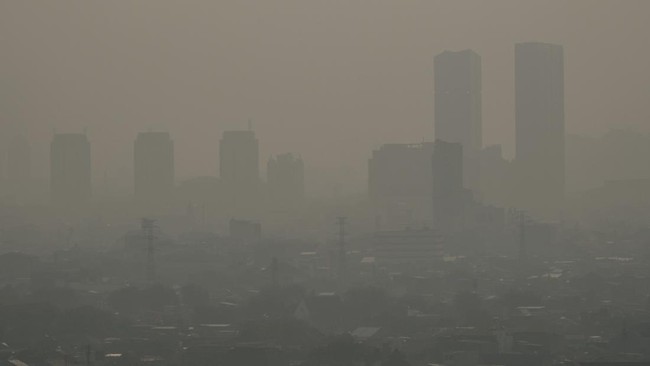
Ilustrasi. Situasi polusi udara di Jakarta, 16 Agustus 2023. (AFP/YASUYOSHI CHIBA)

Download Apps CNN Indonesia sekarang https://app.cnnindonesia.com/

Jakarta — The Indonesian Forum for the Environment (Walhi) has criticised government efforts to overcome air pollution headed up by Coordinating Minister for Maritime Affairs and Investment Luhut Binsar Pandjaitan.

The government has highlighted a number of issues such as reducing deforestation, accelerating the use of electric vehicles and using water mist generators on tall building.

Walhi urban affairs and pollution campaign head Abdul Ghofar says that reducing deforestation should indeed have been started long ago. But the current air pollution problem is not just because of deforestation — rather it is also effected by forest and land fires (karhutla). Ghofar said that this effect is mostly found in Sumatra and Kalimantan.

“Outside the big cities in regions like Sumatra and Kalimantan the air quality is also quite bad. The cause of the air pollution in areas other than cities, the majority is from the forestry sector, yeah, or from land [fires]”, Ghofar told CNN Indonesia on Tuesday September 3.

“It’s not a single problem, it’s quite unfortunate if for example the government only identifies the issue of deforestation and then says, oh, deforestation has declined, meaning air pollution from deforestation is low”, he continued.

Ghofar said that forest and land fires are getting worse again. Based on Walhi’s records, there are 7,800 hotspots, some of which are in company concession areas.

“Meaning there’s burning going on, burning by companies for land and plantation clearing, especially palm oil. But [the government] is only focusing on deforestation while incidents of forest and land fires, some of which are occurring in company concession areas, are still high”, he explained.

Ghofar also highlighted the government’s push to accelerate the use of electric vehicles. According to Ghofar, there is a bias between this effort to overcome the air pollution problem and businesses that are owned by some government officials.

He said there are a number of government officials at the ministerial level that own businesses in the electric vehicle sector.

“I’m not prepared to mention any names, but there are several public officials at the ministerial level and under them that do indeed own electric vehicle businesses. This policy obscures the interests of the ordinary people and business interests”, he said.

In addition to this, the process of making electric vehicles is also inseparable from power generation and materials which are currently seen as big contributors to emissions, namely coal and nickel.

Ghofar also believes that the subsidies being offered by the government for the purchase of electric vehicles should be reallocated to subsidise public transport.

We think that these big subsidies could actually be reallocated to subsides public transport, then to subsidise the purchase of new armadas for cities that don’t yet have adequate [public] transportation”, he said.

Furthermore, he also took up the issue of water spraying using the mist generators on tall buildings. According to Ghofar, the effectiveness of water spraying has not yet been proven to reduce air pollution.

“If it only becomes a new project, it’s a shame, especially if the burden falls on the private sector who own tall buildings to install water mist [generators]”, he said.

Ghofar also question the government’s seriousness in overcoming the air pollution problem because the air quality in a number of regions is still getting worse.

“Regarding the efforts to overcome air pollution that are being carried out by the government, so far the air quality in Jakarta and surrounding areas is still getting worse”, he said. (yla/tsa)

[Translated by James Balowski. The original title of the article was “Walhi Pertanyakan Keseriusan Pemerintah Atasi Buruknya Kualitas Udara”.]

Tabuni new ULMWP President

West Papuan activists groups elect new

By Len Garae

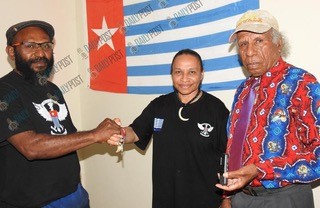
ULMWP Interim President Mr. Manase Tabuni (left) hands over key to ULMWP Office to ULMWP Spokesperson Paula Makabori with long-time Port Vila Office caretaker, Freddy Warome ready to receive key from her

By Len Garae

The population of West Papua represented by United Liberation Movement of West Papua (ULMWP) have an Interim President to succeed Mr. Benny Wenda.

He is Mr. Manase Tabuni, 45, who risked finding his way to attend the recent ULMWP Summit here in Port Vila.

The only difference between him and his predecessor is that Mr. Wenda lives in London at the other side of the world while Mr. Tabuni lives with his people in Melanesian West Papua.

Asked to comment after his election, Mr. Tabuni said, “While my task ahead is immense and risky, I am prepared to commit myself towards the positive outcome of the West Papua struggle, with my people of West Papua, the Vanuatu Free West Papua Association. Vanuatu Christian Council, the Vanuatu National Council of Chiefs and the Government of Vanuatu and the people of Vanuatu are all behind me”.

Mr. Tabuni said there won’t be any difference since all ULMWP Leaders speak with one voice for the liberation of West Papua to realise the dream of their people, in line with the road map and spirit of the Summit.

Asked if there is going to be any difference in his leadership since he lives with his people, he replied that while their diplomats continue to handle their diplomatic tasks abroad, he will focus on his job on the ground backed by his people. “We will all work together in ULMWP for the benefit of our people in West Papua,” Mr. Tabuni said.

“This is also a confirmation on the contrary to what Jakarta said that ULMWP was organised and led by individuals from abroad, let me confirm that my election is a confirmation of what we have been repeating all along that it is a struggle ignited by the spirits of our ancestors in West Papua and as well as their Melanesian descendants today.

“Our mandate is supported by the three political parties in West Papua and the people of West Papua.

“In fact my election is a confirmation that I am taking the leadership back to my people in West Papua, who are longing to fly their own flag in their God-given country, free of fear on their Independence Day.”

Asked of any risk involved in his leadership, Mr. Tabuni said if it is to do with his mandate then it is a risk that he is prepared to take.

The Interim President appeals to the Government of Vanuatu, chiefs, churches and Non-Governmental Organisations (NGOs), media and people to stand united for West Papua freedom.

news

Menase Tabuni leads ULMWP, ready to fight for independence from within West Papua

Syam Terrajana – ULMWP Summit II, Menase Tabuni, New Leader of ULMWP

September 4, 2023

Writer: Abeth You | Editor: Syam Terrajana

Dari kiri ke kanan, Markus Haluk sekretaris ULMWP, Benny Wenda urusan Luar Negeri, Paola Makabori perwakilan WPNCL, Menase Tabuni Presiden ULMWP dan Octovianus Mote Wakil Presiden ULMWP – ULMWP untuk Jubi

Nabire, Jubi – The United Liberation Movement for West Papua or ULMWP has held a second high-level conference or summit which will be held in Port Vila starting on August 22 2023. At this momentum something new happened in the leadership structure that has been formed to continue the struggle from within West Papua Alone.

on that occasion, at least 50 representatives who attended the summit had traveled from West Papua and all over the world to Port Vila. This is the second summit since ULMWP was formed in 2014.

Menase Tabuni has been announced as the new President and will lead the ULMWP Management from within West Papua, thereby maintaining its presence and solidarity with the Papuan people on the ground.

“I am honored to be appointed as the new ULMWP President and I will do everything I can to continue our legitimate struggle for independence. We must do this from within West Papua as well as campaigning in the international community. “I will remain in Papua with the people while continuing to fight for human rights and my own determination,” said Menase Tabuni to Jubi in a press statement received on Monday (4/9/2023).

The new ULMWP executive structure is Menase Tabuni as President, while Vice President is held by Octovianus Mote, Markus Haluk as Secretary, Benny Wenda for Foreign Affairs, while Buchtar Tabuni as Chair of the Legislative Council and Apollos Sroyer as Chair of the Judicial Council.

According to him, ULMWP continues to be the umbrella organization that represents all the main group organizations in West Papua. Including the West Papua National Coalition for Liberation (WPNCL), the Federal Republic of West Papua (NFRPB) and the West Papua National Parliament (PNWP).

“And that we work with executives are Paula Makabory and Rex Rumakiek from WPNCL, and also Jacob Rumbiak from NFRPB and Oridek Ap from PNWP, and others too.” he said.

Also read: Coordinating Minister for Political, Legal and Security Affairs: The government has not apologized for serious human rights violations

Tabuni emphasized that the aim of the ULMWP summit meeting was to announce new leadership and create a strategic road map for the next five years.

“ULMWP also wants to clarify that there is no ‘Interim Government’ and ULMWP is a representative body for all Papuans,” he said.

Markus Haluk, secretary of the ULMWP, emphasized that his party welcomed the decision of the MSG leaders to encourage Indonesia to allow the visit of the UN Human Rights Commissioner to West Papua, together with the Pacific Delegation, so that the international community has a better understanding of the real situation on the ground in Papua. West.

ULMWP, he continued, continues to demand access for international media to be able to visit West Papua and report freely.

“Indonesia cannot call itself a democratic country if Indonesia continues to hide its largest province from the world,” he said firmly.

ULMWP also expressed its deepest gratitude to the Vanuatu government for hosting the MSG Summit and the ULMWP group. Also to the people of Vanuatu for their continued support, including the Malvatumauri National Chiefs Council, SHEFA

Province, Pacific Council of Churches and all leaders and groups within the Pacific Region who continue to maintain solidarity.

“Finally to the West Papuan people in our homeland, we are united and committed to working together to achieve our vision for an independent and democratic West Papuan state in the Pacific family,” said Haluk. (*)

——————————————–

Indonesia responds after claim official attempted to bribe RNZ Pacific journalist

Koroi Hawkins, RNZ Pacific Editor @KoroiHawkins koroi.hawkins@rnz.co.nz 

Members of the Indonesian delegation at the Melanesian Leaders’ Summit pre-meeting of the Foreign Ministers’ in Port Vila. 21 August 2023 Photo: RNZ Pacific / Kelvin Anthony

A Radio New Zealand journalist says an Indonesian government official attempted to bribe and intimidate him at the recent 22nd Melanesian Spearhead Group leaders’ meeting in Port Vila.

The Indonesian government has responded on Monday saying it will “surely look” into the claims.

RNZ journalist Kelvin Anthony was in Port Vila to cover the MSG Leaders’ Summit two weeks ago when he was offered “a gift” after an exclusive interview with Indonesia’s Ambassador to Australia, Dr Siswo Pramono.

The alleged bribe was offered between 1pm-1.10pm on Wednesday, 23 August in the carpark of the Holiday Inn Resort in Port Vila by Indonesian government representative Ardi Nuswantoro, Anthony said.

“I was offered an exclusive interview with the Indonesia’s Ambassador to Australia at the MSG meeting after being told earlier in the week by Ardi Nuswantoro that his government did not like what RNZ had published on West Papua and that it was not balanced,” he said.

“I advised the delegate that RNZ makes every effort to be balanced and fair and we want to get Indonesia’s side too, but we need the chance to speak on the record.”

After communicating face-to-face and online via WhatsApp – texts and call records seen by RNZ – Nuswantoro asked Anthony to visit the Holiday Inn Resort at 12pm for the interview on Wednesday, 23 August.

“I interviewed Dr Pramono covering a broad set of questions including human rights issues in West Papua, the MSG meeting, and Jakarta’s intentions in the Pacific, which lasted over 40 minutes,” Anthony said.

“I thought I had an exclusive interview that went well for a strong story out of the meeting that touched sensitive but pertinent issues involving Indonesia, the West Papua issue, and the Pacific.”

Anthony said he was escorted out of the reception area at the end of the interview and accompanied by at least three Indonesian officials.

He said Nuswantoro, who he was liaising with to set up the interview, “asked me several times if I had a car and how I was going to get back”.

“I told them that my colleague from a local media who was with me was driving me back to town. As we walked to the car park, the same official continued to walk with me and just as we were about to approach the car, he said, ‘The Indonesian delegation would like to offer you token of appreciation’.”

“I asked him, ‘What’s that?’ He replied, ‘A small gift’.

“I asked him again, ‘But what is it?’ And he replied: ‘Money’.

“At that point I was shell-shocked because I had never experienced something like that in my career.

“I declined to accept the money and told him, ‘I cannot take money because it compromises the story and my credibility and integrity as a journalist’.”

Anthony said the Indonesian official looked visibly withdrawn at the rejection and apologised for offering money.

Due to the incident RNZ chose at the time not to air the interview with Dr Pramono.

RNZ put the claims of bribery and intimidation to the Indonesian government.

In an email response, Jakarta’s Ministry of Foreign Affairs, Asia Pacific and African Affairs director general Abdul Kadir Jailani neither confirmed nor denied the claims.

“Bribery has never been our policy nor approach to journalists,” Jailani said.

“We will surely look into it,” he said.

MSG has failed West Papua: Regenvanu

The Melanesian Spearhead Group (MSG) has failed West Papua.

Minister for Climate Change Adaptation, Mr. Ralph Regenvanu, who is also a pioneer spokesman for freedom for the Melanesian people of West Papua, made this statement when he delivered his remarks at the closing of the United Liberation Movement for West Papua (ULMWP) Second Summit at Owen Hall at the Presbyterian Paton Memorial (PMC) recently.

“Today I feel very sad because the MSG has failed West Papua. When I found out the decision of the leaders, I was shocked and I was really sad,” he said.

“We have not gone forward, we have gone backward here in Vanuatu. And this should not have happened in Vanuatu as (we are) the Chairman of MSG.”

Speaking on behalf of the Government, he described the failure to the abrupt failure to adopt West Papua as the latest full member of MSG, as “a failure not only by the Vanuatu Government, but a failure by the Vanuatu Free West Papua Association (VFWPA), a failure by the ULMWP and we all have to pull up our socks”.

He continued, “If we had all been much better prepared in working together, I think we would have had a different result here in Vanuatu. For example the Vanuatu Government gave an office here for ULMWP, but the ULMWP was not a participant of Senior Officials’ Meeting of MSG.

“What is the purpose of having a meeting to decide the agenda for the leaders if ULMWP was absent from the meeting?”

However, he assured the second ULMWP Summit, “For me this meeting is more important than the MSG Summit.

“Because it is a meeting to represent the unity for the people of West Papua for the self-determination of the people of West Papua”.

Minister Regenvanu challenged ULMWP to learn from Vanuatu’s political history.

“Vanuatu became independent because we formed a political grouping called Vanua’aku Pati and everybody got behind it to become independent. In fact without it, we would not have become independent,” he said.

“I am pleading with you to refocus this organisation which was formed here in Port Vila (in 2014). Rebuild, reunite, restrategise and with a truly united movement representing all Melanesians of West Papua, and one which is responsive and strategic and smart, we can achieve what we all want to help the Vanuatu Government to do better the next time.

“The Vanuatu Government is helping you but this is your struggle. We are your backup but we can’t set the direction for you. So please help us to help you.”

Vanuatu’s first former Roving Ambassador and a former Prime Minister Barak Sope, was the Second Speaker. “We struggled for our freedom from Britain (and France),” he said.

“Despite that happened now (to adopt West Papua as latest full member of MSG), the struggle must continue until victory is certain. We fully support the statement of Mr. Regenvanu that united we stand, divided we fall. Vanuatu will continue support the struggle of the people of West Papua.

“We’ve always taken the stand that West Papua should have been the first Melanesian country to become independent.

“The first Speaker of Parliament (of West Papua) Ayamiseba stayed with us here. He told us everything that happened. How Holland the colonial power sold the people of West Papua, how the United States and Australia also sold the West Papuan people.

“And how the United Nations sold the people of West Papua.

“So we must never accept how Indonesia came in and stole your freedom.

“The reason for their presence is because of West Papua’s resources and not because of us the Melanesians.

“They are stealing (Melanesian resources). They are stealing our lands, they are stealing our trees, and they are stealing our gold so the struggle must continue for West Papua victory is certain!”

The ceremony was closed with a prayer from the Vanuatu Christian Council.

A Melanesian custom ceremony followed. It was coordinated by the Chairman of the Council of Chiefs of West Papua referred to as “Chief Tommy”.

Witnessed by the Interim President of ULMWP, Mr. Benny Wenda and his delegates and custom chiefs of Efate, the ceremony ended in the Melanesian way with the presentation of three live pigs, food, kava and mats to the Government, Vaturisu and VFWPA.

Facebook Twitter Email Print

Melanesian leaders group decides West Papua independence body does not meet ‘existing criteria’ to join

By foreign affairs reporter Stephen Dziedzic and Indonesia correspondent Birtles Bill

Posted 16h ago16 hours ago, updated 16h ago16 hours ago

Pacific leaders wearing matching blue Hawaiian shirts sit at table with flags in the background.
Leaders at the Melanesian Spearhead Group meeting in Port Vila signed declarations on security and climate change.(ABC News: Leah Lowonbu)

Melanesian leaders have rejected a push from pro-independence activists in Indonesia’s restive Papua region to join a key regional group, saying they could not reach consensus on the bid.

Key points:

  • Indonesian diplomats have been lobbying Melanesian leaders on ULMWP’s membership
  • A final communique from the MSG seems to close the door on the issue
  • The MSG leaders also endorsed a Fossil Fuel Non-Proliferation Treaty Initiative

The United Liberation Movement for West Papua (ULMWP) had been pressing to gain full membership of the Melanesian Spearhead Group (MSG) — which includes Solomon Islands, Fiji, Vanuatu and Papua New Guinea — in what would have given the organisation a rare diplomatic victory in its search for international recognition.

But Melanesian leaders remained publicly non-committal to the idea in the wake of a series of meetings in Vanuatu’s capital Port Vila this week.

Indonesian diplomats have also been furiously lobbying Melanesian leaders on the issue, and staged a walkout when ULMWP leader Benny Wenda was about to address the gathering on Wednesday.

And on Friday MSG leaders released a final communique which seemed to close the door on membership, saying the ULMWP did not meet the “existing criteria” and that the group could not reach “consensus” on the issue.

‘A significant blow’

Tess Newton Cain, from the Griffith Asia Institute, told the ABC that Papua activists would be “very disappointed” with the response.

“What is in the communique seems to indicate that there is no pathway to them becoming members and this will be a significant blow,” she said.

“It is not surprising to learn that the five leaders who met in the retreat would not have been able to reach a consensus even if the ULMWP had satisfied the criteria for membership.

“We have yet to hear from Benny Wenda or other ULMWP spokespersons how they feel about this but they may well consider that the goalposts have been moved.”

A Papuan student looks at the camera with his body and face painted with the colors of the banned separatist flag.
Membership of the Melanesian Spearhead Group would mean valuable international recognition for the United Liberation Movement for West Papua.(AP: Binsar Bakkara)

Multiple protests have been organised in recent weeks in various towns and cities in Papua, including one in the city of Jayapura on Tuesday that saw several dozen demonstrators facing off against Indonesian police.

Some of the protests have been forcefully suppressed according to activists, and they come amid a backdrop of ongoing sporadic violence between Indonesian security forces and armed rebels.

On Monday in the rebel-stronghold of Papua’s central highlands, a member of Indonesia’s military was shot dead in an attack, according to information from both a pro-independence spokesman and Indonesia’s armed forces.

Pollution rises froman industrial chemical plant that is silhouetted against an evening sky.
Papua New Guinea, which has a large gas export industry, had not endorsed the Fossil Fuel Non-Proliferation Treaty Initiative until this week. (AP: Michael Probst)

Climate change initiative endorsed

MSG leaders also endorsed a Fossil Fuel Non-Proliferation Treaty Initiative designed to rapidly phase out the use of fossil fuels.

The initiative has been spearheaded by a block of six Pacific nations but had not before been endorsed by Papua New Guinea, which has a large gas export industry.

The Pacific director of the Fossil Fuel Non-Proliferation Treaty Initiative, Auimatagi Joe Moeono-Kolio, said the declaration from Melanesian leaders showed “just how seriously they are taking the threat” of escalating climate change.

“Far from the empty rhetoric of some of our larger neighbours, today’s decision shows yet again that Pacific leaders and communities are serious about committing to the tangible pathways set out in the Port Vila Call, ensuring a managed phase-out of fossil fuels and a just and equitable transition for all our Pacific peoples.”

An aerial view shows the storage tanks for treated water and an opening onto an expanse of water.
Japan began releasing treated water from the crippled Fukushima nuclear power plant on Thursday. (Reuters: Kyodo)

Fukushima water release criticised

Melanesian leaders also criticised Japan’s decision to start releasing treated water from the Fukushima nuclear power plant into the Pacific – even though Fiji’s Prime Minister Sitiveni Rabuka appeared to endorse the move just days ago.

The IAEA found the discharge would pose a “negligible” impact on people and the environment, and was in line with international standards.

But Melanesian leaders said that did not amount to an “endorsement” from the IAEA, and said that Japan should not release the water “until and unless” it was “incontrovertibly proven to be safe by science”.

Jostling for influence

The MSG leaders meeting was also shadowed by the broader strategic contest in the Pacific, with both Australian and Chinese diplomats attending as “special guests” as both nations continue to jostle for influence across the region.

The leaders said on Thursday they had signed a new joint declaration on regional security, but have not yet publicly released the document.

Dr Newton Cain said that Australia’s decision to attend as a guest was “hugely significant considering that for most of the time that the MSG has been in existence, Australia has paid it little or no attention”.

She also pointed out that the communique specifically noted Australia’s desire to play a bigger role supporting the MSG.

“Whilst it is important that Australia has more and better engagement with the MSG, it is not without risk — as we have seen this week and previously, it can be a complex and volatile environment,” she said.

MSG leaders defer Papua membership decision to Forum

The leaders of five Melanesian countries and territories avoided a definitive update on the status of the United Liberation Movement of West Papua’s application for full membership in Port Vila.

However, the 22nd Melanesian Spearhead Group Leaders’ Summit was hailed as the “most memorable and successful” by Vanuatu’s prime minister as leaders signed off on two new declarations in their efforts to make the sub-region more influential.

As well as the hosts, the meeting was attended by Papua New Guinea, Solomon Islands, Fiji and the FLNKS of New Caledonia.

But the meeting had an anti-climactic ending after the leaders failed to release the details about the final outcomes or speak to media.

The first agreement that was endorsed is the Udaune Declaration on Climate Change to address the climate crisis and “urging countries not to discharge potentially harmful treated nuclear contaminated water into the Pacific Ocean”.

“Unless the water treated is incontrovertibly proven, by independent scientists, to be safe to do and seriously consider other options,” Vanuatu Prime Minister Alatoi Ishmael Kalsakau said at the event’s farewell dinner on Thursday.

The leaders also signed off on the Efate Declaration on Mutual Respect, Cooperation and Amity to advance security initiatives and needs of the Melanesian countries.

This document aims to “address the national security needs in the MSG region through the Pacific Way kipung, tok stori, talanoa, and storian and bonded by shared values and adherence to the Melanesian vuvale, cultures and traditions,” Kalsakau said.

Kalsakau said the leaders “took complex issues such as climate change, denuclearisation, and human rights and applied collective wisdom” to address the issues that were on the table.

Passing on Papua

The issue of the United Liberation Movement of West Papua’s membership was a big ticket item on the agenda at the meeting in Port Vila according to MSG chair Kalsakau.

However, there was no update provided on it and the leaders avoided fronting up to the media except for photo opportunities.

Benny Wenda at the 22 Melanesian Spearhead Group Leaders' Summit in Port Vila. 22 August 2023

Benny Wenda at the 22 Melanesian Spearhead Group Leaders’ Summit in Port Vila. 22 August 2023 Photo: RNZ Pacific / Kelvin Anthony

ULMWP leader Benny Wenda (above) told RNZ Pacific late on Thursday he was still not aware of the result of their membership application but that he was “confident” about it.

“I don’t know the outcome. Maybe this evening the leaders will announce at the reception,” Wenda said.

“From the beginning I have been confident that this is the time for the leaders to give us full membership so we can engage with Indonesia.”

According to the MSG Secretariat the final communique is now expected to be released on Friday.

However, it is likely that the West Papua issue will be referred to the Pacific Islands Forum to be dealt with.

Papua New Guinea Prime Minister James Marape said after the signing: “on the issues that was raised in regards to West Papua…these matters to be handled at [Pacific Islands Forum]”.

“The leaders from the Pacific will also visit Jakarta and Paris” to raise issues about sovereignty and human rights,” he said.

Kalsakau said he looked forward to progressing the implementaiton of important issue recommendations from the 22nd MSG Leaders’ Summit which also include “supporting the 2019 call by the Forum Leaders for a visit by the OHCHR to West Papua”.

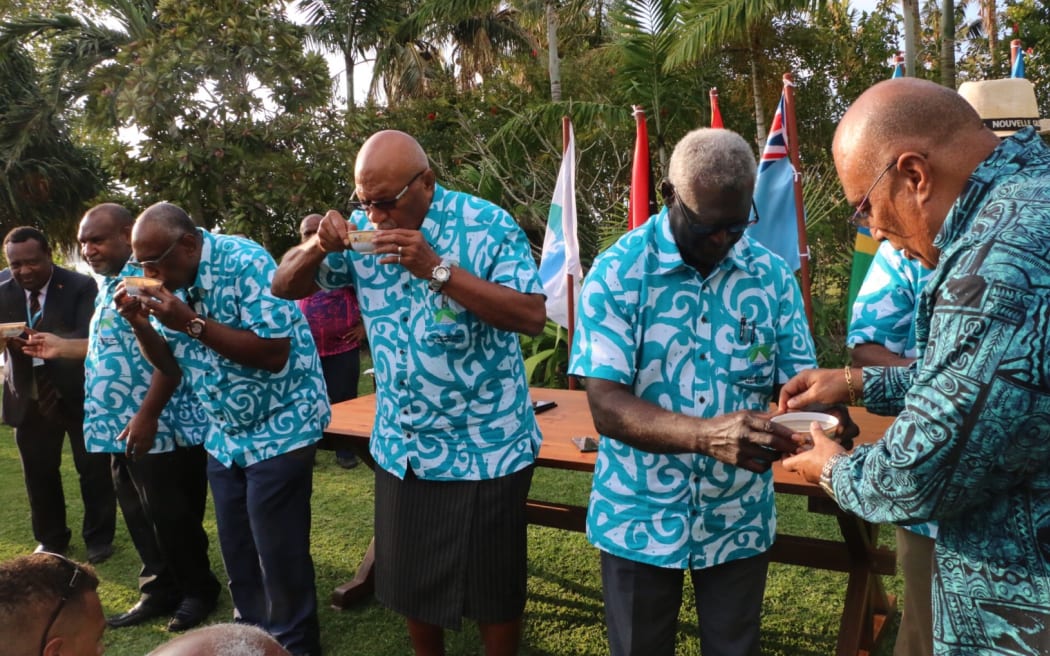
MSG leaders drink kava to mark the end of the meeting and signing two declarations. Photo: RNZ Pacific / Kelvin Anthony

Indonesia proud

Indonesia’s Vice Minister for Foreign Affairs, Pahala Mansury, said Indonesia is proud to be part of the Melanesian family.

Indonesia is an associate member of MSG and have said they do not accept ULMWP’s application to become a full member because it goes against the MSG’s founding principles and charter.

During the meeting this week, Indonesian delegates walked out on occasions when ULMWP representatives made their intervention.

Some West Papua campaigners say these actions showed that Indonesia does not understand the Melanesian way.

“You just don’t walk out of a sacred meeting haus when you’re invited to be part of it,” one observer said.

However, Mansury said Indonesia hopes to “continue to increase, enhance and strengthen future collaboration between Indonesia and all of the Melanesian countries”.

“We are actually brothers and sisters of Melanesia and we hope we can continue to strengthen the bond together,” he said.

Australia and China attended as special guests at the invitation of the Vanuatu government.

China supported the Vanuatu government to host the meeting.

Catholics seek probe into atrocities in Indonesia’s Papua

UCA News reporter By UCA News reporter Published: August 18, 2023 12:05 PM GMT

Rights group’s report reveals military violence displaced and forced thousands of tribal villagers into dire situations Catholic activists have called on Indonesian government to probe and ensure justice after a rights group released a report detailing military atrocities that displaced thousands of villagers and led to deaths due to hunger and diseases in Christian-majority Papua region.The 50-page report entitled “Destroy Them First, Discuss Human Rights Later” by Germany-based Human Rights Monitor (HRM), was released on Aug. 17, the 78th anniversary of Indonesian independence.“The report provides a meticulous and scientific analysis of the Indonesian forces’ attacks on indigenous villages, highlighting the urgent need for international attention and action,” the group said in a press release. The report focuses on the army attack on the Kiwirok District between 13 September and late October 2021 where the Indonesian military used mortars in air strikes, which destroyed 206 buildings, including public facilities such as schools and churches.The report “really describes conditions on the ground, which have so far not been noticed,” said Neles Kieb, a Catholic activist in Papua.The findings can “hopefully open international eyes on the situation in Papua,” he said.“Reports like this represent the hope of the Papuan people to end the inhumane situation that has led to the long-running conflict in the region,” he told UCA News.Father Bernard Baru, from the Justice, Peace and Integrity of Creation Commission in the Diocese of Jayapura covering the provincial capital, said ongoing impunity must end to stop such atrocities.”Unfortunately, the government’s current series of policies are actually exacerbating the situation, such as by adding more security forces to secure the expanding investment in Papua,” he said.President Joko Widodo’s visit to Papua did not improve the situation in Papua, the priest said.”Promises of changing approaches to problems in Papua, including through dignified dialogue with all parties to the conflict, are just empty messages,” he said.Since Papua is a Christian-majority region, Church groups and leaders from across the world including the Vatican and Pope Francis, will open their eyes and hearts to the people here following the report, he added.”Indonesian security forces repeatedly attacked eight indigenous villages in the Kiwirok District, using helicopters and spy drones. The helicopters reportedly dropped mortar grenades on civilian homes and church buildings while firing indiscriminately at civilians,” the report noted.The military attacks displaced at least 2,252 indigenous Ngalum people who fled their villages and have not returned to their homes as of June this year.Though the military operations caused no direct civilian deaths, people were forced to flee into the forest and live in shelters without access to adequate food and medicine, where they are vulnerable to hypothermia, malnutrition, and disease, the report said.As of July, at least 72 displaced people died due to dire conditions in shelters amid a lack of any form of government support.The military atrocities came in response to attacks on security forces by members of the West Papua National Liberation Army (TPNPB), an armed outfit fighting for the independence of Papua from Indonesian rule.The report “paints a harrowing picture of over two thousand villagers displaced and forced to live in subhuman conditions, without access to food, healthcare services, or education.” said Eliot Higgins, director at Bellingcat, a Netherlands-based investigative journalism group. Higgins said the instances of violence deliberately perpetrated against indigenous Papuan civilians by security forces, leading to loss of life and forced displacement amounts to “crimes against humanity” under the Rome Statuteof International Criminal Court.Indonesia is not a signatory of the Rome Statute.Usman Hamid, executive director of Amnesty International Indonesia, said the report provides necessary information for the National Human Rights Commission (Komnas HAM) to take up the case for a probe.Peter Prove, director for International Affairs at the World Council of Churches said the conflict in Papua “remains a hidden crisis, largely forgotten by the international community – a situation that suits the Indonesian Government very well.”“This report helps shine a small but telling beam of light on one specific part of the conflict, but from which a larger picture can be extrapolated,” he said.“Indonesia – which is currently campaigning for election to the UN Human Rights Council – must provide more access and transparency on the situation in the region, and the international community must respond appropriately to the increasing gravity of the crisis,” he said. Indonesian authorities and human rights commission were not available for comment.

Papua urged to commit to low-carbon development by Greenpeace

Jayapura, Jubi – Greenpeace Indonesia calls on the Papua Provincial Government to make a commitment to a low-carbon development strategy in Papua. The organization emphasizes that the government’s dedication is pivotal to ensure the sustainability and preservation of Papua’s natural forests.

Nico Wamafma, the Forest Campaigner for Greenpeace Indonesia, highlights that achieving the low-carbon development plan hinges on the government’s willingness to acknowledge the land, forest, and natural resource rights of indigenous people.

Additionally, the government needs to shift away from its exploitative development approach, which includes reducing the issuance of licenses for activities like mining, Industrial Plantation Forests (HTI), Forest Concession Rights (HPH), and oil palm plantations.

Greenpeace, in collaboration with the Institute for Development of Economics and Finance (INDEF), has uncovered that oil palm plantation licenses in Papua cover a vast area of 1.88 million hectares. Wamafma underlines that without concrete implementation of this commitment, the low-carbon development plan will stay as empty rhetoric on documents.

Wamafma reflects on Papua’s development trajectory over the past 23 years, citing it as a lesson on the pitfalls of a non-participatory approach that neglects the rights of Indigenous Papuans and damages the natural environment. According to Greenpeace Indonesia’s research, Papua has lost 641.4 thousand hectares of natural forest between 2000 and 2020.

Integrating indigenous territories into the Papua Spatial and Regional Plan (RTRW) is a crucial step, according to Wamafma. The Customary Territory Registration Agency (BRWA) has registered 107 maps of customary territories in Papua Province spanning 3,547,259 hectares. Of these, nine territories have gained recognition from the local government, covering an area of 26,972 hectares.

Wamafma asserts that incorporating indigenous territories into the RTRW document facilitates development planning within these areas, ensuring their protection and sustainability. He emphasizes that the active involvement of indigenous peoples is essential for this safeguarding process.

He stresses the importance of the Free, Prior, and Informed Consent (FPIC) process as a prerequisite for spatial designations. Wamafma argues that involving indigenous people guarantees their participation in managing and safeguarding land, forests, water, and natural resources in Papua. (*)

Jakarta’s air position and people’s right to live in a decent city

Arah Juang – August 20, 2023

Dipo Negoro — On Sunday August 13, based on data from the IQAir air quality monitoring website at 6 am, the Air Quality Index (AQI) in Jakarta stood at 170 or in the unhealthy category, with high levels of

PM2.5 pollutants. Over the last few weeks, the IQAir website has recorded Jakarta as being the most polluted city in the world, with an air quality nine times worse than the WHO ideal quality standard.

Reports have emerged about residents in Jakarta and its surrounds suffering respiratory illnesses. President Joko “Jokowi” Widodo was even reported to have been coughing for the last three weeks. The Jakarta Health Office said that throughout 2023 there has been a rise in residents suffering respiratory illnesses. Air pollution can cause respiratory infections, pneumonia, bronchitis, cardiovascular illnesses and cancer. Those who are most vulnerable are children who physiologically breathe faster and deeper than adults.

So what is a cause of all this? The Director General for Pollution Control and Environmental Damage at the Environment and Forestry Ministry, Sigit Reliantoro, says that the government is currently focused on efforts to control pollution in the transportation sector.

This is because, according to Reliantoro, transportation is the largest contributor to air pollution at 44 percent. The industrial sector meanwhile, contributes around 31 percent.

Environment and Forestry Minister Siti Nurbaya Bakar claimed that the main cause of the air pollution is motor vehicles. Because based on their records for 2022, there are some 24.5 million motor vehicles in Jakarta, 19.2 million of which are motorcycles. She also denied that the air pollution originated from the nearby Suralaya coal-fired power plant

(PLTU) in Cilegon. This is because based on an analysis of the pollution from the power plant it does not travel towards Jakarta, but North to the Sunda Strait. “So it can be said that it’s not because of the PLTU, yes, moreover it can be seen from the results of a study on the utilisation of coal its influence on Jakarta is less than 1 percent”, she said.

Yet, research by the Center for Research on Energy and Clean Air (CREA) published in August 2020 found that fossil fuel power plants and industrial factories were the principle polluters. The CREA noted that Jakarta is surrounded by 118 industrial facilities which also contribute to air pollution in Jakarta. These pollutants can reach Jakarta as a consequence of the wind direction at certain times.

Actually, the President of the Republic of Indonesia, the Environment Minister, the Home Affairs Minister and the Health Minister have already been found guilty by a court of violating the law in their handling of Jakarta’s pollution. The defendants were declared guilty of violating articles under Law Number 32/2009 on Environmental Protection and Management.

The class action suit on air pollution in the capital was launched by 32 residents represented by the Capital City Advocacy Team (an initiative of the Universal Clean Air Coalition) in July 2019 at the Central Jakarta District Court. The plaintiffs argued that Jakarta’s polluted air had resulted in the public’s right to enjoy a good and healthy environment not being fulfilled.

In 2010 there were 5 million cases of illness related to air pollution, which increase in 2016 to 6 million cases. As a consequence, the Jakarta public was burdened with a cost of 38.5 trillion rupiah in 2010 and 51.2 trillion rupiah in 2016 for the treatment of air pollution related illnesses.

The court ordered the first defendant (President Joko Widodo) to set a national ambient air quality standard that would be sufficient to protect human health, the environment and the ecosystem, including the health of sensitive sectors of the population based on scientific developments and technology.

The second defendant (Siti Nurbaya Bakar) was ordered to conduct supervision of then Jakarta Governor Anies Baswedan, Banten Governor Wahidin Halim and West Java Governor Ridwan Kamil in conducting an inventory of cross boarder emissions in Jakarta, Banten and West Java provinces.

The third defendant, Home Affairs Minister Tito Karnavian was ordered to conduct supervision and provide guidance on the performance of the fifth defendant (Baswedan) in controlling air pollution.

The fourth defendant, Health Minister Budi Gunadi Sadikin, was ordered to calculate the a decrease in the health impacts due to air pollution in Jakarta that needs to be achieved as a basis for assessing the fifth defendant (the Jakarta governor) in drafting a strategy and action plan to control pollution.

But instead of carrying out the court’s ruling, in early January the President of the Republic of Indonesia and the Environment and Forestry Minister instead submitted an appeal against the ruling with the Supreme Court.

In response to the mounting public outcry over the problem, Coordinating Minister for Maritime Affairs and Investment Luhut Binsar Pandjaitan summoned two regional heads and several ministers for a coordinating meeting. In a post on his Instagram account Pandjaitan said that six measures would be taken to address the problem.

First, they would attempt weather modification by cloud seeding; second industry and power plants would be obliged to utilise scrubbers to reduce smokestack pollutants; third there would be an extension and tightening up of vehicle emission tests; fourth, working hours would be staggered; fifth, the government would promote the use of public transport by increasing capacity during working hours; and sixth, there would be an acceleration in the use of electric vehicles.

Meanwhile, acting Jakarta Governor Heri Budi Hartono asked all government ministries and institutions with offices in Jakarta to apply work-from-home (WFH) policies for their employees. Official vehicles would also be replaced by electric vehicles. Environment Minister Bakar meanwhile said that they would closely monitor independent power plants in Jakarta and its surrounds.

These solutions all look good on paper, such as tightening control of industry and violators being subject to being taken over by the government. But can the government actually control the owners of big industry? The majority of President Widodo’s cabinet and House of Representatives (DPR) members are businesspeople or have links with big conglomerates, likewise also those who sit in the administration.

They are also the ones who when workers demand wage increases always respond by claiming that productivity is low and the company is suffering losses. They are free to criminalise and repress farmers fighting against land theft. They are also the ones who used all kinds of trickery and repression to push through the enactment of the highly unpopular Omnibus Law on Jobs Creation, which they themselves benefit from.

The private PLTUs that contribute to air pollution are owned by people like Pandjaitan, Tourism and Creative Economy Minister Sandiaga Uno, State-Owned Enterprises Minister Erick Thohir, business tycoon Aburizal Bakrie, former State-Owned Enterprise Minister Dahlan Iskan, former State Intelligence Agency (BIN) chief AM Hendropriyono, billionaire Arini Subianto, former Minister of Religion retired General Fachrul Razi, business tycoon Teddy Permadi Rachmat, mining and energy tycoon Wiwoho Basuki Tjokronegoro, Garibaldi “Boy” Thohir, owner of Indonesia’s second-largest coal mining company, Indonesia’s third richest person Prajogo Pangestu and palm-oil tycoon Martua Sitorus.

So then, why is public transport capacity only going to be increased during busy working hours? Public transportation should in fact be increased massively, meaning that all public transportation must be nationalised so it can be interconnected, not privatised. Decent wages and working conditions must be provide for public transport drivers. It must also be easily accessible, comfortable, cheap and punctual. And of course environmentally friendly.

Electric vehicles, which continue to be touted by the government as a solution to pollution, are not actually free from emissions or pollutants. The production of electric vehicles and their batteries use more energy and release more carbon dioxide than conventional vehicles.

This is also closely related to how electricity is used and how it is

produced: will it be from burning coal or from renewable energy sources?

Unfortunately, in the past five years, the share of coal-based energy increased by almost 10 percent, reaching 67.21 percent of the national energy mix in 2022, while at the same time renewable energy only grew by

1 percent to 14.11 percent.

Every kilowatt-hour of batteries capacity produced for electric vehicles results in 150-200 kilograms of carbon dioxide being emitted. The production of a single electric vehicle produces 17.5 tons of carbon dioxide. So even if every single vehicle was electric, a huge amount of carbon dioxide would still be produced.

The other problem with producing large numbers of electric vehicles is that mining the metals for the production of batteries and other components is rife with rights abuses and violations of workers’ rights.

Around 100 thousand mine workers in the Congo rely on simple equipment to obtain cobalt. The work is extremely dangerous and often results in accidents and even death. Wages are also very low. Meanwhile lithium in Chile is obtained by seizing indigenous people’s land and damaging the environment. It is not uncommon for lithium mines to employ child labour. Elon Musk, who is so highly praised by people like Widodo and his ministers, supported the coup d’etat against Evo Morales in Bolivia in order to obtain access to lithium.

And the ordinary people will not find it easy to shift to electric vehicles. Aside from the cost, which can be in the hundreds to billions of rupiah, electric power consumption is also high. Bandung Institute of Technology (ITB) research recommends that households should increase electricity capacity to 2,200 VA. For poor households with a 1,300 VA capacity or less, it would be impossible for them to recharge an electric vehicle.

So what’s behind the government’s push for eclectic vehicles as an environmentally friendly solution to pollution, to the point that the government is offering massive subsidies for people to buy electric cars and motorcycles?

Presidential Chief of Staff Moeldoko is the chairperson of the Electric Car Entrepreneurs Association. Pandjaitan has links with conglomerates such as the Hartono Brothers, Agus Lasmono, Bambang Soesatyo and Aburizal Bakrie, who all have interests in the electric vehicle business. Why is it that the elites and the conglomerates are always able to benefit when the ordinary people are suffering. Many of these people also saw their wealth increase significantly while ordinary people were impoverished by the Covid 19 pandemic.

There is a possibility that the problem will disappear with the onset of rain that is expected to begin in September. Rain helps dissolve pollutants floating in the air. Pressure on the government to take responsibility for the problem will subside, and electric vehicle and other industries will continue with business as usual. But the pollution problem will not go away. It will only ease subside temporarily then resurface in the future, perhaps even worse. We must act now.

— Dipo Negoro is a leading member of the Socialist Union (Perserikatan

Sosialis)

[Translated by James Balowski. The original title of the article was “Polusi Udara dan Hak Rakyat atas Kota Layak”.]