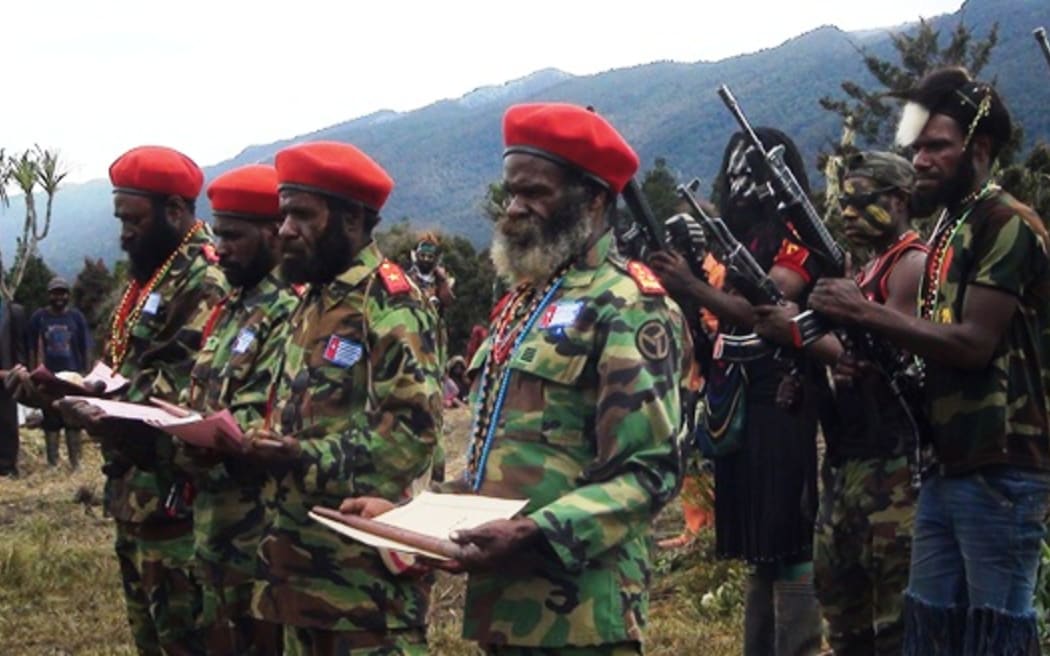
Highlands-based Defense Region Command of the West Papua National Liberation Army, or TPNPB. Photo: TPNPB
A researcher at Human Rights Watch in Jakarta is calling for the immediate release of the hostages including a New Zealand pilot being held by a rebel group in Indonesia’s Papua region.
The rebels in Highland Papua are threatening to execute Susi Air pilot Phillip Mehrtens if their demands are not met.
Five other people were also believed to have been taken hostage in the attack.
The West Papua National Liberation Army has posted an ultimatum on social media demanding Jakarta negotiate with them over independence for the region.
“Pilot is still alive and he will be held hostage for negotiations with Jakarta, if Jakarta is obstinate, then the pilot will be executed,” the statement read.
“We will take the New Zealand citizen pilot as hostage and we are waiting for accountability from the Australian Government, the New Zealand Government, the European Union Governments, and the United Nations, because for 60 years these countries have supported Indonesia to kill Indigenous Papuans.”
Researcher Andreas Harsono knows the main spokesperson of the rebel group Sebby Sambom after decades of research in the field.
He made a call to him personally to let the hostages go.
“I call on this group to immediately release all of the hostages including the pilot – it is a crime to kidnap anyone including this pilot,” he told RNZ Pacific.
“I do not know how to measure the seriousness of such a threat but this is a hostage situation, things could be out of control. So the best way is to negotiate and ask them to release the pilot.”
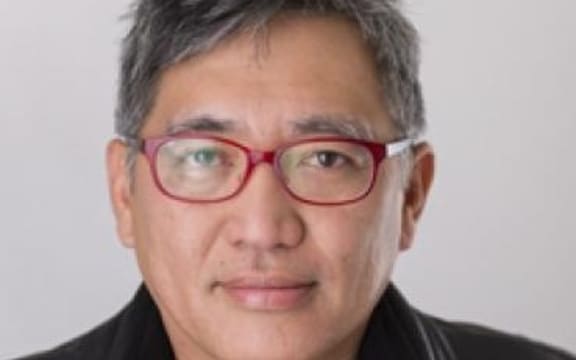
Andreas Harsono Photo: Human Rights Watch
Harsono noted the difficulties in New Zealand attempting to negotiate with the group, particularly given their demands.
“I don’t think it is easy or even internationally accepted to pressure the New Zealand government to negotiate for West Papuan independence from Indonesia.
“It is way too complicated for any country in the world including New Zealand to negotiate the independence of this particular territory but of course the Papuan people have suffered a lot and the Indonesian government should do more to end impunity and human rights abuses in West Papua.
“But this is a hostage situation. The most important thing is to call on this group to immediately and unconditionally release all of the hostages including the New Zealand pilot.”
Harsono said he does not know whether the passengers have been taken hostage, nor does he know if they are indigenous Papuans.
“The area is very remote, only certain people go there, mainly construction workers, and there were killings against Indonesian workers back in 2018,” he said.
Indonesian authorities say it’s facing difficulties locating Merhtens because of the lack of telecommunications facilities in Paro District and the absence of any Indonesian Military or police post in the area.
Jubi TV quotes Papua Police spokesperson Ignatius Benny Ady Prabowo saying his party continued to track the whereabouts of Mehrtens and are preparing to go to Paro District.
He said that before the burning of the plane, rumours had been circulating that a rebel group had threatened 15 construction workers who were building a health centre in the district.
“The New Zealand embassy in Indonesia is working on the case,” New Zealand’s prime minister, Chris Hipkins, told Radio New Zealand.
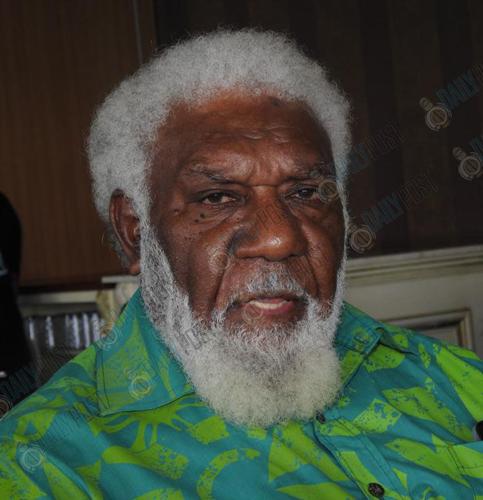
Former Vanuatu Prime Minister (PM) Joe Natuman says allowing Indonesia (by former Prime Minister Mr. Sato Kilman) into the Melanesian Spearhead Group (MSG) was a mistake.
“We (Melanesians) have a moral obligation to support West Papua’s struggle in line with our forefathers’ call including first former Prime Minister, Father Walter Lini, Chief Bongmatur, and others,” he said.
“Vanuatu has cut its canoe over 40 years ago and successfully sailed into the Ocean of Independence and in the same spirit, we must help our brothers and sisters in the United Liberation Movement of West Papua (ULMWP), to cut their canoe, raise the sail and also help them sail into the same future for the Promised Land.”
The former PM graced the West Papua Lobby Team on its appointment with the Minister of Foreign Affairs, Jotham Napat, this week when he agreed to an interview to confirm his support for the West Papua Struggle as above and admitted the mistake.
During their discussions with the Minister for Foreign Affairs, Mr. Natuman thanked the Minister and Minister for Climate Change Mr. Ralph Regenvanu and Prime Minister Ishmael Kalsakau, for their united stand for ULMWP to achieve full membership into the Melanesian Spearhead Group.
“When we created MSG, it was a political organisation before economic and other interests were added,” he said.
“After our Independence on July 30 of 1980, heads of different political parties in New Caledonia started visiting Port Vila to learn how to stand up strong to challenge France for their freedom.
“I joined the Team this week because I was involved under then Prime Minister Father Walter Lini, we advised the Political Leaders of New Caledonia at the time to form one political umbrella organisation to argue their case, and they formed FLNKS.
“We created ULMWP in 2014 here in Port Vila, to become your political umbrella organisation. After the child that we helped to create, we must continue to work with it to develop it towards its destiny.”
Like the Minister for Foreign Affairs, Mr. Natuman challenged both the Government and the Lobby Team to continue to lobby for ULMWP victory when all MSG Leaders unanimously vote West Papua in as the latest full member of MSG.
“But now that Indonesia is inside, it is not interested in the ULMWP issue but its own interests. So we must be careful here. We have passed resolutions regarding Human Rights and the United Nations have agreed for the UN Human Rights Commissioner to visit West Papua to report on the situation on the ground and Jakarta has blocked the visit,” he said.
Mr. Natuman challenged the Government whether or not to allow Indonesia to continue to behave towards MSG by ignoring the ULMWP demands.
Meanwhile, then Prime Minister Kilman had the same reasoning for allowing Indonesia into the MSG believing that the occupier would sit on the same table to be allowed to discuss the West Papua dilemma. However, it did not work out.
In the latest development, Mr. Natuman thinks new Fiji PM Sitiveni Rabuka is not going to govern in the same manner as former PM Bainimarama, now that he has already ordered the revival of Fiji’s Great Council of Chiefs which his predecessor had revoked.
“I also think PM Manasseh Sogavare (of the Solomons) still stands in support of ULMWP. I think the Foreign Affairs Minister of Papua New Guinea has to talk to PM James Marape,” he added.
In his opinion, based on the Mr. Napat’s briefing to the Lobby Team this week, the MSG Secretariat suddenly seems to follow every line to the book regarding the ULMWP Application for full membership of MSG.
“There is no need for the Committee of Officials to control the processes towards a positive outcome to the ULMWP Application. I suggest that you recommend to the PM to revisit the processes,” Mr. Natuman suggested.
“At the Leaders’ Summit, it is the (MSG) Leaders who decide what to talk about in their Meeting and do not allow ‘smol-smol man’ to dictate to you what or how you should talk about in your meeting.”
In addition, he said he was a member of an Eminent Group made up of Ambassador Kaliopate Tavola of Fiji, Roch Wamytan of FLNKS of News Caledonia and Solomons’ Prime Minister Sogavare who produced an MSG Report.
“In the Report we suggested that it was good that Indonesia came in and I personally recommended a Melanesian Nakamal Concept which in Polynesia and Fiji, it is called Talanoa (Process),” Mr. Natuman continued.
“This would allow Indonesia to sit down within a Melanesian umbrella to discuss their issues. Such a session should be chaired by an independent person such as a church leader or chief.
“The Report is there and it should allow Indonesia to talk about their human right issues. Indonesia could use the avenue to hear ULMWP’s view on their proposed Autonomy in West Papua.”
Indonesia could also bring in their other supporters to place their issues on the table for discussion.
Foreign Affairs Minister Napat recommended his “top to the bottom” approach instead of from a bottom up approach, allowing the ‘smol-smol man’ to dictate to the leaders how to make their decisions.
World leaders recently announced a $20 billion climate deal to help get Indonesia off coal power. But there are doubts about the deal because — for one thing — the country is planning to build new coal plants, including here in Kalimantan.
Adek Berry/AFP via Getty Images
Not far from the white sand beaches on the island of Borneo, the Indonesian government is building what it calls a “green industrial park.” In the ground-breaking ceremony, Indonesia’s president said this area of more than 40,000 acres would become a hub for green manufacturing using the country’s vast mineral reserves.
Indonesian officials are pursuing deals with Chinese battery manufacturer CATL as well as Elon Musk and Tesla to make EV batteries there. The idea is that this “green” park will eventually run on solar power and hydropower from a nearby river.
But building the hydropower infrastructure could take several years. In the meantime, Indonesia plans to build new coal-fired plants to power its “green” park, says Rachmat Kaimuddin, Deputy Minister of Indonesia’s Coordinating Ministry for Maritime Affairs and Investment.
Running green tech factories on brand new coal plants captures the often contradictory push-and-pull of Indonesia’s approach to climate change. Now these inconsistencies are raising questions as Indonesia emerges as an ambitious test case of a developing nation getting billions from industrialized countries to get off fossil fuels.
The deal would rely on loans, grants and other financial tools from countries like the U.S. and Japan, as well as banks like Citigroup and Bank of America, to help Indonesia retire coal plants early and increase renewable energy. Some analysts hope it could be a model to get other developing countries off coal-fired electricity.
But Indonesian energy experts and solar executives worry much of this deal may be “omong kosong” — empty talk. They say despite Indonesia’s renewable aspirations, the country has many coal-friendly policies which this deal might not address, including an exemption to build more coal plants.
The credibility issues of this deal could cast doubt on future international efforts to get other countries off coal, says Anissa Suharsono, a Jakarta-based energy analyst at the think tank the International Institute for Sustainable Development. “If the government cares about international image, then they better make sure this one doesn’t fall apart,” she says.
Indonesia gets less than 1% of its energy from solar — about 60% from coal. The deal has a target to double the country’s renewables by 2030, but many solar executives aren’t optimistic, because of coal subsidies and a potential loophole to build more coal plants.
Aditya Irawan/NurPhoto via Getty Images
A potential loophole to “no new coal”
Emerging economies continue to use coal to fuel their development. But industrialized countries hope an influx of funding could speed up the transition to renewables. World leaders already invested in a similar “Just Energy Transition Partnership” in South Africa. The goal is not just to do deals one country at a time, but make a template for wider adoption across the world, says Camilla Fenning of the climate and energy research group E3G.
Sponsor Message
Indonesia, the world’s largest exporter of coal for electricity, has more coal power than it can use. Indonesia made bad projections about rising power demand over the last decade, and built too many coal plants on islands like Java, Kaimuddin says. “And you can’t just say, ‘Sorry, we don’t want to do it anymore.'”
The $20 billion deal could enable Indonesia to retire those coal plants early without as much economic pain, says Kaimuddin, whose ministry is leading negotiations. “Instead of operating for X amount of years, we reduce it by 5 years, by 10 years,” he says.
But there are questions about how fast Indonesia’s transition off coal will be, in part because of a potential loophole to allow the country to build even more coal plants. “You’re paying this country to shut down some coal power plants while [it’s] also still building new ones? That just, it just doesn’t make sense,” Suharsono says.
“You’re paying this country to shut down some coal power plants while [it’s] also still building new ones? That just, it just doesn’t make sense.”
Anissa Suharsono
Not long before Indonesia signed the deal, Indonesia’s president made a commitment to stop developing new coal plants. But the new regulation includes an exemption to build coal plants if they are already in the pipeline or attached to nationally strategic projects like the green park in Indonesian Borneo. “They keep saying ‘no new coal, no new coal, no new coal,'” Suharsono says. “It’s like they put that clause there to give a loophole.”
As the country plans new industrial parks to take advantage of its huge nickel reserves, a key component for batteries and EVs, the exemption for new coal plants should raise alarm bells, says Flora Champenois, coal research analyst at Global Energy Monitor, a climate data organization. “The nickel industry is booming in Indonesia,” she says. “That can’t be powered by coal to meet climate goals.”
Kaimuddin’s office notes that new coal plants linked to strategic projects must shut down by 2050 and reduce emissions by 35% within 10 years through technology or carbon offsets. Experts say there is no good way to know if carbon offsets really work. And the International Energy Agency recently reaffirmed that to keep warming less than 1.5 degrees Celsius and avoid the worst effects of climate change, there must be “no new development of unabated coal-fired power plants.”
Sponsor Message
John Kerry, U.S. special presidential envoy for climate, said in an emailed statement, “Indonesia made these commitments not only to combat the climate crisis, but also to transform and grow their economy, and the Just Energy Transition Partnership is squarely focused on supporting Indonesia’s aspirations.”
Indonesia’s political elite have links to coal, say analysts
Overshadowing Indonesia’s energy transition are links between the country’s political establishment and the coal industry, says Putra Adhiguna, analyst at the Institute for Energy Economics and Financial Analysis, a nonprofit think tank.
The green park that plans to build new coal plants is a project of coal billionaire Garibaldi Thohir, whose brother, Erick Thohir, is Minister of State Owned Enterprises. And the official running the deal to get off coal, Luhut Pandjaitan, Coordinating Minister for Maritime Affairs and Investment, has coal assets himself. Indonesians worry there might be political conflicts of interest over which coal plants get shut down, which still get to operate, and which new ones get built, Adhiguna says.
Luhut Pandjaitan’s office says in an email that “transparency and accountability continue to be critical components of Indonesia’s decarbonization efforts.” His deputy minister, Kaimuddin, adds: “Pak Luhut is my direct supervisor, and I can say so far he’s been very, very supportive of this decarbonization and never once he mentioned, like, you know, ‘What about my asset?’ or whatever.”
U.S. Treasury Secretary Janet Yellen meets with Luhut Pandjaitan, Indonesia’s Coordinating Minister for Maritime Affairs and Investment, in September 2022. Pandjaitan is running the deal to get Indonesia off coal. He also has coal assets himself.
Jacquelyn Martin/AP
Indonesia’s solar industry worries the nation won’t reach its targets
But NPR spoke to half a dozen Indonesian renewable energy executives and investors who worry that the country won’t actually reduce the roadblocks that have in recent years kept more solar and wind from coming online.
“A lot of things that are appearing on the news and to the public can be quite different from what is being actually implemented,” says Josh Ching, CEO of Solardex, an Indonesian solar company. While the Indonesian government says it wants to promote renewables, Ching says it also creates obstacles towards them being profitable.
For example, the country has a price cap that keeps coal prices artificially low, says Fabby Tumiwa, executive director of the think tank the Institute for Essential Services Reform and chairman of the Indonesia Solar Energy Association. That makes things challenging for renewable energy producers who — in much of the country — have to sell power lower than the average price for electricity. “It makes renewables actually very, very difficult,” Tumiwa says. “They cannot compete in the situation where coal is actually subsidized.”
A statement from world leaders says Indonesia will phase down domestic coal subsidies. But Adhiguna says it’s unclear what that means, especially as the country continues to find new ways to invest in domestic coal. Last year Indonesia and a Pennsylvania-based company began constructing a $2.3 billion facility to turn coal into gas for cooking, which, in addition to having high emissions, is expensive and requires subsidies, Tumiwa says.
“It’s really important to keep an eye on phasing down coal power in the traditional sense, but also in the sort of emerging technology sense,” Champenois says, “There’s sort of no such thing as clean coal.”
International banks still fund new Indonesian coal plants
As Indonesia and its international partners wrap up the first stage of the deal, Adhiguna says the government needs to start disclosing more details to the public, like the criteria around which coal plants get retired and which new ones get built.
Ultimately Suharsono says the strongest message from the international community to help move Indonesia off coal would be for international banks to commit to not financing any of the country’s new coal developments. “If you wanna send a message, you want us to get off coal, stop funding us.”
On Friday 10 February 2023, it will be one month since the Papua Governor Lukas Enembe was “kidnapped” at a local restaurant during his lunch hour by the Corruption Eradication Commission (KPK) and security forces.
The crisis began in September 2022, when Governor Enembe was named a suspect by the KPK and summoned by Indonesia’s Mobile Brigade Corps, known as BRIMOB, after being accused of receiving bribes worth one million rupiah (NZ$112,000).
Since the governor’s kidnapping, Indonesian media have been flooded with images and videos of his arrest, his deportation, being handcuffed in Jakarta while in an orange KPK (prisoner) uniform, and his admission to a heavily armed military hospital.
Besides the public display of power, imagery, morality and criminality with politically loaded messages, the governor, his family, and his lawyers are still enmeshed in Jakarta’s health and legal system, while his health continues to steadily deteriorate.
His first KPK investigation on January 12 failed because of his declining health, among other factors such as insufficient or no concrete evidence to be found to date.
During the first examination, the governor’s attorney, Petrus Bala Pattyona, stated his client was asked eight questions by the KPK investigators. However, all eight questions, Petrus stressed, had no substance to relevant matters involved — the alegations against the governor.
None of the questions from the KPK were included in the investigation material, according to the attorney. Enembe’s health condition was the first question asked by the investigator, Petrus told Kompas TV.
“First, he was asked if Mr Lukas was in good enough health to be examined? His answer was that he was unwell and that he had had a stroke,” Petrus said.
But the examination continued, and he was asked about the history of his education, work, and family. According to the governor’s attorney, during the lengthy examination no questions were asked about the examination material.
To date, authorities in Jakarta continue to question the governor and others suspected of involvement in the alleged corruption case, including his wife and son.
Meanwhile, the governor’s health crisis is causing a massive rift between the governor’s side, civil society groups and government authority.
Fresh update “The governor of Papua is critically ill today but earlier the KPK still forced an examination and wanted to take him to the Gatot Subroto Hospital, owned by the Indonesian Army; the governor refused and requested treatment in Singapore instead” said the governor’s family last Thursday (February 2), after trying to report the mistreatment case to the country’s Human Rights Commission, who have been dispersed by the Indonesian military and police.
It appears, they continued, that the Indonesian Medical Association (IDI) and Gatot Subroto Hospital did not transparently disclose the real results of the Papua governor’s medical examination.
Instead, they hid and kept the governor’s illness quiet. As a result, Lukas Enembe was forced to undergo an investigation by the KPK.
Angered by this treatment, the governor’s team said, “only those who are unconscious and dead to humanity can insist that the governor is well.”
They said that IDI, Gatot Subroto Hospital and KPK had “played with the pain and the life” of Papua’s Governor Lukas Enembe.
“Still, the condition hurts. The governor complained that in KPK custody, there was no appropriate bedding for sick people. Earlier today, the governor’s family complained about the situation to the country’s human rights commission, but they refused to accept it.
“That’s where the governor is, and that’s where we are now. They even call for security forces to be deployed at the human rights office as if we were committing crimes there,” the governor’s family stated.
“Save Lukas Enembe and save Papua. Papuans must wake up and not be caught off guard. They keep the governor in KPK’s facilities even though he is very ill,” the statement continued.
Grave concerns In his statement, Gabriel Goa, board chair at the Indonesian Law and Human Rights Institute, criticised the Human Rights Commission. He said he questioned the integrity of the chair of the National Human Rights Commission, Atnike Nova Sigiro, for not independently investigating the violations of the rights of the governor by the KPK.
Goa stated that he had “never seen anything like this” in his 20 years of handling cases related to violations of human rights.
This was the first he had seen the office of Human Rights Commission involving security forces attending victims seeking help. The kind of treatment that is being perpetrated against Indigenous Papuans is indeed of a particular nature.
Goa warned: “If this is ignored, and something bad happens to Governor Lukas Enembe, the Human Rights Commission and KPK Indonesia will be held responsible, since victims, their families, and their legal companions have made efforts as stipulated by law.”
Despite these grave concerns for the Governor’s health and rights violations, the deputy chair of the KPK, Alexander Marwata, stated: “Governor Enembe is well enough to undergo the KPK’s investigation and doesn’t need to go to Singapore.
“The Indonesian authority says Gatot Subroto Hospital and IDI can handle his health needs, institutions the governor and his family refused to use because of the psychological trauma of the whole situation.”
‘Inhumane’ treatment of Enembe condemned In response to Jakarta’s mistreatment of Governor Enembe, Papua New Guinea’s Vanimo-Green MP Belden Namah condemned Jakarta’s “cruel behaviour”.
Namah, whose electorate borders Papua province, said it was very difficult to ignore this issue because of Namah’s people’s traditional and family ties that extend beyond Vanimo into West Papua.
According to the PNG Post-Courier, he urged the United Nations to investigate the issue, particularly the manner in which Governor Enembe was being treated by the Indonesian government.
The way PNG’s Namah asked to be investigated is the way in which Jakarta treats the leaders of West Papua — cunning deceptions that undermine their efforts to deliver their own legal and moral goods and services for Papuans.
This manner of conduct was criticised even last September when the drama began.
Responding to the way KPK conducted itself, Dr Roy Rening, a member of the governor’s legal team, stated the governor’s designation as a suspect had been prematurely determined.
This was due to the lack of two crucial pieces of evidence necessary to establish the legitimacy of the charge within the existing framework of Indonesia’s legal procedural code.
Dr Rening also argued that the KPK’s behaviour in executing their warrant, turned on a dime. The governor was unaware that he was a suspect, and that he was already under investigation by the KPK when he was summoned to appear.
In his letter, Dr Rening explained that Governor Enembe had never been invited to clarify and/or appear as a witness pursuant to the Criminal Procedure Code. The KPK instead declared the governor as a suspect based on the warrant letters, which had also changed dates and intent.
Jakarta’s deceptive strategies targeting Papuan leaders There appears to be a consistent pattern of Indonesia’s behaviour behind the scenes as well — setting traps and plotting that ultimately led to the kidnapping of the governor, the same manner as when West Papua’s sovereignty was kidnapped 61 years ago by using and manipulating the UN mechanism on decolonisation.
As thousands of Papuans guarded the governor’s residence, Jakarta employed two cunning ruses to kidnap the governor, the humanist approach and what the Jakarta elites now proudly refer to as “nasi bungkus” (“pack of rice strategy”).
A visit by Firli Bahuri, chair of KPK, to the governor in Koya Jayapura, Papua, on 3 November 2022, was perceived as being “humane”, but it was a false approach intended to gain trust, thereby weakening the Papuan support for their final attack on the governor.
Recently leaked information from the governor’s side alleged that the chair had advised the Governor to put his health first, allowing him to travel to Singapore for routine medical check-ups as he had in the past.
KPK, however, stated that it had never said such things to Governor Enembe during that meeting.
With hindsight, what seemed to have resulted from the KPK chief’s visit to the Governor’s house had “loosened” the governor’s defence.
This then, processed by Indonesian intelligence began keeping a daily count of the number of Papuan civilians guarding the governor’s house by calculating the number of “nasi bungkus”purchased to feed the hungry guardians of the Governor.
Moreover, critics say information was fabricated regarding an alleged plan for the ill Governor to flee overseas through his highland village in Mamit a few days prior to the kidnapping which would justify this act.
Kidnapping, sending into exile, imprisoning, and psychologically torturing of Papuan leaders within the Indonesia’s legal system may be part of Indonesia’s overall strategy in maintaining its control over West Papua as its frontier settler colony.
In order to achieve Jakarta’s objectives, eliminating the power and hope emerging from West Papuan leaders appears to have been the key strategy.
Victor Yeimo’s fate in Indonesia Victory Yeimo, a Papuan independence figure facing similar health problems, has also been placed under the Indonesian judiciary with no clear outcome to date.
He faces charges of treason and incitement for his alleged role in anti-racial protests that turned into riots in 2019, following the attack on Papuan students in Surabaya by Indonesian militia.
Yeimo provided a key insight into how this colonial justice system operated in a short video that recently appeared on Twitter. He explained:
“ALTHOUGH I HAVE NOT BEEN CHARGED, BUT I HAVE ALREADY BEEN CHARGED WITH THE LAW, AS IF I WANTED TO BE PUNISHED, SO I HAVE BEEN SENTENCED. IT APPEARS AS IF THE DECISION HAS ALREADY BEEN MADE. AH, THIS SEEMS UNFAIR TO ME AND IS A LESSON TO THE PAPUAN PEOPLE. YOU [INDONESIA] DECIDE WHETHER OR NOT THERE IS LEGAL JUSTICE IN THIS COUNTRY?
Tragically, choices and decisions of existence for Papuan leaders like Governor Enembe and Victor Yeimo are made by a shadowy figure, camouflaged in a human costume, incapable of feeling the pain of another.Yamin Kogoya is a West Papuan academic/activist who has a Master of Applied Anthropology and Partic
A New Zealand pilot has been taken hostage by separatist fighters in Papua province, who say they will not release him “unless Indonesia recognises and frees Papua from Indonesian colonialism”.
Papuan police said soldiers and officers were searching for pilot Philips Max Marthin after independence fighters stormed the plane when it landed at a remote airport in Paro, in the mountainous district of Nduga.
Sebby Sambom, a spokesman for the separatists, said independence fighters from the West Papua Liberation Army, the military wing of the Free Papua Organization, attacked and set fire to the small aircraft as part of their struggle for independence. He demanded that all flights to Nduga be halted.
“We have taken the pilot hostage and we are bringing him out,” Sambom said in a statement. “We will never release the pilot we are holding hostage unless Indonesia recognises and frees Papua from Indonesian colonialism.”
Sambom said Marthin was alive, but did not reveal his location. Five passengers who were on board, including a young child, were released because they were indigenous Papuans.
The pilot was being held because New Zealand, along with Australia and the United States, cooperate militarily with Indonesia, Sambom said.
“New Zealand, Australia and America must be held accountable for what they have done, helping the Indonesian military to kill and wage genocide against indigenous Papuans in the past 60 years,” Sambom said.
The plane, operated by Indonesian aviation company Susi Air, was carrying about 450km of supplies from an airport in Timika, a mining town in neighbouring Mimika district.
Conflicts between indigenous Papuans and Indonesian security forces are common in the impoverished Papua region, a former Dutch colony in the western part of New Guinea that is ethnically and culturally distinct from much of Indonesia.
Papua was incorporated into Indonesia in 1969 after a UN-sponsored ballot that was widely seen as a sham. Since then, a low-level insurgency has simmered in the mineral-rich region, which is divided into two provinces, Papua and West Papua.
Conflict in the region has spiked in the past year, with dozens of rebels, security forces and civilians killed.
Last July, gunmen believed to be separatist rebels killed 10 traders who came from other Indonesian islands and an indigenous Papuan. Sambom later claimed responsibility for the killing, accusing the victims of being spies for the Indonesian government.
Last March, rebel gunmen killed eight technicians repairing a remote telecommunications tower. In December 2018, at least 31 construction workers and a soldier were killed in one of the worst attacks in the province.
Flying is the only practical way of accessing many areas in the mountainous and jungle-clad easternmost provinces of Papua and West Papua.
2) Rebels take New Zealand pilot hostage in Indonesia’s Papua province
Victor Mambor and Dandy Koswaraputra
2023.02.07
Jayapura, Indonesia, and Jakarta
Rebels burned a small commercial plane at an airport in Papua and took its New Zealand pilot hostage on Tuesday, in the latest attack by armed separatists targeting civil aviation in the Indonesian province.
However, the fate of five Papuan passengers on the Susi Air flight was not immediately known after the plane was set on fire on the tarmac in Nduga regency.
A statement issued by the rebels made no mention of them, but a lawyer for the airline said that five passengers were on board. A spokesman for the insurgent group meanwhile told BenarNews that only non-Papuans would have been taken hostage.
In its statement, the West Papua National Liberation Army (TPNPB) said it planned to hold the pilot, identified by local media as New Zealander Philip Merthens, 37, hostage.
“We TPNPB … will not release the pilot unless Indonesia sets us free from its colonization,” Egianus Kogoya, the local commander of the Liberation Army, said in the statement.
In a similar incident in 2021, Papuan rebels held hostage another Susi Air pilot from New Zealand, and his passengers, but later released them unharmed. Also that year, Papuan rebels set fire to an airplane operated by an American-Christian humanitarian organization and shot a helicopter contracted by a U.S.-Indonesian mining company during separate attacks in the region at the far-eastern end of Indonesia.
The statement from the TPBPB about the latest incident went on to say that rebels had burned a Susi Air plane at Paro district airport in Nduga regency. The statement also demanded that all flights to Nduga be stopped.
Asked about the fate of the five Papuan passengers, Kogoya told BenarNews: “They are all indigenous Papuans. If they had been non-Papuans, we would have held them.”
Susi Air owner Susi Pudjiastuti, a former cabinet minister, urged the captors to not harm the passengers and pilot.
“Please pray and give support. With all humility and for the sake of humanity, we appeal for the safety of the pilot and passengers,” Susi wrote on Twitter.
Authorities in the provincial capital, Jayapura, said they were sending a team to investigate claims that the pilot was held hostage.
“We are still investigating the veracity of this information. A lack of access to communication means that many rumors have surfaced,” said Ignatius Benny Ady Prabowo, Papua police spokesman.
“It is possible that the pilot and passengers are being sheltered by the local community because the plane was set on fire and there was no means of transportation to Timika,” he said.
A lawyer for Susi Air, Donald Faris, confirmed that the plane was set ablaze by a rebel group, but said the company had not been contacted by anyone claiming responsibility for the attack.
“We are still waiting for the competent authorities … to take practical steps to be able to resolve this matter,” Donald told BenarNews.
Meanwhile, Benny also said police were investigating reports that rebels have been holding 15 workers who were building a community health clinic in Nduga province since Saturday.
History of violence
Violence and tensions in Papua, a region that makes up the western half of New Guinea island, have intensified in recent years.
In July 2022, rebels killed 10 civilians, mostly traders from other parts of Indonesia, accusing them of being spies for government security forces.
It was the deadliest attack by insurgents in the region since 2018 when insurgents attacked workers who were building roads and bridges in Nduga, killing 20 people, including an Indonesian soldier. At the time, the TPNPB said those killed were not civilian workers, but soldiers from the army’s engineering detachment.
The attack prompted the government to send more troops to Papua.
The region has a history of human rights violations by Indonesian security forces and police. Papuan separatist rebels also have been accused of attacking civilians.
In 1963, Indonesian forces invaded Papua, a former Dutch colony like Indonesia, and annexed it.
In 1969, the United Nations sponsored a referendum where only about 1,000 people voted. Despite accusations that the vote was a farce, the U.N. recognized the outcome, effectively endorsing Indonesia’s control over Papua.
Nazarudin Latif in Jakarta contributed to this report.
Separatist fighters in Indonesia’s Papua region have taken a New Zealand pilot hostage after setting a small commercial plane alight when it landed in a remote highland area on Tuesday, a pro-independence group says in a statement.
A police spokesperson in Papua province, Ignatius Benny Adi Prabowo, said authorities were investigating the incident, with police and military personnel sent to the area to locate the pilot and five passengers, Reuters is reporting.
“We cannot send many personnel there because Nduga is a difficult area to reach. We can only go there by plane,” he said.
A military spokesperson in Papua, Herman Taryaman, said the pilot had been identified as Captain Philip Merthens and it was unclear if the five accompanying passengers had also been abducted.
The plane operated by Susi Air landed safely early on Tuesday morning, before being attacked by rebel fighters, authorities said.
The West Papua National Liberation Army (TPNPB) claimed responsibility for the attack in a statement seen by Reuters, saying the pilot would not be released until the Indonesian government acknowledged the independence of West Papua – which refers to the western side of New Guinea island.
The TPNPB made no mention of the passengers, but said this was the second time the group had taken a hostage. The first incident was in 1996.
New Zealand Prime Minister Chris Hipkins told Morning Report he had not had a full briefing yet, but the New Zealand Embassy was working on the case.
“New Zealand diplomatic officials are aware of it. They haven’t yet fully briefed me on what they know and what they are doing, but I’m aware they are working on the case.”
It was standard practice to give hostage situations minimal publicity, he said.
The New Zealand embassy in Jakarta and the Indonesian Foreign Ministry did not immediately respond to requests for comment.
Indonesia’s easternmost provinces have been wracked with a low-level battle for independence since the resource-rich region was controversially brought under Indonesian control in a vote overseen by the United Nations in 1969.
The conflict has escalated significantly since 2018, with pro-independence fighters mounting deadlier and more frequent attacks.
The increased intensity of these attacks have been enabled by an improved ability to obtain more weapons, including by raiding and stealing from army posts, cross-border purchases and the illegal sale of government-issued weapons, the Institute for Policy Analysis of Conflict said in a report last year.
Susi Air founder and former fisheries minister Susi Pudjiastuti said on Twitter she was praying for the safety of the pilot and passengers.
RNZ has approached the Ministry of Foreign Affairs in New Zealand for comment.
anuatu’s Minister for Foreign Affairs, Jotham Napat, said he is considering visiting Suva, Honiara and Port Moresby to personally get a “yes or no” answer as to whether or not their Governments support the United Liberation Movement of West Papua (ULMWP) full membership of the Melanesian Spearhead Group (MSG) before the MSG Summit in Port Vila later this year.
The Minister spoke of his intention in his Office, when the seven strong Lobby Team led by ULMWP Interim President, Benny Wenda, appealed for his support this week.
The Minister said he had met with senior officials from the MSG Secretariat to brief him on the processes towards the Application by United Liberation Movement for West Papua for full membership of the MSG.
Following the answers to his queries from the MSG Secretariat, the Minister said he plans to personally tour all member countries of MSG to get each one to come out clear as to whether or not they support ULMWP’s Application for full membership of MSG in the next MSG Summit in Port Vila.
The Lobby Team Leader, Benny Wenda, briefed the Minister on the plight of his people and the killings of approximately 500,000 Melanesians in the last half a century.
He asked how the military of such country could be involved in astronomical human abuse while being allowed to sit as an Associate Member of a Melanesian political organisation.
Former Prime Minister, Joe Natuman who with the involvement of the Pacific Council of Churches and Malvatumauri Council of Chiefs, witnessed the birth of the first ever West Papua “male child” called United Liberation Movement of West Papua in 2014.
Natuman reiterated the late Prime Minister, Father Walter Lini’s emphasis which said Vanuatu would not be completely free until West Papua and Kanaky became free from colonialism.
President of Vanuatu Free West Papua Association, Elder Job Dalesa compared West Papua’s historical plight to Israelis “crying in the wilderness until God heard their cry” and freed team.
In the same way, Vanuatu heard the cry of the people of West Papua and stepped up to stand up with them to “amplify” their cry for freedom.
It resulted in the successful formation of the UMWP in the ‘nasara’ of the Chiefs’ Nakamal in November of 2014.
“Our target is for ULMWP to become a full member of MSG,” he said.
Since MSG is recognised by the United Nations, Dalesa said ULMWP would be able to sit on the same table to talk on equal footing with Jakarta. “It would open the door for West Papua and Indonesia to talk to each other,” he said.
The Lobby Team appealed to the Minister to use his networks to influence support for ULMWP to be accepted for full membership of MSG. “With your support, my team wishes to meet with all relevant Ministries including the Office of the Prime Minister this week if it is possible,” he said.
Mr. Wenda said his people have been isolated from the rest of the world for 57 years. “When we go to Europe and Africa to lobby internationally, they always ask us, ‘What about your neighbour countries in Melanesia?’
“So we are confused and are looking for our Melanesian nakamal. In the last 50 years, Indonesia has massacred 500,000 men and women,” he said.
“It is hard to explain (but) we have been killed because of our Melanesian race and because we are Christians. Seven of our pastors have been killed including our bible prominent translator in Dunga two years ago.
“Under international law, Indonesia’s occupation of West Papua is illegal so it has no right to control our country. The occupiers have illegally banned international media, Amnesty International and the Red Cross from entering our country for the last 57 years.
“Only a few people were lucky to escape from Indonesia. I myself was lucky enough to escape a 25-year prison term simply for flying our West Papua flag.
“I hope that with your Government’s involvement, we would become a full member of MSG to sit down with Indonesia to talk about our future. That is what we ask.”
The Interim President said it is their prayer that they would be able to sit face to face to talk with Indonesia.
Internationally, Wenda says 83 countries have agreed for Indonesia to allow a United Nations Human Right Commissioner to visit West Papua. Jakarta has turned a blind eye to the request.
“And here they come, the Indonesians are pretending that they are clean of any wrong doing, talking to Melanesians in MSG while ULMWP is left out in the cold.
“ULMWP under my leadership – we are ready to engage with Indonesia. In 2019, I signaled Jakarta that I was ready to meet with the President of Indonesia. I am still waiting”.
It is his prayer that through the MSG Summit, they would be able to speak up for their God-given rights to govern themselves.
INDONESIA: A Papuan journalist faced terror and intimidation due to a loud explosion
ISSUES: Press freedom, the freedom of expression, the rule of law, access to justice, the freedom of information
———————————————————————
The Asian Human Rights Commission (AHRC) has received information from the Commission for the Disappeared and Victims of Violence (KontraS) regarding the terror and intimidation experienced by a senior journalist of Jubi Papua, Mr. Victor Mambor, on Monday 23, January 2023. The terror and intimidation occurred near his house which is located in the Angkasa Pura Village, the Jayapura Utara District, the Jayapura City, the Papua Province, at 04.20 a.m. (Papua time).
CASE NARRATIVE:
Based on the chronology of the case that we received, on Monday, at around 02.00 a.m., Mr. Victor Mambor woke up and then left the house to do something. Subsequently, at around 04.00 a.m., Mr. Mambor went back into his house to watch television. Shortly thereafter, Mr. Mambor heard the sound of a motorbike approaching his house and the motorbike stopped for a few minutes. A few minutes later, the motorbike left Victor’s house, and subsequently, there was a loud explosion, which resulted in Victor’s house vibrating. It is estimated that the explosion occurred at around 04.20 a.m. Based on the closed circuit television (CCTV) camera installed in one corner of Victor’s house, it appears that an automatic motorbike passed Victor’s house right before the bomb exploded. There is a strong suspicion that it was the motorbike that planted the bomb at Victor’s house.
This case of terror is not the first time that Victor Mambor has experienced the same, as previously, on April 21, 2021, Victor’s car was damaged by an unknown person and to date, the perpetrators of the damage have not been uncovered by the law enforcement.
We are suspicious that the acts of terror and intimidation experienced by Mr. Victor Mambor are related to his profession as a journalist. Bearing in mind that Victor is the leader of the Jubi Papua Tabloid, and moreover, he is currently monitoring several cases that are currently happening in the Papua Island such as incidents of mutilation, the Bloody Paniai case, the shooting at Gunung Bintang, etc.
ADDITIONAL INFORMATION:
In fact, journalists, in carrying out their duties, must be protected as stipulated under Article 8 of the Law, No. 40 of 1999 concerning the press. The freedom of the press is also guaranteed as a human right of citizens as stipulated under Article 4 of the Law, No. 40 of 1999. Furthermore, we also see that this act of terror and intimidation is a form of violation of Article 30 of the Law, No. 39 of 1999, concerning human rights, in particular, the right to feel safe and secure as well as protection against the threat of fear to do or not to do something.
Related to the case, the Government, through law enforcement instruments, is obliged to thoroughly investigate the case and ensure the security and safety of the victims and their families. This is important to do so that similar incidents do not happen again. Considering based on KontraS’ documentation, over the past year, from December 2021 to November 2022, there have been at least 48 cases of violence in Papua that have victimized civilians where 13 victims experienced intimidation and forced dissolution, 72 were arrested, 68 were injured and 28 were killed.
SUGGESTED ACTION:
Please write to the authorities listed below. Request the following action. Ask them to ensure:
Firstly, for the Papua Regional Police Office (Polda Papua) to be able to carry out their duties in a transparent and accountable manner in carrying out investigations related to this case, and thereby, the perpetrators can be exposed and prosecuted under the judicial processes.
Secondly, for the Witness and Victim Protection Agency (LPSK) to actively guarantee protection for the security and safety of Mr. Victor Mambor and his family.
The AHRC is writing a separate letter to the United Nations Special Rapporteur on the promotion and protection of the right to the freedom of opinion and expression.
To support this case, please click here:
SAMPLE LETTER:
Dear ___________,
INDONESIA: A Papuan journalist faced terror and intimidation due to a loud explosion
Name of victim: Mr. Victor Mambor
Names of alleged perpetrators: Unknown Date of incident: on Monday 23, January 2023 Place of incident: Angkasa Pura Village, Jayapura Utara District, Jayapura City, Papua Province
I am writing to voice my deep concern regarding the terror and intimidation experienced by a senior journalist of Jubi Papua, Mr. Victor Mambor, on Monday 23, January 2023. The terror and intimidation occurred near his house which is located in the Angkasa Pura Village, the Jayapura Utara District, the Jayapura City, the Papua Province, at 04.20 a.m. (Papua time).
Based on the chronology of the case that we received, on Monday, at around 02.00 a.m., Mr. Victor Mambor woke up and then left the house to do something. Subsequently, at around 04.00 a.m., Mr. Mambor went back into his house to watch television. Shortly thereafter, Mr. Mambor heard the sound of a motorbike approaching his house and the motorbike stopped for a few minutes. A few minutes later, the motorbike left Victor’s house, and subsequently, there was a loud explosion, which resulted in Victor’s house vibrating. It is estimated that the explosion occurred at around 04.20 a.m. Based on the closed circuit television (CCTV) camera installed in one corner of Victor’s house, it appears that an automatic motorbike passed Victor’s house right before the bomb exploded. There is a strong suspicion that it was the motorbike that planted the bomb at Victor’s house.
This case of terror is not the first time that Victor Mambor has experienced the same, as previously, on April 21, 2021, Victor’s car was damaged by an unknown person and to date, the perpetrators of the damage have not been uncovered by the law enforcement.
We are suspicious that the acts of terror and intimidation experienced by Mr. Victor Mambor are related to his profession as a journalist. Bearing in mind that Victor is the leader of the Jubi Papua Tabloid, and moreover, he is currently monitoring several cases that are currently happening in the Papua Island such as incidents of mutilation, the Bloody Paniai case, the shooting at Gunung Bintang, etc.
Therefore, I resepectfully urge you to ensure:
Firstly, for the Papua Regional Police Office (Polda Papua) to be able to carry out their duties in a transparent and accountable manner in carrying out investigations related to this case, and thereby, the perpetrators can be exposed and prosecuted under the judicial processes.
Secondly, for the Witness and Victim Protection Agency (LPSK) to actively guarantee protection for the security and safety of Mr. Victor Mambor and his family.
Yours sincerely,
PLEASE SEND YOUR LETTERS TO
Mr. Joko Widodo President of the Republic of Indonesia Jl. Veteran No. 16 Jakarta Pusat INDONESIA Tel: +62 21 3458 595 Fax: +62 21 3484 4759 E-mail: webmaster@setneg.go.id
2. Mr. Yasonna Laoly Minister of Law and Human Rights Jl. H.R. Rasuna Said Kav. 6–7 Kuningan, Jakarta 12940 INDONESIA Tel: +62 21 525 3006, 525 3889 Fax: +62 21 525 3095
3. Dr. Mualimin Abdi, S.H., M.H.
Director General of Human Rights
Office of the Director General of Human Rights
Jl. H.R. Rasuna Said Kav. 6–7
Kuningan, Jakarta 12940
INDONESIA
Tel: +62 21 5253006
Fax: +62 21 5253095
4. General of Police Listyo Sigit Prabowo
Chief of National Police (KAPOLRI)
Jl. Trunojoyo No. 3, Kebayoran Baru, Jakarta Selatan 12110
5. Police Inspector General.Mathius D. Fakhiri, S.I.K.
The Chief of Police Area of Papua [KAPOLDA] Jalan. Sam Ratulangi No. 8, Papua 99112 INDONESIA Tel: +62 967 531014 Fax : +62 967 533763
6. Ms. Poengky Indarti Commissioner of the National Police Commission Jl. Tirtayasa VII No. 20 Kebayoran Baru, Jakarta Selatan INDONESIA Tel: +62 21 739 2315 Fax: +62 21 739 2352 E-mail: secretariat@kompolnas.go.id, skm@kompolnas.go.id
Thank you.
Urgent Appeals Programme Asian Human Rights Commission (ua@ahrc.asia)
Jakarta — The Indonesian Forum for the Environment (Walhi) predicts that the issuance of mining and palm oil plantation permits will increase during the political year in the lead up to the 2024 elections.
This prediction is a reflection on what happened in 2018, ahead of the
2019 elections.
Walhi noted that as many as 1,158 Forest Concession Rights (HPH) were issued in 2018. Then, 1,524 Business License Management of Industrial Plantation Forest Products (IUPHHK-HTI). A total of 76,040 Forest Use Loan Permits (IPPKH) and 1,422 Mining Business Permits (WIUP) were issued.
“In political years the issuance of permits always increases”, said Walhi Executive Director Zenzi Suhadi during the launch of the book “Monitoring the Environment” on Tuesday January 31.
In addition to this, it is predicted that there will be more mining and palm oil companies operating illegally in forest areas that will be “forgiven” or given clearance to continue operating.
“It won’t just be the issuance of permits that will increase but also a mass amnesty for crimes in the natural resource sector”, he said.
Suhadi said that during President Joko “Jokowi” Widodo’s second term in office there were some 829 palm oil companies and 1,600 mining companies that were proven to have committed environmental violations.
But with the issuance of Law Number 11/2020 on Job Creation (Ciptaker) thousands of companies became eligible for an amnesty under the condition that they make administrative improvements and pay a fine. The law gives them three years to fulfill this requirement.
Even though the Constitutional Court declared the Jobs Law conditionally unconstitutional in November 2021, said Suhadi, thousands of companies could still potentially be forgiven. This is because in December last year President Widodo issued a government regulation in lieu of law
(Perppu) to replace the Jobs Law.
“Two thousand or so companies will again be given an opportunity in November this year. November this year is a political year, the year in which the candidates register themselves for the elections”, he said.
“We’ll see, in November 2023 and with the Perppu Ciptaker, the state is giving space to the political elite to involve natural resource business criminals to get involved in Indonesian politics”, he said.
Last year, the Environment and Forestry Ministry (KLHK) revealed that there are more than a thousand companies found to be operating illegally in forest areas throughout the territory of Indonesia.
Thanks the Jobs Law, these companies can receive amnesties and continue operating.
So far, a total of 75 companies operating in forest areas have received amnesties using the Jobs Law. The breakdown is 18 companies that were “forgiven” using Article 110B of the law and 57 using Article 110A of the law.
This data was outlined by KLHK Secretary General Bambang Hendroyono during a meeting with the House of Representatives (DPR) Commission IV in Jakarta on Monday August 23, 2021. (yla/DAL)
[Translated by James Balowski. The original title of the article was
“LSM: Pemutihan Perusahaan Sawit & Tambang Ilegal Akan Naik Jelang 2024”.]
If you are not already subscribing to this news service, you can do so by sending a blank e-mail to <subscribe-indoleft@riseup.list.net> and you will be automatically added to the list.
Tlections.
Walhi noted that as many as 1,158 Forest Concession Rights (HPH) were issued in 2018. Then, 1,524 Business License Management of Industrial Plantation Forest Products (IUPHHK-HTI). A total of 76,040 Forest Use Loan Permits (IPPKH) and 1,422 Mining Business Permits (WIUP) were issued.
“In political years the issuance of permits always increases”, said Walhi Executive Director Zenzi Suhadi during the launch of the book “Monitoring the Environment” on Tuesday January 31.
In addition to this, it is predicted that there will be more mining and palm oil companies operating illegally in forest areas that will be “forgiven” or given clearance to continue operating.
“It won’t just be the issuance of permits that will increase but also a mass amnesty for crimes in the natural resource sector”, he said.
Suhadi said that during President Joko “Jokowi” Widodo’s second term in office there were some 829 palm oil companies and 1,600 mining companies that were proven to have committed environmental violations.
But with the issuance of Law Number 11/2020 on Job Creation (Ciptaker) thousands of companies became eligible for an amnesty under the condition that they make administrative improvements and pay a fine. The law gives them three years to fulfill this requirement.
Even though the Constitutional Court declared the Jobs Law conditionally unconstitutional in November 2021, said Suhadi, thousands of companies could still potentially be forgiven. This is because in December last year President Widodo issued a government regulation in lieu of law
(Perppu) to replace the Jobs Law.
“Two thousand or so companies will again be given an opportunity in November this year. November this year is a political year, the year in which the candidates register themselves for the elections”, he said.
“We’ll see, in November 2023 and with the Perppu Ciptaker, the state is giving space to the political elite to involve natural resource business criminals to get involved in Indonesian politics”, he said.
Last year, the Environment and Forestry Ministry (KLHK) revealed that there are more than a thousand companies found to be operating illegally in forest areas throughout the territory of Indonesia.
Thanks the Jobs Law, these companies can receive amnesties and continue operating.
So far, a total of 75 companies operating in forest areas have received amnesties using the Jobs Law. The breakdown is 18 companies that were “forgiven” using Article 110B of the law and 57 using Article 110A of the law.
This data was outlined by KLHK Secretary General Bambang Hendroyono during a meeting with the House of Representatives (DPR) Commission IV in Jakarta on Monday August 23, 2021. (yla/DAL)
[Translated by James Balowski. The original title of the article was
“LSM: Pemutihan Perusahaan Sawit & Tambang Ilegal Akan Naik Jelang 2024”.]
If you are not already subscribing to this news service, you can do so by sending a blank e-mail to <subscribe-indoleft@riseup.list.net> and you will be automatically added to the list.
To view the archive of Indoleft postings since 2003 visit:
Benny Wenda is both an International Lobbyist for Independence of West Papua as well as Interim President of the United Liberation Movement for West Papua (ULMWP) Provisional Government. But he is much, much more than that. His future was prophesied by his people to go to school in order to carry the message to the world with his “pencil” for West Papua freedom.
At the beginning he was a displaced child with his mother and Lani Tribe for seven years fending for themselves in the jungle and mountains of West Papua, while hiding from the Indonesian soldiers.
In his latest revelation, the Interim President tells me he saw with his own eyes what the Indonesian soldiers did to his mother. Out of Melanesian decency, it cannot be mentioned in this article.
His uncle insisted on sending him to school and Wenda was sent to school in Jayapura. “I was seated next to an Indonesian female student who immediately spat in my face. I wiped away her spittle with my hand and suspected that coming from the jungle, perhaps I needed to shower properly. So the next morning I showered three times before class. As soon as I sat down on my chair, she spat in my face again. My Indonesian teacher turned a blind eye as though nothing had happened,” he says.
Despite the mistreatment in his own country, he bravely struggled to get an education for the freedom of his people. Between 1977 and 1983 Benny and his family, along with thousands of other highlanders, lived in hiding in the jungle. He was appointed leader by the elders in his tribe, and later after the Lani people surrendered to the Indonesian military he attended Cenderawasih University in Jayapura, studying Sociology.
Benny went on to complete a degree in sociology and politics in Jayapura. While at university, he initiated discussion groups for Papuan students in Jayapura – of all ages and from all tribes from both the highlands and coastal regions – so they could come together and talk about what it was to be Papuan.
Without going into detail, Benny said he was jailed for 25 years for raising the Morning Sun West Papua Flag.
While in jail, he recalls that he missed being assassinated once. “I knew that I had to pray for God’s intervention to help me escape from prison. I also called on all my ancestors to intervene. Then one night in the middle of the night, I went to the toilet and executed my escape plan without knowing as to what the security lights searching the perimeter every few seconds should shine on me, as well as without knowing what awaited me on the other side of the wall,” he said.
There were three walls to jump and the security lights came on and off when he executed his escape.
Benny became the only West Papuan to have successfully escaped to freedom from an Indonesian prison.
He says he walked to his people and the news of his escape astonished both Indonesian and West Papuan.
Asked if he has any wish for a permanent job, he replies with his knockout smile that this is it – to free his people. He has never enjoyed another job.
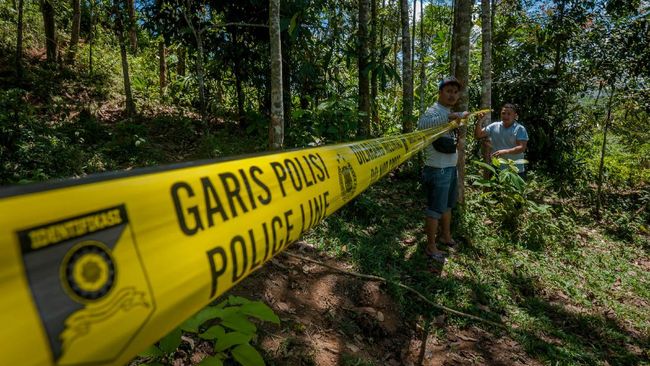
An unknown person threw a bomb near the house of Jubi journalist Victor Mambor in Jayapura City, West Papua, on Monday at 04.00 a.m. West Papua is the most dangerous region for journalists in Indonesia and Victor Mambor has been targeted several times.
The bomb exploded about three meters from Victor Mambor’s house in North Jayapura District, Jayapura City. Victor said, before a low-power explosion occurred, he heard the sound of a motorcycle stopping which was recorded by the CCTV at his house. Victor and his family are safe, nor is there any damage to his house.
A police team has been investigating the incident on the ground, taking Victor’s statement and finding evidence of the bomb blast.
Victor is the founder of an independent news website in Papua, Jubi.id. He has been repeatedly subjected to digital attacks such as doxing, hacking and online harassment. On April 21, 2021, his car was vandalized by unknown people. No perpetrators have ever been arrested for these attacks.
The Alliance of Independent Journalists (AJI) strongly condemns the bombings as a threat to press freedom in Papua. AJI urges the Indonesian Police to thoroughly investigate the perpetrators behind the terror. AJI call all journalists in Papua not to be afraid and give up on voicing the truth amidst various obstacles.
AJI Indonesia recorded 114 cases of violence against journalists from 2000-2021. Meanwhile, in 2022 there were four cases of attacks against 7 journalists in West Papua.




 Australia West Papua Association Adelaide