Jayapura, Jubi – Director Latifah Anum Siregar of the Democracy Alliance for Papua (ALDP) emphasized the importance of raising awareness about human rights violations in Papua during a discussion at the launch of the Jubi Documentary films. The event took place at the St. Nicholaus Ambassador of Peace Study House in Jayapura City on Wednesday, September 27, 2023.
The Jubi Documentary released five films about Papua at the end of September: When the Microphone Turns On; Pepera 1969: Democratic Integration?; Black Pearl of the Field General; My Name is Pengungsi; and Voices from the Grime Valley. They were launched in Jayapura, Yogyakarta, and Jakarta.
Siregar stressed that these documentaries are not meant for mere entertainment but should serve as a platform for everyone, especially young students, to speak out against human rights violations in Papua.
Former football giant Persipura captain Fernando Fairyo, who was also present at the launch event, expressed how emotionally impactful the documentary “Black Pearl of the Field General” was for him. He mentioned shedding tears while watching the film, which highlighted the history of Persipura’s journey and invoked mixed emotions of joy and sadness.
Fairyo also emphasized the need for Persipura to focus on strengthening the team and urged creative management to find funds beyond sponsorship from PT Freeport Indonesia and Bank Papua to support the team.
The five documentaries released by Jubi were produced over two years by Jubi Documentary, a branch of Jubi media based in Jayapura City. These films share a common theme of humanity and the repercussions of human rights violations in Papua.
Watchdoc, an audio-visual production house founded by Andhy Panca Kurniawan and Dandhy Dwi Laksono in 2009, supervised the production of these films. Watchdoc is renowned for its social justice-themed documentaries and received the 2021 Ramon Magsaysay Award in the ‘Emergent Leadership’ category.
Voices from the Grime Valley, directed by Angela Flassy, explores the social consequences of forest clearing for oil palm plantations in Keerom Regency and Jayapura Regency, both located in Papua Province.
Meanwhile, Black Pearl of the Field General, directed by Maurids Yansip, narrates the story of Persipura football team as a symbol of pride and identity for Papuans, its achievements, and its current struggle to regain a spot in League 1.
The launch event included discussions with the filmmakers and experts, providing a platform for in-depth exploration of the documentary topics.
Dian Erika Nugraheny, Icha Rastika, Jakarta — Coordinating Minister for Maritime Affairs and Investment Luhut Binsar Pandjaitan says that the environmental impact analysis (Amdal) for the Eco City project on Rempang Island, Batam, is still in process.
According to Pandjaitan, there are no problems with the Amdal.
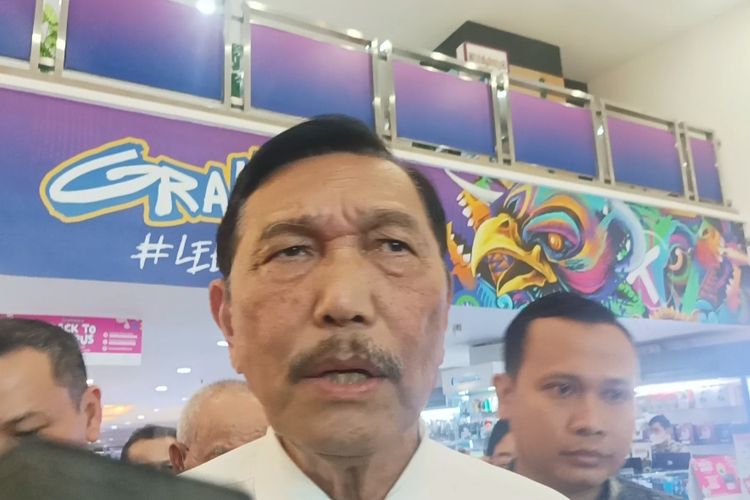
“Yeah, right now everything is in the process. There aren’t any problems”, said Pandjaitan after attending a launch and discussion on the book “Luhut Binsar Pandjaitan According to us” at the Gramedia Matraman bookstore in Jakarta on Friday September 29.
Pandjaitan emphasised that there is no target for resolving the problems on Rempang Island.
Earlier, Investment Minister Bahlil Lahadalia said that the government had already conducted a thorough study of the Eco City project and the glass and solar panel industry that is to be established on Rempang Island.
Lahadalia rejected criticism from the Indonesian Forum for the Environment (Walhi) about the risk of environmental damage as a consequence of the project on Rempang.
“It’s been done already, of course (it’s part of the study). Walhi shouldn’t feel like it knows better than the government. You are behaving like this country, as if its regulated by some other institution”, he said during a press conference on Monday September 25 as reported by Kompas TV.
Lahadalia said that there is already an Amdal on the construction project on Rempang, and insisted that the Eco City project will not harm the local environment.
“Where is there a country that wants to bring suffering to its people?
Write this down carefully, we respect Walhi’s thoughts, but the country also has its goals”, he said.
“There is an Amdal, if in this country we keep worrying, continue to be suspicious, when do you want to move forward? We’re being given spice to curry suspicion, keep being afraid, when do we want to progress”, he said.
[Translated by James Balowski. The original title of the article was
“Luhut: Amdal Rempang Eco City Masih Proses, Enggak Ada Masalah”.]
Members of Indonesia’s Nduga District Police and the Damai Cartenz Police Task Force have raided a residential house and the local head office of the Papuan Tabernacle Church (Kingmi Papua) in the town of Kenyam, Nduga Regency, Papua Pegunungan Province, reports Human Rights Monitor.
Before raiding the Kingmi Papua office on September 17, the police officers arbitrarily arrested Melince Wandikbo, Indinwiridnak Arabo, and Gira Gwijangge in their home in Kenyam.
They were tortured and forced to reveal the names of people who had attended a recent burial of several members of the West Papua National Liberation Army (TPNPB).
After one of the suspects mentioned the name of Reverend Urbanus Kogeya, the police officers searched the Kingmi Papua Office in Kenyam.
They arrested three other Papuans without showing a warrant. Police officers reportedly beat them during arrest and subsequent detention at the Nduga District police headquarters.
Everybody detained were later released due to lack of evidence.
Local Kingmi Papua church leaders and congregation members slept inside the Kingmi head office that night because they were preparing for a church event.
Around 11:30 pm, the police officers forcefully entered the office, breaking the entrance door.
Excessive force According to the church leaders, the officers used excessive force against the suspects and the office facilities during the raid. Nine people suffered injuries as a result of police violence during the raid at the Kingmi Papua office — including an 85-year-old man and four women.
As Reverend Nataniel Tabuni asked the officers why they had come at night and broken the entrance door, a police officer approached him and punched him three times in the face.
According to Reverend Tabuni, one of the police officers ssaid: “You are the Church of Satan, the Church of Terrorists! You are supporting Egianus Kogeya [TPNPB Commander in Nduga] under the pretext of praying.”
The acts of torture were witnessed by the head of Nduga Parliament (DPRD), Ikabus Gwijangge.
He reached the Kingmi Papua Office around 11:45 pm after hearing people shouting for help.
As Gwijangge saw the police officers beating and kicking suspects, he protested the use of excessive force and called on the officers to follow procedure.
‘I’ll come after you’ A Damai Cartenz officer reportedly pointed his finger at Gwijangge and threatened him, saying: “Stupid parliamentarian. I’ll come after you! Wherever you go, I will find out where you are. I’ll chase you!”
Another police officer pushed Gwijangge outside the building to prevent him from witnessing the police operation. After that, the police officers searched all the office rooms and broke another office door.
The Nduga police chief (Kapolres), Commissioner Vinsensius Jimmy, has apologised to the local church leaders for the misconduct of his men.
The victims demanded that the perpetrators be processed according to the law.
Congregation members in Kenyam carried out a spontaneous peaceful protest against the police raid and violence against four Kingmi Papua pastors.
The Human Rights Monitor (HRM) is an independent, international non-profit project promoting human rights through documentation and evidence-based advocacy. HRM is based in the European Union and active since 2022.
Jakarta. A senior Indonesian diplomat said Friday that no country raised the issue of Papua at the recent UN General Assembly (UNGA) talks in New York.
Indonesia in the past had faced accusations of human rights violations in its easternmost region at the UN forum. These accusations mainly came from Pacific island nations, particularly Vanuatu. However, the 78th UNGA session, which had just ended earlier this week, did not see anyone pointing their fingers at Indonesia.
“The UNGA forum did not see any country bringing up the Papua issue. [This shows] how other nations’ respect towards Indonesia is growing,” Tri Tharyat, the director-general for multilateral cooperation at the Foreign Affairs Ministry, told a press conference in Jakarta on Friday.
Tri attributed the lack of mentions of Papua to the Indonesian government’s efforts to fast-track the region’s infrastructure and human capital development, among others. Indonesia has also tried to speak to the countries who took an interest in the Papua matter. Tri, however, did not refer to the said countries whom Indonesia had been talking to by name.
“Remember how there would be some countries who would call the [UNGA] forum’s attention to Papua,” Tri said.
“We have done so many things this year. But what is of utmost importance is to talk with other countries to give them a better picture of what is going on in Papua, including its development progress,” Tri also told reporters.
There have been several instances of Indonesia arguing with Pacific island nations over the latter’s human rights abuse accusations in Papua. For instance, at the 75th UNGA Session in 2020, then Vanuatuan Prime Minister Bob Loughman alleged indigenous West Papuans continued to suffer from human rights violations. Indonesia then accused Vanuatu of not respecting the UN Charter and its principle of non-interference in other countries’ internal affairs.
President Joko “Jokowi” Widodo in March visited the Papuan capital of Jayapura during which he said the government considered Papua a priority for a more “Indonesia-centric” development.
His remarks aimed to dispel doubts that Indonesia’s development only focused on Java Island. Jokowi then listed some major infrastructure projects in Papua, including the 3,462-kilometer Trans-Papua road. The government has also built a road that spanned 1,098 kilometers in the Papuan borders, according to Jokowi.
Reiner Brabar, Sorong — Calls for a boycott on carbon trading, ending the release and discharge of emissions, as well as accelerating the recognition of customary and people’s management areas have been echoed because of its direct impact on the existence of the archipelago’s indigenous peoples.
The government officially launched the Indonesian Carbon Exchange (IDX
Carbon) on Tuesday September 26. A carbon exchange business management license was given to the IDX by the Financial Services Authority (OJK) through Decree Number Kep-77/D.04/2023 on September 18. President Joko “Jokowi” Widodo said that it is hoped that the launch of the exchange will contribute to fighting the climate crisis.
According to media reports, during the launch at the Stock Exchange Building, president Widodo said, “The result of this [carbon] trading is that it will be reinvested in efforts to protect the environment, especially though reducing carbon emissions”.
In response to this, a network of civil society organisation such as the Indonesian Forum for the Environment (Walhi), the Nusantara Traditional Community Alliance (AMAN), Greenpeace, the Mining Advocacy Network (JATAM), the People’s Earth Heritage Foundation (Pusaka), the PIKUL Foundation, the Nusantara Traditional Community Defense Association
(PPMAN) and the School of Democratic Economics (SDE) expressed their opposition to carbon trading, which has been chosen by the government to overcome the climate crisis.
The opposition was officially conveyed through a letter titled “Boycott carbon trading, end the release and discharge of emissions, and accelerate the recognition of customary and people’s management areas!”, which was address to the president, related industries, the IDX and the international verification institute Verra.
Walhi national plantation and forestry campaign manager Uli Arta Siagian said that carbon trading is a misguided way to overcome the climate crisis.
The network of organisations believes that the government is creating a trade crisis because the nature of carbon trading is granting permits by the state to corporation and industrial countries to continue releasing emissions by balancing carbon or carbon offsets.
“Carbon trading was chosen in order to ensure that corporations and industrial countries can continue to extracting [resources from] nature, either through extracting underground fossil fuels, burning fossil fuels, deforestation as well as conservation project that will further extend the chain of conflict and the climate crisis”, said Siagian.
AMAN director for legal policy advocacy and human rights, Muhammad Arman, is of the view that carbon trading by the Indonesian government will threaten traditional communities. Carbon trading practices will be done without recognising, protecting or fulfilling the rights of traditional communities.
This, according to Siagian, is the same as the practice of colonialism.
“The various legal instruments that have been issued by the government in bridging carbon trading are only orientated to the interests of investment, and represent a tangible manifestation of the government ‘washing its hands’ of extractive industrial practices that are the source of emissions” said Arman.
[Translated by James Balowski. The original title of the article was “Boikot Perdagangan Karbon Diserukan”.]
Jakarta — The Indonesian Legal Aid Foundation (YLBHI) has found that national strategic projects (PSN) and the management of natural resources (SDA) under the administration of President Joko “Jokowi”
Widodo has crfeated injustice and oppression for the ordinary people.
In addition to this, these national strategic projects and natural resource industries have caused environmental destruction and land conflicts.
“The YLBHI found that PSN and the management of SDA produced multiple effects in the form of injustice and the oppression of ordinary people”, wrote the YLBHI in a written release on Sunday September 25.
There has yet to be a response or comment from the government on the YLBHI’s statement.
“In fulfilling these ambitious projects, the state has committed a series of repressive acts and used excessive force (excessive use of
force) against residents who are defending their land, water and living space through state security forces, namely the TNI [Indonesian military] and the Polri [Indonesian police]”, they continued.
The YLBHI found that farmers, traditional communities, human rights defenders and environmental activist suffered physical violence, non-physical violence and criminalisation.
Over the period 2017-2023, the YLBHI recorded a number of incidents of violence against farmers in cases being handled by its 18 regional Legal Aid Foundation (LBH) offices. This seven-year period was determined based on the start of national strategic projects in 2016.
The explanatory data on criminalisation covers areas of natural resource conflict, especially in areas where there were national strategic projects. The data is divided into several variables, including the number of conflicts, the area of conflict and number of victims, the perpetrators of violence and criminalisation, patterns of violence, the laws that were frequently used, the causes and the structural impacts of conflict.
The YLBHI data
As many as 106 agrarian conflicts and cases involving national strategic projects were handled by the YLBHI and its regional LBH offices throughout Indonesia. The land area where there were conflicts covered around 800,000 hectares and resulted in more than 1 million ordinary people falling victim.
The plantation sector was dominant with 42 cases, followed by the mining sector with 37 cases, then conflicts involving national strategic projects with 35 cases.
The YLBHI said that there were a variety of perpetrators in these conflicts. Private companies were involved in 100 conflicts, regional governments in 74 conflicts and the police in 50 conflicts.
A many as 123 acts of violence were recorded, which broadly speaking fell into three types of patterns.
First, patterns of violence in the form of verbal violence such as intimidation in the form of physical violence ranging from physical abuse to torture. This pattern was recorded in 48 cases (40 cases of intimidation and eight cases of physical violence).
Second, 43 cases split between these two patterns, and third, criminalisation with 43 cases.
“Usually, these three patterns were applied in stages, for example beginning with the threat of forced eviction and the threat of criminalisation, then increasing to the level of violence and criminalisation”, wrote the YLBHI.
Furthermore, said the YLBHI, local people that were criminalised were used as negotiation tools causing divisions between those who supported and opposed a given project within the community.
The YLBHI recorded that out of the 43 cases, some 212 farmers were criminalised. The majority of cases of criminalisation used articles under the Criminal Code (KUHP) with 29 cases.
This was followed by the Mineral and Coal Mining Law (UU Minerba) with seven cases, Law Number 39/2014 on Plantations with four cases, Law Number 18/2013 on the Prevention of Forest Clearing and Destruction with three cases, the Information and Electronic Transaction Law (UU ITE) with two cases and the anti-communism law in one case.
The YLBHI also highlighted attempts to criminalise farmers involving strategic national projects in the 18 regions where there are LBH offices. There were some 35 national strategic projects in which 35 farmers became victims of criminalisation. The victims came from five different provinces or municipalities, namely Central Java, West Java, Padang, Makassar and Manado.
The largest number of cases of criminalisation in national strategic projects occurred in Central Java (10 cases) and Padang (10 cases).
If viewed from the legal basis for the criminalisation, the YLBHI noted that almost all of them were based on Article 362 of the KUHP on theft.
Second, Article 333 that contains criminal offices on depriving a person of their freedom. Third, Article 170 that contains offences on crimes of violence against persons or materials.
Fourth, Article 154a that contains offences on insulting state symbols.
Fifth, Article 406 that regulates damage to another person’s property.
And finally, Article 27 of the ITE Law that contains offences on defamation.
The YLBHI and its 18 regional LBH offices are urging the government and the House of Representatives (DPR), as well as related ministries and government institutions, to cancel all strategic national projects that are considered to harm the ordinary people or trigger practices of violence and human rights violations by the state though its apparatus.
The YLBHI is also asking the government to stop appropriating the people’s land in the name of management rights and state land claims.
The other demand is asking the government to withdraw all security forces from agrarian conflict areas and national strategic projects, as well as revoking the Omnibus Law on Job Creation and its derivative regulations, which are seen as triggers for the increase in land grabs and state violence against the ordinary people.
The YLBHI is also asking that national programs disguised as agrarian reform or fake agrarian reform programs to be stopped.
In addition to this, the government is being asked to stop the criminalisation of those fighting for land rights and the environment, as well as their unconditional release from all charges and criminal indictments.
“Ensure that the state implements the constitutional mandate, especially Article 33 Paragraph (3) of the 1945 Constitution, [which states] that the earth, water and natural resources contained therein are controlled by the state for the greatest prosperity of the people, not for investors and/or those in power or entrepreneurs”, wrote the YLBHI.
(yoa/tsa)
[Translated by James Balowski. The original title of the article was
“YLBHI: PSN Era Jokowi Hasilkan Penindasan Terhadap Rakyat”.]
Former Papuan Governor Lukas Enembe has presented his case for the defence, denying the corruption and bribery charges against him, with the end of the controversial and lengthy trial at the Tipikor Court of Jakarta Central District Court this week. The verdict is due on October 9.
During the hearing, Enembe and his legal team argued there was no evidence to support the allegations made by the Anti-Corruption Commission (KPK) prosecutor.
The two-term Papuan governor and his legal team firmly stated that the KPK prosecutors had no evidence in the indictment against him.
In a statement presented by his lawyer, Petrus Bala Pattyona, Enembe strongly denied the allegations of receiving bribes and gratuities from businessmen Rijatono Lakka and Piton Enumbi.
Enembe emphasised that the accusations made against him were “baseless and lacked substantial evidence”.
Enembe maintains innocence He stated that his case was straightforward, as he was being accused of accepting a staggering amount of 1 billion rupiahs (NZ$100,000) from Rijatono Lakka, along with a hotel valued at 25.9 billion rupiahs (NZ$2,815,000) and a number of physical developments and money amounting to Rp 10,413,929,500.00 or 10.4 billion rupiahs (NZ$1,131,000) from Piton Enumbi, lawyer Pattyona said during the reading, reports Kompas.com.
Enembe maintained his innocence throughout the proceedings and asserted that he had never received any form of illicit payments or favours from either businessman.
The simplicity of Lukas’ case, as stated by his lawyer, Petrus Bala Pattyona, lay in the clarity of the accusations made against his client.
Enembe and his legal team emphasised that none of the testimony of the 17 witnesses called during the trial could provide evidence of their involvement in bribery or gratuities in connection with Lukas Enembe, reports National.okenews.com.
“During the trial, it was proven very clearly that no witness could explain that I received bribes or gratuities from Rijatono Lakka and Piton Enumbi,” Enembe said through his lawyer Pattyona during the hearing, reports Kompas.com.
“I ask that the jury of pure hearts and minds, who have tried my case, may decide on the basis of the truth that I am innocent and therefore acquit me of all charges,” Enembe said.
In addition to asking for his release, Enembe also asked the judge to unfreeze the accounts of his wife and son that were frozen by the authorities when this legal saga began last year.
He claimed his wife (Yulce Wenda) and son (Astract Bona Timoramo Enembe) needed access to their funds to cover daily expenses.
Ex-Governor Enembe also discussed gold confiscated by the KPK, calling on judges to allow its return.
Enembe asked that no party criminalise him anymore. He insisted he had never laundered money or owned a private jet, as KPK had claimed.
Enembe’s lawyer also requested that his client’s honour be restored to prevent further false accusations from emerging.
KPK prosecutor’s demands However, the public prosecutors of the KPK considered Lukas Enembe legally and conclusively guilty of corruption in the form of accepting bribes and gratuities when he served as Governor of Papua from 2013 to 2023.
The prosecutors alleged that there was evidence that Lukas Enembe had violated Article 12 letter A and Article 12B of the Law of the Republic of Indonesia No. 31 of 1999 concerning the Eradication of Corruption Criminal Acts and Article 55 paragraph. (1) of I of the Criminal Code jo Article 65, clause (1), of the Criminal Code, reports Beritasatu.com.
In addition to corporal crime, the prosecution is seeking a fine of Rp 1 billion for Enembe and want a court order for him to pay Rp 47,833,485,350 or 47.9 billion rupiah (NZD$5,199,000) in cash, accusing him of accepting bribes totalling Rp 45.8 billion and gratuities worth 1 billion, reports Kompas.com.
A verdict date is set The Jakarta Criminal Corruption Court panel of judges is scheduled to read the verdict in the case against Enembe on 9 October 2023.
“We have scheduled Monday, October 9, 2023, for the reading of the verdict against the defendant Lukas Enembe,” said presiding judge Rianto Adam Pontoh yesterday at the Central Jakarta District Court after undergoing a hearing of the readings, reports CNN.com.
The date marks an important milestone in the trial as it will bring clarity to the charges against Enembe. The outcome of the judgement will have a profound impact on Enembe’s future and the public perception of his integrity and leadership, and most importantly, his deteriorating health.
Former Governor’s health Previously, the KPK prosecutor had requested a sentence of 10 years and six months in prison.
Enembe’s senior lawyer, Professor OC Kaligis, argued that imprisonment of Enembe for more than a decade would be tantamount to the death penalty due to the worsening of his illness, calling it “brutal demands” of the KPK prosecutors.
“The defendant’s health condition when examined by doctors at Gatot Soebroto Army Central Hospital (RSPAD) showed an increasingly severe illness status. So we, legal counsel, after paying attention to the KPK Public Prosecutor’s concern for the defendant’s illness, from the level of investigation to investigation, concluded that the KPK Public Prosecutor ignored the defendant’s human rights for maximum treatment.
“With such demands, the KPK Public Prosecutor expects the death of Lukas Enembe in prison,” said Professor Kaligis, reports mambruks.com.
Lukas Enembe’s life Former Governor Lukas Enembe was born on 27 July 1967 in Mamit village, Kembu Tolikara, Papua’s highlands. He graduated from Sam Ratulangi University, Manado, in 1995, majoring in socio-political science.
After returning to West Papua, he began his public service career in the civil service of Merauke district.
Enembe studied at Christian Cornerstone College in Australia from 1998 to 2001. In 2001, he returned to West Papua and ran for the regency election, becoming the deputy regent of Puncak Jaya.
In 2007, he was elected as the regent of Puncak Jaya.
Enembe served as the Governor of Papua from 2013 to 2018 and was re-elected for a second term from 2018 to 2023.
His tenure focused on infrastructure development and cultural unity in West Papua, leading to landmark constructions such as a world-class stadium and a massive bridge.
He also introduced a scholarship scheme, empowering hundreds of Papuan students to pursue education both locally and abroad — such as in New Zealand which he visited in 2019.
Enembe’s achievement as the first Highlander from West Papua to become governor is a groundbreaking milestone that challenged long-held cultural taboos.
His success serves as an inspiration and symbolises the potential for change and unity in the region.
His ability to break cultural barriers has significantly impacted the development of West Papua and the collective mindset of its people, turning what was once regarded as impossible into possibilities through his courage and bravery.
The fact that he is still holding on despite serious health complications that he has endured for a long time under Indonesian state pressure is widely regarded as a “miracle”.
One could argue that West Papua’s predicament as a whole is mirrored in Enembe’s story of struggle, perseverance, pain, suffering, and a will to live despite all odds.
Yamin Kogoya is a West Papuan academic who has a Master of Applied Anthropology and Participatory Development from the Australian National University and who contributes to Asia Pacific Report. From the Lani tribe in the Papuan Highlands, he is currently living in Brisbane, Queensland, Australia.
Australia is willing to turn a blind eye to alleged human rights abuses in West Papua because alienating Indonesia is not worth the risk as China jostles for regional influence
As reported by the Guardian, Australia is seeking to strengthen its defence relationship with Indonesia, despite well-documented human rights abuses by the Indonesian military in West Papua.
As tens of thousands of West Papuan civilians are turned into refugees in their own land and innocents are allegedly tortured and gunned down by Indonesian soldiers, Australia is embarking on further training and support for the Indonesian military and its counter-terrorism police.
Human rights considerations appear to have been pushed down the list of diplomatic priorities.
Indeed, it is an open secret in the defence department that some would welcome an even closer relationship than is currently being negotiated with Indonesia. The view is that the more defence cooperation Australia has with regional neighbours, including Indonesia, the safer it would feel should tensions between the US and China spill over into open conflict.
A formal military alliance with Indonesia – which would enact mutual national security obligations – is unlikely, however, because Indonesia still harbours suspicions about Australia as a trusted friend following the 1999 Timor-Leste intervention. Indonesia is also wary of being drawn into a war not of its choosing, and its military orientation is still largely internally focused.
Indonesia has undergone significant reforms since the Suharto era. It has regular, transparent elections, a free and fairly robust media and, outside West Papua, a military that has also undergone some reform.
Yet “money politics” continues to prevail in Indonesian politics, restrictive legislation has been passed in recent years and there remains huge disparities in wealth. Further, the Indonesian military effectively ceased its own, incomplete, reform process around 2007.
The military may be under civilian control, but it continues to fund some of its activities through its own business interests. Its minister, Prabowo Subianto, is a former military hardliner with extensive human rights skeletons rattling around his own closet.
Critically, too, Prabowo is running a very close second to Ganjar Pranowo for Indonesia’s 2024 presidential elections. With both candidates having less than 30% support, a solidifying of the presidential race over coming months could see Prabowo take the lead.
A man widely accused of being a human rights abuser could become the president of the country Australia wants to be closer to.
The calculation behind Australia’s closeness to Indonesia focuses on China’s assertive strategic reach. China has very close relations with Myanmar, Cambodia and Laos, and has recently extended its illegal claim – and built up its bases – in the South China Sea. It has also been building stronger relationships in the Pacific as well as south Asia and east Africa, in what is referred to as the String of Pearls strategy.
Closer to home, China signed new economic and defence agreements with Timor-Leste this week. This follows China’s earlier, high profile investments in diplomacy and defence cooperation with the young nation.
After 15 years of overspending, and its oil-base sovereign wealth fund running dry, Timor-Leste’s economy is expected to run out of money in about a decade. Australia’s small neighbour is now looking for any new friends that might assist with a soft economic landing.
Timor-Leste also sees its strategic security being enhanced by having several powerful friends, rather than being dominated by one or two countries. China ticks a few important boxes.
Australia regards China’s diplomatic, economic and strategic reach in the region with considerable discomfort and some alarm. This has caused reflection on how Australia has taken for granted and sometimes abused regional relationships. After a couple of decades of trashing many of them, Australia is now playing diplomatic catch-up.
Part of this catch-up is for Australia to not further alienate countries it wishes to have as friends and strategic partners. Hence Australia is reluctant to question, much less criticise, Indonesia on human rights grounds.
The longsuffering people of West Papua, marginalised and abused in their own land, are therefore being sacrificed on the altar of real politik.
Damien Kingsbury is an emeritus professor at Deakin University and has published widely on regional political and security issues
Vitorio Mantalean, Jessi Carina, Jakarta — The Agrarian Reform Consortium (KPA) has recorded at least 73 agrarian conflicts that have broken out in different parts of the country since 2020 as a result of national strategic projects (PSN).
The KPA believes that the development model and PSN policy is “land hungry”, moreover it is being supported by the Omnibus Law on Job Creation, which is seen as leading to industrial liberalisation.
KPA Secretary General Dewi Kartika highlighted how the government continues to form new agencies in order to support these national strategic projects.
“These new institutions are becoming a state within the state that are given extremely wide authority and powers to control and regulate land on a massive scale”, said Kartika during a virtual discussion organised by the KPA to mark Farmers Day 2023.
She cited several of these agencies, such as the Land Bank, the new Capital City Authority, the Lake Toba Executive Body, the Labuan Bajo Authority and similar institutions that are given various powers including control, utilisation and management of land and capital, through to authority over business development and ease of transactions.
“The authority and state assets that are given to these kinds of new agencies are like creating mini states and kingdoms within the state, where the abuse of power and agrarian corruption can flourish and is structured”, explained Kartika.
The latest case of a large scale agrarian conflict that has attracted public attention is on Rempang Island, Batam, resulting from an order to clear local residents off their land in a repressive manner to make way for the Rempang Eco City national strategic project.
In this case, the Batam Free Trade Zone Authority (BP Batam) was given special authority in the form of regulations and supporting infrastructure, which was then reinforced by a memorandum of understanding on the use of land by the Xinyi Group in order to accelerate the project.
“We can see, that the Labuan Bajo Authority was also given the authority to acquire local [people’s] land for the construction of the imagined New Bali on Komodo Island”, said Kartika.
All of these policies are applied on the basis of “domain verklaring” — the principle that if a person cannot prove the ownership of their land then it belongs to the state and they are not entitled to occupy it.
This principle is problematic because it ignores communal land rights over land that has been cleared, cultivated and occupied by generation after generation.
Kartika gave another example of a traditional community in East Nusa Tenggara (NTT) who were forced to surrender their customary land in order to make way for the Lambo Dam strategic national project.
“This is the practice of domain verklaring over our land, over land and local people’s settlements that ends in eviction and forced land pegging by the government”, she said.
Aside from the examples above, the KPA also citied many other strategic national projects that have given rise to agrarian conflicts around the country since 2020, ranging from infrastructure projects, property development, agribusiness, coastal development and mining.
These include, among others, the Mandalika MotoGP project in Lombok, West Nusa Tenggara (NTB), the Gresik Special Economic Zone in East Java, the Bener Dam project in Wades, East Java, the MNC multiland project in Sukabumi, West Java, the food estate project in North Sumatra and the new irrigated rice field project in the forests of Kalimantan.
Never mind the construction of various kinds of infrastructure to support the new capital city Nusantara in East Kalimantan, the Air Bangis oil refinery in West Sumatra, the hydroelectric power plant
(PLTA) in Pinrang, South Sulawesi, the North Kayong Airport in West Kalimantan, the Karalloe Dam in Gowa, the Serang-Panimbang, Balikpapan and Samarinda toll roads, the construction of the Muna coal-fired power plant (PLTU) in South-East Sulawesi and the Royal Boskalis sand mining project in South Sulawesi.
[Translated by James Balowski. The original title of the article was
“KPA: Proyek Strategis Nasional Jokowi “Lapar Tanah”, Picu 73 Konflik Agraria sejak 2020″.]
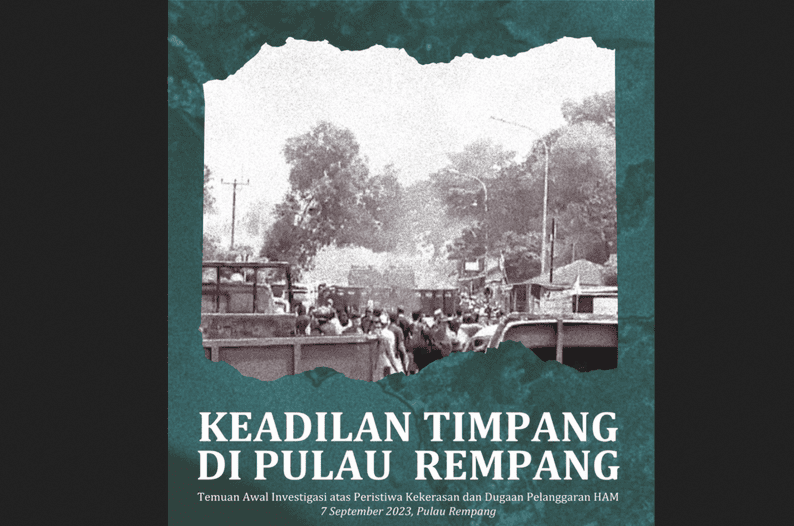
Vonita Betalia — Nine human rights organisations calling themselves the “National Solidarity for Rempang” have published the results of a preliminary investigation into the September 7 riots on Rempang Island in Batam, Riau Islands. The investigation found a number of human rights volitions.
The publication, titled “Flawed Justice on Rempang Island”, is the result of a joint investigation by the Indonesian Legal Aid Foundation (YLBHI), the Pekanbaru Legal Aid Foundation (LBH Pekanbaru), the Indonesian Forum for the Environment (Walhi) National Executive, Walhi Riau, the Commission for Missing Persons and Victims of Violence (Kontras), Amnesty International Indonesia, the Agrarian Reform Consortium (KPA), the Nusantara Indigenous Peoples Alliance (AMAN) and Trend Asia.
“We concluded that alleged human rights violations occurred during the violent incident in Rempang on September 7, 2023 and therefore it must be declared as a human rights violations as stipulated under Law Number
39/1999 on Human Rights”, read a section from the report published on Monday September 18.
In the report it said that these rights violations can be seen from a number of things such as the excessive deployment of security forces, the use of violence and minimum participation and access to information on the Eco City project on Rempang Island.
This included arbitrary arrests by the Barelang municipal police
(Polresta) following protests by residents, the violation of the rights of women and children related to the social conflict, the loss of a sense of security and widespread fear among Rempang residents.
In addition, the series of violations that occurred in Rempang were violations of national and international human rights instruments including Law Number 39/199 and the International Convention on Civil and Political Rights which Indonesia has ratified through Law Number 12/2005.
“Thus, this is enough for the National Human Rights Commission (Komnas
HAM) to declare the tragedy in Rempang on September 7, 2023 as a human rights violation”, read the report.
As reported earlier, residents on Rempang Island opposing the Rempang Eco City project held a protest that ended in a clash with joint units of the TNI (Indonesian military) and police on September 7.
The Coalition is asking security forces to end the repressive actions against Rempang Island resident and stop the development of the Rempang Eco City.
The act of violence, according to the Coalition, resulted in the local indigenous people falling victim to the ambitions of the national strategic project.
“The Indonesian military and the police were used as a tool by the state to facilitate the development of the Rempang Eco City area requiring the eviction of people from 16 ancient Malayu [traditional Malay communities] villages which have existed since 1834”, read the Coalition’s report.
The clash between the local peoples and the authorities occurred at around 10 am. The joint force of TNI and police using tactical vehicles attempted to force their way onto Rempang Island to install boundary markers and conduct land measurements.
At the time, residents were gathered at the entry point onto Rempang Island at the Barelang IV Bridge. A clash was inevitable and during the incident police arrested at least six people. Scores of other suffered injuries, several children were traumatised and one child was injured after police fired tear gas into their school.
The Rempang Eco City will an industrial area resulting from investment commitments by a glass and solar panel company from China, namely the Xinyi Group. Later, Batam will have the second largest glass and solar panel factory in the world after China.
[Translated by James Balowski. The original title of the article was “Laporan Investigasi 9 Lembaga HAM: Peristiwa di Pulau Rempang Adalah Pelanggaran HAM”.]




 Australia West Papua Association Adelaide