Papua prelate’s Indonesian food project stance sparks moral crisis 

Support for state-backed development puts Church at odds with Indigenous Catholics defending ancestral land

By Ryan Dagur Published: April 20, 2026 06:12 AM GMT

For decades, the Catholic Church has presented itself as a moral ally of Indigenous peoples.

From Laudato Si’, in which Pope Francis defended ancestral lands, to Vatican endorsements of the UN Declaration on the Rights of Indigenous Peoples, the Church has framed the protection of Indigenous communities as a matter of justice, dignity and faith.

That global moral posture makes what is now unfolding in Papua deeply unsettling.

In Indonesia’s easternmost region, a senior Catholic leader is facing fierce opposition from his own congregation for supporting a government-backed food mega-project that threatens Indigenous land.

The controversy erupted after Archbishop Petrus Canisius Mandagi of Merauke warned that Catholics protesting the project would “perish.” His comment ignited outrage among Papuan Catholics and exposed a profound contradiction between the Church’s teachings and its actions on the ground.

In Papua — a region long scarred by land dispossession, militarization and resource extraction — the Church’s stance is never merely theological. It is political, moral and deeply consequential.

Mandagi’s words force an unavoidable question: Will the Church in Papua live up to its global teachings by standing with Indigenous communities defending their ancestral land, or will it align itself with state power and corporate interests under the banner of development and food security?

The archbishop’s remarks were delivered during a church inauguration Mass on April 6, in response to peaceful weekly protests led by lay Catholics opposing his support for a massive food estate designated by Jakarta as a national strategic project.

“God destroys those who do not respect places of worship,” Mandagi told them.

For many Papuan Catholics, the statement felt less like spiritual guidance than a threat — one issued from the pulpit against those invoking their faith to defend their land and livelihoods.

The backlash was immediate. Expressions of pain and anger flooded social media as lay Catholics accused the archbishop of silencing dissent rather than shepherding his flock.

Yet the furor did not arise overnight. Since 2024, Mandagi’s vocal endorsement of the project has prompted sustained protests demanding that he withdraw his support and apologize.

Rather than easing tensions, his latest remarks have widened the rift, transforming internal disagreement into an open moral confrontation.

At the heart of the dispute is a government food project that aims to clear up to 3 million hectares of land in Merauke — two-thirds for sugarcane and the rest for rice. The administration of Prabowo Subianto has presented the initiative as essential to Indonesia’s food sovereignty.

But the land is far from empty. It is the ancestral territory of the Malind, Maklew, Khimaima and Yei peoples — forested wetlands where life depends on sago groves, rivers and seasonal hunting.

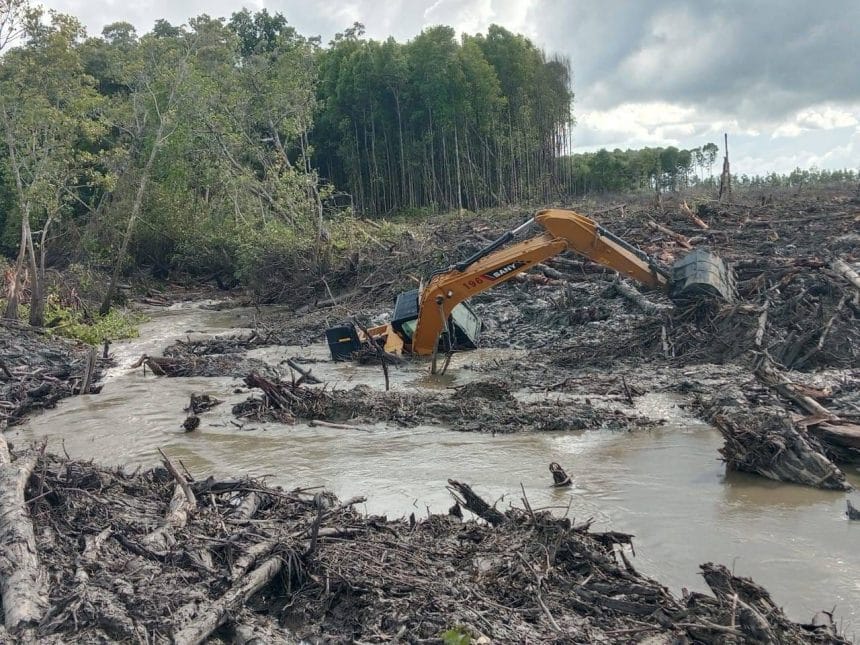
More than 50,000 Indigenous residents across 40 villages are expected to be affected. Deforestation is already underway. By the end of 2025, nearly 6,000 hectares had been cleared for rice cultivation, while sugarcane plantations destroyed more than 15,000 hectares in early 2026 alone.

Each hectare lost represents not only environmental damage but also the erosion of Indigenous food systems, culture and collective memory.

While urban Catholic youth stage demonstrations inside churches, Indigenous communities have mounted their own form of resistance.

Across Merauke, villagers have planted red crosses — salib merah — on land earmarked for clearing, asserting ownership and erecting a spiritual barrier against destruction.

The symbolism is striking: Catholic imagery deployed by Indigenous people themselves, yet without the backing of the Church’s hierarchy.

Rather than listening to these concerns, Mandagi has suggested that protesters are being manipulated by vested interests. What has been conspicuously absent is any public acknowledgment of the harm the project poses to his own congregants.

His background — he is not Papuan, but from North Sulawesi — has further fueled criticism, prompting growing calls for the Vatican to appoint an Indigenous Papuan archbishop.

These demands are not merely symbolic. In recent years, Papuan-born bishops have emerged as some of the strongest moral voices opposing land grabs and militarization.

Bishop Bernardus Bofitwos Baru of Timika, for example, has repeatedly described food estate projects as existential threats to Indigenous communities. 

His stance aligns closely with Papua’s Protestant churches, which have long opposed land dispossession. In February, the Communion of Churches in Indonesia — which includes 105 denominations — formally condemned land seizures carried out in the name of food security at the conclusion of its assembly session in Merauke.

The controversy also recalls the failure of an earlier mega-project: the Merauke Integrated Food and Energy Estate, launched in 2010 and eventually abandoned after widespread displacement and ecological damage.

At the time, under Archbishop Nicolaus Adi Seputra, the archdiocese’s Justice, Peace and Integrity of Creation office actively supported community resistance.

The contrast with Mandagi’s leadership is stark. Shortly after his appointment, in January 2021, he signed a memorandum of understanding with a palm oil company linked to the controversial Korindo Group to renovate a seminary — without meaningful consultation with local communities.

The dangers posed by the current project extend far beyond land loss.

In 2025, Indonesia’s National Human Rights Commission identified at least five areas of concern: land rights, environmental health, food security, participation in decision-making and personal security.

Militarization is the most acute threat. Troops have been deployed to secure project sites, with military posts established near Indigenous villages.

In 2025, a battalion was stationed inside a company concession on the ancestral land of the Kwipalo clan from the Yei tribal group without consent. When villagers blocked excavators, they faced police reports and threats of criminal charges.

The United Nations has also raised the alarm. In March 2025, nine UN special rapporteurs warned Indonesia of alleged land grabbing, forced evictions, deforestation and military repression linked to the project.

The pattern is familiar: sweeping promises of food security, land acquisition enforced by armed force and the displacement of Indigenous peoples — echoing colonial plantation models rather than participatory development.

It is here that the Church in Papua stands at a crossroads.

One path prioritizes harmony with state power, reframes Indigenous resistance as disorder and recasts dispossession as progress — risking the erosion of decades of moral authority.

The other is grounded in Catholic social teaching: standing with communities whose land, culture and survival are under threat.

The Papuan Catholics who protest week after week are not enemies of the Church. They are its conscience

The question is whether the Church hierarchy will heed that call — or allow the words uttered from the pulpit to define its legacy.

*The views expressed in this article are those of the author and do not necessarily reflect the official editorial position of UCA News.

Dispossession, violence, and resistance: The human rights crisis around the Merauke National Strategic Project

Human Rights News / IndonesiaWest Papua / 15 April 2026 

In the forests and villages of Merauke Regency, South Papua Province, a quiet but intensifying crisis is unfolding. Indonesia’s National Strategic Project (Proyek Strategis Nasional, or PSN), an ambitious state-backed programme encompassing rice field development, a 135-kilometre access road, sugarcane plantations for bioethanol, and food self-sufficiency schemes, is colliding with the lives, lands, and rights of the Malind and other indigenous Papuan groups who have inhabited this region for generations.

Since late 2024, a growing body of evidence has documented serious procedural violations, the dismantling of indigenous land rights, incidents of violence against community members who resist, and the systematic exclusion of affected communities from decision-making processes. Legal challenges are now working their way through the Indonesian courts, while civil society organisations, churches, and human rights advocates have raised increasingly urgent calls for the government to halt the project and respect its obligations under national and international law.

The situation in Merauke is a stark illustration of the human costs of large-scale development projects that are pursued without adequate legal safeguards, meaningful community participation, or respect for indigenous rights. The communities who have lived in and stewarded these forests for generations are not opposed to development as such; they are opposed to development that destroys their homes, eliminates their food sources, and is imposed upon them without consultation or consent.

This article summarises the key developments from early 2026 and sets out the principal human rights concerns arising from the implementation of the PSN in Merauke.

Background: What is the Merauke PSN?

The Merauke PSN is a cluster of large-scale development programmes formally designated as National Strategic Projects under the administration of President Prabowo Subianto for the 2024–2029 term. The centrepiece is the construction of a 135-kilometre road connecting Wanam Village in Ilwayab District to Selauw Village in Muting District, intended to serve as infrastructure for a food and energy security programme.

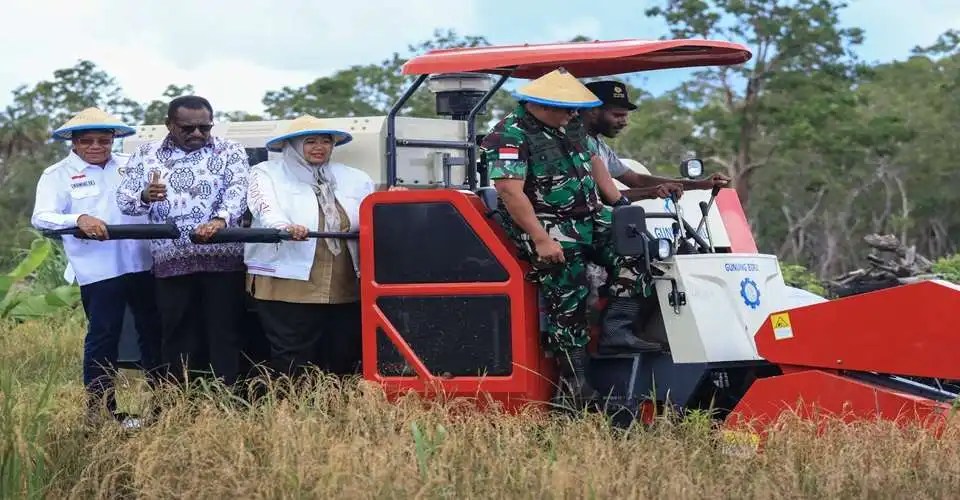
The PSN includes a rice field development programme in Ilwayab District, implemented by Indonesia’s Ministry of Defence in collaboration with PT Jhonlin Group, a company owned by South Kalimantan entrepreneur Andi Syamsuddin Arsyad (widely known as Haji Isam). Other important components of the project are the sugarcane cultivation for bioethanol, a biogas project, and an agricultural land optimisation scheme. The programmes covers land in three regencies of south Papua Province, namely Merauke, Boven Digoel, and Mappi.

According to Suara Papua and Yamenadi, hundreds of excavators arrived at the Merauke port on 13 March 2026. (see video below, source: independent HRD) Reports suggest PT Jhonlin Group intends to bring additional of 2,000 excavators to the region to accelerate the programme. The scale of the operation signals the government’s determination to press forward regardless of ongoing legal challenges and community opposition.

Procedural violations: Building without a permit

One of the most legally significant findings to emerge from investigations by civil society groups is that the construction of the 135-kilometre road began approximately one year before the required environmental permit was issued.

According to the Merauke Solidarity legal advocacy team, land clearing for the road began in September 2024. The Environmental Impact Assessment (EIA) decision (Merauke Regent’s Decree No. 100.3.3.2/1105/2025) was only issued in September 2025. This means that for roughly twelve months, construction proceeded without any valid environmental authorisation, a clear violation of Article 22(1) of Law No. 32 of 2009 on Environmental Protection and Management. Legal advocates argue that the permit effectively sought to retroactively legitimise activities that had already taken place illegally.

The Papua Human Rights Coalition, in a statement published on 18 March 2026, further noted that the absence of an EIA also means the project proceeded without a valid business licence, since under Article 24 of Law No. 6 of 2023 on Job Creation, the EIA serves as the mandatory basis for determining environmental feasibility prior to any licence being granted. The coalition argues that the project may therefore have violated Article 109 of the same law, which sets out environmental offences.

Advocates have also raised concerns about the financial implications of these procedural irregularities. According to the lawyers, the delayed issuance of the permit is suspected of being designed to allow state budget funds to reimburse private parties who had been financing construction costs. This practice raises potential corruption concerns. According to records from the Pusaka Bentala Rakyat Foundation cited in the same report, land clearing had by that point covered 56 kilometres of the planned route.

Reclassification of 486,939 hectares forest without consent

In January 2026, further alarm was raised when two decisions issued by the Minister of Forestry (Decrees No. 591 and No. 430 of 2025) came to the attention of civil society groups. These decisions reclassify 486,939 hectares of forest area in South Papua Province as non-forest land, intended to support the national food, energy, and water self-sufficiency programmes.

Critically, the decisions were never made public. However, the Merauke Solidarity Advocacy team was able to obtain copies by filing a formal public information request, receiving the documents on 13 January 2026. The affected indigenous communities in Merauke and Boven Digoel Regencies were neither informed nor consulted. The communities’ formal administrative objection, filed on 10 February 2026.

The free, prior and informed consent (FPIC) principle ensures that indigenous communities be meaningfully consulted before decisions affecting their lands are made. It is not only enshrined in international human rights law, but also in Indonesian law, including Articles 43 and 44 of Law No. 2 of 2021 on Special Autonomy, Article 6 of Law No. 39 of 1999 on Human Rights, and Constitutional Court Decision No. 35/PUU-X/2012, which confirms that customary forests are not state forests.

The consequences for affected communities are profound. Among those acutely affected is the Wambon Kenemopte tribe of Boven Digoel, whose eight clans had submitted a formal application for recognition of their customary forest as early as September 2023, with assistance from the Pusaka Foundation. While they were still working to fulfil the documentation requirements requested by the Ministry of Forestry, the Minister issued the reclassification decree, changing the status of their forest to non-forest land earmarked for oil palm cultivation.

On 10 February 2026, twelve representatives of indigenous communities from Boven Digoel and Merauke lodged a formal administrative appeal against the two ministerial decisions, demanding their revocation and calling for concrete steps towards the recognition of indigenous Papuan land rights.

Violence against the Kamuyen Clan: A community under attack

Among the most disturbing developments in early 2026 have been the attacks on Esau Kamuyen, head of the Kamuyen clan in Nakias Village, Ngguti District, and his family. The Kamuyen clan is one of several clans in Merauke whose customary land falls within the planned route of the 135-kilometre road. Unlike some neighbouring clans, Esau Kamuyen has consistently refused to relinquish his community’s land.

As far back as 8 October 2025, the Kamuyen clan erected red crosses on their territory as a traditional symbol of prohibition (see photo on top, source: independent HRD), blocking access to their customary land and demanding a halt to all activities by PT Jhonlin Group, which had already begun clearing the forest. According to investigations by LBH Papua Merauke, the clan’s forest had been forcibly cleared by contractors despite their explicit objections.

The attacks on the family began on 23 January 2026. A group of people reportedly set fire to a temporary forest shelter used as a resting place (see top left photo below, source: independent HRD). Mr Norton Kamuyen, was struck with the blunt side of a machete and threatened. The following night, on 24 January, a larger group, believed to include residents from Yodom Village and Nakias Village, mounted a more serious attack on Mr Esau Kamuyen’s home. The attackers were armed with axes, machetes, spears, arrows, and air rifles. Arrows and spears were fired at the house; one spear became lodged in the wall.

Outnumbered, Mr Kamuyen and his family fled their home to seek refuge in another village. The attackers entered the house, ransacked and damaged household property, and stole the motorbike (see photos above, source: independent HRD). The motorcycle was later found in another village. The violence was followed by threats of further assault and murder delivered via text messages, as well as a written declaration from several customary leaders affiliated with the attacking group threatening further action if authorities and other parties did not meet their demands within 72 hours.

Solidarity Merauke’s investigations suggest the attackers are residents from four villages who hold opposing views to the Kamuyen clan on the question of releasing customary land for the road construction. Civil society groups attribute the violence directly to the pressures generated by the PSN and the approaches taken by the project’s implementers to secure land access.

On 14 February 2026, accompanied by LBH Papua Merauke, Mr Esau Kamuyen formally filed a police report (reference number LP/B/39/II/2026/SPKT/Res Merauke/Polda Papua). However, the intimidations did not end there. On 3 March 2026, members of the Kamuyen clan patrolling their territory discovered that the red crosses had been removed by unknown persons and replaced with a piece of wood wrapped in yellow palm fronds resembling a traditional ritual object from the Marind community. LBH Papua Merauke characterised this act as part of a systematic effort to undermine the Kamuyen clan’s resistance and provoke intra-community conflict.

Legal challenges

Following the mounting pressure, indigenous communities and their legal representatives have pursued an active legal strategy, filing challenges at multiple levels of Indonesia’s administrative and judicial system. On 5 March 2026, five representatives of the Malind indigenous community filed a lawsuit at the Administrative Court (PTUN) in Jayapura, formally challenging the environmental feasibility permit for the 135-kilometre road. The plaintiffs represent the Balagaize, Mahuze, Moyuwend, Basik-Basik, and Gebze clans. The case is registered under number 9/G/LH/2026/PTUN Jayapura.

The filing was accompanied by a solidarity demonstration at the court in Jayapura’s Waena district, where the plaintiffs were joined by students and civil society representatives. Before entering the court building, the plaintiffs held a traditional prayer ceremony during which they daubed their bodies in white clay as a symbol of grief over the destruction of their ancestral forests.

The first hearing took place on 31 March 2026.  A second hearing followed on 14 April 2026, at which judges requested amendments and clarifications to the lawsuit, including strengthening arguments around climate change impacts. The road construction was confirmed to still be ongoing at the time of the hearings. A next hearing was scheduled for 21 April 2026. The Papua Human Rights Coalition, in a statement published 18 March 2026, urged President Prabowo and the Minister of Defence to halt all construction pending the court’s ruling on environmental feasibility.

At the national level, civil society groups have also initiated a judicial review at the Constitutional Court (Mahkamah Konstitusi), challenging provisions in the Job Creation Law that facilitate PSN designation and implementation.

Voices of resistance: Church, civil society, and indigenous communities

The resistance to the Merauke PSN has drawn support from a broad coalition of actors beyond the directly affected communities. In late January and early February 2026, the Indonesian Council of Churches (PGI) held its Full Workers’ Council (MPL) session in Merauke, providing a prominent platform for community voices. Following the session, PGI General Chair Rev Jacklevyn Manuputty issued a statement strongly condemning military expansion and PSN implementation in Papua, describing these as tools of state oppression and a continuation of internal colonialism. The PGI further called for an end to militarism and authoritarianism, and urged President Prabowo to engage in dialogue with affected communities.

LBH Papua Merauke and the Merauke Solidarity Group welcomed the PGI statement, calling on President Prabowo to halt the PSN and withdraw security forces from project sites in Wanam and other locations, noting that the presence of armed TNI personnel has generated fear among communities already under pressure.

IDP Update January 2026:  Humanitarian crisis deteriorates as Indigenous communities bear brunt of expanding security operations

Human Rights NewsReports / IndonesiaWest Papua / 7 January 2026 

Between November and December 2025, human rights defenders and local media covered new internal displacements in West Papua due to new security force raids and the ongoing expansion of military infrastructure in the central highlands. As of 1 January 2026, more than 105,878 civilians across multiple regencies remained internally displaced due to military operations and armed conflict (see table below). The vast majority of the internally displaced persons (IDPs) are indigenous peoples, as security force operations exclusively target areas that indigenous Papuans mainly inhabit. Incidents triggering new internal displacements reportedly occurred in the regencies Mimika, Nduga, Lanny Jaya, Intan Jaya, and Yahukimo.

On 21 November 2025, the Papuan Church Council, in collaboration with the STT Walter Post Jayapura Centre for Social and Pastoral Human Rights Studies, organised a Literacy and Resilience Festival titled “Caring for Memories Through Words” in Jayapura City. The event provided a platform for IDP representatives to share their experiences and brought together civil society stakeholders to document and raise awareness about the humanitarian crisis. The testimonies at the festival illustrated both the challenges faced by displaced populations and grassroots resilience efforts.

The humanitarian conditions across all displacement sites remain uniformly dire, characterised by acute shortages of food, medicine, clean water, and shelter. IDPs sheltering in forests face particularly harsh conditions with minimal humanitarian access, while those in evacuation camps struggle with severe overcrowding, inadequate resources, and the complete cessation of daily activities. The situation is further complicated by restricted humanitarian access due to security force controls and challenging geographical conditions. The militarisation of health access in conflict zones across West Papua has created fear and hesitation in seeking medical care, with fatal consequences for vulnerable populations.

This crisis reveals a systematic pattern of military operations that disproportionately affect civilian populations and violate principles of distinction between combatants and non-combatants. The long-term nature of these displacements, with some populations like those in Pegunungan Bintang displaced since 2021 and over 10,000 Nduga IDPs living in Jayawijaya since December 2019, indicates an entrenched humanitarian emergency requiring sustained attention. The IDPs refuse to return until military forces withdraw from their villages.

Mimika

On 31 October 2025, Indonesian military forces entered Jila District, Mimika Regency, and opened fire on villages without prior warning, despite no reported armed conflict with the TPNPB at the time. The operation reportedly resulted in the internal displacement of approximately 1,500 civilians. Some fled to Timika City while others remained sheltering in forests around Jila District without government assistance or humanitarian access. Restricted internet access in the area hampered the documentation of the situation.

The crisis escalated significantly on 10 December 2025, as military forces reportedly conducted aerial bombardments in Amuagom Village at approximately 5:00 a.m. The attack destroyed civilian homes, livestock, and property, with ammunition casings found in yards and bullet holes penetrating house walls. Hundreds of IDPs fled dozens of kilometres to the Jila District centre without adequate food or water. A dozen residents fled to Puncak and Puncak Jaya Regencies. Military operations reportedly continued on 11 December, expanding to ten villages with additional troops and helicopters deployed.

IDPs fleeing the Jila District after military operations began on 31 October 2025, without prior incident or notice

Full update

https://humanrightsmonitor.org/reports/idp-update-january-2026-humanitarian-crisis-deteriorates-as-indigenous-communities-bear-brunt-of-expanding-security-operations

Formation of Three Battalions in Papua Deemed to Have Potential to Lead to Human Rights Violations

January 9, 2026 in Politics, Law, and Security Reading Time: 3 mins read

0

Author: Larius Kogoya – Editor: Arjuna Pademme

Jayapura, Jubi – Reinhart Kmur, a Legal Aid Volunteer from the Papua Legal Aid Institute (LBH Papua), stated that the formation of three new TNI battalions in three regencies in Papua has the potential to lead to human rights violations.

He stated that this concern arose because the policy for resolving conflicts in Papua has always prioritized a security approach.

According to Reinhart Kmur, based on information gathered by his office, the TNI has officially formed three new battalions in three regencies in Papua: Biak Numfor Regency, Supiori Regency, and Waropen Regency.

He said, these three battalions are new units of the Territorial Development Battalion (TP) which are prepared to carry out duties in Papua in supporting food security, infrastructure development, public health, and economic empowerment to improve welfare and security in Papua.

The presence of these three battalions has the potential to create violence and perpetuate human rights violations in Papua, because the amount of violence [perpetrated by security forces] in Papua is always directly proportional to the continued implementation of a security and armed approach through military operations,” Reinhart Kmur told Jubi in Jayapura, Papua, Thursday (January 8, 2026) via text message.

Reinhart Kmur stated that, using his authority as stipulated in Article 100 of Law Number 39 of 1999 concerning Human Rights, he strongly condemned the addition of three new battalions to Papua Province.

“Adding military personnel to Papua will only lead to human rights violations and add to the long list of human rights violations,” he said.

Kmur stated that the formation of the battalion would make the public fearful of the presence of TNI personnel. The presence of the new battalion would certainly be accompanied by the mobilization of military personnel.

“[This situation] is very dangerous amidst the TNI’s institutional problems, namely its professionalism and human rights violations,” he said.

He stated that the formation of the new battalion under the pretext of supporting food security programs, infrastructure development, economic empowerment, and other issues clearly violates the TNI’s primary duties and functions as stipulated in law.

Previously, the Kankain Karkara Byak Cultural Institute (KKB), along with tribal chiefs (Mananwir Bar Wamurem, Manfasfas Bar Wamurem, and Manfun Kawsa Byak), declared their rejection of the deployment of Indonesian National Armed Forces (TNI) soldiers from Battalion Yonif TP 858, Yonif TP 859, and Yonif TP 860 in the Byak customary territory of Biak Numfor Regency and Supiori Regency, Papua.

This statement was conveyed by the Kankain Karkara Byak Cultural Institute and the tribal chiefs, who claim to represent the entire Byak indigenous community, through the Chairman of the Byak Tribal Customary Council, Apolos Sroyer, to Jubi via telephone on Tuesday (January 6, 2026).

Apolos Sroyer stated that personnel from the 858th, 859th, and 860th Infantry Battalions (TP Yonif TP Yonif TP 858, TP Yonif TP 859, and TP Yonif TP 860) were stationed in Biak Numfor, Supiori Regency, from November 29-30, 2025. The military personnel arrived in Biak aboard a Navy ship.

“The presence of these TNI Battalion personnel surprised the public. Approximately 1,700 personnel from the three battalions were deployed to Biak,” said Apolos Sroyer.

According to Apolos Sroyer, the TNI personnel were divided into several locations. The 858th Infantry Battalion was stationed in the Wamure customary area of ​​East Biak, while the 859th and 860th Infantry Battalions were stationed in Supiori Regency.

“The presence of these TNI personnel is very worrying and has seriously disrupted the activities of indigenous communities in Biak Numfor and Supiori Regencies, which are part of the Byak customary territory,” he said.

He said that, in general, the community was unaware of the deployment of military personnel in these locations. Only certain community members held limited meetings and closed-door meetings with the TNI, then released hundreds of thousands of hectares of land for the construction of TNI posts or headquarters. (*)

————————————

Indonesia calls in military to help clear forests at rapid pace

Indonesia is clearing forests at a rapid pace with military assistance in one of its most biodiverse regions for a state-backed agricultural project, even as recent fatal floods have illustrated the dangers of deforestation.

Some soldiers have posted videos on TikTok posing with excavators and regular patrols © reinharddengo/TikTok

Billed as a project to ensure the fourth-most populous nation’s food and energy security, Indonesia is planning to cultivate rice and sugar on 3mn hectares in the eastern province of Papua. The area covers a mix of primary forests, grasslands, woodlands and wetlands.

It will ultimately be five times the size of London and bring irreversible environmental consequences, worsen greenhouse gas emissions and reverse the south-east Asian country’s progress over the past decade in slowing deforestation for palm oil production.

A former general is overseeing the project, and five battalions have been placed in Papua to support the government’s food security initiatives in the province.

Residents and local activists say soldiers are involved in the clearing of forests and eviction of residents, in addition to providing security. Some soldiers have posted videos on TikTok posing with excavators and regular patrols.

Military posts have also been set up near food estate developments, according to the residents and satellite imagery analysed by the Financial Times. 

“Since the clearing of the forest, the military has been actively involved,” said Ariston Moiwen, a resident in the South Papua town of Merauke, whose family land has been taken over for rice cultivation. “The military operates the heavy equipment too,” said Ariston, who still lives nearby.

Between May 2024 and November 2025, more than 40,000 hectares of land were cleared, according to an FT analysis of satellite imagery.

While a fraction of the total being razed, the pace has been swift. Most of the land cleared so far is being prepared for sugarcane, which will also be used to produce bioethanol.

“It’s hard to justify this project from any perspective . . . environmental, climate and the wellbeing of local communities,” said Glenn Hurowitz, chief executive of environmental group Mighty Earth.

The so-called food estate project stands in sharp contrast to the climate pledges that President Prabowo Subianto has made to achieve net zero emissions before 2060, and his public comments in the aftermath of floods in recent weeks that claimed more than 1,000 lives in Sumatra.

Environmentalists, scientists and even government officials say the loss of forests for mining and palm oil production and resulting soil degradation on Sumatra island exacerbated the flooding and deadly landslides.

Prabowo vowed action after touring the devastated areas, threatening fines for companies in breach of permits. “Climate change, global warming and environmental damage. These are issues we must confront,” he said. “We must truly prevent the cutting down of trees and the destruction of forests.”

But late last year, he said claims about deforestation should not deter the expansion of palm oil plantations. “I think in the future, we also need to plant more palm oil. Oil palms are trees, right? They have leaves, right? So why are we being accused [of deforestation]?”

The government has already revoked the “forest area” status for hundreds of thousands of hectares in Papua to allow the protected areas to be converted to agricultural development, conceived under former President Joko Widodo.

Natural ecosystems in Papua had previously remained largely intact because of its remoteness and the presence of indigenous communities.

But that is now under threat, with another part of Papua also being developed for contentious nickel mining.

Indonesia is the world’s fifth-largest emitter, based on CO₂ emissions, of about 660mn tonnes from fuel combustion, according to the International Energy Agency.

A government-sanctioned feasibility study dated July 2024, seen by the FT, estimated emissions of 315mn tonnes from the land clearing, but independent groups have forecast more than double that amount.

The study, conducted by Indonesian inspection group Sucofindo, also acknowledges that the rice fields will overlap with protected forests, wildlife sanctuaries and nature reserves. Papua is home to rare birds, tree kangaroos and other endemic species.

It says the development will result in increased temperatures, disruption to water systems and soil degradation. Sucofindo did not respond to a request for comment on its report. Indonesia has said it planned reforestation over 12mn hectares to mitigate possible negative impacts from the food estates.

A former military general, Prabowo has made food and energy security one of his priorities.

But campaigners say Indonesia does not need to sacrifice its nature to expand food production. “The major agricultural industries in Indonesia have shown that it is possible to expand by focusing on productivity improvements and their expansion on degraded lands, instead of bulldozing intact rainforest,” said Hurowitz.

Deforestation in Indonesia for rice terraces develops at rapid pace

A map of land with a map of land

Description automatically generated

The development also involves a massive infrastructure effort: a 135km road, a seaside port and a new airport. About 59km of the road has been completed as of November after construction began in July 2024.  

The project is being led by two Indonesian companies. The Jhonlin Group, a coal miner and palm oil producer, is developing the rice fields and ordered 2,000 excavators from China to be used for the Papua project.

The Merauke Sugar Group is leading the sugarcane cultivation. The companies did not respond to requests for comment.

US chocolate maker Hershey has suspended both companies from its suppliers list because of their involvement in the Papua project, according to a grievance log published on its website. 

Indigenous community faces criminalization and land seizures as Merauke Food Estate Project advances

16 October 2025 / 4 minutes of reading

The Indonesian government’s ambitious National Strategic Project (PSN) in Merauke has entered a critical phase marked by escalating conflict between indigenous landowners and corporations backed by state authority, with customary land seizures now accompanied by police criminalization of community members resisting plantation development on their ancestral territories. On 29 September 2025, Coordinating Minister for Food Zulkifli Hasan announced plans to convert 481,000 hectares of Papuan forest in Wanam, Merauke Regency, for rice, oil palm, sugarcane, and cassava production, alongside renewable energy facilities, including bioethanol and biodiesel processing industries. The government claims the forest area has already been “released” from protected status, with Minister of Agrarian Affairs, Nusron Wahid, stating the land “does not belong to the community because it was previously state forest,” allocating 263,000 hectares for rice fields in Wanam, 41,000 hectares in Merauke City, 146,000 hectares for oil palm, and 1,140 hectares for ports and settlements. This massive land conversion contradicts the lived reality of indigenous Yei communities like the Kwipalo clan, whose ancestral territories are being forcibly seized by PT Murni Nusantara Mandiri (MNM). The company is part of the PT Global Papua Abadi consortium holding a 52,700-hectare concession for sugar cane plantation development.

The conflict reached a new level on 15 September 2025, when Mr Vincen Kwipalo and his relatives physically stopped PT MNM employees operating excavators and bulldozers clearing their customary forest to build road access through Kwipalo clan territory in Jagebob District. Following this confrontation, PT MNM used one of its employees to file a police report against Mr Kwipalo at the Merauke Resort Police Station. Following the police report, Mr Kwipalo was summoned for clarification on 2 October 2025. On 17 September 2025, Mr Kwipalo and three relatives erected traditional barriers named “Sasi“ using tree trunks across the cleared land, painting them orange and posting warning signs reading “No entry to the Kwipalo customary area,” to protect the 2,308 hectares of ancestral land threatened by corporate encroachment. As of August 2025, PT MNM had already cleared 4,912 hectares of the concession area, with periodic monitoring by Pusaka Bentala Rakyat Foundation documenting ongoing deforestation.

The Kwipalo clan’s resistance reflects systematic violations of indigenous land rights under Indonesian law, particularly Article 43(3) of Law No. 2/2021, requiring that provision of customary and individual land “for any purpose” must be “carried out through deliberation with the customary law community and residents concerned to reach an agreement on the transfer of required land and compensation.”

The Kwipalo Clan has manifested its rejection through multiple channels: planting red crosses on customary territory as traditional symbols of prohibition, openly declaring rejection through the national media, staging demonstrations in both Merauke and Jakarta, and filing an ongoing lawsuit with Indonesia’s Constitutional Court challenging the project’s legality. His position is reinforced by Article 21 of Merauke Regency Regulation No. 5/2013. The article obligates the South Papua Governor and Merauke Regent to immediately order PT. MNM to stop the criminal act of seizing and embezzling the customary land of the Kwipalo clan and protect Mr. Vinsen Kwipalo from the threat of criminalisation. State institutions, including the police, have become enforcement mechanisms for corporate land acquisition. Ín addition, the military has established the 817th Territorial Development Infantry Battalion within PT MNM’s concession area on Kwipalo customary land in July 2025, without clan permission or consent. The developments support growing concerns of deliberate militarization for the purpose of securing corporate business interests.

The Merauke PSN represents a broader pattern documented across Indonesia, where National Strategic Projects systematically dispossess indigenous communities under the legal framework established by the Job Creation Law. Civil society organizations argue that the law provides “facilitation and acceleration” mechanisms that bypass normal consultation and compensation requirements. The case parallels the displacement of 75 families from Soa Village in Tanah Miring District by PT Global Papua Abadi for road and bridge construction, and other conflicts at other PSN sites, including Rempang Island (Riau Islands), Indonesian Green Industrial Zone (North Kalimantan), and the National Capital (East Kalimantan), where communities face forced evictions for development projects. Greenpeace Indonesia Forest Campaigner, Mrs Sekar Banjaran Aji, notedthat “PSN Merauke has deprived indigenous peoples of their rights, destroyed natural forests, and threatened the biodiversity of the landscape,” while emphasizing that “the involvement of the army and police in the project has also caused terror among the community and indigenous Papuans.” 

Indonesia’s National Human Rights Commission has documented violations in PSN Merauke activities. Yet the government continues advancing the project as part of President Prabowo Subianto’s vision referenced at the UN General Assembly, positioning Indonesia as a “candidate for the world’s food barn.” The Papua Law Enforcement and Human Rights Coalition has called on the President to “immediately revoke the National Strategic Project policy that legalizes PT. MNM’s seizure and misappropriation of the customary land of the Kwipalo clan. The criminalization of Mr Vincen Kwipalo represents an “early example” of tactics that will be deployed against indigenous land rights holders resisting investment projects throughout the South Papua Province and in other PSN sites across Indonesia.

Mr Vinsen Kwipalo stops PT MNM excavators from destroying the Kwipalo clan’s customary forest, 17 September 2025

Mr Vinsen Kwipalo and supporters in front of the Merauke District Police Station, 2 October 2025

Detailed Case Data
Location: Jagebob, Merauke Regency, South Papua, Indonesia (-7.9103659, 140.7624493)Kwipalo customary land in Jagebob District
Region: Indonesia, South Papua, Merauke, Jagebob
Total number of victims: dozens

#Number of VictimsName, DetailsGenderAgeGroup AffiliationViolations
1.Vincent Kipalo

maleelderly Human Rights Defender (HRD), Indigenous Peoples
2.dozens 

mixedunknown Indigenous Peoples

Period of incident: 15/09/2025 – 15/10/2025
Perpetrator: Private Company, Government
Issues: business, human rights and FPIC, human rights defenders, indigenous peoples

New interactive mapping platform exposes accelerating environmental destruction in West Papua

Human Rights News / IndonesiaWest Papua / 30 July 2025 

Groundbreaking satellite data analysis and interactive mapping tools have revealed the unprecedented scale of deforestation and ecosystem destruction across West Papua, with the National Strategic Projects driving 24% of the forest loss in 2024. A comprehensive new study published by Nusantara Atlas has unveiled a detailed analysis of land clearing trends across West Papua, revealing alarming acceleration in environmental destruction driven by government mega-projects and corporate expansion. The research introduces powerful new data visualization tools that allow interactive monitoring of ecological changes across one of the world’s last intact tropical wilderness areas.

The research methodology combines multiple data sources, including satellite imagery analysis, land-use planning documents obtained through information requests, and ground-based verification, to create a comprehensive picture of environmental change across West Papua. The publication’s combination of scientific analysis and accessible data visualisation tools marks a new era in environmental monitoring, providing the evidence base necessary for urgent policy intervention to protect one of Earth’s most biodiverse regions.

The Nusantara Atlas publication represents a breakthrough in environmental transparency by opening public access to civil society organisations, researchers, and policymakers with sophisticated tools previously available only to government agencies and large corporations. The interactive mapping platform allows public access to environmental monitoring data, enabling real-time tracking of ecological destruction and corporate accountability.

New data platform transforms environmental monitoring

The publication introduces “Papua Watch,” an interactive story map that provides unprecedented access to satellite-based monitoring of land clearing activities across 13 key locations in West Papua. The platform combines high-resolution satellite imagery, land-use planning data, and comparative analysis tools to track the ongoing expansion of food estates, oil palm plantations, mining operations, and infrastructure development in the region.

The mapping application’s most significant innovation lies in its ability to provide comparative satellite imagery analysis, allowing users to observe environmental changes over time with precision previously unavailable to the public. Users can visualize the exact locations where deforestation occurred, identify which ecosystems were affected, and track the companies responsible for the destruction.

Key data visualisation features include:

  • Time-series satellite imagery comparison showing before-and-after environmental changes
  • Detailed mapping of forest loss by driver and geographic location
  • Interactive overlay of protected areas, indigenous territories, and development projects
  • Real-time tracking of road construction and infrastructure expansion
  • Ecosystem-specific analysis distinguishing between primary forest, swamp forest, savanna, and grassland conversion

Alarming acceleration of environmental destruction

The research reveals that primary forest loss in West Papua rose 10% from 2023 to 2024, reaching 25,300 hectares, with preliminary 2025 data indicating the pace is accelerating further. Most significantly, the Merauke National Strategic Project (PSN) emerged as the top driver of deforestation in 2024, resulting in the loss of 5,936 hectares of primary forest. This figure equals 24% of all recorded forest destruction.

The satellite data shows that from January 2024 to June 2025, the Merauke PSN cleared 22,272 hectares of natural ecosystems, including primary forest (9,835 ha), Melaleuca swamp forest, natural savanna, and grassland. This represents only a fraction of the project’s ultimate target of converting up to 3 million hectares for rice fields and sugarcane plantations.

Interactive tools reveal corporate networks behind destruction

The mapping platform’s corporate tracking capabilities expose the key players driving environmental destruction in West Papua. The analysis identifies the Jhonlin, Fangiono, and Salim groups as the three primary actors. The interactive data allows users to trace specific concessions to their corporate owners and track their clearing activities over time.

Major findings through the mapping analysis revealed that PT Global Papua Abadi (linked to the Fangiono family) cleared 11,751 hectares between January 2024 and June 2025. Land clearings associated with the oil palm expansion in the first half of 2025 are already equal to those of all of 2024, indicating an accelerating pressure on land and resources. According to the satellite imagery analysis on the infrastructure development, 40 km of a planned 135 km access road have been completed, opening new areas for exploitation that have previously been inaccessible.

Mining threats exposed through island-specific analysis

The research platform also provides a detailed analysis of mining impacts on West Papua’s ecologically sensitive small islands, particularly in Raja Ampat. The mapping reveals that PT Gag Nikel cleared 35 hectares between January 2024 and June 2025, while PT Kawei Sejahtera Mining cleared an additional 35 hectares on Kawe Island.

The platform’s ecosystem-specific analysis demonstrates why island mining poses exceptional risks. Smaller islands are home to globally significant biodiversity, which cannot regenerate once damaged by industrial operations due to their geographical limitation and their exposure to various forms of erosion.

Infrastructure development catalyses environmental destruction

The mapping shows that completion of planned infrastructure will inevitably increase accessibility to protected areas, including Danau Bian and Bupul Nature Reserves, facilitate speculative land clearing as road access increases land values, and enable expansion of transmigration sites with associated population pressure.

The platform’s road network analysis reveals the strategic nature of current development. The new PSN road, when completed, will connect to the existing Trans-Papua Highway and MIFEE road networks, creating a continuous corridor across southern Papua’s wilderness. The mapping illustrates that this corridor ends less than 1 km from the Danau Bian Nature Reserve, putting this protected ecosystem at immediate risk.

The comparative satellite imagery supports the observation that road construction acts as a catalyst for broader environmental destruction, with clearing expanding along transport corridors and facilitating industrial access to previously protected areas.

Scientific validation of environmental concerns

The research validates concerns about the environmental suitability of current projects through detailed ecosystem analysis. The mapping reveals that much of the targeted area consists of acidic peat soils and seasonally flooded wetlands, conditions that have caused similar food estate projects to fail elsewhere in Indonesia.

The platform’s soil and climate data integration shows that Merauke’s tropical wet-dry savanna climate, combined with naturally occurring annual wildfires and highly acidic soils, creates conditions “far from ideal for rice cultivation.” The research notes that while the Indonesian government claims a successful first rice harvest on a 4-hectare plot in May 2025, initial yields often succeed due to residual soil nutrients before productivity typically declines as tropical soils become increasingly acidic and nutrient-poor.

International implications and conservation priorities

The research platform positions West Papua’s environmental crisis within global conservation priorities, noting that the region represents one of the world’s last intact tropical wilderness areas. The mapping demonstrates that without urgent intervention, such as Indigenous land rights recognition, science-based land use planning, and a permanent halt to the Merauke Strategic National Project, West Papua is at high risk of losing irreplaceable ecosystems.

Interestingly, the study warns that continued destruction could jeopardize Indonesia’s 2030 net-zero emissions target, as the clearing of carbon-rich peat forests and wetlands releases significant greenhouse gases into the atmosphere.

Urgent call for policy response

The research concludes with specific policy recommendations based on the mapping analysis. Recommendations include implementing a moratorium on forest conversion to oil palm, banning mining on small islands, recognizing Indigenous land rights, and adopting science-based land use planning. The interactive platform provides policymakers with the precise geographic and temporal data needed to implement targeted conservation measures.

Civil society condemns government denial and calls for international intervention

Human Rights News / IndonesiaUN on West PapuaWest Papua / 2 July 2025 

In the past months, the situation surrounding the National Strategic Project (PSN) in Merauke, Papua Selatan Province, has further escalated. In the Soa Village, Tanah Miring District, indigenous women from 75 families have collectively opposed the land encroachment by PT. Global Papua Abadi, which received a government concession for an energy project without the community’s free, prior, and informed consent (FPIC). This project threatens to destroy their natural sources of livelihood and violates their rights to land and self-determination. Similarly, on 23 June 2025, indigenous land belonging to the Kwipalo clan in Kakyo Village, Semangga District, was reportedly seized by the military for the construction of a post without consent or legal process, constituting a grave act of militarisation and forced dispossession.

Investigations by the National Commission on Human Rights (Komnas HAM) in May and June 2025 revealed widespread violations across multiple districts in Merauke. These include forced evictions, destruction of sacred sites, and the complete disregard for FPIC principles. Indigenous communities, religious leaders, and civil society groups have united in protest, calling the PSN an instrument of structural injustice and ecocide. On 17 June 2025, the Indonesian Fellowship of Churches (PGI) condemned the PSN for violating indigenous rights, destroying ecosystems, and exacerbating the climate crisis.

In addition to public mobilisation and advocacy, a coalition of Indonesian civil society organisations (CSOs) issued a formal response to the joint communication of nine UN Special Rapporteurs dated 7 March 2025. The CSOs strongly criticised the Government of Indonesia’s reply of 6 May 2025 for denying ongoing and well-documented human rights and environmental violations related to the National Strategic Project (PSN) in Merauke. They noted that the government’s response ignored empirical evidence and failed to address the substantive issues raised by the UN experts, including land dispossession, militarisation, food insecurity, ecological destruction, and the lack of respect for FPIC principles

According to the CSOs, the government’s reply reflected a broader institutional reluctance to engage meaningfully with international human rights norms. They pointed out that the Indonesian state has failed to comply with recommendations made by Komnas HAM, as well as with constitutional and international legal standards safeguarding indigenous peoples’ rights. Furthermore, they underscored that permits and business licences had been granted to companies in areas with customary land claims, without community consent or proper consultation. The coalition urged the UN Special Rapporteurs to conduct direct monitoring in Merauke and called for the immediate suspension of PSN implementation to prevent the continued expansion of human rights and environmental violations.

The PSN’s implementation in Merauke reflects a deeper failure of democratic governance and environmental responsibility. It undermines constitutional protections and international legal obligations, particularly under the UN Declaration on the Rights of Indigenous Peoples. The Indonesian government’s response to concerns raised by UN Special Rapporteurs has been criticised as evasive and dishonest. Indigenous leaders and civil society continue to demand the immediate suspension of all PSN activities, restoration of customary lands, adequate reparations, and a UN-led investigation. Without urgent corrective action, the PSN will inevitably destroy the ecological, cultural, and spiritual fabric of West Papua’s indigenous communities.

The military seized land belonging to the Kwipalo Clan in the Kakyo Village, Semangga District, without consent or legal process

Indigenous Moi Tribe rejects massive palm oil project threatening last remaining forests in West Papua

Human Rights News / IndonesiaWest Papua / 26 June 2025 

The Indonesian government’s plan to implement a National Strategic Project (PSN) worth 24 trillion rupiah in the Papua Barat Daya Province has sparked resistance from indigenous communities. They understand the massive palm oil development as an existential threat to their ancestral lands and way of life. PT Fajar Surya Persada Group’s proposal, submitted to the Governor on 27 May 2025, seeks to establish an integrated palm oil-based food industry across 98,824.97 hectares covering key districts in Sorong and Tambrauw regencies. The project involves a consortium of five companies that would control vast swaths of traditional Moi territory, including PT Inti Kebun Sawit (18,425.78 hectares), PT Inti Kebun Sejahtera (307.91 hectares), PT Sorong Global Lestari (12,115.43 hectares), PT Omni Makmur Subur (40,000 hectares), and PT Graha Agrindo Nusantara (13,799.51 hectares).

The indigenous Moi Tribe has voiced resistance against what they describe as systematic land grabbing disguised as development. On 21 June 2025, Moi communities from 13 affected districts held traditional consultation meetings in the Klaso District, culminating in sacred oath-taking ceremonies (see photo on top, source: Suara Papua) and the planting of “Tui” bamboo poles, traditional symbols of prohibition and spiritual protection. Traditional leader, Dance Ulimpa declared that the Moi people “can live without palm oil, but cannot live without our customary forests,” emphasizing that these represent their last remaining forest territories. The communities have threatened to paralyze government offices in the provincial capital and the Sorong Regency if authorities accept the company’s application.

Evidence from existing palm oil operations in the region reveals devastating environmental and social impacts that fuel indigenous resistance. According to community testimonies, palm oil companies already operating in Sorong District have caused severe ecological damage, including pollution of the once-pristine Malalis and Klasof rivers where PT Hendrison Inti Persada and PT Inti Kebun Sejahtera operate. Traditional representative Desi Karongsan reported that the Klasof River now runs yellow and oily during rainy seasons, killing fish and causing skin rashes among children. Despite promises of economic benefits, only one Moi person reportedly works for the palm oil companies, while customary land is leased at exploitative rates of just 100,000 rupiah (approximately € 6.00) per hectare per month. The economic marginalization is so severe that some indigenous land is leased at only 6,000 rupiah per hectare, highlighting the gross inequality in benefit distribution.

Political resistance is building at multiple levels, with the West Papua Regional Parliament (DPRP) committing to draft regional regulations protecting indigenous rights and imposing a moratorium on palm oil expansion. A coalition of 18 organizations, including the Moi Great Tribe Council, Indigenous Peoples Alliance of the Archipelago (AMAN), Greenpeace Indonesia, and various human rights groups, has formally rejected the PSN, arguing that despite Papua’s Special Autonomy Law intended to protect indigenous rights, communities continue facing poverty, displacement, and human rights violations. The coalition demands an immediate halt to all PSN activities that deprive indigenous communities of their ancestral land. The coalition calls for development policies that prioritize indigenous participation and environmental protection over corporate interests in what they describe as West Papua’s transformation into “a testing ground for greedy and reckless development.”

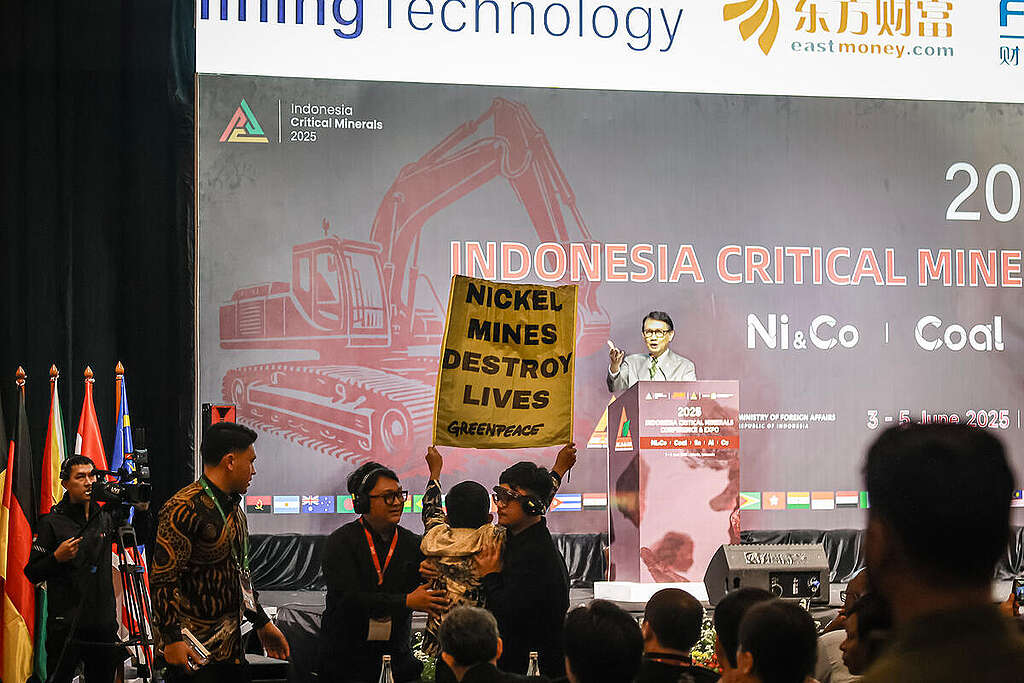
Greenpeace and Raja Ampat youth confront nickel industry during conference

Igor ONeill June 3, 2025 

Banners unfurled at Indonesia Critical Minerals Conference demand accountability: What is the True Cost of Your Nickel? Greenpeace Indonesia activists, alongside four young West Papuans from the Raja Ampat archipelago, staged a peaceful protest about the impacts of nickel mining while Indonesia’s Deputy Minister for Foreign Affairs addressed the Indonesia Critical Minerals Conference in Jakarta © Dhemas Reviyanto / Greenpeace Jakarta, June 3, 2025 – Greenpeace Indonesia activists, alongside four young West Papuans from the Raja Ampat archipelago, staged a peaceful protest today to expose the devastating environmental and social consequences of nickel mining and smelting. While Deputy Minister for Foreign Affairs, Arief Havas Oegroseno, addressed the Indonesia Critical Minerals Conference in Jakarta, the activists deployed a banner reading, “What’s the True Cost of Your Nickel?” and unfurled others with messages: “Nickel Mines Destroy Lives” and “Save Raja Ampat from Nickel Mining.”

Through this direct action, Greenpeace aims to deliver an urgent message to the Indonesian government, nickel industry executives gathered at the event, and the wider public: nickel mining and processing are inflicting profound suffering on affected communities across Eastern Indonesia. The industry is razing forests, polluting vital water sources, rivers, seas, and air, and is exacerbating the climate crisis through its reliance on captive coal-fired power plants for processing.

“While the government and mining oligarchs discuss expanding the nickel industry at this conference, communities and our planet are already paying an unbearable price,” said Iqbal Damanik, Greenpeace Indonesia Forest Campaigner. “The relentless industrialization of nickel – accelerated by soaring demand for electric cars – has destroyed forestlands, rivers, and seas from Morowali, Konawe Utara, Kabaena, and Wawonii, to Halmahera and Obi. Now, nickel mining even threatens Raja Ampat in West Papua, a globally renowned biodiversity hotspot often called the last paradise on Earth.”

Following an investigative journey through West Papua, Greenpeace exposed mining activities on several islands within the Raja Ampat archipelago, including Gag Island, Kawe Island, and Manuran Island. These three are classified as small islands and, under the law concerning the management of coastal areas and small islands, should be off-limits to mining.

Greenpeace analysis reveals that nickel exploitation on these three islands has already led to the destruction of over 500 hectares of forest and specialised native vegetation. Extensive documentation shows soil runoff causing turbidity and sedimentation in coastal waters – a direct threat to Raja Ampat’s delicate coral reefs and marine ecosystems – as a result of deforestation and excavation.

Beyond Gag, Kawe, and Manuran, other small islands in Raja Ampat such as Batang Pele and Manyaifun are also under imminent threat from nickel mining. These two adjacent islands are situated approximately 30 kilometers from Piaynemo, the iconic karst island formation pictured on Indonesia’s Rp100,000 banknote.

Raja Ampat is celebrated for its extraordinary terrestrial and marine biodiversity. Its waters are home to 75 percent of the world’s coral species and over 2,500 species of fish. The islands themselves support 47 mammal species and 274 bird species. UNESCO has designated the Raja Ampat region as a global geopark.

Ronisel Mambrasar, a West Papuan youth from the Raja Ampat Nature Guardians (Aliansi Jaga Alam Raja Ampat), said, “Raja Ampat is in grave danger due to the presence of nickel mines on several islands, including my own home in Manyaifun and Batang Pele Islands. Nickel mining threatens our very existence. It will not only destroy the sea that has sustained our livelihoods for generations but is also fracturing the harmony of our communities, sowing conflict where there was once harmony.”

Greenpeace Indonesia urgently calls on the government to fundamentally reassess its nickel industrialization policies, which have already triggered a cascade of problems. The hollow boasts about the benefits of downstreaming, championed by the previous administration and now perpetuated during the presidency of Prabowo Subianto, must end. The nickel industrialization drive has proven to be a tragic irony: instead of delivering a just energy transition, it is systematically destroying the environment, violating the rights of Indigenous Peoples and local communities, and deepening the damage to an Earth already buckling under the weight of the climate crisis.

ENDS

Photos and videos are available in the Greenpeace Media Library.

Contacts:

Iqbal Damanik, Greenpeace Indonesia Forest Campaigner +62-811-4445-026

Igor O’Neill, Greenpeace Indonesia, ioneill@greenpeace.org +61-414-288-424