A prayer for democratic revival in Indonesia

President Jokowi kick-off the implementation of recommendations for non-judicial settlement of 12 cases of gross human rights violations in the past, at Rumoh Geudong, one of the former Tactical and Strategic Unit Posts (Pos Sattis) in Sector A-Pidie during the implementation of the Military Operations Area ( DOM) in Aceh (1989-1998), located in Gampong Bili Aron, Glumpang Tiga District, Tuesday, 27 June 2023.

The quick count of Indonesia’s recent elections indicates the winner is previously disgraced Prabowo. Accusations abound of voting fraud, vote buying, court-rigging, and corruption within the electoral commission, and many friends are despairing of Indonesia’s retreating democracy. I share that concern, but I can see a potential different interpretation of the facts. My prayer, and an exerted effort by political parties and civil society, Indonesia can revive its democracy in regional elections next November.

Pearls and Irritations published Duncan Graham’s “Indifference Killing Democracy in Indonesia on 11 March, 2024. He presented well-documented sins of Prabowo under President Soeharto. But after Soeharto was forced to resign, Prabowo exiled himself to Jordon. He returned twenty years ago, declaring to be a different person because it was a different era.

Prabowo

In 2008 Prabowo formed Gerindra, his own political party. And in 2009, Megawati accepted this ally of the hated Soeharto as her running mate for the 2009 Presidential elections. They lost.

In 2014 and 2019 he campaigned dirty against Jokowi. After losing a second time, Jokowi appointed him as Minister for Defence. Thus both Megawati and Jokowi had accepted a changed Prabowo.

After a year working for Jokowi, Prabowo confessed that Jokowi was a better leader. Then in 2023 Jokowi supported Prabowo for Presidency in 2024, and it seems Prabowo has won.

On Monday 4 March 2024, less than three weeks after the election, Prabowo declared that Indonesia’s democracy has “a lot of room for improvement”, which he described as “vibrant and resilient”, though he said that democracy is “really very, very tiring; democracy is very, very messy” and “we are still not satisfied with our democracy.” Face value, Prabowo was saying he is pro-democracy but not pro Indonesia’s current democracy.

Prabowo has been supported up to now by his younger brother, businessman Hashim Djojohadikusumo, who has just now been reported as being bankrupt. Will Prabowo now revert to his military style, or to Soeharto’s kleptocracy, to save his brother that helped him get to the top? Or will he act like a convert, and un-mess Indonesia’s democracy?

Jokowi

Had Jokowi been practicing democracy for so long, and now leave such a trail undoing Indonesia’s democracy? Maybe he never was pro-democracy, maybe adept as manager and marketeer where his achievements seemed democratic. But maybe he believes his actions are to democratise Indonesia’s form of democracy?

In his first term he refused to appoint politicians to his cabinet. He avoided parliament (DPR). But in 2016, DPR supported his bill for simultaneous elections of regional leaders after Presidential elections in 2024. Was he laying the foundation for profound change?

Then big news after Jokowi was re-elected in 2019 was his ministerial appointment of Prabowo, his acrimonious rival.

Jokowi has been duplicitous concerning the 2004 undemocratic National System of Development Planning Law (UU SPPN), that requires a long-term development plan every twenty years and five-year development plans drafted before elections, only edited by incoming leaders and valid without amendment for five years. Jokowi’s 2019 five-year plan was 2279 pages long. Jokowi did not make any effort to change this problematic planning system, but he paid little attention to it.

And in 2019, Jokowi produced a vision for Indonesia by 2045, to be the basis for long-term planning in 2025. But he has retained UU SPPN, and demands long-term plans to be prepared in 2024.

The only scenario I can see for maintaining the planning law that Jokowi disdains, is that it is a lever over parties for the regional elections in November for the 550 positions of Governor, Regent and Mayor, to be elected by popular vote. Maybe Jokowi is attempting to reform local democracy.

Parties, all undemocratic, are under pressure in three ways. With too many elections and too many candidates, national party committees and party patrons cannot hold the reigns. They must delegate to their provincial branches.

Campaigns will be based on carefully overseen long term plans for 2025-2045, based on Jokowi’s Indonesia Emas 2045. No more room for candidates to campaign beyond their authority, and candidates mut look to the long term.

And economic outlooks must include collaboration to embrace connectivity within markets. From 2025, Jokowi is demanding decentralise governance of the economy. Political parties within provinces need to prepare collaborative campaigns, not just campaigns between local elites.

In 2019 Jokowi surrounded Prabowo with people who could monitor his faithfulness. Yes, Jokowi seems to be creating a dynasty. Maybe also keeping a watch over Prabowo, like he did in 2019. Could that very same brother-in-law in the constitutional court who helped create the dynasty, also keep close watch over any attempt to undermine the constitution? Will Jokowi demand he appoints opponents Ganjar and Mahfud or even Ahok as ministers, as he appointed Prabowo back in 2019?

Could he be demanding Prabowo oversee better decentralisation, a focus on SDG 2030, a revision of the Planning Law, and political party law to demand parties to be democratic?

Whether Prabowo returns to his old self, or whether my hope and prayer is answered, political parties can start preparing to change local democracy by being more democratic themselves. And local civil societies can be demanding it.

Consider making a donation to support independent journalism

Pearls and Irritations relies totally on donations from its readers. We are independent and we don’t accept financial support from governments, their agencies or vested interests such as fossil fuel and arms manufacturing companies. We do not accept advertising, nor do we have a paywall.

Please consider a donation to help Pearls and Irritations extend its voice and reach.

Owen Podger

Owen Podger is an Australian living in Indonesia. Since March 1998 when Soeharto was elected for the final time, he has concentrated on assisting Indonesian reforms , mainly in two areas: (1) policies to improve performance of government in Indonesia’s new democratic and decentralised system, and (2) sustainable urbanisation considering climate change and disasters.

The Australia West Papua Association condemns the brutal torture of a West Papuan man by Indonesian troops in Yahukimo.

A video of the  torture is circulating on social media. The video shows soldiers brutally beating a man as he stands in a barrel of water and slashing him with a knife.

Joe Collins of AWPA said , “one can only imagine the fear and terror the Papuan man must feel at this brutal torture being inflicted on him”.

Gustaf R. Kawer, chair of PAHAM Papua, (The Human Rights Lawyers Association)  said they have  tried to carry out a brief investigation and suspect that this torture incident was carried out by Non-Organic Troops from Kodam III/Siliwangi, Yonif Raider Unit 300/Brajawijaya, against civilians around Puncak or Puncak Jaya Regency (Mulia, Ilaga, Sinak, etc.).

PAHAM Papua is calling on Indonesia’s National Human Rights Commission (and the TNI Commander) to immediately carry out a thorough investigation and take the perpetrators to court.

Benny Wenda has also condemned the torture stating 

“I am truly horrified by the video that has emerged from Yahukimo of Indonesian soldiers torturing a West Papuan man. More than anything, the sadistic brutality on display shows how urgently West Papua needs a UN Human Rights visit”. 

The video (with the warning : graphic, violent content ) is on the ULMWP webpage at 

https://www.ulmwp.org/president-wenda-a-crime-against-humanity-has-been-committed-in-yahukimo


Joe Collins said, “as more information comes to light about the incident , AWPA  will be writing to the Australian Foreign Minister  Penny Wong  not only about this incident but about the deteriorating human rights situation in the territory”. 

Ends.
——————————

Image from FB

————————-
PAHAM Papua media release (Translated) (posted on AWPA FB page)

Commanders and perpetrators of torture against civilians MUST be prosecuted and dismissed from the unit.

Good morning fellow Papuan media and activists, observing the video of very sadistic torture carried out by TNI officers in Papua which is circulating quite widely on online media, it is very important for us to work together to urge the perpetrators to be prosecuted, including the commander of this unit.

We have tried to carry out a brief investigation, while it is suspected that this torture incident was carried out by Non-Organic Troops from Kodam III/Siliwangi, Yonif Raider Unit 300/Brajawijaya, against civilians around Puncak or Puncak Jaya Regency (Mulia, Ilaga, Sinak, etc.).

This act of torture against one of the civilians was very sadistic, carried out by TNI officers without prioritizing the principle of presumption of innocence. If the person concerned was suspected of committing a criminal act/was involved in the TPN PB organization, TNI in sufficient numbers was accompanied by complete military equipment and faced with A mere civilian, helpless, does not deserve to be subjected to cruel acts of sadistic torture as circulated in the video. According to regulations, the TNI handed over suspected criminals to the police for legal proceedings before the court and the court determined the person guilty based on the facts of the trial.

The actions of the TNI officers constitute an act of extrajudicial torture, a thorough investigation needs to be carried out and if it is discovered that the victim has died, then the actions of the officers can be categorized as extrajudicial killing.

We from PAHAM Papua urge the Republic of Indonesia’s National Human Rights Commission and the TNI Commander to immediately carry out a thorough investigation and take the perpetrators to court until they receive the maximum verdict, including being fired from the unit.

That’s our press release.

Best regards,

Gustaf R. Pawer

Chairman

 ——————-

Indonesian military probes viral video allegedly showing Papuan’s brutal torture by soldiers

Victor Mambor and Dandy Koswaraputra

Indonesian military probes viral video allegedly showing Papuan’s brutal torture by soldiers

Victor Mambor and Dandy Koswaraputra
2024.03.22
Jayapura, Indonesia, and Jakarta

Share on Facebook

Share

A

 2024.03.22 Jayapura, Indonesia, and Jakarta

Military officials in Indonesia’s restive Papua region said Friday they were verifying the authenticity of a video that has gone viral and appears to show Indonesian servicemen beating and cutting with a bayonet a man believed to be an indigenous Papuan. 

Human rights activists demanded a swift inquiry to determine if soldiers were involved in what would be yet another case of torture and abuse, which is a longstanding accusation against Indonesian military and security forces in Papua.

The location and time of the alleged incident are unclear.

“We are verifying its authenticity,” Col. Gusti Nyoman Suriastawa, a military spokesman in Papua, told BenarNews. “If it is genuine, we need to determine where and when it occurred.”

The graphic video footage, viewed by BenarNews, shows men in trousers that resemble Indonesian military uniform fatigues, taunting the victim who is seen inside a water-filled drum.

“How does that feel? Head up! Head up,” the men say as they hit him and make incisions on his back with a bayonet.

As the men continue to inflict the wounds, the water in the drum can be seen turning red.

In a statement issued after the video was widely circulated, PAHAM Papua, a local human rights organization, issued a statement that makes the assumption that the abusers in the footage are members of the Indonesian Armed Forces [TNI].

“If the individual was suspected of criminal activity, the TNI should not have resorted to such brutal and sadistic torture as shown in the video,” PAHAM chairman Gustaf Kawer said.

“The act of torture inflicted on [the] civilian was extremely cruel, carried out by TNI [personnel without adhering to the principle of presumption of innocence.”

PAHAM urged the National Commission on Human Rights (Komnas HAM) and the Indonesian military to conduct a “comprehensive investigation.”

Theo Hesegem, executive director of the Papua Human Justice and Integrity Foundation, urged authorities “to ensure that the perpetrators of the torture are processed swiftly.”

“It is clear that the individual subjected to torture is a native Papuan,” he said in a statement.

Komnas HAM, meanwhile, indicated that initial findings point to the incident taking place in the Puncak regency of Central Papua province. 

“This compounds the toll of violence from the ongoing conflict in Papua, with suspicions pointing to torture by authorities,” Komnas HAM chairwoman Atnike Nova Sigiro Atnika said in a statement. 

Rights groups have long accused Indonesian security forces of abuses in Papua, including arbitrary arrests, torture, and extrajudicial killings. 

Papua, at the far-eastern end of the Indonesian archipelago, has seen an escalation in violence following an insurgent attack that resulted in the deaths of 19 road construction workers and a soldier in 2018.

The heavy military presence and ongoing violence have stifled development in the region.

On Friday, Rumadi Ahmad, a deputy chief of the Indonesian presidential staff, said that President Joko “Jokowi” Widodo had committed to accelerating development in Papua, but these efforts would be hampered if the military was responsible for the violence in the video.

“While we hold a strong hope that our soldiers are not involved in such reprehensible acts, if proven true, the individuals responsible must be held accountable in accordance with the applicable rules and regulations,” Rumadi said in a statement.

He said the military played a strategic role “in bringing about a sense of security” in Papua.

“If the video is proven to be true, the actions by a few irresponsible individuals could be very disruptive to the development that has been planned and implemented so well,” Rumadi said.

Insurgents have also been responsible for civilian fatalities, targeting those they suspect of espionage for the authorities. In 2022, rebels killed eight employees of Telkomsel, the nation’s leading telecommunications provider, who were constructing cellular towers in the Puncak regency.

However, one armed separatist group, the West Papua National Liberation Army, quickly distanced itself from the incident in the video and condemned the acts therein, which spokesman Sebby Sambom attributed to the TNI.

“The actions of the Indonesian military and police are akin to [those of] ISIS terrorists,” Sambom said, referring to the Islamic State militant group.

Papua, a mineral-rich and underdeveloped region, has been grappling with a separatist insurgency for decades. The mineral extraction and alleged discrimination against indigenous Papuans by the Indonesian government have fueled the conflict. 

Papuans have long felt marginalized economically and politically, despite the immense wealth their land generates.

The territory was incorporated into Indonesia in the 1960s after a controversial United Nations-backed plebiscite. 

Many Papuans allege the vote was rigged and have since fought for independence.

Videos of Indonesian soldiers torturing Papuan go viral – Human rights defenders demand judicial process against perpetrators

Human Rights News / IndonesiaWest Papua / 22 March 2024 

Videos of Indonesian soldiers torturing an indigenous Papuan have gone viral on social media and caused public outrage. Human rights defenders found hints that the video might have been taken during a security force raid in Omukia and Gome on 3 and 4 February 2024. Both districts are located in the Puncak Regency, Pegunungan Tengah Province. One of the men is wearing an army shirt with a 300 imprint, indicating his affiliation with the III/Siliwangi, Yonif Raider 300/Brajawijaya Unit. The unit was deployed in the Puncak Regency for several months until 16 February 2024 before returning to their battalion in Cianiur, Jawa Barat Province. The video is rare visual evidence of the utmost brutality used by security force members during raids in conflict areas across West Papua. The XVII Cenderawasih spokesperson, Lieutenant Inf Candra Kurniawan, stated that his men are currently examining the truthfulness of the video.

Such raids have repeatedly occurred in the regencies NdugaPegunungan BintangIntan JayaPuncak, and Yahukimo – all located in the central Papuan highlands. Security forces regard these regencies as strongholds of the West Papua National Liberation Army (TPNPB). Human rights organisations have repeatedly raised concerns regarding atrocities against the civilian population during such raids, including acts of arbitrary detention, burning of houses, torture, enforced disappearance, and extra-judicial killings.

The video shows a Papuan man with hands tied to his back. He is sitting in a blue drum filled with water that has turned red as a result of blood from his wounds. The drum is surrounded by at least five non-Papuans, some wearing military trousers and one wearing an army shirt with a 300 imprint on the front. The men speak Indonesian with a Javanese accent (see video below. Viewer discretion is advised for these graphic images).

The videos display different forms of torture. One video shows the victim shivering. A man in a black jacket and black fingerless gloves repeatedly stabs and slashes the shoulder with a knife while saying, “{[The skin is] though. This feels good, right?” The second video shows various non-Papuan men taking turns punching, elbowing, and kicking the victim in the face and the back of the head. One man is beating the Papuan detainee with a stick, repeatedly shouting, “Take your head up. Dog! Bastard!”. Another man steps in and says,” It’s time to switch. Be patient.”

Human rights organisations urged Indonesian authorities to immediately investigate the allegations of torture and take legal firm action against the perpetrators. Cases of torture have been rampant in West Papua due to the widespread impunity in the region. Perpetrators are not held accountable in public trials, while the internal court processes, particularly police internal disciplinary procedures, lack transparency and independence. The perpetrators often receive sentences that are disproportionately lenient with regard to the severity of the crime. Recent military tribunals related to the enforced disappearance and execution of five indigenous Papuans in the regencies Intan Jayaand Mimika illustrate the pressing issue of accountability and impunity in West Papua.

Raids in the Districts Gome und Omukia, February 2024

According to information compiled by human rights defenders in Puncak, security forces raided the villages Manggume and Aminggaru, Omukia District, as well as in the villages Yenggernok and Agiyome in the Gome District, following the theft of an automatic firearm by members of the West Papua National Liberation Army (TPNPB) on 1 February 2024. According to information received, on 3 and 4 February 2024, security force members burnt houses in various villages to the ground and arbitrarily tortured villagers.

One Papuan villager reportedly died because of the injuries he sustained due to the torture. At least three other civilians were injured after being tortured, including one pastor named Rev Eriak Waker. The torture occurred during his interrogation in the Yenggernok Village.

According to information received, security force members carried out a raid in the Manggume Village, Omukia District, on 4 February 2024, around 10.00 am. Mr Andinus Murib, 21, and Mr Devius Wanikbo, 19, were fixing the roof of a house when the security forces came to the villages. Villagers panicked and fled to the forest while Mr Murib and Mr Wandikbo were trapped on the roof. They were temporarily detained and tortured by security forces.

Mr Murib and Mr Wandikbo were admitted to the public hospital after losing consciousness due to the pain they experienced during the torture. On 5 February 2024, authorities suggested transferring both patients to Timika, where the hospital was better equipped. However, the relatives rejected the offer. Instead, they brought Mr Murib and Mr Wandikbo back to the village and treated them with traditional medicine because they feared further violence or criminalisation by the authorities.

During the raid in Manggume on 4 February 2024, security forces encountered Mr Werinus Murib, 20, in the forest near the village around 11.15 am while collecting firewood. After being arrested, security force members reportedly tortured Mr Murib until he succumbed to the injuries he sustained. The pattern of injuries indicated that the security force member beat and kicked the victim’s head and body using bare hands and blunt objects. The body also had stabbing and slashing injuries. Witnesses saw joint security forces tying Mr Murib’s feet to a car and allegedly dragging him for a distance of 1 kilometre. Mr Murib died on the way to the hospital as a result of the injuries he sustained.

Presence of Military in Puncak Regency

The XVII Cenderawasih spokesperson, Lieutenant Inf Candra Kurniawan, declared that he had never received any complaints about the presence of III/Siliwangi, Yonif Raider 300/Brajawijaya Unit in Puncak. “There have never been complaints of harsh behaviour towards the community. In fact, the community is pleased with the presence of the Yonif 300 / R Task Force and was honoured by the Dani tribe with the title Kogoya from the Chief of the Puncak Regency Tribe in Gome.”

The video is a crack in the image of the military. Military officials have been trying to promote the military as being close to the people in Papua. Military members become teachers and provide medical services because the fundamental healthcare and education services in conflict areas remain dysfunctional. Professional health and education workers have left the areas (see images below, source: independent HRDs). The image contradicts information shared by affected community members in the Puncak Regency. Human Rights Monitor has received complaints about the heavy military presence in conflict areas, including from the Puncak Regency, as part of the Government’s soft security approach in West Papua. In November 2021, the coordinating minister for political, legal, and security affairs, Mahfud MD, declared a new security force approach in West Papua, which implied that military members should directly engage in community matters, participating in education, health, and infrastructural services in conflict-affected areas. Military members reportedly visit homes, schools, and public medical facilities. The government-driven practice is highly concerning, as many indigenous children in West Papua are afraid of the military. They have been traumatized over generations by the history of human rights violations over a period of more than 50 years.  Moreover, the presence of military members in communities exposes civilians to a higher risk of becoming civilian victims during armed clashes between the conflict parties

Video of Indonesian soldiers torturing indigenous Papuan

Videos

Indifference killing democracy in Indonesia

A reason for Indonesians overwhelmingly supporting cashiered general Prabowo Subianto and a likely military dictatorship is because the electorate rarely reads; voters haven’t been taught to think critically so know little of their new president’s past.

In 1998, Prabowo was stripped of his rank and discharged from the Army for disobeying orders. His squad arrested student dissidents and 13 have never reappeared. He fled to Jordan and returned earlier this century to become a hugely successful businessman.

Australian author and academic Max Lane, who translated the works of political prisoner Pramoedya Ananta Toer into English last century, says Indonesia is the only country in the world that doesn’t require students to read their own nation’s literature:

“This was deliberately created so that the Indonesian people would not understand their own nation so they would not have any imagination for the future.” As Spanish-American philosopher George Santayana (1863-1952) said: ‘Those who cannot remember the past are condemned to repeat it.’

The condemnation of intellectuals and creatives, heavy censorship and book banning during second president Soeharto’s rule (1966 – 1998) caused a great slump in reading history. A US university study of The World’s Most Literate Nations ranked Indonesia at 60 of the 61 states surveyed. (Top is Finland; Australia is 12th).

A Melbourne University commentary concluded: “Culturally, Indonesians have a very strong oral tradition, and the country is not going to transform into a nation of bookworms overnight (but) … creativity and innovation are urgently needed to address the reading crisis.”

Although World Bank data shows Indonesian literacy above 96 per cent, knowing how to read and using that skill widely are separate issues.

Indonesian public schools are in a mess. One Australian academic review blamed “inadequate funding, human resource deficits, perverse incentive structures, and poor management” adding: “Problems with education quality and learning have also been, at their root, a matter of politics and power.”

In the past liberal Muslim parents ignored crucifixes nailed above doorways to get a better education in Catholic schools; this trend is waning as independent schools develop. However, the curriculum is still controlled by the government which is again rewriting history.

The first version of the 1965 coup, widely and uncritically taught, had naked Communist women dancing on the castrated corpses of murdered generals. The brief uprising was savagely suppressed by General Soeharto who went on to become the nation’s second president.

The lewd story was untrue – a pre-internet hoax to foment hatred towards the Communist Party and its supporters seeking land reform. It worked – and an estimated half-million were slaughtered in a military-engineered genocide.

Soeharto (who died in 2008) is known overseas as the greatest kleptocrat in the Republic’s history, though never charged. He allegedly stripped US $35 billion from the public purse. This is also not taught in schools.

Now Golkar Party Deputy Chair Melchias Markus Mekeng reckons Soeharto should be made a national hero. That’s reportedly because he “did a lot of good work and was dedicated when he served as president.” No details.

The motive for trying to canonise a villain comes after the current and seventh president Joko ‘Jokowi’ Widodo last month suddenly smoothed the facts by rehabilitating his rival.

He awarded his cashiered successor Prabowo with the honorary rank of four-star general. When kicked out of the military 26 years ago he had three stars.

The promotion dismayed civil society groups that claimed Prabowo’s promotion was a ”betrayal of the 1998 Reformation.”

A career military man educated in the UK and US, Prabowo’s meteoric rise in the army was boosted by serving with alleged brutality in East Timor and marrying Soeharto’s second eldest daughter Siti Hediati Hariyadi. The couple have since divorced.

He then tried to be elected president, crashing both times against the current holder of the title. To widespread astonishment Jokowi made his bitter opponent Prabowo Defence Minister, giving the failed candidate a platform.

On his third try on 14 February Prabowo convincingly won the presidency, sweeping the stage of his two main candidates with close to 60 per cent of the vote. (Jokowi had already served two five-year terms and was prevented by the Constitution from standing a third time.)

There are 24 political parties registered in Indonesia, including Golkar, the vehicle for Soeharto who served for 32 years before he quit in 1998 during an economic crisis and massive student protests.

Golkar (Party of Functional Groups) was formed by the military in 1964. It’s now the second-largest party and claims to be democratic and nationalist. It backed Prabowo’s candidacy in this year’s election so will get some of the ministries.

Merit and skills in a specific portfolio are not required.

So far the priority is not education but military bases in every province. There are 14 at present. During the election campaign, Prabowo pledged to increase these to all 38.

Any chance the schooling situation will change for the better with Prabowo as president? It’s unlikely though it depends on who’s appointed Education Minister and how much clout they carry. In the Indonesian system, a minister can be recruited from outside politics.

The current education minister is billionaire businessman Nadiem Anwar Makarim who started the Gojek motorbike taxi service in 2009. He’s not known as a member of a political party.

Dr Anies Baswedan, once a university rector and failed presidential candidate, was a former Education Minister. He tried to reform the system but soon encountered opposition and was sacked by Jokowi in 2016.

Monash University’s Dr Sharyn Davies reportedly said Prabowo’s nationalism “could affect higher education policy – including appetite for overseas university campuses.

“No Indonesian university apart from Monash Indonesia has foreign academics employed in anything other than guest adjunct positions.

“It’s a very insular, ultra-nationalist kind of education system and…my sense (is that) Prabowo will move that even more towards the nationalist insular side.”

Consider making a donation to support independent journalism

Pearls and Irritations relies totally on donations from its readers. We are independent and we don’t accept financial support from governments, their agencies or vested interests such as fossil fuel and arms manufacturing companies. We do not accept advertising, nor do we have a paywall.

Please consider a donation to help Pearls and Irritations extend its voice and reach.

Duncan Graham

Duncan Graham has been a journalist for more than 40 years in print, radio and TV. He is the author of People Next Door (UWA Press). He is now writing for the English language media in Indonesia from within Indonesia.
Duncan Graham has an MPhil degree, a Walkley Award, two Human Rights Commission awards and other prizes for his radio, TV and print journalism in Australia. He lives in East Java.

Indonesia is still a tricky proposition for foreign investors

It’s unfortunate timing. In the same week that Prime Minister Anthony Albanese announced a $2 billion facility to encourage investment in South-East Asia, a Canadian pension fund investor hit pause on a much-touted push into Indonesia.

In
recent years, South-East Asia’s largest economy has made some big
strides in welcoming institutional investors – including Australia’s
Macquarie Asset Management – by dealing with concerns about political,
economic and regulatory risks.

The three-year-old Indonesian
Investment Authority (INA), protected by its own legislation and a
reporting line straight to the president, has done much to smoothen the
way.

INA chief executive Ridha Wirakusumah
has briefed fund managers across the globe on its mission to bring
world-class investors to Indonesia. He has made several visits to
Australia and was back again this week as Albanese launched the $2
billion Southeast Asia Investment Financing Facility in the presence of
regional leaders and executives at the ASEAN Summit in Melbourne.

INA
has done a good job of insulating investors from Indonesia’s always
complex and often piecemeal regulatory framework. However, a recent
development shows the path is not straightforward, even for seasoned
investors who have done years of due diligence.

One of the INA’s early triumphs, a $US3.75 billion investment platform formed with three international partners, has taken an unexpected turn. Canada’s Caisse de dépôt et placement du Québec (CDPQ) was left off the list when the INA announced that the platform had become a shareholder in a major tollway project this year. This week, an INA spokeswoman confirmed that CDPQ was no longer involved in the platform “for the time being”. The target investment had consequently been reduced to $US2.75 billion.

A spokesman said CDPQ would not go into the details regarding its engagement with INA “but active discussions are ongoing”.

The diminished size of the investment platform demonstrates Indonesia’s continuing battle to diversify its financial backers. Although foreign direct investment has reached record levels recently, much of this has been concentrated in huge new industrial parks centred on nickel mining. The country’s ambitious goals for clean energy and its pressing need for more infrastructure require billions more.

In November, Indonesian President Joko Widodo inaugurated a floating solar farm in West Java province. It’s the third largest such structure in the world, but just one small step in what the president, commonly known as Jokowi, estimates is a $US1 trillion task to get South-East Asia’s largest economy to zero emissions.

The Albanese government views the green transition as a chance to both strengthen a crucial bilateral relationship and help turn the dream for Australia to become a renewables superpower into reality. Hence, the $2 billion promise to help tempt Australian investors into South-East Asia, which was announced at the ASEAN Summit.

The initiative will provide loans, guarantees, equity and insurance to help bolster what the government describes as the “underweight” and “stagnant” two-way trade and investment with ASEAN member countries. Renewable energy and infrastructure development are the priority areas.

The $2 billion could be “catalytic in Indonesia,” says Andrew Hudson who leads the Melbourne-based Centre for Policy Development, which also has a presence in Jakarta. “We’ve seen investment in South-East Asia drop off drastically over the last decade and the big question is how do we encourage the private sector. I think this new facility will help derisk and provide higher return rates – and it really should be focused on Indonesia, the giant of South-East Asia.”

It’s a good time to be looking around, he notes. The Indonesian government is increasingly frustrated by delays in the $US20 billion promised by G7 countries in 2022 to help shift its developing economy. The country is still powered almost entirely by coal-fired electricity that is heavily subsidised – as is the gasoline used by the vast majority of cars and motorbikes across the archipelago.

Indonesia is at the point of what the OECD refers to as the country’s “reform journey” where more institutional investors are becoming increasingly comfortable they won’t be caught out by political or economic crises. The INA’s two other partners in the investment platform launched in 2021 have stuck with the initiative under which the acquisition of a stake in a Trans-Java toll road was announced in January. However, CDPQ’s actions show the country remains complex for international investors – even those whose due diligence goes back years.

ugboats and barges transporting coal are moored on the Mahakam River in Samarinda, East Kalimantan, Indonesia.  Bloomberg

Shrinking involvement

Although these considerations are not incompatible with the Albanese government’s strategy for the region, they will be top of mind for Export Finance Australia, which will run the $2 billion South-East Asia Investment Financing Facility. The goal is to reverse our shrinking involvement with a region that is tipped to be the fourth largest in the world by 2040, after the US, China and India.

Macquarie Asset Management is one of the few Australian institutions to have invested directly in Indonesia, where it has a minority stake in Bersama Digital Infrastructure. Singapore-based King & Wood Mallesons partner Nicola Yeomans advised MAM’s co-investor in that deal, Canada’s Public Sector Pension Investment Board. Yeomans was also in Melbourne this week. She praises the government for acting so quickly on the recommendations made in the South-East Asia strategy that was led by former Macquarie boss Nicholas Moore.

“The issue is there are not enough big, bankable projects. This will provide finance for ventures at an earlier stage than private capital,” Yeomans says.

Advertisement

“My view is we need to normalise the risk. Yes, it’s a different legal system and yes, you need to understand your partner. The risks are real and people have been in trouble in the past. But there are many investors from elsewhere in the world that have done the work and who understand the nature of those risks.”

Shifting Indonesia to green energy is an immense task – sobering not only in terms of its size but also its social impact, with a lot of workers engaged in fossil fuel-related industries and many consumers being used to heavily subsidised purchases.

The 192-megawatt peak solar farm on the Cirata reservoir in West Java is expected to generate 245 gigawatt-hours of electricity a year. That’s enough to power 50,000 households, though this could increase with plans to expand the project to 500MWp and perhaps as high as 1000MWp.

A view of the Cirata Floating Photovoltaic Power Plant in Purwakarta, Indonesia.  Bloomberg

Renewables account for just 12 per cent of Indonesia’s power generation and the country is likely to miss its target of increasing that to 23 per cent by next year. The government has estimated it needs $US600 billion to retire 15 gigawatts of coal power generation over the next three decades.

At the end of 2022, developed nations agreed to help fund the transition from coal to clean power. The $US20 billion Indonesia Just Energy Transition Partnership is led by the United States and Japan and supported by the UK, Germany, France, the EU, Canada, Italy, Norway and Denmark. The plan is for public sector agencies to pledge $US10 billion, and the same amount would be put up by the private sector.

The JETP for Indonesia – and others agreed with South Africa, Vietnam and Senegal – are an acknowledgement the world is moving too slowly on climate action, and too unevenly. More than 90 per cent of all increased spending on renewables is going into developed countries and China, according to the Rockefeller Foundation.

But so far, those good intentions have failed to translate into cash. A JETP Secretariat opened in Jakarta a year ago and 400 priority projects have been whittled down to just under 50. However, Jokowi expressed frustration when he told the Financial Times last year there was “tremendous” concern over the lack of action in funding. “Don’t question Indonesia’s commitment towards the energy transition. What I’m questioning is the commitment of the developed states.”

In a report on the overall JETP approach released last month, the Rockefeller Foundation concluded that “healthy scepticism and continued scrutiny are warranted given how long the process is taking and how slowly the money has flowed so far”.

When the Indonesian JETP was announced, some observers felt Australia should have been involved. One well-informed observer said the Indonesian government suggested informally that Canberra should jump in only if it were willing to commit a substantial sum.

The $2 billion facility directed squarely at the region shows serious intent. But it remains to be seen if institutional investors will turn into active players and team up with fund managers operating in the region, and also follow the lead of the newly appointed regional business champions by backing companies keen to do more with our northern neighbours.

T

Emma Connors

Emma ConnorsSenior editor and writerEmma Connors was South-east Asia correspondent from October 2019 until mid-2023, based in Jakarta and Singapore. She has previously edited Perspective, Review and op-ed, and has written extensively across the AFR and related titles. Connect with Emma on Twitter. Email Emma at emma.connors@nine.com.au

Latest In Asia

Adding TNI commands waste of budget, won’t bolster national defense says Coalition

CNN Indonesia – March 2, 2024

Jakarta — The Civil Society Coalition for Security Sector Reform is asking the Indonesian military Headquarters (Mabes TNI) to cancel a plan to add Regional Military Commands (Kodam) in all Indonesian provinces.

The Coalition believes that this will not contribute to strengthening national defense and will only cause disputes in the management of domestic security and have a negative impact on democracy.

“The Mabes TNI must stop the plan to add Kodams to all Indonesian provinces … The additional Kodams are also a form of wasting the national defense budget amid a limited budget for the fulfillment of and modernisation of our current Alutsista (primary defense equipment(“, said the group in a written statement on Friday March 1.

The Coalition believes that the addition of Kodams also shows a strong orientation to a development posture, as well as the degree to which the TNI’s forces are more aimed at and oriented towards being inward looking, not outward looking.

According to the coalition, this has implications for the tendency for the military to become involved in political life. As a consequence, it is difficult to create a TNI that is a strong, professional and modern national defense tool.

The coalition also said that the 1998 TNI reform agenda mandates the political authorities, namely the government and the House of Representatives (DPR), to restructure the TNI’s territorial command structure, namely the existence of Kodam down to Koramil (sub-district military commands) at the lowest level.

“The government and DPR should immediately restructure the territorial commands (Kodam to Koramil) and replace them with a military force posture model and title that is more contextual to the dynamics of threats and the geographical conditions of Indonesia as an archipelagic country”, said the Coalition.

The plan to add additional Kodams was raised again by TNI commander General Agus Subiyanto at a TNI-Indonesian police leadership meeting on Wednesday February 28. Currently, there are a total of 15 Kodams throughout Indonesia and the plan is to add 22 more.

“The TNI AD (Army) plans to build and deploy 37 Kodams where there will be 37 Kodams rolled out, 15 Kodams will be strengthened with Korems [sub-regional military commands], while 22 Kodams will be without Korems under them, this includes the construction of the IKN [new capital city Nusantara in East Kalimantan] Kodam and two new battalions”, said Subiyanto on Wednesday February 28.

Meanwhile, Army Chief of Staff (KSAD) General Maruli Simanjuntak has said that they will accommodate criticism regarding the plan to add more Kodams. However Simanjuntak said that the additional Kodams are also in response to requests from the public.

“If I visit a region, they ask for this. Yeah, there are many places, where they even say, ‘Pak [Sir], we’ll prepare the land. Pak, please make a Kodam here, a battalion, a Koramil [sub-district military command] and so on’. Because indeed our presence is needed by them”, Simanjuntak said following an Army (TNI AD) leadership meeting on Thursday February 29.

Simanjuntak explained that the formation of military commands at the smallest level has consequences for organisational management at higher levels.

“We have been asked for Ramil [Koramil] posts, which means there must be a coordinator after several dozen, a Kodim. After there are several Kodim [district military commands] we must have a Korem, after there are several Korems, most of them must have a Pangdam [regional military commander]” said Simanjuntak.

“Because maybe people don’t realise what it’s like to be a military commander covering three provinces in Kalimantan. Just moving from province to province, you have to go through Jakarta, that’s basically the problem”, he added. (yoa/chri)

Notes

The TNI’s territorial command structure mandates the deployment of military command posts and detachments at all levels of the civil

administration: provincial, district, sub-district and village. This structure provides the organisational framework for the TNI to act as a political security force at all levels of society. The five respective commands are: Kodam — Komando Daerah Militer, Regional Military Command; Korem — Komando Resort Militer, Military Command at a level below the residency; Kodim — Komando Distrik Militer, District Military Command; Koramil — Komando Rayon Militer, Sub-District Military Command

(Kecamatan) level and; Babinsa — Bintara Pembina Desa, Non-commissioned military officer posted in villages and wards and affiliated with the civilian administration. Since becoming Defense Minister in 2019, Prabowo Subianto, who is set to become Indonesia’s next president in October, has on several occasions pushed the idea of establishing Kodam in every province.

[Translated by James Balowski. The original title of the article was “Koalisi Sipil Minta TNI Hentikan Rencana Tambah Kodam di Tiap Provinsi”.]

Source:

https://www.cnnindonesia.com/nasional/20240302000428-20-1069493/koalisi-sipil-minta-tni-hentikan-rencana-tambah-kodam-di-tiap-provinsi

—————————————————————

Army chief claims many people ask for new military commands, TNI posts

Kompas.com – March 1, 2024

Icha Rastika, Jakarta — Army Chief of Staff (KSAD) General Maruli Simanjuntak claims that many local people have asked him for new TNI (Indonesian military) post to be established in regions that he has visited.

That was conveyed by Simanjuntak when answering questions from media crews about the involvement or input from local people on the plan to build 22 new regional military commands (Kodam) around the country.

When visiting the regions, Simanjuntak has heard input from communities that want TNI posts to be established.

“If I visit a region, they ask for this. Yeah, there are many places, where they even say, ‘Pak [Sir], we’ll prepare the land. Pak, please make a Kodam here, a battalion, a Koramil [sub-district military command] and so on’. Because indeed our presence is needed by them”, Simanjuntak said following an Army (TNI AD) leadership meeting at the Kartini public hall in South Jakarta on Thursday February 29.

Simanjuntak also hopes that media crews can conduct a survey on the issue in the regions. “So you can really get an opinion in accordance with the wishes of the many ordinary people”, said the KSAD.

He also said that many local people have asked for a new Ramil (Koramil) post.

“Almost all of them said, ‘Pak, please help making a Ramil post so that we can help to help reconcile the community, help development, help prevent stunting [in children], and so on”, said Simanjuntak.

The TNI AD is indeed planning to establish regional military commands in every province in the country.

Based on a presentation delivered by TNI commander General Agus Subiyanto at a TNI-Indonesian police leadership meeting on Wednesday February 28, there will be a total of 37 regional military commands.

This means there will be an additional 22 new Kodam, complementing the

14 that already exist.

Notes

The TNI’s territorial command structure mandates the deployment of military command posts and detachments at all levels of the civil

administration: provincial, district, sub-district and village. This structure provides the organisational framework for the TNI to act as a political security force at all levels of society. The five respective commands are: Kodam — Komando Daerah Militer, Regional Military Command; Korem — Komando Resort Militer, Military Command at a level below the residency; Kodim — Komando Distrik Militer, District Military Command; Koramil — Komando Rayon Militer, Sub-District Military Command

(Kecamatan) level and; Babinsa — Bintara Pembina Desa, Noncommissioned military officer posted in villages and wards and affiliated with the civilian administration.

[Translated by James Balowski. The original title of the article was “Klaim Banyak Warga Minta Dibangun Pos TNI, KSAD Maruli: Kehadiran Kami Diperlukan”.]

Source:

https://nasional.kompas.com/read/2024/03/01/08090201/klaim-banyak-warga-minta-dibangun-pos-tni-ksad-maruli-kehadiran-kami

—————————————————————

Military members shot two Papuans during electoral activity in Titigi Village, Intan Jaya

Cases, Human Rights News / Indonesia, West Papua / 1 March 2024

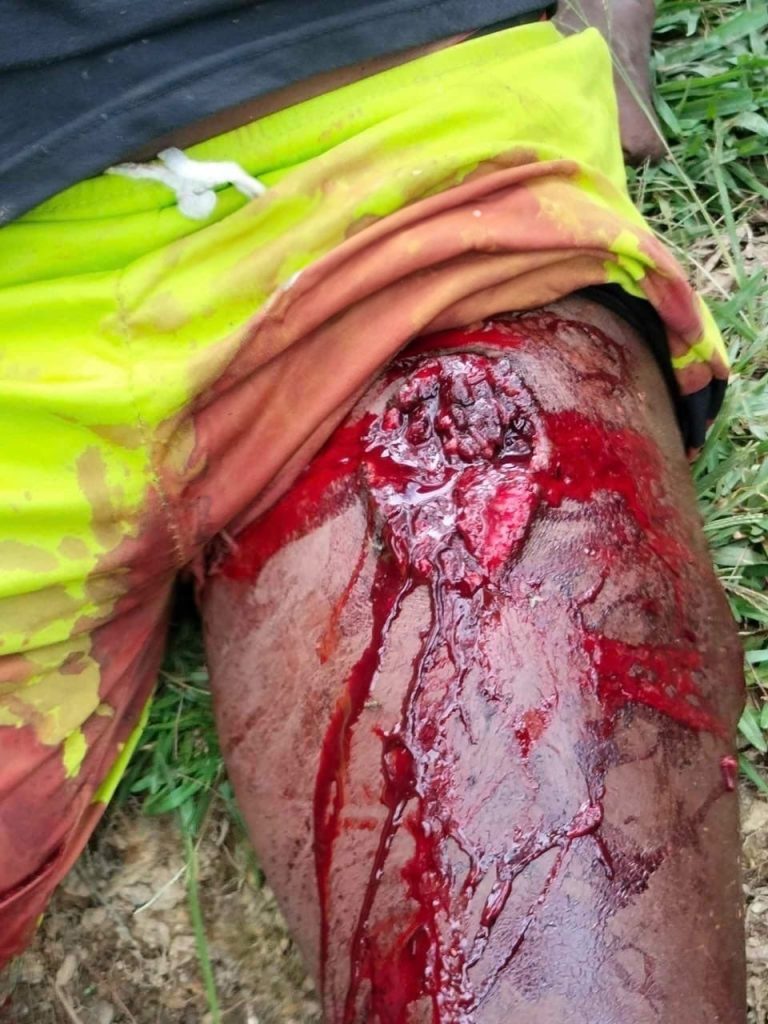
On 28 February 2024, around 10:30 pm, members of the Indonesian National Army (TNI) command Yonif 330 reportedly shot down the two indigenous Papuans, Selli Maiseni, 16, and Mr Mikalon Yoani, 18, in Titigi Village (see satellite image on top, source: European Space Imaging), Sugapa District, Intan Jaya Regency, Papua Tengah Province. Selli Maiseni sustained a gunshot wound on the arm, while Mr Yoani was shot in the thigh (see photos below, source: WPCC). The incident occurred during the vote count for the Indonesian Legislative and Presidential elections. The circumstances of the shooting are currently being investigated and verified. The XVII/Cenderawasih military command spokesperson, Colonel Candra Kurniawan, denied the allegations, saying there was no shooting in Suagapa on 28 February 2024 .

The case highlights a disturbing pattern of violence perpetrated by the TNI in Intan Jaya, citing many instances of shootings resulting in extrajudicial killings or injuries among civilians, including school children. The armed conflict in West Papua is a driver of internal displacement and prompted not only the indigenous population. but also teachers and health workers to leave the conflict areas. Accordingly, military members have become more involved in providing fundamental government health services, teaching in schools, and engaging in public activities such as burials and joint garden work. This is also part of the new Government strategy to tackle the armed conflict in West Papua with ‘Smart Power,’ a combination of soft approach, hard approach, and military diplomacy.

Many indigenous Papuans are traumatized by the presence of the military in their communities. Many are concerned that this exposes the community to increased potential risk of armed attacks by the West Papua National Liberation Army (TPNPB) near indigenous settlements and human rights violations. Human rights observers call for immediate action, demanding the withdrawal of all TNI Yonif 330 members operating there.

Mr Mikalon Yoani (left) and Selli Maiseni (right) sustained bullet injuries after military members bullet injuries opened fire in Titigi on 28 February 2024

Security forces raid villages Manggume, Aminggaru, Yenggernok, and Agiyome, Puncak Regency

CasesHuman Rights News / IndonesiaWest Papua / 13 February 2024 

Security forces raided the villages Manggume and Aminggaru, Omukia District, as well as in the villages Yenggernok and Agiyome in the Gome District, following the theft of an automatic firearm by members of the West Papua National Liberation Army (TPNPB) on 1 February 2024. According to information received, on 3 and 4 February 2024, security force members burnt houses in various villages to the ground (see images, source independent HRDs) and arbitrarily tortured villagers.

One Papuan villager reportedly died because of the injuries he sustained due to the torture. At least three other civilians were injured after being tortured, including one pastor named Rev Eriak Waker. The torture occurred during his interrogation in the Yenggernok Village. The other two victims sustained more severe injuries and were hospitalised. The Military later claimed that all victims were associated with the TPNPB. The relatives and the victims themselves underlined that they were civilians and not affiliated with the armed resistance.   

According to information received, security force members carried out a raid in the Manggume Village, Omukia District, on 4 February 2024, around 10.00 am. Mr Andinus Murib, 21, and Mr Devius Wanikbo, 19, were fixing the roof of a house when the security forces came to the villages. Villagers panicked and fled to the forest while Mr Murib and Mr Wandikbo were trapped on the roof. Security force members were temporarily detained and beaten.

Mr Murib and Mr Wandikbo were admitted to the public hospital after losing consciousness due to the pain they experienced during the torture. On 5 February 2024, military members suggested transferring both patients to Timika, where the hospital was better equipped. However, the relatives rejected the offer. Instead, they brought Mr Murib and Mr Wandikbo back to the village and treated them with traditional medicine because they feared further violence or criminalisation by the authorities.

During the raid in Manggume on 4 February 2024, security forces encountered Mr Werinus Murib, 20, in the forest near the village around 11.15 am while collecting firewood. After being arrested, security force members reportedly tortured Mr Murib until he succumbed to the injuries he sustained. The pattern of injuries indicated that the security force member beat and kicked the victim’s head and body using bare hands and blunt objects. The body also had stabbing and slashing injuries. Witnesses saw joint security forces tying Mr Murib’s feet to a car and dragging him for a distance of 1 kilometre. Mr Murib died on the way to the hospital as a result of the injuries he sustained.

Background

The pattern of attacks involving killings, torture, the destruction of houses, and the killing of livestock was also observed in the regencies Intan Jaya, Nduga, and Pegunungan Bintang, all located in the central highlands. This pattern indicates that these procedures are part of the security forces’ counterinsurgency strategy against guerrilla fighters. Armed resistance members hide among civilians and need the villages to supply their members with food and other essentials. The fighters are indigenous locals. Many are related to civilians living in the conflict areas. However, the presence of combatants among civilians is not sufficient reason to justify indiscriminate attacks directed against civilian settlements. Particularly in the case of air raids against small villages, a clear separation between civilians and targets can no longer be guaranteed. Strategies involving the deliberate destruction of civilian settlements and livestock cannot be justified under international law.

The use of extra-judicial execution, torture, and forced displacements during such raids amount to crimes against humanity as defined under the Rome Statue. While Indonesia has not yet been willing to become a party to the Rome Statute, the definitions provided in it are internationally recognised legal norms. An investigation by the National Human Rights Commission (Komnas HAM) into allegations of crimes against humanity is necessary and mandated by Indonesian law to reveal command structures, determine who authorised the attacks, and what security force units carried out the raids. Houses burnt to the ground during the raid in Puncak Regency, Papua Pegunungan Province, on 3 a