The blast occurred in the courtyard of St Paul’s Church, Intan Jaya Regency, shortly after Sunday Mass. The injured are all civilians from the local community. Indonesian authorities have not yet clarified the origin of the device, delivered by a drone, nor identified those responsible. Meanwhile, fighting between separatists and Indonesian forces intensifies.
Jayapura (AsiaNews) – An explosive device, likely dropped by a drone, exploded yesterday, 17 May, in the courtyard of St Paul’s Nabuni Mbamogo Catholic Church, in the remote Intan Jaya region of Central Papua, injuring four civilians who were leaving the place of worship after Sunday Mass.
The area is part of Bilogai Parish, Sugapa District. Many worshippers were still gathered outside the church when the attack occurred.
According to local media outlet Suara Papua, the four victims – Pit Pogau (30), Robert Nabelau (35), Pius Pogau and Piter Nabelau were hit by shrapnel, which embedded in the bodies of the first two. All four were in the church courtyard at the time of the attack.
Bilogai Parish’s pastoral team, led by Father Yanuarius Yance Yogi, head of the Moni Puncak Deanery, immediately evacuated the injured. Two were taken to the Bilogai Regional Hospital in Sugapa District, for medical treatment.
According to initial reports, a second grenade, presumably dropped by drone, was found on the same day in the courtyard of St Pete’s Mbamogo Church.
So far, neither the Indonesian police nor the Indonesian military have released official statements regarding the origin of the device or the perpetrators of the attack.
The use of drones to drop explosives is nothing new in Central Papua, where fighting between Indonesian security forces and Papuan separatist groups has intensified in recent years.
Similar incidents have already been reported in Intan Jaya and Puncak Jaya regencies, two of the most unstable areas in the region. Indonesian-held Papua remains one of the most militarised and difficult to reach areas in the country.
For decades, pro-independence movements have denounced discrimination, repression, and human rights violations by Indonesian authorities, while the Indonesian government considers Papuan armed groups to be terrorist organisations.
In the past few years, religious communities have increasingly found themselves caught up in the violent conflict. The Catholic Church, deeply rooted among Papua’s indigenous peoples, has repeatedly called for peaceful dialogue and an end to military operations that target civilians.
Five West Papuans were killed by the Indonesian military in Mimika;
Four Papuans were killed by the Indonesian military in Puncak;
Indonesian police killed a Papuan civilian in Dogiyai;
Indonesian security forces shot and injured seven Papuan students in Mamberano Tengah for painting the Morning Star on their clothes. ______________________________________
While the world looks away, genocide continues in West Papua.
Indonesian security forces have committed a series of new mass killings over the past ten days, executing at least ten Papuans and shooting many more.
According to on-the-ground reports from the TPNPB and humanitarian defenders, the Indonesian military conducted a sweeping operation in a gold panning area in Tembagapura, Timika Regency, spanning from the evening of May 7th to the morning of May 8th. Five civilian gold miners were shot dead during the operations, while a toddler was reportedly injured and is in critical condition. One of the victims, 17-year-old Nalince Wamang, was hoping to raise money to fund her university studies.
At the same time, military operations conducted in Omukia District, Puncak Regency between May 1st and May 6th resulted in the deaths of at least four Papuan civilians – all murdered by Indonesian troops. According to Human Rights Monitor, the victims were as follows:
Ms Tarling Wanimbo, 20, shot whilst searching for food in her family’s garden.
Mrs Naena Murib, 31, shot dead whilst gardening.
Mr Bebison Murib, 19, shot dead during the operations
Mr Amukiamen Magay, 41, shot dead during the operations.
Earlier, on May 5th, the military shot seven West Papuan students, ranging in age from 17 to 24, during a graduation parade in Kobakma, Mamberamo Tengah Regency. One, 18-year-old Yali Elabi, remains in hospital in critical condition. The only “crime” these students had committed was painting the Morning Star on their clothes. Indonesia fears our flag so much they will shoot our children for flying it.
Indonesia’s ten days of bloodshed then continued yesterday (May 10th), as the police executed yet another Papuan civilian in Dogiyai, Mr Nopison Tebai.
Massacres have become normal in West Papua. The latest killings by the Indonesian colonial occupiers occurred in the wake of recent massacres in Dogiyai and Kembru, Puncak Regency. Thirty-seven West Papuans have now been killed by Indonesian security forces in 2026 – evidence of a serious escalation in Indonesian militarisation. We must also remember that this figure doesn’t include the many civilians who will die of hunger or disease in the bush after being forcibly displaced by military operations.
Tembagapura is in the dead zone surrounding the Freeport mine, the biggest and most toxic gold mine on earth. The forests there have been destroyed, the water is poisoned, the fish are all dead, and the basin of the Ajkwa river has been transformed into a huge grey wasteland. As a result, West Papuans who once hunted there have been forced to pan for gold just to survive.
Those who were killed in Tembagapura suffered three times – first they lost their lands, then their livelihoods, and finally their lives.
This new wave of brutality is a result of Indonesia’s increased military deployment in West Papua. At least 110 new battalions have been formed in West Papua since the election of Prabowo Subianto as Indonesian President in 2024, bringing tens of thousands of additional soldiers to the highlands and villages.
These troops are not in West Papua to protect civilians or preserve Indonesia’s ‘sovereignty’. They are there to protect Indonesia’s investments: to defend the Wabu Block, the Freeport Mine, and the South Papua National Strategic Project (PSN), the biggest deforestation project in human history. The government deliberately creates violence and chaos to feed their troops and the industrial projects they serve.
On behalf of the ULMWP and the Pacific people of West Papua, I demand the immediate expulsion of Indonesia from the Pacific Islands Forum (PIF) and Melanesian Spearhead Group (MSG). Indonesia currently sits as a dialogue partner in PIF and an Associate Member of the MSG. If their positions are not reviewed following these massacres, the Pacific will be complicit in the genocide of its West Papuan neighbours.
Pacific leaders must ask themselves: will you allow this to happen in your backyard? Will you close your eyes as West Papuans are slaughtered? Future generations will judge your actions at this critical moment.
9 May 2026 Johnny Blades, RNZ Pacific senior journalist
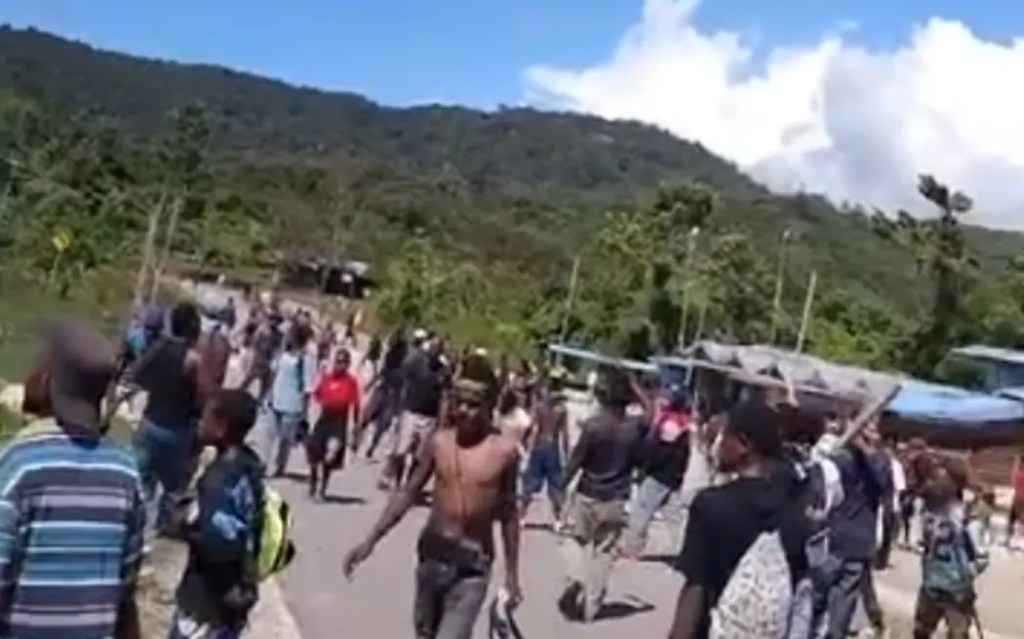
Video footage obtained by human rights researchers shows a crowd of angry Papuans throwing stones towards police infrastructure. The sound of gun shots follows. Photo: Screengrab / Human Rights Monitor
Indonesian authorities say investigations are underway into an incident in West Papua when a number of people were allegedly injured after police fired shots amid a student graduation event.
Reports from West Papua say seven people sustained injuries when tensions flared at a parade by senior high school graduates through the town of Kobakma in Mamberamo Tengah Regency of Papua’s central highlands on Monday (5 May).
The situation reportedly escalated after local people watching the parade, objected to attempts by police officers to stop graduates displaying the West Papuan nationalist Morning Star flag.
Brandishing the flag, or painting school uniforms and personal accessories with a Morning Star symbol, is relatively common across West Papua on graduation day – despite the flag being effectively outlawed by Indonesia.
Video footage obtained by human rights researchers shows a crowd of angry Papuans throwing stones towards police infrastructure. The sound of gun shots follows.
According to Human Rights Monitor, seven West Papuans – including some students – were injured from being shot. The seven were aged between 17 and 24 years old.
Local police said their officers tried to persuade the students not to display the Morning Star, but they were ignored and the situation developed into unrest. Police said that in response they dispersed the crowd using tear gas and fired warning shots into the air.
According to police, a number of people were injured, including police personnel. Security forces, including military, are patrolling the area after the melee briefly descended into rioting and looting at the at Kobakma’s central market.
A spokesperson at the Indonesian Embassy in New Zealand told RNZ Pacific that information it had gathered about the incident indicated the students’ parade had been “infiltrated by another group that provoked to create discord related to an unfortunate incident that happened in the area on the previous day”.
“Local authorities in close relations with civic groups, including church authorities and traditional leaders, are currently trying to conduct a thorough investigation regarding the incident that happens.”
The spokesperson said national and local authorities would focus their efforts to avoid any further “unfortunate similar incidents” happen in the future.
On 20 August 2024, Mr Tobias Silak, a civilian, was fatally shot and Naro Dapla sustained serious gunshot injuries on the Dekai mountain road, Yahukimo Regency, Papua Pegunungan Province. Following a criminal trial, a panel of judges at the Wamena District Court delivered verdicts against four Indonesian police officers involved in the incident in late October 2025. On 2 February 2026, credible information emerged that Second Brigadier Fernando Alexander Aufa, one of the convicted officers, was seen walking freely in Wamena (see videos below, source: independent HRD), raising serious concerns that he may have been released by the Jayawijaya District Police despite a five-year custodial sentence.
A solidarity activist saw ç walking in front oft he Jayawijaya police station, only three months after he had been sentenced to five years imprisonment. Following the encounter, the activist reported the encounter to the Jayawijaya District Police and the Wamena corrective facilty. According to the activist, neither police officers nor correctional officers took action, raising serious impunity concerns.
Background
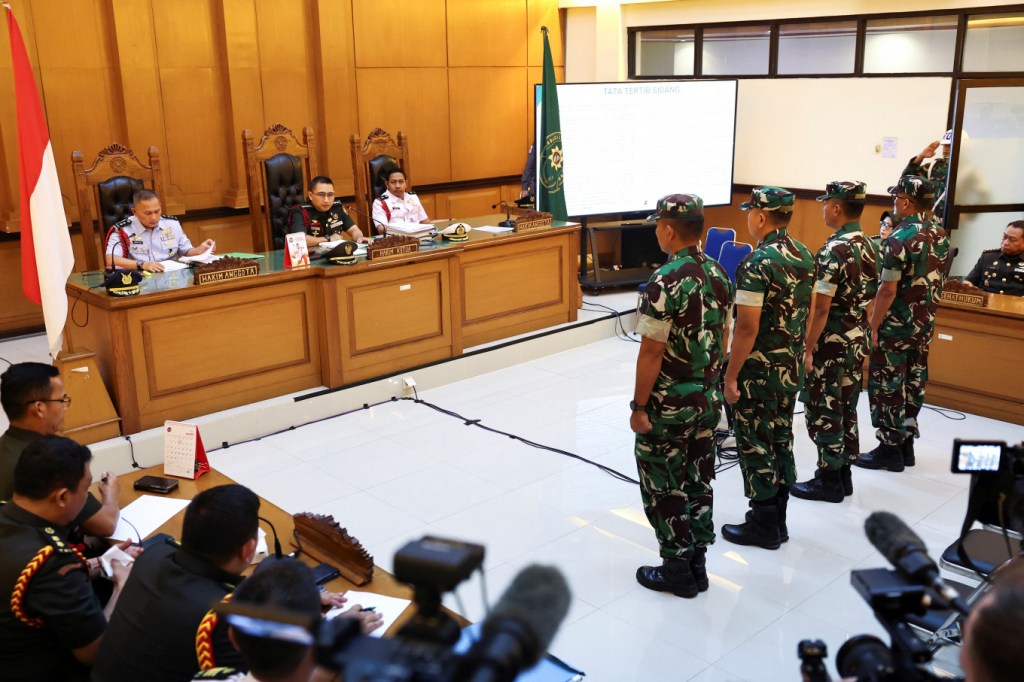
On 28 October 2025, the Court convicted Chief Brigadier Muhammad Kurniawan Kudu (Gorontalo Police Mobile Brigade) under Article 338 of the Indonesian Criminal Code (murder) and sentenced him to 14 years’ imprisonment for shooting an unarmed civilian. Three additional defendants were convicted under Article 360 in conjunction with Article 55 of the Criminal Code and each sentenced to five years’ imprisonment. Evidence before the Court established that eight direct shots were fired at the victim without prior warning.
The victims’ legal team welcomed the sentence but condemned the leniency of sentences relative to the gravity of the crimes. Counsel argued that the evidence demonstrated premeditation, warranting prosecution under Article 340 (premeditated murder), which carries life imprisonment or the death penalty. The families further objected to the classification of the three co-defendants’ conduct as mere negligence, citing courtroom facts indicating coordinated actions and false reporting of a alleged shootout at Pasar Lama to cover-up the crime.
The verdict neither included dismissal from the Indonesian National Police, nor did the Court award restitution, compensation, or rehabilitation to the victims and their families. This is particularly concerning given that domestic law enables such remedies. Moreover, Naro Dapla was a minor at the time of the shooting. The trail also failed to establish command-level accountability, leaving those holding command responsibility free from prosecution.
Second Brigadier Fernando Alexander Aufa fleeing after being caught walking freely in Wamena
14 January 2026 / On 12 December 2025, Indonesian military forces (TNI) conducted a large-scale air and ground military operation against indigenous settlements in Woneworasosa village, Gearek District, Nduga Regency, Papua Pegunungan Province. The operation involved at least six military helicopters, aerial gunfire, and the deployment of mortar-type explosive ordnance in and around civilian homes, gardens, and livestock areas. The attack resulted in the killing of a seven-year-old child, serious injury to an indigenous woman, widespread destruction of civilian property, and the forced displacement of at least 539 civilians.
An investigation by the Papuan Foundation for Justice, Human Integrity (YKKMP) found no evidence of armed confrontation or resistance at the time of the attack. The military operation took place in a populated civilian area and caused severe humanitarian consequences.
On 10 December 2025, residents of Gearek District reported the presence of three military helicopters conducting surveillance flights over indigenous settlements without prior notification, coordination, or explanation. This activity caused widespread fear among the villagers. On 11 December 2025, the military presence escalated. Three helicopters and several drones again flew over Woneworasosa Village. Witnesses reported that helicopters dropped explosive devices near homes to facilitate troop deployment, while additional aircraft fired live ammunition from the air. Mortars reportedly exploded next to civilian houses, prompting panic among residents.
The operation reached its peak on 12 December 2025 at around 05:30 am, when six helicopters attacked from multiple directions. Mortar-type explosives were dropped near homes and gardens, and helicopters fired sustained gunfire onto residential areas. Roofs were perforated by bullets, walls were riddled with impact marks, livestock were shot, and solar panels and household interiors were destroyed (see photos below, source: YKKMP). The attack was carried out without warning and without prior armed hostilities in the area.
As residents attempted to flee, Arestina Giban, a seven-year-old girl (see photo on top, source: YKKMP), was shot in the back of the head while being carried by her mother, Mrs Wina Kerebea, 35. The child died instantly. Mrs Kerebea was injured by shrapnel from a mortar explosion, which became lodged in her right thigh (see photos below, source: YKKMP). Despite sustained gunfire from the air, she attempted to recover her child’s body while shielding her other child, who was reportedly also grazed by a bullet. Mrs Kerebea and her other child survived the attack but had to leave Arestina’s body behind.
Following the attack, residents fled into forests and neighbouring districts, including Pasir Putih and areas of Asmat Regency. Many spent days without food, shelter, or medical care. Military operations reportedly continued until 13 December 2025 at around 10:00 am. Searches for the child’s body between 14 and 16 December 2025 were unsuccessful, raising serious concerns about the enforced disappearance or concealment of remains.
The documented events indicate serious violations of international human rights law and international humanitarian law. The use of aerial bombardment, mortar explosives, and live ammunition in densely populated civilian areas constitutes a breach of the principle of distinction and the principle of proportionality, which prohibit attacks directed at civilians and civilian objects.
The destruction of homes, food sources, livestock, and essential infrastructure, as well as the contamination of gardens by explosive remnants, violated civilians’ rights to adequate housing, food, health, and livelihood. The forced displacement of more than 500 civilians without safety guarantees or humanitarian assistance constitutes arbitrary displacement and exposes vulnerable populations, including women and children, to further harm.
Mrs Wina Kerebea (left) and her seven-year-old daughter Arestina Giban (right)
Photos showing the destruction of the military operation in the Woneworasosa village between 11 and 13 December 2025
Period of incident: 11/12/2025 – 13/12/2025 Perpetrator: , Indonesian Military (TNI) Issues: indigenous peoples, security force violence, women and children
January 9, 2026 in Politics, Law, and Security Reading Time: 3 mins read
0
Author: Larius Kogoya – Editor: Arjuna Pademme
Jayapura, Jubi – Reinhart Kmur, a Legal Aid Volunteer from the Papua Legal Aid Institute (LBH Papua), stated that the formation of three new TNI battalions in three regencies in Papua has the potential to lead to human rights violations.
He stated that this concern arose because the policy for resolving conflicts in Papua has always prioritized a security approach.
According to Reinhart Kmur, based on information gathered by his office, the TNI has officially formed three new battalions in three regencies in Papua: Biak Numfor Regency, Supiori Regency, and Waropen Regency.
He said, these three battalions are new units of the Territorial Development Battalion (TP) which are prepared to carry out duties in Papua in supporting food security, infrastructure development, public health, and economic empowerment to improve welfare and security in Papua.
The presence of these three battalions has the potential to create violence and perpetuate human rights violations in Papua, because the amount of violence [perpetrated by security forces] in Papua is always directly proportional to the continued implementation of a security and armed approach through military operations,” Reinhart Kmur told Jubi in Jayapura, Papua, Thursday (January 8, 2026) via text message.
Reinhart Kmur stated that, using his authority as stipulated in Article 100 of Law Number 39 of 1999 concerning Human Rights, he strongly condemned the addition of three new battalions to Papua Province.
“Adding military personnel to Papua will only lead to human rights violations and add to the long list of human rights violations,” he said.
Kmur stated that the formation of the battalion would make the public fearful of the presence of TNI personnel. The presence of the new battalion would certainly be accompanied by the mobilization of military personnel.
“[This situation] is very dangerous amidst the TNI’s institutional problems, namely its professionalism and human rights violations,” he said.
He stated that the formation of the new battalion under the pretext of supporting food security programs, infrastructure development, economic empowerment, and other issues clearly violates the TNI’s primary duties and functions as stipulated in law.
Previously, the Kankain Karkara Byak Cultural Institute (KKB), along with tribal chiefs (Mananwir Bar Wamurem, Manfasfas Bar Wamurem, and Manfun Kawsa Byak), declared their rejection of the deployment of Indonesian National Armed Forces (TNI) soldiers from Battalion Yonif TP 858, Yonif TP 859, and Yonif TP 860 in the Byak customary territory of Biak Numfor Regency and Supiori Regency, Papua.
This statement was conveyed by the Kankain Karkara Byak Cultural Institute and the tribal chiefs, who claim to represent the entire Byak indigenous community, through the Chairman of the Byak Tribal Customary Council, Apolos Sroyer, to Jubi via telephone on Tuesday (January 6, 2026).
Apolos Sroyer stated that personnel from the 858th, 859th, and 860th Infantry Battalions (TP Yonif TP Yonif TP 858, TP Yonif TP 859, and TP Yonif TP 860) were stationed in Biak Numfor, Supiori Regency, from November 29-30, 2025. The military personnel arrived in Biak aboard a Navy ship.
“The presence of these TNI Battalion personnel surprised the public. Approximately 1,700 personnel from the three battalions were deployed to Biak,” said Apolos Sroyer.
According to Apolos Sroyer, the TNI personnel were divided into several locations. The 858th Infantry Battalion was stationed in the Wamure customary area of East Biak, while the 859th and 860th Infantry Battalions were stationed in Supiori Regency.
“The presence of these TNI personnel is very worrying and has seriously disrupted the activities of indigenous communities in Biak Numfor and Supiori Regencies, which are part of the Byak customary territory,” he said.
He said that, in general, the community was unaware of the deployment of military personnel in these locations. Only certain community members held limited meetings and closed-door meetings with the TNI, then released hundreds of thousands of hectares of land for the construction of TNI posts or headquarters. (*)
Indonesia is clearing forests at a rapid pace with military assistance in one of its most biodiverse regions for a state-backed agricultural project, even as recent fatal floods have illustrated the dangers of deforestation.
Billed as a project to ensure the fourth-most populous nation’s food and energy security, Indonesia is planning to cultivate rice and sugar on 3mn hectares in the eastern province of Papua. The area covers a mix of primary forests, grasslands, woodlands and wetlands.
It will ultimately be five times the size of London and bring irreversible environmental consequences, worsen greenhouse gas emissions and reverse the south-east Asian country’s progress over the past decade in slowing deforestation for palm oil production.
A former general is overseeing the project, and five battalions have been placed in Papua to support the government’s food security initiatives in the province.
Residents and local activists say soldiers are involved in the clearing of forests and eviction of residents, in addition to providing security. Some soldiers have posted videos on TikTok posing with excavators and regular patrols.
Military posts have also been set up near food estate developments, according to the residents and satellite imagery analysed by the Financial Times.
“Since the clearing of the forest, the military has been actively involved,” said Ariston Moiwen, a resident in the South Papua town of Merauke, whose family land has been taken over for rice cultivation. “The military operates the heavy equipment too,” said Ariston, who still lives nearby.
Between May 2024 and November 2025, more than 40,000 hectares of land were cleared, according to an FT analysis of satellite imagery.
While a fraction of the total being razed, the pace has been swift. Most of the land cleared so far is being prepared for sugarcane, which will also be used to produce bioethanol.
“It’s hard to justify this project from any perspective . . . environmental, climate and the wellbeing of local communities,” said Glenn Hurowitz, chief executive of environmental group Mighty Earth.
The so-called food estate project stands in sharp contrast to the climate pledges that President Prabowo Subianto has made to achieve net zero emissions before 2060, and his public comments in the aftermath of floods in recent weeks that claimed more than 1,000 lives in Sumatra.
Environmentalists, scientists and even government officials say the loss of forests for mining and palm oil production and resulting soil degradation on Sumatra island exacerbated the flooding and deadly landslides.
Prabowo vowed action after touring the devastated areas, threatening fines for companies in breach of permits. “Climate change, global warming and environmental damage. These are issues we must confront,” he said. “We must truly prevent the cutting down of trees and the destruction of forests.”
But late last year, he said claims about deforestation should not deter the expansion of palm oil plantations. “I think in the future, we also need to plant more palm oil. Oil palms are trees, right? They have leaves, right? So why are we being accused [of deforestation]?”
The government has already revoked the “forest area” status for hundreds of thousands of hectares in Papua to allow the protected areas to be converted to agricultural development, conceived under former President Joko Widodo.
Natural ecosystems in Papua had previously remained largely intact because of its remoteness and the presence of indigenous communities.
But that is now under threat, with another part of Papua also being developed for contentious nickel mining.
Indonesia is the world’s fifth-largest emitter, based on CO₂ emissions, of about 660mn tonnes from fuel combustion, according to the International Energy Agency.
A government-sanctioned feasibility study dated July 2024, seen by the FT, estimated emissions of 315mn tonnes from the land clearing, but independent groups have forecast more than double that amount.
The study, conducted by Indonesian inspection group Sucofindo, also acknowledges that the rice fields will overlap with protected forests, wildlife sanctuaries and nature reserves. Papua is home to rare birds, tree kangaroos and other endemic species.
It says the development will result in increased temperatures, disruption to water systems and soil degradation. Sucofindo did not respond to a request for comment on its report. Indonesia has said it planned reforestation over 12mn hectares to mitigate possible negative impacts from the food estates.
A former military general, Prabowo has made food and energy security one of his priorities.
But campaigners say Indonesia does not need to sacrifice its nature to expand food production. “The major agricultural industries in Indonesia have shown that it is possible to expand by focusing on productivity improvements and their expansion on degraded lands, instead of bulldozing intact rainforest,” said Hurowitz.
Deforestation in Indonesia for rice terraces develops at rapid pace
The development also involves a massive infrastructure effort: a 135km road, a seaside port and a new airport. About 59km of the road has been completed as of November after construction began in July 2024.
The project is being led by two Indonesian companies. The Jhonlin Group, a coal miner and palm oil producer, is developing the rice fields and ordered 2,000 excavators from China to be used for the Papua project.
The Merauke Sugar Group is leading the sugarcane cultivation. The companies did not respond to requests for comment.
US chocolate maker Hershey has suspended both companies from its suppliers list because of their involvement in the Papua project, according to a grievance log published on its website.
On the evening of 17 July 2025, members of the Indonesian National Armed Forces (TNI) reportedly tortured and executed Mr Obert Mirip, an 18-year-old student, inside the Titigi Military Post, Sugapa District, Intan Jaya Regency, Papua Tengah Province (see photo on top, source: Jubi). The incident occurred after Obert was accused of being a member of the West Papua National Liberation Army (TPNPB) for wearing a shirt displaying the Morning Star Flag and the Papua New Guinea flag. Multiple reports affirm that Mr Mirip was not affiliated with any armed group but was summarily executed in military custody. His body was later returned to his village by order of the local TNI commander, without formal investigation or due process.
According to reports from multiple independent sources, TNI personnel deployed drone surveillance over Ndugusiga Village on 17 July 2025, at approximately 7:00 pm. After identifying Mr Obert Mirip based on his clothing, TNI soldiers reportedly descended from their post, forcibly arrested him at his home, and escorted him to the Titigi military post. That same night, he was allegedly tortured and eventually succumbed to the injuries he sustained as a result of torture. The next day, TNI soldiers informed nearby villagers that a TPNPB member had been shot and demanded that the body be collected for burial. Upon verification, community members confirmed that the deceased was Mr Obert Mirip.
The TPNPB Central Headquarters released a statement according to which Obert Mirip was not associated with the TPNPB and condemned the killing as a deliberate act of intimidation aimed at suppressing civilians. Local civil society actors denounced the TNI’s narrative as disinformation and accused state authorities of violating the civil and political rights of the indigenous population. The dissemination of false claims labeling Mr Obert Mirip as a TPNPB member was widely criticised as a defamatory tactic aimed at justifying unlawful violence against civilians.
Relatives and civil society representatives have called upon Indonesian authorities to conduct an independent, impartial, and transparent investigation into the killing of Mr Obert Mirip and to ensure that all perpetrators, including those with command responsibility, are held accountable. The Indonesian National Human Rights Commission (Komnas HAM) should monitor the situation in Intan Jaya and other conflict areas and timely investigate allegations of grave human rights violations in West Papua.
On the night of 12 July 2025, joint security forces consisting of Navy’s Marine Corps, Police Mobile Brigade (Brimob), and the local police raided the secretariat of the West Papua National Committee (KNPB) in Dekai, Yahukimo Regency, Papua Pegunungan Province, and arbitrarily arrested the four KNPB members, Mr Sinduk Enggalim, Mr Deko Kobak, Mr Hulu Amosoho, and Mr Ronal Kobak. The four activists were subjected to severe physical abuse during and after their arrest, amounting to torture. They were released two days later, on 14 July 2025, in a physically injured state and without charges filed against them.
On 12 July 2025, at 10:35 pm, police forces arrived at the KNPB office in a patrol vehicle and remained parked on the main road for approximately 20 minutes. At 10:55 pm, joint security forces entered the KNPB office compound. Three police officers approached two activists sitting on the veranda, followed by dozens of Brimob and military personnel. Security forces entered the building and started searching the office while devastating the interior. Witnesses reported hearing cries of pain from inside the secretariat.
The four activists were then apprehended, their hands bound behind their backs, their eyes blindfolded with duct tape, and loaded onto a military vehicle. The activists testified they were severely beaten while en route to the Koramil military post, causing two of them to urinate involuntarily. Upon arrival, they were thrown onto the ground and subjected to a six-hour torture session that included burning of skin, electrocutions, beatings with hard objects to the head and body, and being submerged in drums filled with water, in an attempt to force confessions regarding alleged affiliations with the West Papua National Liberation Army (TPNPB). Mr Hulu Amosoho was separated from the group and tortured in isolation.
On 13 July 2025, around 06:00 am, they were transferred to the Yahukimo Police Station, where the torture continued. Police officers reportedly burned their hair and beards. Despite a subsequent visit to the hospital, only minimal treatment was provided following instructions from military personnel. All four were released on 14 July 2025, at 3:00 pm, due to the lack of incriminating evidence.
Legal and human rights analysis
The arrest and detention of the four activists constitute grave violations of international human rights law, including the prohibition of torture under the Convention Against Torture (CAT), to which Indonesia is a party. The arrest was carried out without a warrant, at night, and in the absence of any visible or declared legal basis, violating Article 18 of Indonesia’s own Criminal Procedure Code (KUHAP), which mandates due process safeguards.
Moreover, the involvement of military personnel in civilian law enforcement, particularly in the arbitrary arrest and inhumane treatment of political activists, further constitutes a breach of the principle of civilian supremacy and violates Article 9 of the International Covenant on Civil and Political Rights (ICCPR), which guarantees the right to liberty and security of person.
The prolonged incommunicado detention, denial of access to legal counsel and family members, and the lack of judicial oversight strongly suggest the presence of enforced disappearance-like practices during the initial hours of detention.
The Indonesian government is obliged under international human rights law to launch an independent investigation into acts of torture and arbitrary arrest committed by state agents, ensuring that those responsible will face criminal prosecution. The Indonesian Government should refrain from the use of military personnel in civilian law enforcement roles, particularly against political actors. All victims of arbitrary arrest and torture must receive comprehensive medical treatment, psychosocial support, and reparations, including compensation and rehabilitation in accordance with international standards.
Table of KNPB activists arrested and tortured during police detention in Dekai on 12 July 2025
No
Name
Age
Affiliation
Additional information
1
Sinduk Enggalim
28
Chairman, KNPB Yahukimo
Beaten, could not sit or stand for extended periods
2
Deko Kobak
25
Activist, KNPB Yahukimo
Chin laceration requiring stitches, unable to eat; he was beaten with a blunt object to the face, sustained a cut above the left eye
3
Hulu Amosoho
23
Activist, KNPB Yahukimo
Head and facial injuries required stitches
4
Ronal Hiben Ris Kobak
23
Activist, KNPB Yahukimo
Beaten, suffered from inability to sit or stand for long
Photos showing the physical condition of four KNPB activists after being tortured in Yahukimo
Video testimony by four KNPB activists after being released on 14 July’25
The TNI Headquarters stated that the TPNPB-OPM’s accusations were a way to discredit the TNI and seek world sympathy.
May 16, 2025 | 15.55 WIB
TEMPO.CO, Jakarta – The West Papua National Liberation Army of the Free Papua Movement (TPNPB OPM) accused the Indonesian military of planting a landmine bomb on the body of a TPNPB OPM soldier. Previously, the soldier was killed in a shootout between them and Indonesian military forces.
“The victim’s body was planted with a landmine bomb by the Indonesian government military, but the TPNPB troops did not know about it,” said TPNPB OPM spokesman Sebby Sambom in a written statement on Friday, May 16, 2025.
The mine bomb then exploded right when the evacuation of the bodies was carried out. As a result, two TPNPB OPM members who were helping to evacuate the victims were killed in the incident.
“During the evacuation, the mine bomb that was installed exploded and resulted in two TPNPB members being killed and two other members being injured,” said Sebby.
According to Sebby, the three TPNPB OPM soldiers who died were Gus Kogoya, Notopinus Lawiya, and Kanis Kogoya. Meanwhile, those who suffered minor injuries due to bomb fragments included Tinus Wonda and Dnu-Dnu Seperti.
“The injured are currently at the TPNPB headquarters to undergo medical treatment,” he said.
Previously, armed contact between the TPNPB OPM and the Indonesian military occurred since around 05.00 in the morning on Tuesday, May 13, 2025. Sebby claimed that the armed contact occurred after the Indonesian military launched an operation and shot civilians in Titigi Village, Ndugusiga Village, Jaindapa Village, Sugapa Lama Village, and Zanamba Village.
The Indonesian National Armed Forces Headquarters has dismissed allegations by the West Papua National Liberation Army-Free Papua Movement (TPNPB-OPM) regarding the use of explosives in an operation in Sugapa District, Intan Jaya Regency, Papua, last Wednesday, May 14, 2025.
Head of the TNI Headquarters Information Center, Major General Kristomei Sianturi, said that soldiers from the Habema Task Force did not use explosives or plant mines during the operation.
“That is OPM propaganda to discredit the TNI and seek world sympathy that the TNI is committing human rights violations in Papua,” said Kristomei when contacted on Friday, May 16, 2025. According to him, the TPNPB-OPM’s accusations and negative narratives against the TNI are nothing new. This is because this action is often carried out to attract world attention.
Tempo has tried to confirm this with the Head of the Cartenz 2025 Peace Operation Brigadier General Faizal Ramadhani and the Head of Information for the Cendrawasih XVII Military Command Lieutenant Colonel Candra Kurniawan. However, until this news was written, there had been no response.
Andi Adam Faturahman contributed to the writing of this article