Indonesia’s president-elect, Prabowo Subianto, has form. As the son-in-law of the former dictator, Suharto, he rose quickly through the ranks of the military to become head of the greatly feared Indonesian special forces, Kopassus. To put it bluntly, in 1983 he was involved in one of the biggest massacres in Indonesian-occupied Timor-Leste, in Kraras in the south of the country. His soldiers killed up to 300 men, women and children in the biggest mass killing in Timor-Leste’s 24-year war with Indonesia. He was also involved in the killing of the first president of Timor-Leste, Nicolau Lobato, whose body was taken by Indonesian forces and never recovered.
Prabowo was finally thrown out of the army in 1998 following the detention and disappearances that year of pro-democracy Indonesian activists in Jakarta, who were protesting against Suharto and calling for his overthrow. Thirteen of the activists disappeared and were never seen again, presumed killed by Kopassus troops who were under his command. Prabowo was given a travel ban to the United States, where he had previously trained in counterinsurgency with US special forces at Fort Benning and Fort Bragg, and to Australia. He has always denied his involvement in kidnapping, torture and killings, and has never been charged in relation to any of the allegations against him and his men.
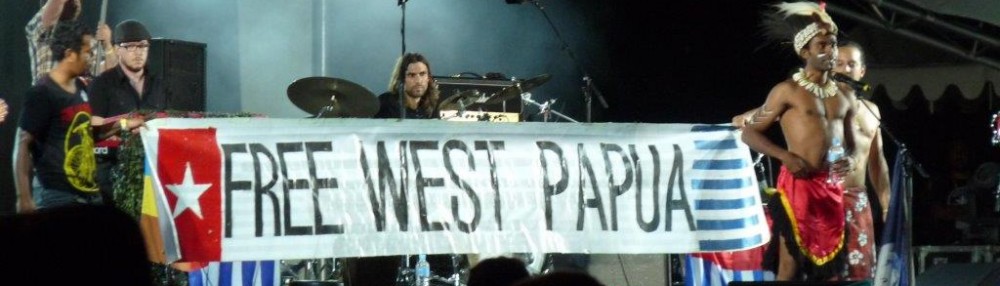
Prabowo orchestrated the strategy of separating those fighting for independence and the population. In Timor-Leste, Aceh and West Papua, troops under his command carried out countless casual human rights abuses.
Coopting former resistance fighters into his own control was one of the lessons he learnt in America and he put it into effect firstly in Timor-Leste. He created auxiliaries called Hansips and later two notorious Indonesian-led but Timorese-staffed battalions, 744 and 745. Both were among the most brutal towards their own people. They killed civilians, students, nuns, priests and journalists, right up until the final Indonesian withdrawal in 1999. Prabowo orchestrated the strategy of separating those fighting for independence and the population. In Timor-Leste, Aceh and West Papua, troops under his command carried out countless casual human rights abuses.
Some acts, such as the prominent killing of West Papuan leader Chief Theys Eluay in 2001, were blamed on his subordinates, who were given brief and sometimes-ignored convictions and jail terms.
Prabowo rose quickly in the military. By the age of 32, he was a major. He was untouchable and powerful. When I spoke to Indonesian human rights workers, student activists, independence supporters, members of Timor-Leste resistance fighters Falintil in the mountains, or their civilian supporters in Fretilin and CNRT, Prabowo’s name always came up.
I remember talking to Munir, an Indonesian human rights leader who had come to Timor-Leste after the fall of Suharto in May 1998 to document the abuses of the Indonesian military there. In August 1998, he told me about Prabowo’s role in recruiting and organising the Indonesian-led and funded militias that were starting to form back then in Timor-Leste. Munir was later killed by a poisoned cup of orange juice on a Garuda flight to Singapore as he tried to flee Indonesia after reporting on Indonesian military abuses in Aceh. Kopassus was blamed.
In many ways August, September and October in 1998 were extraordinary times in Timor-Leste. The Indonesian military, unsure if it was allowed to shoot demonstrators as it used to under Suharto, stood aside as Timorese students mounted louder and more heavily attended rallies in the capital Dili and in regional centres such as Manatuto and Baucau.
The lid was off and they came in their thousands, chanting, singing and waving pro-independence flags. Apart from the occasional killing, the Indonesian military seemed to tolerate the speeches and calls for independence, but they were always there watching, taking photos and video, identifying those who spoke out. They always had guns and you never knew if that day was the day they would start shooting.
As the protests continued, I joined the students on a trip to Lacluta in the remote south-east of the island. The trip down there felt like a day off – sitting in an open-backed truck. The group sitting on the roof would sing the solo verse and the others the chorus. The villagers couldn’t believe their defiance. We got to Viqueque.
There had been trouble in the area: houses burnt, a few men killed by a new group of Indonesian soldiers. When we arrived for the rally the next day it was mostly the students from Dili and a few old people. Horrible things had happened in this area. On August 8, 1983, Indonesian soldiers from Battalion 501, who later trained in Australia, entered the town of Kraras and began rounding up the men. They killed them all in a group and threw their bodies in a swamp. They killed the children by swinging them against walls or stabbing them with knives. There had been 3000 people living in this village and only about 1300 escaped. The killings in that area went on until September.
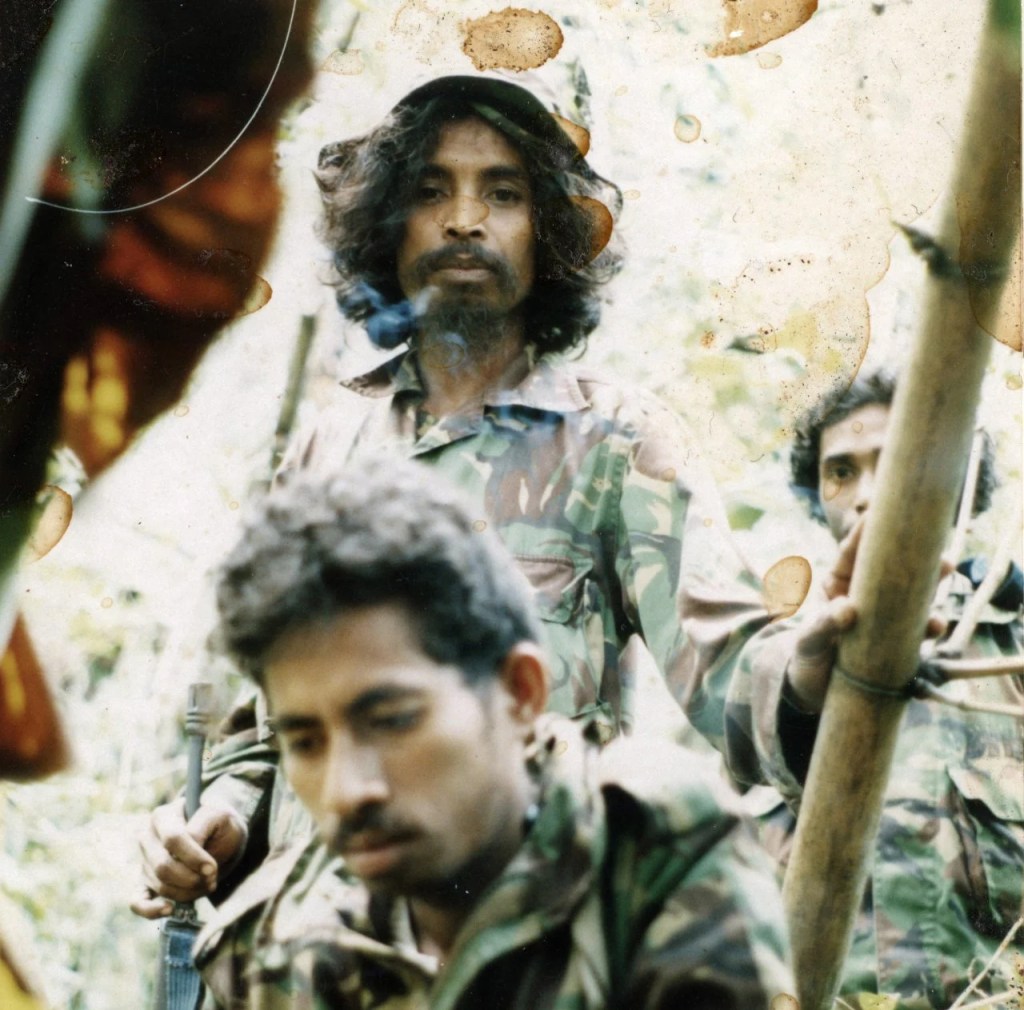
Later, when the militia violence was in full swing, I went up into the mountains to interview the Falintil commander Falur Rate Laek. Things had cracked down and it involved lots of planning. There was a long drive and a long mountain walk in monsoonal rain, trying to be quiet to avoid Indonesian military patrols. It was hard and nerve-racking. In this sparse mountain camp of tarps with bush thrown over the top, the guerillas spoke in whispers. I had done this before and knew what to expect. The threat of being captured with them was ever-present. They were taking a risk to speak and I was taking a risk going up there.
Ostensibly I was there to interview Falur Rate Laek about the recent killings in the village of Alas. The Indonesian soldiers and militia had killed at least 50 men the previous November. I had walked there too and been run out of town by armed Indonesians troops and militia, who shot at me and my guide as we scrambled up the muddy hill to get out of that place.
I got Falur’s version of the killings, which his men had witnessed. After endless coffee and cigarettes in the night, our talk turned to Prabowo. I knew Falur had once been in the Indonesian army and had deserted back to Falintil. I asked him why. He told me he had been forced to join the Indonesian military in 1980 and deserted in 1983. He told me it was because of what he had seen in Kraras.
He wanted to talk and, with the rain pelting down on the branch-covered tarp, he spoke in a low voice. He told me he had never talked to a Western journalist about this before.
He told me he was forced to witness the killing of his own people in Kraras in 1983 – when the entire male population, including children, were killed by the Indonesian military. After that, he rejoined the guerillas in the bush. He told me the troops who carried out the killings were under the command of then Captain Prabowo Subianto, who was head of Koppasandha, later to become Kopassus, in the district at the time. Prabowo may not have been there on the day – but it was his men who carried out the killings.
Prabowo is now president-elect of Indonesia. Lieutenant General Falur Rate Laek is now commander of the Timor-Leste Defence Force.
John Martinkus first wrote for The Saturday Paper in October 2015.
This article was first published in the print edition of The Saturday Paper on March 2, 2024 as “Chasing Prabowo in Timor-Leste”.

 Australia West Papua Association Adelaide