
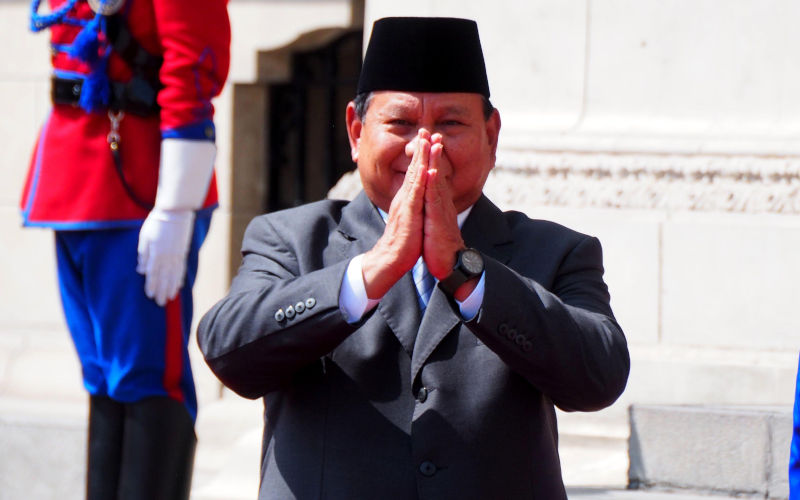
Indonesia remembers the coming of democracy, 27 years later

2YJG244 Lima, Peru. 14th Nov, 2024. Prabowo Subianto, President of the Republic of Indonesia, on an official visit to Peru. This visit, within the framework of the APEC Peru 2024 Economic Leaders Week (AELW), consists of a meeting between the Heads of State, of a protocolary nature with the signing of bilateral instruments. Credit: Fotoholica Press Agency/Alamy Live News

The shadow of Soeharto’s past now seems to loom over the nation, threatening the civilian supremacy we fought so hard to establish.

Last Wednesday marked the 27th anniversary of a pivotal moment in Indonesian history. On 21 May 1998, the nation demonstrated its collective power by forcing Soeharto to end his 32-year authoritarian rule.

This milestone achievement, which The Jakarta Post recorded in its memorable headline “I QUIT”, paved the way for Indonesia to become the world’s third-largest democracy in less than a decade. However, the shadow of Soeharto’s past now seems to loom over the nation, threatening the civilian supremacy we fought so hard to establish.

Just one year after Soeharto’s fall from grace, Indonesia surprised the world with its first democratic elections, which were held in a free and peaceful manner. This commitment to democracy deepened in 2004 with the adoption of direct presidential elections, followed a year later by direct regional head elections.

Indonesia stands as a remarkable example, likely the only predominantly Muslim nation that has consistently proven Islam’s compatibility with even the most sophisticated democratic systems. In many other Islamic nations, democracy remains fragile or is even suppressed in the name of religion.

Indonesia now confronts the danger of a complete reversal in its democratic trajectory. While in 1998, the military was largely seen as the primary cause of political and economic instability, a growing number of civilians now view the Indonesian Military (TNI) as a potential saviour amid rising frustration with civilian governments at both central and regional levels.

However, the public must remember that any return of the military to public life should be for limited and ad hoc purposes. We must acknowledge that Indonesia’s largely Army-centric military currently faces no significant external security or defence threats. As an archipelagic nation, the Navy and Air Force should naturally play more strategic roles.

It is unrealistic to expect the military to simply remain in their barracks when they have little to do. So, what is a solution that upholds the strict principle of civilian supremacy while being acceptable to all?

The public is increasingly weary of seemingly rampant abuses of power by state officials and political elites. They are also fed up with the corrupt and abusive behaviour of the police. Consequently, many desire the military to step out of the barracks and reengage in social-political affairs.

President Prabowo Subianto, a former son-in-law of Soeharto, has repeatedly pledged to strictly abide by the Constitution, including upholding democracy. We trust the president’s commitment, and we believe his government will be stable, given that his ruling coalition controls more than 80% of the House of Representatives.

The end of Soeharto’s regime remains an unforgettable event for Prabowo, as just three months after the former’s resignation, Prabowo himself was dismissed from the military. Furthermore, Prabowo has often been linked to atrocities, including the abduction of government critics, although his case was never brought to justice.

The sweeping reforms removed the military’s privileges, recognising that Soeharto had used the institution to cling to power. In 2004, the House of Representatives passed the TNI Law, primarily outlining its duties for external security and defence, with tight restrictions on military personnel holding civilian positions.

However, in February this year, the House endorsed a revision of this law that allows the military to reclaim some of its old power. The government insists that the revised TNI Law only focuses on three main issues: expanding military operations other than war, increasing civilian posts that can be held by active TNI personnel and changing soldiers’ mandatory retirement age. This assurance, however, has not been enough to quell public scepticism.

After nearly three decades, there are convincing signs of the state’s temptation to revert to the Soeharto era, when stability was the currency. The election of Prabowo, in particular, has clearly become a significant moment for the military to potentially regain lucrative power in social-political affairs.

Twenty-seven years ago, Soeharto stepped down after nationwide protests. May the day serve as a clarion call to the nation, reminding us all that we must never abandon the vibrant tapestry of democracy which was woven with our blood and tears.

Republished from The Jakarta Post, 21 May 2025

The views expressed in this article may or may not reflect those of Pearls and Irritations.

Release four Papuan political activists in Sorong who were arrested on charges of treason

Responding to the arrest and determination of suspects in a treason case against four political activists who are members of the Federal Republic of West Papua (NFRPB) by the Police in Sorong City and the loss of civilian lives in armed violence in Intan Jaya, Deputy Director of Amnesty International Indonesia, Wirya Adiwena, said:

“The criminalization of the four Papuan political activists shows that the state continues to repress the rights to freedom of expression, opinion and assembly of indigenous Papuans. They were arrested only for peacefully conveying their political aspirations by visiting the West Papua government offices without using violence.

Peaceful expression is guaranteed by the Constitution and is not a criminal act. Peaceful political aspirations are also not hate speech as alleged by the police. Law enforcement officers are also again using accusations of treason to silence the political expression of Papuans, even though they should understand that such expression is part of human rights protected by Article 28E of the 1945 Constitution.

The police in Sorong City must immediately release the four people unconditionally. Every citizen, including indigenous Papuans, must not be criminalized just for expressing opinions or making legitimate political demands, including voicing disappointment with the state regarding the conflict in their region.

Not only that, we also condemn the loss of life and injuries to civilians, as well as hundreds of people displaced, after the operation carried out by security forces in Intan Jaya on May 13, 2025. There must be a thorough investigation into the loss of civilian lives in the incident. Likewise, there must be a sharp reflection on the placement of security forces in Papua which has so far resulted in casualties, both indigenous Papuans, non-Papuans, including the security forces themselves.”

Background

The Chief of the Sorong City Police, Southwest Papua, on May 5 announced the arrest and determination of suspects in a treason case against four people with the initials AGG, PR, MS, and NM. They are known as administrators of the Federal State of the Republic of West Papua (NFRPB).

Media reports said the suspects allegedly visited the Sorong Mayor’s Office, the West Papua Governor’s Office, the West Papua Papua People’s Assembly (MRP) Office, the West Papua Police’s Water Police Directorate, and the Sorong City Police on April 14 to deliver a letter from the NRFPB president regarding an invitation to peace talks. During the visit, they also allegedly called for ‘Papua independence.’

The police have also questioned five witnesses and secured 18 documents related to the NFRPB organization, including uniforms resembling police and military attributes, as well as the organization’s membership identification.

The four suspects were charged with treason and hate speech articles, namely Article 106 of the Criminal Code in conjunction with Article 187 of the Criminal Code in conjunction with Article 53 paragraph (1) of the Criminal Code and/or Article 45 Letter A paragraph (2) in conjunction with Article 28 paragraph (2) of Law of the Republic of Indonesia Number 1 of 2024 concerning the Second Amendment to Law Number 11 of 2024 concerning Information and Electronic Transactions in conjunction with Article 55 paragraph (1) to 1 and/or in conjunction with Article 56 paragraph (1) to 1 of the Criminal Code. For these articles, the suspects face a sentence of 20 years in prison or even life imprisonment.

Meanwhile, regarding the latest violence in Papua, the Communion of Churches in Indonesia (PGI) received a report from the Kemah Injil Church that a military operation had taken place in the early hours of Tuesday, May 13, 2025, in three villages in Intan Jaya Regency, Central Papua. The military operation is said to have targeted civilian settlements and resulted in fatalities and injuries among residents.

At least three civilians were reported to have died. In addition, a seven-year-old child and an adult woman suffered injuries from shrapnel. Then as many as 950 congregation members from 13 churches were reported to have fled shortly after the shooting.

Amnesty International does not take any position on the political status of any province in Indonesia, including their calls for independence. However, in our opinion, freedom of expression includes the right to peacefully express one’s political views or solutions.

—————————-

TPNPB-OPM Accuses Indonesian Military of Planting Mine Bombs on Corpses of Its Members

The TNI Headquarters stated that the TPNPB-OPM’s accusations were a way to discredit the TNI and seek world sympathy.

May 16, 2025 | 15.55 WIB

TEMPO.CO, Jakarta – The West Papua National Liberation Army of the Free Papua Movement (TPNPB OPM) accused the Indonesian military of planting a landmine bomb on the body of a TPNPB OPM soldier. Previously, the soldier was killed in a shootout between them and Indonesian military forces.

“The victim’s body was planted with a landmine bomb by the Indonesian government military, but the TPNPB troops did not know about it,” said TPNPB OPM spokesman Sebby Sambom in a written statement on Friday, May 16, 2025.

The mine bomb then exploded right when the evacuation of the bodies was carried out. As a result, two TPNPB OPM members who were helping to evacuate the victims were killed in the incident.

“During the evacuation, the mine bomb that was installed exploded and resulted in two TPNPB members being killed and two other members being injured,” said Sebby.

According to Sebby, the three TPNPB OPM soldiers who died were Gus Kogoya, Notopinus Lawiya, and Kanis Kogoya. Meanwhile, those who suffered minor injuries due to bomb fragments included Tinus Wonda and Dnu-Dnu Seperti.

“The injured are currently at the TPNPB headquarters to undergo medical treatment,” he said.

Previously, armed contact between the TPNPB OPM and the Indonesian military occurred since around 05.00 in the morning on Tuesday, May 13, 2025. Sebby claimed that the armed contact occurred after the Indonesian military launched an operation and shot civilians in Titigi Village, Ndugusiga Village, Jaindapa Village, Sugapa Lama Village, and Zanamba Village.

The Indonesian National Armed Forces Headquarters has dismissed allegations by the West Papua National Liberation Army-Free Papua Movement (TPNPB-OPM) regarding the use of explosives in an operation in Sugapa District, Intan Jaya Regency, Papua, last Wednesday, May 14, 2025.

Head of the TNI Headquarters Information Center, Major General Kristomei Sianturi, said that soldiers from the Habema Task Force did not use explosives or plant mines during the operation.

“That is OPM propaganda to discredit the TNI and seek world sympathy that the TNI is committing human rights violations in Papua,” said Kristomei when contacted on Friday, May 16, 2025. According to him, the TPNPB-OPM’s accusations and negative narratives against the TNI are nothing new. This is because this action is often carried out to attract world attention.

Tempo has tried to confirm this with the Head of the Cartenz 2025 Peace Operation Brigadier General Faizal Ramadhani and the Head of Information for the Cendrawasih XVII Military Command Lieutenant Colonel Candra Kurniawan. However, until this news was written, there had been no response.

Andi Adam Faturahman contributed to the writing of this article

Don’t stir Semar – He seeks harmony 

https://johnmenadue.com/post/2025/05/dont-stir-semar-he-seeks-harmony/

Ancient Javanese mythology, often inherited from India and adapted to fit local culture, is rich with striking characters in the wayang kulit shadow puppet theatre. The fat-gut wise clown Semar is charged with maintaining stability.Shadow Puppet of Semar. Contributor: YA/BOT / Alamy Stock Photo Image ID: 2HWMM88

This mirrors Anthony Albanese’s zip-in-and-out visit to Jakarta. The prime minister came with the doctrine, made famous by Paul Keating in 1994, to tell President Prabowo Subianto that “there is no country more important to Australia than Indonesia”.  

Keating may have thought it true – the electorate knows it’s not.

Albanese is being polite by meeting Prabowo and getting a hotel visit that was “warm”. Government PR has a limited temperature range for such events. There was much flag waving by the hire-a-parade service – but that’s a standard Jakarta welcome for VIPs.

Here’s the cold front that Albanese hasn’t addressed: In 2023 the Lowy Institute asked: Do Australians and Indonesians trust each other?

“Australian attitudes towards Indonesia have been — at best — lukewarm. And at worst, they betray a lurking suspicion.

“Only 12% of Australians nominated Indonesia as Australia’s ‘best friend in Asia’ – fewer than Japan, India and Singapore.”

If Albanese and the Department of Foreign Affairs and Trade have read the Lowy surveys, there’s little sign they’re clearing out the threadbare cliches for an Op Shop. Melbourne Uni Prof Tim Lindsey has written:

“Indonesia and Australia have almost nothing in common other than the accident of geographic proximity. This makes their relationship turbulent, volatile and often unpredictable.”

With this talkfest, all was predictable. Much of the reporting reads as though it’s been assembled using AI – such is the lack of mainstream media expertise in the region.

Security, trade and defence were the leads, though there were few proposals to effect change. The Indonesia-Australia Comprehensive Economic Partnership Agreement is a bipartisan deal signed in 2020 after 10 years of negotiation.

It was supposed to improve two-way trade. Apart from adding university outposts, it’s failed to meet diversity goals, remaining a dealer in bulk – mainly meat and grains, heading from us to them. Albanese urged Oz Biz to show greater ambition, but the big problem is in Indonesia.

Explained The Jakarta Post: “Indonesia’s ambition to attract world-class investment is being quietly sabotaged, not by interest rates or the threat of US trade tariffs, but by the familiar menace of thuggery and extortion.

“From street-level rackets to entrenched mafia control of parking, freight and food markets, criminal coercion continues to drain business confidence, inflate costs and corrode the very rule of law that investors depend on.”

Now add numbers – 11 of them to one of us. Stir in the Red Threat – phantom Russian bombers scouting for a base in West Papua leading to nuclear strikes on Kirribilli. This beat-up was refuelled at the leaders’ media conference, though the hollow story has long been trashed by Jakarta.

The chance to raise serious issues in the relationship was missed. That was wrong. Likewise, the whitewashing of Prabowo, 73. To be informed world citizens, Australians need to know more of the ruler next door.

He now gets benign labels like “retired general” or “former army general and defence minister”. The full story is that in 1998, he was cashiered, fled into exile in Jordan and banned from the US and Australia for alleged human rights abuses and war crimes.

He denies the charges, which come from putting down dissident movements in East Timor and West Papua, and the kidnapping and disappearance of Jakarta students protesting for democracy in 1998. The BBC described him as “tainted”.

Through his recorded statements, the man comes across as a bombastic autocrat and a bit loony. Like Trump, he inflates nonsense: “In other countries they have made studies where the Republic of Indonesia has been declared no more in 2030.”

The source turned out to be the US Sci Fi novel Ghost Fleet.

Leaders can’t select neighbours. Had Albanese washed his shaken hands, all diplomacy would have gone down the gurgler with the blood.

Our Catholic prime minister would have missed the kiddy flag wavers and dashed for Rome ahead of the inaugural Papal mass.

He reportedly plans to ask the new pontiff to visit Australia in 2028 – an invite not offered to the divorced Prabowo.

DFAT knows he wouldn’t be cheered like his predecessor Joko “Jokowi” Widodo. He and his wife Iriana were hosted by Malcolm Turnbull in 2017 and enjoyed jolly blusukan – impromptu public walkabouts.

People-to-people ties are a key – but there’s little chance of that until we stop discriminating against Indonesians.

Malaysians and Singaporeans get free Electronic Travel Authority visas online – a facility not available to Indonesians who have to pay $195 per person and lodge a printed form. That could be changed at the admin level, and be a useful present for Albanese to offer.

Another would be the so-called Backpacker (Working Holiday) Visas. There are almost 5000 available to Indonesians but the quota isn’t full, probably because the rules — which include having $5000, a big sum for many applicants — are onerous.

There are no caps on the numbers of British passport holders.

Making it easier for young Indonesians to travel and earn would help lift cultural knowledge – and could be done without recourse to Parliament or arousing the Murdoch media.

Only one politician’s comment moved the dial from discussion to detail. David Shoebridge raised the plight of Hazara refugees stuck in Indonesia when Kevin Rudd struck the 1 July 2013 cut-off date for asylum-seekers.

Said the Greens Senator: “Labor previously opposed this policy because of its unfairness, but did nothing about it during the last Parliament; now is the time.”

The Hazara are not economic refugees and few are failed boat people; they are escapees from Sunni Taliban persecution largely because they are Shi’a Muslims. Many helped Australian troops as interpreters and guides during our 2001-2021 involvement in the war against the Taliban.

Prabowo and most Muslims next door are Sunni. In loose detention, the Shi’a are barely tolerated and unwelcome.

There are about 42,000 Hazara in Australia and about 7600 stranded in Indonesia – a state that hasn’t signed the 1951 UN Refugee Convention.

In the wayang shadow theatre, Semar often takes a more realistic view of the world as opposed to the idealistic. Just the guy to help improve the talks of two leaders from cultures far apart.

Duncan Graham

 Duncan Graham has been a journalist for more than 40 years in print, radio and TV. He is the author of People Next Door (UWA Press). He is now writing for the English language media in Indonesia from within Indonesia. Duncan Graham has an MPhil degree, a Walkley Award, two Human Rights Commission awards and other prizes for his radio, TV and print journalism in Australia. He lives in East Java. ————————————————————

Indigenous Papuans look to the new pope with hopes

 By Ryan Dagur, 16 May 2025

Pope Francis did not visit the Christian-majority region of Papua during his Asia tour last September; however, his concerns and gestures regarding the plight of Papuans have provided them with a renewed perspective on the Church.

The first Jesuit and the first Latin American pope, during his 12-year papacy, achieved something that no other pope has done for the Papuans, the Christian-majority indigenous people of the western half of New Guinea Island, which is part of Indonesia.

Pope Francis became popular among Papuans as they began to see him as a champion for the cause of poor, marginalized, and oppressed people like them worldwide. They expect the next pope to follow in his footsteps.

Papuans expect the next pope to build on Pope Francis’ two actions, which have left an indelible mark on their conflict-torn region, regarded as the most underdeveloped part of Indonesia.

In a historic first, Francis appointed two native Papuan priests as bishops — Yanuarius Teofilus Matopai You of Jayapura in 2022 and Bernardus Bofitwos Baru of Timika — just two months before his death.

The appointments followed years of demand for native bishops in the region, where the Catholic faith arrived more than a century ago.

The demand has grown louder in recent years, as many Papuan Catholics feel that their bishops from other parts of Indonesia, and even the Vatican, do not care enough about their aspirations, plight, and challenges.

Most Indonesian bishops assigned to Papua have remained silent about human rights violations and social injustices in light of the Indonesian government’s apparent disregard for Papuans’ rights.

The violations are linked to the government’s efforts to suppress the Free Papua Movement, which has persisted in the region since the 1960s and advocates for self-determination.

Baru, a leading rights activist advocating for an end to violence between security forces and armed rebels in Papua, is scheduled to be ordained as bishop on May 15.

The Papuans felt abandoned as the local Church hierarchy, based in the Indonesian capital, consistently aligned with the government.

“The official stance of the Catholic Church on the Papua issue is very clear, namely to support the government’s stance, because it is guaranteed by international law,” the hierarchy’s de facto head, Cardinal Ignatius Suharyo Hardjoatmodjo of Jakarta, said once.

A recent example is Archbishop Petrus Canisius Mandagi of Merauke supporting the controversial state-backed food projects in southern Papua, despite the Papuans’ rejection of the initiative. The projects reportedly aim to seize land from Indigenous people, including members of the archdiocese.

Francis’ visit to Asia last September marked a second defining moment for Papuans and offers lessons for the Indonesian hierarchy and the heads of the Vatican bureaus.

Many Papuans believe that Francis expressed his love for the indigenous people by visiting Vanimo in Papua New Guinea, just across the border from Indonesian Papua. This visit enabled many Papuans to cross the border to see the pope.

Francis’ visit to Indonesia did not include a stopover in Papua or even mention Papua, apparently due to the insistence of Indonesian bishops, who did not want to upset the government.

Papuans who could not afford the flight to Jakarta to see the pope found Vanimo to be the closest place where they could meet him. He chose Vanimo to feel the pulse of the Papuans.

He also did not upset the Muslim-majority Indonesia, where he was widely popular for fostering Christian-Muslim harmony, a hallmark of his pontificate.

Francis proved that church leaders can find ways to understand and communicate with their marginalized communities, even if exploitative systems attempt to block them.

The tragedy is that Indonesian bishops remain confined within their narrow nationalistic views, which prevent them from recognizing Papuans as equal individuals and Christians deserving of dignity and rights.

The Papuan Church, which has long been dominated by Indonesian clergy, has done little to protest the state’s exploitation of this resource-rich region’s forests and minerals, disregarding the fundamental rights of Papuans to live on their land.

Just as Francis stood for the rights and dignity of the poor and oppressed, the new leader of the Church has a responsibility to confront the timidity of the Indonesian hierarchy, who believe that supporting the oppressed would make them targets of the state.

The Vatican must also support the two native Papuan bishops in representing their Papuan Catholics without permitting them to be overshadowed by the other 36 non-Papuan bishops in the country.

With thanks to Union of Catholic Asian (UCA) News and Ryan Dagur, where this article originally appeared.

Fiji rights coalition slams ‘betrayal’ of West Papua for Indonesian benefits

By APR editor – 

May 17, 2025

By Anish Chand in Suva

The NGO Coalition on Human Rights in Fiji . . . campaigning also against colonisation and for justice in Kanaky, Palestine and West Papua. Image: FWCC/File

Prime Minister Sitiveni Rabuka and Fiji’s coalition government are “detached from the values that Fijians hold dear”, says the NGO Coalition on Human Rights in Fiji (NGOCHR).

The rights coalition has expressed deep concern over Rabuka’s ongoing engagements with Indonesia.

“History will judge how we respond as Fijians to this moment. We must not stay silent when Pacific people are being occupied and killed,” said NGOCHR chair Shamima Ali.

“Is Fiji’s continuing silence on West Papua yet another example of being muzzled by purse strings?”

“As members of the Melanesian and Pacific family, bound by shared ancestry and identity, the acceptance of financial and any other benefit from Indonesia—while remaining silent on the plight of West Papua—is a betrayal of our family member and of regional solidarity.”

“True leadership must be rooted in solidarity, justice, and accountability,” Ali said.

“It is imperative that Pacific leaders not only advocate for peace and cooperation in the region but also continue to hold Indonesia to account on ongoing human rights violations in West Papua.”

Republished from The Fiji Times with permission.