Unknown's avatar

About AWPA Adelaide administrator

AWPA Adelaide site manager

Understanding the Caledonian crisis

On Friday June 7, 2024, several hundred people demonstrated in front of the French Embassy in Vanuatu regarding the situation in New Caledonia. France understands and respects the legitimate concerns of the people of Vanuatu regarding the situation in New Caledonia. In this article, I would like to respond to the demands expressed in the petition that the president of the Malvatumauri, who led the march, submitted to us on June 7.

Firstly, decolonisation cannot be reduced to independence. As the relevant resolutions of the United Nations Organisation (UN) (res. 1541 and 2625) remind us, decolonisation is first and foremost self-determination: it means letting the people choose what they prefer, and this can be the creation of an independent state, integration with an independent state, free association or any other formula chosen by the people. They alone must decide what they wish to do with their future.

And this is precisely what the French State has been accompanying in New Caledonia for the past 36 years: securing a process of self-determination, the organisation and the conduct of which have been commended by the United Nations Decolonisation Committee called C24, and two auditing reports.

In 1998, the Nouméa Accord – negotiated between pro and anti-independence parties – provided for a high degree of autonomy for New Caledonia, with gradual and irreversible transfers of powers to establish shared sovereignty. The Accord was adopted by popular consultation in New Caledonia with 72 % of positive votes. As provided for by the Accord, the State organised up to three self-determination referendums, if the previous ones had not resulted in a pro-independence vote.

The process provided voters with repeated occasions to cast their ballots, and political stakeholders to act (the local Congress was the one responsible to call for the organisation of the 2nd and 3rd referendums). Repeatedly, a majority of New Caledonians on a special electoral roll opposed independence: 56.67% of voters in 2018 (with a 81.01% turnout), 53.26% in 2020 (with a 85.69% turnout), and 96.50% in 2021 (with a 43.87% turnout). Votes were organised in the presence of the United Nations.

In accordance with democratic principles and the constant will of the people, who have been consulted three times since 2018, and who have therefore been able to exercise their right to self-determination, New Caledonia remains part of France.

Today, as a result of the decolonisation process engaged in 1988, New-Caledonia enjoys a high degree of autonomy, with the local Government and the provinces having all powers except those of a sovereign nature (defense, security, currency, for instance) and those they have not asked to be transferred (rules governing the administration of local authorities, higher education and research, audiovisual communication).

Secondly, what can one say to those who claim that the process described above is invalid because the last referendum was partially boycotted? Boycotting the referendum was the choice of the independentist parties, but it does not invalidate the referendum.

The legitimacy of this vote has not been called into question by the UN and the independentist parties participated to the general elections organised right after.

Thirdly, what can one say to those who believe that the process described above is invalid because only the Kanaks should have taken part, as the only legitimate people? That the 1998 Nouméa Accord – which was signed by all stakeholders, including the pro-independence parties – establishes the existence of a dual legitimacy: not only that of the Kanak people as the first occupants, whose identity and cultural heritage have been recognised and promoted, but also that of other communities “who live in the territory [and] have acquired, through their participation in the building of New Caledonia, a legitimacy to live there and to continue to contribute to its development. They are essential to its social equilibrium and to the functioning of its economy and social institutions”. This is an important point: it means that, together with the Kanaks (41.2% of the population according to the 2019 census), not only Europeans (24%), but also Wallisians and Futunans (8.3%) and many other communities (Tahitians, Indonesians, Ni-Vanuatu, Vietnamese, Chinese, etc. accounting together for 8%) have made Caledonia what it is today.The Nouméa Accord also presents decolonisation as an objective consisting in founding “a new sovereignty, shared in a common destiny”. Common, that is, for all the above-mentioned populations, together.

And that’s only fair, because a New-Caledonian, who has always lived and worked there and contributed to New Caledonia’s development, is fully part of this community, no matter the origins of his or her ancestors.

Fourthly, with regard to discrimination, there are indeed discrepancies, particularly in terms of standard of living, access to employment and education. This is a statistically documented fact, and the State has long been taking steps to correct it, notably through the redistribution of tax revenues between provinces; executive training (for which the state has provided 90% of the 6 million euros in annual funding since 1998); a mining and metallurgy policy (contrary to popular belief, the French state has no jurisdiction over the extraction, processing or export of nickel; these powers have all been transferred to local authorities; but it is the State that is absorbing the losses of the New Caledonian mining industry: since 2016, it has paid out more than 700 million euros in aid to the nickel industry); financial aid for business start-ups; a land policy that has considerably increased the surface area of Kanak land; and the defense and promotion of Kanak culture, as demonstrated by the use of local Kanak languages in the education system or the creation of the Tjibaou Cultural Center, which today remains the territory’s leading cultural institution.

These measures have produced results – the GDP/capita gap has narrowed and a Kanak middle and higher classes have developed – but unbalances remain, as President Macron acknowledged on May 24: “rebalancing has not reduced economic and social inequalities, they have even increased”. While major progress was achieved when it comes to economic and social progress or access to public service, we need to do better. One must note, however, that this public policy issue is not unique to New Caledonia.

In any case, fires, looting, blockades and violence will not solve the problem. On the contrary, by reducing several decades of economic development to ashes, they have undermined the social and economic rebalancing efforts made in favor of the Kanak populations, and destroyed thousands of jobs.

Fifthly, the petition calls for “the immediate cessation of military operations” and “the withdrawal of troops”. I must state clearly that there are no military operations in New Caledonia: there are law enforcement operations by internal security forces (police and gendarmerie), to protect the population and public infrastructure, strictly respecting the principle of proportionate use of force. The rioters are armed and have robbed several gun shops. Their roadblocks paralysed certain neighborhoods and cut off access to the international airport.

Some inhabitants were short of food and medicines and no longer had access to medical care. More than nine hundred businesses have been destroyed or vandalised, thousands of jobs have been lost and the damages are estimated at over a billion euros. Law offenders are being dealt with by independent courts following due legal process, therefore there is no reason to call for “international independent investigations”. Had the State – whose primary responsibility is to protect the population – not rapidly deployed reinforcements, there would have been many more victims, and the socio-economic damage would have been even greater with more lasting effects.

In conclusion, we must be careful not to ethnicise the events in New Caledonia. Many articles, commentaries and fake news portraying the riots as one community against another just simplify and distort reality. Since 1988 and the first Matignon-Oudinot agreements, followed by the Nouméa agreement in 1998, a continuous dialogue has been carried out leading to the setup of new institutions, the transfer of meaningful power to local governing bodies, the acknowledgement of the Kanak identity and promotion of Kanak culture, and to policies dedicated to the social and economic rebalancing.

Our priority is now to resume dialogue as the political path remains to be invented to continue building this “common destiny” in a more inclusive and peaceful way. France will continue to work in the coming months with regional partners including Vanuatu, the Melanesian Spearhead Group, and the Pacific Islands Forum, in order to achieve this dialogue essential to the future of New Caledonia.

news@dailypost.vu

What ye sow ye reap

Dani tribe Warriors. May 15, 2012 The Baliem Valley, Indonesian, New Guinea

There’s nothing profound about the Biblical quote; variations are embedded in many religions and cultures.

So it needs no prophet, seer or conman to make this prediction: After a war like the current one in Gaza has cooled, the survivors will be bent on revenge.

The ancient tragedy is underway just next door in Papua, bleeding now and for years to come as the hate goes on.

Canberra expresses its horror at the Middle East conflict 14,000 km distant and calls for peace, but looks away from what’s happening in the neighbourhood just 250 km to the north.

Last year the late NZ journalist John McBeth reported that Papua independence leader Egianus Kogoya’s determination to fight for freedom started after his father, Daniel Yudas Kagoya was killed by Indonesian troops.

Many in his group of armed partisans have become guerrillas for the same reasons.

They’re now old enough to confront those they blame for the slaughter of their parents, relatives and friends and the destruction of their homes and livelihoods; so they’ve started killing and are getting killed.

The ore-rich province with the world’s fifth largest gold mine reserves has been a simmering low-level civil war zone since Jakarta took over the western part of New Guinea from the Dutch colonists. That was in 1969 following a staged ‘referendum’ using 1,025 hand-picked voters who unanimously supported integration.

One estimate has half a million indigenous Papuans dying in the past half-century through starvation and resisting Indonesian control.

No one knows if the figure is correct as journalists are banned. Thousands of soldiers from across the archipelago are in Papua. How many is not publicised, though last year it was reported that ‘an additional 2,355 military members’ had been deployed.

The conflict shows no signs of lessening. In 2014 when President Joko ‘Jokowi’ Widodo took office he told the Australian media he intended to give Papua “special attention”.

It was benignly assumed that this meant peace talks because Jokowi was not a gung-ho militarist but a civilian, his wife Iriana had been named after the island’s old title and his visits were regular and friendly.

However his “special attention” was infrastructure, not independence: Roads, health services and education – all necessary, but secondary to the self-rule the rebels demanded. Pacifying the insurgents and listening to their emotional concerns wasn’t on the agenda.

In 2022, Jokowi started carving up the territory confusing locals and outsiders by amplifying bureaucracy and control. The four new provinces are Papua Selatan (South Papua), Papua Tengah (Central Papua), Papua Pegunungan (Mountain Papua) and Papua Barat Daya (South-West Papua).

For this story, we’ll use ‘Papua’ to cover all. The population of 4.4 million is largely Melanesian and Christian. However transmigration programmes bringing in poor farmers from Java who are mainly Muslim, has been diluting the indigenous population for decades.

Jokowi’s predecessor, former general Susilo Bambang Yudhoyono said he’d “take quick and appropriate steps to deal with Papua” after violent clashes. His ‘solution’ was force. More died but little changed.

At the time the SMHreported that “(SBY’s) money and good intentions were squandered by corruption, cronyism and bureaucratic dysfunction.”

After a decade in office, Jokowi’s legacy is “a better armed, better resourced, more coordinated pro-independence insurgency,” according to a Jakarta research group the Institute for Policy Analysis of Conflict. 

“(There are) higher civilian casualties; and the failure after a year to secure the release of a New Zealand pilot held hostage by the guerrillas.”

(Phillip Mehrtens, then 37, was seized on 7 February last year and his Cessna used for ferrying construction workers and owned by an Indonesian company was torched. It’s believed he’s still alive.)

The IPAC report said Jakarta’s approaches can be characterised as: “Get them to like us”, “Hit them without mercy”, “Divide and rule”, “Give them money”, “End their isolation” and very occasionally, “Talk to them”.

It recommends that “(Jokowi’s) successor needs to radically change course.” But that’s Prabowo Subianto a general who served in Papua before being cashiered for insubordination in 1998 and fleeing to exile in Jordan.

In his new leadership role he’s offered to send a peacekeeping force to Gaza if there’s a ceasefire.

The idea is saturated in irony: Indonesia has no relationship with Israel. All remnants of Jewish life during the Dutch era – including cemeteries – have been trashed. Most troops are Muslims, and Prabowo has allegedly committed human rights abuses on the island last century.

Veteran Australian journalist Hamish McDonald, author of Demokrasi: Indonesia in the 21st Century has written that in 1984 Prabowo “led troops from Kopassus, the army’s Special Forces Command, across the border into Papua New Guinea to search for fighters from the Free Papua Movement Organisasi Papua Merdeka – OPM.

“In 1996, he led a Kopassus operation to free World Wildlife Fund hostages taken by the OPM. The mission was controversial because soldiers travelled via a white helicopter previously used by Red Cross negotiators”

Indonesia is still far from winning the hearts and minds of its Papuan citizens or erasing its image as a ruthless neo-colonial power. It’s treating the OPM much as the Dutch handled the Javanese partisans during three centuries of European rule – split, discredit, threaten, arrest, kill.

That didn’t work and Indonesia is now an independent republic, largely because the Western world – including Australia, turned against the colonials and demanded change. Weapons and money were denied to a Netherlands weakened by World War II.

That’s unlikely to happen in Papua in the lifetimes of our readers. The mines are too rich and involve influential international players. Indonesia is the world’s fourth-largest nation with more Muslims than any other country.

Australia speaks strongly about human rights but does little; there’s a deep reluctance to advocate a break in the circle of violence in Papua and infuriate Jakarta.

Much like the situation with Jerusalem and the Gaza war.

Consider making a donation to support independent journalism

Pearls and Irritations relies totally on donations from its readers. We are independent and we don’t accept financial support from governments, their agencies or vested interests such as fossil fuel and arms manufacturing companies. We do not accept advertising, nor do we have a paywall.

Please consider a donation to help Pearls and Irritations extend its voice and reach.

Duncan Graham

Duncan Graham has been a journalist for more than 40 years in print, radio and TV. He is the author of People Next Door (UWA Press). He is now writing for the English language media in Indonesia from within Indonesia.
Duncan Graham has an MPhil degree, a Walkley Award, two Human Rights Commission awards and other prizes for his radio, TV and print journalism in Australia. He lives in East Java.

Related

Four killed, hundreds flee as Indonesian military battles Papuan fighters

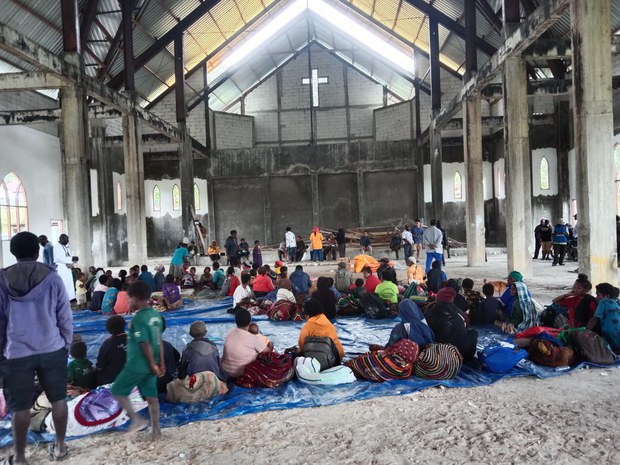
Hundreds of residents in Indonesia’s restive Papua region have sought shelter in a church after clashes between security forces and West Papua independence fighters left two insurgents, a soldier and a civilian dead.

Fighting flared in Paniai regency in Central Papua province after the West Papua National Liberation Army (TPNPB), part of the Free Papua Movement (OPM), burned a public minivan and killed its driver last week, the military said in a statement.

Two-hundred-and-fifty civilians fled the latest clash, the military said, but a local human rights activist told BenarNews at least twice the number have sought refuge.

As at last October, 76,228 refugees from the ongoing conflict were displaced in the Papuan provinces, the Papua Legal Aid Institute has reported, from a total population of 5.6 million people.

The violent conflict in the western half of New Guinea island is estimated to have cost hundreds-of-thousand of mainly Papuan lives since the 1960s, with the Indonesian government and independence groups accusing each other of serious human rights abuses.

Military forces pursued the TPNPB into the Bibida district of Paniai on Friday, resulting in a deadly firefight on Monday that killed two combatants, according to military spokesperson Lt. Col. Yogi Nugroho.

Residents of Bibida district requested assistance from security forces to temporarily relocate to Madi Church in the neighboring East Paniai district, he said.

“The people of Bibida have never accepted the presence of the OPM in their area due to their arbitrary actions and cruel acts, such as forcibly taking crops, livestock, and even some young girls,” Yogi told BenarNews.

TPNPB spokesperson Sebby Sambom has denied the group committed any criminal acts in Bibida that led to the displacement of residents.

“That’s not true. That’s the Indonesian military and police propaganda,” he told BenarNews.

A human rights and church activist in Papua, Yones Douw, accused the presence of government troops in Bibida of fueling fear among Papuans and causing them to flee.

Douw also said the number of displaced residents was 574, not 250 as stated by the military.

“I asked the people of Bibida directly, and they said that it was not true. They [TPNPB] have never stolen crops, and they have never killed livestock,” Douw told BenarNews, adding they usually bought local produce from residents.

“The TPNPB-OPM allowed them to evacuate because Bibida would be used as a battleground,” he added.

Yogi said according to security forces’ observations, insurgents seeking to destabilize Bibida had taken positions in the forest and nearby regions.

“Therefore, if there are people moving into the Bibida forest, they can be confirmed as sympathizers or members of the OPM,” he said.

Security forces on Friday retook Bibida, which had been under TPNPB-OPM control, Yogi said.

One of the slain Liberation Army members was identified as Danis Murib, a deserter from the Indonesian military who had abandoned his post in April.

“Yes, he was a former active member of the Indonesian military who joined the TPNPB four months ago,” Sambom told BenarNews.

On Saturday, the TPNPB shot dead a government soldier, identified as Hendrik Fonataba, in the neighboring Puncak regency, Yogi said.

In 1963, Indonesian forces invaded Papua – like Indonesia, a former Dutch colony – and annexed the region.

Papua was incorporated into Indonesia in 1969 after a United Nations-sponsored referendum, which locals and activists have decried as a sham because it involved only about 1,000 people. However, the U.N. accepted the result endorsing Jakarta’s rule.

The Indonesian Defense Ministry said last month it had requested a bigger budget to buy high-tech weapons that can “detect or retaliate” against Papuan groups who know the region’s terrain better. 

Human rights activists criticized the ministry proposal, arguing it would escalate violence and lead to more civilians being caught in the crossfire in the mineral-rich but underdeveloped region.

Indonesia’s carbon crisis: will Islam get dirty hands?

Nahdlatul Ulama (NU)(revival of the scholars) is Indonesia and the world’s largest Islamic organisation claiming almost 100 million members. If it digs coal it could become mega-rich. How dirty work marries with sending souls to paradise only Allah knows.

President Joko ’Jokowi’ Widodo has four months left in office, enough time to sow division before handing the job on to the elected former cashiered general Prabowo Subianto.

In May, Jokowi signed a decree letting religious groups apply to be the first shovel in the ore for special mining concessions. Not quite a gift from the gods as the Republic is supposed to be monotheistic, but pretty close.

This allows him to make good on an old promise to religious groups to take over mining concessions to raise funds. What the hell has coarse commerce got to do with matters of faith?

One answer: Politics, or as The Jakarta Post described it clumsily because pig meat is taboo to Muslims, “halal-certified state-sponsored pork barrelling”.

It added: “The government has come out with one of the most ridiculous policies in the history of this nation … It’s now up to the country’s largest Muslim organisation to back out on moral grounds.”

But will the lure of lucre prevail over Islam’s obligations to be honest, fair and righteous?

NU supported the Prabowo ticket in the February presidential election as did Jokowi who was constitutionally barred from taking a third five-year term.

Instead, he engineered for his eldest son Gibran Rakabuming to contest as number two. He’s now Vice-President elect.

The lead-up to the inauguration is a time to settle debts and cement alliances. If enough minor parties join the Prabowo-Gibran winning team, opposition will be left to NGOs.

Most are poor and poorly equipped to do more than their narrow roles, like advocating for human rights.

The churches have already knocked back Jokowi’s offer saying that fossil fuels are not their job and they’re better at consulting holy books than mining manuals. The mosques are dithering.

Second behind NU is Muhammadiyah (followers of Muhammad) with 60 million members. It tends to attract the better-educated middle class.

At present it’s pondering the Jokowi offer, but observers reckon nothing will happen as the gift has been pegged only for the NU.

The six government-approved religions, Islam, Protestantism, Catholicism, Hinduism, Buddhism and Confucianism have charity wings. They run schools, hospitals, clinics and retirement homes principally for their members and could probably improve their work with mining profits.

But supping with this devil will need a long-arm excavator.

Investment Minister Bahlil Lahadalia was reported as saying the handout was “in return to their past services during and after the country’s struggle for independence … you are investing for the hereafter.” That’s something most religions have been doing for millennia.

The government says any faith group that accepts the deal has to run the show themselves. This means they can’t flog off a mining permit or farm out business to an established company, even though it has the gear and expertise.

That rule crimps expectations of the beneficiaries only needing bigger truck parks and tips to take Haulpaks of rupiah.

A few right-wing congregations believe the earth is for exploitation; the rest take a more environmentally conscious position accepting that despoiling nature is not part of any Deity’s plan.

The better read will know that most responsible nations are moving away from fossil fuels to renewable energy sources.

Indonesia is the world’s largest coal exporter and third biggest producer; to the distress of those worried about global warming it shows no sign of slowing down; the compound annual growth rate has been seven per cent since 2019. This year it expects to produce 710 million tonnes.

There are precedents for Jokowi’s generosity though unfair and distressing.

Last century then president Soeharto gave forestry concessions. Tens of thousands of hectares of virgin growth mainly in Kalimantan (Borneo island) to relatives and mates, particularly army generals, establishing vast business enterprises.

Many wield enormous power today and are part of the oligarchy. We’ve yet to hear how the profiteers feel about sharing their spoils with the pious.

Consider making a donation to support independent journalism

Pearls and Irritations relies totally on donations from its readers. We are independent and we don’t accept financial support from governments, their agencies or vested interests such as fossil fuel and arms manufacturing companies. We do not accept advertising, nor do we have a paywall.

Please consider a donation to help Pearls and Irritations extend its voice and reach.

Duncan Graham

Duncan Graham has been a journalist for more than 40 years in print, radio and TV. He is the author of People Next Door (UWA Press). He is now writing for the English language media in Indonesia from within Indonesia.
Duncan Graham has an MPhil degree, a Walkley Award, two Human Rights Commission awards and other prizes for his radio, TV and print journalism in Australia. He lives in East Java.

Papuans head to Indonesian court to protect forests from palm oil

Campaigners are taking legal action to stop four palm oil companies from clearing vast tracts of forest for plantations.

The Awyu and Moi say they want to stop the plantations for the benefit of their community and future generations. [Bay Ismoyo/AFP] 

By  Al Jazeera Staff Published On

 28 May 2024 

Indigenous activists from the Indonesian province of West Papua have held traditional ceremonies outside the country’s Supreme Court in Jakarta calling for their traditional land and forests to be protected from palm oil plantations.

Representatives of the Awyu and Moi communities held prayers and performed dances in front of the Supreme Court building on Monday as the court was reviewing an appeal in relation to their efforts to revoke permits for four palm oil companies whose proposed plantations threaten their customary forests. Indonesia began legally recognising customary forests in 2016.

“We have taken the long, difficult and expensive path from Tanah Papua [Papua homeland] to end up here in Indonesia’s capital Jakarta, asking the Supreme Court to restore our rights, and the land that was snatched from us when these palm oil companies were issued permits over it,” said Hendrikus “Franky” Woro, an Awyu Indigenous man.

Woro filed an environmental and land rights lawsuit in the Papuan capital of Jayapura challenging the plan by a Malaysian-owned palm oil company to clear tens of thousands of hectares of previously untouched West Papuan forest, including traditional Indigenous land.

Environmental campaign group Greenpeace said the potential emissions from clearing the 26,326 hectares (65,053 acres) of primary forest in its concession would amount to about 23 million tonnes of CO2, equivalent to 5 percent of Indonesia’s annual carbon emissions expected in 2030.

The Awyu have also intervened in appeals taken by two other palm oil companies against a decision by the minister of environment and forestry to cancel permits that it had previously issued for them to clear Indigenous lands. The revocation has the potential to save 65,415 hectares (161,644 acres) of pristine rainforest, six times the area of the city of Paris, Greenpeace said.

The Supreme Court is the communities’ last chance to defend their customary forest and generations of ancestral heritage.

“We have been tormented for years by the threat of our traditional forests being replaced by palm oil plantations. We want to raise our children with the help of nature, and the food and materials we harvest from the forest. Palm oil will destroy our forests, we reject it,” said Rikarda Maa, an Awyu Indigenous woman.

The Moi Indigenous community, meanwhile, is fighting to protect thousands of hectares of customary forest that has also been earmarked for palm oil. The company involved had its permits revoked amid community opposition but lower courts later ruled in favour of the planter.

“The judicial panel needs to prioritise aspects of the case that relate to environmental and climate justice, the impact of which will not only be felt by the Awyu and Moi but the entirety of the Indonesian people,” Tigor Hutapea, a member of the legal team from Pusaka Bentala Rakyat, said in a statement.

Global Forest Watch, a monitoring platform run by the World Resources Institute, said last month that since 1950, more than 74 million hectares (183 million acres) of Indonesian rainforest — an area twice the size of Germany — had been logged, burned or degraded for the development of palm oil, paper and rubber plantations, nickel mining and other commodities.

Indonesia is the world’s biggest producer of palm oil, and Malaysia number two. Indonesia is also a major exporter of commodities such as coal, rubber and tin.

Testimony from Paniai Regional Hospital Officer: Officials Turned It into a Military Base Hospital

Reporter

Ikhsan Reliubun

Editor

Iqbal Muhtarom

Sunday, 26 May 2024 17:21 IWST

TEMPO.CO, Jakarta – The West Papua National Liberation Army-Free Papua Organization or TPNPB-OPM highlighted the expulsion of people being treated at the Paniai Regional General Hospital (RUSD), Central Papua. The civil forces—later called the armed criminal group or KKB—said that the authorities used hospital facilities as a place of refuge.

“Because they were afraid of facing TPNPB, the Indonesian National Army used the Pania Regional General Hospital (RSUD) as a ‘human shield’ to protect themselves from TPNPB attacks,” said the spokesperson for the TPNPB-OPM National Command Headquarters Management, Sebby Sambom, in a written statement after -patient expulsion, Sunday, May 26 2024.

TPNPB-OPM quoted testimony from health workers regarding this incident, urging the patient to leave the treatment room. In this testimony, the hospital official stated that, for mutual safety, the Paniai Regional Hospital was temporarily closed in view of the dynamics of the Paniai situation. “Especially around the Paniai Regional Hospital, it has been used as a military base,” said a Paniai Regional Hospital officer, as quoted by Sebby.

The testimony explained that hospital employees were very traumatized by the situation in Paniai. He asked for prayers from the public so that the situation at Paniai Regional Hospital returns to normal activities. He said that the presence of the apparatus would have an impact on the safety of all hospital crew and patients. “We are afraid that wherever there are security forces, that will be the target of security disturbances,” he said.

“We feel that the targets were doctors, nurses, all RSUD employees, and more specifically patients who were being treated,” read the written testimony. According to Paniai Regional Hospital officials, the hospital is not a military base. The hospital environment is a base for sick people.

In his testimony, he stated that doctors and nurses obeyed the basic calling in accordance with the vision and mission of Paniai Regional Hospital. He stated that the TNI had violated the service code of ethics, especially violating humanitarian law. “In conclusion, the officer said, ‘This world still exists because righteous people still exist,'” said Sebby.

TPNPB-OPM Headquarters stated that on May 25 2024, a patient reported information from the Paniai Regional Hospital that the 3rd floor of the Regional Hospital in Enarotali, Paniai, was occupied and filled with TNI. “The patients at the Paniai Regional Hospital were told to go home because the TNI had occupied the Regional Hospital as a TNI defense headquarters to face the TPNPB-OPM,” said TPNPB-OPM.

TPNPB-OPM assessed that the hospital occupation had occurred in Intan Jaya. The patient’s healing house was used as the TNI-Polri headquarters. “So patients are forced to go home and sick people are afraid to come for treatment at the hospital,” said Sebby.

Paniai Resort Police Chief, Adjunct Senior Commissioner Abdus Syukur Felani, denied there was any expulsion of patients from the hospital. He said that the news was not true. He asked the public not to easily believe information whose source is unclear.

“It is not true that there is an expulsion of patients, in fact the presence of the TNI-Polri is to provide a sense of security to both patients and health workers,” said Abdus in a written statement on Sunday, May 26 2024. He said that the TNI-Polri secured the RSUD because it was a vital object that needed to be secured. to provide a sense of security to the community.

According to him, closing the door to the Emergency Room at Paniai Hospital is a precautionary measure. The hospital staff closed the emergency room door. The reason is that the door lock is broken. “To prevent theft from occurring in the room, RSUD officers closed it,” said Abdus.

Editor’s Choice: TNI-Polri Allegedly Urging Patients to Vacate Paniai Regional Hospital

The third floor is occupied by security forces, Paniai Regional Hospital services are completely paralyzed

Paramedics are frightened by the presence of security forces at Paniai Regional Hospital. Inpatients were sent home and transferred to other hospitals.

May 26, 2024 in Political, Legal and Security Affairs

  0

Writer: Abeth You – Editor: Aries Munandar

Enarotali, Jubi – All medical services at the Regional General Hospital or Paniai Regional Hospital have been completely paralyzed since Sunday morning (26/5/2024). The paramedics were afraid because joint TNI and Polri troops occupied the third floor of the hospital building.

Paniai Hospital Director Agus said there were no paramedics on duty since the security forces occupied the third floor of the hospital building. Because of this, they entrusted six inpatients to the Deiyai Pratama General Hospital. The rest were transferred to the Enarotali Community Health Center and returned to their homes.

“So, temporarily services [at Paniai Regional Hospital] have been transferred to Enarotali Community Health Center and Deiyai Pratama General Hospital. “[Patients who are sent home] can still consult [with a doctor] by telephone,” said Agus via mobile instant message.

Agus said there were six inpatients transferred to Deiyai Pratama Hospital. They are pediatric patients.

“There is a pediatrician there. “However, we still cover [the need for] medicine, oxygen and consumable medical materials [for these patients],” he said.

Agus admitted that the deployment of security forces was not a policy from the Paniai Regional Hospital management, but rather an instruction from the Ministry of Health. He hopes that all parties can work together well so that services return to normal at Paniai Hospital.

Director of the Deiyai Pratama General Hospital, Selvianus Ukago, said that they were continuing to coordinate with the Paniai Regional Hospital in treating the six entrusted patients. Paniai Regional Hospital has also met all of the patient’s medical needs.

“Pediatricians from both hospitals have coordinated with each other [regarding patient care]. “Paniai Regional Hospital has also met the patient’s medical needs,” said Ukago.

Head of the Enarotali Community Health Center, Rosalina Yogi, said that a number of patients entrusted from Paniai Regional Hospital had also arrived at the community health center. The patients were about to undergo labor.

“Mothers who [wanted to] give birth at the Paniai Regional Hospital have been transferred to the Enarotali Community Health Center. “That’s because we have officers, tools and complete facilities [for delivery services],” said Yogi.

Move location

Acting Regent of Paniai Denci Meri Nawipa said they would immediately move the presence of security officers from Paniai Regional Hospital. The transfer plan will be put together on Monday.

“Tomorrow, the security forces will move them to the regent’s residence, or near the [Enarotali] terminal. “That’s so that services at Paniai Regional Hospital continue to run,” said Nawipa when called by Jubi.

According to him, there are several versions regarding the reasons for placing a number of security officers at the Paniai Regional Hospital. One version states that the placement was triggered by rumors about the Paniai Regional Hospital fire, so health officials wanted security at the Regional Hospital.

“Last night [Saturday], security forces entered [occupying] the Paniai Regional Hospital. That’s because there were medical officers spreading information about the fire at the doctor’s and nurse’s house. “The fire occurred in another resident’s house,” said Nawipa.

Nawipa said he had also reported to Acting Governor Ribka Haluk regarding the deployment of security forces at the Paniai Regional Hospital. To Haluk, Nawipa confirmed that they were solving the problem.

Move location

Acting Regent of Paniai Denci Meri Nawipa said they would immediately move the presence of security officers from Paniai Regional Hospital. The transfer plan will be put together on Monday.

“Tomorrow, the security forces will move them to the regent’s residence, or near the [Enarotali] terminal. “That’s so that services at Paniai Regional Hospital continue to run,” said Nawipa when called by Jubi.

According to him, there are several versions regarding the reasons for placing a number of security officers at the Paniai Regional Hospital. One version states that the placement was triggered by rumors about the Paniai Regional Hospital fire, so health officials wanted security at the Regional Hospital.

“Last night [Saturday], security forces entered [occupying] the Paniai Regional Hospital. That’s because there were medical officers spreading information about the fire at the doctor’s and nurse’s house. “The fire occurred in another resident’s house,” said Nawipa.

Nawipa said he had also reported to Acting Governor Ribka Haluk regarding the deployment of security forces at the Paniai Regional Hospital. To Haluk, Nawipa confirmed that they were solving the problem.

Broken key

Head of the Information Center for the Cenderawasih Regional Military Command, Lieutenant Colonel Candra Kurniawan, said that the deployment of troops to the Paniai Regional Hospital was at the request of local medical officers. They felt their safety was threatened by the actions of the Free Papua Organization (OPM).

“The information circulating on social media regarding the expulsion of patients and the closure of the emergency room at Paniai Regional Hospital is a hoax. “At that time, TNI officers were actually securing the Paniai Regional Hospital because there were complaints from the public that the OPM mob was going to burn down the hospital,” said Candra in a written statement.

A similar denial was conveyed by the Head of Paniai Police, Adjunct Police Commissioner Abdus Syukur Felani. He asked the public not to easily believe information whose source is unclear.

“The closure of the emergency room was an initiative of Paniai Regional Hospital officers because the door lock was broken. “The picket officer had not arrived on Sunday morning so he closed the emergency room door to prevent theft in that room,” said Abdus.

OPM denied rumors about plans to burn Paniai Regional Hospital. They actually accused the TNI and Polri of disrupting community services at the RSUD.

“From the [widely circulated] video, we can see that the TNI/Polri ordered medical officers to close the emergency room door at Paniai Regional Hospital. “So, they have set up a scenario [planning to close the emergency room],” said West Papua Army Commander Damianus Magai Yogi. (*)

West Papua independence group slams French ‘modern-day colonialism’ 

ULMWP president Benny Wenda . . . celebrating the signing of an MOU with the FLNKS in 2022. Roch Wamytan (left, partially obscured), President of New Caledonia’s Congress, is also at the table. Image: ULMWP

By APR editor –  May 26, 2024

Asia Pacific Report

A West Papuan independence group has condemned French “modern-day colonialism in action” in Kanaky New Caledonia and urged indigenous leaders to “fight on”.

In a statement to the Kanak pro-independence leadership, exiled United Liberation Movement for West Papua (ULMWP) president Benny Wenda said the proposed electoral changes being debated in the French Parliament would “fatally damage Kanaky’s right to self-determination”.

He said the ULMWP was following events closely and sent its deepest sympathy and support to the Kanak struggle.

“Never give up. Never surrender. Fight until you are free,” he said.

“Though the journey is long, one day our flags will be raised alongside one another on liberated Melanesian soil, and the people of West Papua and Kanaky will celebrate their independence together.”

Speaking on behalf of the people of West Papua, Wenda said he sent condolences to the families of those whose lives have been lost since the current crisis began — seven people have been killed so far, four of them Kanak.

“This crisis is one chapter in a long occupation and self-determination struggle going back hundreds of years,” Wenda said in his statement.

‘We are standing with you’
“You are not alone — the people of West Papua, Melanesia and the wider Pacific are standing with you.”

“I have always maintained that the Kanak struggle is the West Papuan struggle, and the West Papuan struggle is the Kanak struggle.

“Our bond is special because we share an experience that most colonised nations have already overcome. Colonialism may have ended in Africa and the Caribbean, but in the Pacific it still exists.”

Wenda said he was proud to sign a memorandum of understanding (MoU) with the FLNKS [Kanak and Socialist National Liberation Front] in 2022.

“We are one Melanesian family, and I hope all Melanesian leaders will make clear statements of support for the FLNKS’ current struggle against France.

“I also hope that our brothers and sisters across the Pacific — Micronesia and Polynesia included — stand up and show solidarity for Kanaky in their time of need.

“The world is watching. Will the Pacific speak out with one unified voice against modern-day colonialism being inflicted on their neighbours?”2) 

Soldiers building comfortable public toilet in Papua’s Naira Village

May 21, 2024 14:20 GMT+700

Jayapura, Papua (ANTARA) – The Jayapura/1701 Military Command (Kodim) is building a comfortable public toilet in Naira Village, located 133 km from Jayapura, Papua Province’s capital, to help locals lead a clean and healthy lifestyle, a military officer stated.

Building the public toilet in Naira Village, which administratively belongs to Airu Sub-district in Jayapura District, is part of the 120th TNI Manunggal Masuk Desa (TMMD) Community Service Program, according to the Indonesian Military (TNI) press statement published here, Monday (May 20).

The TMMD Program is the continuation of ABRI Masuk Desa (AMD), which is TNI’s community service program, introduced and routinely carried out during the leadership era of Indonesia’s second president, Suharto.

The availability of the public toilet would hopefully help villagers improve their quality of life amid a lack of basic sanitation facilities in the village, 120th TMMD Task Force commander, Major Afandi, stated.

Apart from building the comfortable public toilet, the TMMD personnel also launched a public awareness campaign to help the villagers get familiarized with a clean and healthy lifestyle, he remarked.

The public awareness campaign was carried out by collaborating with those from the district’s health office and other government agencies, he added.

As reported earlier, Indonesian soldiers in Papua are required to multitask amid the government’s incessant efforts to bridge the regional development gap between Papua and other provinces.

Soldiers deployed in the Papua region are required to be responsive in seeking solutions to problems and challenges faced by Papuan communities in their daily lives.

They are also expected to play the role of problem solvers for local communities amid their central task to defend the country’s territorial integrity and guard the safety of Indonesians.

The geopolitical and geostrategic position of Papua, which shares land and sea borders with Papua New Guinea, occupies a significance in matters of Indonesia’s sovereignty and territorial integrity.

Over the past few years, soldiers stationed in the region have been facing security threats posed by armed Papuan separatist groups operating in several districts.

Despite the security-related challenges, soldiers have actively engaged in community service activities, highlighting their commitment to supporting local populations.

Several personnel of the Indonesia-PNG Border Security Task Force, for instance, have been assisting locals through community services, such as voluntary teaching, mobile libraries, and street cleanup programs. 

Related news: Papua: Soldiers provide free health services to villagers

Related news: Prioritizing soft approach toward armed Papuan groups: TNI


Translator: Evarukdijati, Rahmad Nasution
Editor: Tia Mutiasari

Déjà vu in New Caledonia: why decades of political failure will make this uprising hard to contain

With an air force plane on its way to rescue New Zealanders stranded by the violent uprising in New Caledonia, many familiar with the island’s history are experiencing an unwelcome sense of déjà vu.

When I first visited the island territory in 1983, I interviewed Eloi Machoro, general secretary of the largest pro-independence party, L’Union Calédonienne. It was a position he had held since his predecessor, Pierre Declerq, was assassinated less than two years earlier.

Machoro was angry and frustrated with the socialist government in France, which had promised independence while in opposition, but was prevaricating after coming to power.

Tension was building, and within 18 months Machoro himself was killed by a French military sniper after leading a campaign to disrupt a vote on France’s plans for the territory.

Help us share expert knowledge.

I was in New Caledonia again last December, 40 years after my first visit, and Kanak anger and frustration seemed even more intense. On the anniversary of the 1984 Hienghène massacre, in which ten Kanak activists were killed in an ambush by armed settlers, there was a big demonstration in Nouméa.

Staged by a new activist group, the Coordination Unit for Actions on the Ground (CCAT), it focused on the visit of French defence minister Sébastien Lecornu, who was hosting a meeting of South Pacific defence ministers.

This followed the declaration by French president Emmanuel Macron, during a visit in July 2023, that the process set out in the 1998 Nouméa Accords had been concluded: independence was no longer an option because the people of New Caledonia had voted against it.

The sense of betrayal felt by the independence movement and many Kanak people was boiling over again. The endgame at this stage is unclear, and a lot will ride on talks in Paris later this month.

French president Emmanuel Macron holds a defence council on the New Caledonia situation, Paris May 20. AAP

End of the Nouméa Accords

The Nouméa Accords had set out a framework the independence movement believed could work. Pro- and anti-independence groups, and the French government, agreed there would be three referendums, in 2018, 2020 and 2021.

A restricted electoral college was established that stipulated new migrants could still vote in French national elections, but not in New Caledonia’s provincial elections or independence referendums.

The independence movement had reason to trust this process. It had been guaranteed by a change to the French constitution that apparently protected it from the whims of any change of government in Paris.

The 2018 referendum returned a vote of 43% in favour of independence, significantly higher than most commentators were predicting. Two years later, the 47% in favour of independence sparked jubilant celebrations on the streets of Nouméa.

Arnaud Chollet-Leakava, founder and president of the Mouvement des Océaniens pour l’Indépendance (and member of CCAT), said he’d seen nothing like the spontaneous outpouring after the second referendum.

It was a party atmosphere all over Nouméa, with tooting horns and Kanak flags everywhere. You’d think we had won.

There was overwhelming confidence the movement had the momentum to achieve 50% in the final referendum. But in 2021, the country was ravaged by COVID, especially among Kanak communities. The independence movement asked for the third referendum to be postponed for six months.

Macron refused the request, the independence movement refused to participate, and the third referendum returned a 97% vote against independence. On that basis, France now insists the project set out in the Nouméa Accords has been completed.

Consensus and crisis

The current turmoil is directly related to the dismantling of the Nouméa Accords, and the resulting full electoral participation of thousands of recent immigrants.

France has effectively sided with the anti-independence camp and abandoned the commitment to consensus that had been a hallmark of French policy since the Matignon Accords in 1988.

Kanak and Socialist National Liberation Front (FLNKS) president Jean-Marie Tjibaou returned to New Caledonia after the famous Matignon handshake with anti-independence leader Jacques Lafleur. It took Tjibaou and his delegation two long meetings to convince the FLNKS to endorse the accords.

The Ouvéa hostage crisis that claimed 19 Kanak lives just weeks earlier had reminded people what France was capable of when its authority was challenged, and many activists were in no mood for compromise. But the movement did demobilise and commit to a decades-long consensus process that was to culminate in an independence vote.

With France unilaterally ending the process, the leaders of the independence movement have emerged empty-handed. That is what has enraged Kanak people and led to young people venting their anger on the streets.

Protests spread to Paris: a rally called by Caledonian activists in solidarity with Kanak people, Place de la Republique, May 16. AAP

A new kind of uprising

Unlike those of the 1980s, the current uprising was not planned and organised by leaders of the movement. It is a spontaneous and sustained popular outburst. This is also why independence leaders have been unable to stop it.

It has gone so far that Simon Loueckhote, a conservative Kanak leader who was a signatory of the Nouméa Accords for the anti-independence camp, wrote a public letter to Macron on Monday, calling for a halt to the current political strategy as the only way to end the current cycle of violence.

Finally, all this must be seen in even broader historical context. Kanak people were denied the right to vote until the 1950s – a century after France annexed their lands.

Barely 20 years later, France’s then prime minister, Pierre Messmer, penned a now infamous letter to his overseas territories minister. It revealed a deliberate plan to thwart any potential threat to French rule in the colony by ensuring any nationalist movement was outnumbered by massive immigration.

And now France has brought new settlers into the country, and encouraged them to feel entitled to vote. Until a lasting solution is found, either by reviving the Nouméa Accords or agreement on a better model, more conflict seems inevitable.