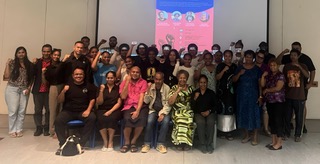
Nearly 11 months after the fatal shooting of Mr Tobias Silak in the Yahukimo Regency, Papua Pegunungan Province, criminal proceedings have commenced at the Wamena District Court against the four police officers, Muh. Kurniawan Kudu (Chief Police Brigadier, Bripka), Fernando Alexander Aufa, Ferdi Moses Koromath, and Jatmiko (see photo on top, source: WPCC). The case files were transferred to the Public Prosecutor in Wamena on 28 May 2025, with the first hearing held on 24 June 2025. The court session focused on the reading of indictments. However, the scheduled 30 June hearing for defendant objections was postponed due to the defence team’s lack of preparedness, raising early concerns about the pace of the proceedings.
In response to these procedural concerns, the Indonesian Judicial Commission in Papua announced in late June’25 that it would monitor the trial proceedings following a request from the victim’s family’s legal team. The Commission is currently awaiting authorization from the headquarters to begin formal oversight. Meanwhile, civil society groups, including the Tobias Silak Justice Front, continue to demand maximum penalties, including dismissal from the police force for the accused officers, while planning consolidation efforts across multiple cities to maintain public pressure throughout the trial process (see photos below, source: FJTS).
On 12 June 2025, police officers arbitrarily detained Mr Imanus Komba, a lawyer working for the Papuan Legal Aid Institute (LBH Papua), and a protester named Mr Kolki Gwijangge during a peaceful demonstration at the Abepura roundabout in Jayapura City, Papua Province (see photo on top, source: Jubi). The demonstration, organised by student and youth groups, opposed the controversial nickel mining project in Raja Ampat, Sorong, and broader illegal resource exploitation in West Papua. Mr Komba and Mr Gwijangge were reportedly subjected to physical ill-treatment during arrest. Both men were temporarily detained at the Abepura Sub-District Police Station before being released after 20 minutes.
The protest began peacefully at 10:00 am, with demonstrators expressing environmental and indigenous rights concerns over the mining project, including its impacts on local ecosystems and customary landowners. At approximately 10:20 am, police from the Abepura Sector, led by the station chief and intelligence officers, attempted to disband the protest, allegedly citing the lack of a valid permit. When LBH Papua lawyer, Mr Imanus Komba, challenged the order and asserted the demonstrators’ constitutional rights, police officers reportedly dragged, choked, and beat Mr Komba with a rubber baton before being escorted to the Abepura Sub-District Police Station. Mr Kolki Gwijangge was also forcibly removed from the site. Despite the violence, both were released again, and Mr Komba resumed his duties accompanying the protest.
The Indonesian Legal Aid Foundation (YLBHI) and LBH Papua condemned the detention, highlighting that such acts amount to a pattern of criminalisation and intimidation of human rights defenders in West Papua. According to YLBHI, the Abepura Police’s conduct represents a breach of Police Regulation No. 2/2003. The organisation demanded a public apology and an end to repressive policing.
The actions of the Abepura police, including physical abuse and obstruction of legal assistance, amount to violations of national law and international standards on the protection of human rights defenders. The incident violates fundamental freedoms, namely the right to freedom of expression and peaceful assembly as enshrined in Article 28E (2) of the Indonesian Constitution, and Articles 19 and 21 of the International Covenant on Civil and Political Rights (ICCPR), to which Indonesia is a State Party. Furthermore, the physical assault and detention of the LBH lawyer violate Law No. 16/2011 on Legal Aid, which explicitly protects lawyers from criminal or civil liability for actions taken in the course of legal representation.
The case adds to a broader pattern of repression against Papuan civil society, where security forces frequently suppress dissent under the guise of public order, infringing upon basic civil liberties and undermining the rule of law.
In the past months, the situation surrounding the National Strategic Project (PSN) in Merauke, Papua Selatan Province, has further escalated. In the Soa Village, Tanah Miring District, indigenous women from 75 families have collectively opposed the land encroachment by PT. Global Papua Abadi, which received a government concession for an energy project without the community’s free, prior, and informed consent (FPIC). This project threatens to destroy their natural sources of livelihood and violates their rights to land and self-determination. Similarly, on 23 June 2025, indigenous land belonging to the Kwipalo clan in Kakyo Village, Semangga District, was reportedly seized by the military for the construction of a post without consent or legal process, constituting a grave act of militarisation and forced dispossession.
According to the CSOs, the government’s reply reflected a broader institutional reluctance to engage meaningfully with international human rights norms. They pointed out that the Indonesian state has failed to comply with recommendations made by Komnas HAM, as well as with constitutional and international legal standards safeguarding indigenous peoples’ rights. Furthermore, they underscored that permits and business licences had been granted to companies in areas with customary land claims, without community consent or proper consultation. The coalition urged the UN Special Rapporteurs to conduct direct monitoring in Merauke and called for the immediate suspension of PSN implementation to prevent the continued expansion of human rights and environmental violations.
The PSN’s implementation in Merauke reflects a deeper failure of democratic governance and environmental responsibility. It undermines constitutional protections and international legal obligations, particularly under the UN Declaration on the Rights of Indigenous Peoples. The Indonesian government’s response to concerns raised by UN Special Rapporteurs has been criticised as evasive and dishonest. Indigenous leaders and civil society continue to demand the immediate suspension of all PSN activities, restoration of customary lands, adequate reparations, and a UN-led investigation. Without urgent corrective action, the PSN will inevitably destroy the ecological, cultural, and spiritual fabric of West Papua’s indigenous communities.
The military seized land belonging to the Kwipalo Clan in the Kakyo Village, Semangga District, without consent or legal process
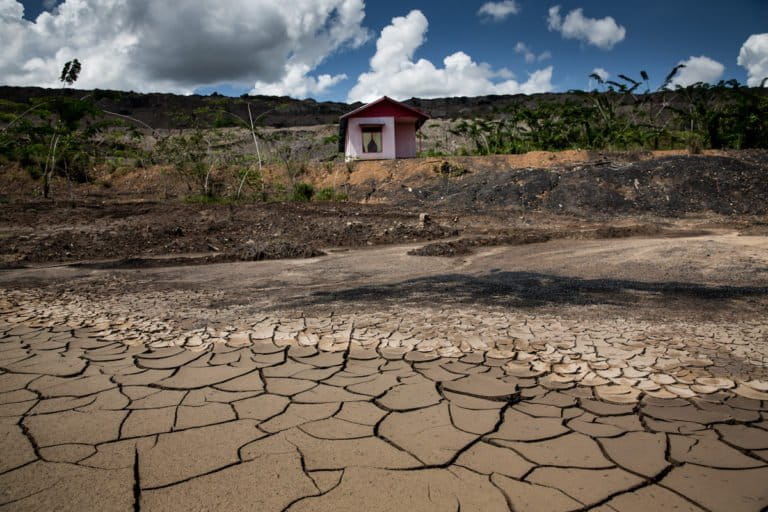
Sediment is clearly visible close to nickel mining operations on Kawe Island, Raja Ampat, discolouring the water in one of Indonesia’s most biodiverse marine areas.
The concession covers an area of 5,922 hectares and is located within the mega-biodiversity region of Raja Ampat, West Papua.
This article is reproduced courtesy of University of Melbourne’s unit Indonesia at Melbourne
The controversy over nickel mining in Raja Ampat, Papua, is a telling example of how capitalist-driven planetary urbanisation is reshaping the world we live in.
Today, urbanisation occurs on a global scale. It is taking place not only within cities and urban areas but even in many non-city zones that serve as ‘operational landscapes’ for supplying cities’ demands. This concept of ‘planetary urbanisation’ explains how non-urban realms in the Global South have played a strategic role as operational landscapes supporting cities in the Global North.
Environmentally destructive nickel mining activities within the Raja Ampat UNESCO Global Geopark, a global tourism site widely known for its idyllic scenery and marine biodiversity, is a case in point. It shows how the current global demand for urban environmental sustainability has incentivised policymakers in the Global South to provide the materials needed for the cities in the North to be more sustainable.
It also tells the disturbing story of how Indonesia, in a nutshell, is willing to destroy its invaluable green islands for the sake of ‘greening’ cities in China and Europe.
Resource exploitation by colonial powers played a critical role in the growth of cities in Indonesia and Europe, since the extraction from Indonesia funded the growth of the Netherlands and its cities. This is one of the first examples of planetary urbanisation — where the South was squeezed to provide for the North.
This process of planetary urbanisation continues today, as nickel becomes the latest commodity sought after by major cities in the northern hemisphere.
Nickel mining activities in the eastern part of Indonesia are embodiments of ‘operational landscapes’ in ‘planetary urbanisation’. This is indicated by the spatial and social concentration of capital in the forms of infrastructural facilities and the influx of migrant workers, some of whom are from China, in the region.
It remains to be seen, however, if these new ‘operational landscapes’ will eventually lead to the creation of new local cities as it was the case during colonial times, or if they will only destroy the environment in Indonesia to support cities in other countries.
The reality is that nickel mining sites are believed to have caused anthropogenic disasters (floods and landslides), and environmental degradation (air, land, and water pollutions), adversely affecting the local communities.
Floods in Morowali, for example, are attributed by many observers to IMIP industrial zones replacing local forest that previously served as a catchment area. In Teluk Weda, for example, Forest Watch Indonesia has found that the expansion of nickel industry encroaching into nearby forested areas has increased the flood risk in the surrounding areas.
The Watchdoc documentary also emphasises the impact of the mining industry on Teluk Weda’s public health. Levels of the heavy metal arsenic have been detected in blood samples taken from residents, mining workers, and fishermen in the area. This demonstrates how the nickel mining industry can have fatal consequences.
Sustainable for whom?
Capitalism can be cruel. Yet, there is no denying that capitalist-driven Dutch colonialism, which heavily relied on plantations, played a role in the making of major cities in Indonesia with less severe environmental degradation. The ongoing process of mining activities in eastern part of Indonesia seems much more ominous.
We need to ask who really benefits from the global campaign for’ sustainable development’. Of course Indonesia should tap this economic opportunity, but we cannot let it happen at the expense of our own natural habitat and our society’s wellbeing.
A West Papuan independence movement leader has warned the Melanesian Spearhead Group after its 23rd leaders summit in Suva, Fiji, to not give in to a “neocolonial trade in betrayal and abandonment” over West Papua.
While endorsing and acknowledging the “unconditional support” of Melanesian people to the West Papuan cause for decolonisation, OPM chair and commander Jeffrey P Bomanak spoke against “surrendering” to Indonesia which was carrying out a policy of “bank cheque diplomacy” in a bid to destroy solidarity.
Fiji Prime Minister Sitiveni Rabuka took over the chairmanship of the MSG this week from his Vanuatu counterpart Jotham Napat and vowed to build on the hard work and success that had been laid before it.
He said he would not take the responsibility of chairmanship lightly, especially as they were confronted with an increasingly fragmented global landscape that demanded more from them.
PNG Prime Minister James Marape called on MSG member states to put West Papua and Kanaky New Caledonia back on the agenda for full MSG membership.
Marape said that while high-level dialogue with Indonesia over West Papua and France about New Caledonia must continue, it was culturally “un-Melanesian” not to give them a seat at the table.
West Papua currently holds observer status in the MSG, which includes Papua New Guinea, Solomon Islands, Vanuatu, and Fiji — and Indonesia as an associate member.
PNG ‘subtle shift’ PNG recognises the West Papuan region as five provinces of Indonesia, making Marape’s remarks in Suva a “subtle shift that may unsettle Jakarta”, reports Gorethy Kenneth in the PNG Post-Courier.
West Papuans have waged a long-standing Melanesian struggle for independence from Indonesia since 1969.
The MSG resolved to send separate letters of concern to the French and Indonesian presidents.
In a statement, Bomanak thanked the Melanesians of Fiji, Papua New Guinea, Solomon Islands, Vanuatu and the Kanak and Socialist National Liberation Front (FLNKS) of Kanaky New Caledonia for “unconditionally support[ing] your West Papuan brothers and sisters, subjected to dispossession, enslavement, genocide, ethnocide, infanticide, and ethnic cleansing, [as] the noblest of acts.”
“We will never forget these Melanesian brothers and sisters who remain faithfully loyal to our cultural identity no matter how many decades is our war of liberation and no matter how many bags of gold and silver Indonesia offers for the betrayal of ancestral kinship.
“When the late [Vanuatu Prime Minister] Father Walter Lini declared, ‘Melanesia is not free unless West Papua is free,”’ he was setting the benchmark for leadership and loyalty across the entire group of Melanesian nations.
“Father Lini was not talking about a timeframe of five months, or five years, or five decades.
“Father Lini was talking about an illegal invasion and military occupation of West Papua by a barbaric nation wanting West Papua’s gold and forests and willing to exterminate all of us for this wealth.
‘Noble declaration’ “That this noble declaration of kinship and loyalty now has a commercial value that can be bought and sold like a commodity by those without Father Lini’s courage and leadership, and betrayed for cheap materialism, is an act of historic infamy that will be recorded by Melanesian historians and taught in all our nations’ universities long after West Papua is liberated.”
Bomanak was condemning the decision of the MSG to regard the “West Papua problem” as an internal issue for Indonesia.
“The illegal occupation of West Papua and the genocide of West Papuans is not an internal issue to be solved by the barbaric occupier.
“Indonesia’s position as an associate member of MSG is a form of colonial corruption of the Melanesian people.
“We will continue to fight without MSG because the struggle for independence and sovereignty is our fundamental right of the Papuan people’s granted by God.
“Every member of MSG can recommend to the United Nations that West Papua deserves the same right of liberation and nation-state sovereignty that was achieved without compromise by Timor-Leste — the other nation illegally invaded by Indonesia and also subjected to genocide.”
Bomanak said the MSG’s remarks stood in stark contrast to Father Lini’s solidarity with West Papua and were “tantamount to sharing in the destruction of West Papua”.
‘Blood money’ It was also collaborating in the “extermination of West Papuans for economic benefit, for Batik Largesse. Blood money!”
The Papua ‘problem’ was not a human rights problem but a problem of the Papuan people’s political right for independence and sovereignty based on international law and the right to self-determination.
It was an international problem that had not been resolved.
“In fact, to say it is simply a ‘problem’ ignores the fate of the genocide of 500,000 victims.”
Bomanak said MSG leaders should make clear recommendations to the Indonesian government to resolve the “Papua problem” at the international level based on UN procedures and involving the demilitarisation of West Papua with all Indonesian defence and security forces “leaving the land they invaded and unlawfully occupied.”
Indonesia’s position as an associate member in the MSG was a systematic new colonialisation by Indonesia in the home of the Melanesian people.
Indonesia well understood the weaknesses of each Melanesian leader and “carries out bank cheque diplomacy accordingly to destroy the solidarity so profoundly declared by the late Father Walter Lini.”
The Indonesian government’s plan to implement a National Strategic Project (PSN) worth 24 trillion rupiah in the Papua Barat Daya Province has sparked resistance from indigenous communities. They understand the massive palm oil development as an existential threat to their ancestral lands and way of life. PT Fajar Surya Persada Group’s proposal, submitted to the Governor on 27 May 2025, seeks to establish an integrated palm oil-based food industry across 98,824.97 hectares covering key districts in Sorong and Tambrauw regencies. The project involves a consortium of five companies that would control vast swaths of traditional Moi territory, including PT Inti Kebun Sawit (18,425.78 hectares), PT Inti Kebun Sejahtera (307.91 hectares), PT Sorong Global Lestari (12,115.43 hectares), PT Omni Makmur Subur (40,000 hectares), and PT Graha Agrindo Nusantara (13,799.51 hectares).
The indigenous Moi Tribe has voiced resistance against what they describe as systematic land grabbing disguised as development. On 21 June 2025, Moi communities from 13 affected districts held traditional consultation meetings in the Klaso District, culminating in sacred oath-taking ceremonies (see photo on top, source: Suara Papua) and the planting of “Tui” bamboo poles, traditional symbols of prohibition and spiritual protection. Traditional leader, Dance Ulimpa declared that the Moi people “can live without palm oil, but cannot live without our customary forests,” emphasizing that these represent their last remaining forest territories. The communities have threatened to paralyze government offices in the provincial capital and the Sorong Regency if authorities accept the company’s application.
Evidence from existing palm oil operations in the region reveals devastating environmental and social impacts that fuel indigenous resistance. According to community testimonies, palm oil companies already operating in Sorong District have caused severe ecological damage, including pollution of the once-pristine Malalis and Klasof rivers where PT Hendrison Inti Persada and PT Inti Kebun Sejahtera operate. Traditional representative Desi Karongsan reported that the Klasof River now runs yellow and oily during rainy seasons, killing fish and causing skin rashes among children. Despite promises of economic benefits, only one Moi person reportedly works for the palm oil companies, while customary land is leased at exploitative rates of just 100,000 rupiah (approximately € 6.00) per hectare per month. The economic marginalization is so severe that some indigenous land is leased at only 6,000 rupiah per hectare, highlighting the gross inequality in benefit distribution.
Political resistance is building at multiple levels, with the West Papua Regional Parliament (DPRP) committing to draft regional regulations protecting indigenous rights and imposing a moratorium on palm oil expansion. A coalition of 18 organizations, including the Moi Great Tribe Council, Indigenous Peoples Alliance of the Archipelago (AMAN), Greenpeace Indonesia, and various human rights groups, has formally rejected the PSN, arguing that despite Papua’s Special Autonomy Law intended to protect indigenous rights, communities continue facing poverty, displacement, and human rights violations. The coalition demands an immediate halt to all PSN activities that deprive indigenous communities of their ancestral land. The coalition calls for development policies that prioritize indigenous participation and environmental protection over corporate interests in what they describe as West Papua’s transformation into “a testing ground for greedy and reckless development.”
Indonesia’s President-elect Prabowo Subianto, Deputy Prime Minister Richard Marles and Prime Minister Anthony Albanese at a joint statement at Parliament House in Canberra, Tuesday, August 20, 2024. Indonesian Defence Minister and President-elect Prabowo Subianto is visiting Australia from 19 to 20 August 2024
June 16, 2025
P&I readers don’t need to be told that Defence Minister Richard Marles is floundering when trying to make security links with Indonesia seem as though they’ve “never been in better shape”.
Relationships could be basking on the sunny side in the interests of regional harmony, though the enthusiasm is partisan. As Professor Tim Lindsey reminded in this newsletter:
“To put it bluntly, Australia struggles to get Indonesia’s attention. It is an uncomfortable truth that… Australia’s leverage and importance is limited. Jakarta sees Canberra as the junior partner in the relationship.”
Readers can measure Lindsey’s academic appraisal against Marles’ bushy-tailed approach when viewing this short clip of his media conference in Jakarta earlier this month.
It appears that little of substance was achieved in the meeting with his Duntroon-trained counterpart, Sjafrie Sjamsoeddin.
The Australian’s job is to persuade the Indonesians to settle disputes through wearing out words before loading weapons. It can be a long and boring process but diplomacy can save lives.
The task will be tough because Marles, 57, is not from the warrior class. He was a lawyer and union official before entering Parliament.
Apart from titles, the two men have nothing in common – they can’t even talk cricket (an alien game in the Archipelago) or swill beer together as Muslim Sjafrie is a teetotaller. His ignorance of Australian values was made clear with the gauche gift of an Indonesian 9mm Pindad combat pistol.
Septuagenarian Sjafrie was a career soldier who served in the Kopassus Special Forces unit which has a reputation for ruthlessness. He became a lieutenant-general, a close mate since training days with President Prabowo Subianto who supplied his present job.
In the Indonesian political system, ministers can be hand-picked by the president from outside Parliament.
Prabowo is now replacing civilian functionaries with military men, raising comparisons to the last century doctrine of dwifungsi(dual function) “that allowed the armed forces to crush dissent and dominate public life”.
(Second President Soeharto, a former general and autocrat who ruled Indonesia for 32 years, was Prabowo’s model – and former father-in-law.)
The Indonesian media favours “retired” when referencing Sjafrie’s exit from his 36-year career. However, his Wikipedia entry claims he was “dismissed” from the military over allegations he was involved in the disappearance of 13 Jakarta student democracy activists – a charge he rejects.
His boss, Prabowo, was cashiered for the same 1998 offence and fled to exile in Jordan.
This month the Marles’ message to his homeland stressed geography and strategy to underline our neighbour’s importance; the first is elementary and the second an on-the-fly concept poorly articulated:
“You just need to look at the map to understand how strategically important Indonesia is to Australia, but how strategically important Australia can be to Indonesia. We really can help provide Indonesia with strategic depth.
“We have a security anxiety in relation to China that’s principally driven by the very significant conventional military build-up that China is engaging in… It does shape how we think about the strategic landscape.”
How Indonesia thinks wasn’t addressed. “We” must have referred to Oz and not the Marles-Sjafrie meeting and its unspecified “optimistic and ambitious bilateral agenda”.
Sjafrie was absent from the Marles’ media stand-up, probably fearing he might encounter a probing journo should he venture too close to a mike.
Not to explain the 20 honour ribbons layered down his uniform, including the Star of Peace Veteran awarded this year, but his behaviours while an ambitious young soldier putting down dissidents.
He was in East Timor during the 1991 Santa Cruz Cemetery massacre when at least 280 protesters against Indonesian occupation were shot and hundreds went missing. Sjafrie also served in Aceh and West Papua, fighting Indonesian citizens demanding independence.
When his army ties ended, he became the defence ministry secretary-general. In 2009 he was scheduled to accompany then president Susilo Bambang Yudhoyono on a trip to Pittsburgh for the G-20 summit.
In those days, the US took a moral stand on VIP visitors with suspect histories. It refused Sjafrie a visa, apparently because of alleged links to past atrocities in East Timor and Jakarta which he denies. He’s never faced a court
Marles has no similar reservations, so he has invited Sjafrie to Australia. He also wants Indonesian troops to train in Australia – though no dates have been set.
Whether this would attract Australian protesters concerned about human rights in Indonesia is doubtful. The lobby is overwhelmed with issues from Israel.
It’s small when compared with Aotearoa NZ where former politicians, Pacific Island NGOs, church leaders and academics regularly report alleged atrocities in the Republic – particularly the closed province of West Papua.
However much they may dislike members of other governments for their policies, personalities and actions, most diplomats tend to swallow hard in their dealings with unpalatable foreign leaders.
That’s why the sanctioning of two members of the Israeli Government, Security Minister Itamar Ben-Gvir and Finance Minister Bezalel Smotrich, is unusual when both nations are allies and democratic.
The far-right politicians’ assets have been frozen and travel bans imposed for reportedly advocating violence. The US is angry, but Oz has support from Canada, the UK and other nations.
Prabowo and Sjafrie won’t get the same treatment — their alleged crimes occurred long ago — and the damage to Australian-Indonesian relations today would be too great for any outbreak of principles.
The days of civilian seventh president Joko “Jokowi” Widodo and Malcolm Turnbull’s jolly strolls around Sydney in 2017 are legendary.
In those times, relationships really were in better shape.
The views expressed in this article may or may not reflect those of Pearls and Irritations.
Duncan Graham
Duncan Graham has been a journalist for more than 40 years in print, radio and TV. He is the author of People Next Door (UWA Press). He is now writing for the English language media in Indonesia from within Indonesia. Duncan Graham has an MPhil degree, a Walkley Award, two Human Rights Commission awards and other prizes for his radio, TV and print journalism in Australia. He lives in East Java.
The AWPA Annual General Meeting will be held following the lunch around 2-15-2.30 p.m.
There will be reporting on the various projects around the continuing problem of Internally Displaced People in West Papua, the renewal of transmigration and the increased political role for the armed force in the Indonesian Government.
Through this direct action, Greenpeace aims to deliver an urgent message to the Indonesian government, nickel industry executives gathered at the event, and the wider public: nickel mining and processing are inflicting profound suffering on affected communities across Eastern Indonesia. The industry is razing forests, polluting vital water sources, rivers, seas, and air, and is exacerbating the climate crisis through its reliance on captive coal-fired power plants for processing.
“While the government and mining oligarchs discuss expanding the nickel industry at this conference, communities and our planet are already paying an unbearable price,” said Iqbal Damanik, Greenpeace Indonesia Forest Campaigner. “The relentless industrialization of nickel – accelerated by soaring demand for electric cars – has destroyed forestlands, rivers, and seas from Morowali, Konawe Utara, Kabaena, and Wawonii, to Halmahera and Obi. Now, nickel mining even threatens Raja Ampat in West Papua, a globally renowned biodiversity hotspot often called the last paradise on Earth.”
Following an investigative journey through West Papua, Greenpeace exposed mining activities on several islands within the Raja Ampat archipelago, including Gag Island, Kawe Island, and Manuran Island. These three are classified as small islands and, under the law concerning the management of coastal areas and small islands, should be off-limits to mining.
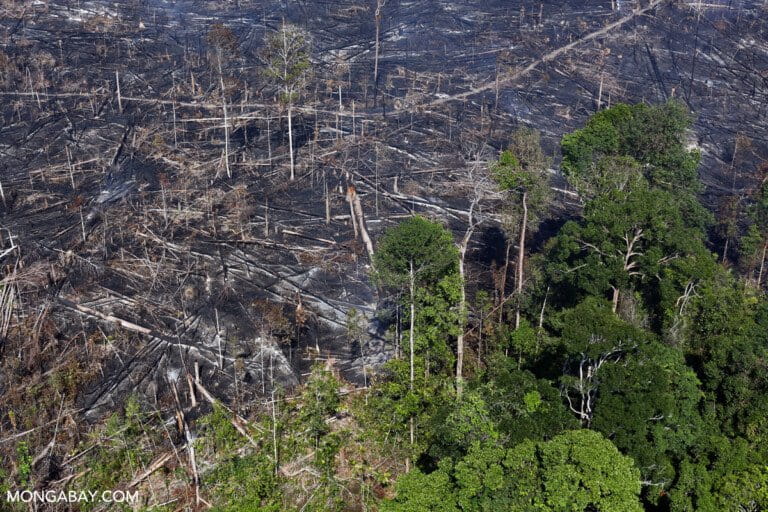
Greenpeace analysis reveals that nickel exploitation on these three islands has already led to the destruction of over 500 hectares of forest and specialised native vegetation. Extensive documentation shows soil runoff causing turbidity and sedimentation in coastal waters – a direct threat to Raja Ampat’s delicate coral reefs and marine ecosystems – as a result of deforestation and excavation.
Beyond Gag, Kawe, and Manuran, other small islands in Raja Ampat such as Batang Pele and Manyaifun are also under imminent threat from nickel mining. These two adjacent islands are situated approximately 30 kilometers from Piaynemo, the iconic karst island formation pictured on Indonesia’s Rp100,000 banknote.
Raja Ampat is celebrated for its extraordinary terrestrial and marine biodiversity. Its waters are home to 75 percent of the world’s coral species and over 2,500 species of fish. The islands themselves support 47 mammal species and 274 bird species. UNESCO has designated the Raja Ampat region as a global geopark.
Ronisel Mambrasar, a West Papuan youth from the Raja Ampat Nature Guardians (Aliansi Jaga Alam Raja Ampat), said, “Raja Ampat is in grave danger due to the presence of nickel mines on several islands, including my own home in Manyaifun and Batang Pele Islands. Nickel mining threatens our very existence. It will not only destroy the sea that has sustained our livelihoods for generations but is also fracturing the harmony of our communities, sowing conflict where there was once harmony.”
Greenpeace Indonesia urgently calls on the government to fundamentally reassess its nickel industrialization policies, which have already triggered a cascade of problems. The hollow boasts about the benefits of downstreaming, championed by the previous administration and now perpetuated during the presidency of Prabowo Subianto, must end. The nickel industrialization drive has proven to be a tragic irony: instead of delivering a just energy transition, it is systematically destroying the environment, violating the rights of Indigenous Peoples and local communities, and deepening the damage to an Earth already buckling under the weight of the climate crisis.
2YJG244 Lima, Peru. 14th Nov, 2024. Prabowo Subianto, President of the Republic of Indonesia, on an official visit to Peru. This visit, within the framework of the APEC Peru 2024 Economic Leaders Week (AELW), consists of a meeting between the Heads of State, of a protocolary nature with the signing of bilateral instruments. Credit: Fotoholica Press Agency/Alamy Live News
The shadow of Soeharto’s past now seems to loom over the nation, threatening the civilian supremacy we fought so hard to establish.
Last Wednesday marked the 27th anniversary of a pivotal moment in Indonesian history. On 21 May 1998, the nation demonstrated its collective power by forcing Soeharto to end his 32-year authoritarian rule.
This milestone achievement, which The Jakarta Post recorded in its memorable headline “I QUIT”, paved the way for Indonesia to become the world’s third-largest democracy in less than a decade. However, the shadow of Soeharto’s past now seems to loom over the nation, threatening the civilian supremacy we fought so hard to establish.
Just one year after Soeharto’s fall from grace, Indonesia surprised the world with its first democratic elections, which were held in a free and peaceful manner. This commitment to democracy deepened in 2004 with the adoption of direct presidential elections, followed a year later by direct regional head elections.
Indonesia stands as a remarkable example, likely the only predominantly Muslim nation that has consistently proven Islam’s compatibility with even the most sophisticated democratic systems. In many other Islamic nations, democracy remains fragile or is even suppressed in the name of religion.
Indonesia now confronts the danger of a complete reversal in its democratic trajectory. While in 1998, the military was largely seen as the primary cause of political and economic instability, a growing number of civilians now view the Indonesian Military (TNI) as a potential saviour amid rising frustration with civilian governments at both central and regional levels.
However, the public must remember that any return of the military to public life should be for limited and ad hoc purposes. We must acknowledge that Indonesia’s largely Army-centric military currently faces no significant external security or defence threats. As an archipelagic nation, the Navy and Air Force should naturally play more strategic roles.
It is unrealistic to expect the military to simply remain in their barracks when they have little to do. So, what is a solution that upholds the strict principle of civilian supremacy while being acceptable to all?
The public is increasingly weary of seemingly rampant abuses of power by state officials and political elites. They are also fed up with the corrupt and abusive behaviour of the police. Consequently, many desire the military to step out of the barracks and reengage in social-political affairs.
President Prabowo Subianto, a former son-in-law of Soeharto, has repeatedly pledged to strictly abide by the Constitution, including upholding democracy. We trust the president’s commitment, and we believe his government will be stable, given that his ruling coalition controls more than 80% of the House of Representatives.
The end of Soeharto’s regime remains an unforgettable event for Prabowo, as just three months after the former’s resignation, Prabowo himself was dismissed from the military. Furthermore, Prabowo has often been linked to atrocities, including the abduction of government critics, although his case was never brought to justice.
The sweeping reforms removed the military’s privileges, recognising that Soeharto had used the institution to cling to power. In 2004, the House of Representatives passed the TNI Law, primarily outlining its duties for external security and defence, with tight restrictions on military personnel holding civilian positions.
However, in February this year, the House endorsed a revision of this law that allows the military to reclaim some of its old power. The government insists that the revised TNI Law only focuses on three main issues: expanding military operations other than war, increasing civilian posts that can be held by active TNI personnel and changing soldiers’ mandatory retirement age. This assurance, however, has not been enough to quell public scepticism.
After nearly three decades, there are convincing signs of the state’s temptation to revert to the Soeharto era, when stability was the currency. The election of Prabowo, in particular, has clearly become a significant moment for the military to potentially regain lucrative power in social-political affairs.
Twenty-seven years ago, Soeharto stepped down after nationwide protests. May the day serve as a clarion call to the nation, reminding us all that we must never abandon the vibrant tapestry of democracy which was woven with our blood and tears.