
Papuans head to Indonesian court to protect forests from palm oil

Campaigners are taking legal action to stop four palm oil companies from clearing vast tracts of forest for plantations.

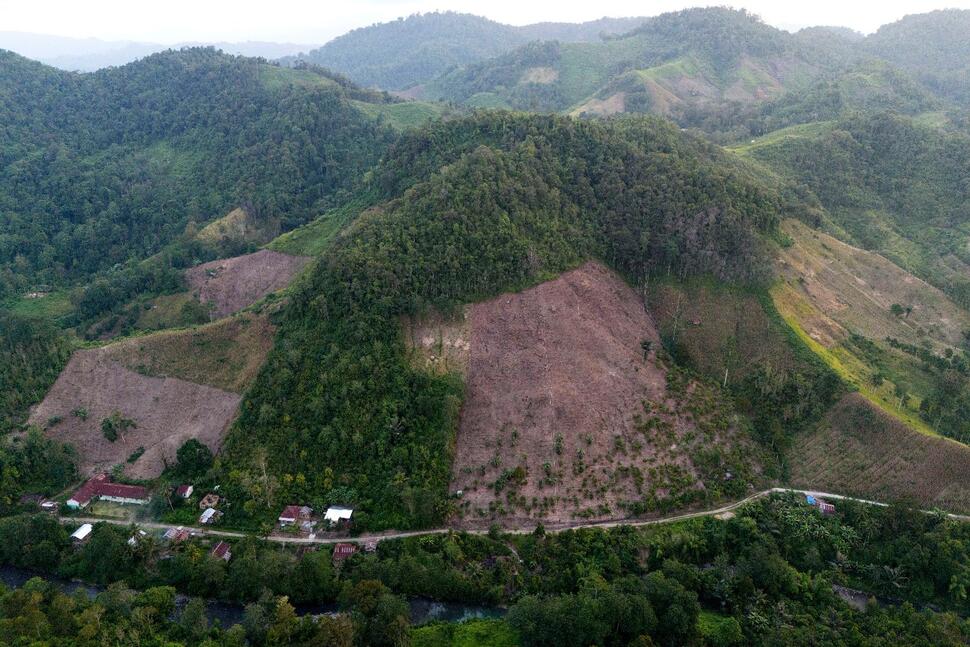
The Awyu and Moi say they want to stop the plantations for the benefit of their community and future generations. [Bay Ismoyo/AFP] 

By  Al Jazeera Staff Published On

 28 May 2024 

Indigenous activists from the Indonesian province of West Papua have held traditional ceremonies outside the country’s Supreme Court in Jakarta calling for their traditional land and forests to be protected from palm oil plantations.

Representatives of the Awyu and Moi communities held prayers and performed dances in front of the Supreme Court building on Monday as the court was reviewing an appeal in relation to their efforts to revoke permits for four palm oil companies whose proposed plantations threaten their customary forests. Indonesia began legally recognising customary forests in 2016.

“We have taken the long, difficult and expensive path from Tanah Papua [Papua homeland] to end up here in Indonesia’s capital Jakarta, asking the Supreme Court to restore our rights, and the land that was snatched from us when these palm oil companies were issued permits over it,” said Hendrikus “Franky” Woro, an Awyu Indigenous man.

Woro filed an environmental and land rights lawsuit in the Papuan capital of Jayapura challenging the plan by a Malaysian-owned palm oil company to clear tens of thousands of hectares of previously untouched West Papuan forest, including traditional Indigenous land.

Environmental campaign group Greenpeace said the potential emissions from clearing the 26,326 hectares (65,053 acres) of primary forest in its concession would amount to about 23 million tonnes of CO2, equivalent to 5 percent of Indonesia’s annual carbon emissions expected in 2030.

The Awyu have also intervened in appeals taken by two other palm oil companies against a decision by the minister of environment and forestry to cancel permits that it had previously issued for them to clear Indigenous lands. The revocation has the potential to save 65,415 hectares (161,644 acres) of pristine rainforest, six times the area of the city of Paris, Greenpeace said.

The Supreme Court is the communities’ last chance to defend their customary forest and generations of ancestral heritage.

“We have been tormented for years by the threat of our traditional forests being replaced by palm oil plantations. We want to raise our children with the help of nature, and the food and materials we harvest from the forest. Palm oil will destroy our forests, we reject it,” said Rikarda Maa, an Awyu Indigenous woman.

The Moi Indigenous community, meanwhile, is fighting to protect thousands of hectares of customary forest that has also been earmarked for palm oil. The company involved had its permits revoked amid community opposition but lower courts later ruled in favour of the planter.

“The judicial panel needs to prioritise aspects of the case that relate to environmental and climate justice, the impact of which will not only be felt by the Awyu and Moi but the entirety of the Indonesian people,” Tigor Hutapea, a member of the legal team from Pusaka Bentala Rakyat, said in a statement.

Global Forest Watch, a monitoring platform run by the World Resources Institute, said last month that since 1950, more than 74 million hectares (183 million acres) of Indonesian rainforest — an area twice the size of Germany — had been logged, burned or degraded for the development of palm oil, paper and rubber plantations, nickel mining and other commodities.

Indonesia is the world’s biggest producer of palm oil, and Malaysia number two. Indonesia is also a major exporter of commodities such as coal, rubber and tin.
Deforestation in Indonesia Spiked Last Year, but Resources Analyst Sees Better Overall TrendA data analysis shows Indonesia had a 27% increase in primary forest loss in 2023

By Associated Press

April 28, 2024, at 10:06 p.m.

JAKARTA, Indonesia (AP) — From trees felled in protected national parks to massive swaths of jungle razed for palm oil and paper plantations, Indonesia had a 27% uptick in primary forest loss in 2023 from the previous year, according to a World Resources Institute analysis of deforestation data. But the loss is still seen as historically low compared to the 2010s, it said.

“Deforestation has been declining from six or so years ago, when there were peak rates,” said Rod Taylor, global director of the forests program at WRI. “It’s good news and commendable for Indonesia.”

But others saw cause for concern in the uptick, and tied some of the more recent deforestation to the world’s appetite for mining Indonesia’s vast deposits of nickel, which is critical for the green energy transition.

The latest data from the University of Maryland’s Global Land Analysis and Discovery laboratory was shared on Global Forest Watch — a platform run by WRI that provides data, technology and tools for monitoring the world’s forests.

A vast tropical archipelago stretching across the equator, Indonesia is home to the world’s third-largest rainforest, with a variety of endangered wildlife and plants, including orangutans, elephants and giant forest flowers. Some live nowhere else.

Since 1950, more than 74 million hectares (285,715 square miles) of Indonesian rainforest — an area twice the size of Germany — have been logged, burned or degraded for development of palm oil, paper and rubber plantations, nickel mining and other commodities, according to Global Forest Watch. Indonesia is the biggest producer of palm oil, one of the largest exporters of coal and a top producer of pulp for paper. It also exports oil and gas, rubber, tin and other resources.

Expansion of industrial plantations occurred in several locations adjacent to existing palm oil tree and pulp and paper plantations on the tropical islands of Kalimantan and West Papua, according to the analysis.

The Indonesian Ministry of Environment and Forestry said the expansion occurred in concessions granted before the current administration took office in 2014.

The Indonesian Ministry of Environment and Forestry did not respond to questions and a request for comment sent by The Associated Press.

Global Forest Watch’s data on Indonesia’s loss of primary forests — which are old-growth forests typically high in stored carbon and rich in biodiversity — are higher than the official Indonesian statistics. That’s because much of the primary forest loss in Indonesia, according to the analysis, is within areas that Indonesia classifies as secondary forest — areas that have regenerated through largely natural processes after human actions such as agriculture clearing or timber harvest. Secondary forests typically have reduced capacity for storing carbon than primary forests.

Deforestation linked to the mining industry occurred in Sumatra, Sulawesi, Mlauku and Kalimantan, according to the analysis.

Indonesia has the world’s largest reserves of nickel — a critical material for electric vehicles, solar panels and other goods needed for the green energy transition. And part of this deforestation can be directly linked to the expansion of Indonesia’s nickel industry, said Timer Manurung, director of Auriga Nusantara, a nongovernmental conservation organization based in Indonesia.

Manurung said it’s not clear exactly how much of Indonesia deforestation is due to mining. But he called it a “significant driver,” and said the government’s rapid development of the country’s mining and nickel industry — including more than 20 new smelters to process the nickel ore — is “repeating Indonesia’s oil palm and pulpwood mistakes” of increasing deforestation.

But Taylor noted that deforestation done on a massive scale seems to be shrinking, compared to the past.

In the 2010s there was gargantuan oil palm, timber and large-scale plantation expansion across Indonesia. Research in the Nature Climate Change journal found that the deforestation rate doubled to approximately 2 million hectares per year during 2004-2014.

In 2023, primary forest loss in patches greater than 100 hectares made up just 15% of the loss, according to the analysis.

Taylor attributes this lack of large-scale deforestation patches to the reputational risks that companies face if they are found to be razing trees. In recent decades nongovernmental organizations, consumers and governments — including the European Union — have pushed for companies to move away from deforestation practices.

In 2018 Indonesian President Joko Widodo put a three-year freeze on new permits for palm oil plantations. And the rate of deforestation slowed between 2021-2022, according to government data.

But small-scale primary forest loss was still prevalent throughout the country, including within several protected areas such as Tesso Nilo National Park and Rawa Singkil Wildlife Reserve on the island of Sumatra. Both areas are home to critically endangered animals such as tigers and elephants.

A wetter than usual El Nino — which usually leads to less rainfall and higher temperatures that can cause rapid spread of fires set to clear land for agriculture — contributed to a quieter than expected fire season, Taylor said. So did investments made by the Indonesian government in fire prevention capabilities, as well as efforts to suppress fire by local communities.

During Indonesia’s last El Nino in 2015-2016, fires intentionally started to clear land for agriculture rapidly spread, sending haze across Southeast Asia. Several Indonesian provinces declared states of emergencies, respiratory illnesses spiked and thousands of Indonesians had to flee their homes.

“The good news in Indonesia is that the fire prevention measures are much more sophisticated than they were in years past,” said Taylor. “It’s really making a difference.”

___ Associated Press climate and environmental coverage receives support from several private foundations. See more about AP’s climate initiative here. The AP is solely responsible for all content.–