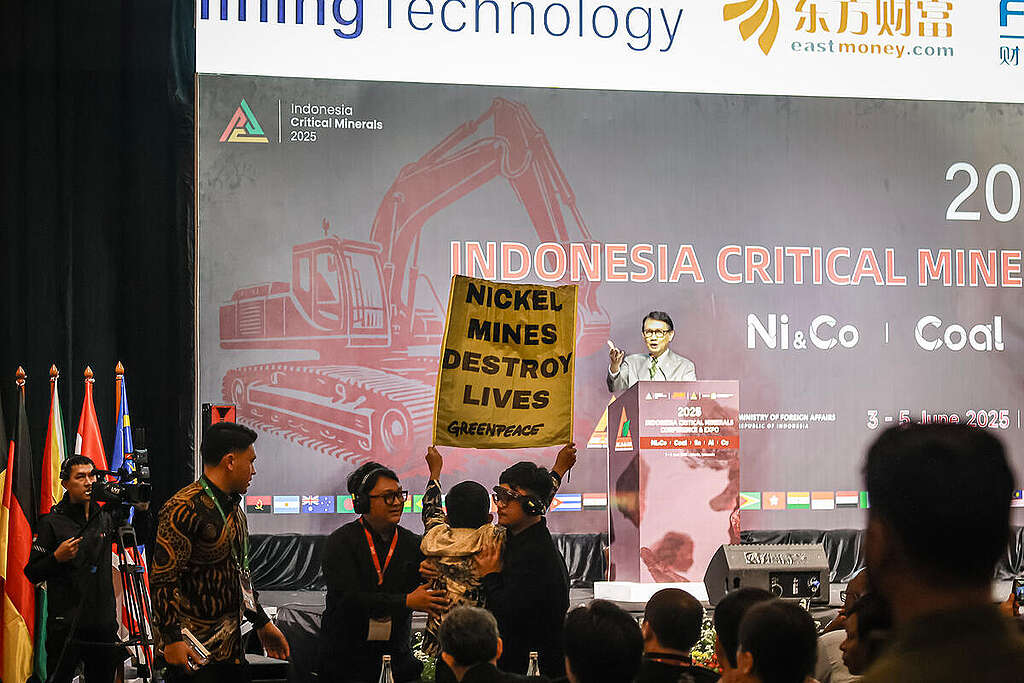
Through this direct action, Greenpeace aims to deliver an urgent message to the Indonesian government, nickel industry executives gathered at the event, and the wider public: nickel mining and processing are inflicting profound suffering on affected communities across Eastern Indonesia. The industry is razing forests, polluting vital water sources, rivers, seas, and air, and is exacerbating the climate crisis through its reliance on captive coal-fired power plants for processing.
“While the government and mining oligarchs discuss expanding the nickel industry at this conference, communities and our planet are already paying an unbearable price,” said Iqbal Damanik, Greenpeace Indonesia Forest Campaigner. “The relentless industrialization of nickel – accelerated by soaring demand for electric cars – has destroyed forestlands, rivers, and seas from Morowali, Konawe Utara, Kabaena, and Wawonii, to Halmahera and Obi. Now, nickel mining even threatens Raja Ampat in West Papua, a globally renowned biodiversity hotspot often called the last paradise on Earth.”
Following an investigative journey through West Papua, Greenpeace exposed mining activities on several islands within the Raja Ampat archipelago, including Gag Island, Kawe Island, and Manuran Island. These three are classified as small islands and, under the law concerning the management of coastal areas and small islands, should be off-limits to mining.
Greenpeace analysis reveals that nickel exploitation on these three islands has already led to the destruction of over 500 hectares of forest and specialised native vegetation. Extensive documentation shows soil runoff causing turbidity and sedimentation in coastal waters – a direct threat to Raja Ampat’s delicate coral reefs and marine ecosystems – as a result of deforestation and excavation.
Beyond Gag, Kawe, and Manuran, other small islands in Raja Ampat such as Batang Pele and Manyaifun are also under imminent threat from nickel mining. These two adjacent islands are situated approximately 30 kilometers from Piaynemo, the iconic karst island formation pictured on Indonesia’s Rp100,000 banknote.
Raja Ampat is celebrated for its extraordinary terrestrial and marine biodiversity. Its waters are home to 75 percent of the world’s coral species and over 2,500 species of fish. The islands themselves support 47 mammal species and 274 bird species. UNESCO has designated the Raja Ampat region as a global geopark.
Ronisel Mambrasar, a West Papuan youth from the Raja Ampat Nature Guardians (Aliansi Jaga Alam Raja Ampat), said, “Raja Ampat is in grave danger due to the presence of nickel mines on several islands, including my own home in Manyaifun and Batang Pele Islands. Nickel mining threatens our very existence. It will not only destroy the sea that has sustained our livelihoods for generations but is also fracturing the harmony of our communities, sowing conflict where there was once harmony.”
Greenpeace Indonesia urgently calls on the government to fundamentally reassess its nickel industrialization policies, which have already triggered a cascade of problems. The hollow boasts about the benefits of downstreaming, championed by the previous administration and now perpetuated during the presidency of Prabowo Subianto, must end. The nickel industrialization drive has proven to be a tragic irony: instead of delivering a just energy transition, it is systematically destroying the environment, violating the rights of Indigenous Peoples and local communities, and deepening the damage to an Earth already buckling under the weight of the climate crisis.
There exists a solidarity among men as human beings that makes each co-responsible for every wrong and every injustice in the world, especially for crimes committed in his presence or with his knowledge.
If I fail to do whatever I can to prevent them, I too am guilty.
– Karl Jaspers
What’s the relationship between an emaciated, dying Wondiwoi tree kangaroo(whose small joey in her pouch is also condemned to death) and tooth decay or obesity in a kid in any European city? The world’s perhaps only fifty remaining Wondiwoi tree kangaroos are gorgeous marsupials with large eyes, sweet faces, thick burnt-umber coats, and strong claws for grasping tree branches. Human kids are also gorgeous creatures, often with large eyes, sweet faces, thick overcoats, and grasping hands (especially if there’s a KitKat in sight). But that’s the superficial connection. The underlying, truly dangerous relational bond is palm oil. Each individual, the cute animal and the cute kid, represents the horrors of an insane system of consumption that’s destroying everything it touches on both sides of the story, the kid’s and the tree kangaroo’s.
It’s no news that unhealthy items stack shelves at child-eye level in supermarket checkout queues. You’re waiting, have nothing to do but look at the last tempting offers, so you throw a couple of KitKats into your basket or buy one to quieten a whining kid. KitKats will sweeten your day. They also kill all sorts of beautiful rainforest creatures, and they displace and kill people who once lived on and with the land where their ingredients are now grown. If you buy cigarettes, the packet screeches, with ghastly illustrations, that you’re courting head or neck cancer, and that your smoking can cause fatal lung disease in nonsmokers. KitKat wrappers show no pictures of dying Wondiwoi tree kangaroos or caries in tender little mouths.
I’m singling out KitKats to represent the vast array of products made from palm oil and because it’s among several supposedly seductive products listed in a boycott recently called by more than ninety West Papuan tribes, political organisations, and religious groups. The other products and labels they name are Smarties, Aero chocolate, Oreo biscuits, Ritz crackers, Pantene, and Herbal Essences. But the boycott is about more than a few products that are damaging at both production and consumer ends of the scale. It’s about late capitalist corporate imperialism where industrialists lawlessly operate in boundless, rather than delineated parameters of space and time, aided by the global data (mis)information economy, which splatters its fraudulent spiel everywhere in worldwide linkups. Hence the connection of KitKat with a treeless, starving tree kangaroo.
After being betrayed by the United Nations more than sixty years ago, Melanesian West Papua, occupied by Indonesia ever since, is a particularly poignant case in point. In its increasingly militarised torture mode of governance, the Indonesian regime—now headed by Prabowo Subianto, notorious for his war crimes in East Timor—is the world’s biggest palm oil exporter, to the tune of 47 million tonnes of crude palm oil in 2023, and 54% of global exports. The industry accounts for 4.5% of Indonesian GDP and directly or indirectly employs 16.2 million people. The total area of Indonesian palm oil cultivation is about 25 million hectares (out of 29 million hectares globally, which amounts to approximately 6.7% of the size of the European Union), and plantations covering many million more hectares are planned. In 2023, industrial oil palm plantations in Indonesia expanded by 116,000 hectares, a 54% increase compared with 2022. The largest oil palm project so far is Tanah Merah, in Boven Digoel Regency. Seven companies control the area of 280,000 hectares of which more than 140,000 hectares of land traditionally occupied by the Awyu people will be taken for oil palm production.
In West Papua this destructive extractivism also entails violent social change for the country’s Indigenous peoples. It’s impossible to know how many people have been displaced in the name of “food security” (security for KitKat production) as the Indonesian government is understandably averse to providing statistics of the genocide it has been committing in West Papua for more than sixty years. The Office of the High Commissioner on Human Rights calculates that there are between 60,000 and 100,000 internally displaced people. Mining, palm plantations, and logging by Indonesian and international companies are protected by the state transmigration programme which creates militarised buffer zones protecting the areas designated for Indonesian government “development” programmes. It’s calculated that Indonesian transmigrants outnumber West Papuans by about ten percent, and approximately 25% of the Indigenous population, or more than 500,000 people have been killed. Needless to say, the demographics represent atrocious human rights violations, including destruction of West Papuan languages and culture.
Taking rainforest land for palm oil monoculture also means taking water. In areas where these plantations are forcefully introduced, women are particularly affected. In West Papua and other parts of the world, they bring water to their villages for activities that sustain community social life and hence its reproductive cycle. When villages disappear with the land and the water, women suffer sexual violence when forced beyond the confines of their traditional safe territory to be exploited as cheap labour on plantations, or when they have to resort to prostitution in shantytowns in order to survive, in a chain of generalised abuse that includes sexually servicing uprooted men who are brought in and also exploited as cheap labour or (in the case of West Papua) as transmigrants.
Here’s an example of how a person eating a KitKat isn’t aware that he or she is also consuming the bravery and resistance of women forest guardians which, now mixed with sugar and trampled into the sludge of what was once rainforest, rots his or her teeth. In October 2023, dozens of women from the Tehit clans of the Afsya people in Kondo district, Sorong Regency, West Papua held an emergency meeting, where they shared and wrote down everything they knew about their community’s special places: where to find good sago, where to cultivate their crops, where to find medicinal plants, where their sacred places were, and all their deep connections with their habitat. But they can’t save this world of community solidarity because in 2014, the Indonesian government granted a concession of 37,000 hectares of what was then 96% intact rainforest to PT Anugerah Sakti Internusa, a subsidiary of the Indonusa Agromulia Groupwhich is owned by Rosna Tjuatja. Subsequent permits gave the company permission to start destroying 14,467 hectares within this concession area and plant millions of oil palm trees.
Meanwhile, Indonesian president, Prabowo Subianto who, with a personal fortune of over $130 million and holdings of almost half a million hectares of land, poses as the great champion of planetary “food security”, says that palm oil expansion won’t deforest because “oil palms have leaves”. In fact, clearing forest for a palm plantation releases more CO2 than can be sequestered by growing oil palms on the same land. But the overriding message is that oil palms are fine because they have leaves and we need “indulgent products” that eat up rainforests to rot children’s teeth. Somehow, consumers swallow this rubbish with sweet junk in colourful wrappers. Nestlé, owner of KitKat (now with a KitKat cereal “designed to be enjoyed as an ‘occasional, indulgent’ breakfast option”) has recently fobbed off investor moves to reduce its high levels of salt, sugar, and fats, with an 88% shareholder vote in favour of said high levels. Nestlé, well known for its many human rights abuses, obtained this majority with the argument that any “move away from ‘indulgent products’ could harm its ‘strategic freedom’”. Strategic freedom, leaf-green and sweetly sugar-coated, to kill.
On the other side of the world, shoppers who are sickened by the slaughter of human kin and other animals, about the ravaging of Earth’s environments, can try to observe the West Papuan boycott by checking to see if products contain palm oil. But information overload is a form of lying, a way of bamboozling people, so palm oil is hidden in names like Vegetable Oil, Vegetable Fat, Palm Kernel, Palm Kernel Oil, Palm Fruit Oil, Palmate, Palmitate, Palm olein, Glyceryl, Stearate, Stearic Acid, Elaeis Guineensis, Palmitic Acid, Palm Stearine, Palmitoyl Oxostearamide, Palmitoyl Tetrapeptide-3, Sodium Laureth Sulfate, Sodium Lauryl Sulfate, Sodium Kernelate, Sodium Palm Kernelate, Sodium Lauryl Lactylate/Sulphate, Hydrated Palm Glycerides, Etyl Palmitate, Octyl Palmitate, Palmityl Alcohol, Laureth-7, Steareth-2, Cocamide MEA (fatty acid-derived) Cocamiede DEA (fatty acid derived), Stearamidopropyldimethylamine, Cetyltrimethylammonium chloride, Isopropylmyristate, Caprylic/capric Trigylceride, Fatty Isethionates (SCI), Alkylpolyglycoside (APG), and Laurylamine oxide. The large number of names behind which palm oil is hidden warns, in itself, what a destructive product it is. People can do their best to boycott these products, but any boycott also requires thinking about whether we actually need them, and how to overthrow the system that produces them, knowing how damaging they are, knowing how the profits are concentrated in ever smaller circles of greedy despoilers, and how these profits are plump with death and mayhem in societies we are supposed not to think about, unless in racist terms, let alone learn from them about their harmonious ways of living on this planet.
In its multifarious disguises, palm oil is everywhere, in about 50% of packaged products sold in supermarkets, from foodstuffs to deodorant, shampoo, toothpaste (for rotting teeth), makeup, “beauty” products (thus profiting from exploitation and control of women’s bodies), petfood, and biofuels. In other words, the question of the caries-producing KitKat is also a moral question because governments, political institutions, and the multinational companies they protect are lying to the people they are supposed to represent. Waivered so that corrosive, erosive and literally poisonous (in places like West Papua) food products can keep flooding markets, national and international legal provisions are facilitating the ruination of rainforests and their guardians. Hence, they are not legitimate. It’s pure madness. KitKats are unnecessary. Rainforests and their guardians are more necessary that ever in this age of climate catastrophe. The climate breakdown, “the severe and potentially catastrophic consequences of unchecked climate change, including extreme weather events, rising sea levels, and widespread environmental degradation, often used in a context of urgency and alarm” is also a generalised moral breakdown that is accelerating the calamity from which no one will be spared.
Freedom from hunger is a basic human right. But there’s a difference between a hungry child whining for a KitKat in a western supermarket and people, hungry to the point of starvation, who have been displaced to ensure that supermarket shelves can be stocked with KitKats. A couple of dollars satisfy a child who wants a KitKat but nothing will fill the bellies of Indigenous peoples who are displaced from their customary lands, deprived of resources which, more than just filling their bellies, constitute their livelihoods, their culture, community values, and physical and psychological wellbeing. In the language of “development”, this way of life that respects the environment is presented as backward and discardable. So, in the Merauke district, in the name of “national food sovereignty” and supposedly green “renewable energy”, more than a million hectares have been chopped down in the last decade for monocrop oil palm plantations, with the result of massive food insecurity among the local Marindpeople, as anthropologist Sophie Chao describes. No longer able to harvest their traditional rainforest food—fish, game, fruits, sago, and tubers—they are now obliged to subsist on instant noodles, rice, canned foods, and sugary drinks, a diet which, closer to KitKats than forest nutrition, has led to, “Stunting, wasting, and chronic protein-energy malnutrition are particularly high among women and children, rendering them vulnerable to pneumonia, parasitism, bronchitis, and a range of gastrointestinal and musculoskeletal diseases” which are aggravated by “collective feelings of sorrow, grief, pain, and anger”.
Unlike KitKat-producing tree killers, the Marind people understand the rainforest as having a sentient ecology that is manifested in seasonal rhythms and the natural signs of the rainforest, its features, and its dwellers. Every change, every sign tells them about the health of the forest and suggests how to care for it by knowing which animals they should hunt and when, by using the appropriate tracks or river sections, and by harvesting the vegetation in season. This care for the forest’s health is reflected in their own wellbeing. It is a harmonious way of life.
The hungry child in a supermarket can be satisfied with a tooth-rotting treat but hunger for West Papua’s dispossessed Indigenous peoples also means destruction of whole “ecosystems, soils, and water that these plants and animals depend on to survive and thrive in mutual relations of eating and being eaten that operate across species lines”, as Sophie Chao writes. Eating in the rainforest has a social significance expressed in traditional hunting and gathering, food preparing, and consumption practices that feed more than human bodies because they nurture ties between individuals and groups. The fact that there some 250 tribes with their own languages may, for a western shopper in a supermarket (where people rarely speak to or even look at each other), seem to be primitive and hostile fragmentation. Far from it. This is a complex system of democracy, rules and agreements among tribes that has worked well for some 50,000 years. People, identifying with their own tribes and also as West Papuans, have always understood the rules of the system. Lawless junk foods that destroy and replace this intricate system have no social meaning except for being trash and trashing everything.
A kid crying for a KitKat in a supermarket feels only his or her imperious individual need for instant satisfaction. But among the Marind people, hunger is contagious because it’s a social malaise. If one person is weak and malnourished, the group feels undernourished and fragile in what Chao calls “a form of transcorporeal and affective transference”. In rainforest “communities of fate”, the contagion spreads beyond humans, the plants wilt when their biodiverse ecologies are fenced off, or they are poisoned with pesticides, fertilisers, and contaminated water, or chopped down, burned, and crushed by heavy industrial farming and military equipment. Tree kangaroos, wild pigs, cassowaries, and birds of paradise are enslaved or killed in the pet and feathers trade, fish are poisoned in contaminated streams, and when homeless creatures are adopted in an effort to protect them, they too pine away.
Chao gives a moving account of the fate of a cassowary called Ruben, hatched by villagers from an egg rescued from a deserted nest in bulldozed rainforest. She was sitting with a group of villagers enjoying an after-dinner conversation when, “During a momentary lull in the conversation, Ruben’s shy whistle echoed through the night. I smiled and commented on how sweet his song was, and how lucky we were to have such a cute pet among us”. Her friends immediately fell sad. One old woman explained how mistaken she was. “This is no song, sister. This is a weeping. This is the cry of the cassowary. Can you not hear the sadness, child? Does it not rip through your heart with the speed of a hardwood ngef (Arenga pinnata) arrow? We hear only a weeping, a lament. We feel the grief of the khei (cassowary) as it seeps through our skin and bone. We hear death and mourning in its call. No longer wild (liar) or free (bebas), the cassowary has become plastik (plastic).”
In this “more-than-human ecology of hunger”, the oil palm too is hungry (lapar)—and this is exactly how the Marind people describe it—but it is voracious and antisocial, not unlike a kid throwing a tantrum in a supermarket, except that it does far more damage by insatiably devouring the rainforest, all living things in it, its social life, its identities, and its cultures, turning even cassowaries into “plastic” things, and extending all the way to rotting the teeth of people who insouciantly consume its products on the other side of the planet. Territory-gobbling roads and towns are also lapar and the Marind people very well understand that the governments, corporations, and obscenely rich individuals that are fuelling their fires and machines with plants, animals, humans, and traditions as they go devouring everything that is beautiful, valuable, and meaningful around them, are greedy things contributing nothing but rot to the world. They know all too well that hunger is a political phenomenon. National food security discourse dictates which bodies and ecologies must be fodder (literally, biofuel), to produce junk food for others.
Greenwashing organisations like the World Wildlife Fund, established by dodgy characters like the racistDuke of Edinburgh and Nazi-linked, leading man of the Lockhart bribery scandal, Prince Bernhard of Holland, as an elite club of an anonymous thousand-plus richest people in the world, influencing global corporate and policy-making power, and “setting up ‘round tables’ of industrialists on strategic commodities such as palm oil, timber, sugar, soy, biofuels and cocoa”, argue that oil palm boycotts aren’t “helpful”. No, of course they aren’t helpful for WWF funders, among them Coca-Cola, Shell, Monsanto, HSBC, Cargill, BP, Alcoa, and Marine Harvest. This pretence that there are sustainable solutions for the sugary rot of KitKat, is yet another smokescreen (obscuring everything like sooty clouds rising from burning rainforest to the extent of even halting air traffic) to hide the fact the West Papuan call for a boycott of KitKat and other palm oil products is a profoundly moral stance, challenging western consumption practices and all the lies underpinning them.
The names of many oil palm products, reveal how they lie (Nature’s Bounty, for example) and that they are nearly all “indulgent” (Pampers, for example). Lists might be boring but some names should be mentioned to show how the wreckage of most of what is good about human existence is wreaked by more than just a few useless, “indulgent”, corruptive products. They involve food retailers and companies like Aldi, Booths, Ocado, Spar, Monde Nissin, Vbites, Mitsubishi, Eat Natural, Nature’s Bounty (ultimately owned by Nestlé), Thai Union, Food Heaven, Almond Dream, East End Foods, Müller, Koko; drinks companies like Redbush Tea Co, Healthy Food Brands, SHS Group, Nichols, R. White’s, Fruitshoot; coffee shops including Soho Coffee Company, Caffè Nero, Caffè Ritazza, Coffee Republic, AMT Coffee, Esquires, Harris and Hoole, Muffin Break, Boston Tea Party, Puccino’s, and Bewley’s; fast foods, among them Leon, Domino’s Pizza, Yo! Sushi, Burger King, Yum! Brands (Pizza Hut, KFC), Itsu, Subway, Greggs, Pret A Manger; restaurant chains like Wahaca, TGI Friday’s, Giraffe, Mitchells and Butlers (Harvester, All Bar One), Greene King. Whitbread, Pizza Express, The Restaurant Group (Chiquito, Frankie and Benny’s, Wagamama), Azzurri (ASK), Jamie’s Italian, Colgate-Palmolive and Nestlé getting the worst ratings; perfumes like Holland and Holland (Chanel perfume), Shiseido Company Limited (Dolce and Gabbana perfume), Inter Parfums (Jimmy Choo, Karl Lagerfield, Oscar dela Renta, Paul Smith, Gap, Banana Republic perfumes), Pacifica, Bliss, L’Occitane, Coty (Max Factor, Wella, plus perfumes for Adidas, Burberry, David Beckham, Calvin Klein); Natura Cosmeticos (Aesop), Suntory (F.A.G.E), Wahl, The King of Shaves, Lansinoh (Earth Friendly Baby), Baylis and Harding, Koa (John Frieda, Molton Brown), Crystal Spring, PZ Cussons (Morning Fresh, Original Source Charles Worthington, Imperial Leather), WBA Investments (Boots, No7, Soap and Glory, Botanics), Tom’s of Maine, Superdrug, Midsona (Urtekram), Laverana (Lavera), Logocos (Logana, Sante), Li and Fung (Vosene, Clinomyn toothpaste), Church and Dwight (Arm & Hammer, Pearl Drops, Arrid, Batiste), Revlon (Revlon, Almay, Mitchum), Bull Dog, Clarins, Edgewell (Banana Boat, Wilkinson Sword, Carefree, Bulldog Skincare for men), and Holland and Barrett; and cleaning products including Mcbride (Frish, Surcare, Planet Clean, LimeLite), The London Oil Refining Co Ltd (Astonish), Enpac (Simply), Lilly’s Eco Clean, Active Brand Concepts (Homecare), WD-40 (1001), Jeyes (Jeyes, Bloo, Sanilav, Parozone), and Procter and Gamble (Fairy, Head and Shoulders, Pampers, Always).
Rainforests are essential for the planet and all life on it. The ethical reach of the West Papuan boycott has the same scope as Karl Jasper’s insight about the all-embracing nature of metaphysical guilt, because the rot in a child’s teeth resulting from capitalist consumption practices is tangible and often painful evidence of the rot throughout the whole system that peddles—as essential for human wellbeing—commodities that kill wondiwoi tree kangaroos, kill people, kill planet Earth, and where life, in the plans of the richest men, will be confined to the “strategic freedom” of “indulgent”, “intelligent” bunkers.
Christian Solidarity International’s statement against expanded land exploitation and military occupation provokes reaction from government of Indonesia
GENEVA, SWITZERLAND, March 28, 2025 /EINPresswire.com/ — The indigenous peoples of West Papua face renewed threats to their land rights, Christian Solidarity International (CSI) warned at the United Nations Human Rights Council in Geneva on March 28.
In an oral statement delivered during the 58th Session, CSI’s Abigail McDougal recalled that since assuming office last fall, Indonesian President Prabowo Subianto had announced a revival of the government’s transmigration program to settle non-indigenous people in the province of West Papua. In addition, he had authorized the creation of two million hectares of new rice and sugar plantations, and a 50 percent increase in production capacity at the region’s Tangguh liquid natural gas facility.
“These projects threaten not only the third largest rainforest in the world and one of the most biodiverse regions on the planet, but also the land that the indigenous peoples of West Papua call home,” CSI’s Deputy Director of Public Policy and Communications stated. According to Amnesty International, the resulting environmental degradation would pose an “existential threat to the people of West Papua.”
—
“These projects threaten not only the third largest rainforest in the world and one of the most biodiverse regions on the planet, but also the land that the indigenous peoples of West Papua call home.”
Abi McDouga
—
The planned projects would entail an increased military presence in West Papua, which has been subjected to military occupation for decades. This “is particularly concerning,” McDougal said, “as Indonesia’s parliament last week amended the country’s military law, removing checks on the military’s power.”
West Papua is the easternmost region of modern-day Indonesia. While Indonesia is the largest Muslim-majority country in the world, the indigenous peoples of West Papua are almost completely Christian
West Papua was made a colony of the Netherlands in 1898, and was administered separately from Dutch-ruled Indonesia. It was only handed over to Indonesia in 1962, thirteen years after Indonesia became independent. This decision provoked widespread protests and an independence movement that continues until today.
With more than 79,000 West Papuans already internally displaced by military operations, protecting Papuans’ land ownership is an urgent imperative, McDougal said.
The UN’s 2021 Durban Declaration and Program of Action on combatting racism calls on states “to ensure that indigenous peoples are able to retain ownership of their lands and of those natural resources to which they are entitled under domestic law,” she recalled.
“Christian Solidarity International calls on the government of Indonesia to halt its transmigration program in West Papua, protect indigenous land rights, and allow international rights monitors to enter the region,” McDougal concluded.
The Indonesian delegation responded to CSI’s statement during the general debate, stating that they “reject the allegation that the Indonesian people in the six provinces of Papua are subjected to…discrimination” and pledging to “continue dialogue with all stakeholders, including with the local communities, to ensure their voices are heard.”
Reacting to the Indonesian delegation’s reply, CSI’s Director for Public Advocacy, Joel Veldkamp, said, “There could not be a greater contrast between the Indonesian government’s assurances at the Human Rights Council, and what we hear from our friends in West Papua – that Indonesian government-led projects cause them to fear for the very survival of their people.”
“We reiterate our call to the government of Indonesia to halt its destructive campaigns in West Papua.”
About CSI
Christian Solidarity International is an international human rights group campaigning for religious liberty and human dignity.
Video
Joel Veldkamp Christian Solidarity International +41 76 258 15 74 email us here
CSI at the UN: Indonesia must protect indigenous land rights in West Papua
More than 250 members of Indigenous and local communities gathered in Indonesia’s Merauke district to demand an end to government-backed projects of strategic national importance, or PSN, which they say have displaced them, fueled violence, and stripped them of their rights.
PSN projects, including food estates, plantations and industrial developments, have triggered land conflicts affecting 103,000 families and 1 million hectares (2.5 million acres) of land, with Indigenous communities reporting forced evictions, violence and deforestation, particularly in the Papua region.
In Merauke itself, the government plans to clear 3 million hectares (7.4 million acres) for rice and sugarcane plantations, despite Indigenous protests; some community members, like Vincen Kwipalo, face threats and violence for refusing to sell their ancestral land, as clan divisions deepen.
Officials have offered no concrete solutions, with a senior government researcher warning that continued PSN expansion in Papua could escalate socioecological conflicts, further fueling resentment toward Jakarta and potentially leading to large-scale unrest.
JAKARTA — Hundreds of Indigenous people and civil society groups in Indonesia are demanding an end to government projects that have seized their lands, fueled violence, and stripped them of their rights.
In the second week of March, more than 250 members of Indigenous and local communities affected by projects classified as being of strategic national importance, or PSN, gathered in Merauke, a district in Indonesia’s Papua region bordering Papua New Guinea.
Over four days, attendees shared their experiences of displacement and suffering caused by PSN projects, which include roads, dams, power plants, industrial estates and plantations.
The communities represented at the dialogue included those impacted by food estate projects in the provinces of North Sumatra, Central Kalimantan, Papua and South Papua; the Rempang Eco City project in the Riau Islands province; the Nusantara capital city (IKN) project in East Kalimantan; the Poco Leok geothermal project in East Nusa Tenggara; extractive industries related to biofuel in Jambi; various projects in West Papua; and the expansion of oil palm plantations across the wider Papua region.
Some community members have been displaced from their ancestral lands. Others, who continue fighting for their land rights, face violence at the hands of the military and police.
According to the Agrarian Reform Consortium (KPA), there were 154 PSN-related conflicts from 2020 to 2024, affecting 103,000 families and 1 million hectares (2.5 million acres) of land. The National Commission on Human Rights (Komnas HAM) received 114 complaints related to PSN between 2020 and 2023, including allegations of forced evictions, violence against protesters, labor abuses, environmental degradation, and attacks on journalists.
With PSN projects continuing, affected communities at the Merauke dialogue, facilitated by the NGO Pusaka, issued a declaration on March 14, calling for the projects’ termination in front of government officials.
“We demand the complete cessation of National Strategic Projects and other so-called national interest projects that clearly sacrifice the people,” the declaration read in part. “The perpetrators of state-corporate crimes must return all stolen wealth to the people and immediately restore their health and living spaces in all areas sacrificed in the name of national interest.”
Pusaka director Franky Samperante said the “Merauke solidarity declaration” marks the beginning of resistance to the destruction of communities and their living spaces.
“Our next task is to strengthen the Merauke solidarity movement and continue rejecting and resisting PSN and other so-called national interest projects that blatantly sacrifice the people,” he said.
History of PSN
The PSN framework was formalized during the administration of former president Joko Widodo, in office from 2014-2024. His government prioritized infrastructure development as a key driver of economic growth, issuing a regulation in 2016 that outlined a list of priority projects to be developed under the PSN framework. The main benefit to developers of such a designation is eminent domain: the government can invoke this power to take private property for public use, ostensibly to fast-track development, but often at the cost of people’s rights and environmental and social impacts.
Between 2016 and 2024, the government initiated 233 PSN projects, with a total investment value of around $378 billion.
When Prabowo Subianto took office as president in 2024, he continued and expanded the PSN program. His administration retained 48 ongoing projects from the previous administration, while adding 29 new projects, increasing the total PSN count to 77 projects. The new projects focus on food security, energy sovereignty, water infrastructure, and mining and industrial downstreaming.
The awarding of PSN designation to various projects has drawn criticism for bypassing regulatory hurdles, fast-tracking approvals, limiting oversight, and granting the government eminent domain rights to evict entire communities. Many projects primarily benefit large corporations and politically connected businesses rather than local communities, despite the government claims that they drive economic
Food estate
One example is the food estate project in Merauke, where agribusiness giants have secured vast concessions, often at the expense of Indigenous land rights. Carried over from the previous administration, the project aims to clear 3 million hectares (7.4 million acres) of land in Merauke — two-thirds of it for rice fields and the rest for sugarcane plantations — an area 45 times the size of Jakarta.
From the start, Indigenous Papuans living in the project area have protested, saying they were never properly informed or consulted. Many say they fear for their safety due to the heavy military presence and pressure from fellow community members who had already sold their land to developers.
Vincen Kwipalo, a 67-year-old Indigenous man from the Kwipalo clan of the Yei tribe, has been vocal in opposing the project, as the planned concessions overlap with his clan’s ancestral lands.
“We are not selling our customary land. The forests and hamlets owned by the clan are not large. We want to manage them ourselves for our livelihoods and food sources, for our children and grandchildren,” he said.
Vincen said that on Dec. 11, 2024, he was confronted at his home by five machete-wielding men who verbally assaulted him, calling his family “stupid.” He called the police, and the attackers fled when officers arrived.
The next morning, a larger group returned with machetes, threatening to kill him. The situation deescalated only after the village chief intervened.
Vincen said he suspects the attackers were from a neighboring clan that’s been embroiled in a land dispute with his clan. He said this clan had already sold their customary land to a sugarcane developer for around 300,000 rupiah ($18) per hectare — the same offer made to Vincen’s family, which they refused.
Vincen’s wife, Alowisia Kwerkujai, has stood by his side throughout the ordeal. For her, the forest is the source of their life.
The 1,400-hectare (3,460-acre) customary forest claimed by the Kwipalo clan is a thriving ecosystem that’s home to towering trees and diverse wildlife such as cassowaries, wallabies, parrots and eagles. It provides food, materials for daily needs, and is a source of income through rubber and teak plantations.
“That’s why I won’t give the land to the company,” Alowisia said as quoted by BBC Indonesia. “Where would we go? I am a mother raising children, and this land is for them.”
Disappearing forests
Despite the opposition from Indigenous peoples, the food estate project is moving ahead.
As of January 2025, 7,147 hectares (17,660 acres) of forest and savanna had been cleared in Tanah Miring district for the sugarcane project, while 4,543 hectares (11,226 acres) of forest and mangrove had been cleared for the rice-related infrastructure, such as roads and a port, in Ilwayab district, according to data from Pusaka.
Senior officials have claimed there are no forests being cleared.
“There’s no forest in the middle of Merauke,” said the country’s energy minister, Bahlil Lahadalia, who’s in charge of a government task force that manages the project. “There’s only eucalyptus [trees], swamps and savannas.”
However, a spatial analysis by TheTreeMap shows that the ecosystems cleared for the rice project are mostly Melaleuca swamp forests, which are dominated by paperbark trees (Melaleuca leucadendron). These forests are unique ecosystems that appear sparse but are rich in biodiversity and store large amounts of carbon.
A 2016 study in Australia found that Melaleuca forests there store between 210 and 381 tons of carbon per hectare — higher even than the Amazon Rainforest on a per-hectare basis.
“However, Melaleuca forests are often overlooked because, unlike dense rainforests, they are less diverse and have more open structures,” TheTreeMap wrote in a blog post. “These characteristics are sometimes mistaken for signs of degradation, leading to misconceptions that Melaleuca forests are degraded ecosystems, which are not worthy of conservation.”
The construction of a new road for the rice project will further threaten these ecosystems, it added.
Direct plea
During the Merauke dialogue, Vincen addressed government officials in attendance, including the Deputy minister of human rights, Mugiyanto Sipin.
He described how the arrival of the sugarcane plantation project under the PSN scheme had torn apart the social fabric of his community, with families and clans who refuse to sell their land being pressured, intimidated and pitted against each other.
“Sir, can you guarantee my safety if I get killed in the forest?” Vincen asked Mugiyanto as reported by BBC Indonesia. “The government doesn’t see what’s happening. Forget about Jakarta — even the local government here isn’t paying attention to how we are being pushed to fight one another.”
He also made a direct plea to President Prabowo.
“Mr. President, you see the development happening, but you don’t see that we, the Indigenous people, are being forced into conflict — into bloodshed,” Vincen said. “Where else can we seek legal protection?”
Despite growing evidence of human rights violations, Mugiyanto offered no concrete solutions beyond saying he would relay the concerns to higher authorities.
If left unchecked, PSN projects like the Merauke food estate are a “ticking time bomb” waiting to explode, warned Cahyo Pamungkas, a senior researcher at Indonesia’s National Research and Innovation Agency (BRIN).
In Merauke, the food estate project could further escalate tensions, deepening resentment of Papuans toward Jakarta, he said.
If ignored, these warnings foreshadow a crisis unlike any in Indonesia’s history, with “an escalation of socioecological chaos,” warned affected community members in their declaration.
Citation:
Tran, D. B., & Dargusch, P. (2016). Melaleuca forests in Australia have globally significant carbon stocks. Forest Ecology and Management, 375, 230-237. doi:10.1016/j.foreco.2016.05.028
Banner image: Local and Indigenous communities affected by PSN projects in Indonesia gathered to read a declaration calling for the halt of PSN projects in Merauke on March 14, 2025. Image courtesy of YLBHI.
TEMPO.CO, Jakarta – Twenty-two Indonesian civil society organizations have sent a letter to European Union Commissioners to express their concerns over the worsening condition of Papua’s rainforests. The region faces the threat of the deforestation of 2 million hectares of forest, alongside increasing risks to the Indigenous Malind and Yei communities.
The letter was addressed to Teresa Ribera, Executive Vice President for a Clean, Fair, and Competitive Transition; Kaja Kallas, High Representative for Foreign Affairs and Security Policy and Vice President of the European Commission; Jessica Roswall, Commissioner for Environment, Water Resilience, and the Competitive Circular Economy; Jozef Síkela, Commissioner for International Partnerships; and Maroš Šefovi, Commissioner for Trade and Economic Security, Interinstitutional Relations, and Transparency.
According to the press release received today, March 4, the civil society organizations urge the European Commission to seriously consider the deforestation crisis and threats to Indigenous rights in Papua as part of its country risk assessment within the European Union Deforestation Regulation (EUDR) benchmarking system. Under this scheme, the EU will classify countries or regions as low, standard, or high risk for deforestation and human rights violations, with classifications to be determined before June 30, 2025.
Article 29 of the EUDR states that the risk assessment must take into account deforestation rates and agricultural land expansion. Furthermore, Article 29(4)(d) requires the European Commission to consider the existence of laws protecting human rights, Indigenous rights, anti-corruption measures, and transparency in data necessary to comply with the EUDR.
“We urge the European Commission to ensure that Article 29(4)(d) is applied consistently and strictly across all countries and regions, including West Papua. Without a rigorous approach to forest and Indigenous rights protection, the EUDR framework risks failing to achieve its goal of preventing deforestation and human rights violations in global supply chains,” said Andi Muttaqien, Executive Director of Satya Bumi, in the press release.
A report previously submitted to the European Commission in 2024—supported by more than 30 Indonesian civil society organizations—clearly outlined how the expansion of large-scale plantations in Papua threatens both ecosystem sustainability and the rights of Indigenous communities who depend on the forests. Papua holds one of the largest remaining reserves of natural forests designated for plantation industries in Indonesia, covering more than 2 million hectares, 1.9 million of which are allocated solely for palm oil and timber commodities.
For this reason, the organizations urging the European Union to ensure that the risk classification under the EUDR benchmarking scheme reflects the vulnerability of Papua to deforestation, aligning with the realities on the ground.
Franky Samperante, Director of the Pusaka Bentala Rakyat Foundation, emphasized that forest clearing in Papua clearly violates the rights of Indigenous communities living within and around plantation concessions, particularly the Malind and Yei peoples.
“The European Union must consider the destruction of livelihoods, the economic dispossession, and the social fragmentation occurring in several districts in South Papua, including the intimidation by military and police forces. Europe’s clean consumption should not only be free from deforestation but also free from the destruction of human dignity,” he said.
The large-scale deforestation project in Papua designates 1.5 million hectares for rice fields and 500,000 hectares for sugarcane plantations. Although these two commodities are not included in the EUDR, there is a risk that timber from forest clearing could enter the European market. Furthermore, deforestation potential should be assessed based on the total forest area cleared—not just the seven commodities covered by the EUDR.
Research conducted by Satya Bumi and others shows that the maximum sustainable plantation area for oil palm in Indonesia, based on the country’s Environmental Carrying Capacity, is 18.1 million hectares. Currently, Indonesia’s oil palm plantations cover 17.7 million hectares. With President-elect Prabowo Subianto’s ambition to open 20 million hectares of land for food and energy plantations, Papua—Indonesia’s largest remaining natural forest—faces the risk of rapid deforestation.
“Papua is a distinctive region and its protection is crucial. Our modeling results indicate that the cap for oil palm development in Papua is 290,837 hectares. Currently, oil palm plantation development has reached 290,659 hectares, meaning it has already reached the cap. The EU Commission should carefully assess this situation when considering benchmarking”, said Giorgio Budi Indrarto, Deputy Director of Yayasan MADANI Berkelanjutan, in the same release.
The European Commission must maximize the use of the EUDR to halt deforestation and protect Indigenous communities. This letter specifically calls on the EU to:
Prioritize the risk of deforestation in Papua related to food and energy plantations, including the lack of community involvement, which constitutes a potential human rights violation.
Request the UN Human Rights Council and other relevant bodies to investigate whether the situation in West Papua constitutes a violation of Indonesia’s international human rights obligations.
Support Indonesia in finding sustainable ways to enhance food and energy security, including increasing agricultural productivity on existing land, reducing food waste, and prioritizing the use of degraded land for expansion.
TEMPO.CO, Jakarta – The Masyarakat Adat, or indigenous people, of Yoboi village of Papua are adopting new ways to turn their native sago palms into high-value products, reducing processing time from several days to only five hours and opening doors to wider markets.
Papua has the second largest sago palm plantations in Indonesia, but customary sago processing remains largely manual and time-consuming, resulting in low-grade products that offer limited benefits to local livelihoods and food security.
Now, however, members of the Masyarakat Adat Yoboi can process sago into value-added products that meet food safety standards by using a small-scale sago processing unit, built through the support of a project jointly implemented by the Ministry of Agriculture and the Food and Agriculture Organization of the United Nations (FAO), and now owned by the community. FAO and Analisis Papua Strategis (APS) have trained 30 community members to sustainably operate the units and diversify sago-derivative products.
“With the sago processing machine unit, Yoboi people have become economically independent. It is the right solution for us in Yoboi, who have large sago forest areas in Jayapura,” said Sefanya Walli, Head of the Yoboi Adat Village, in a written statement released by the UN Indonesia.
Sago, a sacred staple for Masyarakat Adat, has been considered an alternative source of carbohydrates to help ensure food security and diversity.
However, efforts remain necessary for sago products to be accepted and consumed by the wider population, said Elvyrisma Nainggolan, Chair of the Plantation Products Marketing Group, Directorate General of Plantations, Ministry of Agriculture of the Republic of Indonesia.
“Sago-producing village groups play an important role, and they need to be empowered so they can process sago into flour, which can then be turned into sago-based cakes and even noodles, like in Yoboi. That way, it is hoped that Masyarakat Adat Yoboi’s sago derivatives could become more widespread in markets across the archipelago and even go global in the future,” said Elvyrisma.
community’s sago-based products and connect them with potential buyers, distributors, and market actors, FAO, Masyarakat Adat Yosiba (Yoboi, Simforo, and Babrongko), and Analisis Papua Strategis launched today the first Sago Festival in Yoboi, Jayapura.
During the festival, women and other members of the Masyarakat Adat Yoboi presented live demonstrations of their sago-based dishes, such as noodles and rice analogs, showcasing their market potential. A business networking session allowed community members, small and medium sago entrepreneurs, market actors, and cooperatives to be connected and leverage business potential and opportunities. Over 100 people participated in this festival, including members of Masyarakat Adat, business representatives, and the public of Jayapura.
Head of Papua Province Plantation and Livestock Agency, Matheus Philep Koibur, expressed his appreciation toward the Sago Festival for showcasing the high potential of sago commodities to meet food needs, environmental preservation, and economic improvement of the community.
“The Sago Festival has opened up a big room to promote our sago to industry players who can then turn them into high-value products. Moreover, it is hoped that people of other sago-producing districts are motivated to follow the footsteps of Masyarakat Adat Yoboi,” said Matheus.
For more than 60 years, the Indigenous people of West Papua have sought independence from Indonesia. It’s estimated that more than 500,000 civilians have been killed in the struggle, while thousands more have fled the region.
Rosa Moiwend is from Merauke in the southeast of West Papua, which borders Papua New Guinea. Colonial administrations have repeatedly tried to secure land in Merauke, with land grabs dating back to the Dutch regime, West Papua’s first colonial occupier.
Today, Merauke is the site of the Indonesian government’s National Food Strategic Project, which will see the destruction of more than two million hectares of native Merauke forests and wetlands. The authorities say the huge project will provide food and energy for all of Indonesia — but for the Indigenous Malind people who live there, it’s a disaster about to happen.
Here, Rosa talks to Teuila Fuatai.
Our land is well known for its wildlife, especially the fish and meat you can hunt.
It’s a vast area, which is covered by wetlands, savannahs, forests and mangroves. According to UNESCO, our land has some of the largest and healthiest wetlands in the Asia-Pacific region. It’s also home to an incredibly diverse range of species.
Of course, my people have always known this.
Those still living in Merauke continue to rely on our natural resources for sustenance. In the swampy areas, you can catch fish and fresh water shrimp. We also harvest sago from the forest, and keep crops.
The different local clans, collectively known as the Indigenous Malind Anim people, have a special system to ensure food is distributed to everyone. For example, with the sago forest, one clan or family will come for a week, build a base or camp, and then harvest a few trees. If there’s a lot of trees to be harvested at once, then all the clans work together. It’s the same for hunting. The men go as a collective, with dogs and guns. Whatever the group comes back with is shared among the clans.
This system has been in place for generations. But as the Indonesian authorities and companies have come with their developments and plans over the years, that way of life and our connection to the land has been threatened and, in some places, broken.
Some of our sacred sites in the forests have been destroyed to make way for roads and infrastructure projects. Rather than go around them, developers have chosen to bulldoze their way through because it’s more economical. Parts of the forests have also been cut off entirely for development projects.
All of this has devastating impacts.
People say that Malind people are very poor, that not many of us are educated or go to school. I believe these challenges, and the poverty our families experience, are directly related to the destruction of our land and our connection with it.
For Malind people, areas of the forests and wetlands are sacred because they are inhabited by the dema or atua, our ancestral spirits who guard the land and villages. Because of that, we’ve always respected and preserved these areas. We believe the presence of the dema results in abundant and fertile harvests, which ensures, for example, that the fish and large-sized shrimp are plentiful.
Destruction of these sacred sites is akin to killing the dema, and that has severed our people’s connection with our ancestral spirits. The dema, the protectors of our land and lives, have departed due to the harm caused by human greed. Without them, our lifecycle and wellbeing as people is incomplete.
This is a trauma that has accumulated over generations.
Even before Indonesia took over in the 1960s, the Dutch administration was displacing our people and way of life through transmigration. This involved bringing Indonesian people to West Papua, to places like Merauke, to work and live. When Indonesia claimed control, transmigration simply resumed under the Suharto regime.
The occupiers bring their people, take our lands, teach their way of life, and say their people are citizens. It’s been particularly devastating for Malind people because much of what’s been confiscated over the years has been fertile land, which our people rely on to source and grow food.
Now, in 2025, we are confronted with the National Food Strategic Project. The Indonesian government plans to clear more than two million hectares of forests, wetlands and grasslands in Merauke for sugarcane and palm oil plantations, and rice fields. It has already started excavation work.
The government says the project will help Indonesia, which has a population of 270 million, achieve energy and food self-sufficiency.
In Merauke, we’ve heard this kind of talk before. For us, it’s not just wrong and disrespectful — it doesn’t make any sense.
In 2010, President Susilo Bambang Yudhoyono launched the Merauke Integrated Food and Energy Estate. More than one million hectares of land was set aside for a food and energy estate. The project ultimately failed because of the condition of the land and the fact that the local people rejected it.
Those who are familiar with Merauke know the land requires a lot of work for any large-scale agricultural farming.
First, a lot of Merauke is wetlands. When it rains, people have to get around the wetland areas using a little canoe because it gets so swampy.
Second, Merauke has a rainy and dry season, and each presents uniquely different environments.
The dry season is often compared to the northern part of Australia. During this part of the year, it doesn’t really rain and Merauke is very dry. The rainy season is the exact opposite. Everyone in Merauke knows that during this time, you don’t go around with a motorbike or car because you’ll end up getting stuck in the mud. Heavy vehicles and machinery also get bogged down.
The climate and extreme terrain make it difficult to grow crops like rice and sugar cane. The Indonesian authorities saw that in 2010 when the food estate failed.
The current project is basically a repeat of that. It targets the same location, people, and area of land. In fact, the Indonesian government has promoted it for the same purposes as the 2010 project. Specifically, authorities anticipate a significant increase in food production through huge rice fields, the development of sugar cane plantations for ethanol biofuel, and oil palm plantations for palm oil production.
All of this, according to the Indonesian government, is not only a solution to its country’s food and energy crisis, but also part of addressing the climate crisis.
For me, these are false solutions.
You can’t destroy the forest and wetlands, which have multiple purposes in the local ecosystem, and say that this helps to address climate change. You also can’t promote such a large project as being pro-environment without undertaking a comprehensive environmental impact study — and we’ve seen no evidence of that to date.
Another red flag is the involvement of the Indonesian Army.
In November, 2000 soldiers arrived in Merauke “to provide assistance to the community” for the project. Indonesian authorities say the soldiers are there to help promote food security and fill labour gaps related to the project.
Despite that, human rights advocates and media reports have already highlighted human rights violations linked to the project and clearing of land. In particular, concerns have been raised about the heavy military presence and its impact on Malind people, who are still suffering from the destruction and violence inflicted on their land and communities through previous Indonesian initiatives.
Unsurprisingly, there have also been practical failures in the project’s early stage.
It’s now the rainy season in Merauke. Two thousand excavators have already been brought in from China to prepare the land. Temporary ports have been constructed, roads have been built, and the land has also been excavated to construct a water channel.
Last December, I learned that companies had evacuated workers due to flooding. That’s linked to the excavation of the land. Merauke is flat, so the wetland areas act as a barrier from the sea during heavy rain. Clearing and excavating the land to make way for crops removes protection for inland areas and significantly heightens the flooding risk.
The development simply doesn’t make sense. For the Indonesian government to claim otherwise is dishonest. And the misinformation doesn’t stop there.
Since the project’s inception, Indonesian authorities have repeatedly claimed that it is using “empty land”.
This statement was made by Hashim Djojohadikusumo, one of the government ministers overseeing the project. He’s also President Prabowo Subianto’s brother and a top Indonesian businessman. He claimed that 60 percent of land in Merauke is empty.
That framing is totally incorrect.
Just because we don’t physically live on a specific piece of land, doesn’t mean it can be defined as empty.
There are areas in Merauke which we use for hunting, fishing and harvesting food, but where people don’t necessarily have their homes. We also have our sacred places in the forest and wetlands, which, out of respect, we don’t enter.
The land is our life and identity, and all of it must be respected. Indonesia simply refuses to recognise or understand that.
It’s why all the tribes of Merauke are united against this project. Every village has put out statements rejecting it. We’ve also created an Indigenous Malind Anim legal forum to organise and mobilise our people.
If the Indonesian government has its way, the area we’ve always called home, where we’ve lived and hunted for thousands of years, will cease to exist.
We know our land, and the ocean around it, is rich in natural resources. Despite our objections, and our rights and place as West Papuans, as Indigenous people, Indonesia wants to exploit all of it. To them, we are an inconvenience.
We have had enough.
West Papua is not Indonesia. West Papua is Melanesian, it’s Pacific, and it’s being occupied by Indonesia. And we will stand up for our place and rights.
Indonesia must understand that we are our own people. For us, the right solution is self-determination. Free West Papua.
Rosa Moiwend is a West Papuan human rights activist from the Gebze Moyu clan of the Malind Makleuw Anim in Merauke. She is a member of the Melanesian Land Defense Alliance and a Pacific rights campaigner for the Pacific Network on Globalisation (PANG).
As told to Teuila Fuatai. Made possible by the Public Interest Journalism Fund.
This article is based on insights shared by Dorthea Wabiser, a young Indigenous researcher at Yayasan Pusaka Bentala Rakyat (PUSAKA), who I had the privilege of speaking with about her work defending the rights of Indigenous communities in West Papua and the environmental challenges they face. Throughout the article, you’ll find Dorthea’s personal experiences and perspectives as she leads the fight for her people’s ancestral lands.
West Papua, a region of immense cultural diversity and breathtaking natural beauty, is also home to deep-rooted challenges: ongoing human rights violations, environmental degradation, and a long legacy of colonial and governmental oppression. Few people illustrate this tension more poignantly than Ms. Dorthea Wabiser, a young Indigenous researcher at Yayasan Pusaka Bentala Rakyat—an Indonesian civil society organisation committed to defending Indigenous peoples’ rights and the environment.
Today, as the Indonesian government proposes opening more than two million hectares for the Merauke Food and Energy Development project, the urgency of Dorthea’s work—and that of her organisation—has never been clearer.
A Childhood Shaped by Activism
Born and raised in Jayapura, West Papua, Dorthea’s parents were both activists deeply involved in fighting against human rights violations in different regions of Indonesia. Her father, originally from Byak Island and now based in Timika, has long advocated for communities impacted by the waste of Freeport mining operations in the region where he now lives. Her mother, hailing from the Yali tribe of the Papuan Highlands, has fought passionately for women’s rights and againsthuman rights violationsderived from the Independence movement. Growing up surrounded by stories of injustice and witnessing them firsthand set Dorthea on a path of activism early on.
“Living under oppression in West Papua, you feel how they try to shut your voices when you want to say something, you see every day the human rights violations, you experience the racism, the discrimination” she recalls, pointing out that this discrimination was also present when she moved from Jayapura to Bandung, in Java, for school, where she also felt the prejudice as a West Papuan.
Growing up in an activist family inspired Dorthea to follow a similar path, leading her to study International Relations and write her thesis on conflict resolution in West Papua. But her passion for activism and human rights advocacy began even earlier. During her school years, Dorthea created YouTube videos analysing current events and highlighting social injustices in West Papua. One of these videos eventually connected her with Yayasan Pusaka Bentala Rakyat, the civil society organisation where she now works.
PUSAKA’s mission to protect Indigenous peoples’ rights and the environment resonated with Dorthea’s core values. After briefly considering a job offer from a large gas company, she realised it conflicted with her principles. “It’s against my morals,” she explains. Seeking a path that resonated with her beliefs, she was drawn to PUSAKA, as its values reflected not only her own but also the lessons she observed through her parents’ work. Joining the organisation felt like a meaningful step toward fulfilling her purpose.
Protecting Indigenous Rights and Cultures in Southern West Papua
Currently based in Jakarta, where PUSAKA’s head office is located, Dorthea works as a researcher, documenting Indigenous peoples’ knowledge and the communities’ resilience confronting the climate crisis in West Papua. She specifically focuses on protecting the rights of Indigenous peoples in the southern part of the region, covering Merauke, Boven Digoel, and Mappi, where large-scale deforestation poses a serious threat. An example of this is a new 2-million-hectare food and energy projectin an area of 4-million-hectare, recently declared a National Strategic Project (PSN). Backed by the Ministry of Defense and the Ministry of Agriculture, this initiative involves extensive land clearing for rice fields, sugarcane and bioethanol plantation, activities that violate ancestral territories.
PUSAKA’s broader work involves research, advocacy, and capacity building to help local communities understand their legal rights and create security awareness, document environmental damage, and secure formal recognition of customary lands. Dorthea also supports communities’ efforts to“reconnect with nature”, challenging what she describes as the ways capitalism has weakened the relationship between Papuans and their environment.
Dorthea’s connection to the communities she works with is rooted in a deep emotional attachment to the land and its people. Raised in an Indigenous family, she was taught the value of knowledge transfer by her parents and grandparents. Emphasising the importance of preserving traditional knowledge, she recalls family gatherings at her grandparents’ home: “Every time we gather together in their home, my grandfather always tells stories about our culture”.
When she first entered the southern regions of West Papua for her work, she felt an immediate bond with the local people. “I always felt safe and happy there; it was like healing,” she reflects. Through her research, Dorthea has become part of the communities she helps, learning their languages and cultures as she documents their traditional knowledge. Her relationship with the people is one of mutual trust and respect. “When I enter a new community, I know these are my people,” she says. “Even though we come from different backgrounds, they take care of me, and I feel safe.“
Challenging the “Empty Land” Narrative: Affirming the Rights and Presence of Indigenous Communities in West Papua
One of the core challenges Dorthea and PUSAKA confront is the government’s narrative that frames Papua as an “empty land”, void of people or culture. This false narrative aims to justify large-scale exploitation of the region’s resources, ignoring the thriving Indigenous communities who have lived on the land for centuries. In response, Papuan civil society organisations and grassroots communities launched the campaign “West Papua Is Not an Empty Land,” with support from organisations like PUSAKA. The campaign aims to highlight the presence of thriving Indigenous communities with distinct cultures, languages, and ancestral ties to these forests. For this, Dorthea has engaged in research in the affected villages to document and showcase the richness of the land. This includes crafting an inventory of local animals and plants meticulously recorded in the tribe’s original languages, as well as in Indonesian and Latin. Through this work, she highlights the vibrant life, human culture and history that the government’s “empty land” narrative tries to erase.
Indigenous Papuans from Merauke in eastern Indonesia protest against plans to convert indigenous and conservation lands into sugar cane plantations and rice fields, Oct. 16, 2024.
Land clearance was underway even before the feasibility study was completed.
Stephen Wright for RFA 2024.11.13
Indonesia’s plan to convert over 5 million acres of conservation and indigenous lands into agriculture will cause long-term damage to the environment, create conflict and add to greenhouse gas emissions, according to a feasibility study document for the Papua region mega-project.
The 96-page presentation reviewed by Radio Free Asia was drawn up by Sucofindo, the Indonesian government’s inspection and land surveying company. Dated July 4, it analyzes the risks and benefits of the sugar cane and rice estate in Merauke regency on Indonesia’s border with Papua New Guinea and outlines a feasibility study that was to be completed by mid-August.
Though replete with warnings that “comprehensive” environmental impact assessments should take place before any land is cleared, the feasibility process appears to have been a box-ticking exercise. Sucofindo did not respond to questions from RFA, a news service affiliated with BenarNews, about the document.
Even before the study was completed, then-President Joko “Jokowi” Widodo participated in a ceremony in Merauke on July 23 that marked the first sugar cane planting on land cleared of forest for the food estate, the government said in a statement. Jokowi’s decade-long presidency ended last month.
In late July, dozens of excavators shipped by boat were unloaded in the Ilyawab district of Merauke where they destroyed villages and cleared forests and wetlands for rice fields, according to a report by civil society organization Pusaka.
Hipolitus Wangge, an Indonesian politics researcher at Australian National University, told RFA the feasibility study document does not provide new information about the agricultural plans. But it makes it clear, he said, that in government there is “no specific response on how the state deals with indigenous concerns” and their consequences.
The plan to convert as much as 5.7 million acres of forest, wetland and savannah into rice farms, sugarcane plantations and related infrastructure in the conflict-prone Papua region is part of the government’s ambitions to achieve food and energy self-sufficiency. Previous efforts in the nation of 270 million people have fallen short of expectations.
Echoing government and military statements, Sucofindo said increasingly extreme climate change and the risk of international conflict are reasons why Indonesia should reduce reliance on food imports.
Taken together, the sugarcane and rice projects represent at least a fifth of a 10,000 square km (38,600 square mile) lowland area known as the TransFly that spans Indonesia and Papua New Guinea and which conservationists say is an already under-threat conservation treasure.
Indonesia’s military has a leading role in the 2.47 million acre rice plan while the government has courted investors for the sugar cane and related bioethanol projects.
The likelihood of conflict with indigenous Papuans or of significant and long-term environmental damage applies in about 80% of the area targeted for development, according to Sucofindo’s analysis.
The project’s “issues and challenges,” Sucofindo said, include “deforestation and biodiversity loss, destruction of flora and fauna habitats and loss of species.”
It warns of long-term land degradation and erosion as well as water pollution and reduced water availability during the dry season caused by deforestation.
Sucofindo said indigenous communities in Merauke rely on forests for livelihoods and land conversion will threaten their cultural survival. It repeatedly warns of the risk of conflict, which it says could stem from evictions and relocation.
“Evictions have the potential to destabilize social and economic conditions,” Sucofindo said in its presentation.
If the entire area planned for development is cleared, it would add about 392 million tons of carbon to the atmosphere in net terms, according to Sucofindo.
That’s about equal to half of the additional carbon emitted by Indonesia’s fire catastrophe in 2015 when hundreds of thousands of acres of peatlands drained for pulpwood and oil palm plantations burned for months.
Indonesia’s contribution to emissions that raise the average global temperature is significantly worsened by a combination of peatland fires and deforestation. Carbon stored in its globally important tropical forests is released when cut down for palm oil, pulpwood and other plantations.
In a speech on Monday to the annual United Nations climate conference, Indonesia’s climate envoy, a brother of recently inaugurated president Prabowo Subianto, said the new administration has a long-term goal to restore forests to 31.3 million acres severely degraded by fires in 2015 and earlier massive burnings in the 1980s and 1990s.
Indonesia’s government has made the same promise in previous years including in its official progress report on its national contribution to achieving the Paris Agreement goal of keeping the rise in average global temperature to below 2 degrees Celsius.
“President Prabowo has approved in principle a program of massive reforestation to these 12.7 million hectares in a biodiverse manner,” envoy Hashim Djojohadikusumo said during the livestreamed speech from Baku, Azerbaijan. “We will soon embark on this program.”
Prabowo’s government has announced plans to encourage outsiders to migrate to Merauke and other parts of Indonesia’s easternmost region, state media reported this month.
Critics said such large-scale movements of people would further marginalize indigenous Papuans in their own lands and exacerbate conflict that has simmered since Indonesia took control of the region in the late 1960s.
Military-led project also risks stirring resentment in the easternmost Papua region, researchers say.
Stephen Wright
for RFA 2024.10.02 Bangkok
Indonesia’s military is taking a leading role in plans to convert more than 2 million hectares of wetlands and savannah into rice farms and sugarcane plantations in a part of conflict-prone Papua that conservationists say is an environmental treasure.
The military’s involvement has added to perceptions that it is increasingly intruding into civilian areas in Indonesia and prompted a warning that it would bring bloodshed to Merauke, a regency in South Papua province slated to become a giant food estate.
It’s an area of easternmost Indonesia that has largely avoided violence during the decades-long armed conflict between Indonesia and indigenous Papuans seeking their own state.
The plans are part of the government’s ambitions for the nation of 270 million people to achieve food and energy self-sufficiency. They highlight the tension globally between the push for economic development in lower-income countries and protection of the diminishing number of pristine ecosystems.
Taken together, the sugarcane and rice projects for Merauke represent at least a fifth of a 10,000-square-kilometer (38,600-square-mile) lowland known as the TransFly, which spans Indonesia and Papua New Guinea. Its name comes from the Fly River – a squiggle on the otherwise straight line on the map that marks the border of the two countries on New Guinea island.
The great expanse of wetlands, grasslands and pockets of tropical rainforest in the south of the island is “globally outstanding,” said Eric Wikramanayake, a conservation biologist who wrote about its significance for a book on conservation regions in Asia.
Researchers say it is home to half of the bird species found in New Guinea including about 80 that exist nowhere else and other endemic animals such as the pig-nosed turtle and cat-like carnivorous marsupials.
The World Wildlife Fund (WWF) has called it a “global treasure” and a proposed World Heritage listing says no other place in the region compares to it, including the famous Kakadu national park in northern Australia.
“If you were to convert a lot of the TransFly into agriculture then it’s going to change the conservation assessment, it will make it much more threatened,” Wikramanayake said.
“There is going to be some impact and those impacts, it’s like opening the can of worms” in paving the way for further development, he said.
For Ahmad Rizal Ramdhani, the major-general who heads Indonesia’s National Food Security Taskforce, the area targeted for development is swamps that should be converted to agriculture to realize their “extraordinary” fertile potential.
He told a 40-minute-long podcast with state broadcaster Radio Indonesia in August that the 1 million-hectare rice component of the agricultural plans was being funded by the government and overseen by the military and agriculture ministry. The sugar cane plantations and a related bioethanol industry are funded by private investors, he said.
Wearing an indigenous Papuan headdress, Ramdhani said he envisioned that Papuans would ask “Mr. TNI” – the initials of the name for the Indonesian military – for help with cultivating their customary lands.
Sacred and conservation areas would be protected and the land would remain in the ownership of indigenous Papuans, he said.
“To the people of Papua, especially those in Merauke, there is no need to worry and doubt, there is no need to be afraid,” Ramdhani said.
In seemingly contradictory remarks, Ramdhani said the conversion to rice paddy needed to be carried out in three years to ensure food security, but rice would also be exported – to Pacific island countries and Australia because it’s too expensive to send it to Java, Indonesia’s most populated island.
Analysis of land-use maps shows areas designated for rice overlap with conservation areas, indigenous sacred places and ancestral trails and hunting grounds, said Franky Samperante, director of Indonesian civil society organization Pusaka.
Pusaka said in a report in September that more than 200 excavators had begun clearing wetlands, customary forests and other lands belonging to the Malind Makleuw indigenous people in Ilwayab, Merauke.
Members of the community protested against the rice project during a Sept. 24 reception for Indonesian officials, video shows.
Women with faces caked in white mud to symbolize grief wore cardboard signs around their necks that said “We reject the Jhonlin Group company” – an Indonesian conglomerate that is reportedly a key part of the agricultural projects.
Earlier government and military-led attempts to develop agriculture in Merauke, including in the last decade, led to land grabs and other problems.
‘Risk of resentment’
The military’s leadership of the rice program adds to perceptions it is increasingly intruding into civilian areas, according to three Indonesian security researchers.
The large agricultural projects could fuel pro-independence sentiment and grievances over environmental destruction, said military analyst Raden Mokhamad Luthfi at Al Azhar University Indonesia.
“There’s a real risk that the project could spark new resentment from OPM [Organisasi Papua Merdeka-Free Papua Movement], who may view it as further evidence of inequality, injustice, and environmental harm faced by Papuans,” he told BenarNews.
Justification for the military’s role in the Merauke project, Luthfi said, is based on the concept of food security outlined in Indonesia’s 2015 defense white paper.
Officers at the army staff college perceived a security threat from possible food shortages in the future caused by climate change and population growth, he said. However, the white paper also said food security efforts should be led by civilian ministries.
Hipolitus Wangge, a researcher at Australian National University, said the military had silenced discontent among Papuans during a failed program last decade to make Merauke into a major center of food production.
“We should expect more discontent, even bloodshed in Merauke in the next five years,” he told Radio Free Asia.