IPWP Statement: West Papua at COP30

As COP30 begins in Belém, Brazil, we the undersigned express our profound concern over the intensifying deforestation currently occurring in West Papua, Indonesia. 

West Papua has been under Indonesian control since a controversial 1969 process, “the Act of Free Choice”, which saw 1026 West Papuans vote for integration into Indonesia under conditions of intimidation and violence. In 2019, the Act of Free Choice was described by the UK Government as “utterly flawed”. The number of West Papuans killed since Indonesian rule began has been estimated at between 100,000 and 540,000, while a state-backed ‘transmigration’ policy which has relocated more than 800,000 Indonesians to West Papua has likely made the indigenous population a minority.

Indonesian governance in West Papua is characterised by corruption, violation of Indigenous land rights, and widespread deforestation. 71% of the decrease in West Papua’s forest cover has occurred since 2011. Given that the territory contains over half of the world’s third largest rainforest, protecting this unique environment is critical to the preservation of a habitable planet. West Papua is also home to a number of extremely destructive industrial projects. Since 1988, US company Freeport McMoran has operated the world’s largest and most toxic gold mine in the Mimika Regency, which dumps over 200,000 tonnes of toxic tailings into the local Aikwa river system daily. 

More recent deforestation in West Papua has concentrated in agribusiness initiatives as well as mining. In 2024, a government-designated National Strategic Project (PSN) was launched in the southeastern Regency of Merauke, dedicated to sugarcane and rice production. Spanning more than three million hectares in total, the Merauke PSN has been described by conservation news service Mongabay as the largest deforestation project in human history. Upon completion, the PSN will release 782.45 million additional tonnes of CO2, more than doubling Indonesia’s existing yearly CO2 emissions. Much of the Merauke landscape is covered by Melaleuca paperbark trees, which store up to 381 tons of carbon per hectare. This makes the Merauke rainforest a denser CO2 sink than the Amazon rainforest.

As is often the case in West Papua, the Merauke mega-project appears to have been launched without consultation with indigenous West Papuans, deepening an already widespread sense of disenfranchisement and marginalisation. Industrial policy in West Papua is marked by a consistent violation of Free, Prior, and Informed Consent (FPIC). In another example of this trend, a 2018 investigation into the Tanah Merah mega-plantation in Boven Digoel revealed that all seven of the permits for oil palm concessions had been falsified.

We observe that industrial development is one of the major drivers of violence and internal displacement in West Papua. According to data compiled by human rights defenders on the ground, a total of 102,966 West Papuans were currently displaced as of October 2025. 

This interplay between deforestation and displacement is perhaps clearest in Intan Jaya Regency, where an area of forest the size of Jakarta is currently being cleared for the development of the Wabu Block gold mine. A 2022 Amnesty International report described construction at Wabu Block as having resulted in a ‘clear escalation’ in militarisation, including beatings, restrictions on free movement, extrajudicial killings, and a greatly increased number of military checkpoints. 

Intan Jaya has been a site of intense conflict and multiple human rights abuses in 2025, as construction on the Wabu Block has accelerated. On October 15th, fifteen civilians were massacred during an Indonesian military raid on Soanggama Village. A similar atrocity was committed in May 2025, when up to fifteen West Papuans were killed or disappeared in Sugapa district. The victims of this massacre included a minor, a 75-year-old, and two women, one of whom was buried by Indonesian soldiers in a shallow grave. In March, a series of aerial military bombardments destroyed a number of villages in Intan Jaya, prompting hundreds of civilians to flee.

We express our deep concern that Indonesia’s programme of deforestation in West Papua, is incompatible with UN’s sustainable development goals, as well as the Tropical Forest Forever Facility set to be launched at COP30. 

We urge leaders at COP to protect the natural environment of the unique rainforest of West Papua. Specifically, we urge leaders to support the Green State Vision developed by the United Liberation Movement for West Papua (ULMWP) for an environmentally just and sustainable West Papua. 

Alex Sobel, MP, UK, Labour Party, IPWP Chair
Carles Puigdemont, MEP, Catalonia (Spanish State), Junts, IPWP Vice-Chair
Gorka Elejabarrieta, Senator, Basque Country (Spanish State), EH Bildu, IPWP Vice-Chair

Matthew Wale MP, Leader of the Opposition, Solomon Islands, IPWP Vice-Chair
Lord Lexden OBE, UK, Conservative
Rt. Reverend Lord Harries of Pentregarth, UK, Crossbench
Maggie Chapman MSP, Scotland (UK), Scottish Greens
Ross Greer MSP, Scotland (UK), Scottish Greens 
Jeremy Corbyn, MP, UK, Your Party

Baroness Nathalie Bennett of Manor Castle, UK, Green Party
Nadia Whittome, MP, UK, Labour Party

Fatal free lunch

November 20, 2025

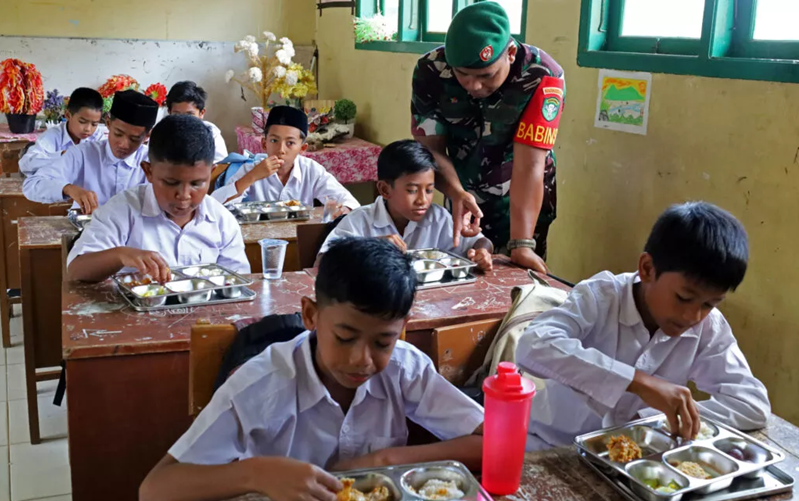
Indonesia’s free meals for kids program has left thousands of youngsters with food poisoning, and returned the country to the bad old days of military influence.

“All power flows from the barrel of a gun,” said Mao Zedong. His aphorism may have been right a century ago in China, but not in modern Indonesia. In the nation next door, power comes subtly via unarmed brigadiers in boardrooms. The riflemen are there, but out of sight.

Professional corporations with genuine jobs to fill normally advertise for the best certified and experienced applicants to stay innovative and competitive. Patronage appointments kill such management essentials.

Meat and veggie buyers, cooks, hygiene inspectors, nutritionists, quality controllers, agricultural advisors – there are scores of positions with Makan Bergizi Gratis (MBG) the free meals for kiddies’ programme.

The venture is to stop stunting through malnutrition – a most worthwhile goal – so standards should be high.

They’re not. Much of the work is being done by young guys hired to kill but employed to care. No surprise that more than 10,000 children have reportedly been gripped by food poisoning,

Dirty kitchens, food left to the flies, delivery delays, and hands and workbenches unwashed – the list is extensive and the blame clear: kitchens are no place for enlistees.

Video grabs of screaming students on classroom floors, fouled by vomit and diarrhoea, have ensured widespread coverage and demands that the program be shut until fixed.

That won’t happen, because the initiator of this stench is President Prabowo Subianto, 74, who swept into power last year on the promise of free tucker. It remains his flagship policy, and to stall would show defeat – difficult for an ageing authoritarian who knows he knows best.

The goal is 75 million meals a week through 1,400 kitchens by the end of this year – the cost A$10 billion.

Next year, the budget is expected to blow out threefold. Economists fear health and education money boxes will get raided and services suffer, though not the military, which is on an international weapons-buying spree.

By 2027, the MBG could gallop past A$27 billion, overtaking the defence allocation of A$18 billion.

It shows what goes wrong when a voter-grabbing policy first scribbled on a restaurant receipt isn’t backed by thought-throughs on infrastructure and planning. The public gets fed up with delays in implementing promised change – but here’s a good reason why patience is prudent.

When Prabowo won the election last year and flaunted his pledge, the applause was worthy of a footy win, though players knew there were too few cooks and bottle washers and a dearth of commercial kitchens.

The solution? Conscript the army.

Soldiers who joined for adventure, a uniform, a haircut and the chance to shoot dissidents in Papua found themselves scrubbing food trays.

Corruption has reportedly flooded the fractured system as a tsunami of unchecked government cash swirls around the dishes of cold soup and burned rice. The service is a continuous rush; no time for audits.

The policy of employing the military in civic affairs was refined by the Republic’s second president, former army general Soeharto. When he was overthrown in 1998 by students preaching democracy, dwifungsi (two functions) was also ditched. Now it’s back with Prabowo, also a former general and Soeharto’s former son-in-law.

There are already ten departments and industries where the military rules. They’ve also seized 3.7 million hectares of private palm-oil plantations and handed them to a state-owned company.

The Kuala Lumpur-based youth NGO World Order Lab voiced its concerns: “Partisan loyalty has increasingly dictated appointments, often sidelining professional qualifications in leadership. This is no accident but a calculated strategy of power consolidation, which signals that loyalty and political stability outweigh technocratic competence.

Patronage appointments undermine the crucial link between responsibility and expertise, leaving critical programs in the hands of those unprepared to manage them.”

The military is getting bigger, spreading wider and digging deeper. Orwell’s Big Brother was a wimp when measured against the Indonesian military’s ambitions.

Expect uniforms everywhere. Regional commands will be doubled to cover most of the archipelago’s 38 provinces. One hundred ’territorial development’ battalions will deploy units in 7,285 kecamatan (districts) within five years.

This isn’t secret stuff – the Defence Ministry published a full-page explanatory ad in the Kompas newspaper. The headline read Bukan Lagi Sekadar Militer: Pertahanan Rakyat Gaya Indonesia (No longer just the military: Indonesian-style people’s defence). No need for a catchy title – it’s an order.

It listed plans to enlarge battalions specialising in health and agriculture between now and 2030, claiming these have expanded and transformed “people’s defence based on prosperity and cross-sector collaboration”. The reasoning here is impenetrable.

The ad was published  “to counter public perception that these actions represent militarisation.” The public’s perception has been clear – so have the commentators.

Veteran Bloomberg Asian affairs columnist Karishma Vaswani warned: “The military’s increased influence (is) potentially enabling human rights violations and corruption.

“(The Kompas ad) was an attempt to normalise the presence of soldiers and generals in everyday life, potentially giving them the kind of influence they had during the Soeharto era…. an outsized role in politics and governance.

“A rejuvenation of the military’s power will reinforce (Prabowo’s) image as a leader who cannot rule without the assistance of the army.”

The Tentara Nasional Indonesia (TNI – Indonesian armed forces) has embedded itself in the national legend for almost eight decades, starting with guerrilla heroes routing the returning Dutch colonialists in the late 1940s.

Through its untouchable status, the TNI has boosted incomes and officers’ salaries by running foundations, factories and co-ops. Men in khaki moved off parade grounds onto the boards of banks, insurance companies, and even big retailers.

Soldiers are supposedly prohibited from business activities, though this is widely overlooked. The TNI is proposing a law change so Army wives can run village kiosks, though the real reason is to legitimise jobs for officers in civil businesses.

Perceptive readers of Pearls and Irritations would have foreseen that Indonesia was sliding into the black pit of military control when a story was published of MPs in fatigues at a post-election boot camp.

The few who still uphold democracy were dismayed; others saw it as a chance for selfies of giggling pols flashing thumbs-up. They should have been down.

The views expressed in this article may or may not reflect those of Pearls and Irritations.

Duncan Graham

Duncan Graham has been a journalist for more than 40 years in print, radio and TV. He is the author of People Next Door (UWA Press). He is now writing for the English language media in Indonesia from within Indonesia. Duncan Graham has an MPhil degree, a Walkley Award, two Human Rights Commission awards and other prizes for his radio, TV and print journalism in Australia. He lives in East Java.

The World’s Largest Deforestation Project

Douglas Gerrard

Share on BlueskyShare on FacebookEmailPrint

In the West Papuan regency of Merauke, close to the border with Papua New Guinea, Indonesia is rapidly clearing land in the world’s largest ever deforestation project: three million hectares for sugarcane and rice production. Within three years, Indonesia plans to convert an expanse of forest roughly the size of Belgium into profitable monoculture. The ambition and destructiveness of the development distinguish it from previous mining or agribusiness initiatives in West Papua, which has been under Indonesian occupation since the 1960s. 

At a ground-breaking ceremony in June 2024, Indonesia’s then president, Joko Widodo, described Merauke as Indonesia’s future ‘food barn’. He also touted the potential of converting sugarcane into bioethanol fuel. (On the Raja Ampat islands meanwhile, Papuan activists are fighting plans to exploit nickel reserves for electric vehicle batteries.)

Since formalising its control of West Papua in a fraudulent 1969 referendum, Indonesia has carried out genocidal military assaults – up to a quarter of West Papuans have been killed under occupation – and ‘transmigration’ settlement programmes that have reduced the Indigenous population to a minority. 

In the nine months since he took office, Indonesia’s new president, Prabowo Subianto, has both restarted the transmigration programme and accelarated deforestation in West Papua. Widodo designated Merauke a ‘National Strategic Project’ (PSN), giving the state eminent domain powers to expel civilians. Fifty thousand Indigenous Papuans face displacement over the project’s lifespan; already, people are finding vast tracts of their customary land have been closed to them, with wooden stakes signalling the expropriation by the Indonesian military.

The human costs of the PSN, while severe, are eclipsed by its possible environmental consequences. The destruction of Merauke is set to release over 780 million additional tons of CO2 into the atmosphere, more than doubling Indonesia’s yearly emissions and leading to irreversible ecosystem collapse in one of the world’s most biodiverse regions. Officials have pressed on with the development while trying to conceal its impact. The energy minister, Bahlil Lahadalia, in charge of parcelling out land to developers, has claimed there is ‘no forest in the middle of Merauke … only eucalyptus, swamps and savannahs’. But though the sago and paperbark mangroves that cover much of the Merauke landscape may appear sparse from above, they store up to 381 tons of carbon per hectare – a higher concentration than the Amazon rainforest. 

The PSN is not Indonesia’s first attempt to convert Merauke into profitable farmland. In the 2010s, huge swathes of the rainforest were razed to make way for a palm oil mega-project, the Merauke Integrated Food and Energy Estate (MIFEE). It has been described by one researcher as effecting an ‘ecologically-induced genocide’ of the Marind tribe, whose gardens and hunting grounds also extend into the territory now threatened by the PSN. As their forest recedes, the Marind are forced to rely on remittances from the corporations that have seized their land. Rice and instant noodles are replacing traditional sago cultivation. 

In her book In the Shadow of the Palms, Sophie Chao describes the warping effects that MIFEE has had on both the environment and the Marind worldview. Before palm oil arrived, the forest provided a rich network of relationships between people, plants and animals. Under the monocrop regime, everything is ‘abu-abu’ – grey, uncertain. In a new documentaryabout Merauke, a Yei tribesman describes the transformation of his land in similarly alienated terms: ‘Before, when I went there [to the forest], I could catch deer, pigs, fish … Now it’s like I’m half dead.’

MIFEE was intended not only to boost Indonesia’s food security, but also to make it a net exporter of rice and palm oil – to ‘feed Indonesia, then the world’. The profit motive is harder to identify in the Merauke PSN. Its advocates have instead emphasised national self-sufficiency, partly in response to the precarity of global supply chains exposed by the Covid pandemic. Even a staunch rightwinger like Prabowo can sound like an anti-colonial nationalist when discussing the project: ‘How can a country be independent if it cannot feed its people?’ he asked in 2023, when he was defence minister. 

During Indonesia’s three decades of dictatorship under Suharto (Prabowo’s father-in-law), more than a third of its national revenue came from West Papua, much of it from the world’s largest gold mine, which was operated until 2017 by the US company Freeport McMoran. But while the Freeport mine primarily enriched foreign and domestic elites, the Merauke PSN is designed to insulate ordinary Indonesians from food and energy shocks – caused by a climate crisis that the PSN will drastically worsen. Both ventures aimed to secure the future of the regime, though in different ways. West Papua has gone from being Indonesia’s gold mine to its larder.

Where private interests are involved in the PSN, the principal beneficiaries are not foreign corporations but politically connected Indonesian entrepreneurs. Co-ordinating the project is the palm oil magnate Andi Syamsuddin Arsyad, also known as Haji Isam (or the ‘new poster boy of Indonesia’s oligarchy’). Isam owns the Jhonlin Group, which has bought two thousand excavators from a Chinese company to begin the deforestation. His cousin, Amran Sulaiman, is the agriculture minister. 

The military role in the development of the PSN goes far beyond their normal land-grabbing and security remit. Following a large recruitment drive in Java, more than three thousand additional troops have been deployed to Merauke, where they are directly engaged in felling and crop cultivation. Instagram posts show fresh-faced soldiers playing at farmers, ineptly watering crops or operating Isam’s excavators. 

Sulaiman has insisted that ‘the military support is there because of a lack of manpower’ – but while most of the soldiers deployed to Merauke may be new recruits, photographs have also surfaced of some sporting the insignia of Yonif Raiders, an elite combat unit notorious among West Papuans for their brutality. In August 2022, a troop of Raiders murdered four Papuan villagers and dumped their dismembered bodies in a local river. Such atrocities are commonplace in the West Papuan highlands, where the armed resistance movement is strongest and international scrutiny all but non-existent. 

Merauke is a lowlands region, which may be one reason the PSN hasn’t yet been met with violence from its opponents. Nonetheless, resistance has been immediate and widespread: there have been mass protests throughout West Papua, while a coalition of NGOs and Indigenous groups has drawn the UN’s attention to the project. A UN fact-finding mission has long been a demand of the United Liberation Movement for West Papua (ULMWP), a proto-governmental organisation uniting the three most significant independence factions, operating under the stewardship of the exiled leader Benny Wenda (I have worked with them). 

While the forces arrayed against the ULMWP are forbidding – not least a decades-long ban on foreign media that has kept West Papua from international attention – the climate crisis gives their liberation struggle a global dimension. The New Guinea rainforest is the world’s third largest, after the Amazon and the Congo. Uniquely, tribal struggles for land rights in West Papua form part of a wider revolutionary movement that seeks to replace military-corporate domination with Indigenous sovereignty and a ‘green state’. Wenda has urged environmental activists to ‘accept climate catastrophe or fight for a free West Papua’. Merauke will determine their choice. 

Indonesia on Watchlist as President Prabowo’s Government Crushes Civic Freedoms

  • Violent arrests and attacks on protesters by security forces
  • Journalists and human rights defenders intimidated with surveillance and threats
  • Quick expansion of repressive laws sidestepping democracy

Johannesburg, 30 July 2025 – Indonesia is added to CIVICUS Monitor Watchlist amid widespread state intimidation, legal manipulation, and violent crackdowns on dissent, pushing civic space to a precarious point. Nine months into President Prabowo Subianto’s administration, dozens of activists have been attacked, intimidated or arrested. Authorities have crushed protests with violence, harassed human rights groups and journalists, and introduced restrictive legal revisions.

The CIVICUS Monitor currently rates Indonesia as “obstructed”, indicating serious challenges to the freedoms of expression, peaceful assembly, and association. Indonesia joins Kenya, El Salvador, Serbia, Turkey, and the United States on the latest Watchlist of countries where there has been a notable decline in the state of civic freedoms.

“Speaking out is becoming a dangerous act in Indonesia’s tightening environment,” said Josef Benedict, CIVICUS Monitor Asia researcher. “Anyone who criticises the government is being forced into silence through fear, violence, and intimidation.”

Silencing Human Rights Defenders and Stifling Protests

In the first six months of 2025, more than 100 human rights defenders have faced arrest, criminalisation, intimidation, or physical attacks, according to civil society. This includes land and environmental activists, student organisers, academics, labour advocates, and anti-corruption campaigners.

The crackdown is particularly evident at protests. In March, police and military units violently dispersed public demonstrations opposing military law revisions, which dramatically expanded military influence over civilian life and weakened oversight. Security forces assaulted several journalists covering the protests and forced them to erase footage of police violations.

During a peaceful protest on International Labor Day, police arrested 14 people, including paramedics, and physically assaulted 13 of them, resulting in serious injuries. No one was held accountable. Security forces also deployed tear gas and water cannons on demonstrators without provocation.

In Papua, police met student-led demonstrations in April with tear gas, arrests, and assaults. In May, police violently shut down a peaceful protest at Cenderawasih University (UNCEN) over rising tuition fees.

Authorities targeted the Commission for the Disappeared and Victims of Violence (KontraS), a leading human rights group, with sustained harassment and surveillance from March to May. Intimidation tactics included attempted break-ins at its Jakarta office, unknown vehicles loitering outside its premises, and calls flooding its lines including from a number allegedly linked to intelligence services.

Independent journalism faces growing hostility and intimidation too. One journalist from the critical Tempo outlet received a severed pig’s head in the mail, was doxxed, and her relatives received online harassment and threats. Parliament also introduced a new regulation in March requiring foreign journalists to obtain police clearance prior to reporting inside Indonesia.

“In Indonesia today, human rights defenders, protesters, and journalists are being treated like enemies of the state. Even paramedics at protests risk being beaten by security forces. This isn’t just a failure to protect people’s rights. It reinforces the climate of impunity in the country,” said Benedict. “This is how civic space, including press freedom and the right to protest, dies. Not in one dramatic moment, but in a hundred acts of intimidation and retaliation.”

Besides the military law revisions, legislative proposals for the Criminal Procedure Code (KUHAP) and the National Police Law could further empower law enforcement agencies without strengthening accountability mechanisms or protecting victims’ rights.

Moreover, in June, the government entered a wiretapping agreement with four major telecommunications operators, dramatically increasing risks of mass surveillance and arbitrary data collection. Authorities also continue to wield the Electronic Information and Transactions Law to stifle online dissent.

“The pace and secrecy of these new repressive revisions show that Indonesia’s government is sidestepping democratic processes,” said Benedict. “These legal changes are designed to consolidate power, not safeguard citizens.”

The Prabowo government must stop targeting activists and hold those involved in attacks against them to account. It must ensure that legal revisions passed meet international laws and standards. The processes must be transparent and include participation of civil society.

Adding Indonesia to the CIVICUS Monitor watchlist reflects warnings civil society groups in Indonesia have been flagging on dwindling civic freedoms since Prabowo took office. The international community must call out these blatant violations, demand progress on civic freedoms, and stand in solidarity with civil society,” said Nadine Sherani from KontraS.

The CIVICUS Monitor highlights countries with notable declines in civic freedoms, based on analysis from research partners, grassroots activists, and human rights defenders. CIVICUS Monitor currently rates Indonesia’s civic space as “obstructed”, indicating serious challenges to the freedoms of expression, peaceful assembly, and association

NOTES TO THE EDITOR:

On Indonesia’s civic space rating of Obstructed:

This rating is typically given to countries where civic space is heavily contested by power holders, who impose a combination of legal and practical constraints on the full enjoyment of fundamental rights (see full description of ratings). See Frequently Asked Questions about the Watchlist here.

There are a total of 35 countries in the world with this rating (see all).

About the CIVICUS Monitor Watchlist:

The new watchlist is released by the CIVICUS Monitor, an online platform that tracks the latest developments to civic freedoms, including the freedoms of expression, association and peaceful assembly, across 198 countries and territories.

The ratings are categorised as either ‘closed,’ ‘repressed,’ ‘obstructed,’ ‘narrowed’ or ‘open,’ based on a methodology that combines several data sources on the freedoms of association, peaceful assembly and expression.

Over twenty organisations collaborate to provide an evidence base for action to improve civic space on all continents.

For more information or to arrange an interview, please contact: media@civicus.org

Security members recorded pressuring indigenous community in Beoga to pay social funds

By Documentation Centre / 1 August 2025 

On 17 July 2025, members of the Indonesian security forces, including the Beoga Police Chief and personnel from the Indonesian Armed Forces (TNI), were captured on video engaging in the illegal collection of community funds from village heads in Beoga District, Puncak Regency, Central Papua Province. The recording (see video below, source: independent HRD) reveals a police officer, apparently in command, orchestrating and directing the unlawful redistribution of BLT (Direct Cash Assistance) funds, including orders to transfer money to armed personnel. The total amount allegedly extorted from all nine villages in the district is estimated at Rp. 450,000,000 (approx. € 24,000).

The 90-second recording, reportedly made on 17 July 2025, shows armed TNI officers and a high-ranking police officer addressing several village heads about the distribution of Direct Cash Assistance (BLT) funds. During the conversation, the officer suggests that part of the funds should be handed over to personnel from the TNI task force, Koramil, and Polsek as a form of “security” compensation. His statements imply an orchestrated and coercive appropriation of public aid funds by security forces.

In the exchange, one village head confirms that such a process had occurred previously and volunteers to facilitate the distribution. Another village leader, dressed in a red shirt, expresses concern and requests that the funds first be presented to traditional leaders for oversight. The police officer disregards the concern and insists that the handover be completed swiftly. The environment of the exchange, taking place in the presence of fully armed and uniformed personnel, added an element of intimidation.

Following the incident, community members reported that security forces forcibly collected Rp. 50,000,000 from nine villages. The total amount allegedly extorted reached Rp. 450,000,000. From 17 to 22 July 2025, the Papua Justice and Human Integrity Foundation (YKKMP) received complaints from residents, describing the incident as extortion under duress by members of the security apparatus.

On 22 July 2025, the Papua Coalition for Law Enforcement and Human Rights (KPH HAM Papua), comprising several civil society organisations, issued a Press Release in Jayapura, calling for a thorough investigation and for those responsible within the police and military forces to be held legally accountable.

The following day, 23 July 2025, KPH HAM Papua addressed official complaints to the Attorney General of Indonesia, the Papua High Prosecutor, and the Nabire District Prosecutor. They demanded legal proceedings against the alleged perpetrators for the misuse of social aid funds, illegal levies, and abuse of power carried out under the guise of state authority.

Human rights analysis

This incident constitutes a serious violation of economic and social rights, particularly the right to social protection as enshrined under Article 9 of the International Covenant on Economic, Social and Cultural Rights (ICESCR), to which Indonesia is a State Party. The direct coercion of civilian representatives under military and police presence represents a blatant abuse of power and an infringement on the principle of free and informed access to state-sponsored social assistance.

The use of military force and full armament during civil aid distribution also violates the principle of civil-military distinction and may amount to state-led intimidation and coercion of indigenous populations, contravening protections outlined in United Nations Declaration on the Rights of Indigenous Peoples (UNDRIP), particularly Article 21 and Article 22.

Moreover, this case indicates a potential pattern of corruption, intimidation, and militarisation of public administration in West Papua, exacerbating the vulnerability of conflict-affected communities and undermining lawful governance and local autonomy.

Video showing TNI officers and a police chief addressing village leaders in Beoga District, Puncak Regency, on 17 July 2025

Detailed Case Data
Location: 5CPF+2RP, Unnamed Road, Nungai, Beoga, Kabupaten Puncak, Papua 98972, Indonesia (-3.8149074, 137.4245889) Beoga District
Region: Indonesia, Central Papua, Puncak, Beoga
Total number of victims: hundreds

#Number of VictimsName, DetailsGenderAgeGroup AffiliationViolations
1.hundreds 

diverseunknown Indigenous Peoples

Period of incident: 17/07/2025 – 17/07/2025
Perpetrator: , Indonesian Security Forces

Perpetrator details: Beoga Police Chief and personnel from the Indonesian Armed Forces (TNI)

Issues: indigenous peoples

———————————————

analysis

The events at PT PMP raise serious concerns under Indonesian labour law and international human rights standards, particularly ILO Convention No. 87 (Freedom of Association) and No. 98 (Right to Organise and Collective Bargaining), as well as the right to just and favourable conditions of work under Article 7 of the International Covenant on Economic, Social and Cultural Rights (ICESCR), to which Indonesia is a State Party.

The alleged non-payment of BPJS contributions and inadequate severance pay fall short of the protections guaranteed under Indonesian Law No. 13/2003 on Manpower and subsequent amendments. Moreover, the imposition of excessively long working hours without clear consent or renegotiation of contracts, especially without due consultation with the affected workers or their representatives, may amount to exploitative labour conditions and breach standards for decent work.

Detailed Case Data
Location: 5F8J+8VV, Istikem, Moskona Barat, Teluk Bintuni Regency, West Papua 98455, Indonesia (-1.834134, 132.4821843) PT. Putera Manunggal Perkasa
Region: Indonesia, Southwest Papua, South Sorong
Total number of victims: dozens

#Number of VictimsName, DetailsGenderAgeGroup AffiliationViolations
1.dozens 

diverseunknown Labourer

Period of incident: 01/06/2025 – 31/07/2025
Perpetrator: Private Company

Perpetrator details: PT Putera Manunggal Perkasa (PT PMP)

Issues: business, human rights and FPIC ——————————————————

The West Papuan Legislative Council Has Held Its Inaugural Meeting in Jayapura

BY PAUL GREGOIRE PUBLISHED ON 17 JUL 2025 

The 5 July 2025 inauguration of the West Papuan Legislative Council in West Papua’s Jayapura City “marked the rebirth of the West Papuan state”, remarked United Liberation Movement West Papua president Benny Wenda in a 10 July 2025 statement, adding that the globe  “should respect” that it has “fulfilled all international requirements to be recognised as a government-in-waiting”.

According to reports, 350 members were inaugurated into the West Papuan Legislative Council on 5 July, along with thousands of regional council members, to represent the Indigenous peoples of the land across the seven customary regions that the ULMWP government recognises in West Papua: not the six provinces that the colonial Indonesian administration has imposed upon the region.

The establishment of the West Papuan government-in-waiting is the latest stage in a heightened push by the West Papuan liberation movement began with the September 2017 presentation of the West Papuan People’s Petition to the United Nations General Assembly, prior to the December 2020 founding of a provisional government and subsequent establishing of infrastructure on the ground.

These bounds towards independence, however, have also seen an intensification of Indonesian military attacks on occupied West Papuans, which began on villages in Nduga Regency, and continues to the present day, while the inauguration of alleged habitual war crimes perpetrator Prabowo Subianto as Indonesian president last year neither bodes well for the Melanesian region.

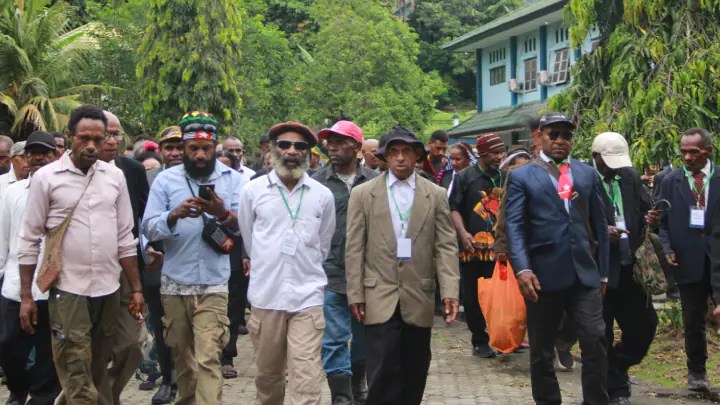
But as ULMWP Legislative Council chair Buchtar Tabuni led thousands of West Papuans, who’d just attended the first session of the West Papuan Legislative Council held in Jayapura City, in a procession through the main streets of one of the nation of West Papua’s largest cities, the message was clear: West Papua now has a government-in-waiting, and it does not want to wait too long.

A nation-in-waiting

“We have now completed our internal structure, implementing democracy even before winning independence,” said ULMWP president Benny Wenda, who currently lives in exile. “The world should respect the fact that we have fulfilled all international requirements to be recognised as a government-in-waiting,”

“We have our own provisional government, cabinet, laws, constitution and Green State Vision for a liberated West Papua,” the president-in-waiting continued, as he noted the commitment an independent West Papua has made to becoming a truly green state. “We also have a network of diplomatic representatives around the world, ready to engage with international diplomats.”

In the lead up to the Netherland colonisers 1962 departure, the West New Guinea Council, which was made up of West Papuans, celebrated their nation’s coming independence on 1 December 1961, Wenda recalled, with the raising of the Morning Star flag, and diplomats from the UK, France, Papua New Guinea, Australia and the Netherlands all bore witness to the ceremony.

As Wenda explains the roll out of the Legislative Council finishes the process of actualising an entire Indigenous government on the ground, which commenced with the first meeting of the West Papuan congress in November 2023.

This finishes the establishment of the legislative framework for an independent West Papua, as well as produces a body to legitimise this point on the global stage.

“With the 2020 provisional government, we built a legitimate governance structure and declared Indonesian presence in West Papua to be illegal,” Wenda underscored. 

“With this inauguration, we have deepened our sovereignty on the ground. The ULMWP is now present at every level of West Papuan life.”

Never any choice

As it was leaving West Papua, the Netherlands handed control of the territory to the United Nations, as per the 1962 New York Agreement, and then in May 1963, it passed on interim administration to Indonesia, another country that had been colonised by the Dutch, who’d left in 1949. This handover was done on the basis that Jakarta let the West Papuans hold a referendum on independence.

Indonesia then held the 1969 UN-brokered “Act of Free Choice”, which saw the Indonesian military select 1,026 West Papuans to take part in, and via threat of gunpoint, they all voted to remain with Jakarta. So, the New York Agreement was never honoured, a fraud vote occurred and the 1.8 million West Papuans, or 70 percent of the population, who signed the petition, want a real referendum.

Since 1 May 1963, Jakarta has killed over half a million West Papuans, and, as Indonesia has been running a transmigration program into the Melanesian region since the 1970s, the 90 percent of the population that the locals, the West Papuans, had made up at that time, has now dropped down to comprising of less than 50 percent of the people living in the region.

The attacks on villages and displacement of local West Papuans has picked up since 2018, and this has been accompanied by the construction of the Trans-Papua Road project, which is a highway needlessly being rolled out that harms the West Papuan landscape and people. The attacks on people in the highlands and coastal regions across the nation of West Papua continue to this day.

The real choice awaits

Former Kopassus general and now Indonesian president Prabowo has a notorious reputation for the brutal manner in which he carried out operations in the former colony of East Timor and the continuing colony of West Papua.

Under the new president’s watch, the aerial bombing of West Papuan villages has heightened recently and the world’s largest act of deforestation is being committed on West Papuan soil in the name of sugarcane farming.

But so too has the West Papuan Legislative Council just met for the first time under Prabowo’s watch, and Wenda points out that for the United Liberation Movement of West Papua to be recognised as legitimate on the international stage has precedent, and he raised the Vanuatu People’s provisional government and the Palestine Liberation Organisation as examples of this.

ULMWP Legislative Council chair Tabuni said a fortnight ago that the 5 July plenary council meeting was an “historical milestone” that involved “the formation of a legitimate and representative legislative structure”, which has “strengthened the foundation of our government, as a nation ready for sovereignty”.

“The ULMWP is ready to play that role,” Wenda underscored. “We are ready to take our seat at the table, to help find a diplomatic political solution to the West Papuan issue through international political mechanisms.”

 PAUL GREGOIRE 

Paul Gregoire is a Sydney-based journalist and writer. He’s the winner of the 2021 NSW Council for Civil Liberties Award For Excellence In Civil Liberties Journalism. Prior to Sydney Criminal Lawyers®, Paul wrote for VICE and was the news editor at Sydney’s City Hub.

————————————-

Arbitrary detention and use of force against human rights lawyer during peaceful protest in Jayapura

Cases / IndonesiaWest Papua / 2 July 2025 

On 12 June 2025, police officers arbitrarily detained Mr Imanus Komba, a lawyer working for the Papuan Legal Aid Institute (LBH Papua), and a protester named Mr Kolki Gwijangge during a peaceful demonstration at the Abepura roundabout in Jayapura City, Papua Province (see photo on top, source: Jubi). The demonstration, organised by student and youth groups, opposed the controversial nickel mining project in Raja Ampat, Sorong, and broader illegal resource exploitation in West Papua. Mr Komba and Mr Gwijangge were reportedly subjected to physical ill-treatment during arrest. Both men were temporarily detained at the Abepura Sub-District Police Station before being released after 20 minutes.

The protest began peacefully at 10:00 am, with demonstrators expressing environmental and indigenous rights concerns over the mining project, including its impacts on local ecosystems and customary landowners. At approximately 10:20 am, police from the Abepura Sector, led by the station chief and intelligence officers, attempted to disband the protest, allegedly citing the lack of a valid permit. When LBH Papua lawyer, Mr Imanus Komba, challenged the order and asserted the demonstrators’ constitutional rights, police officers reportedly dragged, choked, and beat Mr Komba with a rubber baton before being escorted to the Abepura Sub-District Police Station. Mr Kolki Gwijangge was also forcibly removed from the site. Despite the violence, both were released again, and Mr Komba resumed his duties accompanying the protest.

The Indonesian Legal Aid Foundation (YLBHI) and LBH Papua condemned the detention, highlighting that such acts amount to a pattern of criminalisation and intimidation of human rights defenders in West Papua. According to YLBHI, the Abepura Police’s conduct represents a breach of Police Regulation No. 2/2003. The organisation demanded a public apology and an end to repressive policing.

The Jayapura Police Chief, Commissioner Fredrickus Maclarimboen, stated that there were no arrests or detentions. The Jayapura police’s claim that “there were no detainees” contrasts sharply with the victim testimonies, further underlining the lack of transparency and accountability.

Legal and human rights analysis

The actions of the Abepura police, including physical abuse and obstruction of legal assistance, amount to violations of national law and international standards on the protection of human rights defenders. The incident violates fundamental freedoms, namely the right to freedom of expression and peaceful assembly as enshrined in Article 28E (2) of the Indonesian Constitution, and Articles 19 and 21 of the International Covenant on Civil and Political Rights (ICCPR), to which Indonesia is a State Party. Furthermore, the physical assault and detention of the LBH lawyer violate Law No. 16/2011 on Legal Aid, which explicitly protects lawyers from criminal or civil liability for actions taken in the course of legal representation.

The case adds to a broader pattern of repression against Papuan civil society, where security forces frequently suppress dissent under the guise of public order, infringing upon basic civil liberties and undermining the rule of law.

———————————————————

Human Rights Monitor

Release four Papuan political activists in Sorong who were arrested on charges of treason

Responding to the arrest and determination of suspects in a treason case against four political activists who are members of the Federal Republic of West Papua (NFRPB) by the Police in Sorong City and the loss of civilian lives in armed violence in Intan Jaya, Deputy Director of Amnesty International Indonesia, Wirya Adiwena, said:

“The criminalization of the four Papuan political activists shows that the state continues to repress the rights to freedom of expression, opinion and assembly of indigenous Papuans. They were arrested only for peacefully conveying their political aspirations by visiting the West Papua government offices without using violence.

Peaceful expression is guaranteed by the Constitution and is not a criminal act. Peaceful political aspirations are also not hate speech as alleged by the police. Law enforcement officers are also again using accusations of treason to silence the political expression of Papuans, even though they should understand that such expression is part of human rights protected by Article 28E of the 1945 Constitution.

The police in Sorong City must immediately release the four people unconditionally. Every citizen, including indigenous Papuans, must not be criminalized just for expressing opinions or making legitimate political demands, including voicing disappointment with the state regarding the conflict in their region.

Not only that, we also condemn the loss of life and injuries to civilians, as well as hundreds of people displaced, after the operation carried out by security forces in Intan Jaya on May 13, 2025. There must be a thorough investigation into the loss of civilian lives in the incident. Likewise, there must be a sharp reflection on the placement of security forces in Papua which has so far resulted in casualties, both indigenous Papuans, non-Papuans, including the security forces themselves.”

Background

The Chief of the Sorong City Police, Southwest Papua, on May 5 announced the arrest and determination of suspects in a treason case against four people with the initials AGG, PR, MS, and NM. They are known as administrators of the Federal State of the Republic of West Papua (NFRPB).

Media reports said the suspects allegedly visited the Sorong Mayor’s Office, the West Papua Governor’s Office, the West Papua Papua People’s Assembly (MRP) Office, the West Papua Police’s Water Police Directorate, and the Sorong City Police on April 14 to deliver a letter from the NRFPB president regarding an invitation to peace talks. During the visit, they also allegedly called for ‘Papua independence.’

The police have also questioned five witnesses and secured 18 documents related to the NFRPB organization, including uniforms resembling police and military attributes, as well as the organization’s membership identification.

The four suspects were charged with treason and hate speech articles, namely Article 106 of the Criminal Code in conjunction with Article 187 of the Criminal Code in conjunction with Article 53 paragraph (1) of the Criminal Code and/or Article 45 Letter A paragraph (2) in conjunction with Article 28 paragraph (2) of Law of the Republic of Indonesia Number 1 of 2024 concerning the Second Amendment to Law Number 11 of 2024 concerning Information and Electronic Transactions in conjunction with Article 55 paragraph (1) to 1 and/or in conjunction with Article 56 paragraph (1) to 1 of the Criminal Code. For these articles, the suspects face a sentence of 20 years in prison or even life imprisonment.

Meanwhile, regarding the latest violence in Papua, the Communion of Churches in Indonesia (PGI) received a report from the Kemah Injil Church that a military operation had taken place in the early hours of Tuesday, May 13, 2025, in three villages in Intan Jaya Regency, Central Papua. The military operation is said to have targeted civilian settlements and resulted in fatalities and injuries among residents.

At least three civilians were reported to have died. In addition, a seven-year-old child and an adult woman suffered injuries from shrapnel. Then as many as 950 congregation members from 13 churches were reported to have fled shortly after the shooting.

Amnesty International does not take any position on the political status of any province in Indonesia, including their calls for independence. However, in our opinion, freedom of expression includes the right to peacefully express one’s political views or solutions.

—————————-

Indigenous Papuans look to the new pope with hopes

 By Ryan Dagur, 16 May 2025

Pope Francis did not visit the Christian-majority region of Papua during his Asia tour last September; however, his concerns and gestures regarding the plight of Papuans have provided them with a renewed perspective on the Church.

The first Jesuit and the first Latin American pope, during his 12-year papacy, achieved something that no other pope has done for the Papuans, the Christian-majority indigenous people of the western half of New Guinea Island, which is part of Indonesia.

Pope Francis became popular among Papuans as they began to see him as a champion for the cause of poor, marginalized, and oppressed people like them worldwide. They expect the next pope to follow in his footsteps.

Papuans expect the next pope to build on Pope Francis’ two actions, which have left an indelible mark on their conflict-torn region, regarded as the most underdeveloped part of Indonesia.

In a historic first, Francis appointed two native Papuan priests as bishops — Yanuarius Teofilus Matopai You of Jayapura in 2022 and Bernardus Bofitwos Baru of Timika — just two months before his death.

The appointments followed years of demand for native bishops in the region, where the Catholic faith arrived more than a century ago.

The demand has grown louder in recent years, as many Papuan Catholics feel that their bishops from other parts of Indonesia, and even the Vatican, do not care enough about their aspirations, plight, and challenges.

Most Indonesian bishops assigned to Papua have remained silent about human rights violations and social injustices in light of the Indonesian government’s apparent disregard for Papuans’ rights.

The violations are linked to the government’s efforts to suppress the Free Papua Movement, which has persisted in the region since the 1960s and advocates for self-determination.

Baru, a leading rights activist advocating for an end to violence between security forces and armed rebels in Papua, is scheduled to be ordained as bishop on May 15.

The Papuans felt abandoned as the local Church hierarchy, based in the Indonesian capital, consistently aligned with the government.

“The official stance of the Catholic Church on the Papua issue is very clear, namely to support the government’s stance, because it is guaranteed by international law,” the hierarchy’s de facto head, Cardinal Ignatius Suharyo Hardjoatmodjo of Jakarta, said once.

A recent example is Archbishop Petrus Canisius Mandagi of Merauke supporting the controversial state-backed food projects in southern Papua, despite the Papuans’ rejection of the initiative. The projects reportedly aim to seize land from Indigenous people, including members of the archdiocese.

Francis’ visit to Asia last September marked a second defining moment for Papuans and offers lessons for the Indonesian hierarchy and the heads of the Vatican bureaus.

Many Papuans believe that Francis expressed his love for the indigenous people by visiting Vanimo in Papua New Guinea, just across the border from Indonesian Papua. This visit enabled many Papuans to cross the border to see the pope.

Francis’ visit to Indonesia did not include a stopover in Papua or even mention Papua, apparently due to the insistence of Indonesian bishops, who did not want to upset the government.

Papuans who could not afford the flight to Jakarta to see the pope found Vanimo to be the closest place where they could meet him. He chose Vanimo to feel the pulse of the Papuans.

He also did not upset the Muslim-majority Indonesia, where he was widely popular for fostering Christian-Muslim harmony, a hallmark of his pontificate.

Francis proved that church leaders can find ways to understand and communicate with their marginalized communities, even if exploitative systems attempt to block them.

The tragedy is that Indonesian bishops remain confined within their narrow nationalistic views, which prevent them from recognizing Papuans as equal individuals and Christians deserving of dignity and rights.

The Papuan Church, which has long been dominated by Indonesian clergy, has done little to protest the state’s exploitation of this resource-rich region’s forests and minerals, disregarding the fundamental rights of Papuans to live on their land.

Just as Francis stood for the rights and dignity of the poor and oppressed, the new leader of the Church has a responsibility to confront the timidity of the Indonesian hierarchy, who believe that supporting the oppressed would make them targets of the state.

The Vatican must also support the two native Papuan bishops in representing their Papuan Catholics without permitting them to be overshadowed by the other 36 non-Papuan bishops in the country.

With thanks to Union of Catholic Asian (UCA) News and Ryan Dagur, where this article originally appeared.

Police officers as agricultural experts? Corn project threatens democracy and human rights

CasesHuman Rights News / IndonesiaWest Papua / 8 April 2025 

In a controversial move, the Indonesian National Police (Polri) launched a large-scale corn cultivation project targeting 1.7 million hectares of land across the country. The project, which includes agricuktural activities in the Aib Village, Jayapura Regency, is supposed to contribute to Indonesia’s food security. However, it has sparked widespread concerns regarding the misuse of police authority, poor planning, and the intimidation of local farmers who publicly voiced criticism.

While Polri claims the program supports national food resilience, critics argue the project lies outside the legal mandate of the police. Law No. 2/2002 on the National Police clearly outlines the primary responsibilities of the police as maintaining security and public order, enforcing the law, as well as providing protection and services to the public. However, the law does not mandate agricultural development as part of the police’s responsibilities. Human rights organizations and legal experts have flagged this initiative as a dangerous precedent that blurs the line between civil governance and law enforcement.

The project shows follows an alarming trend in Indonesia, where the police and the military are in direct competition for taking over civil roles and responsibilities. These developments have significantly aggravated under Indonesia’s current President Prabowo Subianto, a former military general. Prabowo has handed over direct responsibility to the Indonesian military for the implementation of a rice and sugarcane estate in the Merauke Regency as part of national strategic projects (PSN) on food security. Indigenous communities oppose the ambitious project which has targetted more than 2 million hectares of their customary land, raising the lack of free, prior, informed consent procedures, land grabbing, ecological destruction, and systematic human rights violations.

Project implementation in Jayapura, Papua Province

The project’s implementation in the Aib Village has exposed serious flaws. Farmers joined the initiative hoping for improved income and development. Instead, they encountered a lack of technical support, no tools or fertilizer, and crops that failed to thrive. Many of the farmers have no experience in commercial corn farming and were not provided with training or sustainable guidance. The false selection of land, unsuitable for corn, and the absence of agricultural extension services further point to poor planning and disregard for local agronomic conditions.

Several farmers have been subjected to intimidation after sharing their disappointment over the proiject with the media. They were summoned to the local police station after speaking to BBC Indonesia journalists about the project’s shortcomings. During a meeting with seven officers, they were asked to retract their statements and record a video apology—requests they refused. The incident raises concerns regarding intimidation and suppression of free expression. Police have denied claims of coercion and intimidation against community members.

The implications of the project are profound. By stepping into the realm of agricultural development without a legal basis or technical capacity, Polri has undermined public trust, violating the rule of law, and compromising its core mission. Moreover, the treatment of critical voices contradicts democratic norms and Indonesia’s obligations under international human rights law, including the ICCPR’s protections for freedom of expression and protection from state intimidation.

————————-