West Papua independence group slams French ‘modern-day colonialism’ 

ULMWP president Benny Wenda . . . celebrating the signing of an MOU with the FLNKS in 2022. Roch Wamytan (left, partially obscured), President of New Caledonia’s Congress, is also at the table. Image: ULMWP

By APR editor –  May 26, 2024

Asia Pacific Report

A West Papuan independence group has condemned French “modern-day colonialism in action” in Kanaky New Caledonia and urged indigenous leaders to “fight on”.

In a statement to the Kanak pro-independence leadership, exiled United Liberation Movement for West Papua (ULMWP) president Benny Wenda said the proposed electoral changes being debated in the French Parliament would “fatally damage Kanaky’s right to self-determination”.

He said the ULMWP was following events closely and sent its deepest sympathy and support to the Kanak struggle.

“Never give up. Never surrender. Fight until you are free,” he said.

“Though the journey is long, one day our flags will be raised alongside one another on liberated Melanesian soil, and the people of West Papua and Kanaky will celebrate their independence together.”

Speaking on behalf of the people of West Papua, Wenda said he sent condolences to the families of those whose lives have been lost since the current crisis began — seven people have been killed so far, four of them Kanak.

“This crisis is one chapter in a long occupation and self-determination struggle going back hundreds of years,” Wenda said in his statement.

‘We are standing with you’
“You are not alone — the people of West Papua, Melanesia and the wider Pacific are standing with you.”

“I have always maintained that the Kanak struggle is the West Papuan struggle, and the West Papuan struggle is the Kanak struggle.

“Our bond is special because we share an experience that most colonised nations have already overcome. Colonialism may have ended in Africa and the Caribbean, but in the Pacific it still exists.”

Wenda said he was proud to sign a memorandum of understanding (MoU) with the FLNKS [Kanak and Socialist National Liberation Front] in 2022.

“We are one Melanesian family, and I hope all Melanesian leaders will make clear statements of support for the FLNKS’ current struggle against France.

“I also hope that our brothers and sisters across the Pacific — Micronesia and Polynesia included — stand up and show solidarity for Kanaky in their time of need.

“The world is watching. Will the Pacific speak out with one unified voice against modern-day colonialism being inflicted on their neighbours?”2) 

Déjà vu in New Caledonia: why decades of political failure will make this uprising hard to contain

With an air force plane on its way to rescue New Zealanders stranded by the violent uprising in New Caledonia, many familiar with the island’s history are experiencing an unwelcome sense of déjà vu.

When I first visited the island territory in 1983, I interviewed Eloi Machoro, general secretary of the largest pro-independence party, L’Union Calédonienne. It was a position he had held since his predecessor, Pierre Declerq, was assassinated less than two years earlier.

Machoro was angry and frustrated with the socialist government in France, which had promised independence while in opposition, but was prevaricating after coming to power.

Tension was building, and within 18 months Machoro himself was killed by a French military sniper after leading a campaign to disrupt a vote on France’s plans for the territory.

Help us share expert knowledge.

I was in New Caledonia again last December, 40 years after my first visit, and Kanak anger and frustration seemed even more intense. On the anniversary of the 1984 Hienghène massacre, in which ten Kanak activists were killed in an ambush by armed settlers, there was a big demonstration in Nouméa.

Staged by a new activist group, the Coordination Unit for Actions on the Ground (CCAT), it focused on the visit of French defence minister Sébastien Lecornu, who was hosting a meeting of South Pacific defence ministers.

This followed the declaration by French president Emmanuel Macron, during a visit in July 2023, that the process set out in the 1998 Nouméa Accords had been concluded: independence was no longer an option because the people of New Caledonia had voted against it.

The sense of betrayal felt by the independence movement and many Kanak people was boiling over again. The endgame at this stage is unclear, and a lot will ride on talks in Paris later this month.

French president Emmanuel Macron holds a defence council on the New Caledonia situation, Paris May 20. AAP

End of the Nouméa Accords

The Nouméa Accords had set out a framework the independence movement believed could work. Pro- and anti-independence groups, and the French government, agreed there would be three referendums, in 2018, 2020 and 2021.

A restricted electoral college was established that stipulated new migrants could still vote in French national elections, but not in New Caledonia’s provincial elections or independence referendums.

The independence movement had reason to trust this process. It had been guaranteed by a change to the French constitution that apparently protected it from the whims of any change of government in Paris.

The 2018 referendum returned a vote of 43% in favour of independence, significantly higher than most commentators were predicting. Two years later, the 47% in favour of independence sparked jubilant celebrations on the streets of Nouméa.

Arnaud Chollet-Leakava, founder and president of the Mouvement des Océaniens pour l’Indépendance (and member of CCAT), said he’d seen nothing like the spontaneous outpouring after the second referendum.

It was a party atmosphere all over Nouméa, with tooting horns and Kanak flags everywhere. You’d think we had won.

There was overwhelming confidence the movement had the momentum to achieve 50% in the final referendum. But in 2021, the country was ravaged by COVID, especially among Kanak communities. The independence movement asked for the third referendum to be postponed for six months.

Macron refused the request, the independence movement refused to participate, and the third referendum returned a 97% vote against independence. On that basis, France now insists the project set out in the Nouméa Accords has been completed.

Consensus and crisis

The current turmoil is directly related to the dismantling of the Nouméa Accords, and the resulting full electoral participation of thousands of recent immigrants.

France has effectively sided with the anti-independence camp and abandoned the commitment to consensus that had been a hallmark of French policy since the Matignon Accords in 1988.

Kanak and Socialist National Liberation Front (FLNKS) president Jean-Marie Tjibaou returned to New Caledonia after the famous Matignon handshake with anti-independence leader Jacques Lafleur. It took Tjibaou and his delegation two long meetings to convince the FLNKS to endorse the accords.

The Ouvéa hostage crisis that claimed 19 Kanak lives just weeks earlier had reminded people what France was capable of when its authority was challenged, and many activists were in no mood for compromise. But the movement did demobilise and commit to a decades-long consensus process that was to culminate in an independence vote.

With France unilaterally ending the process, the leaders of the independence movement have emerged empty-handed. That is what has enraged Kanak people and led to young people venting their anger on the streets.

Protests spread to Paris: a rally called by Caledonian activists in solidarity with Kanak people, Place de la Republique, May 16. AAP

A new kind of uprising

Unlike those of the 1980s, the current uprising was not planned and organised by leaders of the movement. It is a spontaneous and sustained popular outburst. This is also why independence leaders have been unable to stop it.

It has gone so far that Simon Loueckhote, a conservative Kanak leader who was a signatory of the Nouméa Accords for the anti-independence camp, wrote a public letter to Macron on Monday, calling for a halt to the current political strategy as the only way to end the current cycle of violence.

Finally, all this must be seen in even broader historical context. Kanak people were denied the right to vote until the 1950s – a century after France annexed their lands.

Barely 20 years later, France’s then prime minister, Pierre Messmer, penned a now infamous letter to his overseas territories minister. It revealed a deliberate plan to thwart any potential threat to French rule in the colony by ensuring any nationalist movement was outnumbered by massive immigration.

And now France has brought new settlers into the country, and encouraged them to feel entitled to vote. Until a lasting solution is found, either by reviving the Nouméa Accords or agreement on a better model, more conflict seems inevitable.

Indonesia’s claims that West Papua was never colonised false’ 

By Doddy Morris  23 hrs ago

It has been 60 years since Indonesia has refused humanitarian agencies and international media access to enter West Papua.

According to Benny Wenda, the President of the United Liberation Movement for West Papua (ULMWP), Indonesia is comparable to North Korea in terms of media access. North Korea does not allow international media visits, and the situation in West Papua is similar.

Speaking with the Vanuatu Daily Post yesterday, Mr. Wenda said organisations such as the Red Cross, International Peace Brigades, Human Rights Agencies, and even the British Broadcasting Corporation (BBC) have been completely banned from West Papua for 60 years.

“Indonesia claims to be a democratic country. Then why does Indonesia refuse to allow, in line with calls from the Pacific Islands Forum (PIF) and the Melanesian Spearhead Group (MSG), a visit from the United Nations (UN) Commissioner to examine the human rights situation? It has been 60 years, yet Indonesia has not heeded this call, while the killings continue,” he said.

“If Indonesia truly upholds democracy, then it should allow a visit by the UN Commissioner. This is why we, as Melanesians and Pacific Islanders, are demanding such a visit. Even 85 countries have called for the UN Commissioner’s visit, and Indonesia must respect this as it is a member of the UN.”

The ULMWP also issued a statement, stating that over 100,000 West Papuans were internally displaced between December 2018 and March 2022, as a result of an escalation in Indonesian militarisation.

They reported that as of October 2023, 76,228 Papuans remained internally displaced, and over 1,300 Papuans were killed between 2018 and 2023, and a video of Indonesian soldiers torturing a West Papuan in Puncak has made international news.

In response to the disturbing video footage about incident in Papua, Indonesia stated that the 13 Tentara Nasional Indonesia (TNI) personnel (National Armed Forces of Indonesia) involved have been detained.

“The Embassy emphasised that torture is not the policy of the Government of Indonesia nor its National Armed Forces or Indonesian National Police,” the statement relayed.

“Therefore, such actions cannot be tolerated. Indonesia reaffirms its unwavering commitment to upholding human rights, including in Papua, in accordance with international standards.”

The ULMWP said Indonesian is lobbying in Vanuatu and the Pacific, presenting themselves as friends, while allegedly murdering and torturing Melanesians.

“For instance, in the Vanuatu Daily Post interview published on Thursday this week, the Indonesian Ambassador to Vanuatu claimed that West Papua was never colonised. This claim is flatly untrue: for one thing, the Ambassador claimed that ‘West Papua has never been on the UN Special Committee on Decolonisation (C-24)’ – but in fact, West Papua was added to the list of ‘Non-Self Governing Territories’ as the Dutch decolonised in the 1960s,” the Movement stated.

“According to the 1962 New York Agreement, West Papua was transferred to Indonesia on the condition of a free and fair vote on independence. However, in 1969, a handpicked group of 1,022 West Papuans (of an estimated population of 800,000) was forced to vote for integration with Indonesia, under conditions of widespread coercion, military violence and intimidation.

“Therefore, the right to self-determination in West Papua remains unfulfilled and decolonisation in West Papua is incomplete under international law. The facts could not be clearer: West Papua is a colonised territory.”

The Vanuatu Daily Post also asked some similar questions that had been posed to Indonesia on March 28, 2024, to which Mr. Wenda responded adeptly. Additionally, he provided insightful commentary on the current geopolitical landscape.

What do you believe Indonesia’s intention is in seeking membership in the MSG?

Indonesia’s intention to join MSG is to prevent West Papua from becoming a full member. Their aim is to obstruct West Papua’s membership because Indonesia, being Asian, does not belong to Melanesia. While they have their own forum called the Association of Southeast Asian Nations (ASEAN), we, as Melanesians, have the PIF, representing our regional bloc. Indonesia’s attempt to become an associate member is not in line with our Melanesian identity. Melanesians span from Fiji to West Papua, and we are linguistically, geographically, and culturally distinct. We are entitled to our Melanesian identity.

Currently, West Papua is not represented in MSG; only Indonesia is recognised. We have long been denied representation, and Indonesia’s intention to become an associate member solely to impede West Papua’s inclusion is evident.

Is Indonesia supporting West Papua’s efforts to become a full member of the MSG?

I don’t think their intention is to support; rather, they seek to exert influence within Melanesia to obstruct and prevent it. This explains their significant investment over the last ten years. Previously, they showed no interest in Melanesian affairs, so why the sudden change?

What aid is Indonesia offering Vanuatu and for what purpose? What are Indonesia’s intentions and goals in its foreign relations with Vanuatu?

I understand that Indonesia is an associate member of the MSG and contributes to its annual budget, which is acceptable. However, if Indonesia is investing heavily here, why aren’t they focusing on addressing the needs of their own people? I haven’t observed any Ni-Vanuatu begging on the streets from the airport to here (Golden Port). In contrast, in Jakarta, there are people sleeping under bridges begging for assistance. Why not invest in improving the lives of your own citizens? People in Jakarta endure hardships, living in slum settlements and under bridges, whereas I have never witnessed any Melanesians from West Papua to Fiji begging. So, why the sudden heavy investment here, and why now? —

Buchtar Tabuni of ULMWP arrested by police

Arrest of Buchtar TabuniNews Desk

18 October 2022

Buchtar Tabuni
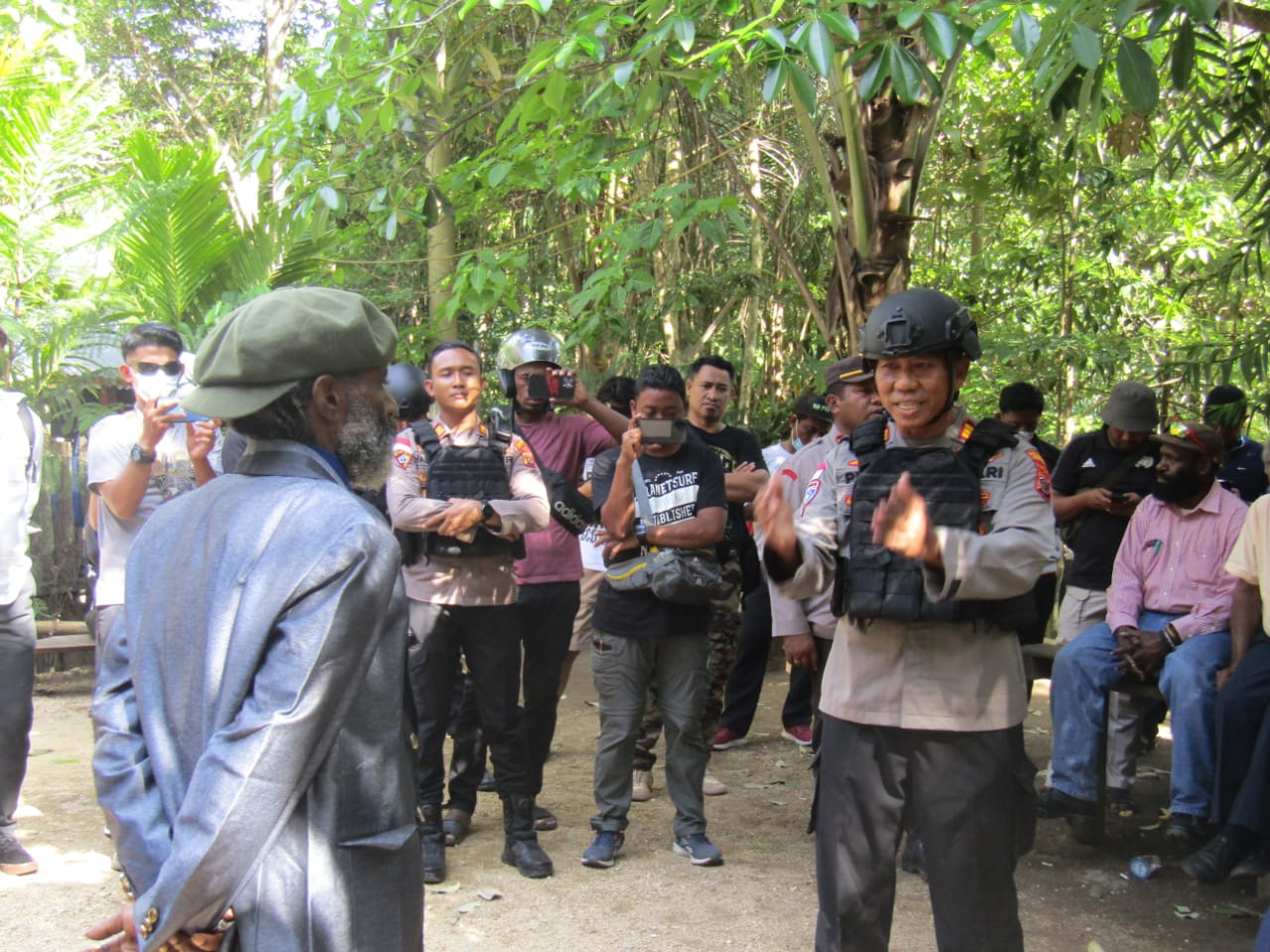
United Liberation Movement for West Papua (ULMWP) figure, Buchtar Tabuni during negotiations with members of the Jayapura City Police at his home, Jayapura City, before being arrested on Monday (17/10/2022) afternoon. – Doc. ULMWP

Jayapura, Jubi – United Liberation Movement for West Papua (ULMWP) leader Buchtar Tabuni was arrested by police in Jayapura City on Monday, October 17, 2022. Tabuni was arrested at his home in Kampwolker, Yabansai Village, Jayapura City. Until Monday night, Tabuni was still undergoing examination at the Jayapura City Police Headquarters.

The news of Tabuni’s arrest was conveyed to Jubi by the Secretary of the ULMWP Action Committee, Christianus Dogopia, via WhatsApp message service. “Buchtar was forcefully arrested by the police. Until now, it is not yet known what the reason for the arrest of Buchtar was,” he said.

Dogopia said, on Monday a number of armed police surrounded Tabuni’s house in Kampwolker. “At around 10 a.m. Papua time, heavily armed Indonesian police came to Buchtar Tabuni’s residence in Kampwolker,” he said.

According to Dogopia, the police surrounded Tabuni’s house until around 3 p.m. The police then arrested Tabuni.

“We also don’t know the reason why the police surrounded Tabuni’s residence. Currently, the police have arrested Buchtar Tabuni and brought him to Jayapura City Resort Police,” he said. Dogopia said Tabuni’s arrest was not accompanied by an arrest warrant.

Buchtar Tabuni
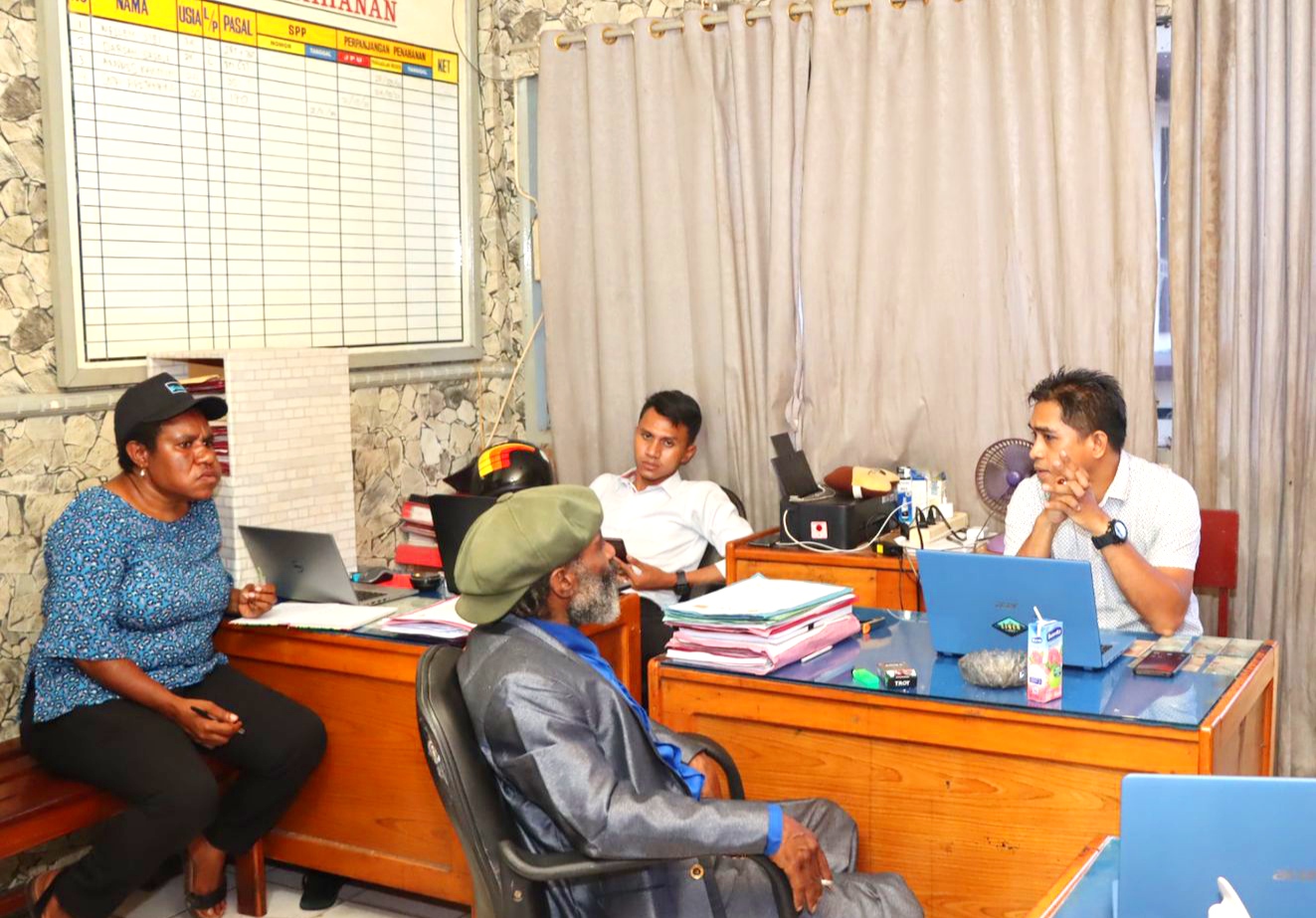
Buchtar Tabuni when questioned by investigators from the Criminal Investigation Unit of the Jayapura City Police, Monday (17/10/2022). – IST

Jayapura City Police Chief Sr. Comr. Victor D. Mackbon on Monday afternoon confirmed that his office arrested Buchtar Tabuni. According to him, Tabuni was arrested to clarify the activities held at his home since three days ago. “Buchtar Tabuni’s arrival is to clarify his community gathering activities,” said Mackbon.

He explained that the police came to Tabuni’s residence because they received a report from the community. “We are responding to reports related to community gathering activities carried out by Buchtar Tabuni as they do not have a permit and are considered to have disturbed the community,” he said.