Aryo Putranto Saptohutomo, Jakarta — Transparency International Indonesia (TII) Secretary General Danang Widoyoko says that Indonesia’s poor Corruption Perception Index (CPI) is not caused by frequent Corruption Eradication Commission’s (KPK) sting operations (OTT).
Widoyoko conveyed this in response to remarks by Coordinating Minister for Maritime Affairs and Investment Luhut Binsar Pandjaitan who proposed that the KPK not be excessive in conducting frequent sting operations because it impacts upon the country’s image.
“The low corruption perception in Indonesia is not because of OTT”, said Widoyoko when contacted by Kompas.com on Wednesday December 21.
“What make Indonesia’s corruption perception index low is primarily the practices of political corruption and judicial corruption. So if the main agenda is fixing political funding and improving the effectiveness of judicial supervision”, continued Widoyoko.
Widoyoko said that based on the results of TII’s research it is corruption practices in public services which have caused a poor corruption perception index. “So what must be fixed is public services, not OTT”, said Widoyoko.
According to TII, Indonesia achieved its best CPI score of 40 in 2019.
But at the end of that year the House of Representatives (DPR) ratified the revisions to the KPK Law and in 2020 Indonesia’s CPI fell to 37.
Then in 2021 the index rose by one point to 38.
Speaking separately, Indonesia Corruption Watch (ICW) Coordinator Agus Sunaryanto shrugged off Pandjaitan’s statements about the KPK’s OTT giving the country a bad image.
According to Sunaryanto, efforts to eradicate corruption must be continued in an integrated manner and there cannot be a separation between prevention and law enforcement such as OTTs.
“The eradication of corruption must be comprehensive, [running] parallel between prevention and enforcement”, said Sunaryanto when contacted by Kompas.com.
Sunaryanto said he agrees with efforts to digitalise systems as one of the ways to close off opportunities for corruption. But he is convinced that law enforcement through OTTs cannot be avoided if violations are still occurring.
“If a system is already digital or electronic does that then mean corruption disappears? What’s referred to as openings always exist, right, that it must be fixed is of course is a must”, said Sunaryanto.
“But if after being fixed there are still illegal activities, yes well it must be acted on. I can be through OTTs or via other strategies”, said Sunaryanto.
Earlier, Pandjaitan made a statement which was seen as controversial during an event titled The 2023-2024 Launch of Corruption Prevention Actions that was organised by the KPK and several other government ministries and institutions at the Thamrin Nine Ballroom in Central Jakarta on Tuesday December 20.
Panjaitan took the opportunity to say that moves to digitalise port operating systems is the best way to fight corruption in the maritime sector.
According to Pandjaitan, digitalization is one of the measures need to prevent corruption in order to improve Indonesia. In addition to this, he said that OTTs also have an impact on the country’s image.
“Because this has changed the country, we don’t need to talk all high and mighty, we’re OTT-OTT [crazy], that’s not actually good, it’s really bad for the country”, said Pandjaitan.
Pandjaitan asked the KPK not conduct such frequent sting operations saying that if digital systems are in place then there won’t be any corruptors brave enough to commit corruption.
“Yes, if you can live a little okay. If we want it to be totally clean then you should just go to heaven”, said Pandjaitan.
“So the KPK should also not make small arrests here small arrests there, like that. Yes, look around, but if this digitalisation is already running, I don’t think that (corruptors) will be able to play around”, said Pandjaitan.
When questioned after the event at the Thamrin Nine Ballroom, Pandjaitan said that what he meant by bad was when the government created opportunities for corruption so sting operations had to take place.
According to Pandjaitan, with digitalisation it will no longer be possible for officials to commit corruption so there won’t be any need for sting operations.
“It’s not ugly, it’s only ugly for us because we create opportunities for there to be OTT, if everything has been digitalised right, it won’t be possible for there to be any more OTT, that would be great, right”, said Pandjaitan.
[Translated by James Balowski. The original title of the article was “Respons Luhut, Aktivis Sebut OTT Bukan Penyebab Indeks Korupsi Indonesia Buruk”.]
JAKARTA, Dec 23 (Reuters) – Indonesia has extended by 20 years a production sharing contract (PSC) with BP and its partners for Berau, Muturi, and Wiriagar working areas in West Papua, government officials and the company said on Friday.
The extension would allow BP and its partners to operate on the fields until 2055, BP said in a statement. The working areas supply to Tangguh liquefied natural gas (LNG) plant.
BP is trying to increase Tangguh’s production capacity from the current 7.6 million tonnes per annum (MTPA) to around 11.4 MTPA by adding a new, Train-3 plant which is expected to come onstream in March 2023, SKK Migas said earlier this year.
Indonesia usually extends a PSC two to 10 years before it expires, but BP needed to secure a longer contract to guarantee its long-term investment plan, according to Dwi Soetjipto, chairman of Indonesia’s upstream regulator SKK Migas.
“In order to maintain production for LNG Train-3, BP is committed to conducting further exploration activities at several sites … BP also committed to preparing a 2×90 MMSCFD gas pipe to support industry development in Papua,” said Dwi
Output from LNG Tangguh plant is estimated to drop before 2030 if there is no new exploration.
Energy minister Arifin Tasrif said Tangguh gas production is needed to supply Indonesia’s increasing energy demand as the country will rely on gas while transitioning to cleaner energy.
Separately, Indonesia also said on Friday that development of BP’s Ubadari field, also in West Papua, and its carbon capture, utilisation and storage (CCUS) project would be included in the country’s list of National Strategic Projects.
Wahyu Utomo of the Acceleration of Priority Infrastructure Committee told reporters that such CCUS projects are needed for the country’s energy industry to become cleaner and that Indonesia would benefit from the technology.
Indonesia usually puts important projects in the National Strategic Projects to accelerate their realisation, Wahyu said.
Projects in the list sometimes get special treatment such as tax breaks.
Reporting by Bernadette Christina, Fransiska Nangoy, and Ananda Teresia; Writing by Gayatri Suroyo; Editing by Kanupriya Kapoor
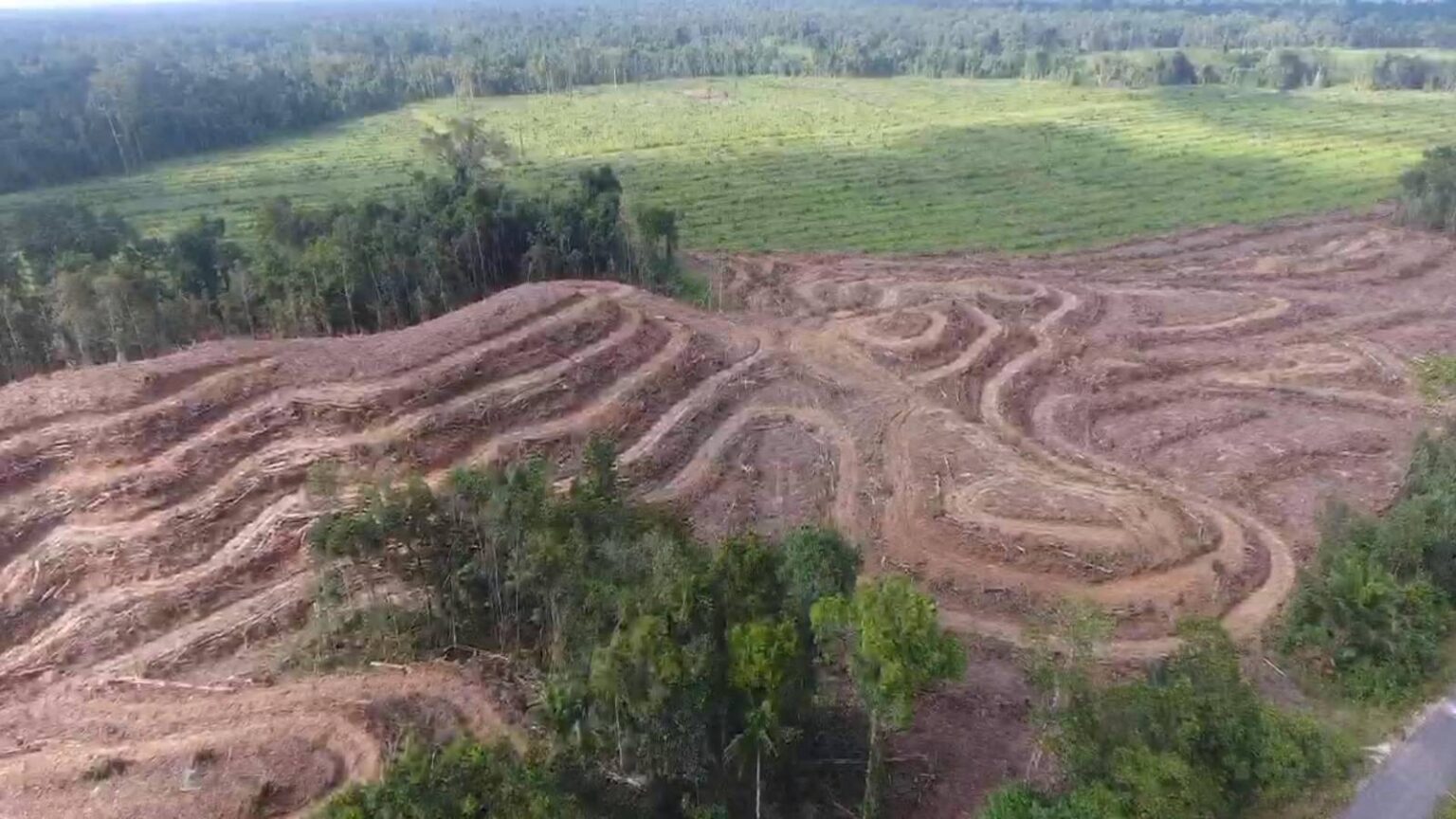
Land clearing in Grime Nawa Valley, Jayapura Regency that is planned to be planted with oil palm. – Doc. JubiTV Team
Jayapura, Jubi – Head of Greenpeace Indonesia’s Forest Campaign Kiki Taufik said there are ten regencies in Papua island with the highest deforestation rate from 2001 to 2020. Deforestation occurs due to overissuance of licenses for land-based extractive industries that threaten the rights of indigenous Papuans.
This was conveyed by Taufik in an online discussion of the research report “The Curse of Natural Resources in the Land of Papua” organized by Greenpeace in collaboration with the Institute for Development of Economics and Finance (IDEF) on Monday, December 19, 2022. Kiki said that in the last two decades, Papua has been the region with the highest deforestation rate in Indonesia.
Greenpeace and IDEF’s research shows that at least 417,800 ha of natural forest have been lost in ten Papua regencies. Of the ten regencies, half of them are in Papua Province, with the loss of natural forest reaching 292,100 ha. The five regencies are Merauke Regency (92,200 ha), Boven Digoel Regency (69,800 ha), Mappi Regency (30,200 ha), Nabire Regency (36,000 ha), Keerom Regency (29,900 ha) and Mimika Regency (34,000 ha).
Deforestation at a high rate also occurred in West Papua Province, with the area of natural forest lost reaching 125,700 ha. The five regencies are Fakfak Regency (36,100 ha), Teluk Bintuni Regency (31,700 ha), Manokwari Regency (28,700 ha) and Sorong Regency (29,200 ha).
Land-based extractive industries such as mining, Industrial Plantation Forest (HTI), Forest Concession Rights (HPH), and oil palm plantations are rampant in Papua, leading to deforestation. The formation of New Autonomous Regions (DOB) such as the three new provinces can also accelerate deforestation.
Rosita Tecuari, the chairperson of the Namblong Tribal Women’s Organization in Jayapura Regency, said that permit-based exploitation of natural resources has marginalized the rights of indigenous Papuans. “We have experienced firsthand how our forests were forcibly taken by the company, while we who own the customary land do not get any welfare,” she said.
Tecuari said that she and the indigenous people in the Grime Nawa valley are currently fighting to reject palm oil company PT Permata Nusa Mandiri. According to Tecuari, the company has cleared up to a hundred hectares of land belonging to the indigenous community without permission.
Kamu mungkin suka
;
Tecuari said that the presence of the company did not have a positive impact on the indigenous community. Instead, the company’s activities are destroying nature and the land that is the source of life for the indigenous people.
“The forest for us is a place to find food. We take vegetables and side dishes from the forest, not in the city or in shops,” she said. (*)
Rainforest in Papua New Guinea | Nature Picture Library / Alamy Stock Photo
OPINION: Independence activists want to combine the best parts of liberal democracy with indigenous traditions
Ben Wray 20 December 2022, 11.20am
Due to the strength of their diverse indigenous traditions and the unique biodiversity of their lands, it is axiomatic for West Papuans that human life and nature are inseparable.
Now, the leaders of the province’s independence movement have a proposal to make it “Earth’s first green state”.
As Benny Wenda, exiled leader of the United Liberation Movement for West Papua (ULMWP), told a conference at Queen Mary University of London (QMUL) on 9 December: “The forest is our friend, our supermarket, our medical cabin. You cannot separate West Papua from our environment. We have always been at peace with nature.”
Unfortunately, the Indonesian government, which has maintained a bloody and brutal occupation of West Papua for almost 60 years, and the global corporations they invite to “develop” its lands, does not abide by such values.
West Papua, which is home to more than 250 tribes with their own languages and cultures, has the third largest rainforest in the world. But it is imperilled by gold mines, logging companies, palm oil plantations and many more forms of resource extraction that strip the land bare. Mine sedimentation kills off plants and natural life for hundreds of kilometres around.
According to Lisa Tilley, a political ecologist at SOAS University of London, these ecological “dead zones” are a “paradise for pathogens”.
“Genetic diversity is usually the firewall which prevents pathogens spreading and making those zoonotic [animal-to-human] shifts,” Tilley says.
The Indonesian government claims to want to be part of an “Opec for the rainforests” – along with the Democratic Republic of Congo and Brazil – a rival to the club of oil-producing nations, promoting conservation rather than fossil fuels. But the reality on the ground is that rainforest destruction is ramping up.
A gold mine the size of Jakarta, the Indonesian capital, is being planned. In the ongoing construction of the Trans-Papua Highway, a forest area the size of Denmark could be cleared by 2036. The BBC reported in 2020 that Korean palm oil giant Korindo has cleared nearly 60,000 hectares of West Papuan forest, an area the size of Seoul.
An eco-revolution in West Papua, to protect this valuable landscape, is in all of our interests.
We have the solution to the global climate crisis. Indigenous people should be able to manage their lands as they have done for thousands of yearsBenny Wenda, United Liberation Movement for West Papua
Wenda and the ULMWP have a plan for such a transformation. The Green State Vision is part of their programme for independence.
“The Green State Vision is our offer to the world,” Wenda said. “We have the solution to the global climate crisis. Indigenous people should be able to manage their lands as they have done for thousands of years.”
The Green State Vision was developed based on the values of the indigenous Melanesian tribes of West Papua, where living in balance and harmony with nature are core values, and collectivity is emphasised over individualism. There are “three pillars” to the vision: environmental and social protection; customary guardianship; and democratic governance.
Measures would include making ecocide a serious criminal offence and compelling resource extraction companies to work within an ecologically sustainable framework. Guardianship of the forests, lands and rivers will be restored to “customary authorities at family, clan and tribal level”.
The political model is an attempt to combine “the best features” of a liberal democratic state – a legislature, an independent judiciary, and so on – with approaches rooted in holistic indigenous practices that prioritise community-based decision making and collective land rights. Could other parts of the world benefit from a similar approach?
Lessons for the rest of the world
As Joan Martinez-Alier, author of ‘Environmentalism for the Poor’, pointed out at the conference, while 5% of the world population is officially considered to be indigenous, they appear in 40% of known environmental justice disputes in the world.
The fact that indigenous communities tend to live off lands that hitherto have not been the object of ‘development’, and thus tend to be resource-rich, makes them targets for extractivist modes of capital accumulation. As such, environmental violence and resistance usually follows.
“Indigenous people are defending their rights at the extraction frontiers, motivated by their own cultural values and interests – sacredness, identity and livelihood – against coloniality and racism,” Martinez-Alier added.
But even in the non-indigenous world, where workers have long since been torn from the land and survive via the market, inspiration can be taken from the Green State Vision’s willingness to criminalise ecocide and challenge the apparently sacred ‘right’ of capital to ruthlessly exploit nature.
David Whyte, director of the Centre for Climate Crime and Climate Justice at QMUL, said struggles for environmental justice in West Papua and countries like the UK are more intimately connected than we might think.
“If we don’t protect the world’s major forests from predatory business investors, then we have no chance at all to prevent global warming,” he explained. “Without the Amazon, the Congo and the New Guinea forests, the world stops breathing. London-based companies are major beneficiaries of this. The likes of BP and Unilever, heavily invested in West Papua, quite literally profit from our asphyxiation.
“The West Papuan Green State Vision offers us a way out of the predatory cycle. It offers the most viable way for us to keep us all breathing and to keep us all alive.”
Victims and family members of victims of the 1989 Talangsari incident in Central Lampung attend a meeting with representatives of the National Commission on Human Rights (Komnas HAM) in Jakarta. (The Jakarta Post/Dhoni Setiawan)
Editorial board (The Jakarta Post)
Jakarta ● Thu, December 15, 2022
)
Last week’s acquittal of Maj. (ret) Isak Sattu of all charges in the December 2014 fatal shooting of civilians in the Papuan regency of Paniai came as no surprise. From the very beginning, observers had doubted that justice could be served by the Makassar Human Rights Court in South Sulawesi, partially because Isak was the only person the prosecutors had indicted in the case.
As one Papuan human rights activist put it after the five justices delivered their three-to-two verdict on Dec. 8, the trial was designed to fail. Isak was only a liaison officer with the Paniai Military Command (Kodim) at the time of the shootings, which killed five people and injured 21 others.
The bench, nonetheless, agreed that the incident, dubbed Bloody Paniai, constituted a gross human rights violation. Security forces had opened fire into a crowd of demonstrators protesting the alleged beating of a young person the previous day by Indonesian Military (TNI) personnel.
But the fact that only Isak went to trial shows that the proceedings were no more than a formality, especially after early this year President Joko “Jokowi” Widodo formed a team to settle past crimes against humanity first and foremost through “non-judicial measures”.
Following its investigation into the Paniai shooting, the National Commission on Human Rights (Komnas HAM) recommended that rank-and-file soldiers and their superiors should shoulder the blame for the tragedy. The commission interviewed two dozen witnesses, analyzed documents and visited the scene to determine to what extent the TNI had been involved in the incident.
The failure of the Attorney General’s Office to bring all the alleged perpetrators of the Paniai shooting to justice is more than just a technical problem. There is an acute lack of political will on the part of not only law enforcement but the government as a whole to resolve past human rights violations.
The Paniai shooting is only the fourth gross human rights crime to be heard in court in the country, after the 1999 East Timor atrocities, the 1984 Tanjung Priok massacre and the 2000 Abepura, Papua, incident. In all the cases, all the defendants – military, police and civilians – were acquitted of all charges, either by the ad hoc Human Rights Court or the Supreme Court.
There are many more cases the state is reluctant to address, despite repeated calls from Komnas HAM. The rights body’s list includes the 1965-1966 communist purge, the 1998 Trisakti shooting and ensuing Jakarta riots, the Semanggi I incident in 1998 and Semanggi II in 1999. The commission has also recorded a number of crimes against humanity in Papua, apart from the Paniai and Abepura incidents.
The not guilty verdict for Isak in the Paniai shooting is a grim reminder of the daunting challenges the nation faces in upholding human rights as mandated by the Constitution. The acquittal has sent the message, loud and clear, that impunity will persist for years to come unless the AGO takes bold measures – first by challenging the verdict and then by bringing everyone responsible for the tragedy to justice.
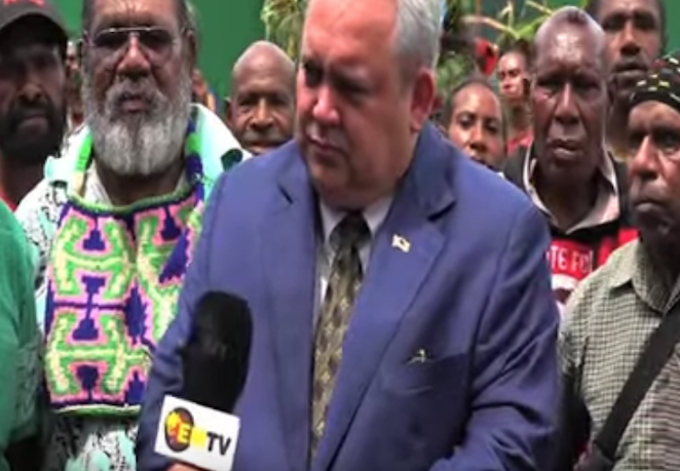
PNG Foreign Minister Justin Tkatchenko speaking at the West Papuan Independence Day event in Port Moresby on December 1. West Papuan representative Frank Makanuey (with a green and purple bilum) is at his right shoulder. Image: EMTV screenshot APR
ANALYSIS:By Yamin Kogoya
“We are part of them and they are part of us,” declared politician Augustine Rapa, founder and president of the PNG Liberal Democratic Party, on the 61st anniversary of the struggle for West Papuan independence earlier this month.
Rapa’s statement of West Papua at Gerehu, Port Moresby, on December 1 was in response to Papua New Guinean police who arrived at the anniversary celebration and tried to prevent Papuans from the other side of the colonial border from commemorating this significant national day.
According to Rapa, the issue of West Papua’s plight for liberation should be at the top of the agenda in PNG. Rapa also urged PNG’s Foreign Affairs Minister Justin Tkatchenko to take the plight of West Papuans to the United Nations.
Frank Makanuey, a senior West Papuan representative, also appealed to the PNG government to alter its foreign policy and law so Papuans from the other side of the border could continue to freely express their opinions peacefully, akin to the opinions and rights inscribed in the UN Charter of Indigenous People.
According to Makanuey, 7000 West Papuans living in PNG will continue to fight for their freedom for as long as they live, and when they die will pass on the torch of resistance to their children.
On the day of the commemoration, Minister Tkatchenko appeared in a short video interview reiterating the same message as Rapa.
“These West Papuans are part of our family; part of our members and are part of Papua New Guinea. They are not strangers,” the minister reminded the crowd.
‘Separated by imaginary lines’ “We are separated only by imaginary lines, which is why I am here.”
He added: “I did not come here to fight, to yell, to scream, to dictate, but to reach a common understanding — to respect the law of Papua New Guinea and the sovereignty of Indonesia.”
The minister then explained how West Papuans in PNG should be accommodated under PNG’s immigration law through an appropriate route.
A few days after this speech, the same minister attended bilateral meetings with countries and international organisations in the Pacific, including Papua New Guinea, Timor-Leste, Vanuatu along with the Director General of the Melanesian Spearhead Group (MSG), ahead of the Indonesia-Pacific Forum for Development (IPFD) in Bali on December 6.
Following a ministerial meeting with the Indonesian Foreign Minister, Retno Marsudi, Tkatchenko said: “As Papua New Guineans, we must support and respect Indonesia’s sovereignty.”
Tkatchenko said Port Moresby would work with Indonesia to resolve any issues that arose with West Papuans living in the country.
One of the most critical and concerning developments of this visit was the announcement of the defence cooperation agreement between Papua New Guinea and Indonesia.
“We are moving forward in the process of signing a defence cooperation agreement between PNG and Indonesia. We will work harder and partner on a common goal to achieve security along both countries’ borders,” Tkatchenko said.
Sllencing Melanesian leaders? In January 2022, there was a meeting in Jakarta at the office of the state intelligence agency. It was intended to silence all Melanesian leaders who supported West Papua’s independence and bring them under Jakarta’s sphere of influence, with an allocation of roughly 450 billion rupiahs (about A$42.5 million).
A couple of months later, on March 30, the Prime Minister of Papua New Guinea led a large delegation to Indonesia for bilateral discussions.
Forestry, Fisheries, Energy, Kumul companies, and the Investment Promotion Authority were among the key sectors represented in the delegation. Apparently, this 24 hour trip in an Air Niugini charter from Port Moresby to Jakarta cost K5 million kina (A$2 million).
Considering such a large sum of money was spent on such a brief visit; this must have been a significant expedition with a considerable agenda.
Visits of this kind are usually described with words such as, “trade and investment”, but the real purpose for spending so much money on such a brief trip before an election, are facts the public will never know.
In this case, the “public” is ordinary Papuans on both sides of the border, that the foreign minister himself stated were separated by “imaginary lines”.
It is those imaginary lines that have caused so much division, destruction, and dislocation of Papuans from both sides to become part of Western and Asian narratives of “civilising” primitive Papuans.
Imaginary to real lines Could the proposed defence agreement remove these imaginary lines, or would it strengthen them to become real and solid lines that would further divide and eliminate Papuans from the border region?
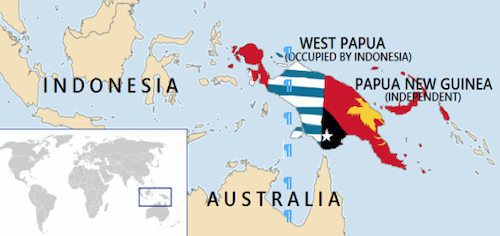
A “colonisation” map of Papua New Guinea and West Papua. Image: File
Prime Minister Marape grew up in the interior Papuan Highlands region of Tari, of the proud Huli nation, which shares ancient kinship with other original nations such as Yali, Kimyal, Hubula, Dani and Lani on the West Papuan side of the border.
As a custodian of this region, the Prime Minister may have witnessed some of the most devastating, unreported, humanitarian crises instigated by ruthless Indonesian military in this area, in the name of sovereignty and border protection.
Why does his government in Port Moresby boast about signing a defence agreement in Jakarta? Is this a death wish agreement for Papuans — his people and ancestral land, specially on the border region?
Which entity poses an existential threat to Papuans? Is it China, Australia, Indonesia, or the Papuans themselves?
There is nothing unusual or uncommon about countries and nations making bilateral or multilateral agreements on any matter concerning their survival, no matter what their intentions may be. Especially when you share a direct border like Indonesia and Papua New Guinea, which has been stained by decades of protracted war waged against Papuans.
Why now for defence pact? However, what is particularly interesting and concerning about the development between these two countries is, why now is the time to discuss a defence agreement after all these years?
What are the objectives of this initiative? Is it to serve the imperial agenda of Beijing, the United States, Jakarta, or is it to safeguard and protect the island of New Guinea? What is the purpose of a defence agreement, who is protected and who from?
Exactly like the past 500 years, when European vultures circled the island of New Guinea and sliced it up into pieces, new vultures are now encroaching upon us as the global hegemonic power structure shifts from West to East.
Responding to these developments, James Marape warned that his country would not be caught up in a geopolitical standoff with the US, Australia, or China, saying the global powers should “keep your fights to yourselves”.
But does the prime minister have a choice in this matter? Does he have the power to stop war if or when it breaks out in the Pacific like the past?
Let‘s be honest and ask ourselves, when did Papuans from both sides of this imaginary line have the power to say no to all kinds of brutal, exploitative behaviour exhibited by foreign powers?
From World War I to II, then to Pacific nuclear testing, and to foreign international bandits currently exploiting papua New Guinea’s natural resources?
Brutality of Indonesia Since its independence, when has the PNG government been able to halt the brutality and onslaught of the Indonesians against their own people on the other side of these imaginary lines?
Why does PNG’s foreign affairs minister sit in Jakarta negotiating a defence deal with an entity that threatens to annihilate West Papuans, after he himself conveyed a heartfelt message to them on December 1?
Can both the prime minister and the foreign affairs minister avoid being caught in the middle of a looming war as the Pacific becomes yet another gift for strategic war space between the Imperial West and the Imperial East?
Benny Wenda, an international icon for the liberation of West Papua, made the following statement on his Facebook page in response to the defence agreement: “Let’s not make this happen, please, our PNG brothers and sisters open your eyes! Can’t you see they’re trying to take over our ancestors Land.”
While the PNG government gambles on West Papua’s fate with Jakarta, West Papuans are marginalised, chased, or hunted by establishing unlawful settler colonial administrative divisions across the heartland of New Guinea and direct military operations.
As Wenda warned in his latest report, “mass displacements are occurring in every corner of West Papua”.
Whatever the philosophical approach underlying Papua New Guinea’s foreign policies in relation to West Papua’s fate — realist or idealist, traditional or transcendental — what matters most to West Papuans is whether they will survive under Indonesian settler colonialism over the next 20 years.
A reverse situation What if the situation is reversed, where Papuans in PNG were being slaughtered by Australian settler colonial rule, while the government of West Papua continues to sneak out across the border to Canberra to keep making agreements that threaten to annihilate PNG?
Papuans face a serious existential threat under Indonesia settler colonial rule, and the PNG government must be very careful in its dealings with Jakarta. Every single visit and action taken by both Papua New Guinea and Indonesia will leave a permanent mark on the wounded soul of West Papua.
The only question is will these actions destroy Papuans or rescue them?
The government and people of Papua New Guinea must consider who their neighbours will be in 100 years from now. Will they be a majority of Muslim Indonesians or a majority of Christian West Papuans?
It is a critical existential question that will determine the fate of the island, country, nation, as well as languages, culture and existence itself in its entirety.
Will the government and the people of Papua New Guinea view West Papuans as their brothers and sisters and restructure their collective worldview in the spirit of Rapa’s words, “we are part of them, and they are part of us”, or will they continue to sign agreements and treaties with Jakarta and send their secret police and army to chase and threaten West Papuans seeking protection anywhere on New Guinea’s soil?
West Papua is bleeding. The last thing West Papua needs is for the PNG government apparatus and forces to harass and chase them as they seek refuge under your roof.
Papua New Guinea is not the enemy of West Papua; the enemy of PNG is not West Papua.
The enemies are those who divide the island into pieces, exploit its resources and sign defence agreements to further solidify imaginary lines while leaving its original custodians of the land stranded on the streets and slums like beggars.
Papuans have lived in this ancient and timeless land from Sorong to Samarai for thousands of years. The actions we take today will determine whether the descendants of these archaic autochthons will survive in the next thousands of years to come.
Yamin Kogoya is a West Papuan academic who has a Master of Applied Anthropology and Participatory Development from the Australian National University and who contributes to Asia Pacific Report. From the Lani tribe in the Papuan Highlands, he is currently living in Brisbane, Queensland, Australia.
Kadek Melda Luxiana, Jakarta — The sole defendant in the Paniai gross human rights violation case trial being heard in the Makassar District Court in South Sulawesi, retired Infantry Major Isak Sattu, has been found not guilty.
Coordinating Minister for Security, Politics and Legal Affairs (Menko
Polhukam) Mahfud MD has related how it was President Joko “Jokowi”
Widodo who asked that the case be taken to court.
“What about Paniai, why did the court rule he was free? Remember, right, we said that the data provide by Komnas HAM [the National Human Rights Commission] was inadequate, but at the time the Pak [Mr] President summoned me, ‘Pak Menko, every Human Rights Day Komnas HAM always gives a speech about taking gross human rights cases to the courts, why haven’t they been taken [to court]'”, said Mahfud imitating Widodo’s remarks during the presentation of Menko Polhukam’s end of year report at the Coordinating Ministry for Security, Politics and Legal Affairs in Jakarta on Thursday December 15.
Mahfud then explained that Attorney General ST Burhanuddin responded by saying there was not enough evidence to declare the case a gross human rights violation. He then alluded to the East Timor cases in where out of the 34 people tried only two were found guilty and sentenced, but they were then released after submitting an appeal (PK).
“The Pak Attorney General said, ‘Pak, there isn’t any evidence, it’s only a declaration that a human right violation occurred here, a review found it didn’t meet the requirements, there are no autopsies, the victims are unclear, who are the perpetrators, so if it’s taken [to court] it’ll lose. Like, oh yeah, like the [2002] cases in East Timor where 34 people were released, only two were sentenced, [pro-integration militia leader Eurico] Guterres, Guterres and one other, but after Guterres and his comrades submitted a PK they were all released'”, said Mahfud imitating Burhanuddin.
Mahfud said if evaluated based on feelings, the Paniai case was a human rights violation. He said that Widodo was firm that he wanted the Paniai case to be taken to trial because he truly wanted to pursue Komnas HAM’s recommendations even if in the end the defendant could be released.
“I know in terms of feelings it was truly a human rights violation, but it’s up to the court to decide, right, so in the end the President said enough, take it to court even though, the Attorney General said ‘But Pak, why if you already know it’ll lose in court’. No, not if we truly implement Komnas HAM’s recommendations”, he said.
“So, we tied four, arranged four, Wasior, Wamena, Paniai, it was arranged, but it was very difficult to connect the facts together, very difficult, so in the end, yeah, just one, Paniai, was taken to court, and [the defendant] was released”, he continued referring to the 2001 Wasior and 2003 Wamena incidents in Papua.
Furthermore, Mahfud said that the Paniai case was not a gross human rights violation but a crime.
“It wasn’t a gross human rights violations, it was a crime, there’s a different way to resolve [crimes], sometime you don’t know the difference between a serious violation and gross human rights violations, even though they’re both legal terms”, he added.
Paniai defendant released
The Makassar District Court released Isak Sattu, the former Paniai/1705 District Military Command (Kodim) liaison officer who had been indicted on charges of committing gross human rights violations during the Paniai incident.
As reported by Detik Sulsel (South Sulawesi), on Thursday December 8 the panel of judges ruled that Sattu was found not guilty of the indictment as laid out by the public prosecutor on Wednesday September 21 and that all of the defendant’s rights be restored.
“The defendant is released from all of the public prosecutor’s charges”, said presiding judge Sutisno in the ruling.
“[We] declare that the defendant retired Infantry Major Isak Sattu as cited above has not been proven legally and convincingly guilty of committing gross human rights violations as laid out in the first and second indictments”, added Sutisno.
The public prosecutor had charged that Sattu was responsible for the bloody Paniai tragedy in front of the Enarotali/1705-02 Sub-District Military Command (Koramil) on Monday December 8, 2014. The incident resulted in four people being shot dead and 10 others suffering injuries.
“[The prosecution] demands that the court’s panel of judges in the Human Rights Court in the Makassar Class IA Court who are examining and trying this case rule and hand down a sentence of 10 years in prison against retired Infantry Major Isak Sattu”, said the public prosecutor at the Makassar District Court on Monday November 14. (dek/jbr)
[Translated by James Balowski. The original title of the article was “Mahfud Cerita Jokowi Minta Kasus HAM Berat Paniai Dibawa ke Pengadilan”.]
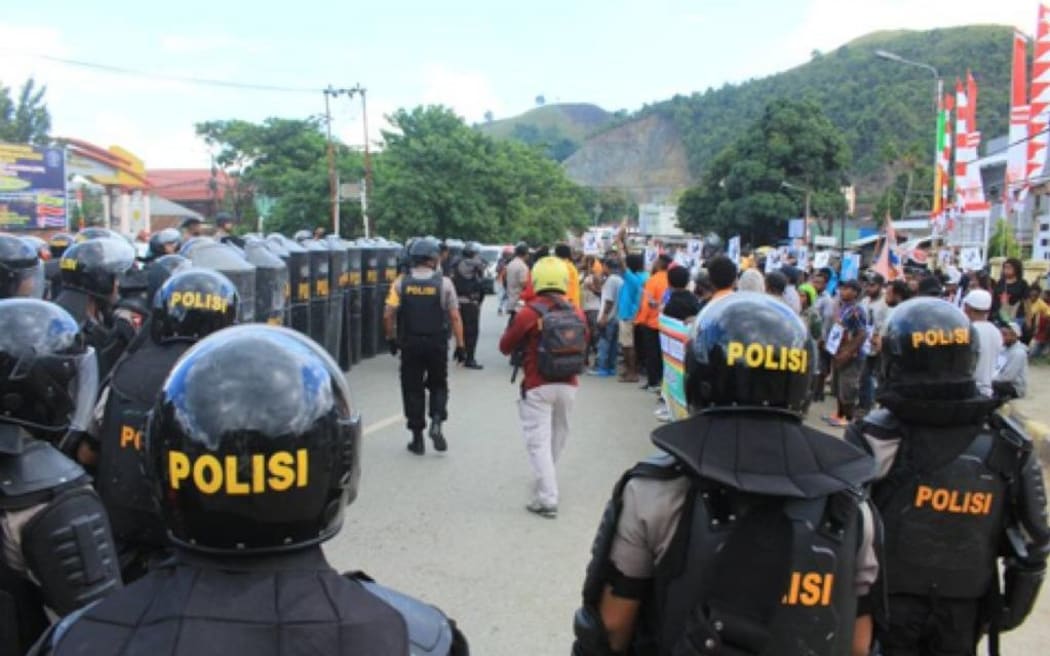
Police blockade the protest in Jayapura. Photo: Whens Tebay
An Indonesian rights group claims Indonesian police and soldiers have carried out at least 72 extra-judicial killings over the past year.
The report by the Commission for Missing Persons and Victims of Violence – or KontraS – said the police were responsible for 50 of the unlawful killings, with the remainder committed by military personnel.
The latest report situated the unlawful killings in the context of a “narrowing of democratic space” and “massive violations of rights related to the basic principles of democracy” by President Joko Widodo’s administration.
“The widespread practice of extrajudicial killings throughout 2022 by security personnel shows that they are like wolves in sheep’s clothing who are ready to pounce when there’s an opportunity,” KontraS researcher Rozy Brilian told reporters, according to a report by BenarNews.
The article quoted Rozy as saying that most of those allegedly killed by police were under criminal investigations and at least 12 of the cases involved torture.
While six Indonesian soldiers were arrested recently for their involvement in the deaths of four Papuans in Mimika regency in the unsettled Papua region, the report claims the security forces still enjoy a high degree of impunity for illegal behavior.
“This is a reminder of the considerable degree of continuity between Suharto’s military-backed New Order, in which the security forces enjoyed political prominence and vast power, and the democratic system that was established after the regime’s fall in 1998,” the authors said.
KontraS said far from investigating or prosecuting those responsible for past rights outrages, the Indonesian government has often promoted them to key positions in government.
In particular, KontraS pointed to the appointment of Maj. Gen. Untung Budiharto, the alleged perpetrator of enforced disappearances during the terminal crisis of the Suharto government in 1997 and 1998, as commander of the Greater Jakarta Command Area.
Below is the speech that ULMWP Interim President Benny Wenda gave at Queen Mary University of London on December 9th, 2022.
Interim President Wenda opened the “Resisting Ecocide: Restoring Balance and Harmony to West Papua” conference with a reflection on the Green State Vision, Indonesian ecocide, and his own upbringing in West Papua. Featuring speakers including Raki Ap, Chris Saltmarsh, Joan Martinez Alier, and Lisa Tilley, the conference explored the link between Indonesian state violence and environmental destruction in West Papua.
The Green State Vision was a focal point of speakers’ contributions. Its combination of customary guardianship, environmental protection, and modern democratic governance was discussed as both a model for an independent West Papua, and a solution to the climate crisis at large. As Benny Wenda put it, the Green State Vision is West Papua’s offer to the world.
Thank you to everyone here for their contributions. Thank you to Roy Lee and David White for organising this conference. Thank you to everyone who is speaking, and thank you to everyone watching here and online.
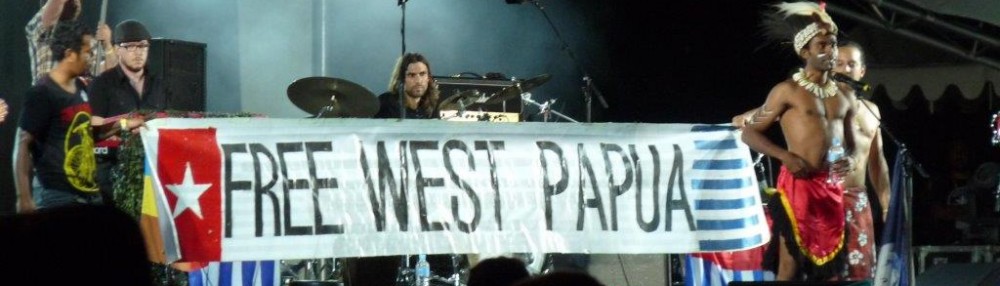
This is an important day. The people of West Papua need to be heard by the world. For sixty years, Indonesia has tried to shut down our speech, to prevent us from protesting against their illegal occupation.
Academics have a big role to play in securing the West Papuan vision. This conference should be the opening for a wider discussion of Indonesian ecocide in West Papua. The world needs to know our struggle, the hidden genocide we are suffering, the destruction of our beautiful country by Indonesia. You can help us by using your voice and showing solidarity with our struggle.
West Papua is a green land in a blue ocean, the Pacific. We have thousands of miles of rainforest, the third largest in the world. We have hundreds of animals and plants that can’t be found anywhere else on earth. But Indonesia is tearing up our forest, destroying our mountain and poisoning our river.
The world needs to know that there can be no climate justice without West Papuan freedom. That is why we announced the Green State Vision for an independent West Papua, free from Genocidal and Ecocidal Indonesian colonialism.
The Green State Vision says that we need to reclaim and restore our nature, otherwise we will become voiceless and separated from our being. The Green State Vision means peace and harmony. It means self-determination, independence, and freedom.
But the Green State Vision is also our offer to the world. We have the solution to the global climate crisis. Indigenous people should be able to manage their lands as they have done for thousands of years. If you support us, you are making history in this global struggle against global warming.
The forests of West Papua are the lungs of the world. Growing up in nature, the forest is our friend. It is our supermarket, our medicine cabinet. You cannot separate West Papuans from our environment. We have always been at peace with nature and with all beings in our land.
I grew up in the forest, but Indonesia’s illegal occupation forced me to move to the town. This was a different world. And while I was growing up in the town, our forest was being destroyed.
In West Papua, climate change and colonialism are connected. By removing indigenous West Papuans from our land, Indonesia is able to build big new developments, like the Trans Papua highway and Wabu Block gold mine. Wabu Block is a gold mine the size of Jakarta. Business and military are connected –removing West Papuans from our land also allows Indonesian military to control us.
Since 2019, the Indonesian Military occupation has become more violent, causing a crisis of displacement in West Papua. 25,000 new Indonesian troops have been deployed to West Papua since then. Between 60,000 to 100,000 West Papuans have been displaced by Indonesian militarisation in the last four years. In so many regions, like Nduga, Maybrat, Intan Jaya, and Puncak Jaya, West Papuans are refugees in their own land.
My people have had to abandon their homes, churches, schools, and flee into the forest. Young children have been shot dead, women have given birth in the bush, people do not have food or medical care. Hundreds have died. Hundreds have fled across the border to Papua New Guinea refugee camps.
Indonesia says that they are doing this for our own good. They say West Papuans need colonial development, that we need palm oil plantations and gold mines.
This is racism. It is the same racism that calls us ‘monkeys’. They want the world to think that West Papuans cannot manage our own land – the land we have been custodians of for thousands of years.
We are not asking for development, we are asking for freedom.
The world needs to understand. Indonesia doesn’t want the West Papuan people. They only want our resources. That is why they are committing genocide – to clear us away from our land and take our gold, copper, gas. Over 500,000 West Papuans have died since we were colonised in the 1960s.
Who caused Global Warming? The big powers and big corporations – not the indigenous people. We do not intend to destroy our forests, our environment. Our environment makes us who we are.
When we become independent, we make these promise to the world. We will be the first country to make ecocide a criminal offence. We will fight for it to be prosecuted at the International Criminal Court. We will tell corporations operating in our land that they must stop destroying nature or their license will be revoked.
In a free West Papua, the rights of all beings will be placed above the rights of private corporations.
The struggle of the West Papua liberation movement is growing in strength. We have our provisional government, our temporary constitution, and our cabinet. With the Green State Vision, we have the solution, for us and for the world. We are ready to take control of our country, for the good of all our people – not just for profit.
Now is the right time for everyone – ordinary people, academics, world leaders –to stand behind us. On behalf of the people of West Papua, I invite you to support us in our fight for independence and climate justice.
Benny Wenda Interim President ULMWP Provisional Government
Americans will get to the ballot box in late 2024. Such is our infatuation with US politics that by Guy Fawkes’ night we’ll have absorbed enough minutia to know more about their electoral system than ours. Does anyone in the media remember Indonesia?
Earlier the same year there’ll be another election of great importance to our future – yet so far the media has shown little interest in telling what’s going on in the nation next door.
On Valentine’s Day 2024 citizens of the world’s third-largest democracy will decide who’ll run their nation for the next five years. Their choice could maintain the current harmony of indifference between us and them, or revive mistrust.
The man to worry about is Prabowo Subianto, adored by hankerers for the good ol’ days when leaders ruled and the masses obeyed. Like his late father-in-law President Soeharto, the disgraced former general knows how to create myths and crush dissent.
This Alpha male could try again in the 2024 Presidential election. If he wins we’ll have an unstable authoritarian on our doorstep.
Subianto is the archipelago’s Donald Trump, a hot-tempered autocrat minus bone spurs so he has a military record. He’s a successful businessman but better educated than the US version.
Despite having a mighty war chest and on-side media, in 2019 he lost to lowly lad Joko ‘Jokowi’ Widodo.
Subianto had fought furiously for the top job. His team had viciously slandered Widodo through fictions about family history, ethnicity and religion. Just like Trump claimed Barack Obama was not a native-born American.
Despite the slurs, Widodo took 55.5 per cent of the vote. The voluntary participation rate was 83 per cent of the almost 191 million registered voters.
Some claimed the result had been rigged, so rioted in Jakarta. Six were killed, 200 injured, vehicles were firebombed and buildings trashed. Agent provocateurs were blamed but none charged.
After being humiliated Subianto should have crept back to his ranch and locked the gate.
Instead, he’s travelling the world shopping for guns and bombs as Indonesia’s Defence Minister while his defeated sidekick Sandiaga Uno is Minister for Tourism.
Discovering how these losers got their jobs and kept face will test readers’ incredulity levels but might improve understanding of Indonesian politics, best done with a hypothetical.
Back in May new PM Anthony Albanese was pondering picks for Cabinet. Home Affairs is tricky so best go for experience. Obviously Scott Morrison.
Primary Industries demands a ruddy rural face. So Albo rang Barnaby Joyce. Unbelievable in Oz, but reality next door.
Widodo’s benevolence and forgiveness weren’t just quests for harmony, a value well embedded in Javanese culture. They were politically smart.
As Lyndon Johnson crudely said: ‘Better to have your enemies inside the tent pissing out than outside the tent pissing in.’
The downside is that as Defence Minister Subianto, 71, gets to spruik policies and keep his name before the public and face on TV.
Like Kim Jong-un, he’s shown surrounded by men with more medals on their chests than hair, which he seems to enjoy.
Like Putin he rides horses but keeps his shirt on; the septuagenarian flab would mar the image which some equate to Mussolini reviewing paramilitary parades atop a stallion.
Subianto has such a damaged past that in other jurisdictions he’d be forever damned.
When Soeharto fell in 1998 after 32 years running the world’s fourth most populous country Subianto, head of the ‘most highly trained killers – the Kopassus red berets’– saw a sudden opportunity. He tried to get the departing president to make him army chief.
The bid failed and Subianto was dishonourably discharged for ‘misinterpreting orders’. He was banned from the US for human rights abuses relating to the disappearance of student activists. He then fled to exile in Jordan.
But he still had swags of ambition, a rich younger brother and mates in the oligarchy to aid his return and get into politics.
Unable to find an empty launch pad he started the Partai Gerakan Indonesia Raya – the Great Indonesia Movement Party (Gerindra). It’s dubbed nationalistic and populist.
If it has any policies other than to elect the leader, then they’re well hidden. Rural Indonesians have been promised care and recognition, but his party gets most ‘likes’ by slandering LGBTQs and warning that foreigners plan to destroy the country. This last claim came from a sci-fi novel.
In the 575-seat lower house Gerindra holds 78 against the Partai Demokrasi Indonesia Perjuangan (Democratic Party of Struggle) with 128.
The PDIP is Widodo’s party though the power is with its matriarch Megawati Soekarnoputri. She’s the daughter of Soekarno, the founder of modern Indonesia and its first president. Widodo reckons his relationship is like ‘mother and child.’
The lady was the nation’s fifth president (2001- 04), a rest awhile period. As VP she inherited the job when Abdurrahman Wahid (Gus Dur) was impeached, but rejected by the public when she sought election in her own right.
To stop Subianto from taking another stab at the presidency, lobbyists have been pushing for a change in the Constitution so Widodo, 61, can hang in there for a few more years.
The incumbent hasn’t completely abandoned the idea of staying on – clarity is not his style. However, it seems he’s shaken his head rather than nodded by obliquely promoting a candidate ‘who thinks only of the people’s interests that his hair grows white.’
Riddling is another Javanese trait, allowing the listener to interpret while keeping the speaker free to deny should plans go awry.
The assumption is that Widodo wants Central Java Governor Ganjar Pranowo, 54, as his successor. His thatch fits, but so do many others.
Pranowo doesn’t come from the elite, the military or big business. His father was a cop and the family were hillside villagers in Central Java, while Widodo was raised in a riverbank shack.
Both went to Jogjakarta’s Gadjah Mada University, Widodo for forestry and Pranowo law. The two show little interest in matters beyond domestic issues.
When he met Australian Ambassador Penny Williams in September Pranowo’s comments were bland: ‘Hopefully, the emotional atmosphere will become closer.’
That won’t happen without major efforts on both sides. Otherwise, Australians will be full bottle about people and events 16,000 km distant, while knowing nothing of the neighbours, what they’re up to, and why.
ABC TV has Planet America, China Tonight and India Now. Time for Inside Indonesia.
Duncan Graham has been a journalist for more than 40 years in print, radio and TV. He is the author of People Next Door (UWA Press) and winner of the Walkley Award and Human Rights awards. He is now writing for the English language media in Indonesia from within Indonesia.