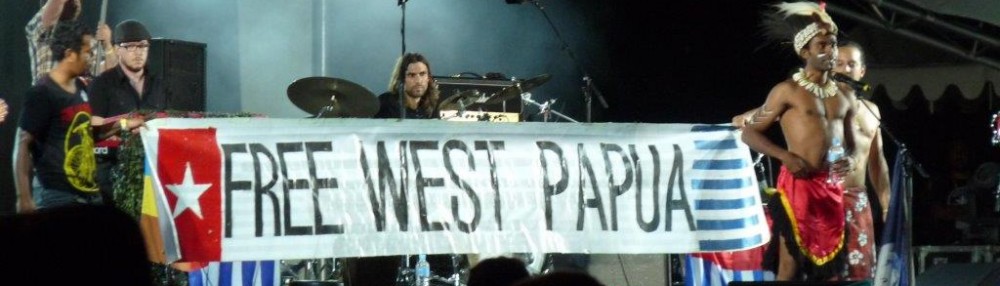
Historic swim delivers Free West Papua petition across Lake Geneva to the United Nations

Historic swim delivers Free West Papua petition across Lake Geneva to the United Nations

September 3, 2017

On 28th August at 08:30 in the morning, at the far shores of Lake Geneva, 6 swimmers departed across a 69km journey that lasted over 28 hours. With them, they symbolically carried both the West Papuan People’s Petition and the Global Petition in solidarity with the people of West Papua.

These are petitions calling on the United Nations to do what is right. To right the wrongs of past injustices. They call for the restoration of West Papua’s fundamental rights, including the fundamental right to self-determination.

They are petitions people around the world have given their mind, body and soul to. Petitions which speak to us all in our common humanity. They read:

“We call on you to urgently address the human rights situation in West Papua and to review the UN’s involvement in the administration of West Papua that led to its unlawful annexation by Indonesia ‐- and the human rights abuse that continues today. We call upon you to: – appoint a Special Representative to investigate the human rights situation in West Papua; – put West Papua back on the Decolonisation Committee agenda and ensure their right to self‐determination ‐- denied to them in 1969 -‐ is respected by holding an Internationally Supervised Vote (in accordance with UN General Assembly Resolutions 1514 and 1541 (XV)).”

Background

In January 2017, the people of West Papua, in collaboration with 6 swimmers launched the Global Petition for West Papua at the British Parliament in Westminster. This was then followed by the West Papuan People’s Petition, hand signed by thousands upon thousands of people inside West Papua. It was envisaged that the swim team would carry both petitions across Lake Geneva as a means of raising awareness and support for West Papua.
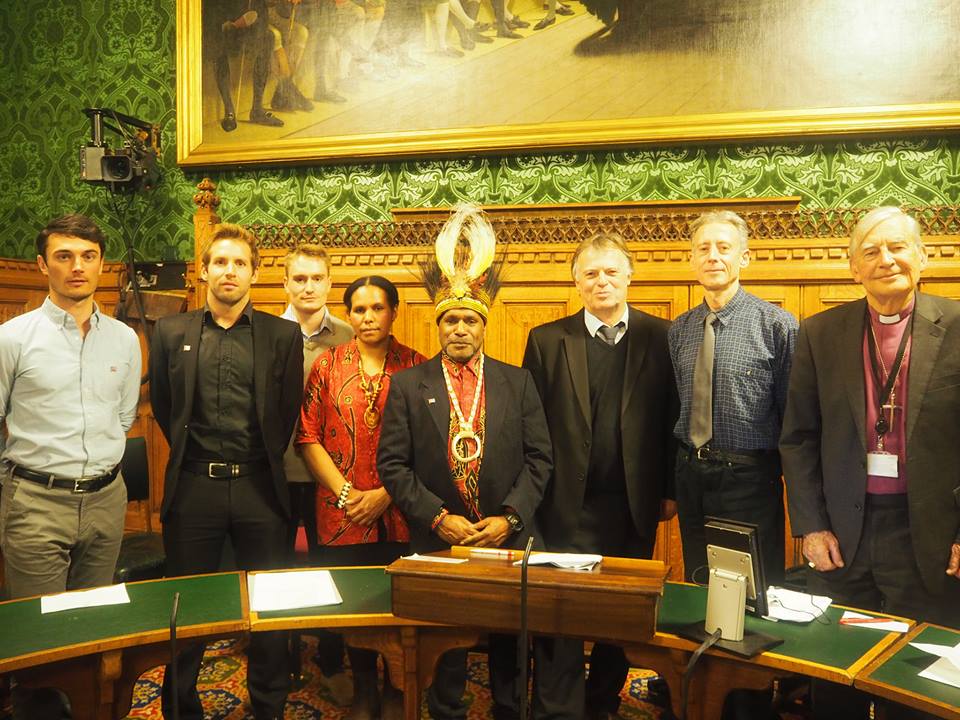
Since then, the petition has made a monumental journey around the world and across Lake Geneva.

Swim for West Papua

As the Swim for West Papua team landed in Geneva on Sunday 27th August, they were given a traditional West Papuan welcome by members of Free West Papua Campaign – Netherlands who came to Geneva to show their support.

After this moving welcome, the swimmers were driven to the far shore of Lake Geneva at Montreaux and were then given a traditional West Papuan send off with a tabura/conch shell played by Free West Papua Campaign – Netherlands Coordinator Oridek Ap, the son of legendary West Papuan musician Arnold Ap who was assassinated by the Indonesian Special Forces in 1984.
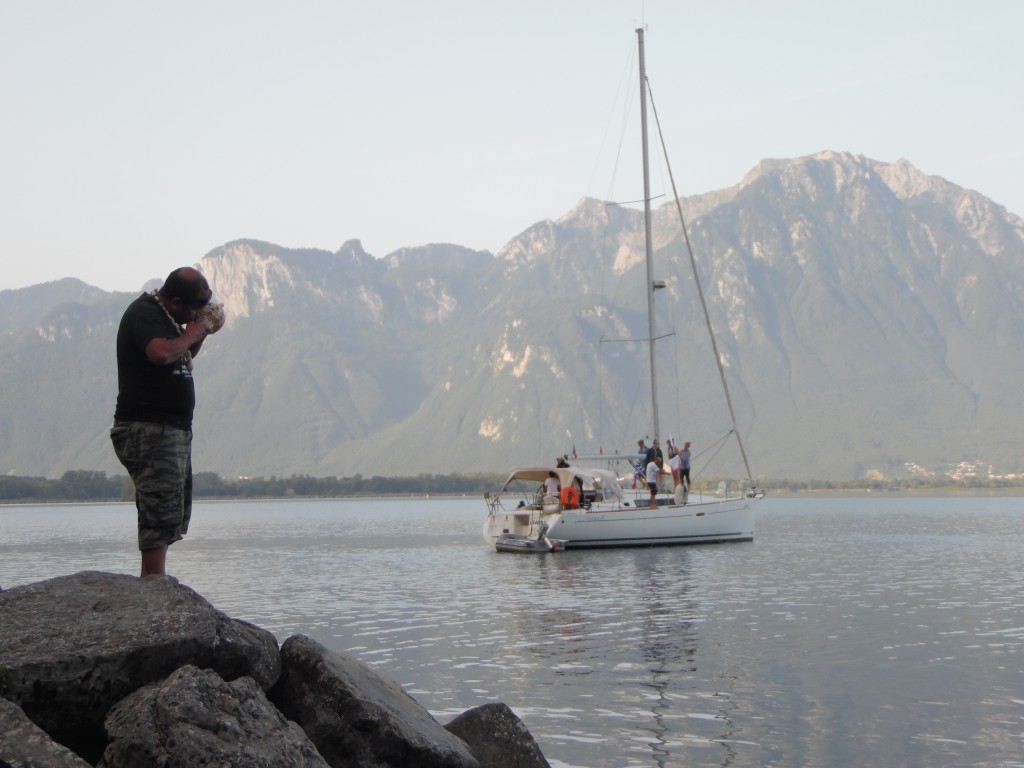
The swimmers then departed in a boat flying the West Papuan flag, followed by a dinghy as the first swimmer Abby dived into the water. They got off to a great start amid hot weather and fair winds and kept up a livestream of the journey throughout day and night.

Back in West Papua, thousands of people gathered in the capital city of Port Numbay/Jayapura to watch the swim on a makeshift big screen and cheered on the swimmers!

The swim continued through the night and continued to make good progress. At 23:47 in the night, Swim for West Papua uploaded this photo to show the incredible effort of the team.

“Tom smashed out his first night swim, Carey is now in the water, Joel is up next…”

Arrival of the swimmers

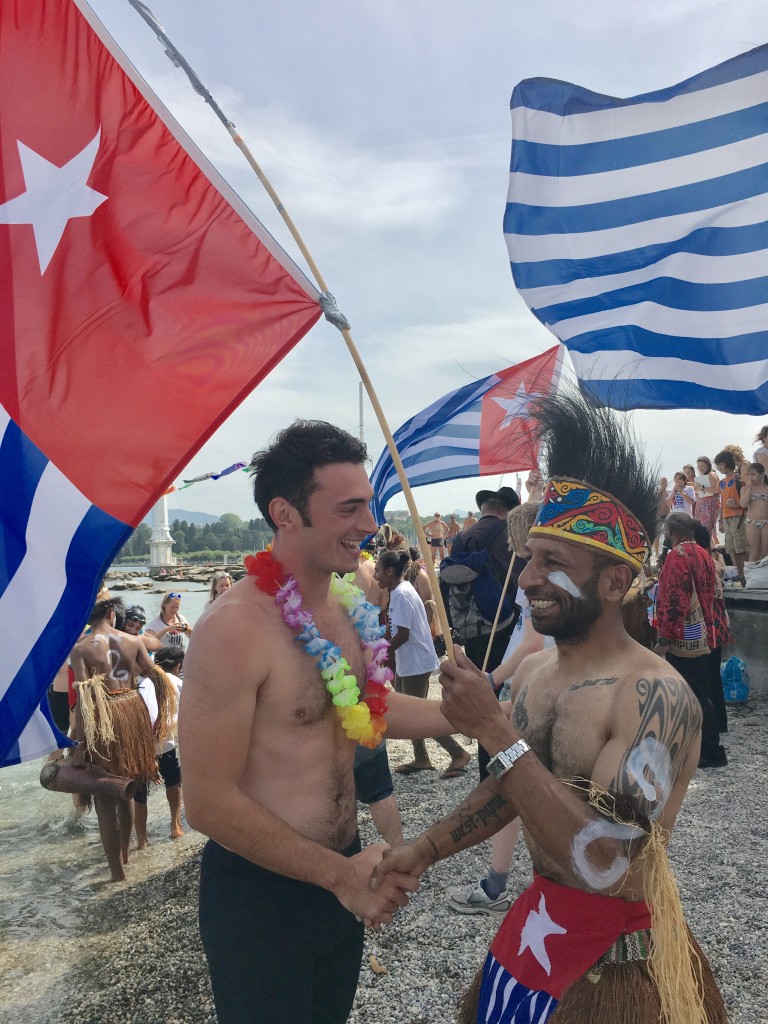
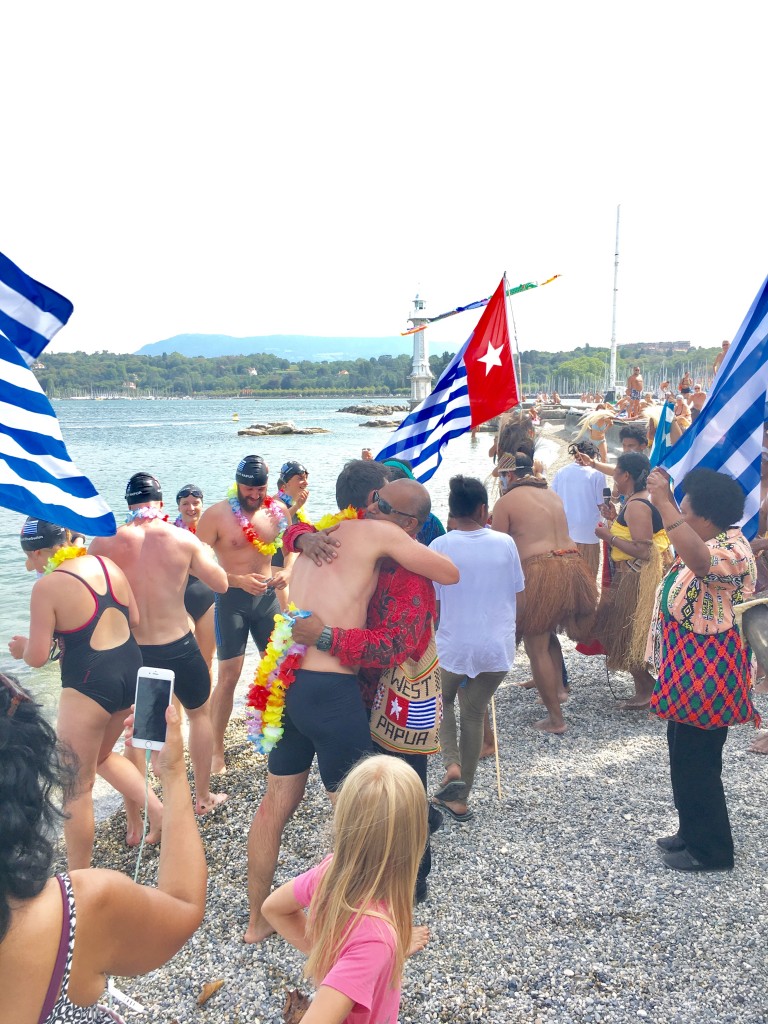
At approximately 12:30, the swimmers, led by team captain Joel Evans arrived at the shores of Lake Geneva, greeted by West Papuan people signing and dancing with flags and drums.

It was a truly emotional moment for everyone as the swimmers were presented with garlands and embraced by the welcoming party.

The West Papuan People’s Petition, in tandem with the Global Petition for West Papua was then displayed at the beach and shared between the swim team and West Papuan Independence Leader Benny Wenda.

Image may contain: 2 people, people standing, sky and outdoor

Benny Wenda gave a moving speech in which he described the truly historic significance of the petition arriving on the shores of Lake Geneva, representing the bones of the West Papuan people and as direct expressions of their voices, hopes and aspirations.

March to UN

The next day on 31st August 2017, the Free West Papua Campaign, joined by the swim team marched the petition to the United Nations in Geneva. It was a powerful march full of signing and chanting as the rain beat heavily down. Oridek Ap proudly described how it was raining because the ancestors of the West Papuan people were crying.

Image may contain: one or more people, people standing and outdoor

Banners were unveiled in front of the United Nations Headquarters, reading “Swim for West Papua petition to the UN for an Internationally Supervised Vote” and “Save the People of West Papua”.

As the rain beat harder, Benny Wenda gave an emotive speech with a suitcase sheltering the petition in his hands. He stated: “Today, we carry the bones. There is 500,000 bones of West Papuans that have been killed by Indonesia over the last 50 years. Now we are carrying this burden. We stand here. We will carry these bones to the United Nations.”

Celebration

That night, the swim team was honoured to a West Papuan feast with more music and dancing. Benny Wenda each presented them with an award and a traditional bilum bag, symbolising their care for the people of West Papua and the people of West Papua’s care for them.
Submission of the petition

The West Papuan People’s Petition was then privately submitted to the United Nations by Benny Wenda along with a physical copy of the Global Petition as it stood on 26th August with 156,933 signatures from 185 countries.

The petition will continue to be run online until mid-September when it will be submitted along with another physical copy of the West Papuan People’s Petition to the United Nations in New York.

Messages of thanks and respect

The Free West Papua Camagn would like to convey it’s deepest and most heartfelt thanks and respct to all those who heped this historic petition and swim to happen. The amount of work that went into the collection of signatures inside West Papua and outside of West Papua was absolutely phenomenal and has officially been non-stop since January and effectively non stop since June 2016 when the idea began.
 

To everyone who singed the petition, you did so much more than simply add your name to a petition. You gave a voice to the voiceless and helped to shine a light on a people long forgotten suffering a genocide long neglected.
Rest assured, YOUR efforts have made this petition one of the most powerful tools the people of West Papua have to push forwards down the long rod to freedom.
And finally to all the Swim for West Papua team, no amount of words can ever describe the incredible thanks and gratitude from the Free West Papua Campaign and the people of West Papua. It takes true courage and determination to dedicate so much time and effort in such a worthy cause that pushes people’s minds and bodies to the limit. We will never be able to express how much of an honour it was and is to send you off and welcome you all back to the shores of Lake Geneva and back into the Free West Papua Campaign family. From all of us, wa wa wa.


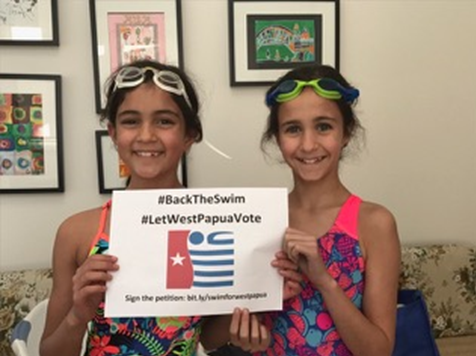
Big thanks to all of you who took action to #BackTheSwim to #LetWestPapuaVote!

Continue reading

Four police officers found guilty over fatal Deiyai shooting ordered to apologise


Four police officers found guilty over fatal Deiyai shooting ordered to apologise


CNN Indonesia – August 31, 2017


Martahan Sohuturon, Jakarta — Four Indonesian police (Polri) officers have been found guilty in relation to a clash that took place in Bomou village, South Tigi district, Deiyai regency, Papua, in early August. Their only punishment however is that they must issue a verbal apology and will be transferred.


Those found guilty are former sectoral Police Chief Inspector Maing Raini and Mobile Brigade (Brimob) platoon commander (Danton) Iptu Aslam Djafar along with two of his subordinates Second Deputy Inspector Esra Sattun and Sergeant Victor Manggaprouw.


Papua regional police public relations chief Senior Commissioner Ahmad Musthofa Kamal said Wednesday that the four offices were sentenced to making a verbal apology by a hearing of the Indonesian Police Code of Ethics Commission (KKEP) and will be demoted and transferred to different posts for one year.


“The result of the ethics hearing was that the four were declared guilty of deplorable [tercela] actions”, said Kamal when sought for confirmation on Thursday August 31.


He said that the Code of Ethics hearing declared Maing guilty of failing to report to his superiors and going to the location of the incident without wearing a uniform.


In addition to this the hearing found that Maing failed to follow the directions of his superior and should have gone to the location of the incident with his officers without bringing Brimob personnel.


Maing was found to have failed to control his officers, abandoned officers conducting negotiations with the community and leaving the location of the incident without paying attention to officers who were still confronting protesters.


According to Kamal, Maing’s actions violated Article 7 Paragraph 1 Subsections b and c and Article 13 Paragraph 1 Subsection e of Police Regulation Number 14/2011 on the Indonesian Police Professional Code of Ethics.


“Indonesian police officers are obliged to maintain an image of solidarity, the credibility, reputation and respect of Polri and are obliged to carry out their duties in a professional manner. Polri officers are prohibited from misusing their powers in carrying out their duties as police”, he said.


Meanwhile the ethics commission found that Iptu Aslam Djafar had deployed Brimob officers as security at the company without permission from his superiors.


Djafar was also found to have failed to comprehend the situation and should have allowed the sectoral police to first resolve the problem and should have followed the instructions of the sectoral police chief as the head of operational control (kodal) at the time.


At the time, said Kamal, the sectoral police chief ordered police to withdraw because conditions were unfavorable. Djafar however only withdrew slowly and as a result the protesters pushed forward approaching and attacking the officers.


He said that Djafar as the platoon commander should not have allowed the protesters to get too close to the police officers.


Meanwhile Kamal said that the ethics commission declared Esra Sattun and Victor Manggaprouw guilty of deciding to use live ammunition without orders from their superiors and directing fire above and below the protesters without due consideration.


“This is what possibly resulted in victims falling, specifically the one that was hit by live rounds”, he said.


Kamal added that the ethics commission found five other Brimob officers not guilty because they carried out their duties as police in accordance with standard operational procedures as stated under Article 15 Paragraph 3 of National Police Regulation 1/2009 on The Use of Force in Police Actions.


The clash in Deiyai, which occurred on August 1, 2017, was triggered by dissatisfaction on the part of local people because a company building a bridge in the Oneibo river area refused to help them.


The residents had asked the company to transport a person in a critical condition to hospital after they had drowned in the river but the company refused to provide a vehicle.


Local people eventually obtained a vehicle from elsewhere and took the person to hospital but they were unable to be saved. The angry residents then returned to the encampment at the bridge construction and vandalized a work post.


Brimob and Tigi Sectoral Police officer immodestly went to location. The crowed went on a rampage and police fired shots. One person was shot dead and eight others wounded (wis)


[Translated by James Balowski for the Indoleft News Service. The original title of the article was “Penembakan di Deiyai, Empat Polisi Divonis Minta Maaf”.]


Source: https://www.cnnindonesia.com/nasional/20170831162855-12-238698/penembakan-di-deiyai-empat-polisi-divonis-minta-maaf/


—————————————————————

Serious violations of human rights in Papua should be investigated

 Serious violations of human rights in Papua should be investigated

http://www.humanrights.asia/news/ahrc-news/AHRC-STM-099-2017


August 17, 2017

The Asian Human Rights Commission (AHRC) urges the Indonesian Authorities to ensure that cases of human rights violations that occurred in Papua must be investigated properly, under fair trial principles and the Rule of Law. In the last two months, the AHRC has documented and reported some three cases of serious human rights violations, as follows: #1. Ruthless shooting and violence committed by the Paniai Police Mobile Brigade in South Tigi District, Deiyai Regency, resulting in the death of one indigenous Papuan; #2. Cruel assault of 15-year-old Albert Nawipa, an indigenous Papuan teenager; #3. The torture of Mr. Niko Hisage, an indigenous Papuan. He was assaulted by Army personnel from the sub-district military command of Wamena city.

In addition, the AHRC very recently documented and reported the case of arbitrary arrest and detention of Mr. Yanto Waine, a member of the National Committee for West Papua (KNPB). He was illegally detained in the Nabire Police Station (Polres Nabire) after distributing statements on the street. Besides this case, the AHRC also notes the forced dissolution and arbitrary arrest of 29 Papuan student activists. They were brought to the Yogyakarta Police Station after conducting a peaceful protest. They were denouncing the New York agreement concerning the legitimacy of the 1969 Referendum in Papua. It resulted in Papua’s becoming part of the Republic of Indonesia until the present day. There were 32 student activists in Jakarta and 46 student activists in Semarang who were also arrested for holding peaceful protests. Despite the fact that they have been released without criminal charges laid on them, the illegal arrest and forced dissolution had the following effect. It caused trauma by breaching the Rule of Law and the Principles of Democracy. Indonesia, in its Constitution, has recognized democracy and the freedom of opinion.

The AHRC has learned about and monitored the criminal justice system in Indonesia, in this case, Papua. To put it simply, it does not really function. Human right cases and even alleged gross violations of human rights such as the Paniai case remain unaddressed. On the contrary, the Government under President Joko Widodo is mainly concerned about infrastructure and economic development in the country. Local indigenous Papuans, on many occasions, have questioned this limited development focus. Does this development increase the living standard of the ordinary Papuan, or does it foster the expansion of multi-national corporations and mining exploitation in Papua?

So far, the Government does not have a strong policy of human rights protection in Papua. It tends to simplify problems. An example would be the statement by Mr.Wiranto the Coordinating Minister of Politics, Law and Security (Menkopolhukam). After a vicious shooting by the Police in Deiyai Regency, and without proper investigation, he stated through the Media, that the case was not one of a violation of human rights. Of course, this kind of utterance undermines the legal standing of victims seeking justice and redress. In the Papua, Deiyai Regency shooting incident, the Police used lethal force. They attacked indigenous Papuans, resulting in the death of one man and injuries to at least ten other indigenous Papuans.

Massive and frequent human rights violations in Papua are caused by the security approach used. The Government had been reluctant to evaluate and audit the present Security Forces in Papua. The AHRC also learned that since Papua had been divided into two Provinces namely West Papua and Papua, the number of security forces increased due to the development of new military offices and facilities. Media and public access to Papua is still difficult, especially in remote areas. President Widodo had declared that the international media were allowed to enter Papua but, in fact it is very difficult to obtain the required permit. This matter had become a serious concern of the World Press Freedom Day Conference, held in Indonesia recently. Many journalists who attended the event questioned the Police concerning press freedom in Papua. Lack of journalistic access to Papua is worsening the human rights situation in Papua.

Therefore, the AHRC calls on the Government and Law Enforcement Agencies to seriously and promptly investigate the cases of human rights violations which took place in Papua. The Government should not hide behind the focus of infrastructure and economic development. Infrastructure and economic development will be nothing without law enforcement and justice. It is clear that Papua is waiting for justice, waiting for a serious Indonesian Government to take on the pending human rights cases guaranteeing human rights protection for Indigenous Papuans.

On August 17, 2017 Indonesia is celebrating 72 years of independence from Dutch colonialism. The Government should reflect that 72 years is more than enough to ensure that the State / the Government is present at ground level to protect its citizens, including indigenous Papuans. In order to protect human rights, law enforcement must be carried out, legal certainty should be presented, impunity must go, and no further recurrences of the same crimes.

Document Type :

Statement

Document ID :

AHRC-STM-099-2017

Countries :

Indonesia

Campaigns :

End Violence in West Papua

Issues :

Administration of justiceArbitrary arrest and detention,DemocracyEnforced disappearances and abductions,Freedom of expressionHuman rights defendersInhuman and degrading treatmentInstitutional reformJudicial system,Prosecution systemRight to fair trialRight to lifeRule of law

Indonesian Military Officer Orders That Forest Burners Be Shot

Jakarta. A military official in the Indonesian province of Jambi said on Saturday (05/08) he has ordered that anyone who deliberately sets fire to forest areas be shot, as authorities struggle to contain fires that cause choking smoke in the region.

Five Indonesian provinces have declared emergencies because of forest fires, according to Indonesia’s disaster mitigation agency (BNPB), with the number of hotspots steadily increasing in many areas over the past week.

The BNPB is working with many government branches, including the military, to contain the fires. Indonesian media have reported that authorities in the neighboring province of South Sumatra, also on the island of Sumatra, had issued the same order.

“This is to stress a point to the people, who have been warned many, many times,” said Colonel Refrizal, commander of the forest fire task force in Jambi. “[This is] to show our firmness and seriousness.”

The order would be carried out “responsibly”, said Refrizal, who goes by one name.

BNPB spokesman Sutopo Purwo Nugroho said on Twitter the Jambi task force was working to extinguish a fire covering an area of 10 hectares.

Sutopo also said authorities had found one area in Jambi that had been “intentionally” burned by its owner.

The number of hotspots had increased to 239 by July 30, from 173 hotspots three days earlier, according to the BNPB. The hotspots were seen mostly on Kalimantan, the Indonesian portion of Borneo island, with some also on Sumatra and Java island.

The agency had previously warned that the threat of forest fires would escalate, with the dry season expected to peak in September.

Indonesia is regularly hit by forest fires, which can result in choking smoke blowing across to neighboring countries like Singapore and Malaysia.

The sprawling Southeast Asian archipelago suffered some of its worst forest fires in 2015, hitting Sumatra and Kalimantan.

The World Bank, citing government data, said 2.6 million hectares of land in Indonesia burned between June and October 2015, causing $16 billion of estimated economic damage.

Draining and conversion of peatland, often driven by palm oil plantations, contributed to the intensity of haze from the fires, the World Bank said.


Reuters

West Papua protest: Indonesian police kill one and wound others – reports

West Papua protest: Indonesian police kill one and wound others – reports

the Guardian 3/8/17

28-year-old man reportedly killed during the incident in Deiya regency, with up to seven wounded, including two children

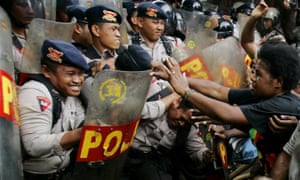
West Papuan activists clash with police guarding the office of a US mining company. On Tuesday, one person was reportedly killed by Indonesian police at a protest in Deiya regency.
West Papuan activists clash with police guarding the office of a US mining company. On Tuesday, one person was reportedly killed by Indonesian police at a protest in Deiya regency. Photograph: Ed Wray/AP

Indonesian paramilitary police have shot and killed one person and wounded a number of others at a protest in a West Papuan village, according to human rights groups and local witnesses.

A 28-year-old man was reportedly killed during the incident in Deiya regency on Tuesday afternoon, and up to seven wounded, including at least two children.

The regency’s parliament has reportedly called for the arrest of the officers involved, and for the withdrawal of the police mobile brigade, known as Brimob.

The incident began after workers at a nearby construction site refused to assist locals in taking a man to hospital, after he was pulled from the river.

After a five hour delay in sourcing another vehicle the man died on his way to hospital, according to local sources. Angry relatives and friends protested against the construction company, allegedly attacking a worker’s camp – believed to be primarily from Sulawesi – and destroying some buildings.

Authorities were called to the protest, and Associated Press reported police alleged protesters kidnapped a worker, which protesters denied.

“The joint forces of police, mobile brigade police and army officers came. Did not ask questions but shot several youths,” Father Santon Petege told West Papuan information site, Tabloid Jubi.

“There were no warning shots at all,” witness, Elias Pakagesaid. “Officers immediately fired on the unarmed villagers.”

A human rights lawyer investigating the case, who requested to remain anonymous, also said there was no verbal warning from authorities, and she labeled the incident an extrajudicial killing.

“When they arrive they just shoot. They used guns and violence and shoot directly,” she said.

Advertisement

Unconfirmed reports said 17 people were shot by the police mobile brigade, including the deceased man and a number of children.

Pictures purported to be of the victims and seen by Guardian Australia show deep bullet wounds.

According to local media, police denied they shot directly at the protesters, but rather at the ground and hit four people after warning shots failed to calm the situation.

The head of public relations for Papua police, Kombes A.M. Kamal denied anyone died other than a person who was critically ill, and alleged protesters had attacked an employee.

A separate report quoted the spokesman as saying the police only fired rubber bullets.

The lawyer said the police spokesman’s claims were not true, that the hospital doctor had recognised the injuries as bullet wounds, and that one young man died of his injuries, not an illness.

A police report cited by AP said a 28-year-old man died instantly after being shot multiple times.

Dr Eben Kirksey, a senior lecturer at UNSW, said there was often a “disinformation campaign” by authorities following incidents in West Papua.

Kirksey said history had shown investigations rarely translated into prosecutions, and prosecutions often saw light sentences.

“If we look at the history, of when there is evidence of security force misconduct I don’t have much hope.”

The Asian Human Rights Commission called for a full transparent investigation by human rights groups, and for the officers to be held accountable.

There are frequent reports of violence and mass arrests by authorities against West Papuans, the indigenous people of an Indonesia-controlled region on the western half of an island shared with Papua New Guinea, and which has battled for independence for decades.

But information is difficult to verify, largely because of the restrictions on foreign media.

In 2015 Indonesian president Joko Widodo announced the lifting of the media ban for the province, but in reality, government clearing houses vet media visits and maintain restrictions. Two French journalists were deported earlier this year for reporting without the required visa.

The Jakarta Post on Wednesday called for the government to open up the province to the world’s media, noting the significant gains made by a “relentless” independence campaign.

It argued Jokowi should stop hiding his government’s purported improvements and developments in the region.

“At almost every turn, we are being outmaneuvered by campaigners who want to see Papua separate from Indonesia. And yet the Indonesian government has done very little to counter it,” it said.

“By maintaining this restriction, the government is operating like a paranoid regime, afraid the outside world may find the skeletons it hides in its closet. If the government has done much to improve the lives of Papuans, why not show it to the world?”

Swim for West Papua. Here’s why your name matters to the people of West Papua.

How you can help the people of West Papua .Sign & Share the Global Petition for West Papua

Swim for West Papua. Here’s why your name matters to the people of West Papua.

JULY 18, 2017

Sign & Share the Global Petition for West Papua here

https://www.freewestpapua.org/…/swim-for-west-papua-heres-…/

How you can help:

Sign and share the petition as widely as possible either online via Avaaz or by collecting signatures & email addresses on paper. See below for paper resources.
Raise awareness by printing the #BackTheSwim sign and taking a photo with it. Send us your #BackTheSwim pictures on Facebook and Twitter and we’ll share your support with the world!
Follow the Swim for West Papua Team’s incredible journey and encourage them as they train for this epic feat! #BackTheSwim
#BackTheSwim & #LetWestPapuaVote

Sign & Share the Global Petition for West Papua here Photo: KNPB. On a tropical island in the South Pacific, tens of thousands of people…
freewestpapua.org

DEFORESTATION AND ITS IMPACTS TOWARD INDIGENOUS PAPUANS


DEFORESTATION AND ITS IMPACTS TOWARD INDIGENOUS PAPUANS


AdminJun 26, 2017

By : Julian Howay (*)


Drone footage of the border between untouched land and the land cleared by Korindo on its Papua Agro Lestari concessions in Merauke – mighty.com


THE island of New Guinea or Papua in the South Pacific has a largely unspoiled tropical forest (75%). These forests were formed over thousands of years ago and spread from the lowlands, valleys, hills to the towering mountains. For outsiders, the largely virgin tropical forest of Papua holds a number of mysteries.

Forest exoticism on the island has become the last bastion of life providers for biodiversity in Indonesia and internationally. Not surprisingly, the powerful ocean explorers from Europe, China, Arabia and India who first landed on this land dubbed the island of New Guinea (Papua) as a dazzling world paradise that just began to be explored in the 19th century. The high value of biodiversity makes many natural scientists know Papua as the Major Tropical Wilderness Area (TWA), beside Brazil and the Democratic Republic of Congo (DRC).


The total area of ​​tropical forests of the island of New Guinea (Papua) is about 73.8 million hectares (80%) of the land area or 22 percent of the land area of ​​Indonesia. From this total area, neighboring state of Papua New Guinea (PNG) in the east has 34 million hectares or 70 percent of the country’s territory. By this amount, approximately 25,211,000 hectares (55 percent) are primary forests and the rest are secondary forests.

Because of the important benefit of the forests, fundamentally the life of indigenous Papuans can not be separated from the natural environment such as land, water, oxygen and forests. For thousands of years, these forests have been the main provider of life for at least 1,187 indigenous tribes who inhabit the island of New Guinea (Papua). Divided between 312 indigenous tribes in western New Guinea (West Papua) which is now part of Indonesia and 875 tribes in Papua New Guinea (PNG).

In the view of the Papuans, the nature of which belongs to the land and the forest is like a “life-giving mother.” In the life of a traditional sub-system living, the forests function as “natural supermarkets” which provide various food needs, the place of ritual actualization culture, entertainment, and as place to give them inspiration about life. Therefore, when the land and its natural resources such as forests are expropriated or damaged, Papuans as part of world indigenous people will suffer and are deprived of their cultural identity.

Unfortunately, the existence of tropical forests in Papua continues to shrink as degradation and deforestation rates occur over time. In the life of a traditional sub-system living, illegal logging and improper forest management of local people have caused the destruction of forests in Papua getting worsening. It could even say that it has entered an “emergency status.” Deforestation began in the 1980s when general Soeharto, the Indonesian Government military dictatorship issued a political economy policies that supported development and investment. But these policies were not friendly to the environment and local people who live around the forest.

From the total 73.8 million hectares of Papua’s forest area recorded in 2005, it is now drastically reduced. West Papua as a region on the western part of New Guinea is now the largest contributor to deforestation compared to neighboring state of Papua New Guinea (PNG) in the east. In 2005-2009, Papua’s forest area ranged from 42.22 million hectares. But three years later in 2011, it has experienced degradation to the remaining 30.07 million hectares.

Average deforestation rate in Papua ranging from 300,000 hectares (25%) per year. From these facts, Greenpeace, the international environmental organization recorded that the loss of Papua’s forest in the period of 2000-2009 ranged from 8.19 million hectares or on average 910,000 hectares of forest lost each year. Even some environmental NGOs like Center for International Forestry Research (CIFOR) estimate, the average of deforestation in Papua reaches one million hectares annually.

Some major causes of deforestation in Papua (Indonesia) consist of forest conversion by illegal logging and oil palm plantations, forest burning, mining, construction of roads and new settlements. Illegal logging and expansion of large-scale oil palm plantations are two main factors that caused the largest deforestation in Papua.

Illegal logging cases are generally done by licensed timber companies, but are cutting forests outside of their concession area. Large-scale palm oil plantations so far have been proven to bring environmental problems and disasters to the local community from the social aspect. In two regions in Indonesia such as Sumatra and Kalimantan, the presence of large scale oil palm plantations has impacted the destruction of thousands of hectares of primary forest.

As a result, local people as landowners who had been able to live peacefully only by depending on forest products, changed their lifestyles due to being low-wage palm oil planters. Local people are also uprooted from the cultural roots associated with the existence of the forest as a provider of life. In general, deforestation in Papua gives negative impacts towards the function of the forest as climate regulator, CO2 and oxygen producer and forest is no longer a life support provider.

Therefore, to reduce deforestation in Papua (Indonesia), there are some important things that can be done. First, the Indonesian government needs to change its political economy policy to provide the preservation and protection of forest. Second, the government need to apply development policies oriented to sustainable development that does not destroy the forest.

Third, supervision and law enforcement against any perpetrator of environmental crime and destruction of forests. Fourth, the government need to empower the local communities (indigenous people), who live around the forest to engage in surveillance efforts, conservation and sustainable use of forests.

Fifth, the government must commit to implementing policies related to the Reducing Emissions from Deforestation and forest Degradation (REDD) mechanism in order to reduce carbon emissions by providing compensation to the parties (including local communities) in the prevention of deforestation and forest degradation. Sixth, replanting (reforestation) and rehabilitation of degraded forest with native plants that are beneficial to the local communities.

Advocacy efforts and the joint campaign of saving Papua’s forests have been ongoing since 2006. This campaign was formulated into a major theme: “Save the Forest and Papuan” or in bahasa (Indonesia language) “Selamatkan Hutan dan Manusia Papua.” The reason is that Papua’s forests and its indigenous people are so intertwined that the rescue effort is a heavy task and must be taken seriously.

Given the increasingly deteriorating condition of forests, it is necessary to engage customary institutions as active government partners in the preparation, establishment, socialization and implementation of forest management governance. Law implementation and strict sanction is required to stop illegal logging perpetrators.

In conclusion, Papua’s vast tropical forest riches are a God’s gift worthy of being grateful as well as protected. Do not let this valuable gift be a curse in the future. By saving the forests of Papua, it means saving the natural wealth of humans and the invaluable Papuan culture. We have to do something to save the people and the forest of Papua for the better future. Save the forest, save the future !

*) Julian Howay is a freelance journalist and environmental activist.

Indonesian province revokes palm oil licenses


Indonesian province revokes palm oil licenses

Merauke govt’s move to pull 11 permits wins church and popular backing, but damage to nature ‘has already been done’

http://www.ucanews.com/news/indonesian-province-revokes-palm-oil-licenses/79476
This picture taken on May 19 shows an Indonesian forest that was recently cleared to plant oil palm trees. Church and local people in Papua have welcomed a recent decision by local officials to revoke the licenses of 11 plantation firms. (Photo by Goh Chai Hin/AFP)

Eman Riberu, Merauke
Indonesia


June 12, 2017

A local government’s decision in Papua to pull licenses for a number plantation companies has won overwhelming backing from the Catholic Church and local people, calling the move a victory for the environment.

The Merauke regency government revoked the permits of 11 palm oil and sugarcane plantations last week, saying their presence were of little benefit to local people.

The deputy regent of Merauke, Sularso ­ who like many Indonesians goes by only one name ­ said land that had been leased to the companies would be returned to their owners.

The decision to revoke existing licenses goes a step further than following a moratorium imposed by Indonesian President Joko Widodo in April last year halting the issuing of new permits for plantation firms for at least three years.

Father Anselmus Amo, chairman of Merauke Diocese’s secretariat of Justice and Peace, said the move was welcome news and long overdue.

“The presence of palm oil companies harms indigenous peoples, their land rights and the environment,” Father Amo said.

These plantations have “caused the loss of tens of thousands of hectares of forest in Merauke, damaging the environment and creating land conflicts,” he said.

He called on local government to do more and monitor the activities of plantation companies still operating in Merauke more closely.

The church, wants local government to conduct a detailed assessment of the environmental and socio-cultural impacts palm oil companies have by involving academics, practitioners and indigenous peoples.

Elisabeth Ndiwaen, a leader of the local Marind tribal community, said her people looked forward to taking back their land but expressed bitterness that much of it had been ruined by deforestation.

Forests are like the womb of a mother who gives life. From the forest they can get food by hunting and harvesting other crops, she said.

“Nature provides for free, but the value of the land is now reduced because forests have been cleared by palm oil companies,” she added.

Some 42,000 hectares of lush tribal forest land had been destroyed by palm oil firms in Ngguti district alone, Ndiwaen said.

Merauke Regency covers about 4.6 million hectares, 95.3 percent was forest.

As of today, more than 1.6 million hectares has been given to companies, of which 316,347 hectares were for palm oil plantations.

Papua province is predominantly Christian. Some 65 percent of the province’s 3.2 million people are Protestant, 18 percent are Catholic, while 15 percent are Muslim.


The legal system and Blashemy

A Written Submission to the UN Human Rights Council by the Asian Legal Resource Centre

INDONESIA: Hardliner groups have more power over the judiciary than the text of the law

1. The Asian Legal Resource Centre (ALRC) wishes to inform the UN Human Rights Council (UNHRC) regarding the immense pressure and protests put on the trial against the Jakarta governor Mr. Basuki Tjahja Purnama (aka Ahok). Ahok stands convicted today, by a court that feared and acted upon the pressure from Islamic fundamentalists than the principles of law.

2. This case is bad precedent, wherein law enforcement agency has acted under pressure to pacify hardliner groups who organised massive demonstrations calling to punish Ahok. Since the beginning of the trial in December 2016 until its end in May 2017, public protests were organised in front of the court to pressure the judges to punish Ahok and the judiciary complied.

3. Mobilizing of mobs, to pressure judges to decide cases in line with what the pressure group demands undermines the possibility of fair trial and the independence of judiciary. The UN Human Rights Council should note that today the institution of judiciary in Indonesia faces serious threats.

4. During the long years of dictatorship, the judiciary was virtually ignored, and the basic institutional framework for an independent judiciary was completely undermined. It is in the years after the fall of the dictatorship that some measures were adopted to negate the situation that prevailed under the dictatorship and these efforts are at a very early stage.

5. The Indonesian judiciary lacks the adequate infrastructure and resources to function properly. The country does not have enough number of judges to undertake court proceedings and adequate courts and other infrastructure to function for the existing judges that given the number of cases they have to deal with the workload is enormous and delays in adjudication a common phenomenon.

6. An institution to develop independence and professionalism takes time. In essence it is a change in the professional culture of the institution, for which exceptional care and encouragement is to be provided to the institution to undergo that transformation. In the case of judiciary, it is the responsibility of the state to provide all the catalysts for such a change to happen, for the members of the judiciary and the Bar to ensure that threats to their independence are not ignored. Unfortunately this is not the case in Indonesia. The Bar for instance is fractured with biased interests, for instance in the name of religion and ethnicity, where the principles of rule of law and fair trial are given a back seat.

7. The result of this situation is that the average citizen believes that the courts are not temples of justice where equality before the law is practiced, but institutions that work for those in power and are rich. To change this, instances like that led to the conviction of Ahok do not help.

8. Instances like the conviction of Ahok, once again recalls the state of Indonesian judiciary during the time of the dictatorship. If the military was the ultimate arbiter during dictatorship, it is hardliner groups that have formed a political force that dictates the judiciary today in Indonesia. In addition, the military itself operates above the law in Indonesia. This means laws apply in two different ways to the ordinary people and those in uniform. This has to end.

9. In view of the above, the ALRC requests the Human Rights Council to urge the government of Indonesia to ensure an environment to develop an independent judiciary in the country. The ALRC also requests the Council to encourage Indonesia to formally invite the UN Special on the Independence of Judges and Lawyers to visit the country and undertake a study of the challenges faced by the country’s justice institutions and to work with the government to bring about a positive change.

# # #

About the ALRC: The Asian Legal Resource Centre is an independent regional non-governmental organisation holding general consultative status with the Economic and Social Council of the United Nations. It is the sister organisation of the Asian Human Rights Commission. The Hong Kong-based group seeks to strengthen and encourage positive action on legal and human rights issues at the local and national levels throughout Asia.

Indonesia’s UN story on Papua is no longer a single truth

Indonesia’s UN story on Papua is no longer a single truth

Jubi | News Portal Tanah Papua No. 1,Saturday, 13 Mei 2017 — 13:06 By Cypri Dale

The Indonesian delegation headed by the Minister of Foreign Affairs responded to the review of UN member states – Doc. Author

The Universal Periodic Review (UPR) for Indonesia at the UN Human Rights Forum has just been completed. The Indonesian government represented by a large delegation led by two ministers presented Indonesia’s human rights accountability for the last 5 years (since UPR 2012) with diplomatic confidence. The upholding of human rights in Papua has become a central issue, in response to the increasing intensive concerns and concerns of the international community over the situation in the region. A number of major allies are asking crucial questions and statements. While the seven Pacific States are firm against Indonesia on the issue of Papua it chooses not to attend. How is the development of the Papuan problem in the international arena?

Litany of Success

Especially on Papua, there are at least four matters of accountability of the Government of Indonesia in the UPR forum.

First, that the government is accelerating development as a solution to various problems in Papua. It was reported that “the President regularly visits these two provinces to check the progress of infrastructure development” and “directly dialogue with Papuans”.

Second, the Government of Indonesia “has a very strong commitment to resolve issues of injustice and human rights violations. A team under the leadership of Menkopolhukam has been formed. Promised also that the case of Paniai, Wamena, and Wasior will soon be processed in the Supreme Court.

Third, that “the Government has also lifted restrictions on foreign journalists to visit Papua.” Papua is already open to the international community.

Fourth, that Papua Special Autonomy has been implemented to improve effective local governance and development, and for that reason Papua has received substantial funding.

Diplomatic Response

Interestingly, in response to the report of Indonesia, some countries are simply asking simple questions and statements; Namely the fact of its implementation concretely.

There are at least nine countries that specifically highlight the concrete situation of human rights enforcement in Papua. These countries are Switzerland, Germany, the United States, Belgium, Austria, Australia, the Netherlands, New Zeland and Mexico (other countries only mention the substance of the problem, without specifically mentioning Papua) .Otherwise they question the steps and progress of the case resolution conket Paniai, Wasior, and Wamena which has been repeatedly promised by the Government. They also highlighted violence against local journalists and human rights defenders, as well as a concrete form of abolishing the ban on foreign journalists in Papua. The United States, Australia, Austria and New Zealand have specifically highlighted cases of arrests of activists in peaceful action as well as restrictions on freedom of expression and expression. Continue reading