Eating Bacon and Eggs in Secret with the Leader of Free West Papua

 Eating Bacon and Eggs in Secret with the Leader of Free West Papua

May 12 2017, 10:43am


Benny Wenda looked entirely incongruous as his face hovered over a plate of bacon and eggs, his chieftain’s neckwear, pig tusks at the end of a necklace adorned by shells—he calls it his “tie”—hanging from his neck to rest against his tiny frame, as we sat in the dining-room of a house in a sleepy South Auckland suburb. I was asked not to identify its location for fear of Wenda’s safety, or photograph him with any locatable features in the background; Wenda had that morning flown in from England, and his team told me they had suspicions that people with ties to the Indonesian Government had monitored his arrival.

That same government arrested Wenda in 2002, accusing him of inciting a riot in Abepura, even though he wasn’t in the country at the time. Fearing for his safety he broke through the ventilation unit of a bathroom, and scaled a wall topped with broken glass—he leaned across the table to show me the scars on his palm—dodging searchlights and guards, eventually fleeing through the jungle and across the border to Papua New Guinea. He was later granted political asylum in the UK.

“My people are crying for justice and freedom. I’m on a mission.”

We spoke for close to an hour as he recounted his life and the struggles of his people, at times his eyes filling with tears, at others with laughter. I asked him how it felt to have been away from his home for such a long time. “Very difficult because my heart and my mind is with our people and our land and our mountain. It’s very difficult… I am not in the UK for a better life, but because my people are crying for justice and freedom. I’m on a mission. That’s why I keep going and fight until my people are free in their own land.”

Wenda has never known a West Papua free of Indonesia. “I myself have been a witness,” he told me as we began. “I was born with this issue and I grew up with this issue.” Indonesian troops first set foot in West Papua in 1961; in 1962, Indonesia formally took control over the former Dutch colony under the New York Agreement, with the promise of a vote on independence by 1969. In 1967, Indonesia granted Freeport McMoRan—now the country’s largest taxpayer— mining rights in West Papua. When the promised vote arrived in 1969, it was a sham, the so-called Act of Free Choice, in which just 0.2 percent of the West Papuan population voted to ensure West Papua remained part of Indonesia. Wenda was born in 1975. Continue reading

Pacific nations condemn Indonesia’s human rights violations at ACP meeting

Pacific nations condemn Indonesia’s human rights violations at ACP meeting

By Pasifik Staff – May 5,

THE Pacific Island nations of Vanuatu, the Solomon Islands, Tonga, Tuvalu, Nauru, Palau and the Marshall Islands delivered a hard-hitting joint statement today condemning Indonesia’s human rights violations, including crimes against humanity, at the Council of Ministers of the 79-member Africa Caribbean Pacific Group of States (ACP) and called for an eventual resolution that includes support of the right of West Papuan political self-determination.

The statement, made by Johnny Koanapo, a high-ranking member of the Republic of Vanuatu parliament and Parliamentary Secretary for the Office of the Vanuatu Prime Minister, transfixed the packed council room as he graphically described Indonesia’s violations and West Papuans’ ‘slow-motion genocide’.

West Papua, the western half of New Guinea, the world’s second largest island, has been under Indonesian rule since the 1960s.

Koanapo said that the seven Pacific nations were ‘very concerned [that] the international community had neglected the voices of the Papuan people over the last 50 years’.

The ACP, he stated, was the right place to seek further support for the plight of West Papua because African and Caribbean countries are ‘the oldest defenders of West Papua’s right to self-determination’ and consistently tried to defend the Melanesian West Papuans as they ‘were passed from one colonizer to another’ more than a half century ago. The ACP, which was founded in 1975, is comprised of almost all former colonies itself.

As some among the hundreds of country delegates and staff nodded in strong agreement, Koanapo called Indonesian governance and massive state-backed settlement an ‘Apartheid-like colonial rule’ that was ‘slowly but surely’ going to wipe out the West Papuans as a people ‘while… the world stood by’.

Estimates of indigenous West Papuans killed during Indonesia’s rule range from 10 to 25 per cent of the population, he said, or several hundred thousand people. He added that Indonesia’s own National Commission on Human Rights has described its country’s actions as crimes against humanity.

“According to numerous reports, those deaths and all the associated acts – the violent arrests of non-violent protestors, the beatings, the torture, rape, disappearances, extra-judicial executions, intimidation of the local Papuan media, the barring of foreign media from the territory – have continued through the 20 years of [Indonesian] democracy,” Koanapo said.

“However, this forgotten race [is] still fighting.”

Under a policy of state-supported population movement, more than two million Indonesians have also settled in the territory. They now outnumber the indigenous Papuans and dominate the economy and almost every arena of life in the cities, towns, coastal areas and growing zones of mining, logging, gas and oil production and plantation agriculture.

The West Papua advocacy team in Brussels.
After the meeting, Koanapo stated that the day’s discussion sets up the great likelihood of a resolution on the full range of West Papua issues at the next ACP ministerial council meeting, which is scheduled for this coming November. A number of ministers and ambassadors later approached Koanapo to thank him for his ‘extraordinarily powerful’ speech.

During the past several years, the coalition of Pacific Island nations, echoing the West Papuans, has argued in regional and international venues that Indonesian violations will not be ended by focusing just on human rights. There needs to be a proper act of self-determination or the conflict, which damages Indonesia, as well as West Papua, will continue indefinitely. The ACP appears to be coming to the same conclusion.

This is the fourth round of ACP discussions and sharing of information on West Papua. ACP meetings at the subcommittee and ambassadorial level during the past two months have elicited almost universal affirmations of strong support for West Papuan self-determination among delegates from Africa and the Caribbean.

At today’s Council of Ministers, the Papua New Guinea ambassador Joshua Kalinoe, whose country shares a 760km-long border with its powerful Indonesian neighbour, was the only delegate to speak against ACP moving forward on such a resolution in the months ahead.

The PNG ambassador conceded that no one is denying that the human rights violations are going on. He suggested that a fact-finding mission to West Papua might be necessary for the ACP to get a clearer picture of the situation.

Ambassador Alfredo Lopez Cabral from Guinea-Bissau spoke directly after the PNG ambassador, comparing the plight of West Papua to East Timor, which Indonesia violently invaded and occupied for 24 years. More than one quarter of East Timor’s population reportedly died as a direct result of Indonesian rule.

Guinea-Bissau and other former Portuguese African colonies were leaders in the long campaign on behalf of East Timor, which had earlier been a colony of Portugal, and is now the independent country of Timor Leste.

Ambassador Cabral said that there was no reason why the ACP shouldn’t take up the issue and help West Papua gain a similar referendum on independence to what East Timor finally received after the fall of Indonesia’s Suharto dictatorship in 1998 and mounting international pressure.

West Papuans have long argued that they are geographically, racially and culturally part of the Melanesian Pacific, not Asian Indoneisa. During the 1940s and 1950s, even leaders of the Indonesian independence movement, such as Mohammed Hatta, his country’s first vice-president, stated that Papua had not been part of the Indonesian struggle and needed to become a separate nation. At the time, observers expected West Papua to become the first independent Pacific Island nation.

– ACP

Blacklisting of freelance journalist ‘paranoid’, says Tempo

WEST PAPUA: Blacklisting of freelance journalist ‘paranoid’, says Tempo

Protesters outside the Jakarta headquarters of Freeport Indonesia calling for the closure of the giant mine in Papua. Image: Tempo

Tuesday, April 11, 2017

Item: 9857

ANALYSIS: Tempo
The blacklisting of Jack Hewson, a freelance journalist working for Al Jazeera, shows the Indonesian government’s paranoia towards foreign journalists.

The government should allow the foreign press to cover Papua. Preventing journalists from reporting the facts there is not a good testament on the claim of press freedom in Indonesia.

Jack Hewson … another ban on journalists visiting West Papua in a serious violation of media freedom. Image: Twitter

Jack Hewson … another ban on journalists visiting West Papua in a serious violation of media freedom. Image: Twitter

Hewson, who is based in Jakarta, planned to report on the Freeport issue from Timika in Papua.

But after leaving for the Philippines last week, he learned that he has been banned from returning to Indonesia for no clear reason.

It transpires that the request for the ban came from the Indonesian Military (TNI). According to the Immigration Directorate General, Hewson is suspected of “dangerous activities, endangering security and public order”.

What did Hewson do that was deemed to have endangered security? Was he not simply covering and writing reports about Indonesia like other journalists?

Was it linked with his plan to cover Freeport? Whatever the problem, blacklisting a foreign journalist without a reason or sufficient evidence is a serious violation of press freedom.

Similar bans
Before the Hewson case, there were similar bans on foreign journalists wanting to report on Papua. French journalist Cyril Payen is still barred from entering Indonesia following his documentary film, The Forgotten War in Papua, which detailed human rights violations in Indonesia’s easternmost province.

Two other French journalists, Thomas Dandois and Louise Marie Valentine Bourrat, were jailed for more than two months for covering Wamena while on tourist visas.

The government’s attitude towards foreign journalists damages the claim to press freedom in Indonesia.

In the 2016 Press Freedom Index from Reporters Without Borders, Indonesia is ranked 130 out of 180 nations, below Cambodia and Timor-Leste.

Officials from the TNI and the Interior Ministry are too suspicious of foreign journalists. They seem not to understand the function and the role of the press, including the foreign media.

Papua has been closed to the outside world for almost a quarter of a century. Few foreign journalists have been able to travel there. Therefore, it is not surprising that many reporters from around the world want to take a look, especially since there are many problems there, from the Free Papua Movement to the Freeport debacle.

‘Open’ to foreign journalists
In 2015, President Joko Widodo said Papua was open to foreign journalists. Clearly, state institutions and ministries should support the president by facilitating journalists’ access to that region. Preventing them from going there is inconsistent with the president’s policy.

The government has no reason to ban foreign reporters because Papua is not a military emergency region. Closing it off from the outside world will only make matters worse.

Rumours and fake reports will spread faster and be more credible if there are no professional journalists who can explain the truth about the province.

There is no need for the government to react angrily when foreign journalists report negatively, as long as their reports are factual. We no longer live in the New Order period, when the mass media was under the full control of the authorities. The government should understand that negative or positive reports on Papua depends on whether the government can bring about pro

Moi indigenous people block the road in opposition to oil palm

Moi indigenous people block the road in opposition to oil palm

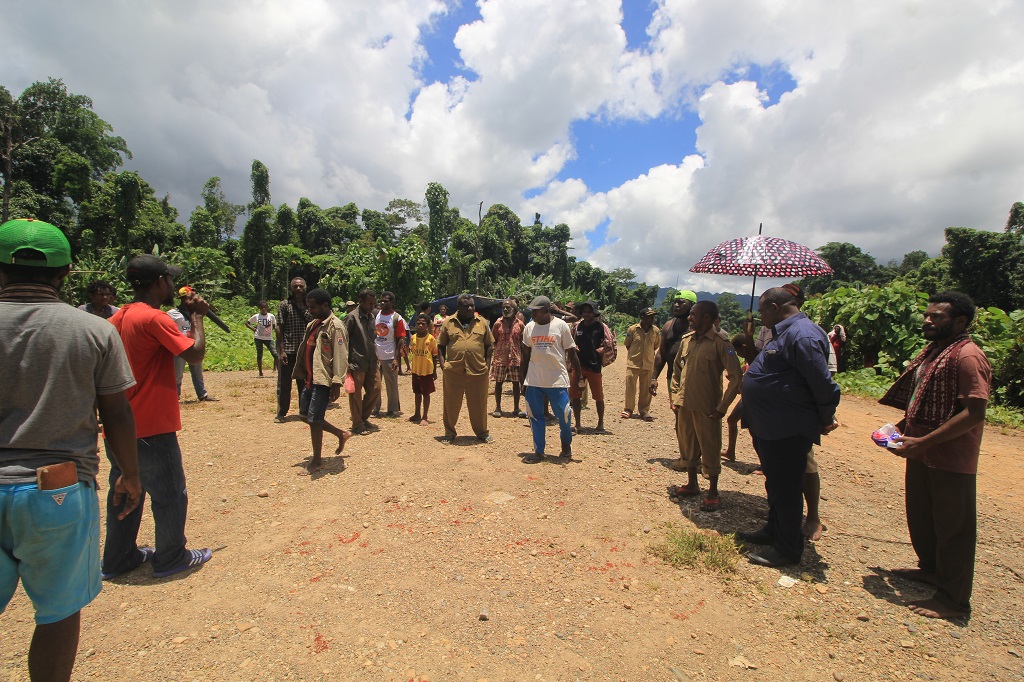
The sky was blue that morning and the sun’s intense heat would burn your skin. Hundreds of people from the Moi indigenous community in Sorong Regency, West Papua arrived at the crossroads at the entrance to the administrative centre of Klaso sub-district, blocking the street while they unfurled banners stating their opposition to oil palm expansion in their ancestral domain.

Moi people from three sub-districts in Sorong Regency took part in the road blockade on the morning of Wednesday 22nd March – Klaso, Saengkeduk and a new prospective sub-district Selekobo. It was timed to coincide with a meeting between the Sorong Regency government and oil palm operator PT Mega Mustika Plantation with the local community, which would take place in the administrative centre of Klaso sub-district.

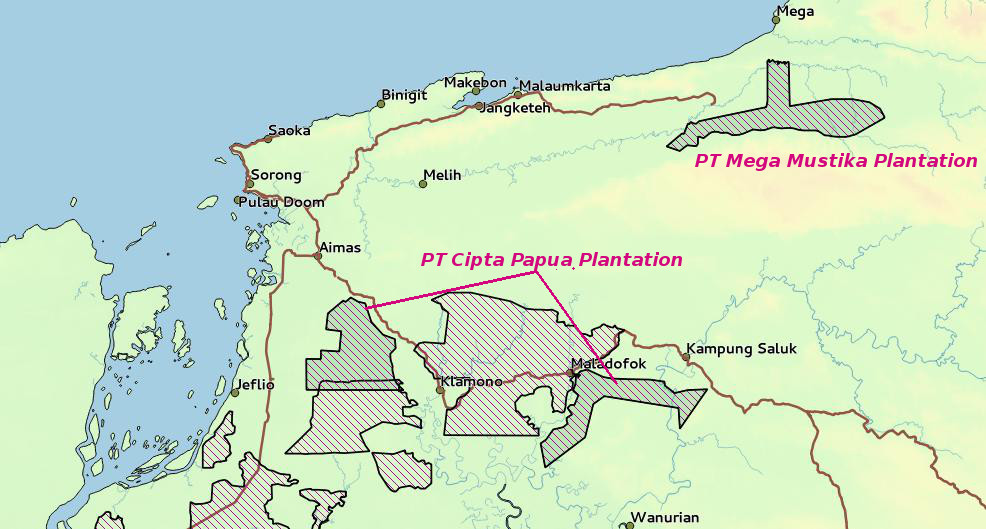
PT Mega Mustika Plantation is one of several oil palm companies which has been issued permits by the local government. Bupati decree 66.1/127/2014 awarded the company a plantation business licence for 9,835 hectares, based on the location permit 221/2011 which had previously been issued on 23rd December 2011

According to Agus Kalalu, who is from the Moi ethnic group, this action to close the road was an expression of the people’s frustration, because none of their previous actions had been met with a meaningful response from the company or government.

“This is the fifth time that people from the three sub-districts have taken action”, Agus said.

The first action started in Saengkeduk village, and was followed by a second action in Klaben village in 2012. The third action was in front of the Sorong District Legislative Council building in 2016 and then most recently during a meeting with the Sorong Regency Forestry Agency in 2016.

David Ulimpa, a Moi indigenous community leader as well as being one of the customary landowners in Klaso sub-district, stated the reasons for opposition to the oil palm plantation in a speech, believing that it would have no effect on the community’s economic wellbeing. On the contrary it would bring hardship.

The people would not only lose their ancestral domain, they would also end up as labourers on their own traditional lands. He took as an example a case from Klamono sub-district, where PT Henrison Inti Persada, the company working in the area, has fired workers, local people, just because they were demanding their rights.

“In Malalilis village, Klayili sub-district in 2016, people who used to work in the plantation were fired by PT Henrison Inti Persada, just because they were demanding their right. The company terminated their contracts, but the land they were working on was their own ancestral land.” said David.

Not only that, last year two children of people who had been fired were detained at the Sorong Regency Police Headquarters just because they were making demands to the company about their parents’ rights.

Another reason, according to David, is that the land and forest belonging to the Moi indigenous community is not that vast, meaning that if a oil palm company were to come and take over the land, it would have an effect on their means of livelihood.

“Where would we look for food? We have always been very dependent on nature. For that reason, I’m standing on the Kalaso land, representing all the clans here, making a pledge in the name of God and the ancestors of the Malamoi land, that we will not accept oil palm companies in our area”, David made clear.

Mialim, a commnity leader from Saengkeduk sub-district, asked Lazarus Malagam, the third assistant regional secretary of Sorong Regency who was present at the meeting, to reveal immediately which clans had signed agreements with PT Mega Mustika Plantation.

“We have already expressed our opposition several times and I’m asking the third assistant regional secretary of the Sorong administration, Lazarus Malagam, to let this be the last time. We, the people of Saengkeduk sub-district are one hundred percent opposed to PT Mega Mustika Plantation.” Mialim added.

As a follow-up to the action, the people made a pledge in their traditional way, planting a certain sort of bamboo in the ground and praying that the people would never again accept oil palm companies in the Saengkeduk sub-district.

Unfortunately, the company representatives soon left the meeting without giving any response to the community’s protest.

“We are annoyed that the company went home, they really should have listened to what we want and witnessed the cutting of the bamboo to show we didn’t accept them.” Mialim said.

In response to the people’s demands. third assistant secretary Lazarus Malagam, stated that he would support the people’s wishes as long as there was unity and consistency between all the different clans.

“Don’t let it happen that everybody is in opposition today but then next year there are clans that suddenly turn around and accept. This can create social tensions, because people will surely think that one group could do this then why couldn’t another. But if we want to say no, then let’s all oppose together. If everyone is in opposition today, then let’s not let oil palm come into the same area in the future.

Rounding off the action, representatives of the indigenous communities in Klaso, Saengkeduk and Selekobo provisional sub-district handed over a statement of their opposition to the local government, as respresented by Lazarus Malagam.

“I will inform the leaders of Klaso and Saengkeduk sub-districts about the outcomes of the meetings and any related decisions in the near future”, Lazarus promised.

Distribution of the Moi ethnic group in Papua Barat.

According to the head of the everyday governing body of the Indigenous People’s Alliance of the Archipelago (AMAN) of the greater Sorong Region, Yusak Konstantinus Magablo, the whole of the Moi ancestral land comprises 400,000 hectares, of which only a small portion has been mapped through participatory mapping. “There are ten Moi sub-ethnic groups, which each have their own boundaries. This sub-ethnic groups are in turn divided into around one hundred large and small clans known as gelet“, Yusak explained.

The Moi sub-ethnic grups include Moi Kalasa, Moi Kalagedi, Moi Malamsimsa, Moi Amber, Moi Malayik, Moi Seget, Moi Kelim, Moi Walala, Moi Abun and Moi Malaibin, but only a few of these are widely known, mostly those in Sorong regency.

The Moi people can be found in almost all areas of Papua’s Bird’s Head Peninsula. In Raja Ampat, the Moi Mayya, were once considered a sub-group of the Moi people but are now their own ethnic group with several sub-groups and gelet.

The Moi ethnic group shares with other ethnic groups in Papua the special characteristic of forming gelet. A gelet could disappear if it becomes part of another ethnic group. Alternatively, other ethnic groups are open to becoming part of the Moi people.

One reason for this could be if they were ‘evicted by nature’ in the form of a natural disaster or other natural phonomena. Moi people have their own social structure, at the highest level are the indigenous leaders, comprised of the nedla, neliging (people who speak well), nefulus (historic people), ne kook (rich people) dan nefoos (holy people).

There are also traditional officials, such as usmas, tukang, finise or those who lead the affairs in the traditional buildings, tulukma, untlan (teachers at traditional schools called kambik), and kmaben.

At the lower level are the wiliwi, young males who have undergone traditional education in the Kambik and have had a traditional graduation ceremony. This group is being trained to become leaders and so they are taught the philosophy of leadership and thorough details of Moi customary laws and practices.

Source: Mongabay Indonesia http://www.mongabay.co.id/2017/03/29/tolak-perkebunan-sawit-masyarakat-adat-moi-palang-jalan/

[awasMIFEE notes on PT Mega Mustika Plantation.

PT Mega Mustika Plantation was given a location permit for 11475 hectares of oil palm plantation on 11th December 2011. We have a copy of the company records from that time, at which time the ownership structure was as follows: Joe Michael 5000 shares, Sudarsono Chandrawidjaja 10000 shares, Rusmina Sumpitan 10000 shares. Sudarsono Chandrawidjaja, who died in a bike race in 2015, was a well-known tae kwondo athelete, but also founded the Ciptana Group, which runs a plywood business in Semarang, central Java. Joe Michael presents angling programmes on Indonesian television and is the husband of pop singer Rita Effendy. The company’s managing director is Tommy Treider Jacobus, who was the Papua Police Chief from 2005 to 2007. We do not currently have up-to-date ownership information, which may have changed.

The same group has another concession in Sorong, PT Cipta Papua Plantation. That location permit was for 18,130 hectares and is split into two blocks, one just to the south east of the Sorong Regency Administrative centre in Aimas and one on mainly primary forest to the east of PT Henrison Inti Persada’s existing oil palm plantation. Another company, PT HCW Papua Plantation which had a concession in Bintuni, also appears to be part of the same group. The current status of that project is not clear.]

Continue reading

West Papuan people in Timika rally to support global petition and Swim for West Papua

West Papuan people in Timika rally to support global petition and Swim for West Papua

April 1, 2017

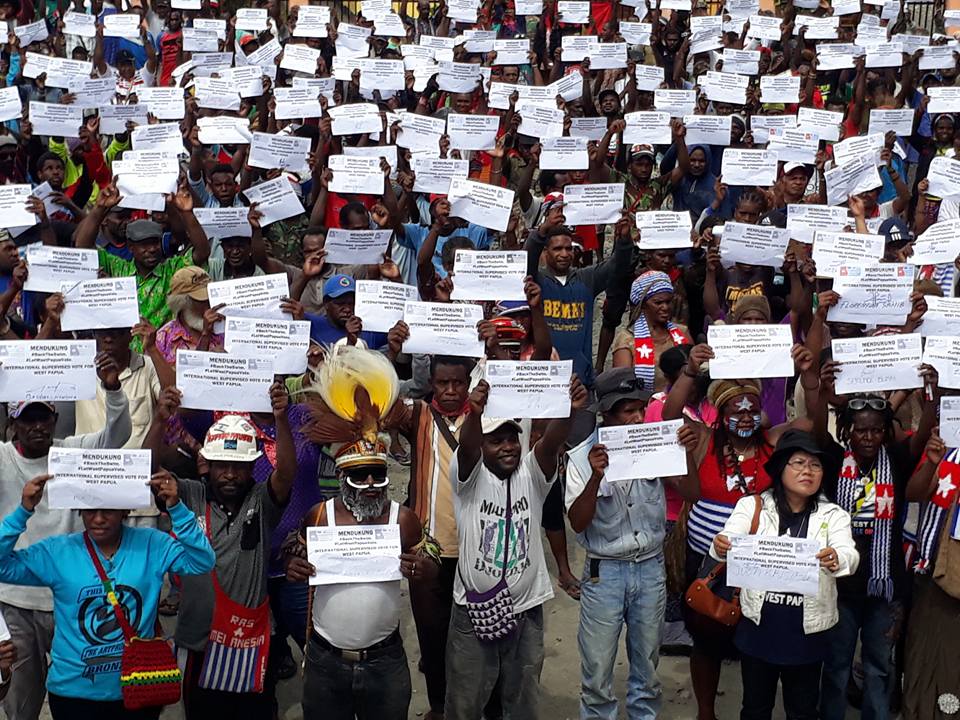
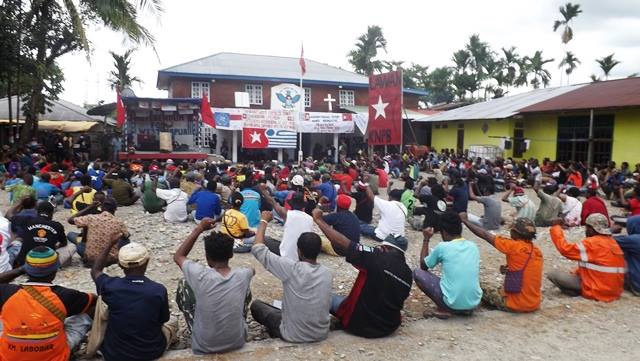
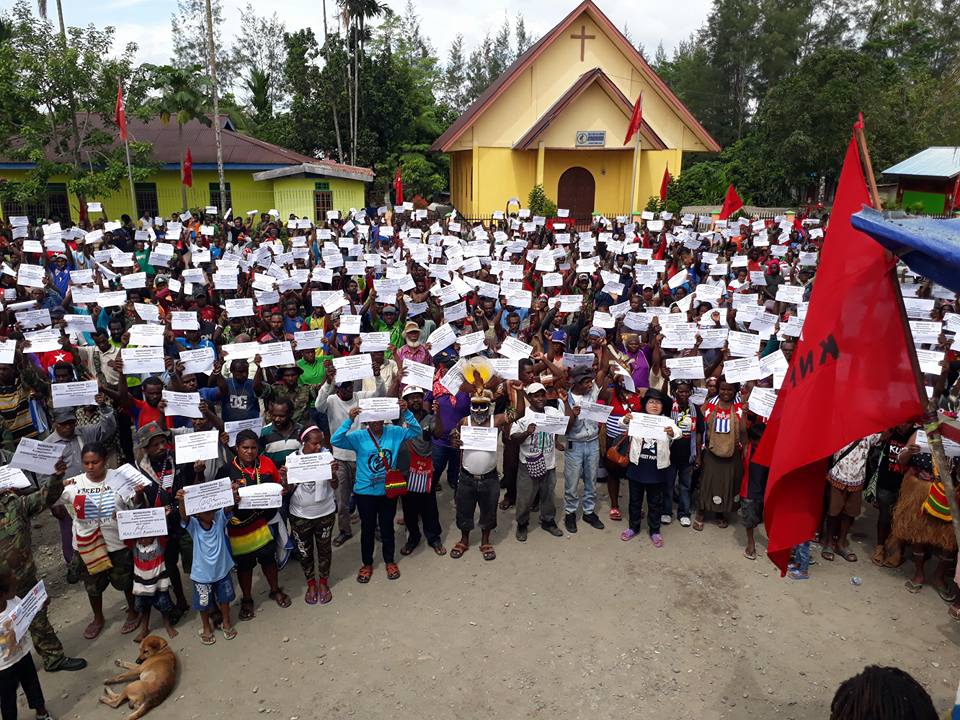
Today in Timika, West Papua, over a thousand people gathered in a rally to show their support for the Global Petition for West Papua and the Swim for West Papua team that will carry it to the United Nations in August 2017.

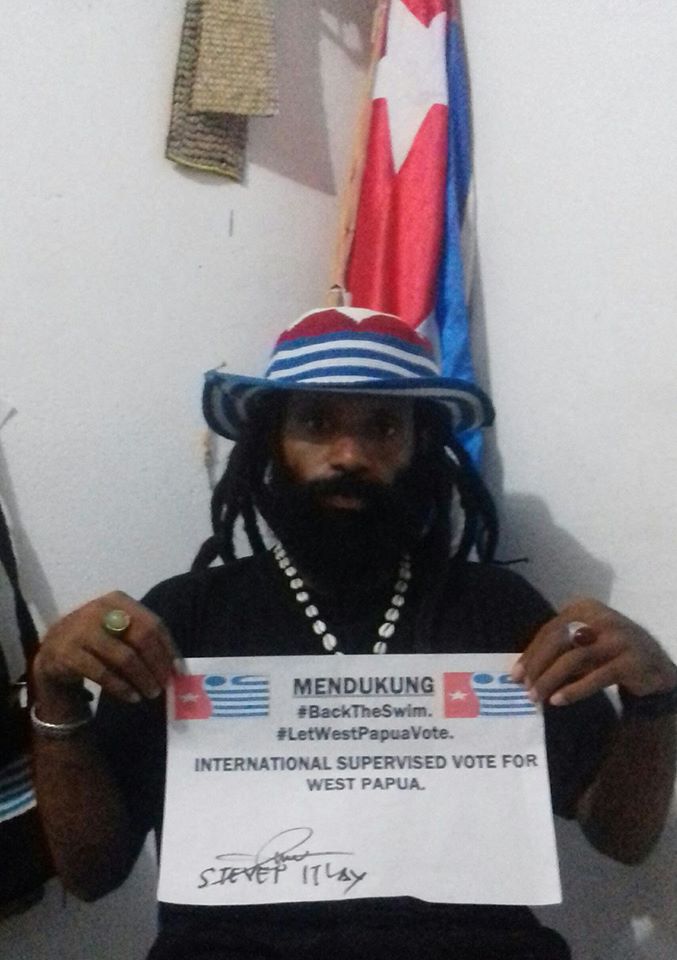
All participants held up hand-signed posters, reading “We support #BackTheSwim #LetWestPapuaVote INTERNATIONALLY SUPERVISED VOTE FOR WEST PAPUA”

The rally was organised by the West Papua National Committee and led by former political prisoner Steven Itlay, who was recently released after serving nearly a year in prison under charges of “treason”.

Former West Papuan political prisoner and Chairperson of the West Papua National committee in Timika, Steven Itlay showing his support for the West Papua petition

About the petition and how you can help

This petition calls upon the UN Secretary General to – “appoint a Special Representative to investigate the human rights situation in West Papua; – put West Papua back on the Decolonisation Committee agenda and ensure their right to self‐determination ‐- denied to them in 1969 -‐ is respected by holding an Internationally Supervised Vote (in accordance with UN General Assembly Resolutions 1514 and 1541 (XV)).”

After collecting tens of thousands of signatures, in August 2017 the petition will be taken by a team of swimmers and literally swum across Lake Geneva and into the hands of the United Nations! YOU can make sure YOUR NAME is included too and show support by signing and sharing the West Papua petition here.  More info about the Swim for West Papua team can be found on their website. 

You can share our offline petition here and if possible, please do send a photo to us of the signatures collected and we will manually add it to our online petition.

You can also print out the #SwimForWestPapua poster here and send photos of you and other people in your city supporting the petition! We will post the photos to our social media, sharing your support to the world!


Let’s all get together and raise support and awareness for the people of West Papua to peacefully determine their own future of freedom. #BackTheSwim #LetWestPapuaVote!


Indonesia Warns US Mining Giant in Fresh Dispute


 Indonesia Warns US Mining Giant in Fresh Dispute

Posted on March 5, 2017 By Dewi Kurniawati

http://www.asiasentinel.com/econ-business/indonesia-warns-us-mining-giant-in-fresh-dispute/

50-year-old “contract of work” at lucrative mine up for grabs


There is rising concern among business sources in Jakarta that tension between the Indonesian government and the US-based mining giant Freeport-McMoRan, Indonesia’s oldest foreign investor, which has been in a months-long deadlock over future mining, could affect relations between Washington and Jakarta.

In addition to taking off a huge share of Freeport’s profits, business sources in Indonesia say the change in the contract could have unpredictable consequences for bilateral ties between the US ad Indonesia. That is because Carl Icahn, a major American investor, acquired 9 percent of Freeport recently. He is now a key investor who also acts as a close adviser to President Donald Trump, who with less than two months in office has already proven to be volatile when it comes to international relations.

Reuters reported last week that shareholders – perhaps meaning the 81-year-old Icahn – are pressuring Freeport to stand up to Indonesia over the changes. Freeport’s chief executive officer Richard Adkerson told a mining conference in Florida that the new regulations are “in effect a form of expropriation of our assets and we are resisting it aggressively.”

“Many of our shareholders feel that we have been too nice,” Adkerson said. “Now we are in the position of standing up for our rights under the contract.” Room exists for common ground – but a resolution could take months during which, according to Jakarta sources, tensions are feared to rise between the US and Indonesian governments.

The government is requiring the company’s local subsidiary PT Freeport Indonesia to convert its 1991 contract of work – its compact with the government to operate – into a special mining license in return for an export permit extension.  The new agreement would require the company to divest 51 percent of its shares to Indonesian interests. The contract of work isn’t due to expire until 2021 but Freeport wants guarantees that it will be extended on the company’s terms before it invests a promised US$18 billion in the mining operation.

Freeport Indonesia operates the huge Grasberg mine in Papua, the world’s biggest copper mine and the second-biggest gold mine.   Its 2016 copper sales from Indonesia were worth about US$2.4 billion, up 130 percent annually since 1996. This year, the Grasberg mine is due to contribute around a third of Freeport’s global 2017 copper sales of £4.1 billion.

The matter spurred President Joko “Jokowi” Widodo to comment on the issue, last week, saying he would take firm action if necessary.

“We want to reach a win-win solution, because this is a business matter. Now, I will leave this matter to the ministers. However, if it’s really difficult to deal with, I will take action.” Jokowi said.

Since starting its operations more than 50 years ago, Freeport’s existence has often been greeted with abhorrence by the Indonesian public. All affairs related to the company have always been political, with many Indonesian politicians and activists referring to it as a symbol of US economic imperialism.

Indonesian commercial and political interests have been attempting to modify the contract of work to get a bigger share of the operations for at least two years. In November 2015, Setya Novanto, then the Speaker of the House of Representatives, was caught on tape allegedly seeking to extort shares from the mining concern.

Although Setya lost his job as house speaker, eventually the scandal cost the job as well of Sudirman Said, the Energy and Resources Minister, who had launched the charges against Setya in the House Ethics Council. Other powerful names were dragged into the allegations against Setya at the same time. The affair pretty much ended inconclusively, however.

Freeport Indonesia insists that the 1991 Contract of Work is still valid and should be respected. Freeport owns 90.64 percent of Freeport Indonesia, while 9.36 percent is owned by the Indonesian government.

On February 17, Freeport Indonesia sent a notification letter to the Energy and Mineral Resources Ministry describing areas of dispute between the two parties. The company also said it would seek the possibility of taking the case to the international arbitration if no settlement was reached within 120 days after sending the letter.

Coordinating Maritime Affairs Minister Luhut Pandjaitan has said local administrations in Papua would get shares from PT Freeport Indonesia when the company divests its 51 percent shares, as required by a new regulation.

Last week, Adkerson said the company expected to find a win-win solution during the dispute settlement period as the Grasberg mine was too important for either party to neglect.

In response to the case, Finance Minister Sri Mulyani Indrawati said the government was undertaking “transitional negotiations” to tweak the management of the mining industry for the sake of investment and national interests, such as job creation, exports and state revenues.

“There will not be private, murky negotiations any longer. We just want to abide by the law and try to be better in explaining this situation to the investors.” She told local media.

PT Freeport Indonesia employs some 32,000 people and has reportedly laid off 25 senior employees as the company negotiates with the government.

Jokowi on Jan. 22 signed the government regulation revising previous conditions on the implementation of the mineral and coal mining business. Under the regulation, mining companies are required to construct domestic smelters as a precondition for them to export the concentrates. That regulation has caused chaos in the mining industry because smelters require huge amounts of power and the government can’t produce enough near distant mining sites to operate them.

What will happen next?

The “win-win solution” seems unlikely, considering Jokowi has the burden to show the Indonesians that “he can stand up against Freeport bullies for more than 50 years”

If both parties fail to come to terms, conciliation or arbitration proceedings would be held in Jakarta, or another location if agreed by both sides.

__._,_.___

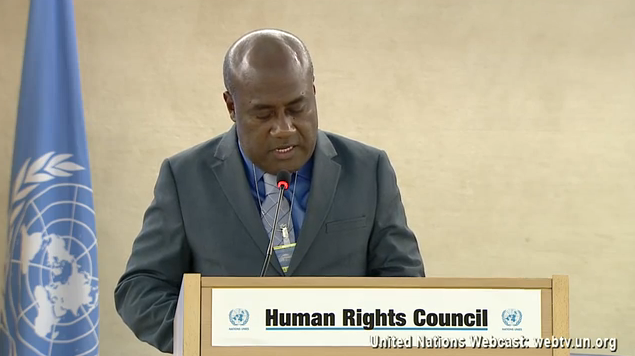
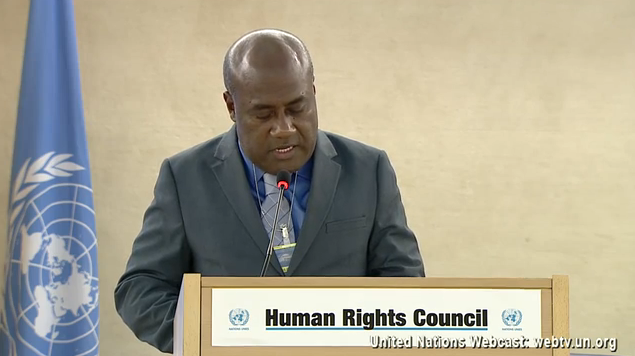
Vanuatu Minister of Justice addresses UN Human Rights Council on behalf of seven Pacific nations


Vanuatu Minister of Justice addresses UN Human Rights Council on behalf of seven Pacific nations

vanuatu-at-un

The Republic of Vanuatu

Statement delivered by the Hon. RONALD K WARSAL (MP)

MINISTER OF JUSTICE AND COMMUNITY DEVELOPMENT, REPUBLIC OF VANUATU

34TH SESSION OF THE HUMAN RIGHTS COUNCIL

1ST MARCH 2017, GENEVA, SWITZERLAND


Mr. President

Excellencies, Distinguished Delegates Ladies and Gentlemen.

The Republic of Vanuatu is very pleased to address this meeting.

Today, I am speaking on behalf of both Vanuatu and six other nations of our Pacific region: Tonga, Nauru, Palau, Tuvalu, the Marshall Islands, and the Solomon Islands

Mr. President, we seven have come together today – and in a separate written joint statement – in order to draw the attention of the distinguished members of the UN Human Rights Council to the grave situation in West Papua.

Mr. President, specifically, we focus your attention on a number of recent pronouncements by mandate holders of this Council about serious Indonesian violations of the human rights of indigenous Papuans:

  • The recent joint letter issued by the UN Special Rapporteur on the promotion and protection of the right to freedom of opinion and expression;
  • The Special Rapporteur on the rights to freedom of peaceful assembly and of association;
  • The Special Rapporteur on the rights of indigenous peoples;
  • The Special Rapporteur on extrajudicial, summary or arbitrary executions;
  • And the Special Rapporteur on torture and other cruel, inhuman or degrading treatment or punishment.

We also draw attention to other accounts of Indonesian state violence in West Papua, including:

  • communications from the UN Committee on the Elimination of Racial Discrimination, referring to killings and arrests of Papuans;
  • numerous well-documented reports of extrajudicial executions of activists and the arrests, beatings and fatal shootings of peaceful demonstrators, including high school students;
  • and reports of persistent violence against Papuan women.

We note that in the last fifteen years the Indonesian National Commission on Human Rights has collected evidence of gross human rights violations by Indonesian security forces in three principal areas of West Papua: Wasior, Wamena, and Paniai. The Commission has described the sets of cases in the first two places as crimes against humanity, which are punishable under Indonesian and international laws.

We want further to highlight another broad aspect of human rights violations – the Indonesian government policy over many decades and continuing until today of the migration of non-indigenous Papuans to West Papua, leading to a dramatic decline in the percentage of the indigenous Papuan population.

Mr. President, to date, the government of Indonesia has, however, not been able to curtail or halt these various and widespread violations. Neither has that government been able to deliver justice for the victims. Nor has there been any noticeable action to address these violations by the Indonesian government, which has, of course, immediate responsibility and primary accountability.

Furthermore, the Indonesian government has consistently been unable to submit the required periodic human right reports and reviews, which are an essential international norm by which the United Nations secretariat and member states monitor human rights around the world. These written assessments are critical to identifying and eradicating torture, racial discrimination and human rights violations generally.

Mr. President, in light of these violations and the Indonesian government’s inaction, we call on the UN Human Rights Council to request the High Commissioner for Human Rights to produce a consolidated report on the actual situation in West Papua.

The High Commissioner’s report needs to take account of the information in existing Treaties, Special Procedures, and the Universal Periodic Review, as well as reports from other international and regional organizations and non-governmental organizations.

The report should also detail the various rights under the International Bill of Human Rights and the related conventions, including the right to self-determination.

And the report must make recommendations for immediate action to halt the pattern of human rights violations as attested to by the numerous Special Procedures and other bodies noted earlier.

Finally, we ask for full and unreserved cooperation with the High Commissioner in the fulfilment of this mandate, including provision by Indonesian authorities of complete access to any persons in West Papua deemed appropriate to meet in the compilation of this report.

Mr. President, as I close, we believe that challenges of West Papua must be brought back to the agenda of the United Nations.

Thank you once again for the opportunity to express my views in this forum. Long God Yumi  Stanap. In God we stand. Thank you.

Indonesian rights violations in Papua triple

Indonesian rights violations in Papua triple

Groups blame emphasis on economic development, militarist approach for being behind sharp increase in abuses

water-cannon-22

Police use water canons on protesters, mostly university students from the Free Papua Organization and the Papua Student Alliance in Jakarta in this Dec. 1, 2016 photo. The protesters were rallying against Indonesian rule over the eastern region of Papua. (Photo by Bay Ismoyo/AFP)

Katharina R. Lestari, Jakarta
Indonesia


February 22, 2017

Human rights violations in Papua more than tripled last year, undermining Indonesian President Joko Widodo’s post election pledge to solve longstanding grievances in the restive region, church and rights activists said.

In a report released on Feb. 20 by rights group Setara Institute for Democracy and Peace, there were 107 recorded cases of rights violations in 2016, which included arrests, torture, forced dismissals, killings and intimidation.

This was a sharp increase on the 2015 figure where only 30 cases were recorded, the report said.

More than 2,200 civilians were victims of violations, and included the arrest of more than 500 people on Dec. 19 during rallies calling for self-determination. Dec. 19 is the anniversary of Indonesia’s invasion of Papua in 1961.

President Joko Widodo’s emphasis on economic and infrastructure development, as well as his military approach in dealing with Papuan issues, caused the sharp increase in rights abuses, according to Bonar Tigor Naipospos, deputy chief of the Setara Institute.

“President Widodo claimed that he would take a different approach from those followed by previous presidents. But what happens is that human rights violations continue to occur,” he said.

“This is dangerous because it can jeopardize relations between the central government and the Papuan people,” he said.

It could eventually result in complete lost of trust in the central government, he said.

Father Neles Tebay, coordinator of the Papuan Peace Network, described the human rights situation in the region as “gloomy.”

The sharp increase in violations showed that “the Papuan people are still regarded as a state enemy that needs to be destroyed,” he said.

“Continued violations have strengthened the spirit of nationalism among Papuans,” the priest said.

“It makes people proud if they can raise the Morning Star flag in public places even though they would end up being arrested and jailed,” he said.

Papuans look upon the flag as their national flag.

Father Tebay said Papuan people want central government to respect their rights and dignity.

He suggested Jakarta should hold dialogues with Papuan people to seek ways to resolve human rights violations.

Journalism award named after West Papuan journalist who passed away aged 23

Pantau Foundation introduced Oktovianus Pogau Award in Indonesia

Febriana Firdaus received the award on courage in journalism

For further information:

Imam Shofwan of Pantau Foundation: phone 0813-92352986 email bung.imam@gmail.com

JAKARTA, 18 February 2017 – Jakarta has a new awardd on courage in journalism in honor of the West Papuan editor, Oktovianus Pogau, who passed away last year. It was awarded for the first time to reporter Febriana Firdaus, who had extensively covered human rights abuses in Indonesia, the Pantau Foundation said.

“We want to honor our colleague, Oktovianus Pogau, a smart and courageous journalist, who edited Suara Papua news and highlighted human rights reporting. He passed away at a very young age, just 23 years old. We want to honor his legacy by establishing this Oktovianus Pogau award,” said Imam Shofwan, the chairman of the Pantau Foundation, in a speech to a small gathering at his office on February 13.

The Pantau Foundation selected Febriana Firdaus, a Jakarta journalist, to receive the inaugural award. Firdaus covered Indonesia’s efforts to deal with the 1965-1966 massacres, disappearances and arbitrary detentions. She also covered discrimination, intimidations, and violence against the LGBT community in Indonesia.

Continue reading

DIFFERENT TREATMENT FROM INDONESIAN OFFICIALS FOR INDIGENOUS JOURNALISTS IN WEST PAPUA


DIFFERENT TREATMENT FROM INDONESIAN OFFICIALS FOR INDIGENOUS JOURNALISTS IN WEST PAPUA

press-sign

AdminFeb 16, 2017


Illustrated

Jayapura, Jubi – Indonesia has less than three months to deliver “full and free” press access to Papua provinces, says PFF, the Pacific Freedom Forum.

“Jakarta risks global condemnation if it continues to ignore the facts,” warns PFF Chair Monica Miller. ”

A visit last month by media freedom campaigners proves that access for Papua press is still far from full and free”, she says.

Violence, Bullying, Sexual Harassment

An eight person delegation from MFCI, the Media Freedom Committee Indonesia, visited the Papua towns of Jayapura, Merauke and Timika, between 29 January to 3 February 2017. Their reported findings include :
– Ten cases of violence against journalists that are still not resolved. – Only 16 foreign press were given permits to visit Papua last year, with 11 forced to accept government guides.
– Different treatment from Indonesian officials for indigenous journalists versus Indonesian journalists – such as stigmatisation and intimidation of “OAP” – ‘original Papua persons’.
– Local press still need police permits to cover public gatherings, including protests.
– Women journalists routinely suffer bullying and sexual harassment from government sources, but rarely report it to police because they “take it for granted.”
– In an atmosphere of surveillance, intimidation and harassment, media outlets find it impossible to recruit new reporters. One training session for newcomers saw 30 people on the first day, 12 the second day and none the third.
– Business models threaten independence of Papua media, including in Timika, where ad revenues are sourced from Freeport mine, its subsidiaries and local government.
– Threats against independence include pressure from “certain parties” on mass media not to cover environmental issues.
– Isolation from other media due to a lack of access to communications resources causes ethical lapses.
Supported by WAN-IFRA, the World Association of Newspapers and News Publishers, under its Strengthening Media and Society programme, the MFCI visit was also backed by the Denmark ministry of Foreign Affairs. PFF welcomes the input from WAN-IFRA, and praises the leadership role played by Denmark.
“Other diplomatic partners in Jakarta need to do much more to support press freedom,” says Miller.

Shameful
“Their continued silence on abuses against the press and other human rights compares shamefully with billions in profit being made from Papua by outside interests.”
Findings from the MFCI visit join recent wide concern expressed about Indonesia blocking access to 800,000 websites. Among blocked sites is SuaraPapua – the Voice of Papua – a news outlet exposing human rights abuses.

Voice for the voiceless
PFF praises LBH Pers, the Legal Aid Institute for the Press, for representing SuaraPapua as a “voice for voiceless.” Last year, PFF laid down a deadline for open access to Papua, in the lead up to Indonesia hosting World Press Freedom Day on 3rd May 2017. The deadline was reportedly rejected by a minor official at the Indonesian embassy in Wellington, New Zealand.

Think Carefully
However, PFF has not been able to get confirmation of the alleged rejection from Jakarta.

“Instead of speeding up preparations for World Press Freedom Day, Jakarta appears to be slowing down”, says Miller.

“Make no mistake, Jakarta needs to think very, very carefully about its continued failure to fulfil its own promises, its own guarantees for media freedom under the Indonesian constitution, and its signature to many international treaties.”

Ahead of #WPFD2017, PFF is calling on journalists everywhere to focus attention on one of the world’s least reported areas.

“This year, global journalists must all prove themselves wantoks of the Papua press”, she says. Indonesia improved eight places between 2015 and 2016 on the RSF, Reporters Sans Frontiers World Press Freedom Index, at 130 of 180 countries, but is still coded red for a generally “bad” situation.