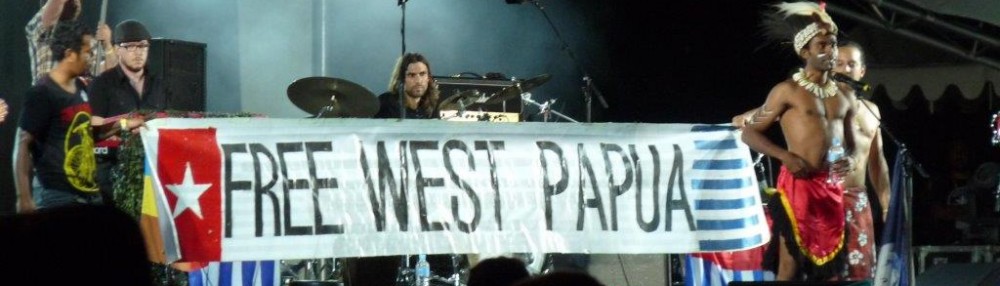
Stop Military business and respect the rights of indigenous Papuans.

Stop Military business and respect the rights of indigenous Papuans.


https://awasmifee.potager.org/?p=1440


Translation of a Press Release from a Coalition of Civil Society Organisations


On 16th July 2016 soldiers from the sub-district military command in Muting, Merauke Regency, came to look for Agustinus Dayo Mahuze, the chair of the Mahuze clan in Muting village, at his house. Their intention was to invite him to meet with the bosses of oil palm company PT Agriprima Cipta Persada (ACP) at the plantation site, and also to deliver a notice signed by the chair of the Kartika Setya Jaya co-operative, a military business linked to the District Military Comand

1707 in Merauke. The letter was dated 11th July 2016 and with reference number 8/16/VII/2016, and it gave notice of a permit of a work contract to clear land for oil palm in PT ACP’s concession..


The soldiers from the sub-district military command met Agustinus Dayo Mahuze away from his house, on the road towards Mbilanggo village, that afternoon, and stated the purpose of their visit. When the military officers told Agustinus Dayo about the plans between the co-operative and the company he felt threatened, afraid and anxious.

PT ACP’s has often involved the military and police in support of its business interests, and they have participated in activities related to obtaining the right to use land and in clearing land. This work has been accompanied by intimidation and threats of violence, generating nervousness and tension between the local community and the company, government and police and military personnel. Evidence for this are the letters the community repeatedly sent to the government, the police and military and the National Human Rights Commission between January and July 2015, to which they received no meaningful response.


Before that, the community had already made their feelings clear to the government and company by erecting notices around their ancestral land that read “the greater Mahuze clan’s land is not to be used for oil palm”. The community are also hoping to resolve the problem of a few members of the clan who have yet to repay money which had been given to a them as land compensation and which is being considered as proof of the transfer of land title, despite the fact that the clan members who accepted it did so without the general agreement of the whole greater Mahuze clan.


The involvement of the state security apparatus in providing security for PT ACP’s business interests, and even taking a direct role in the enterprise by clearing company land which is still disputed, and the way this creates a feeling amongst the community that they are not safe and facing injustice, represents a violation of the constitution and the law. The actions of these military personnel are also in contradiction to the military’s national commander to reform military institutions, including placing curbs on military businesses.


Because of this, we demand:


(1) The Coordinating Minister for Law and Human Rights, National Military Commander and Chief of Police should put a halt to military business, in which the military provides security for or expedites corporate business activities in ways which violate the law and do not support local communities;


(2) The National Military Commander and Police Chief should give harsh penalties to police or military personnel found to be involved in such businesses which lie outside their institutional remit and cause anxiety in local communities;


(3) The Agriculture Minister and Bupati of Merauke Regency should undertake a social and environmental audit, and a review of permits for work being carried out by oil palm company PT Agriprima Cipta Persada in Muting, Merauke.


We support reforms police and military institutions in such a way that they can provide protection and service for citizens, and we also hope that all parties will show respect for the rights of Papuan indigenous peoples.


Jakarta 22 July 2016


Coalition of Civil Society Organisations PUSAKA, Yayasan Satu Keadilan, ELSAM, Konsorsium Pembaruan Agraria, SKP Keuskupan Merauke, SKP KC Fransiskan Jayapura, LBH Jakarta, Perkumpulan JUBI, debtwatch Indonesia, Epistema Institute, GRAIN International, Sekretariat Bina Desa, Koalisi Rakyat untuk Keadilan Perikanan, Indonesian Human Rights Committee for Social Justice, WALHI, Perkumpulan Bantuan Hukum Kalimantan, Institut Global Justice, Solidaritas Perempuan, SAMPAN Kalimantan, HUMA, JKMA Aceh, JERAT Papua, Yayasan Anak Dusun Papua, AURIGA, Institute Ecosoc, KONTRAS, Yayasan Lembaga Bantuan Hukum Indonesia, GARDA Papua, FIM Papua. Individual supporters: Rahma Mary, Idham Arsyad, Dede Shineba, Budi Hernawan, Teguh Surya.

West Papuan refugees in Papua New Guinea: on the way to citizenship

—————————————————————————

http://devpolicy.org/west-papuan-refugees-papua-new-guinea-way-citizenship-20160719/

4) West Papuan refugees in Papua New Guinea: on the way to citizenship?

By Jenny Munro on July 19, 2016

At Rainbow settlement in Port Moresby, 38 families of West Papuan heritage live in a drainage ditch approximately 100 metres wide by 200 metres long. To one side, the neighbours’ retaining wall contains pipes which direct runoff water and rain directly into the settlement. On the other side of the settlement is a construction site that doubles as a soccer field for Rainbow’s children. The houses are small structures built with a patchwork of materials that reveals the recent history of external engagement — tarps from the United Nations High Commissioner for Refugees (UNHCR), plywood from a church fundraiser, plastic chairs from a West Papuan who lives outside the settlement. In the context of increasing efforts from Papua New Guinea (PNG) authorities to register West Papuan refugees and provide citizenship status, this post flags some of the relevant historical context and reflects on current challenges. As Papua New Guineans including Oro Province Governor Gary Juffa have suggested, citizenship is not sufficient to improve West Papuan refugees’ living conditions.

Over 100 West Papuan refugees have been living in Rainbow for the past eight years, since being evicted from 9 Mile settlement. According to one community leader, 22 babies were born to refugee families in the settlement in 2015. The children are entitled to access public school education and health services though their residency status remains ambiguous. But like other urban residents in Port Moresby’s settlements, many children do not attend school because their parents struggle to afford sufficient food, clean clothes, transport or extra costs associated with school. Continue reading

Papuan students in Yogyakarta endure racist insults, multiple arrests in two day siege

Papuan students in Yogyakarta endure racist insults, multiple arrests in two day siege


CNN Indonesia – July 17, 2016


Anggi Kusumadewi, Jakarta — Animal names and racist insults could be heard shouted at midday on Friday July 15. The shouts originated from members of mass organisations besieging the Kamasan I Papua student dormitory on Jalan Kusumanegara in the Central Java city of Yogyakarta.


Four mass organisations arrived at the Papuan dormitories, namely the Indonesian Veterans’ Children (FKPPI), the Pancasila Youth (PP), the Paksi Katon [which sees itself as a guardian of Javanese culture and the Yogyakarta sultanate — JB] and the Yogyakarta Militia (Laskar Jogja). In total they numbered around 100 or more people.


Upon hearing the sudden string of animal names and racist insults, the Papuan students inside the student dormitory were startled. One of the students said, “They really said that, the shouts from out front, I have eyes and ears, at us Papuan students, Papuan people”, they said angrily and with a sickened heart.


According to the Papuan students, the police officers on guard around the dormitory just ignored the racist behaviour. At the time there were just as many police officers. Yogyakarta resident Kindarto Boti said that police had deployed the officers in three or four trucks. Another resident said that the police arrive fully armed as if they were going to arrest terrorists.


And it was not just the police that were armed — members of the mass organisations also carried weapons. “They brought wooden [clubs], crowbars and other sharp objects”, one Papuan student who did not wish to be named for security reasons told CNN Indonesia on Saturday July 16.


Papuan students in Yogyakarta had been receiving racist insults since Thursday July 14 through SMS messages which were sent to those who were members of the People’s Union for West Papua Freedom (PRPPB).


The PRPPB had earlier planned to hold a long-march from the Papuan student dormitories to the zero kilometre point on Jl. Panembahan Senopati. This location is a strategic intersection and a tourist attraction in Yogyakarta and often used for protest actions.


The Long march, which should have taken place at 9am on Friday morning, was part of a peaceful action supporting the United Liberation Movement for West Papua (ULMWP) becoming a full member of the Melanesian Spearhead Group (MSG) — an inter-government organisation in the South Pacific comprising four Melanesian countries, namely Fiji, Papua New Guinea, the Solomon Islands and Vanuatu.


However before the scheduled 9am march could begin, police officers surrounded the Papuan student dormitory. Scuffles broke out between the students and police with the Papuan students being forced back inside the dormitories.


The main road in front of the dormitory was then closed, the front gate blockaded and the rear gate blocked with a police truck. All access in or out of the dormitories was prevented. “Our friends who arrived at the dormitories were intercepted and arrested by police”, said a Papuan student inside the dormitory.


They described how two Papuan colleagues who arrived on a motorcycle via the rear gate were stopped. The motorcycle was confiscated resulting in a scuffle with police who then fired warning shots and arrested the pair.


Another colleague from the group Student Struggle for Democracy who tried to enter the dormitory was also arrested. Seven others were likewise arrested as they returned home from buying sweet potatoes from the Giwangan market.


A local resident asked the police why all the Papuan students had been ordered back into the dormitory. The police replied that they had information that several mass organisations would arrive and it would be extremely difficult to stop them if they decided to attack the students in an open location.


As the clock showed 9am it was clear that students from the PRPPB would not be able to realise their plans for a long-march. Around an hour later they began giving political speeches on the dormitory grounds.


In the hours that followed there was uproar when a number of mass organisations arrived and began shouting insults. The siege continued until the 150 or so Papuan students inside the dormitory began to grow hungry. But the sweet potatoes they were to eat had being seized by police when they arrested the seven students.


Calls for solidarity actions and requests for logistical assistance were made to comrades outside. Yogyakarta residents responded by thronging to gather food for the Papuan students that was channeled through the Indonesian Red Cross (PMI). However the PMI ambulance carrying the food failed to drop of the logistics after it was intercepted by police.


Food was only able to be delivered to the dormitory at 9pm. “I sent it towards midnight because it wasn’t possible in the afternoon, the security was still tight because there were several members of mass organisations there”, said Yogyakarta resident Darto.


Darto, who had been monitoring the dormitory over night, related how difficult it was to send food to the Papuan students. He had to be circumspect.


“I arrived at around 8pm wanting to send food in but wasn’t able to. A plastic bag filled with food was entrusted to a local resident whose house is near the dormitory. I wasn’t able to enter the dormitory, [I] waited until it was dark, changing location, intelligence agents arrived, asking a lot of questions, it gave me the creeps. So I moved away from the dormitory, they checked and approached again, moved away again. Finally I went home at 8am [the next morning] when the situation had calmed down”.


The Yogyakarta regional police say that that officers would continue to guard and monitor the Papuan student dormitories until the situation is considered secure.


“The police hope that the situation will become favourable. We’re on guard so as to prevent something undesirable happening. Because they (the Papuan students) were planning to hold a protest action supporting separatism, Papuan independence, and there were social organisations who didn’t agree”, said Yogyakarta regional police public relations chief Assistant Superintendent Any Pudjiastuti.


The Papuan students wanting to hold a separatist action, according to Pudjiastuti, were not just those studying in Yogyakarta. Protesters arrived from Semarang and Solo in Central Java and the East Java provincial capital of Surabaya. Yogyakarta was the centre for the action.


The arrested Papuan students have now been released with the exception of one who according to Pudjiastuti, “Was proven to have resisted [arrest] and assaulted an officer with a sharp weapon resulting a head injury and the harming of a police official”.


“So we are not detaining them. We secured six people for questioning. Of the six, five were found to be not guilty, one person committed a crime and is being processed”, said Pudjiastuti.


Currently there are still 30 people inside the dormitory while the others have returned to their respective boarding houses. Those from out of town have returned home.


One of the student who remained inside the dormitory said they felt traumatised. “The Papuan student dormitory is still under military siege, but we are now able to continue activities, unlike yesterday on Friday. On Friday, it was dangerous for us to even go out. We were hungry because we couldn’t leave the dormitory to get food”, they said.


The mass organisations that wanted to attack the Papuan students, they said, were not just patrolling in front of the dormitory, but also on Jl. Timoho, Malioboro and Glagahsari. They conducted sweeps for Papuans. Not surprisingly, all of this has made Papuan residents in Yogyakarta feel threatened and intimidated (agk)


[Translated by James Balowski for the Indoleft News Service. The original title of the report was “Kisah Mahasiswa Papua di Yogya Dua Hari Terkurung di Asrama”.]


Source: http://www.cnnindonesia.com/nasional/20160717064356-20-145189/kisah-mahasiswa-papua-di-yogya-dua-hari-terkurung-di-asrama/


—————————————————————


INDOLEFT News service


If you are not already subscribing to this news service, you can do so by sending a blank e-mail to <subscribe-indoleft@yahoogroups.com> and you will be automatically added to the list.


The INDOLEFT news service is produced by the People’s Liberation Party (PPR) and the Asia Pacific Solidarity Network (APSN).


To view the archive of Indoleft postings since 2003 visit: http://www.asia-pacific-solidarity.net/southeastasia/indonesia/indoleft/indoleft.htm.


Follow us on Facebook: http://www.facebook.com/asiapacificsolidaritynet

Give Papua more freedom

http://www.thejakartapost.com/news/2016/07/18/give-papua-more-freedom.html
Give Papua more freedom
Mon, July 18 2016 | 07:09 am
Indonesia could claim a diplomatic victory over those who have for decades been offering international support for Papuan independence after the Melanesian Spearhead Group (MSG) denied full membership to the United Liberation Movement for West Papua (ULMWP) last week. But that would not change anything in Papua, where discontent and distrust toward Jakarta is still rife.

Sadly, heavy-handed approaches, which have proven to be ineffective and obsolete, have remained the only option available to deal with the dissatisfaction and grievances of Papuan people, as seen in the arrest of dozens of people in Papua and Yogyakarta for throwing their weight behind ULMWP over the past week.

Worse still, in the case of the Yogyakarta incident, local community groups have been involved in suppressing the right of Papuans to voice their thoughts, not to mention the dissemination of old pictures on social media to mislead the public about what really happened. The anger of Yogyakartans about Papuan “troublemakers” is reminiscent of the role of hard-line groups in the dispersal of academic forums discussing the 1965 tragedy held in the city over the last few years, as well as in the restriction of freedom of expression throughout the country.

There are indeed sporadic armed attacks launched by the Free Papua Organization (OPM), which the Indonesian Military (TNI) and police have cracked down on, because they pose a clear danger to other people and public security.

The Papuan protesters and students are merely expressing their dissatisfaction with the impoverishment they have been enduring in their resource-rich land. So it should come as no surprise if they aspire for an independent state because they have lost trust in the government.

Such demands were once expressed in other mineral and oil-producing regions like Riau, and even in Yogyakarta when its people defended the city’s monarchy. But rather than making arrests or clamping down on their aspirations, the central government opted for dialogue to reach a settlement.

There has been no action taken against groups and their members for having openly expressed their aspirations for an Islamic state in the country either.

The fact that Papuan people have to risk arrest and jail sentences on treason charges to simply exercise their freedom of expression will only exacerbate their feelings of being discriminated against and further fortify their struggle to part with Indonesia.

President Joko “Jokowi” Widodo has realized his promise to visit Papua more frequently than his predecessors and ordered the acceleration of development in the easternmost territory, especially the construction of roads that will bring many regions out of isolation.

But the initiatives will not help Jakarta win the hearts and minds of Papuans unless the security approach stops. Papuans do not need special autonomy status that only triggers large-scale corruption in the first place, but fulfillment of their rights as Indonesian citizens.

Our Constitution guarantees them this.

An activist’s account of his dedication to peaceful protest


1) Indonesia –

Files Karma, Indonesia           1 July 2016, 10:52AM


Amnesty supporters worldwide wrote thousands of letters on behalf of Filep Karma who was released from prison in November 2015. Today, he shares why he won’t stop fighting for freedom of expression in Indonesia.

filep-karma-1024x768

Filep Karma reading letters from Amnesty International supporters. © Amnesty International


I was born in Jayapura, Papua, the easternmost region of Indonesia. Since my childhood, I witnessed numerous human rights violations.

Under former President Suharto (1966-1998), people who spoke out for the rights of Papuans were immediately accused of separatism by the military government. Anyone who wanted to fight against this injustice had to go [into hiding].

When Papuans demand independence it’s because many of them know that the 1969 independence referendum was unfair. During that time Papuan people were intimidated and coerced by the Indonesian military forces. People were killed or they disappeared. Papuans lived in terror and didn’t have the courage to speak out. I could not accept this.

When I was a civil servant in the 1990s I was invited to study for a year in the Philippines. I learned about Mahatma Gandhi and Martin Luther King – how you could struggle against injustice using peaceful methods. I then decided that Papuans should do the same, and speak up for their rights peacefully.


Imprisoned for the first time


When Suharto resigned in May 1998, I thought this was the moment to initiate a peaceful Papuan independence campaign. I organized a gathering in Biak city and I led the raising of the Morning Star Flag [a symbol of Papuan independence which is banned in Indonesia]. For this, I was convicted of “treason” and sentenced to six and a half years in prison [the sentence was overturned on appeal after 10 months]. Continue reading

SOLOMON ISLANDS IN SUPPORT OF GLOBAL VOTE FOR WEST PAPUA INDEPENDENCE


http://theislandsun.com/solomon-islands-support-global-vote-west-papua-independence/

1) SOLOMON ISLANDS IN SUPPORT OF GLOBAL VOTE FOR WEST PAPUA INDEPENDENCE

BY ERNEST TA’ASI | June 27, 2016


THE SOLOMON Islands government is in support for an international supervised vote on the independence of West Papua.

THE SOLOMON Islands government is in support for an international supervised vote on the independence of West Papua.

Solomon Islands representative Barret Salato gave the country’s support before the UN Human Rights Council for the vote proposal that was made by the International Parliamentarians for West Papua Forum in London last month.

“We strongly endorsed the final declaration of this International Parliamentarians for West Papua (IPWP) Forum which took place in London on 3 May which calls for an internationally supervised vote on the independence of West Papua,” Salato said in his statement over the situation of West Papua.

The London declaration has been endorsed by cross regional parliamentarians from 15 UN member states.

Barret Salato spoke of the brutal oppression faced by West Papuans.

He said the Solomon Islands government is regularly updated on the violation of human rights against West Papuans.

“The Solomon Islands government receives regular reports of cases of arbitrary arrests, summary execution, torture, ill-treatment, restriction of freedom of expression, assembly and association, committed mainly by the Indonesian police,” Salato said.

He said on 2 May alone, 2,109 indigenous Melanesian West Papuans were arrested for participating in peaceful demonstrations in several cities in West Papua and some Indonesian cities.

“The demonstrations were held in support of the United Liberation Movement of West Papua (ULMWP) to be recognized as a full member of the Melanesian Spearhead Group (MSG), the commemoration of 1 May 1963 as Indonesia’s annexation of West Papua and to support the International Parliamentarians for West Papua (IPWP) meeting.

“During the arrest, some of them experienced torture and ill treatment from the Indonesian security forces,” he added.

“The Solomon Islands notes the recent outcomes of the Foreign Ministers Meeting of the Melanesian Spearhead group that was held last week in Fiji (14-17TH June 2016) where both Representatives of Indonesia and the ULMWP sat as MSG members during the deliberation.

“This outcome envisages to establish a safe space for constructive engagement with all parties with a view to addressing the concerns of the MSG members about the recent developments in West Papua.

“In this regard, the Foreign Ministers further agreed to establish a Committee of High Level Representatives of the MSG members to accompany and facilitate this constructive engagement.

“We also welcome the initiative of the MSG to work closely with the Indonesian government to visit the Melanesian Provinces of Indonesia at a later date. This important visit would allow for a clear, objective and independent view by the members of the MSG leaders and ministers.”

———————————————————————

Indonesian crackdown on West Papuan independence protest

———————————————————————————————

https://www.thesaturdaypaper.com.au/world/2016/05/14/indonesian-crackdown-west-papuan-independence-protest/14631480003240

The Saturday Paper

MAY 14, 2016

1) Indonesian crackdown on West Papuan independence protest

JOHN MARTINAS


The harassment, beating and jailing of independence protesters by Indonesian authorities in Papua continues, while Australia turns a blind eye.


West Papua independence protesters, on May 2, in Jayapura.   Facebook

On Monday, May 2, amid the fallout from the Papua New Guinea Supreme Court ruling the Australian detention centre on Manus Island unlawful, another momentous thing happened. Further west along the Papua New Guinea north coast, just over the border with Indonesia in the Papuan capital, Jayapura, 1500 people were arrested. It barely rated a mention here.

It was the largest mass arrest of pro-independence demonstrators in Papua, and included the arrest of demonstrators in the regional centres of Sorong, Merauke, Wamena, Fak-Fak and Manokwari. Arrests were made at similar rallies in Semarang in Java and Makassar in South Sulawesi. In all, 1888 people were arrested for demonstrating for independence. Photos and video circulating both on social media and local media show the masses of people arrested in Jayapura and taken to the Indonesian police compound – forced to sit in rows in the heat and made to remove their clothes.

Continue reading

Vanuatu will call for the Decolonisation of West Papua

Single Goal for Vanuatu Civil Society Summit – Support West Papua – West Papua No.1 News Portal ?

Single Goal for Vanuatu Civil Society Summit – Support West Papua

Church and Civil Society raise the Morning Star flag in Vanuatu - Jubi

Church and Civil Society raise the Morning Star flag in Vanuatu – Jubi

By Len Garae in Port Vila

Jayapura, Jubi – A West Papuan delegation has come to a regional civil society forum with a single goal in mind – full membership for the United Liberation Movement for West Papua in the Melanesian Spearhead Group.

Emele Duituturaga, executive director of the Pacific Islands Association of Non-Government Organisations (PIANGO), said this in an exclusive interview after launching the two-day forum yesterday, adding:”We hope that at the end of our forum, the meeting will endorse that and that will be our goal.”

The West Papua delegation also suggested that Indonesia should not be a member of the MSG. And so the issue of “who and what is a Melanesian” is being discussed amid reports of hundreds of Papuans being arrested in a mass Indonesian crackdown.

The theme of the forum is decolonisation.

“We see Indonesia as colonising West Papua in the same way that we are supporting the movement of Kanaky for independence [from France]. And so it is broadly self-determination and decolonisation,” she said.

The West Papuans insist that ULMWP are the rightful leaders of West Papua because of critical suggestions from some quarters that ULMWP are “external” and not representative of West Papua.

“But there is evidence [to the contrary] and this delegation here today actually came from inside West Papua and they’ve come to call for external international intervention, they’ve come to talk about the genocide that is happening in West Papua.

“We’re going to discuss what we are going to do about it,” Duituturaga said.

Special envoy

“When Vanuatu’s Special Envoy on West Papua, MP Johnny Koanapo, said West Papua was in the blood of the ni-Vanuatu when he launched our Civil Society Organisation Parallel Forum at Owen Hall at Independence Park yesterday, there was a feeling of elation, a real assurance of the leadership role that Vanuatu has been the beacon of hope, the symbol of independence (for West Papua).”

She said it was a joy for PIANGO to note that despite Vanuatu’s internal political challenges, the country’s focus on West Papua had not shifted as confirmed by MP Koanapo’s words.

The MP, who used to be director-general of Foreign Affairs, welcomed the involvement of the civil society forum on the call for West Papua to become a full member of MSG, saying the Vanuatu government also needed the support of civil society on West Papua.

Before he became MP, Koanapo was instrumental in writing the staunch speech of former Prime Minister Moana Carcasses at the UN General Assembly, condemning reports of human rights abuse against Melanesians by the Indonesian military in West Papua.

PIANGO as the umbrella organisation of 21 Pacific Island countries and territories, is at the forefront of West Papua becoming a full member of MSG, Duituturaga said.

‘Missionary report’

In addition she said there was a march and a launch of the “shadow missionary report” in Suva, Fiji yesterday, which had been conducted by the Catholic Commission for Justice and Peace.

The same report would be launched in Port Vila today.

“It was launched in Brisbane last Sunday then Fiji and now Vanuatu,” she said.

“This is in direct response to the Pacific Islands Forum leaders’ decision to send a fact-finding mission to West Papua.

“But now it is heading for the middle of the year and the mission has not taken place because Indonesia has not responded.

“So civil society had committed that we would not wait for the government as this is the second report of human rights violations in West Papua and we want to bring it to the attention of our leaders.”


WP Parade March on April 29 to be bigger than last one above in 2010

1) CHAIRMAN SAYS WEST PAPUA THEN KANAKY

By Len Garae | Posted: Saturday, April 23, 2016 12:00 am


WP Parade March on April 29 to be bigger than last one above in 2010

While more and more people in Port Vila are rushing to sign the public petition at Manples Market for the peaceful march on April 29, to demand the Melanesian Spearhead Group Summit Leaders to give West Papua full membership, the Chairman of the Vanuatu West Papua Committee, Pastor Allan Nafuki says a two-member delegation from Kanaky (New Caledonia) who are pushing to get the Kanaky Referendum issue on the same band wagon, have been advised to wait until after the march on April 29.

The Chairman says his committee has to work on urgent issues one issue at a time. The Presbyterian Church of Vanuatu has always placed Independence for Kanaky at all its annual general assembly since day one.

Now Kanaky already has a political voice through FLNKS Victor Tutugoro as a full member of MSG.

The Chairman has recommended for them to pursue their case through their leader Tutugoro.

The well-travelled Chairman says the two persons – one a caucasian Frenchman called Leonelli Jeannick and his partner Tjibaou Sabine, who is the daughter of the late Jean-Marie Tjibaou, have made a number of claims concerning FLNKS and themselves.

Pastor Nafuki says his Committee has to look into the duo’s claims to make sure they are genuine in order to decide whether or not to place their case on a similar plate as that of West Papua.

Meanwhile an increasing number of petition forms have also been sent to the rural Provinces to get the support of the masses there before April 29.

The Vanuatu West Papua Committee expects to mobilise 12,000 signatures for the planned peaceful march.


63 Papuan activists arrested in the last 9 days

LBH Jakarta: 63 Papuan activists arrested in the last 9 days


Suara Papua – April 15, 2016


Arnold Belau, Jayapura — The Jakarta Legal Aid Foundation (LBH Jakarta) reports that 63 people have been arrested over the last nine days in West Papua. Most of those arrested are activists from the West Papua National Committee (KNPB) and the Regional People Parliament (PRD).


Once again the government’s intentions in Papua are being questioned. The LBH Jakarta is strongly condemning the systematic arrest of activists in the lead up to simultaneous actions that took place in Papua on April 13.


The actions, which were led by the KNPB, were joined by around 5,000 Papuans who were supporting the United Liberation Movement for West Papua (ULWMP) becoming a full member of the Melanesian Spearhead Group (MSG).


“We suspect that the security forces will act repressively in Papua in the lead up to the huge actions on April 13. The KNPB is the organisation in Papua that is being most systematically criminalised at the moment. So on the day before [the actions] we along with 47 other organisations from various elements [of society], from students to workers, issued a solidarity statement calling on security forces not to act repressively. And it was proven. We have the names of all 61 [sic] people who have been arrested”, said LBH Jakarta director Alghiffari Aqsa in an email sent to Suara Papua on April 15.


The LBH Jakarta notes that 15 people were arrested in Timika on April 5 and on April 12 six people were arrested in Yahukimo and 15 in Kaimana. On April 13, thirteen people were arrested in Merauke, three people in Sorong and 11 people were arrested in Jayapura.


LBH Jakarta public defender Veronica Koman meanwhile said that in addition to this, some of those who were arrested were stripped naked, beaten with rifle butts, kicked and forced to stand in the sun.


“Certainly, those who’ve been arrested have now been released, except there are still two who are being detained in Timika. One of them has been charged with subversion (maker) even though the person concerned was only leading a prayer meeting on the grounds of a church that supports the ULWMP”, said Veronica.


In addition to this, the LBH Jakarta is currently investigating allegations that people were tortured in Dekai, Yahukimo.


“We received a report that six of the people arrested were hit in the head with hammers, kicked in the face with military boots, ordered to crawl [on the ground] and eat dirt, beaten in a cell until they were bruised and bleeding, as well as being ordered to sing Indonesia Raya [the national anthem] and eat money they had in their pockets”, she explained.


Veronica continued, “These incidents violate Article 28I of the Constitution, the convention against torture and Article 351 of the Criminal Code. Therefore the Mabes Polri [national police headquarters], specifically the Bareskrim [Criminal Investigation Bureau] and the Propam [Professionalism and Security Affairs Division] must investigate the matter. Perpetrators of torture, even though they are law enforcement officials, must be punished”, asserted Veronica.


The arrests, which began a day before the action, were carried out in order to prevent the demonstrations from going ahead. The legal articles used for these arrests are vague and completely fabricated.


In Yahukimo and Merauke, police were unable to explain which articles were used for the arrests. In Kaimana, police said that the arrests were made because the demonstration did not have a police permit.


“We were having an internal meeting to prepare for the action in our own offices weren’t we, what did we need a permit for?”, asked a LBH Jakarta source in Manokwari as quoted in the email received by Suara Papua.


Furthermore, police also prevented protesters from joining the action and carried out arrests during the action. Police also smashed the windows of a command vehicle in Jayapura even though there was no provocation by the protesters who were demonstrating peacefully.


“The string of incidents over these nine days again demonstrates that there has yet to be any change in the government’s attitude towards Papua, it’s still very repressive. [The people’s] constitutional rights to freedom of expression and opinion are violated repeatedly. The state’s presences in Papua is in the form of violence”, asserted Alghiffari.


The LBH Jakarta is therefore demanding that President Joko “Jokowi” Widodo take action against the national police and the Papua regional police who have violated the constitutional rights of the Papuan people and order them to immediately release Yus Wenda and Steven Itlay who are still being detained in Timika.


“Our call to the Papuan people is that you are not alone. Continue [expressing] your aspirations!”, said Alghiffari.


[Translated by James Balowski for the Indoleft News Service. The original title of the report was “LBH Jakarta: 63 Orang Ditangkap Selama 9 Hari di Papua”.]


Source: http://suarapapua.com/read/2016/04/15/3256/lbh-jakarta-63-orang-ditangkap-selama-9-hari-di-papua


—————————————————————