Audio 17 min.click on the ABC link above to hear the audio
Presented by Jacob McQuire Emily Nguyen-Hunt
In January 2006, 43 West Papuans arrived in Australia by boat seeking asylum.
Within months, all were granted protection visas and have lived in exile in Melbourne ever since.
At the time, their arrival sparked diplomatic tensions between Australia and Indonesia, drawing global attention to Australia’s position on human rights abuses in the Asia-Pacific region.
Years on, a community-led project called Kal Angam-Kal: Stories of West Papua – spearheaded by Cyndi Makabory, Yasbelle Kerkow, and Florence Tupuola, shows young West Papuans interviewing Elders from that group of 43. Some even hearing about their own parents’ journey for the first time.
Since first exhibiting in 2023, Kal Angam-Kal was recently a Commendation Recipient in the 2024 Victorian Community History Awards.
Nesia Daily spoke with Cyndi Makabory and project participant, Mariana Korwa about the power of intergenerational storytelling and what Kal Angam-Kal means to their community.
An Indonesian soldier gives a thumbs up as he crosses a rice field on a combine harvester in remote Papua, where a government food security mega-project has raised fears of mass deforestation.
Keen to end its reliance on rice imports, Indonesia wants to plant vast tracts of the crop, along with sugar canefor biofuel, in the restive eastern region.
But environmentalists warn it could become the world’s largest deforestation project, threatening endangered species and Jakarta’s climate commitments.
And activists fear the scheme will fuel rights violations in a region long plagued by alleged military abuses as a separatist insurgency rumbles on.
The project’s true scale is hard to ascertain; even government statements vary.
At a minimum, however, it aims to plant several million hectares of rice and sugar cane across South Papua province’s Merauke. One million hectares is around the size of Lebanon.
Deforestation linked to the plan is already under way.
By late last year, more than 11,000 hectares had been cleared—an area larger than Paris—according to Franky Samperante of environmental and Indigenous rights NGO Yayasan Pusaka Bentala Rakyat.
That figure has only increased, according to analysis by campaign group Mighty Earth and conservation start-up The TreeMap.
Their work shows areas cleared include primary and secondary natural dryland and swamp forest, as well as secondary mangrove forest, savanna and bush.
“Usually, deforestation is a product of government not doing its job,” said Mighty Earth chief executive Glenn Hurowitz.
“But in this case, it’s actually the state saying we want to clear some of our last remaining forests, carbon-rich peatlands, habitat for rare animals,” he told AFP.
Indonesia’s government says the land targeted is degraded, already cultivated or in need of “optimization,” dismissing some areas as little more than swamps.
‘Tragedy’
Environmentalists argue that misunderstands the local ecosystem.
“In South Papua, the landscape and the ecosystem is lowland forest,” said Samperante.
“There are often misconceptions or even belittling” of these ecosystems, he added.
Mapping done by Mighty Earth shows the project threatens a broader ecosystem range—including peatlands and forests the group says should be protected by a government moratorium on clearing.
“The tragedy in this project,” said Hurowitz, “is that Indonesia has made so much progress in breaking the link between agricultural expansion and deforestation.”
“Unfortunately, this single project threatens to undermine all progress.”
Indonesia has some of the world’s highest deforestation rates and Papua retains some of the largest remaining untouched tracts.
Indonesian think-tank CELIOS says cutting down so much forest could derail Jakarta’s plan to reach net-zero by 2050.
For President Prabowo Subianto’s government, criticism of the project ignores Indonesia’s agricultural and economic realities.
He has made the scheme a priority, visiting soon after taking office.
In January, he said the country was on track to end rice imports by late 2025, and reiterated its energy independence needs.
The agriculture ministry did not respond to AFP’s request for comment.
In Papua, planting is in full swing. In the region’s Kaliki district, AFP saw farmers supported by soldiers tending rice paddies in recently-cleared land.
“This location used to be like the one on the right here. Non-productive and neglected land,” said Ahmad Rizal Ramdhani, a soldier serving as the agriculture ministry’s food resilience taskforce chief, at an event lauding the project.
That characterization is disputed by Mighty Earth’s satellite analysis, which found that at least two areas in the region cleared for rice overlap with government-designated peatland.
Indonesia’s military is heavily involved in the project.
Local farmer Yohanis Yandi Gebze told AFP soldiers gave him “tools, agricultural equipment and machinery” for rice cultivation.
Speaking not far from Ramdhani’s event, he praised the military.
“I see them cooperating with the people very well,” he said.
‘Cannot refuse’
Others say that is only part of the story.
Indonesia officially seized Papua, a former Dutch colony, in a widely criticized but UN-backed vote in 1969.
It has since been accused of abuses in a decades-long separatist conflict in the region.
“The community feels intimidated,” said Dewanto Talubun, executive director at Merauke-based environmental and rights group Perkumpulan Harmoni Alam Papuana.
“Not all members of the community agree with this project, and they cannot directly refuse,” he told AFP.
Samperante too reported local fears.
“Almost every day a human rights violation occurs,” he said.
The defense ministry told AFP the military had the resources and “high discipline” to accelerate the food project while securing “stability and security” in the region.
However, there are significant doubts about the project’s viability.
“Soils in Merauke are likely too acidic and the climate too extreme… to grow rice,” said David Gaveau, founder of The TreeMap.
He warned that draining Merauke’s wetlands for agriculture risks turning the area “into a tinder box”—a fate seen elsewhere in Indonesia.
Critics do not dispute Jakarta’s food security needs, but said crops should be grown elsewhere on abandoned agricultural land.
“It should be done in places that are capable of absorbing it,” said Hurowitz.
“Without destroying Indonesia’s gorgeous, beautiful natural heritage and community lands.”
In several districts across West Papua, educational services are facing severe disruptions, with thousands of students unable to access basic education. Recent reports from multiple locations highlight a troubling pattern of abandoned schools, absent teachers, and students left without educational opportunities.
Three-year shutdown at SD Inpres Kurima
In Obolma, Kurima District, Yahukimo Regency of Papua Highlands Province, the SD Inpres Kurima elementary school (see image) has not conducted any teaching or learning activities for over three years, from 2022 to 2025. The school grounds are now overgrown with grass, and the building has deteriorated due to neglect.
On March 24, 2025, alumni of SD Inpres Kurima and parents of affected students staged a spontaneous protest at the school premises. “We held a meeting with parents and took spontaneous action in response to our school’s deplorable condition,” said Albert Siep, coordinator of the protest.
According to Siep, the school principal has been consistently absent, choosing to stay in Dekai, the capital of Yahukimo Regency, rather than fulfilling duties at the school. As a result, teachers have stopped conducting classes, leaving students stranded.
“Since 2022, approximately three years of elementary students haven’t been able to study. They can’t even progress to junior high or high school. They’ve become victims. Children are neglected and don’t receive proper education,” Siep explained.
Ironically, the Educational Basic Data (DAPODIK) from the Directorate General of Early Childhood, Primary and Secondary Education shows the school supposedly has 352 students for the 2024/2025 academic year, consisting of 203 males and 149 females, with 12 teaching staff and appropriate facilities. Historical data shows varying numbers of students and staff since 2022, suggesting ongoing operations that parents and alumni claim haven’t actually occurred.
The protestors are demanding that the Yahukimo Regency Education Department replace the school principal immediately to restore educational services.
Healthcare and education crisis in Kiyura
In Iwaka District, particularly in Kiyura Village and nine surrounding villages in Mimika Regency, dozens of school-age children are completely deprived of both healthcare and educational services. This was revealed during a visit by Nancy Natalia Raweyai, a member of the Central Papua Provincial Parliament, during her recess visit on March 20, 2025.
The situation is particularly alarming given that Mimika Regency reportedly allocates approximately 1 trillion rupiah annually for education. According to gathered data, dozens of children in these villages were born without medical assistance, received no immunisations, and have reached school age without access to education.
Until recently, children in these ten villages had never received formal education. A school previously built by the government in a palm oil plantation area ceased operations due to the absence of teachers. According to residents, “Teachers only show up when children are supposed to take exams, and then the teachers fill out the exams themselves. The children never actually learn.”
Only in the past few days have 52 children started attending a free school established by GBI Papua Centrum (Pace) church, where they are taught by two teachers sent by the church. These children are divided into just two categories: those aged 5-6 years and those above 6 years. Without following any formal curriculum, they are starting from scratch, learning letters and numbers.
Transportation between villages is also a major issue, as the distances along the Trans Nabire Road are considerable. Children attempting to reach school often have to hitch rides on company trucks that transport timber.
Educational activities paralysed in Puncak Jaya
In Puncak Jaya Regency of Central Papua Province, educational activities have been severely disrupted due to conflict between supporters of different district head candidates following the 2024 local elections. The Student and Scholar Community of Puncak Jaya (KMPPJ) in Jayapura has urged the Puncak Jaya Regency Government to take concrete steps to address the plight of 12th-grade students in high schools and vocational schools who cannot attend classes.
During a press conference on March 7, 2025, KMPPJ Treasurer Herlin Wonda stated, “Education, economy, and security sectors are not functioning properly. We are particularly concerned about the 12th-grade students who are supposed to take exams in the coming months.”
As a solution, KMPPJ is asking the Puncak Jaya Education Department to pass 12th-grade students unconditionally due to the extraordinary circumstances.
Nepron Enumbi, representing senior KMPPJ members, explained that the situation in Puncak Jaya remains unstable, with residents still taking refuge in three locations: the Mulia Puncak Jaya Classis Meeting Hall, Puncak Jaya Police Headquarters, and the 1714 Puncak Jaya Military District Command complex.
Human rights activist Lince Tabuni criticized the situation, suggesting it was deliberately orchestrated by certain interested parties. Tabuni expressed particular concern about the psychological impact on students and the risk of malnutrition in evacuation centres, where people are surviving primarily on instant noodles.
Military Intelligence Raising Concerns
Adding to these educational challenges, a recent letter from the Military District Command (Kodim) 1707/Merauke has requested data on Papuan students studying in various cities and those affiliated with regional student organisations from Merauke Regency. This request, based on the intelligence/security work program of Kodim 1707/Merauke for the 2025 fiscal year, has raised legal questions about military authority to collect personal data from civilians.
Under Indonesian law, every action by state institutions, including the military, must have a clear legal basis. So far, there appears to be no regulation explicitly authorising military institutions to request students’ personal data. Additionally, according to Law No. 34 of 2004 concerning the Indonesian National Army, the military’s primary duties in national defence do not include direct collection of civilian data except under specific circumstances regulated by law.
The situation highlights the complex challenges facing education in West Papua, where traditional educational problems are compounded by security concerns, military involvement, and ongoing regional conflicts.
In a controversial move, the Indonesian National Police (Polri) launched a large-scale corn cultivation project targeting 1.7 million hectares of land across the country. The project, which includes agricuktural activities in the Aib Village, Jayapura Regency, is supposed to contribute to Indonesia’s food security. However, it has sparked widespread concerns regarding the misuse of police authority, poor planning, and the intimidation of local farmers who publicly voiced criticism.
While Polri claims the program supports national food resilience, critics argue the project lies outside the legal mandate of the police. Law No. 2/2002 on the National Police clearly outlines the primary responsibilities of the police as maintaining security and public order, enforcing the law, as well as providing protection and services to the public. However, the law does not mandate agricultural development as part of the police’s responsibilities. Human rights organizations and legal experts have flagged this initiative as a dangerous precedent that blurs the line between civil governance and law enforcement.
Project implementation in Jayapura, Papua Province
The project’s implementation in the Aib Village has exposed serious flaws. Farmers joined the initiative hoping for improved income and development. Instead, they encountered a lack of technical support, no tools or fertilizer, and crops that failed to thrive. Many of the farmers have no experience in commercial corn farming and were not provided with training or sustainable guidance. The false selection of land, unsuitable for corn, and the absence of agricultural extension services further point to poor planning and disregard for local agronomic conditions.
Several farmers have been subjected to intimidation after sharing their disappointment over the proiject with the media. They were summoned to the local police station after speaking to BBC Indonesia journalists about the project’s shortcomings. During a meeting with seven officers, they were asked to retract their statements and record a video apology—requests they refused. The incident raises concerns regarding intimidation and suppression of free expression. Police have denied claims of coercion and intimidation against community members.
The implications of the project are profound. By stepping into the realm of agricultural development without a legal basis or technical capacity, Polri has undermined public trust, violating the rule of law, and compromising its core mission. Moreover, the treatment of critical voices contradicts democratic norms and Indonesia’s obligations under international human rights law, including the ICCPR’s protections for freedom of expression and protection from state intimidation.
There exists a solidarity among men as human beings that makes each co-responsible for every wrong and every injustice in the world, especially for crimes committed in his presence or with his knowledge.
If I fail to do whatever I can to prevent them, I too am guilty.
– Karl Jaspers
What’s the relationship between an emaciated, dying Wondiwoi tree kangaroo(whose small joey in her pouch is also condemned to death) and tooth decay or obesity in a kid in any European city? The world’s perhaps only fifty remaining Wondiwoi tree kangaroos are gorgeous marsupials with large eyes, sweet faces, thick burnt-umber coats, and strong claws for grasping tree branches. Human kids are also gorgeous creatures, often with large eyes, sweet faces, thick overcoats, and grasping hands (especially if there’s a KitKat in sight). But that’s the superficial connection. The underlying, truly dangerous relational bond is palm oil. Each individual, the cute animal and the cute kid, represents the horrors of an insane system of consumption that’s destroying everything it touches on both sides of the story, the kid’s and the tree kangaroo’s.
It’s no news that unhealthy items stack shelves at child-eye level in supermarket checkout queues. You’re waiting, have nothing to do but look at the last tempting offers, so you throw a couple of KitKats into your basket or buy one to quieten a whining kid. KitKats will sweeten your day. They also kill all sorts of beautiful rainforest creatures, and they displace and kill people who once lived on and with the land where their ingredients are now grown. If you buy cigarettes, the packet screeches, with ghastly illustrations, that you’re courting head or neck cancer, and that your smoking can cause fatal lung disease in nonsmokers. KitKat wrappers show no pictures of dying Wondiwoi tree kangaroos or caries in tender little mouths.
I’m singling out KitKats to represent the vast array of products made from palm oil and because it’s among several supposedly seductive products listed in a boycott recently called by more than ninety West Papuan tribes, political organisations, and religious groups. The other products and labels they name are Smarties, Aero chocolate, Oreo biscuits, Ritz crackers, Pantene, and Herbal Essences. But the boycott is about more than a few products that are damaging at both production and consumer ends of the scale. It’s about late capitalist corporate imperialism where industrialists lawlessly operate in boundless, rather than delineated parameters of space and time, aided by the global data (mis)information economy, which splatters its fraudulent spiel everywhere in worldwide linkups. Hence the connection of KitKat with a treeless, starving tree kangaroo.
After being betrayed by the United Nations more than sixty years ago, Melanesian West Papua, occupied by Indonesia ever since, is a particularly poignant case in point. In its increasingly militarised torture mode of governance, the Indonesian regime—now headed by Prabowo Subianto, notorious for his war crimes in East Timor—is the world’s biggest palm oil exporter, to the tune of 47 million tonnes of crude palm oil in 2023, and 54% of global exports. The industry accounts for 4.5% of Indonesian GDP and directly or indirectly employs 16.2 million people. The total area of Indonesian palm oil cultivation is about 25 million hectares (out of 29 million hectares globally, which amounts to approximately 6.7% of the size of the European Union), and plantations covering many million more hectares are planned. In 2023, industrial oil palm plantations in Indonesia expanded by 116,000 hectares, a 54% increase compared with 2022. The largest oil palm project so far is Tanah Merah, in Boven Digoel Regency. Seven companies control the area of 280,000 hectares of which more than 140,000 hectares of land traditionally occupied by the Awyu people will be taken for oil palm production.
In West Papua this destructive extractivism also entails violent social change for the country’s Indigenous peoples. It’s impossible to know how many people have been displaced in the name of “food security” (security for KitKat production) as the Indonesian government is understandably averse to providing statistics of the genocide it has been committing in West Papua for more than sixty years. The Office of the High Commissioner on Human Rights calculates that there are between 60,000 and 100,000 internally displaced people. Mining, palm plantations, and logging by Indonesian and international companies are protected by the state transmigration programme which creates militarised buffer zones protecting the areas designated for Indonesian government “development” programmes. It’s calculated that Indonesian transmigrants outnumber West Papuans by about ten percent, and approximately 25% of the Indigenous population, or more than 500,000 people have been killed. Needless to say, the demographics represent atrocious human rights violations, including destruction of West Papuan languages and culture.
Taking rainforest land for palm oil monoculture also means taking water. In areas where these plantations are forcefully introduced, women are particularly affected. In West Papua and other parts of the world, they bring water to their villages for activities that sustain community social life and hence its reproductive cycle. When villages disappear with the land and the water, women suffer sexual violence when forced beyond the confines of their traditional safe territory to be exploited as cheap labour on plantations, or when they have to resort to prostitution in shantytowns in order to survive, in a chain of generalised abuse that includes sexually servicing uprooted men who are brought in and also exploited as cheap labour or (in the case of West Papua) as transmigrants.
Here’s an example of how a person eating a KitKat isn’t aware that he or she is also consuming the bravery and resistance of women forest guardians which, now mixed with sugar and trampled into the sludge of what was once rainforest, rots his or her teeth. In October 2023, dozens of women from the Tehit clans of the Afsya people in Kondo district, Sorong Regency, West Papua held an emergency meeting, where they shared and wrote down everything they knew about their community’s special places: where to find good sago, where to cultivate their crops, where to find medicinal plants, where their sacred places were, and all their deep connections with their habitat. But they can’t save this world of community solidarity because in 2014, the Indonesian government granted a concession of 37,000 hectares of what was then 96% intact rainforest to PT Anugerah Sakti Internusa, a subsidiary of the Indonusa Agromulia Groupwhich is owned by Rosna Tjuatja. Subsequent permits gave the company permission to start destroying 14,467 hectares within this concession area and plant millions of oil palm trees.
Meanwhile, Indonesian president, Prabowo Subianto who, with a personal fortune of over $130 million and holdings of almost half a million hectares of land, poses as the great champion of planetary “food security”, says that palm oil expansion won’t deforest because “oil palms have leaves”. In fact, clearing forest for a palm plantation releases more CO2 than can be sequestered by growing oil palms on the same land. But the overriding message is that oil palms are fine because they have leaves and we need “indulgent products” that eat up rainforests to rot children’s teeth. Somehow, consumers swallow this rubbish with sweet junk in colourful wrappers. Nestlé, owner of KitKat (now with a KitKat cereal “designed to be enjoyed as an ‘occasional, indulgent’ breakfast option”) has recently fobbed off investor moves to reduce its high levels of salt, sugar, and fats, with an 88% shareholder vote in favour of said high levels. Nestlé, well known for its many human rights abuses, obtained this majority with the argument that any “move away from ‘indulgent products’ could harm its ‘strategic freedom’”. Strategic freedom, leaf-green and sweetly sugar-coated, to kill.
On the other side of the world, shoppers who are sickened by the slaughter of human kin and other animals, about the ravaging of Earth’s environments, can try to observe the West Papuan boycott by checking to see if products contain palm oil. But information overload is a form of lying, a way of bamboozling people, so palm oil is hidden in names like Vegetable Oil, Vegetable Fat, Palm Kernel, Palm Kernel Oil, Palm Fruit Oil, Palmate, Palmitate, Palm olein, Glyceryl, Stearate, Stearic Acid, Elaeis Guineensis, Palmitic Acid, Palm Stearine, Palmitoyl Oxostearamide, Palmitoyl Tetrapeptide-3, Sodium Laureth Sulfate, Sodium Lauryl Sulfate, Sodium Kernelate, Sodium Palm Kernelate, Sodium Lauryl Lactylate/Sulphate, Hydrated Palm Glycerides, Etyl Palmitate, Octyl Palmitate, Palmityl Alcohol, Laureth-7, Steareth-2, Cocamide MEA (fatty acid-derived) Cocamiede DEA (fatty acid derived), Stearamidopropyldimethylamine, Cetyltrimethylammonium chloride, Isopropylmyristate, Caprylic/capric Trigylceride, Fatty Isethionates (SCI), Alkylpolyglycoside (APG), and Laurylamine oxide. The large number of names behind which palm oil is hidden warns, in itself, what a destructive product it is. People can do their best to boycott these products, but any boycott also requires thinking about whether we actually need them, and how to overthrow the system that produces them, knowing how damaging they are, knowing how the profits are concentrated in ever smaller circles of greedy despoilers, and how these profits are plump with death and mayhem in societies we are supposed not to think about, unless in racist terms, let alone learn from them about their harmonious ways of living on this planet.
In its multifarious disguises, palm oil is everywhere, in about 50% of packaged products sold in supermarkets, from foodstuffs to deodorant, shampoo, toothpaste (for rotting teeth), makeup, “beauty” products (thus profiting from exploitation and control of women’s bodies), petfood, and biofuels. In other words, the question of the caries-producing KitKat is also a moral question because governments, political institutions, and the multinational companies they protect are lying to the people they are supposed to represent. Waivered so that corrosive, erosive and literally poisonous (in places like West Papua) food products can keep flooding markets, national and international legal provisions are facilitating the ruination of rainforests and their guardians. Hence, they are not legitimate. It’s pure madness. KitKats are unnecessary. Rainforests and their guardians are more necessary that ever in this age of climate catastrophe. The climate breakdown, “the severe and potentially catastrophic consequences of unchecked climate change, including extreme weather events, rising sea levels, and widespread environmental degradation, often used in a context of urgency and alarm” is also a generalised moral breakdown that is accelerating the calamity from which no one will be spared.
Freedom from hunger is a basic human right. But there’s a difference between a hungry child whining for a KitKat in a western supermarket and people, hungry to the point of starvation, who have been displaced to ensure that supermarket shelves can be stocked with KitKats. A couple of dollars satisfy a child who wants a KitKat but nothing will fill the bellies of Indigenous peoples who are displaced from their customary lands, deprived of resources which, more than just filling their bellies, constitute their livelihoods, their culture, community values, and physical and psychological wellbeing. In the language of “development”, this way of life that respects the environment is presented as backward and discardable. So, in the Merauke district, in the name of “national food sovereignty” and supposedly green “renewable energy”, more than a million hectares have been chopped down in the last decade for monocrop oil palm plantations, with the result of massive food insecurity among the local Marindpeople, as anthropologist Sophie Chao describes. No longer able to harvest their traditional rainforest food—fish, game, fruits, sago, and tubers—they are now obliged to subsist on instant noodles, rice, canned foods, and sugary drinks, a diet which, closer to KitKats than forest nutrition, has led to, “Stunting, wasting, and chronic protein-energy malnutrition are particularly high among women and children, rendering them vulnerable to pneumonia, parasitism, bronchitis, and a range of gastrointestinal and musculoskeletal diseases” which are aggravated by “collective feelings of sorrow, grief, pain, and anger”.
Unlike KitKat-producing tree killers, the Marind people understand the rainforest as having a sentient ecology that is manifested in seasonal rhythms and the natural signs of the rainforest, its features, and its dwellers. Every change, every sign tells them about the health of the forest and suggests how to care for it by knowing which animals they should hunt and when, by using the appropriate tracks or river sections, and by harvesting the vegetation in season. This care for the forest’s health is reflected in their own wellbeing. It is a harmonious way of life.
The hungry child in a supermarket can be satisfied with a tooth-rotting treat but hunger for West Papua’s dispossessed Indigenous peoples also means destruction of whole “ecosystems, soils, and water that these plants and animals depend on to survive and thrive in mutual relations of eating and being eaten that operate across species lines”, as Sophie Chao writes. Eating in the rainforest has a social significance expressed in traditional hunting and gathering, food preparing, and consumption practices that feed more than human bodies because they nurture ties between individuals and groups. The fact that there some 250 tribes with their own languages may, for a western shopper in a supermarket (where people rarely speak to or even look at each other), seem to be primitive and hostile fragmentation. Far from it. This is a complex system of democracy, rules and agreements among tribes that has worked well for some 50,000 years. People, identifying with their own tribes and also as West Papuans, have always understood the rules of the system. Lawless junk foods that destroy and replace this intricate system have no social meaning except for being trash and trashing everything.
A kid crying for a KitKat in a supermarket feels only his or her imperious individual need for instant satisfaction. But among the Marind people, hunger is contagious because it’s a social malaise. If one person is weak and malnourished, the group feels undernourished and fragile in what Chao calls “a form of transcorporeal and affective transference”. In rainforest “communities of fate”, the contagion spreads beyond humans, the plants wilt when their biodiverse ecologies are fenced off, or they are poisoned with pesticides, fertilisers, and contaminated water, or chopped down, burned, and crushed by heavy industrial farming and military equipment. Tree kangaroos, wild pigs, cassowaries, and birds of paradise are enslaved or killed in the pet and feathers trade, fish are poisoned in contaminated streams, and when homeless creatures are adopted in an effort to protect them, they too pine away.
Chao gives a moving account of the fate of a cassowary called Ruben, hatched by villagers from an egg rescued from a deserted nest in bulldozed rainforest. She was sitting with a group of villagers enjoying an after-dinner conversation when, “During a momentary lull in the conversation, Ruben’s shy whistle echoed through the night. I smiled and commented on how sweet his song was, and how lucky we were to have such a cute pet among us”. Her friends immediately fell sad. One old woman explained how mistaken she was. “This is no song, sister. This is a weeping. This is the cry of the cassowary. Can you not hear the sadness, child? Does it not rip through your heart with the speed of a hardwood ngef (Arenga pinnata) arrow? We hear only a weeping, a lament. We feel the grief of the khei (cassowary) as it seeps through our skin and bone. We hear death and mourning in its call. No longer wild (liar) or free (bebas), the cassowary has become plastik (plastic).”
In this “more-than-human ecology of hunger”, the oil palm too is hungry (lapar)—and this is exactly how the Marind people describe it—but it is voracious and antisocial, not unlike a kid throwing a tantrum in a supermarket, except that it does far more damage by insatiably devouring the rainforest, all living things in it, its social life, its identities, and its cultures, turning even cassowaries into “plastic” things, and extending all the way to rotting the teeth of people who insouciantly consume its products on the other side of the planet. Territory-gobbling roads and towns are also lapar and the Marind people very well understand that the governments, corporations, and obscenely rich individuals that are fuelling their fires and machines with plants, animals, humans, and traditions as they go devouring everything that is beautiful, valuable, and meaningful around them, are greedy things contributing nothing but rot to the world. They know all too well that hunger is a political phenomenon. National food security discourse dictates which bodies and ecologies must be fodder (literally, biofuel), to produce junk food for others.
Greenwashing organisations like the World Wildlife Fund, established by dodgy characters like the racistDuke of Edinburgh and Nazi-linked, leading man of the Lockhart bribery scandal, Prince Bernhard of Holland, as an elite club of an anonymous thousand-plus richest people in the world, influencing global corporate and policy-making power, and “setting up ‘round tables’ of industrialists on strategic commodities such as palm oil, timber, sugar, soy, biofuels and cocoa”, argue that oil palm boycotts aren’t “helpful”. No, of course they aren’t helpful for WWF funders, among them Coca-Cola, Shell, Monsanto, HSBC, Cargill, BP, Alcoa, and Marine Harvest. This pretence that there are sustainable solutions for the sugary rot of KitKat, is yet another smokescreen (obscuring everything like sooty clouds rising from burning rainforest to the extent of even halting air traffic) to hide the fact the West Papuan call for a boycott of KitKat and other palm oil products is a profoundly moral stance, challenging western consumption practices and all the lies underpinning them.
The names of many oil palm products, reveal how they lie (Nature’s Bounty, for example) and that they are nearly all “indulgent” (Pampers, for example). Lists might be boring but some names should be mentioned to show how the wreckage of most of what is good about human existence is wreaked by more than just a few useless, “indulgent”, corruptive products. They involve food retailers and companies like Aldi, Booths, Ocado, Spar, Monde Nissin, Vbites, Mitsubishi, Eat Natural, Nature’s Bounty (ultimately owned by Nestlé), Thai Union, Food Heaven, Almond Dream, East End Foods, Müller, Koko; drinks companies like Redbush Tea Co, Healthy Food Brands, SHS Group, Nichols, R. White’s, Fruitshoot; coffee shops including Soho Coffee Company, Caffè Nero, Caffè Ritazza, Coffee Republic, AMT Coffee, Esquires, Harris and Hoole, Muffin Break, Boston Tea Party, Puccino’s, and Bewley’s; fast foods, among them Leon, Domino’s Pizza, Yo! Sushi, Burger King, Yum! Brands (Pizza Hut, KFC), Itsu, Subway, Greggs, Pret A Manger; restaurant chains like Wahaca, TGI Friday’s, Giraffe, Mitchells and Butlers (Harvester, All Bar One), Greene King. Whitbread, Pizza Express, The Restaurant Group (Chiquito, Frankie and Benny’s, Wagamama), Azzurri (ASK), Jamie’s Italian, Colgate-Palmolive and Nestlé getting the worst ratings; perfumes like Holland and Holland (Chanel perfume), Shiseido Company Limited (Dolce and Gabbana perfume), Inter Parfums (Jimmy Choo, Karl Lagerfield, Oscar dela Renta, Paul Smith, Gap, Banana Republic perfumes), Pacifica, Bliss, L’Occitane, Coty (Max Factor, Wella, plus perfumes for Adidas, Burberry, David Beckham, Calvin Klein); Natura Cosmeticos (Aesop), Suntory (F.A.G.E), Wahl, The King of Shaves, Lansinoh (Earth Friendly Baby), Baylis and Harding, Koa (John Frieda, Molton Brown), Crystal Spring, PZ Cussons (Morning Fresh, Original Source Charles Worthington, Imperial Leather), WBA Investments (Boots, No7, Soap and Glory, Botanics), Tom’s of Maine, Superdrug, Midsona (Urtekram), Laverana (Lavera), Logocos (Logana, Sante), Li and Fung (Vosene, Clinomyn toothpaste), Church and Dwight (Arm & Hammer, Pearl Drops, Arrid, Batiste), Revlon (Revlon, Almay, Mitchum), Bull Dog, Clarins, Edgewell (Banana Boat, Wilkinson Sword, Carefree, Bulldog Skincare for men), and Holland and Barrett; and cleaning products including Mcbride (Frish, Surcare, Planet Clean, LimeLite), The London Oil Refining Co Ltd (Astonish), Enpac (Simply), Lilly’s Eco Clean, Active Brand Concepts (Homecare), WD-40 (1001), Jeyes (Jeyes, Bloo, Sanilav, Parozone), and Procter and Gamble (Fairy, Head and Shoulders, Pampers, Always).
Rainforests are essential for the planet and all life on it. The ethical reach of the West Papuan boycott has the same scope as Karl Jasper’s insight about the all-embracing nature of metaphysical guilt, because the rot in a child’s teeth resulting from capitalist consumption practices is tangible and often painful evidence of the rot throughout the whole system that peddles—as essential for human wellbeing—commodities that kill wondiwoi tree kangaroos, kill people, kill planet Earth, and where life, in the plans of the richest men, will be confined to the “strategic freedom” of “indulgent”, “intelligent” bunkers.
The United Liberation Movement for West Papua (ULMWP) and Kanak and Socialist National Liberation Front (FLNKS) held a momentous meeting today in the European Parliament, bringing their shared struggle against foreign occupation to the heart of Europe.
The meeting, entitled ‘Anti-Colonial Struggle in the Pacific’, was hosted by Basque Country MEP Pernando Barrena (EH Bildu, The Left). ULMWP Interim President Benny Wenda addressed the meeting, along with Senator Robert Xowie from the FLNKS, Gorka Elejabarrieta (EH Bildu), former Catalan President Carles Puigdemont (Junts), and ILWP legal advisor Tim Hansen.
Attendees heard about the historic bond between the ULMWP and FLNKS, the ongoinghumanitarian crises in both territories, the EU-Indonesia free trade agreement, and the strength of both parties’ case for self-determination under International Law.
Demonstrations took place across all seven regions of West Papua over the past two days in support of the meeting (video and pictures below).
Christian Solidarity International’s statement against expanded land exploitation and military occupation provokes reaction from government of Indonesia
GENEVA, SWITZERLAND, March 28, 2025 /EINPresswire.com/ — The indigenous peoples of West Papua face renewed threats to their land rights, Christian Solidarity International (CSI) warned at the United Nations Human Rights Council in Geneva on March 28.
In an oral statement delivered during the 58th Session, CSI’s Abigail McDougal recalled that since assuming office last fall, Indonesian President Prabowo Subianto had announced a revival of the government’s transmigration program to settle non-indigenous people in the province of West Papua. In addition, he had authorized the creation of two million hectares of new rice and sugar plantations, and a 50 percent increase in production capacity at the region’s Tangguh liquid natural gas facility.
“These projects threaten not only the third largest rainforest in the world and one of the most biodiverse regions on the planet, but also the land that the indigenous peoples of West Papua call home,” CSI’s Deputy Director of Public Policy and Communications stated. According to Amnesty International, the resulting environmental degradation would pose an “existential threat to the people of West Papua.”
—
“These projects threaten not only the third largest rainforest in the world and one of the most biodiverse regions on the planet, but also the land that the indigenous peoples of West Papua call home.”
Abi McDouga
—
The planned projects would entail an increased military presence in West Papua, which has been subjected to military occupation for decades. This “is particularly concerning,” McDougal said, “as Indonesia’s parliament last week amended the country’s military law, removing checks on the military’s power.”
West Papua is the easternmost region of modern-day Indonesia. While Indonesia is the largest Muslim-majority country in the world, the indigenous peoples of West Papua are almost completely Christian
West Papua was made a colony of the Netherlands in 1898, and was administered separately from Dutch-ruled Indonesia. It was only handed over to Indonesia in 1962, thirteen years after Indonesia became independent. This decision provoked widespread protests and an independence movement that continues until today.
With more than 79,000 West Papuans already internally displaced by military operations, protecting Papuans’ land ownership is an urgent imperative, McDougal said.
The UN’s 2021 Durban Declaration and Program of Action on combatting racism calls on states “to ensure that indigenous peoples are able to retain ownership of their lands and of those natural resources to which they are entitled under domestic law,” she recalled.
“Christian Solidarity International calls on the government of Indonesia to halt its transmigration program in West Papua, protect indigenous land rights, and allow international rights monitors to enter the region,” McDougal concluded.
The Indonesian delegation responded to CSI’s statement during the general debate, stating that they “reject the allegation that the Indonesian people in the six provinces of Papua are subjected to…discrimination” and pledging to “continue dialogue with all stakeholders, including with the local communities, to ensure their voices are heard.”
Reacting to the Indonesian delegation’s reply, CSI’s Director for Public Advocacy, Joel Veldkamp, said, “There could not be a greater contrast between the Indonesian government’s assurances at the Human Rights Council, and what we hear from our friends in West Papua – that Indonesian government-led projects cause them to fear for the very survival of their people.”
“We reiterate our call to the government of Indonesia to halt its destructive campaigns in West Papua.”
About CSI
Christian Solidarity International is an international human rights group campaigning for religious liberty and human dignity.
Video
Joel Veldkamp Christian Solidarity International +41 76 258 15 74 email us here
CSI at the UN: Indonesia must protect indigenous land rights in West Papua
Owing to its violent political history, West Papua’s vibrant human past has long been ignored.
Unlike its neighbour, the independent country of Papua New Guinea, West Papua’s cultural history is poorly understood. But now, for the first time, we have recorded this history in detail, shedding light on 50 millennia of untold stories of social change.
By examining the territory’s archaeology, anthropology and linguistics, our new book fits together the missing puzzle pieces in Australasia’s human history. The book is the first to celebrate West Papua’s deep past, involving authors from West Papua itself, as well as Indonesia, Australasia and beyond.
The new evidence shows West Papua is central to understanding how humans moved from Eurasia into the Australasian region, how they adapted to challenging new environments, independently developed agriculture, exchanged genes and languages, and traded exquisitely crafted objects.
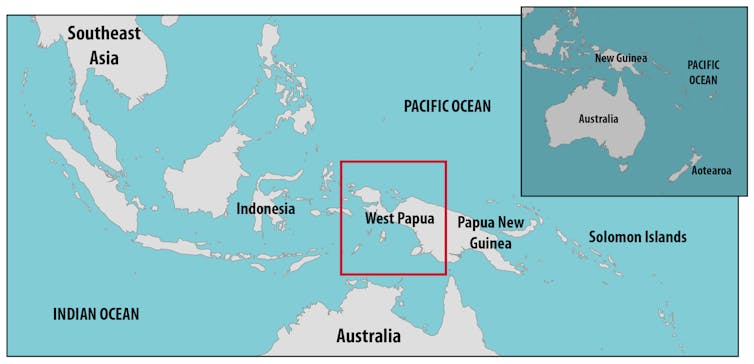
Archaeological evidence shows that people migrating from Eurasia into the Australasian region came through West Papua. Dylan Gaffney, CC BY-SA
Early seafaring and adaptation
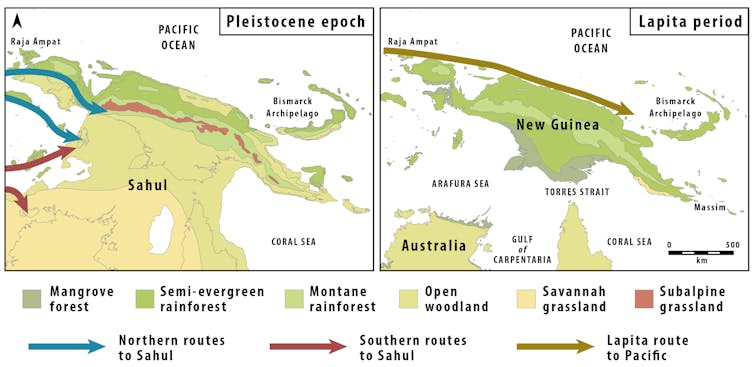
During the Pleistocene epoch (2.5 million to 12,000 years ago), West Papua was connected to Australia in a massive continent called Sahul.
Archaeological evidence from the limestone chamber of Mololo Cave shows some of the first people to settle Sahul arrived on the shores of present-day West Papua. There they quickly adapted to a host of new ecologies.
What do you need to know about this election?
The precise date of arrival of the first seafaring groups on Sahul is debated. However, a tree resin artefact from Mololo has been radiocarbon dated to show this happened more than 50,000 years ago.
Genetic analyses support this early arrival time to Sahul. Our work suggests these earliest seafarers crossed along the northern route, one of two passages through the Indonesian islands.
Human dispersal to West Papua during the Pleistocene epoch (about 50,000 years ago) and during the Lapita period (more than 3,000 years ago). Dylan Gaffney, CC BY-SA
Interestingly, the first migrants carried with them the genetic legacy of intermarriages between our species, Homo sapiens, and the Denisovans, a now extinct species of hominins that lived in eastern Asia. Geneticists currently dispute whether these encounters took place in Southeast Asia, along a northerly or southerly route to Sahul, or even in Sahul itself.
In the same way modern European populations retain about 2% of Neanderthal ancestry, many West Papuans retain about 3% of Denisovan heritage.
As the Earth warmed at the end of the Pleistocene, rising seas split Sahul apart. The large savannah plains that joined West Papua and Papua New Guinea to Australia were submerged around 8,000 years ago. Much of West Papua’s southern and western coastlines became islands.
Social transformations during the past 10,000 years
As environments changed, so did people’s cuisine and culture.
We know from sites in Papua New Guinea that people developed their own agricultural systems between 10,000 and 6,000 years ago, at a similar time to innovations in Asia and the Americas. However, agricultural systems were not universally adopted across the island.
New chemical evidence from human tooth enamel in West Papua shows people retained a wide variety of diets, from fish and shellfish to forest plants and marsupials.
One of the key unanswered questions in West Papua’s history is when cultivation emerged and how it spread into other regions, including Southeast Asia. Taro, bananas, yams and sago were all initially cultivated in New Guinea and have become important staple crops around the world.
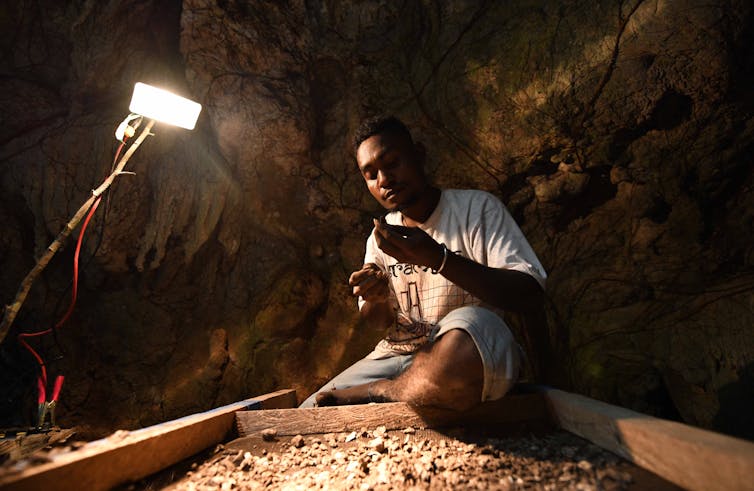
Moses Dialom, an archaeological fieldwork collaborator from the Raja Ampat Islands, examines excavated artefacts at Mololo Cave. Tristan Russell, CC BY-SA
The arrival of pottery, some 3,000 years ago, represents movements of new people to the Pacific. These are best illustrated by iconic Lapita pottery, recorded by archaeologists from Papua New Guinea all the way to Samoa and Tonga.
Lapita pottery makers spoke Austronesian languages, which became the ancestors of today’s Polynesian languages, including Māori.
New pottery discoveries from Mololo Cave suggest the ancestors of Lapita pottery makers existed somewhere around West Papua. Finding the location of these ancestral Lapita settlements is a major priority for archaeological research in the territory.
Rock paintings provide evidence of social change in West Papua. Tristan Russell, CC BY-SA
Other evidence for social transformations includes rock paintings and even bronze axes. The latter were imported all the way from mainland Southeast Asia to West Papua around 2,000 years ago. Metal working was not practised in West Papua at this time and chemical analyses show some of these artefacts were made in northern Vietnam.
At all times in the past, people had a rich and complex material culture. But only a small fraction of these objects survive for archaeologists to study, especially in humid tropical conditions.
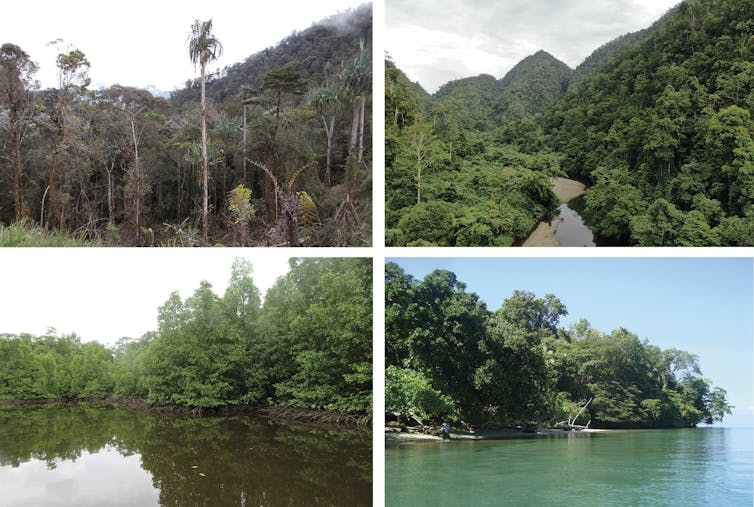
People settled diverse environments around West Papua, including montane cloud forests (upper left), lowland rainforests (upper right), mangrove swamps (lower left) and coastal beaches (lower right). Dylan Gaffney, CC BY-SA
Living traditions and the movement of objects
From the early 1800s, when West Papua was part of the Dutch East Indies, colonial administrators, scientists and explorers exported tonnes of West Papuan artefacts to European museums. Sometimes the objects were traded or gifted, other times stolen outright.
In the early 1900s, many objects were also burned by missionaries who saw Indigenous material culture as evidence of paganism. The West Papuan objects that now inhabit museums in Europe, America, Australia and New Zealand are connections between modern people and their ancestral traditions.
Sometimes these objects represent people’s direct ancestors. Major work is currently underway to connect West Papuans with these collections and to repatriate some of these objects to museums in West Papua. Unfortunately, funding remains a central issue for these museums.
Many West Papuans continue to produce and use wooden carvings, string bags and shell ornaments. Anthropologists have described how people are actively reconfiguring their material culture, especially given the presence of new synthetic materials and a cash economy.
A montage of images showing West Papuan archaeologists in the field. (A) Klementin Fairyo, left, is setting up a new excavation. (B) Martinus Tekege excavating pottery. (C) Sonya Kawer with wartime archaeology. (D) Abdul Razak Macap, right, sieving for archaeological artefacts at Mololo Cave. Klementin Fairyo, Martinus Tekege, Sonya Kawer, Abdul Razak Macap, CC BY-SA
Despite our new findings, West Papua remains an enigma for researchers. It has a land area twice the size of Aotearoa New Zealand, but there are fewer than ten known archaeological sites that have been radiocarbon dated.
By contrast, Aotearoa has thousands of dated sites. This means West Papua is the least well researched part of the Pacific and there is much more work to be done. Crucially, Papuan scholars need to be at the heart of this research.
Widespread protests in Indonesia erupted across the country in response to the government’s controversial revision of the 2004 Indonesian Armed Forces Law. Student-led demonstrations in various cities have been met with forceful responses from security forces, raising serious concerns about police violence, the stifling of civil society participation, and the erosion of democratic freedoms in Indonesia.
The proposed amendments to the law, which were ratified by Indonesia’s House of Representatives in March 2025, significantly expand the military’s role in civilian governance. These revisions allow active military personnel to occupy key positions in government ministries, the judiciary, and other civilian institutions, a move that activists argue undermines the country’s young democracy. Furthermore, the changes include a shift towards a more significant military influence on civilian affairs, which critics claim is reminiscent of Indonesia’s authoritarian past under the “New Order” regime of former dictator Suharto.
Protests against the law have been widespread, with students leading the charge in cities such as Jakarta, Surabaya, Malang, and Sukabumi. Many protesters have taken to the streets dressed in black, with banners reading “Return the military to the barracks” and “Watch out! New ‘New Order’ is right before our eyes.” Activists argue that the amendments are a direct threat to the progress Indonesia has made since the fall of Suharto’s military dictatorship in 1998. Human Rights Watch senior researcher Andreas Harsono voiced concerns that the law’s passage without proper public consultation further signals a regression in Indonesia’s democratic trajectory.
The protests, while largely peaceful, have been met with violent responses from security forces. In Malang, East Java, clashes broke out when police deployed riot squads and water cannons to disperse crowds. Several students were injured, and at least eight journalists were reportedly assaulted while documenting the protests. Similar scenes unfolded in other cities, with police using force to break up demonstrations, leading to injuries, detentions, and allegations of human rights abuses (see video below, source: Instagram). Notably, in Sukabumi, police detained several students and accused them of instigating violence.
Beyond physical violence, there have been instances of intimidation aimed at protest leaders. In Yogyakarta, a threatening banner was placed near a university campus, targeting one of the student leaders. This intimidation, both physical and digital, signals an alarming trend of suppressing dissent and limiting space for civil society to engage in political processes.
One of the most pressing concerns raised by activists is the government’s failure to adequately consult with the public or allow space for meaningful civil society participation in the amendment process. Critics argue that the law was rushed through parliament without sufficient debate and that the military’s increasing involvement in civilian affairs will undermine Indonesia’s democratic foundations. Furthermore, the law could open the door to greater military influence in sectors unrelated to defence, including business and governance, echoing the tactics used during the New Order era.
While the government, including Defense Minister Sjafrie Sjamsoeddin, insists that the reforms are necessary to adapt to changing global military dynamics, activists and students argue that these changes endanger fundamental democratic principles. They fear the expansion of the military’s role in civilian governance may reduce the space for free expression, undermine civilian supremacy, and set back the country’s progress toward democracy.
The Indonesian government’s handling of the crisis—especially its treatment of protesters and the military’s expanding role in government—poses a significant challenge to the nation’s democracy. The events of recent weeks underscore the urgent need for reform, transparency, and respect for human rights, particularly in the context of any changes to laws that impact the nation’s future governance. Following the hasty amendment of the law and the increasing role of the military in civilian matters, there is an urgent need to also revise Military Court Law 31/1997, so that TNI members can be tried in civilian courts if they are accused of having committed violent acts against civilian victims.
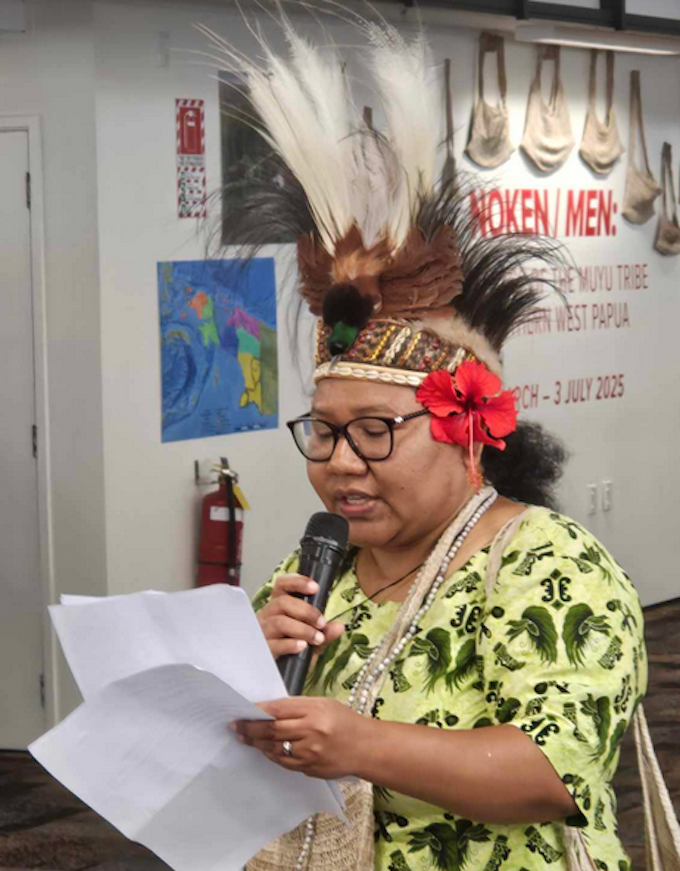
A West Papuan doctoral candidate has warned that indigenous noken-weaving practices back in her homeland are under threat with the world’s biggest deforestation project.
About 60 people turned up for the opening of her “Noken/Men: String Bags of the Muyu Tribe of Southern West Papua” exhibition by Veronika T Kanem at Auckland University today and were treated to traditional songs and dances by a group of West Papuan students from Auckland and Hamilton.
The three-month exhibition focuses on the noken — known as “men” — of the Muyu tribe from southern West Papua and their weaving cultural practices.
It is based on Kanem’s research, which explores the socio-cultural significance of the noken/men among the Muyu people, her father’s tribe.
“Indigenous communities in southern Papua are facing the world’s biggest deforestation project underway in West Papua as Indonesia looks to establish 2 million hectares of sugarcane and palm oil plantations in the Papua region,” she said.
West Papua has the third-largest intact rainforest on earth and indigenous communities are being forced off their land by this project and by military.
The ancient traditions of noken-weaving are under threat.
Natural fibres, tree bark Noken — called bilum in neighbouring Papua New Guinea — are finely woven or knotted string bags made from various natural fibres of plants and tree bark.
“Noken contains social and cultural significance for West Papuans because this string bag is often used in cultural ceremonies, bride wealth payments, child initiation into adulthood, and gifts,” Kanem said.
“This string bag has different names depending on the region, language and dialect of local tribes. For the Muyu — my father’s tribe — in Southern West Papua, they call it ‘men’.
In West Papua, noken symbolises a woman’s womb or a source of life because this string bag is often used to load tubers, garden harvests, piglets, and babies.
“My research examines the Muyu people’s connection to their land, forest, and noken weaving,” said Kanem.
“Muyu women harvest the genemo (Gnetum gnemon) tree’s inner fibres to make noken, and gift-giving noken is a way to establish and maintain relationships from the Muyu to their family members, relatives and outsiders.
“Drawing on the Melanesian and Indigenous research approaches, this research formed noken weaving as a methodology, a research method, and a metaphor based on the Muyu tribe’s knowledge and ways of doing things.”
Hosting pride Welcoming the guests, Associate Professor Gordon Nanau, head of Pacific Studies, congratulated Kanem on the exhibition and said the university was proud to be hosting such excellent Melanesian research.
Professor Yvonne Underhill-Sem, Kanem’s primary supervisor, was also among the many speakers, including Kolokesa Māhina-Tuai of Lagi Maama, and Daren Kamali of Creative New
The exhibition provides insights into the refined artistry, craft and making of noken/men string bags, personal stories, and their functions.
An 11 minute documentary on the weaving process and examples of noken from Waropko, Upkim, Merauke, Asmat, Wamena, Nabire and Paniai was also screened, and a booklet is expected to be launched soon.






 Australia West Papua Association Adelaide