Indonesia prepares 1 mln hectares for sugar factories in Papua
Jakarta (ANTARA) – The government is preparing one million hectares of land in Papua for investors interested in building sugar factories to help Indonesia achieve sugar self-sufficiency, Agriculture Minister Andi Amran Sulaiman said on Tuesday.
“With one million hectares of land, we can attract a lot of companies. One sugar factory may need 20 to 40 hectares of land with a capacity of 12,000 tons of cane per day (TCD),” Sulaiman said after a meeting with President Joko Widodo (Jokowi) in Jakarta.
He added that the government will not limit the number of domestic and foreign investors planning to build sugar factories in Indonesia.
“Yes, it is included in our sugar self-sufficiency plan. We can reach the target if we can build 20 to 30 sugar factories with a capacity of 12,000 TCD,” Sulaiman continued.
He estimated that up to Rp3 trillion (around US$192.7 million) would be needed to build one sugar factory with a capacity of 12,000 TCD.
Claiming that there are companies that have started planting sugarcane in Papua, Sulaiman said that Indonesia’s journey toward sugar self-sufficiency will still take a long time since sugarcane is an annual plant whose seedlings need to be cultivated in stages.
“Sugarcane is an annual plant with several processing stages. It also requires pure and superior seedlings from the beginning of the process,” he added.
Besides the need to adapt to the local agricultural climate, the stages of planting sugarcane seedlings can take more than three years, Sulaiman said.
He added that, to boost sugar production, sugar factories in Papua are expected to be built using modern technology.
“In India, sugar production can reach 150 tons per hectare, whereas in Indonesia it can only reach 60–70 tons. The most important thing is the high-quality seedlings, which can produce a minimum yield of 100 tons per hectare,” he disclosed.
On the Global Day of Action for Climate Justice, the Merdeka West Papua Support Network joins all climate justice activists worldwide and stands together at a pivotal moment in our shared pursuit of a sustainable, healthy and better planet and future.
Central to this movement is the essential recognition and urgent reminder that climate justice cannot be achieved while lands are occupied, Indigenous Peoples are oppressed, and fundamental human rights are trampled upon.
The demand for climate justice is particularly stark in West Papua, a region abundant in ecological diversity and cultural heritage, yet marred by the grips of exploitation and occupation.
Occupied West Papua
Indigenous peoples in West Papua suffer from a never-ending string of human rights abuses, stemming from decades of political and economic conflict that have loomed over the region since the 1960’s.
In a sham referendum ironically called “The Act of Free Choice” (1969), the military orchestrated the formal annexation of West Papua into Indonesia—a move widely condemned for its lack of legitimacy and considered an illegal land grab. This so-called plebiscite involved a minuscule fraction of the West Papuan populace handpicked by the military to vote for integration with Indonesia under duress, facing the threat of violence.
Subsequent decades saw the Indonesian government forcibly changing the region’s demography through its transmigration program. The government drew thousands of people from other parts of the country to become settlers in the area, which resulted in a dwindling population of Indigenous Papuans on their ancestral lands, death tolls, and massive displacement.
A Culture of Impunity and Widespread Human Rights Violations
According to reports, patterns of violations continue to differ from other parts of Indonesia strongly showing the highest cases of extrajudicial killings, arbitrary arrests, and criminalization.
Persistent attacks against human rights, Indigenous Peoples and environmental defenders and political activists contiue. For instance, Papuan activist Victor Yeimo faced an extended sentence and three university students were convicted of treason.
Furthermore, a culture of impunity abounds and allows those in power to evade accountability for enforced disappearance and extra-judicial killings. Case in point: Despite fatally shooting Papuan men Eden Bebari and Ronny Wandik in 2020, military members not only received light sentences but were later acquitted this year.
West Papua’s Integral Role in Battling the Climate Crisis
The state forest in West Papua spans a staggering 38.15 million hectares (94.27 million acres). Together with Papua New Guinea, it stands as the third-largest repository of ancestral tropical forests globally, trailing behind only the Amazon and the Congo.
Unfortunately, roughly 8.13 million hectares (20.09 million acres) of customary forests in Papua are controlled by companies and investors, a reality facilitated by the government and, essentially, protected by the military. Thus, the ancestral forests endure repetitive and reckless logging, without concern for environmental impacts.
The ongoing deforestation contradicts the claims of the current administration, led by Jokowi government, professing support for forest conservation efforts. The government prioritizes bolstering ties with foreign investors and multinational companies, rather than engaging and consulting with indigenous people—who rightfully hold custodianship and possess the knowledge needed to safeguard the forest.
The exact numbers vary, but recent research shows that nearly half of the Earth’s land is under the governance of indigenous communities, supporting roughly 80% of the planet’s biodiversity. This underscores the effective role of indigenous communities as longstanding defenders of nature across generations.
Moreover, the forests situated on indigenous territories globally store a total of 37.7 billion tons of carbon, significantly contributing to stabilizing the Earth’s climate. In West Papua, specifically, a remarkable array of diverse and unique ecosystems exists—from glaciers, alpine meadows, cloud forests, and karst lakes, to savannahs, mangrove forests, coral reefs, and more.
Urgent Need for Solidarity and Action
The tropical forests of West Papua embody both ecological wonders and untapped potential in combating climate change. However, their boundless capabilities remain suppressed amid the grip of military fascism and corporate greed. Only with the liberation of West Papua can we unlock the region’s true potential, leveraging its capacity to safeguard biodiversity, and forge a sustainable future for generations.
Upholding the West Papuan’s and all Indigenous Peoples right to self-determination means taking bold actions for sustainable environmental stewardship. By confronting the systemic injustices faced by indigenous communities and the imperialist encroachment of rich countries over indigenous land and resources, we can address intrinsic link between climate justice, human rights, and liberation.
The liberation of West Papua is a global imperative in our shared pursuit of justice. As we mark this Global Day of Action for Climate Justice, let us recommit ourselves to amplify our call: Climate Justice is Indigenous Justice! Papua Merdeka!
Jakarta — The Ministry of Environment and Forestry (KLHK) has ensured that thousands of illegal oil palm companies operating in forest area have been exonerated or legalised thanks to the Omnibus Law on Job Creation.
“More than 1,000 companies according to national data [have been included in the legalisation list]”, said the Director General of Forestry and Environmental Plantology (PKTL), Hanif Faisol Nurofiq, when speaking to reporters in South Jakarta on Wednesday November 22.
Nurofiq explained that thousands of companies had been given time to meet administrative requirements as stipulated under Article 110A of the law. The government gave companies until November 3 to complete or fix the administrative requirements.
Under Article 110A of the Jobs Law it states that, “Companies that are already operating in forest areas, but have a business license, can continue their activities as long as they complete all requirements within a maximum period of three years”.
Nurofiq said that if palm oil companies do not complete the administrative requirements, then they will be subject to fines.
He said that the fines are stipulated under a derivative regulation namely Government Regulation Number 24/2021 on Procedures for the Imposition of Administrative Sanctions and Non-Tax State Revenue from Administrative Fines in the Forestry Sector.
Nevertheless, Nurofiq emphasised that the legalisation process does not apply to companies in conservation forest area.
“So if everything is resolved, there is [legal] certainty, except in conservation areas that are not allowed, they must leave”, he said.
Earlier, Coordinating Minister for Maritime Affairs and Investment Luhut Binsar Panjaitan said the government had been forced to legalise 3.3 million hectares of oil palm plantations operating in forest area as stipulated under the Jobs Law.
“Yeah, what else could we do, should we have revoked [their licenses], no, use your logic, yeah, we legalised them. We were forced to”, said Pandjaitan during a press conference in Jakarta on Friday June 23.
The articles used under the Jobs Law referred to by Pandjaitan are Articles 110A and 110B. Under this policy, companies who have already established business activities in forest areas can apply for release or legalisation. (yla/pmg)
Notes
Despite a 2013 law on forest degradation that prohibits activities such as palm oil cultivation and mining in forest areas, thousands of companies have illegally cleared forests and established palm oil plantations. Illegal plantations are estimated to cover some 3.37 million hectares — an area the size of the Netherlands — and account for a significant portion of palm oil production in Indonesia. Instead of requiring that the companies cease operations and restore the cleared forest, the amnesty scheme introduced through the Jobs Law in 2020 gave illegal plantations a grace period of three years to obtain the proper permits, have the area officially rezoned as a non-forest, and after paying the requisite fine resume operations.
[Translated by James Balowski. The original title of the article was “Ribuan Perusahaan Sawit Ilegal Diputihkan Berkat UU Cipta Kerja”.]
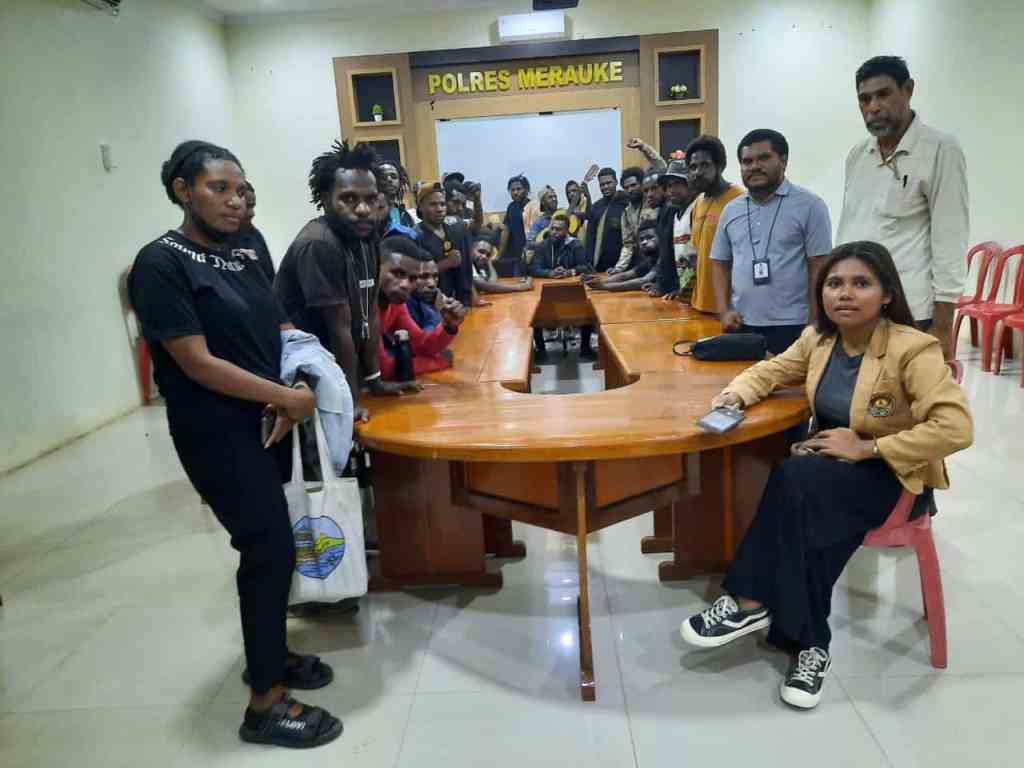
Protesters who were secured at the Merauke Police Station on Saturday (18/11/2023) during a peaceful demonstration in support of the Awyu indigenous people.-Dok AMPERA PS.
Jayapura, Jubi – Several civil coalitions expressed dismay over the apprehension of 20 individuals associated with the South Papua People’s Student Alliance (AMPERA PS) by Merauke Police on November 18, 2023.
The arrests occurred during a peaceful demonstration aimed at extending support to the Awyu indigenous community’s struggle for their ancestral lands against corporate encroachment in the Boven Digoel district.
Ayub Paa, an environmental activist from Greater Sorong, lamented the heavy-handed approach of the police in detaining demonstrators who sought to exercise their freedom of speech supporting Hendrikus Woro’s legal challenge against the Decree issued by the Head of the One-Stop Integrated Investment and Service Office (DPMPTSP) of Papua Province No. 82/2021, pertaining to environmental feasibility permits.
“We deeply regret the disruption of the peaceful protest intended to convey support for Hendrikus Woro. This could potentially lead to Hendrikus Woro’s ancestral lands and forests falling into the hands of a corporation, despite their lack of involvement in relinquishing customary rights or accepting funds for the acquisition of Woro clan’s ancestral lands,” expressed Ayub Paa in a press release received by Jubi on Sunday (11/19/2023).
Tasya Manong, spokesperson for the Alliance of Youth Students Caring for Forests and Indigenous Peoples’ Rights (AMPERAMADA) Papua, criticized the security forces for dispersing the protest and detaining individuals.
“Our fellow demonstrators sought a peaceful demonstration, yet they were dispersed and taken into custody at the Merauke Police station. Despite our rights as citizens being safeguarded by the constitution and other legal frameworks, they were subjected to this treatment. Did they cause any disruption? No. This severely undermines democracy and human rights,” said Tasya Manong. (*)
——————-
) Police disperse peaceful protest advocating indigenous rights in South Papua
News Desk – Freedom Of Expression In Papua
21 November 2023
Jayapura, Jubi – In Merauke Regency of South Papua Province, the local police disbanded a peaceful rally on Saturday (18/12/2023), detaining 20 demonstrators who were advocating for the Awyu indigenous people who embroiled in a legal dispute at the Jayapura State Administrative Court.
The protest, organized by the South Papua Student, Youth, and Advocates for the Traditional Lands Alliance (Ampera PS), aimed to highlight the Awyu indigenous people’s plight,
The dispersal of the rally and subsequent arrests faced opposition from the Legal Aid Institute of Papua (LBH Papua). According to LBH Papua Director Emanuel Gobay, Ampera PS had notified the Merauke Police about the demonstration in advance, suggesting that the police should not have intervened.
“LBH Papua views the police’s actions as a breach of Law Number 9 of 1998 regarding freedom of expression,” said Gobay, highlighting the discrepancy between the police’s duties as law enforcers and their handling of the situation.
Gobay, in a press release on Saturday (18/11/2023), condemned the arrests as an abuse of authority, citing Government Regulation Number 2 of 2003 on Disciplinary Regulations for Members of the Indonesian National Police. He further accused the Merauke Police Chief and staff of stifling democratic space, violating National Police Chief Regulation No. 8 of 2009 that outlines human rights principles in police duties.
LBH Papua urged the Papua Police Chief and the Governor of South Papua to instruct the Merauke Police Chief to release the detained Ampera PS protesters. Gobay emphasized the legitimacy of the rally under democratic mechanisms guaranteed by the Freedom of Expression Law, urging swift action for their release. (*)
Jayapura, Jubi – Students and indigenous advocates protested at the Southwest Papua Forestry Office in Jayapura’s Kilo 7 on Monday (13/11/2023), pleading to the Indonesian Minister of Environment and Forestry to revoke the licenses issued to PT Mancaraya Agro Mandiri and PT Hutan Hijau Papua Baratfor forest exploitation.
The spokesperson and action coordinator, Yordan Malamuk, articulated the collective sentiment of 27 indigenous sub-tribes and clans whose custodial rights extend over these lands.
Malamuk staunchly urged the head of the environment and forestry office in Southwest Papua to uphold their aspirations and repel the intrusion of these companies into their ancestral domains.
“As custodians of these lands, we emphatically reject and oppose any operational endeavors by PT Mancaraya Agro Mandiri and PT Hutan Hijau Papua Barat within our ancestral territories,” said Malamuk.
Malamuk highlighted the staggering scope of land encompassed by PT Mancaraya Agro Mandiri (97,529 hectares) and PT Hutan Hijau Papua Barat (92,158 hectares) within the customary territories of the Moi Tribe, spanning Sorong Regency, Maybrat Regency, and South Sorong Regency in Southwest Papua Province.
The primary concern resonated around the imminent impact on sacred ancestral sites and vital ecological habitats, prompting an ardent defense of the remaining customary lands and forests for the betterment of present and future generations.
Esau Klagilit, the Chairperson of the Papua Indigenous Youth of the Archipelago, echoed the urgency of the situation, appealing to the environmental office to swiftly align with the aspirations voiced by indigenous youth. Klagilit underscored the profound threat posed by these companies to the indigenous community inhabiting the Salkam area and urged the immediate intervention of local government to direct the community’s concerns to the central government.
The collective outcry during the demonstration voiced numerous apprehensions, flagging the presence of PT Hutan Hijau West Papua within the community’s customary territory as a dire menace to societal harmony. Concerns extended to the predicted loss of forests, biodiversity, and habitats, foundational to the sustenance and cultural fabric of indigenous peoples.
Moreover, there was palpable anxiety about the potential repercussions of these corporations’ activities, namely deforestation in indigenous territories leading to global warming and the erosion of environmental integrity, irreparably damaging the cherished and sacred cultural values deeply interwoven with customary forests. (*)
Jakarta — Senior economist Faisal Basri has testified that he once met with the Coordinating Minister for Maritime Affairs and Investment Luhut Binsar Pandjaitan (Menko Marves) and warned him of a potential conflict of interest related to the coal extractive industry.
This was conveyed by Basri when he was presented as an expert witness during a hearing at the East Jakarta District Court on Monday October 30 in the trial of human rights activists Haris Azhar and Fatia Maulidiyanti who are defendants in a case of defamation against Pandjaitan.
“I once met with Pak [Mr] Luhut, I said that his problem is just one, namely a conflict of interest. The Pak minister manages the extractive industry, his policies have the potential to create a conflict of interest”, Basri said before the panel of judges presided over by Judge Cokorda Gede Arthana.
Faisal gave an illustration of this saying that in 2022 revenue from coal was worth more than 1,000 trillion rupiah, reaching a quarter of the total revenue from Indonesia’s exports. This increase was in the context of the war between Russia and Ukraine.
“And 100 percent of this windfall income was enjoyed by the coal tycoons. None was taken by the state [in taxes]”, said Basri.
Basri said that countries like the United States, Australian and all of the countries in the European Union apply tax policies on such “fallen durian” (windfalls). Moreover, he continued, Mongolia applies a 70 percent tax for the state on coal income.
“I proposed to the Menko Marves, the Menko Perekonomian [Coordinating Minister for Economic Affairs], the ESDM [Energy and Mineral Resources] Minister and so on that we use a ‘fallen durian’ tax”, said Basri.
“The minister [Pandjaitan] said, ‘Oh, that would be great too, yes.
Later I’ll talk to the finance minister’, Pak Luhut said to me”, added Basri.
“But, to this day there’s been nothing, because I forgot that Pak Luhut has coal [interests]. So, it was a conflict of interest that was so very real. I met with the person concerned personally, Your Honor”, he reiterated.
Aside from the tax incentive, Basri gave another example of a conflict of interest related to the extractive industry, namely revisions to regulations and laws (UU).
“[Tax incentives], among others, there are still many more. ‘I have power, I have a big influence on revisions to the law. I revised the law in the process at the DPR [House of Representatives] with a quick process so that when my coal [mining contract] expired the concession period could be automatically renewed until the coal is used up'”, said Basri.
“What law was that?”, asked Azhar and Maulidiyanti’s lawyer Nurkholis Hidayat.
“The Minerba [Mineral and Coal Mining] Law”, replied Basri.
Basri added that coal dust has created pollution and threatens people’s health.
“Coal creates pollution, emits dust. Before it was categorised as dangerous waste. The new law, the Omnibus [Law on Job Creation], removed it from the list of dangerous waste so it was no longer considered dangerous, Your Honor”, said Basri.
“My God, Your Honors, I couldn’t imagine a [legal] revision process that was so very fast, in a short space of time the law was issued in the interests of a handful of people”, he concluded.
Azhar and Maulidiyanti have been indicted under Article 27 Paragraph 3 in conjunction with Article 45 Paragraph 3 of the Information and Electronic Transaction (ITE) Law, Article 14 Paragraph 2 and or Article
15 of Law Number 1/1946, and Article 310 of the Criminal code (KUHP).
Each of these articles are in conjunction with Article 55 Paragraph 1 of the KUHP.
A number of witnesses have appeared since the trial began, including Pandjaitan who testified before the panel of judges. Azhar and Maulidiyanti meanwhile have refused to testify against each other.
(ryn/wis)
[Translated by James Balowski. The original title of the article was “Sidang Haris-Fatia, Faisal Basri Akui Pernah Bertemu & Ingatkan Luhut”.]
Hayamuddin — On September 7 residents and security forces clashed on the island of Rempang, Riau province, after local people attempted to stop the authorities from conducting land measurements and boundary marking for the Eco City development project.
Residents blocked the main road spanning the island using trees and burning tyres as makeshift barricades. Police responded by firing teargas into the crowd with some landing in a nearby school, resulting several children suffering from teargas inhalation. Police detained at least eight demonstrators following the incident.
In 2001 plans emerged to turn Rempang Island in Riau province into an industrial and tourism area supported by a free trade zone and free port policy as part of the Batam City Industrial Area Development Project, which was awarded to the company PT Makmur Elok Graha (Meg) on May 17 2004.
Prior to this, in 1986 under Forestry Minister Sujarwo, Rempang Island was declared a conservation area but without any consultation or inspection on the ground, so the island was deemed to be uninhabited.
A new policy in 1992 established that Rempang Island, Galang Island and the surrounding islands were to be included in the Batam Island Industrial Region as a Bonded Zone. This reaffirmed the assumption that there were no local communities living on Rempang Island or that they were not of any concern. As a consequence there was no policy for the relocation of local residents or compensation mechanisms.
Following this in 1999, residents of Galang sub-district on Rempang Island were given the opportunity to become part of the administration of the Batam City municipal government, but this still did not resolve the problem because the communities there were still not recognised because as did not have legal claim over land that had occupied for generations.
In late 2022 a meeting was held between the Batam Free Trade Zone Authority (BP Batam) and Rempang residents at the Tg Kertang Bridge Four Village on Rempang Island, at which the BP Batam explained about the planned Rempang Eco City construction project that would be carried out by PT Mega.
The mega project was to be part of the government’s so-call agrarian reform program known as TORA (Agrarian Reform Land Object), which would be registered by the government by requesting land right certificates from Galang sub-district residents.
In the second period of the process PT Meg conducted aggressive lobbying with relevant ministries in order to get support to accelerate the project, which became easier after a decree was issued designating the project as a strategic national project (PSN).
If we go back a few years following the 1965 mass killings that brought Suharto’s New Order dictatorship into power, land gabbing had become common in many parts of Indonesia. This was in line with Suharto’s move to forge a close relationship with the US imperialist state, which had backed Suharto’s seizure of power and the removal of Indonesia’s leftist founding president Sukarno.
And of course in order to pay back this debt of gratitude, the US was allowed to force its way deeper into Indonesia’s economy though capital exports such as funding development programs in an effort to increase its grip on and in the end be freer to monopolise the economy. By this time land grabs were being carried out though a militaristic approach.
Suharto was overthrown in 1998, but the ideology of developmentalism
(pembangunanisme) continued to dominate in Indonesia. In 2004 the World Bank issued a document titled “Bad Infrastructure Hampers Indonesia’s Economic Growth and Poverty Alleviation Efforts”. These kinds of documents are a scenario that is always applied to control Third World countries because with large debts they can be forced to follow programs that have been determined by the imperialist countries. Thus Indonesia is encouraged to pursue infrastructure projects to support the smooth circulation of capital throughout the country.
The implementation of this on the ground began in 2004 during the era of President Susilo Bambang Yudhoyono (SBY) with the Master Plan for the Acceleration and Expansion of Indonesia’s Economic Development (MP3EI).
Put roughly, the World Bank said that if Indonesia wants to maintain economic stability it must improve the state of its infrastructure.
Since the late 80s Indonesia has adopted the model of public-private partnership schemes (PPP). Under these schemes, infrastructure development is no longer funded by the government but is instead handed over to the private sector or investors. For these investors it becomes a kind of bolu kukus (steamed sponge cake) that is soft and delicious because they can do as they like when investing in Indonesia.
Meanwhile the government’s role in facilitating projects is taking responsibility for the acquisition of land, which can be done by means of forced mediation or forced evictions, as was the recent case in Rempang.
The authority of national strategic projects has been further strengthened by the enactment of the widely unpopular Omnibus Law on Job Creation, which provides strong “legal certainty” for the acquisition of land for the benefit of capitalistic projects in Indonesia.
The law also saw the establishment of a Land Bank. In normative terms this institution guarantees the availability of land through the concept of economic fairness for public, social and national development interests, economic equality, land consolidation and agrarian reform.
This however is only on paper. In practical terms, the hidden goal of land banks is to facilitate the process of land acquisition for investment, both in the name of development for the public interest and economic growth, as well as facilitating the process of the privatising state land. Land controlled by the land bank is given the status of the Land Management Rights (HPL).
The implication of this is the privatisation and commercialisation of state land (something prohibited in the 1960s), and the avoidance of corruption in the use of state land, and the strong potential to displace people from their land, who de facto are occupying or living on state land. Thus people can be evicted on legal grounds.
I order to fight the people’s oppressors, there needs to be a systematic and organised movement. Starting from educating young people, and this education must also be populist in accordance with the definitions and desires of the people. The ordinary people must build for themselves what they want without interference from the corrupt government.
With that also, when young people understand who the real enemy is that is trampling on and grabbed their parents’ necks, and forcibly taking their land, then young people will be two or three steps closer to an organised people’s movement.
Then there is a need for solidarity from the working class, students and other elements of the oppressed people in every part of Indonesia so that it can pressure the government to withdraw all military and police forces from Rempang (as well as Wades and other areas where people are threatened with eviction) and provide the rights that should be afforded to the residents of Rempang Island such as land ownership and the right for the indigenous people on Rempang to control, regulate, manage and utilise their customary lands and all natural resources within it.
— Hayamuddin is a member of the Socialist Study Circle, which is affiliated with the Socialist Union (Perserikatan Sosialis).
[Translated by James Balowski. Two paragraphs at the beginning of the article were added to provide context for non-Indonesian readers. The original title of the article was “Rempang, Pembangunanisme dan Konsep Ekonomi Politik Rezim Paska Reformasi 1998”.]




 Australia West Papua Association Adelaide