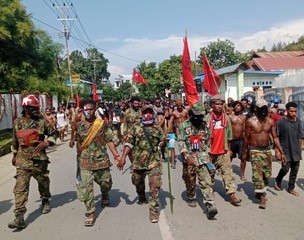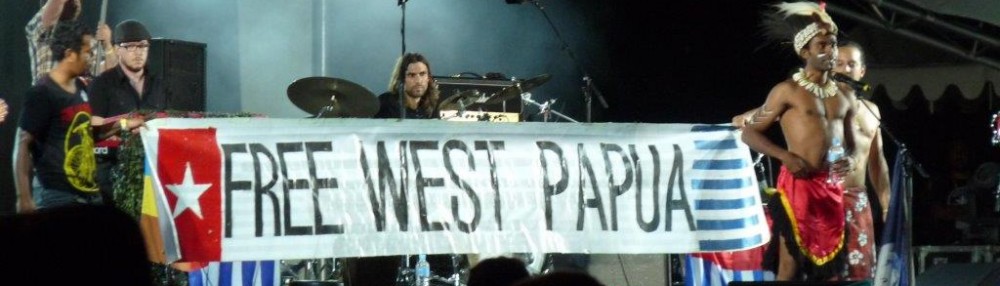
Peaceful rallies planned in West Papua for 15 August. The New York Agreement . Activists already intimidated

The 15 August   marks  62 years since The New York Agreement and West Papuans  are still suffering  under Indonesian colonial rule. Yes, most of the world recognises Indonesian sovereignty over West Papua at this stage but most also would recognise that the so called act of free choice in 1969 was a sham.

The New York Agreement

In August 1962, an agreement was concluded in New York between the Netherlands and Indonesia. Under this agreement, the Dutch were to leave West New Guinea and transfer sovereignty to UNTEA (the United Nations Temporary Executive Authority). After 7 months the UN transferred power to Indonesia with the provision that a referendum be held to determine Papuan preference for independence, or integration with Indonesia. 

The New York Agreement was a betrayal of the West Papuan people. 

President Thomas Wilson said  “ …that no right anywhere exists to hand peoples about from sovereignty to sovereignty as if they were property”

Joe Collins of AWPA said, “and this is exactly what happened to the West Papuan people. Handed over by one colonial power, The Netherlands to another, Indonesia with a short administration period by the UN as a face-saving compromise for the Dutch and the international community”.

The West Papuan National Committee  ( KNPB) has called for West Papuans to come out and peacefully protest this betrayal and have been handing out flyers (on the 13 August) to inform about the upcoming rallies on the 15 August. 

In an act of  intimidation up to 60 activists were taken by the police to the Doyo police Station in Sentani. 

Joe Collins said ,” this is to intimate civil society groups into not taking part in the proposed rallies on the 15 August.  Hopefully, there will not be a repeat of previous years where  the security forces have cracked down in their usual heavy-handed approach on  peaceful demonstrators”.

Photos posted on AWPA FB Page. (KNPB informing public about upcoming rallies).

 “ West Papuan civil society groups regularly hold events and rallies on days of significance in their history,  to try and bring attention to the world, of the injustices they suffer under Indonesian rule. And this is what Jakarta fears most , international scrutiny  on the ongoing human rights abuses in the territory”.

Also of concern is that the 17 August is Indonesian Independence Day.

The Indonesian Security  forces can use the day to take propaganda  photos of Papuans supporting their Independence day. It is now 5 years since the West Papua uprising when thousands of West Papuans took to the streets in all the major cities and towns across West Papua.  The demonstrators were  protesting against the arrest and racial abuse against West Papuan students in Surabaya, Indonesia.

The arrest of 43 students in Surabaya occurred because it had been reported that an Indonesian flag had been vandalised near the students dormitory.

At the time, The Jakarta Post (19 August) reported that security personnel and members of Indonesian organisations launched physical and verbal attacks on the Papuan students accusing them of refusing to celebrate Indonesia’s 74th Independence Day, and that an “angry mob arrived at the dormitory after they found a discarded Indonesian flag near the building. During the incident, they reportedly threw stones at the dormitory while shouting racial abuse and chanting “Kick out the Papuans!” and “Slaughter the Papuans!” 

The mob also called the students monkeys, pigs and dogs, shouting “don’t you come out. We are waiting for you here”.  As they stormed the building the Police fired tear gas into the building and arrested 43 students. The students were later released after questioning. They had denied any knowledge of the damaged flag. However, this incident triggered rallies across West Papua in a show of support for the students and in protest against the discrimination and injustices that West Papuans suffer daily under Indonesia rule.

It is estimated that up to 60 people died , including 35 indigenous West Papuans  and  hundreds injured with  over 20,00 civilians displaced during the Uprising period. 

Joe Collins said, “hopefully this year the Indonesian security forces  will allow the West Papuan people  to hold their peaceful rallies without interference . 

“Canberra,  along with the two regional organisations , the  Melanesian Spearhead Group (MSG) and the Pacific Islands Forum (PIF)  should be strongly  urging Jakarta to allow the UN High Commissioner for Human Rights to visit West Papua to investigate the human rights situation in the territory. Jakarta should also be urged to allow  a joint PIF- MSG fact finding mission to the territory”.

Ends

Report highlights misapplication of treason charges against Papuan activists

Human Rights News / IndonesiaWest Papua / 22 August 2024 

Recent findings highlight the ongoing use of treason charges to suppress peaceful activism in Papua, raising significant concerns over the infringement of fundamental human rights. A report by the Alliance for Democracy for Papua (AlDP) and Tapol, launched in Jayapura in July 2024, reveals that treason laws are frequently employed to criminalise activists advocating for Papuan rights, including those involved in anti-racism protests and commemorations of political leaders.

The research documents 52 cases where activists were charged with treason, noting that these charges are often applied broadly, disregarding the peaceful nature of the protests. Legal experts and human rights advocates argue that the treason laws, rooted in colonial-era legislation, are misapplied to suppress freedom of expression rather than addressing genuine threats to national security.

Professor Melkias Hetharia of Cenderawasih University argues that the expression of support for Papuan independence, when conducted peacefully, does not constitute treason. He emphasizes that such expressions should be protected under international human rights standards, to which Indonesia is a signatory.

The report calls for a revision of treason laws and urges the Indonesian government to respect political expression and engage in dialogue to address the underlying issues in Papua, rather than resorting to repressive legal measures that only fuel further resistance.

From Papua to Gaza, military occupation leads to ‘ecocide’ – climate catastrophe 

By APR editor –  August 14, 2024 0 7 

Environmental destruction is not an unintended side effect, but a primary objective in colonial wars of occupation.

By David Whyte and Samira Homerang Saunders

Many in the international community are finally coming to accept that the earth’s ecosystem can no longer bear the weight of military occupation.

Most have reached this inevitable conclusion, clearly articulated in the environmental movement’s latest slogan “No Climate Justice on Occupied Land”, in light of the horrors we have witnessed in Gaza since October 7.

While the correlation between military occupation and climate sustainability may be a recent discovery for those living their lives in relative peace and security, people living under occupation, and thus constant threat of military violence, have always known any guided missile strike or aerial bombardment campaign by an occupying military is not only an attack on those being targeted but also their land’s ability to sustain life.

A recent hearing on “State and Environmental Violence in West Papua” under the jurisdiction of the Rome-based Permanent Peoples’ Tribunal (PPT), for example, heard that Indonesia’s military occupation, spanning more than seven decades, has facilitated a “slow genocide” of the Papuan people through not only political repression and violence, but also the gradual decimation of the forest area — one of the largest and most biodiverse on the planet — that sustains them.

West Papua hosts one of the largest copper and gold mines in the world, is the site of a major BP liquefied natural gas (LNG) facility, and is the fastest-expanding area of palm oil and biofuel plantation in Indonesia.

All of these industries leave ecological dead zones in their wake, and every single one of them is secured by military occupation.

At the PPT hearing, prominent Papuan lawyer Yan Christian Warinussy spoke of the connection between human suffering in West Papua and the exploitation of the region’s natural resources.

Shot and wounded
Just one week later, he was shot and wounded by an unknown assailant. The PPT Secretariat noted that the attack came after the lawyer depicted “the past and current violence committed against the defenceless civil population and the environment in the region”.

What happened to Warinussy reinforced yet again the indivisibility of military occupation and environmental violence.

In total, militaries around the world account for almost 5.5 percent of global greenhouse gas emissions annually — more than the aviation and shipping industries combined.

Our colleagues at Queen Mary University of London recently concluded that emissions from the first 120 days of this latest round of slaughter in Gaza alone were greater than the annual emissions of 26 individual countries; emissions from rebuilding Gaza will be higher than the annual emissions of more than 135 countries, equating them to those of Sweden and Portugal.

But even these shocking statistics fail to shed sufficient light on the deep connection between military violence and environmental violence. War and occupation’s impact on the climate is not merely a side effect or unfortunate consequence.

We must not reduce our analysis of what is going on in Gaza, for example, to a dualism of consequences: the killing of people on one side and the effect on “the environment” on the other.

Inseparable from impact on nature
In reality, the impact on the people is inseparable from the impact on nature. The genocide in Gaza is also an ecocide — as is almost always the case with military campaigns.

In the Vietnam War, the use of toxic chemicals, including Agent Orange, was part of a deliberate strategy to eliminate any capacity for agricultural production, and thus force the people off their land and into “strategic hamlets”.

Forests, used by the Vietcong as cover, were also cut by the US military to reduce the population’s capacity for resistance. The anti-war activist and international lawyer Richard Falk coined the phrase “ecocide” to describe this.

In different ways, this is what all military operations do: they tactically reduce or completely eliminate the capacity of the “enemy” population to live sustainably and to retain autonomy over its own water and food supplies.

Since 2014, the bulldozing of Palestinian homes and other essential infrastructure by the Israeli occupation forces has been complemented by chemical warfare, with herbicides aerially sprayed by the Israeli military destroying entire swaths of arable land in Gaza.

In other words, Gaza has been subjected to an “ecocide” strategy almost identical to the one used in Vietnam since long before October 7.

The occupying military force has been working to reduce, and eventually completely eliminate, the Palestinian population’s capacity to live sustainably in Gaza for many years. Since October 7, it has been waging a war to make Gaza completely unliveable.

50% of Gaza farms wiped out
As researchers at Forensic Architecture have concluded, at least 50 percent of farmland and orchards in Gaza are now completely wiped out. Many ancient olive groves have also been destroyed. Fields of crops have been uprooted using tanks, tractors and other vehicles.

Widespread aerial bombardment reduced the Gaza Strip’s greenhouse production facilities to rubble. All this was done not by mistake, but in a deliberate effort to leave the land unable to sustain life.

The wholesale destruction of the water supply and sanitation facilities and the ongoing threat of starvation across the Gaza Strip are also not unwanted consequences, but deliberate tactics of war. The Israeli military has weaponised food and water access in its unrelenting assault on the population of Gaza.

Of course, none of this is new to Palestinians there, or indeed in the West Bank. Israel has been using these same tactics to sustain its occupation, pressure Palestinians into leaving their lands, and expand its illegal settlement enterprise for many years.

Since October 7, it has merely intensified its efforts. It is now working with unprecedented urgency to eradicate the little capacity the occupied Palestinian territory has left in it to sustain Palestinian life.

Just as is the case with the occupation of Papua, environmental destruction is not an unintended side effect but a primary objective of the Israeli occupation of Palestine. The immediate damage military occupation inflicts on the affected population is never separate from the long-term damage it inflicts on the planet.

For this reason, it would be a mistake to try and separate the genocide from the ecocide in Gaza, or anywhere else for that matter.

Anyone interested in putting an end to human suffering now, and preventing climate catastrophe in the future, should oppose all wars of occupation, and all forms of militarism that help fuel them.

David Whyte is professor of climate justice at Queen Mary University of London and director of the Centre for Climate Crime and Climate Justice. Samira Homerang Saunders is research officer at the Centre for Climate Crime and Climate Justice, Queen Mary University.

INDONESIA: Torture is still big homework for Indonesia

The Asian Human Rights Commission (AHRC) supports Indonesian civil society organisations to promote the eradication of torture. The organisations consist of the Sekretariat RFP (Aliansi Masyarakat Sipil untuk Reformasi Kepolisian), the LBH Masyarakat (LBHM), the Yayasan Lembaga Bantuan Hukum Indonesia (YLBHI) and the Komisi untuk Orang Hilang dan Korban Tindak Kekerasan (KontraS).

June 26 is an important moment for the international community to commemorate the United Nations International Day in Support of Victims of Torture. This warning began with the formation of the Convention against Torture and Other Cruel, Inhuman or Degrading Treatment or Punishment (Convention against Torture [CAT]) which came into force on 26 June 1987 for all Member Countries. The enactment of the CAT is the main instrument in the struggle to prevent the practice of torture and to respect human dignity.

Indonesia is one of the Member States that has ratified the CAT through Law Number 5 of 1998, exactly 25 years ago on 28 September 1998. However, the practice of torture and cruel punishments still occurs in the law enforcement cycle in Indonesia. Based on the findings of the YLBHI and LBH Jakarta, from 2013-2022, there were at least 58 victims of torture by members of the Police, 25 of whom were victims of wrongful arrest or wrongful conviction and six who were children. From these findings, all the actors or perpetrators were members of the Police. In 2022-2023, the YLBHI and LBH recorded 46 cases of torture with a total of 294 victims. Meanwhile, during 2020-2023, there were 24 victims of extrajudicial killings in detention handled by the legal aid offices. These extrajudicial killings all occurred by means of torture, most of which were carried out by members of the Police. 

Apart from that, from the documentation carried out by the LBHM in three Detention Centres (Rutan) in the DKI Jakarta area in the January-May 2024 period, there were 35 (three women and 32 men) out of a total of 204 detainees who admitted to being tortured. As many as 15 of the 35 detainees who admitted to having experienced torture were suspected of being involved in narcotics cases, and the remaining 20 were suspected of committing general crimes (as regulated in the Criminal Code). The torture cases occurred during the Police investigation stage. This data is a small part of the darkness of the criminal justice system, especially at the Police level, which has minimal supervision and intervention from the civil society.

Meanwhile, the Commission for the Disappeared and Victims of Violence (KontraS) throughout the June 2023 – May 2024 period also documented 60 cases of torture and cruel punishment related practices spread across Indonesia. During this period, KontraS again noted that the Police was an institution that was consistently the dominant actor in various cases of torture which occurred with 40 cases, followed by the Indonesian National Army (Army, Navy and Air Force) with 14 events; and the Warden or Correctional Institution Officer with six cases. The increasing number of torture cases based on KontraS monitoring data from the previous year (2023) shows that the culture of violence in various State institutions is still a problem that must be resolved thoroughly. This ongoing practice is caused by the absence of an adequate legal system and legal culture to prevent and eliminate all forms of torture related practices.

The Government’s steps in ratifying the CAT were not accompanied by the establishment of more rigid regulations at the national level. In fact, to date, Indonesia has not yet ratified the Optional Protocol to the CAT which actually shows the Government’s compromised attitude and disregard for the act of torture itself. 

On the other hand, it took more than 20 years to accommodate acts of torture as a criminal offense in Law Number 1 of 2023 concerning the Criminal Code (New Criminal Code). 

Articles 529 and 530 actually contain elements of acts of torture that are almost similar to the CAT. However, the threat of punishment given to officials who commit acts of torture is not rational enough. Article 529 carries a maximum prison sentence of four years, while Article 530 is a maximum of seven years. This is very different when compared to criminal acts of abuse – where acts are carried out by ordinary civilians – with variations in prison sentences from six months to 15 years, and can even be made worse by qualifying certain actions (Articles 466 to 471 of the New Criminal Code). 

Apart from that, there are also many other power related practices that are equivalent to torture but may be excluded from these torture related Articles. One example is the death penalty which is part of a type of punishment that degrades human dignity. Based on data from the Institute for Criminal Justice Reform (ICJR), as of 19 October 2023, there were at least 509 people on death row in Indonesia. The majority of the cases on death row were for narcotics, namely 351 people (69%). Apart from being a type of punishment that demeans human dignity, the waiting line phenomenon is also a form of torture that causes great psychological suffering because they continue to live in endless terror over the threat of death which could occur at any time.

Regulations in Indonesia still have a number of problems in the formal or procedural legal aspects of the criminal justice system, especially at the Police level. The freedom to carry out detention for 60 days opens up room for torture. A new torture test mechanism can be proposed after coercive measures are taken when someone has the status of a suspect or defendant. As the starting point for the operation of the criminal justice system, the Police actually has enormous authority without optimal supervision. Internal and external monitoring institutions (Propam and the National Police Commission [Kompolnas]) often become tools of impunity for perpetrators of precision related jargon. 

This condition is exacerbated by the discourse to revise Law Number 2 of 2002 concerning the Police of the Republic of Indonesia (RUU Polri), the substance of which actually expands the authority of the Police in invading human rights without clear control and supervision. Torture and cruel punishment should not be underestimated. The Government needs to take serious steps to prevent repeated acts of torture and create a law enforcement climate that relies on human rights based principles.

Based on the above, we encourage the Government and the law enforcement officials to:

  1. The Government and the House of Representative (DPR RI) must immediately ratify the Optional Protocol to the CAT;
  2. The Government and the DPR RI must immediately revise or amend the Criminal Procedure Code, specifically regarding control and testing mechanisms for the authority of law enforcement officials, as well as for the reparation for victims of acts of torture;
  3. The Government and the DPR RI must immediately stop discussing the National Police Bill which threatens democracy and human rights. The revision of the Police Law of the Republic of Indonesia should be carried out comprehensively, not carried out behind closed doors and ignoring the meaningful participation of citizens. The Bill needs to be directed at institutional and system reform that ensures that the National Police becomes a professional, transparent and accountable institution through a humanist approach, rather than strengthening the character of militarism with large powers of repression but without supervision;
  4. In order to effectively prevent the practice of torture, institutions that are the dominant perpetrators, such as the National Police, the National Military (TNI), correctional institutions and prison guards, must improve and develop preventive and anticipatory steps in order to reduce the number of torture cases in their respective institutions. These various institutions can build intensive collaboration with various external supervisory institutions to encourage public accountability;
  5. There must be an improvement in the supervision and law enforcement system that is impartial, transparent and fair to perpetrators of torture, whether in the National Police, the TNI, correctional institutions or other institutions so that there is no impunity for the perpetrators and the practice of torture does not continue to be repeated.

# # #

The Asian Human Rights Commission (AHRC) works towards the radical rethinking and fundamental redesigning of justice institutions in order to protect and promote human rights in Asia. Established in 1984, the Hong Kong based organisation is a Laureate of the Right Livelihood Award, 2014. 

Read this Statement online

AWPA condemns latest military operation in West Papua. Over 5000 villagers flee

AWPA condemns the latest Indonesian security force operation in in the Bibida District, Paniai Regency which has resulted in more than 5,000 people  from 15 villages in Bibida and Paniai  fleeing their villages.

Joe Collins of AWPA said, “this number is added to the already large number of IDPs in the highlands who have fled their villages in the past few years because of the ongoing conflict ” .

Human Rights Monitor (HRM) in its June update reported that there are “over 76,919 people in West Papua, mainly  indigenous Papuans, who remain internally displaced due to the armed conflict in the region.   https://humanrightsmonitor.org/news/idp-update-june-2024-urgent-call-for-humanitarian-access-to-conflict-areas/

Suara Papua media  reported (15 June) that Kugapa and Ugidimi villages in Bibida district, Paniai regency were  reported to be empty  since Friday afternoon (14/6/2024) as residents had fled to other places that are considered safe. https://suarapapua.com/2024/06/15/warga-bibida-mengungsi-ke-pastoran-madi-pemuda-katolik-desak-penanganan-cepat/#google_vignette

According to a HRM report only elderly people who could no longer walk and sick people remained in the villages. 

 A number of villagers fled in fear  to  the Madi Holy Cross Parish Church because the security forces were pursuing  a TPNPB OPM group after  a taxi driver was killed by the TPNPB according to the military on the Enarotali-Bibida road, in Kopo village.  

HRM report from   information received from local sources, that the “security forces entered the Bibida District with ten trucks around 8.00 am and began searching houses. The operation was accompanied by four helicopters circulating over Bibida. One of them reportedly released multiple shootings during the raid causing thousands of people from the villages Bibida, Dama-Dama, Kolaitaka, Kugaisiga, Odiyai, Tuwakotu, and Ugidimi to flee their homes. In the Paniai Timur Districts, people from the villages Amougi, Timida, Kopo, Wouye Butu, Uwibutu, Madi, Ipakiye, and Pugotadi (see table below). https://humanrightsmonitor.org/news/security-force-operation-in-districts-bibida-and-paniai-timur-more-than-5000-indigenous-moni-and-me-people-flee-their-homes/

Joe Collins said, “it’s a pity that the only mainstream media reports on the Indonesian security force operations are those in the Indonesian media with the usual statements from military spokespersons such as 

“The TNI personnel continue to restore security, law and order in Bibida following their success in reclaiming the sub-district area from the Undius Kogoya-led insurgents on Friday, June 14”,

“The success of TNI soldiers in shooting two OPM people has reduced the strength of the OPM, which, of course, has a positive impact on maintaining security and stability for the smooth process of accelerating development in Papua,” Lt. Gen. Richard Tampubolon remarked.

And in an  Antara News report,  Armed Papuan rebels use civilians as human shields: TNI officer. https://en.antaranews.com/news/316266/armed-papuan-rebels-use-civilians-as-human-shields-tni-officer

Collins said “statements so similar to military statements in other conflicts  that there must be a conflict 101 lesson for military spokespersons”.

Local organisations such as the Catholic Youth have asked for the important role of the Paniai district government to quickly resolve the situation in Bibida so that a peaceful atmosphere can be restored, so that residents can return to their hometowns.

Hopefully, the Australian Government will also urge the Indonesian Government to stop using a military approach to every incident in Papua as all it does is increase  the loss of life and create even more internal refugees”.

Ends.

Photos below from Suara Papua report

Indonesian Imperialism Is Alive – And Brutal – in West PapuaIn the restive eastern province, Cold War realpolitik continues to reverberate.


By David Hutt
April 26, 2024

ASEAN BEAT | SECURITY | SOUTHEAST ASIA
Indonesian Imperialism Is Alive – And Brutal – in West Papua
In the restive eastern province, Cold War realpolitik continues to reverberate.

David Hutt
By David Hutt
April 26, 2024
Indonesian Imperialism Is Alive – And Brutal – in West Papua
Supporters of the independence of the West Papua shout slogans during a rally
commemorating the 59th anniversary of the failed efforts by Papuan tribal
chiefs to declare independence from Dutch colonial rule in 1961, in Jakarta,
Indonesia, Tuesday, Dec. 1, 2020.

Credit: AP Photo/Achmad Ibrahim
Last month, videos emerged of 13 soldiers from an elite Indonesian battalion in
West Java torturing a Papuan man, Definus Kogoya. According to Human Rights
Watch, Kogoya “had his hands tied behind him and been placed inside a drum
filled with water. The soldiers taunted Kogoya with racist slurs, kicking and
hitting him. In another video, a man used a bayonet to cut his back. The water
turned red.” The military, while apologizing for the incident, insisted that
Kogoya was a member of the West Papua National Liberation Army and that he and
two comrades – one of whom “died when he jumped from a military vehicle after
arrest” – had burned down a clinic. Later, the police released the two alive
men without charge.

At least 10 Papuan teenagers were killed by Indonesia’s military last September
alone, while the implications of the 2019 Papuan uprising, the largest
pro-independence mobilization in decades, are still being felt. Douglas Gerrard
produced an excellent article on the conflict (“Indonesia Is Stepping Up Its
Repression of West Papua’s Freedom Movement”) last year.

When the rest of Indonesia won independence in the 1950s, West Papua remained
part of Dutch New Guinea. Jakarta wanted the entire territory. Sukarno’s first
foreign minister demanded that Jakarta and its forces “get them down from the
trees,” a racist notion of West Papuans that aped the racism of the European
colonizers and which continues today. In the 1950s, Indonesian troops led some
incursions into the Dutch colonial holdout but they were rebuffed, in part
because Washington was unsure of which side to take, not least because Sukarno
was still flirting with the communists.

But by the end of the 1950s, as the Cold War became more intense and Indonesia
was seen as a country that had to become an ally, by hook or crook, the
Americans made it known to the Dutch that they could no longer count on U.S.
support for the status quo. Knowing that its empire would soon end and motivated
to maintain some influence in Southeast Asia once it did, the Dutch cautiously
favored independence for the West Papuans and supported the formation in 1961
of the New Guinea Council, which drafted a manifesto for Independence and
Self-Government and declared the territory Papua Barat – “West Papua.”

Still, Washington wouldn’t support the effort. Instead, it orchestrated talks
that led to the August 1962 New York Agreement. Jakarta gained control of West
Papua (renamed West Irian), and after a brief transitional period overseen by
the U.N., things were supposed to climax in (and Indonesia was obligated to
hold) a referendum on self-determination.

Starting in July 1969, U.N. officials oversaw the so-called “Act of Free
Choice,” an Orwellian term if there ever was one. The U.N. claimed it would be
a fair election conducted under international scrutiny and by international
norms. And all adults from West Papua were supposed to have a vote, per the
U.N.’s rules. However, that wasn’t the case. Jakarta upped its attacks on West
Papuan separatists, especially after Suharto became dictator in 1965. Having
already decimated much of the separatist movement, Jakarta then handpicked
1,022 West Papuans to vote on behalf of the region’s 800,000 people in the
plebiscite, despite committing to a universal ballot. Naturally, they voted
unanimously in favor of integration with Indonesia.

In July 2004, on the 35th anniversary of this Act of Free Choice, the U.S.
National Security Archive released declassified documents on U.S. policy
deliberations, which I quote liberally from below. The violation of the Act of
Free Choice was obvious long before the 1,000 or so Jakarta patsies were led
forcibly into the polling booths. In 1968, U.S. embassy officials visiting the
region noted that “Indonesia could not win an open election.”  The U.S.
ambassador, Marshall Green, fretted at the time that U.N. officials might “hold
out for free and direct elections,” while Green stressed that all U.S. and
Western officials should make known to their U.N. counterparts the “political
realities,” meaning that Washington needed the vote to go Jakarta’s way because
it was a committed anti-communist ally at the time.

By October 1968, months before the election, the U.S. Embassy wrote back to
Washington in relief that U.N. officials had conceded “that it would be
inconceivable from the point of view of the interest of the U.N., as well as
the [Government of Indonesia], that a result other than the continuance of West
Irian within Indonesian sovereignty should emerge.” Even still, Green’s
successor as U.S. ambassador, Frank Galbraith, noted in 1969, the year of the
“referendum,” that “possibly 85 to 90%” of the West Papuan population “are in
sympathy with the Free Papua cause.”

Nonetheless, Nixon and Kissinger visited Jakarta in July 1969 while the
referendum was underway. Kissinger instructed his boss, “You should not raise
this issue” of West Papua, and advised that “we should avoid any U.S.
identification with” the matter of independence or integration. This was from a
man who described Suharto as a “moderate military man … committed to progress
and reform.” (Or was that said by U.S. officials of Prabowo today?) In any
case, Indonesia’s control over the region was accepted by the international
community, West Papua became a formal part of Indonesia, and six years later
Kissinger masterminded, shadowing another U.S. president, America’s support for
Indonesia’s colonization and occupation of Timor-Leste.

Why do I write all this? For starters, it’s a story often forgotten. How many
people have heard of West Irian or West Papua or know that there remains a
separatist movement? And there remains the notion that Indonesian imperialism
ended in the 1990s with the death of the Suharto regime. That’s true for Timor-Leste,
though Indonesians traipsed off only through pools of blood. Indonesia’s
imperialism is also back in the news as Prabowo Subianto, the incoming
Indonesian president, is accused of war crimes during his time in occupied
Timor-Leste as head of the Kopassus special forces. As I argued some months
ago, it’s not always healthy to pick at history’s healing wounds, and
Indonesia’s relations with Timor-Leste, despite its barbaric past, had been
healing for several years. But it’s quite another thing for the majority of
Indonesians to elect an alleged war criminal, which must surely re-open those
wounds.

But, also, this history serves as a reminder that American foreign policy is at
its most heinous and brutally hypocritical when it wants to appease dictators
and tyrants for a greater cause. A few months ago, after the death of Henry
Kissinger, I was asked by a newspaper to write an obituary. A family emergency
meant I hadn’t the time. But, for research and pleasure, which aren’t mutually
exclusive, I did re-read a number of biographies, including Niall Ferguson’s
sonorous first volume “Kissinger: 1923-1968: The Idealist,” and its polar
opposite, Christopher Hitchens’ “The Trial of Henry Kissinger,” a short
pamphlet that dedicates a chapter to how Washington (and Kissinger) sold out
East Timorese independence and permitted an Indonesian invasion in order to
appease Suharto and to keep stoking anti-communism in Southeast Asia. Hitchens
had no space, though, for West Papua. Yet he did write: “Those who willed the
means and wished the ends are not absolved from guilt by the refusal of reality
to match their schemes.”

Realpolitik didn’t die with Kissinger last November. It is found – although not
to the same extremity as in the 1960s and 1970s – in U.S. policy in Southeast
Asia today. It’s quite obvious that Washington doesn’t just tolerate but
provokes the worst excesses of the Communist Party of Vietnam because of
China’s hostilities with Hanoi. Equally, Washington is now seeking to make
friends with Phnom Penh because it has realized that it cannot condemn
Cambodian authoritarianism at the same time as deterring Cambodia’s friendship
with Beijing, so support for Cambodian democracy has been ditched. Elsewhere,
all effort is now on rivaling China. Liberation and liberty, not least in
Myanmar, are the casualties.

Contributing Author

David Hutt is a journalist and commentator. He is a research fellow at the
Central European Institute of Asian Studies (CEIAS), and a columnist at The
Diplomat and Radio Free Asia.

-- 

Amnesty International Report 2023/24

I

INDONESIA

Peaceful demonstrators were arrested and excessive force was used to break up protests. Military operations in Papua resulted in unlawful killings and torture and other ill-treatment. Pro-independence activists were imprisoned. Torture and other ill-treatment by security forces of criminal suspects was commonplace, in some cases resulting in deaths. Non-state armed groups in Papua were also responsible for unlawful killings. The government failed to conduct meaningful consultations with populations affected by controversial development projects. Indonesia remained heavily reliant on coal for energy generation and plans to phase out fossil fuels were inadequate.

Background
Tensions in Papua increased following the taking hostage in February of a pilot, a New Zealand national, by members of the National Liberation Army of Free Papua Organization (TPNPB-OPM) at Paro Airport in the remote highlands of Nduga regency, Papua Pegunungan province. In response the Indonesian military raised the operational status in Nduga to “combat alert” and deployed additional troops to the area, raising fears for the safety of civilians there and in surrounding areas.

Freedom of assembly
Security forces arrested peaceful demonstrators and used excessive force to disperse protests, often resulting in injuries.

On 5 August, police arrested 18 people who were resting in West Sumatra Grand Mosque in the provincial capital Padang during protests against plans for an oil and petrochemical refinery in Nagari Air Bangis village in Barat regency. Police removed other protesters from the building, some of whom were praying at the time, including women who were dragged from the mosque. At least five journalists who were live-streaming or reporting on the event were physically assaulted and threatened by police officers. All of those arrested, including community leaders and activists, students and lawyers, were subsequently released without charge. These events followed a six-day protest in Nagari Air Bangis by residents concerned about the risk posed by the construction of the refinery to their livelihoods and the local environment.

On 14 August, security forces arrested seven people and used tear gas to disperse protesters who were blocking a road in the city of Bandung, West Java, to protest against the planned eviction of around 300 residents of Dago Elos, a suburb of the city. Those arrested included Dago Elos residents and a lawyer who was supporting them in the land dispute. All were released on 16 August but three were charged with committing violent acts. Several people were reportedly injured as a result of excessive use of force by the police.1

Freedom of expression
Authorities continued to prosecute people for crimes against the security of the state for exercising their right to freedom of expression, including those calling for independence of Papua. At least three Papuan activists were imprisoned during the year for expressing their opinions.

On 8 August, Jayapura District Court found Yoseph Ernesto Matuan, Devio Tekege and Ambrosius Fransiskus Elopere guilty of treason under Articles 55 and 106 of the Criminal Code and sentenced them to 10 months’ imprisonment each. The three students were arrested in November 2022 while participating in a vigil at Jayapura University of Technology and Science to commemorate the 21st anniversary of the abduction and killing of pro-independence leader Theys Eluay, at which the Morning Star flag, a symbol of Papuan independence, was raised. All three were released in September having served their sentences.2

Unlawful killings
At least 26 incidents resulting in unlawful killings by security forces were reported in Papua, involving a total of 58 victims.

In September, security forces shot and killed five Indigenous Papuans in Dekai, the capital of Yahukimo regency, Papua Pegunungan province. The security forces claimed that the five, who were aged between 15 and 18, were killed in a firefight with the TPNPB-OPM. Other sources denied that the youths were members of the armed group but rather were returning to their village having bought food in Dekai. Anyone leaving Dekai was required to report to a security post on the outskirts of the city and if they failed to do so they were automatically considered to be members of the TPNPB-OPM. The authorities had not initiated investigations into the alleged killings by the end of the year.

Torture and other ill-treatment
Security forces subjected detainees to torture and other ill-treatment to extract information or confessions.

Torture and other ill-treatment remained commonplace in Papua, where incidents of arbitrary detention and torture also occurred in the context of military operations in and around Nduga regency. On 6 April, the military detained and tortured six Indigenous Papuans from Kwiyawagi village in Lanny Jaya regency, Papua Pegunungan province. The six, who included four boys, were transported by helicopter to the military headquarters in Timika, where 17-year-old Wity Unue died, reportedly as a result of injuries sustained from torture. The five others were released without charge on 20 April, but were reported to be in poor health. No one had been brought to justice by the end of the year.

In September, eight members of the narcotics division of Jakarta Metropolitan Police were named as suspects in the beating to death of a suspected drug dealer during interrogation in July. None of the eight had been charged by the end of the year.

In August, the body of Imam Masykur was found more than three weeks after he was abducted and tortured by three soldiers from the Presidential Security Force and the Indonesian military. According to the Asian Human Rights Commission, the three detained the 25-year-old in the capital, Jakarta, after accusing him of selling illegal drugs and demanded a ransom for his release. Imam Masykur’s body was found in a reservoir in West Java. In December, the three perpetrators were sentenced to life imprisonment and dismissed from the military.

Abuses by armed groups
Eleven incidents resulting in the unlawful killings of 24 victims by the TPNPB-OPM in Papua were documented during the year.

On 28 August, a spokesperson for the armed group claimed that it had killed Michelle Kurisi Doga in Kolawa, Lanny Jaya regency, Papua Pegunungan province. At the time of her death, Michelle Kurisi Doga was travelling to gather data on displacement resulting from military operations in Nduga, but according to the spokesman they suspected her of being a member of military intelligence.3

The New Zealand national taken hostage by the TPNPB-OPM in February had not been released by the end of the year.

Economic, social and cultural rights
The government failed to carry out meaningful consultations and effective human rights due diligence processes before allowing work to start on the Rempang Eco-City project, a multibillion-dollar industrial and tourism development project on Rempang Island. The project involves the relocation of around 7,500 residents from 16 villages primarily inhabited by the Tempatan Indigenous Peoples that would result in loss of access to their ancestral lands. The national development project met with strong opposition from Tempatan Peoples and other local communities. Consultations on the project were held with affected communities in August, but security at some of the meetings was reportedly heavy and observers described the meetings as a one-way dissemination of information from the government and the company to residents.

A series of protests against the acquisition of land for the Rempang Eco-City project were held in August and September, culminating in clashes with security forces on 7 September during which some protesters threw stones and water bottles and security forces responded with water cannon, tear gas and rubber bullets. At least 20 protesters were injured and approximately 25 pupils from two schools located near the site of the protests required hospital treatment from the effects of tear gas. Following the events of 7 September, new joint police/military security posts were established on the island. According to the local branch of the NGO Legal Aid Institute, at least 35 people were charged with using or threatening to use violence against officials carrying out their duties, which carries a maximum prison sentence of one year and four months.4

Right to a healthy environment
Although Indonesia generated an increasing amount of its electricity from renewables, it remained heavily reliant on coal for electricity generation. Coal was also Indonesia’s biggest export product. Plans to phase out the use of fossil fuels in energy production, set out in Presidential Regulation No. 112 of 2022 on the Acceleration of Renewable Energy Development for Power Supply, were inadequate because, among other factors, although the regulation banned new coal-fired energy plants, it permits the development of those already planned. As such, the government proceeded with a planned 35 thousand-megawatt power generation project, agreed in 2015, involving the construction of 109 mainly coal-fired power plants across the country

NDONESIA 2023

Pacific churches urges MSG to expel Indonesia if it doesn’t allow UN visit to Papua

Suara Papua – April 16, 2024

Elisa Sekenyap, Jayapura — The Pacific Conference of Churches (PCC) says it deplores the recent sadistic torture of indigenous peoples of Melanesia in West Papua committed by the Indonesian government through members of the TNI (Indonesian military).

“Unfortunately this horrifying incident is only the latest in the six decades of Indonesian oppression of the people of West Papua”, PCC General Secretary Reverend James Bhagwan told Suara Papua on Sunday April 14 via email from Suva, Fiji.

The PCC’s statement was conveyed in connection with three Papuan civilians who were tortured by TNI officers in Puncak regency, Central Papua province, a video of which spread widely on social media not long ago.

Bhagwan said that the Indonesian government is a signatory to a number of United Nations conventions, which should guarantee the civil and political rights of its citizens, including West Papuans, regardless of their political ideology or religious beliefs.

“The Indonesian government should also do the same thing under what is called the Special Autonomy Law. However, people who express their rights as indigenous people, express voices that are different from the government, are routinely harassed and tortured brutally”, he said.

Bhagwan said it should be noted that Indonesia, which tries to be seen as a respected member of the international community, has been re-elected for another term as a member of the UN Human Rights Council (2024-2026).

“Do countries that supported Indonesia’s nomination as members of the UN Human Rights Council say they feel comfortable with these human rights violations?”

“With the end of the meeting of Melanesian Spearhead Group foreign officials and in anticipation of the next meeting of MSG leaders, the question is, how is it that the MSG is able to continue to allow Indonesia, which has policies and practices that demean dignity, weaken and eliminate women’s rights, children, Melanesian men and fellow MSG members, remain a member [of the MSG]?”

“Therefore in the name of justice, which is an expression of divine love, and when much of the Pacific people are reflecting on the betrayal, arbitrarily arrest, torture, fake trial and execution of our God and Savior, Jesus Christ, we call for the suspension, or even the expulsion of Indonesia from the MSG if they do not agree to facilitate a visit by the UN Human Rights [Commissioner] to West Papua”, concluded Bhagwan.

[Translated by James Balowski. The original title of the article was “Gereja Pasifik Desak MSG Keluarkan Indonesia Jika Tidak Memfasilitasi Komisi HAM PBB Ke Papua”.]

Source:

—————————————————————

The Australia West Papua Association condemns the brutal torture of a West Papuan man by Indonesian troops in Yahukimo.

A video of the  torture is circulating on social media. The video shows soldiers brutally beating a man as he stands in a barrel of water and slashing him with a knife.

Joe Collins of AWPA said , “one can only imagine the fear and terror the Papuan man must feel at this brutal torture being inflicted on him”.

Gustaf R. Kawer, chair of PAHAM Papua, (The Human Rights Lawyers Association)  said they have  tried to carry out a brief investigation and suspect that this torture incident was carried out by Non-Organic Troops from Kodam III/Siliwangi, Yonif Raider Unit 300/Brajawijaya, against civilians around Puncak or Puncak Jaya Regency (Mulia, Ilaga, Sinak, etc.).

PAHAM Papua is calling on Indonesia’s National Human Rights Commission (and the TNI Commander) to immediately carry out a thorough investigation and take the perpetrators to court.

Benny Wenda has also condemned the torture stating 

“I am truly horrified by the video that has emerged from Yahukimo of Indonesian soldiers torturing a West Papuan man. More than anything, the sadistic brutality on display shows how urgently West Papua needs a UN Human Rights visit”. 

The video (with the warning : graphic, violent content ) is on the ULMWP webpage at 

https://www.ulmwp.org/president-wenda-a-crime-against-humanity-has-been-committed-in-yahukimo


Joe Collins said, “as more information comes to light about the incident , AWPA  will be writing to the Australian Foreign Minister  Penny Wong  not only about this incident but about the deteriorating human rights situation in the territory”. 

Ends.
——————————

Image from FB

————————-
PAHAM Papua media release (Translated) (posted on AWPA FB page)

Commanders and perpetrators of torture against civilians MUST be prosecuted and dismissed from the unit.

Good morning fellow Papuan media and activists, observing the video of very sadistic torture carried out by TNI officers in Papua which is circulating quite widely on online media, it is very important for us to work together to urge the perpetrators to be prosecuted, including the commander of this unit.

We have tried to carry out a brief investigation, while it is suspected that this torture incident was carried out by Non-Organic Troops from Kodam III/Siliwangi, Yonif Raider Unit 300/Brajawijaya, against civilians around Puncak or Puncak Jaya Regency (Mulia, Ilaga, Sinak, etc.).

This act of torture against one of the civilians was very sadistic, carried out by TNI officers without prioritizing the principle of presumption of innocence. If the person concerned was suspected of committing a criminal act/was involved in the TPN PB organization, TNI in sufficient numbers was accompanied by complete military equipment and faced with A mere civilian, helpless, does not deserve to be subjected to cruel acts of sadistic torture as circulated in the video. According to regulations, the TNI handed over suspected criminals to the police for legal proceedings before the court and the court determined the person guilty based on the facts of the trial.

The actions of the TNI officers constitute an act of extrajudicial torture, a thorough investigation needs to be carried out and if it is discovered that the victim has died, then the actions of the officers can be categorized as extrajudicial killing.

We from PAHAM Papua urge the Republic of Indonesia’s National Human Rights Commission and the TNI Commander to immediately carry out a thorough investigation and take the perpetrators to court until they receive the maximum verdict, including being fired from the unit.

That’s our press release.

Best regards,

Gustaf R. Pawer

Chairman

 ——————-

Indonesian military probes viral video allegedly showing Papuan’s brutal torture by soldiers

Victor Mambor and Dandy Koswaraputra

Indonesian military probes viral video allegedly showing Papuan’s brutal torture by soldiers

Victor Mambor and Dandy Koswaraputra
2024.03.22
Jayapura, Indonesia, and Jakarta

Share on Facebook

Share

A

 2024.03.22 Jayapura, Indonesia, and Jakarta

Military officials in Indonesia’s restive Papua region said Friday they were verifying the authenticity of a video that has gone viral and appears to show Indonesian servicemen beating and cutting with a bayonet a man believed to be an indigenous Papuan. 

Human rights activists demanded a swift inquiry to determine if soldiers were involved in what would be yet another case of torture and abuse, which is a longstanding accusation against Indonesian military and security forces in Papua.

The location and time of the alleged incident are unclear.

“We are verifying its authenticity,” Col. Gusti Nyoman Suriastawa, a military spokesman in Papua, told BenarNews. “If it is genuine, we need to determine where and when it occurred.”

The graphic video footage, viewed by BenarNews, shows men in trousers that resemble Indonesian military uniform fatigues, taunting the victim who is seen inside a water-filled drum.

“How does that feel? Head up! Head up,” the men say as they hit him and make incisions on his back with a bayonet.

As the men continue to inflict the wounds, the water in the drum can be seen turning red.

In a statement issued after the video was widely circulated, PAHAM Papua, a local human rights organization, issued a statement that makes the assumption that the abusers in the footage are members of the Indonesian Armed Forces [TNI].

“If the individual was suspected of criminal activity, the TNI should not have resorted to such brutal and sadistic torture as shown in the video,” PAHAM chairman Gustaf Kawer said.

“The act of torture inflicted on [the] civilian was extremely cruel, carried out by TNI [personnel without adhering to the principle of presumption of innocence.”

PAHAM urged the National Commission on Human Rights (Komnas HAM) and the Indonesian military to conduct a “comprehensive investigation.”

Theo Hesegem, executive director of the Papua Human Justice and Integrity Foundation, urged authorities “to ensure that the perpetrators of the torture are processed swiftly.”

“It is clear that the individual subjected to torture is a native Papuan,” he said in a statement.

Komnas HAM, meanwhile, indicated that initial findings point to the incident taking place in the Puncak regency of Central Papua province. 

“This compounds the toll of violence from the ongoing conflict in Papua, with suspicions pointing to torture by authorities,” Komnas HAM chairwoman Atnike Nova Sigiro Atnika said in a statement. 

Rights groups have long accused Indonesian security forces of abuses in Papua, including arbitrary arrests, torture, and extrajudicial killings. 

Papua, at the far-eastern end of the Indonesian archipelago, has seen an escalation in violence following an insurgent attack that resulted in the deaths of 19 road construction workers and a soldier in 2018.

The heavy military presence and ongoing violence have stifled development in the region.

On Friday, Rumadi Ahmad, a deputy chief of the Indonesian presidential staff, said that President Joko “Jokowi” Widodo had committed to accelerating development in Papua, but these efforts would be hampered if the military was responsible for the violence in the video.

“While we hold a strong hope that our soldiers are not involved in such reprehensible acts, if proven true, the individuals responsible must be held accountable in accordance with the applicable rules and regulations,” Rumadi said in a statement.

He said the military played a strategic role “in bringing about a sense of security” in Papua.

“If the video is proven to be true, the actions by a few irresponsible individuals could be very disruptive to the development that has been planned and implemented so well,” Rumadi said.

Insurgents have also been responsible for civilian fatalities, targeting those they suspect of espionage for the authorities. In 2022, rebels killed eight employees of Telkomsel, the nation’s leading telecommunications provider, who were constructing cellular towers in the Puncak regency.

However, one armed separatist group, the West Papua National Liberation Army, quickly distanced itself from the incident in the video and condemned the acts therein, which spokesman Sebby Sambom attributed to the TNI.

“The actions of the Indonesian military and police are akin to [those of] ISIS terrorists,” Sambom said, referring to the Islamic State militant group.

Papua, a mineral-rich and underdeveloped region, has been grappling with a separatist insurgency for decades. The mineral extraction and alleged discrimination against indigenous Papuans by the Indonesian government have fueled the conflict. 

Papuans have long felt marginalized economically and politically, despite the immense wealth their land generates.

The territory was incorporated into Indonesia in the 1960s after a controversial United Nations-backed plebiscite. 

Many Papuans allege the vote was rigged and have since fought for independence.