Amnesty says punishing perpetrators only way to prevent repeat of rights abuses

Kompas.com – January 12, 2023

Singgih Wiryono, Jakarta — Amnesty International Indonesia insists that the only way to prevent human rights violations from happening again is by trying the perpetrators in court.

This was conveyed by Amnesty International Indonesia Executive Director Usman Hamid in response to a statement by President Joko “Jokowi” Widodo who acknowledged that 12 gross human rights violations had taken place in Indonesia.

“We wish to remind the Indonesian government that ending impunity through prosecution and punishment of the perpetrators is the only way to prevent the repeat of human rights violations”, said Hamid in a statement on Thursday December 12.

“And (also) provide truth and genuine justice to the victims and their families”, he reiterated.

Hamid said that the perpetrators must face legal proceedings and not be allowed to evade prosecution. “Let alone be given positions in government institutions”, he said.

According to Hamid, the government must immediately investigate, prosecute and try the perpetrators if President Widodo is committed to preventing a repeat of gross human rights violations.

In addition to this, Hamid also criticised Coordinating Minister for Security, Politics and Legal Affairs Mahfud MD who said that in previous cases perpetrators of abuses have been tried but set free due to a lack of evidence.

This is because, according to Hamid, perpetrators being set free by the courts prove that gross human rights violations in Indonesia are not being seriously addressed.

“Because, the institutions that have the authority and are under the direct authority of the president, namely the Attorney General, have in fact not seriously looked for evidence through a criminal investigation”, said Hamid.

Earlier, Widodo stated that gross human rights violations have indeed occurred in Indonesia.

This was conveyed after receiving a report from the Team for the Non-Judicial Resolution of Past Gross Human Rights Violations (PPHAM) at the State Palace on Wednesday January 11.

“I have carefully read the report on gross human rights violations from the PPHAM that was formed based on Presidential Decree Number 17/2022”, said Widodo.

“With a clear mind and earnest heart, I as Indonesia’s head of state admit that gross human rights violations did happen in the past”, said Widodo.

The president then claimed that he deeply regretted these violations.

“I have deep sympathy and empathy for the victims and victims’ families.

Therefore, first of all, the government and I are trying to restore the victims’ rights in a fair and wise manner without negating a judicial settlement”, he said.

Widodo then cited 12 cases of past gross human rights violations:

1. The 1965-1966 mass killings

2. The Mysterious Shootings (petrus) in 1982-1985 3. The Talangsari incident in Lampung, 1989 4. The Geudong House and Sattis Post incidents in Aceh, 1989 5. The forced disappearances of activists in 1997-1998 6. The May 1998 riots in Jakarta 7. The Trisakti and Semanggi I-II incidents in 1998-1999 8. The murder of shamans in 1998-1999 9. The Simpang KKA incident in Aceh, 1999 10. The Wasior incident in Papua, 2001-2002 11. The Wamena incident in Papua, 2003 12. The Jambo Keupok incident in Aceh, 2003

[Translated by James Balowski. The original title of the article was “Amnesty International: Hukum Pelaku Pelanggaran HAM Berat Satu-satunya Cara Mencegah Peristiwa Terulang”.]

Source:

https://nasional.kompas.com/read/2023/01/12/16171731/amnesty-international-hukum-pelaku-pelanggaran-ham-berat-satu-satunya-cara

—————————————————————

INDOLEFT News service

If you are not already subscribing to this news service, you can do so by sending a blank e-mail to <subscribe-indoleft@riseup.list.net> and you will be automatically added to the list.

To view the archive of Indoleft postings since 2003 visit:

<https://www.indoleft.org>.

Six shooting victims in Mappi were students

Six shooting victims in Mappi were students

News DeskMappi citizen shooting case

28 December 2022

victims
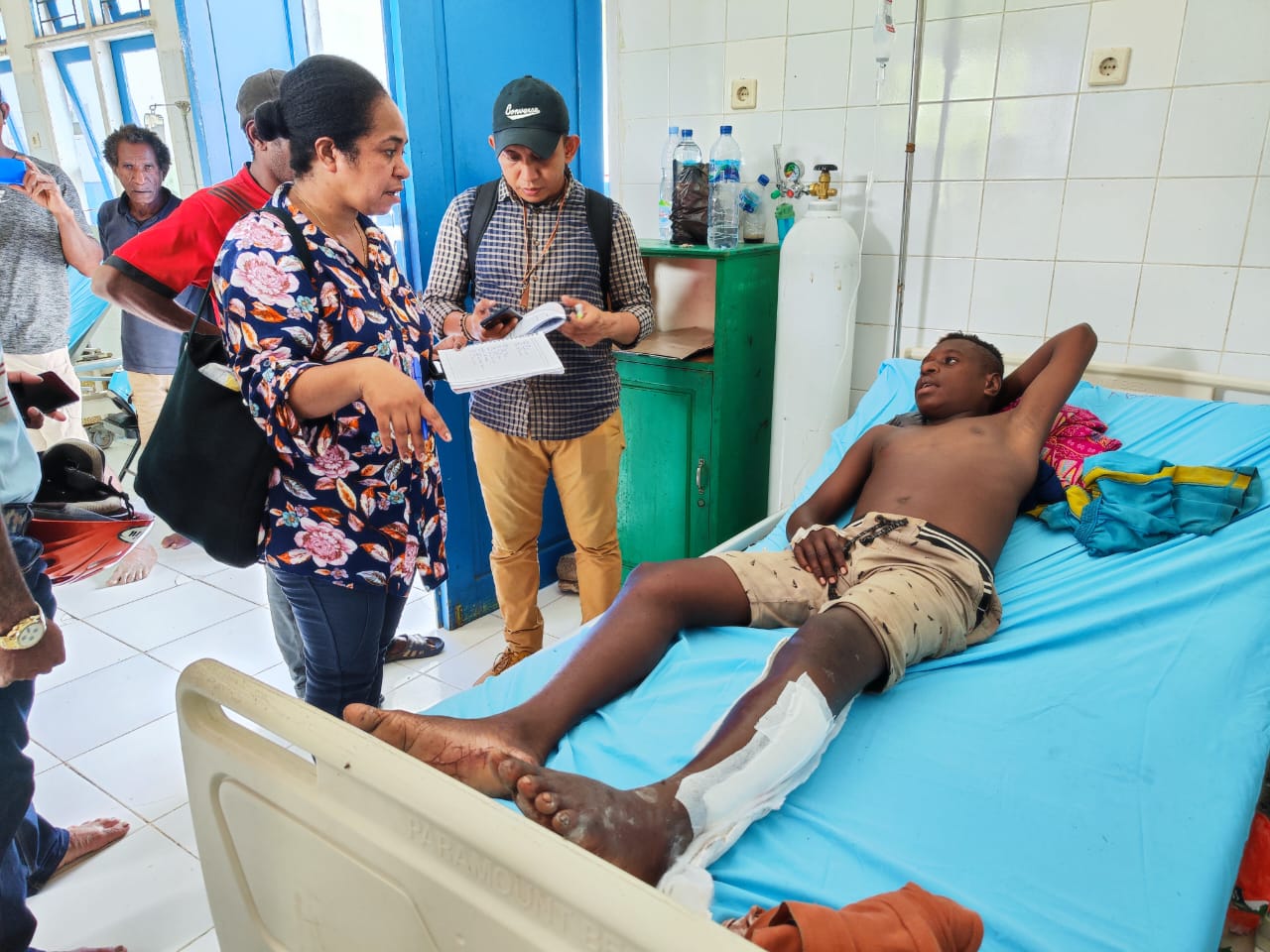
The Papua Law Enforcement and Human Rights Coalition team visits one of the shooting victims at Mappi Hospital. – Doc. Papua Law Enforcement and Human Rights Coalition.

Jayapura, Jubi – The Papua Law Enforcement and Human Rights Coalition revealed that of the nine residents who were victims of shootings by security forces in Kepi, the capital of Mappi Regency on December 14, 2022, six of them were students. The six victims are still undergoing treatment for their gunshot wounds.

Helmi, a member of the Coalition said there were elementary, junior high and high school students among the victims, namely Kaspar Khani Yebo (Inpres Kabe Elementary School), Wilhemus Jeji Samogi (Menyamur 1 Junior High School), Fredirandus Boy (YPPK Yohanis Paulus 1 Kepi Junior High), Sabinus Sokmi Sedap (Obaa 1 High School), Rexon Ya A Pasim (Obaa 1 High School), and Yohanis T Sedap (Obaa 2 Vocational School).

Helmi said that the six students were currently being treated as outpatients. According to Helmi, the victims refused to be hospitalized because they were always visited by the police.

“Every week they go to the hospital to treat their wounds and take medicine. They are also still in shock and traumatized,” he said.

The results of the Coalition’s investigation, which was carried out from December 17-20, concluded there was a stabbing incident by a resident against another resident named Martinus. However, the Coalition denied that there was a clash between residents that followed the stabbing.

With these findings, the Coalition denied the Papua Police’s version that the shooting of civilians occurred because security forces were attacked while breaking up clashes between residents.

The Coalition’s findings differed from the information conveyed by the Liaison Officer of the South Papua Police, Sr. Comr. Erick K Sully, who said the shooting was triggered by an attack on security forces who broke up a clash between two groups of residents under the influence of alcoholic beverages.

;

Helmi said the Coalition had been authorized by the victim to take legal action over the shooting incident in Mappi. The Coalition has assisted Kosmas Yameap, brother of the dead victim Moses Erro, to make a police report at the Mappi Police over the incident. The Coalition also accompanied the victim Rexon Ya A Pasim to report the incident to the Mappi Police.

“This is so that the police investigate who the perpetrators were in the shooting and whether the situation at the time was under control or not. Was there a dangerous incident before the shooting or not,” he said.

In a written press statement on Friday, the Papua Law Enforcement and Human Rights Coalition urged the National Human Rights Commission (Komnas HAM) to conduct an investigation into the shooting of Mappi civilians on December 14, 2022. Komnas HAM RI was also asked to investigate the alleged involvement of Indonesian Military (TNI) and Police in the shooting that killed one and injured eight Mappi residents including students.

The Coalition also suggested that peace efforts made between the victims of the stabbing and the perpetrators be separated from the investigation of the shooting of nine civilians as the two are different cases.

The Coalition urged that the legal process related to Mappi shooting must be carried out professionally in order to ensure a fair trial against the perpetrator and prevent impunity. They hoped that any assistance provided to the shooting victims was not a strategy to silence the victims who demand justice. (*)

Related News

No justice for Paniai

Victims and family members of victims of the 1989 Talangsari incident in Central Lampung attend a meeting with representatives of the National Commission on Human Rights (Komnas HAM) in Jakarta. (The Jakarta Post/Dhoni Setiawan)

  • Editorial board (The Jakarta Post)
  • Jakarta   ●   Thu, December 15, 2022
  • )

Last week’s acquittal of Maj. (ret) Isak Sattu of all charges in the December 2014 fatal shooting of civilians in the Papuan regency of Paniai came as no surprise. From the very beginning, observers had doubted that justice could be served by the Makassar Human Rights Court in South Sulawesi, partially because Isak was the only person the prosecutors had indicted in the case.

As one Papuan human rights activist put it after the five justices delivered their three-to-two verdict on Dec. 8, the trial was designed to fail. Isak was only a liaison officer with the Paniai Military Command (Kodim) at the time of the shootings, which killed five people and injured 21 others.

The bench, nonetheless, agreed that the incident, dubbed Bloody Paniai, constituted a gross human rights violation. Security forces had opened fire into a crowd of demonstrators protesting the alleged beating of a young person the previous day by Indonesian Military (TNI) personnel.

But the fact that only Isak went to trial shows that the proceedings were no more than a formality, especially after early this year President Joko “Jokowi” Widodo formed a team to settle past crimes against humanity first and foremost through “non-judicial measures”.

Following its investigation into the Paniai shooting, the National Commission on Human Rights (Komnas HAM) recommended that rank-and-file soldiers and their superiors should shoulder the blame for the tragedy. The commission interviewed two dozen witnesses, analyzed documents and visited the scene to determine to what extent the TNI had been involved in the incident.

The failure of the Attorney General’s Office to bring all the alleged perpetrators of the Paniai shooting to justice is more than just a technical problem. There is an acute lack of political will on the part of not only law enforcement but the government as a whole to resolve past human rights violations.

The Paniai shooting is only the fourth gross human rights crime to be heard in court in the country, after the 1999 East Timor atrocities, the 1984 Tanjung Priok massacre and the 2000 Abepura, Papua, incident. In all the cases, all the defendants – military, police and civilians – were acquitted of all charges, either by the ad hoc Human Rights Court or the Supreme Court.

There are many more cases the state is reluctant to address, despite repeated calls from Komnas HAM. The rights body’s list includes the 1965-1966 communist purge, the 1998 Trisakti shooting and ensuing Jakarta riots, the Semanggi I incident in 1998 and Semanggi II in 1999. The commission has also recorded a number of crimes against humanity in Papua, apart from the Paniai and Abepura incidents.

The not guilty verdict for Isak in the Paniai shooting is a grim reminder of the daunting challenges the nation faces in upholding human rights as mandated by the Constitution. The acquittal has sent the message, loud and clear, that impunity will persist for years to come unless the AGO takes bold measures – first by challenging the verdict and then by bringing everyone responsible for the tragedy to justice.

Topics :