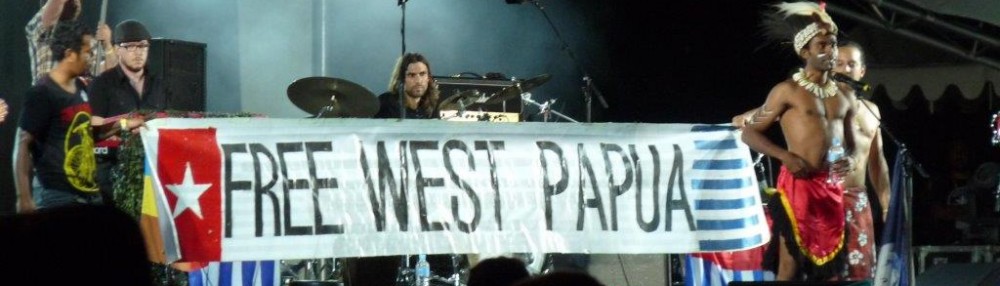
Peaceful rallies planned in West Papua for 15 August. The New York Agreement . Activists already intimidated

The 15 August   marks  62 years since The New York Agreement and West Papuans  are still suffering  under Indonesian colonial rule. Yes, most of the world recognises Indonesian sovereignty over West Papua at this stage but most also would recognise that the so called act of free choice in 1969 was a sham.

The New York Agreement

In August 1962, an agreement was concluded in New York between the Netherlands and Indonesia. Under this agreement, the Dutch were to leave West New Guinea and transfer sovereignty to UNTEA (the United Nations Temporary Executive Authority). After 7 months the UN transferred power to Indonesia with the provision that a referendum be held to determine Papuan preference for independence, or integration with Indonesia. 

The New York Agreement was a betrayal of the West Papuan people. 

President Thomas Wilson said  “ …that no right anywhere exists to hand peoples about from sovereignty to sovereignty as if they were property”

Joe Collins of AWPA said, “and this is exactly what happened to the West Papuan people. Handed over by one colonial power, The Netherlands to another, Indonesia with a short administration period by the UN as a face-saving compromise for the Dutch and the international community”.

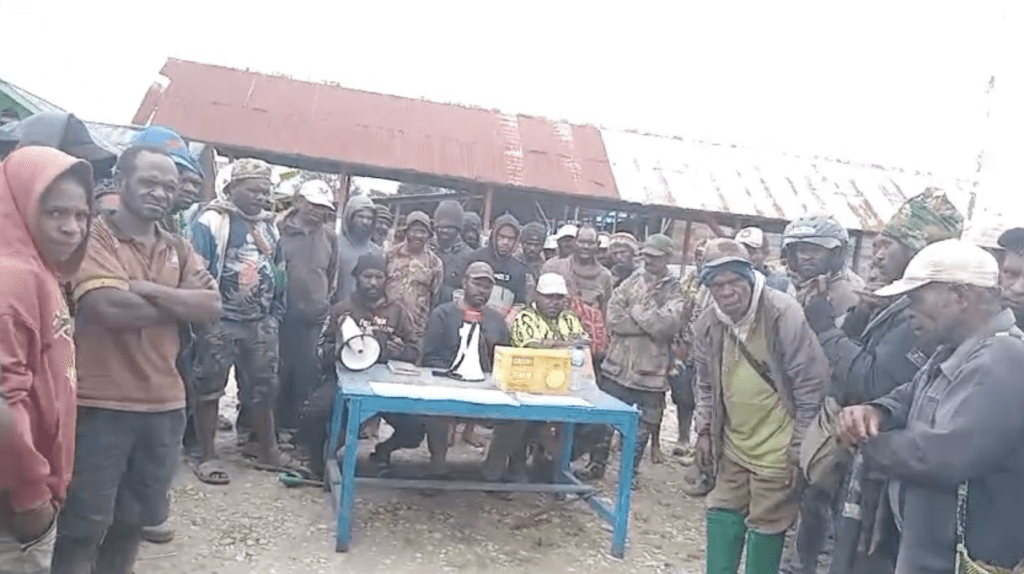
The West Papuan National Committee  ( KNPB) has called for West Papuans to come out and peacefully protest this betrayal and have been handing out flyers (on the 13 August) to inform about the upcoming rallies on the 15 August. 

In an act of  intimidation up to 60 activists were taken by the police to the Doyo police Station in Sentani. 

Joe Collins said ,” this is to intimate civil society groups into not taking part in the proposed rallies on the 15 August.  Hopefully, there will not be a repeat of previous years where  the security forces have cracked down in their usual heavy-handed approach on  peaceful demonstrators”.

Photos posted on AWPA FB Page. (KNPB informing public about upcoming rallies).

 “ West Papuan civil society groups regularly hold events and rallies on days of significance in their history,  to try and bring attention to the world, of the injustices they suffer under Indonesian rule. And this is what Jakarta fears most , international scrutiny  on the ongoing human rights abuses in the territory”.

Also of concern is that the 17 August is Indonesian Independence Day.

The Indonesian Security  forces can use the day to take propaganda  photos of Papuans supporting their Independence day. It is now 5 years since the West Papua uprising when thousands of West Papuans took to the streets in all the major cities and towns across West Papua.  The demonstrators were  protesting against the arrest and racial abuse against West Papuan students in Surabaya, Indonesia.

The arrest of 43 students in Surabaya occurred because it had been reported that an Indonesian flag had been vandalised near the students dormitory.

At the time, The Jakarta Post (19 August) reported that security personnel and members of Indonesian organisations launched physical and verbal attacks on the Papuan students accusing them of refusing to celebrate Indonesia’s 74th Independence Day, and that an “angry mob arrived at the dormitory after they found a discarded Indonesian flag near the building. During the incident, they reportedly threw stones at the dormitory while shouting racial abuse and chanting “Kick out the Papuans!” and “Slaughter the Papuans!” 

The mob also called the students monkeys, pigs and dogs, shouting “don’t you come out. We are waiting for you here”.  As they stormed the building the Police fired tear gas into the building and arrested 43 students. The students were later released after questioning. They had denied any knowledge of the damaged flag. However, this incident triggered rallies across West Papua in a show of support for the students and in protest against the discrimination and injustices that West Papuans suffer daily under Indonesia rule.

It is estimated that up to 60 people died , including 35 indigenous West Papuans  and  hundreds injured with  over 20,00 civilians displaced during the Uprising period. 

Joe Collins said, “hopefully this year the Indonesian security forces  will allow the West Papuan people  to hold their peaceful rallies without interference . 

“Canberra,  along with the two regional organisations , the  Melanesian Spearhead Group (MSG) and the Pacific Islands Forum (PIF)  should be strongly  urging Jakarta to allow the UN High Commissioner for Human Rights to visit West Papua to investigate the human rights situation in the territory. Jakarta should also be urged to allow  a joint PIF- MSG fact finding mission to the territory”.

Ends
Report highlights misapplication of treason charges against Papuan activists

Human Rights News / IndonesiaWest Papua / 22 August 2024 

Recent findings highlight the ongoing use of treason charges to suppress peaceful activism in Papua, raising significant concerns over the infringement of fundamental human rights. A report by the Alliance for Democracy for Papua (AlDP) and Tapol, launched in Jayapura in July 2024, reveals that treason laws are frequently employed to criminalise activists advocating for Papuan rights, including those involved in anti-racism protests and commemorations of political leaders.

The research documents 52 cases where activists were charged with treason, noting that these charges are often applied broadly, disregarding the peaceful nature of the protests. Legal experts and human rights advocates argue that the treason laws, rooted in colonial-era legislation, are misapplied to suppress freedom of expression rather than addressing genuine threats to national security.

Professor Melkias Hetharia of Cenderawasih University argues that the expression of support for Papuan independence, when conducted peacefully, does not constitute treason. He emphasizes that such expressions should be protected under international human rights standards, to which Indonesia is a signatory.

The report calls for a revision of treason laws and urges the Indonesian government to respect political expression and engage in dialogue to address the underlying issues in Papua, rather than resorting to repressive legal measures that only fuel further resistance.

Tensions escalate between Me and Kamoro tribes over gold mining in Central Papua – PT Zoomlion continues with illegal operation

 Cases Human Right 22 August 2024 

Some of the conflicts in Papua stem from illegal operations by companies that have failed to involve the customary land rights owners. A prominent example is the operation of PT Zoomlion in Kapiraya District, Central Papua Province. This issue urgently requires intervention from the Central Papua Provincial Government.

On 18 July 2024, the dispute over gold panning land in Kapiraya District escalated tensions between the Mee and Kamoro tribes. This dispute threatens the peaceful coexistence that has long been maintained between the two tribes. Historically, the Me and Kamoro tribes have lived in harmony, engaging in activities such as hunting, cooking, and bartering together. However, tensions have risen recently when residents of Wakiya Village, armed with weapons, threatened to sweep away the Me tribe residents in Mogodagi Village. This threat arose due to a scramble for control over the gold mining land in the region.

The Dogiyai Regency House of Representatives has taken steps concerning the illegal gold mining activities carried out by PT Zoomlion Indonesia Heavy Industry in Mogodagi Village, Kapiraya District, Deiyai Regency. Since January 2023, PT. Zoomlion has been conducting manual gold mining operations. In May 2024, they expanded their activities by bringing in two excavators and two Hilux vehicles without obtaining permission from the local community. This operation has resulted in severe environmental damage and a blatant disregard for the rights of the indigenous peoples who hold customary rights to the land.

In response to the increasingly volatile situation, the Dogiyai Regency House of Representatives conducted field monitoring (which was announced in May 2024) to Mogodagi Village. Their findings were compiled into official recommendations submitted to the Central Papua Provincial Government, specifically to the Acting Governor, and other relevant parties. The Dogiyai representatives urged that immediate and concrete steps be taken to resolve the situation before lives are lost. The presence of this illegal gold mine has intensified tensions within the local community, particularly between the Kamoro and Kei communities, who have threatened violence against the Me community in Mogodagi Village. Following the DPR’s visit, the situation worsened with the arrival of additional heavy equipment to support the illegal mining activities and the blockade of the Kapiraya airport runway by the Kamoro and Kei people, along with the company. The situation is extremely tense, putting the Me community under serious threat.

It is crucial that the Kamoro and Me tribes engage in dialogue to determine the boundaries of their respective customary lands. This mediation meeting should be facilitated by the Central Papua Provincial Government, given that this region lies at the intersection of three districts: Deiyai, Mimika, and Dogiyai. The community is urging the Acting Governor of Central Papua to promptly take concrete steps based on the recommendations of the Dogiyai Regional People’s Representative Council (DPRD), which reflect the people’s aspirations. This action is vital to prevent casualties and bloodshed. We seek a solution that promptly delineates territorial boundaries and issues a Governor’s Regulation (Pergub) and a Special Regional Regulation (Perdasus) on people’s mining.

Immediate actions that need to be taken include shutting down the illegal gold mining operations carried out by PT. Zoomlion Indonesia Heavy Industry in Mogodagi Village, conducting a transparent investigation into how PT. Zoomlion began its operations without the consent of customary rights owners, restoring the rights of indigenous peoples, protecting the environment by implementing measures to repair the damage caused, and ensuring transparency and accountability in all mining operations permits and other economic activities.

This call must be urgently addressed by the relevant parties before the situation deteriorates further and casualties occur. Let us work together to maintain the peace and well-being of the people of Central Papua.

Open letter to Pacific Island Forum  Leaders AWPA Sydney

26 August 2024 

Dear Pacific Islands Forum Leaders, 

I am writing to you concerning the issue of West Papua. 

We know that there are many issues of concern to discuss at the 53rd Pacific Island Forum (PIF) Summit in Tonga and in particular that climate change is a priority issue for the Leaders and the People of the Pacific. AWPA believes that the issue of human rights in the region is also of concern.  

I would first like to thank the PIF leaders for discussing  the human rights situation in West Papua at previous Forums.  

Unfortunately since last year’s Pacific Islands Forum Leaders’ meeting in Rarotonga, the human rights situation in West Papua has deteriorated further. AWPA will not reiterate the tragic history of West Papua of which  PIF Leaders are well aware. 

Numerous reports have documented the ongoing human rights abuses in West Papua, the burning of villages during military operations and the targeting of civilians. 

One incident in particular which highlights the ongoing abuses committed by the Indonesian security forces concerns  the brutal and horrific torture of a West Papuan man, Defianus Kogoya by Indonesian troops in early February this year. Anybody who saw the video footage of the Papuan man being tortured cannot help but be horrified and outraged. Tragically, this is not an isolated incident.  

There are regular clashes between the Indonesian security forces and the TPNPB (Free Papua Movement) who are fighting for their independence. As a result of these clashes the military respond with what they call sweeps of the area. 

Human Rights Monitor in its 2nd quarterly report for 2004, pointed out that “as of early June 2024, over

76,919 people remained internally displaced  due to the armed conflict in West Papua, with no humanitarian access”.  

In a recent incident “Indonesian security forces fired tear gas and rubber bullets in clashes with protesters marking the 62nd anniversary of a U.N. agreement that paved the way for Jakarta’s annexation of the Papua region.  At least one protester was wounded by a rubber bullet and 95 people were arrested during the unrest in Nabire, the capital of Central Papua province, said Kimot Mote, one of the protest organisers” (Benar News 16 August 2024)  

There is no freedom of assembly in West Papua  

Article 19 of   The Universal Declaration of Human Rights states        

1. Everyone shall have the right to hold opinions without interference. 

2. Everyone shall have the right to freedom of expression; this right shall include freedom to seek, receive and impart information and ideas of all kinds, regardless of frontiers, either orally, in writing or in print, in the form of art, or through any other media of his choice. 

We thank Fiji’s Prime Minister, Sitiveni Rabuka  and PNG’s Prime Minister James Marape for trying to secure an agreement to visit West Papua and urge all the PIF Leaders to continue to strongly urge Jakarta to not only allow a PIF fact finding mission to West Papua but also urge Jakarta to  finalise the visit by UN High Commissioner for Human Rights to the territory. 

We are also concerned about the human rights situation in New Caledonia (Kanaky).  

The UN Office of the High Commissioner for Human Right released a statement on the 20 August  expressing alarm at the situation of the indigenous Kanaks. 

Extract from statement 

“We are particularly concerned by allegations concerning the existence of heavily armed militias of settlers opposed to independence,” the experts said. 

“The fact that no measures have been taken by authorities to disband and prosecute these militias raises serious rule of law concerns.” 

The experts noted that the 2021 consultation on the sovereignty of the French colony of New Caledonia took place amidst the Covid-19 pandemic disregarding Kanak customary mourning and despite the objections of Kanak customary authorities and organisations. 

https://www.ohchr.org/en/press-releases/2024/08/france-un-experts-alarmed-situation-kanak-indigenous-peoples-non-self

We urge the PIF Leaders to continue to raise concerns at the heavy-handed security  approach in New Caledonia (Kanaky)  by France and urge France (a dialogue partner) to accede to the requests of the Kanak people and their representatives  at the Summit. 

AWPA (Sydney)

‘Where is the Christian solidarity’: Benny Wenda on PNG leader’s West Papua comments

Lydia Lewis, in Nuku’alofa, Tonga

West Papua is within the sovereignty of Indonesia, so responsibility lies with them in addressing independence demands, Papua New Guinea (PNG) Prime Minister, James Marape, says.

But the leader of the United Liberation Movement for West Papua (ULMWP), Benny Wenda, told RNZ Pacific the issue was not about sovereignty.

Marape was responding to questions from PNG journalists before travelling to the 53rd Pacific Islands Forum Leaders’ Meeting (PIFLM53), which began in Tonga on Monday.

The PNG prime minister was asked whether West Papua would be openly discussed at the summit, particularly as Indonesia’s President-elect Prabowo Subianto has advocated for West Papua.

Marape said just as PNG would not want its neighbouring countries talking about sovereignty issues within its borders, Indonesia would not want its neighbours talking about West Papua and its sovereignty.

He said all other areas of its relationship with Indonesia, such as economy, will be open for discussion at the meeting.

Indonesia’s incoming president has indicated to give greater respect to indigenous views on customs, culture, and land rights and indigenous heritages should be preserved, he said.

However, Wenda told RNZ Pacific: “It’s not about sovereignty.”

“But this is about discrimination because we have been different, black Christians. That’s why Indonesia [has] committed genocide and ecocide West Papua.”

He said the indigenous West Papuans are facing the same issue as the Kanaks in New Caledonia.

“This is our sovereign state, our ancestral land, which was stolen from us, so we [have] the right to exist in our sovereign state of West Papua.”

Wenda said the people of PNG need to ask their government if they supported genocide.

“If they allow this [to] happen to their own brother, where is the Christian solidarity? Where is it?” he asked?

He said Pacific leaders have a “moral obligation” to find a solution for the indigenous Kanaks and West Papuans.

“The world is watching the Pacific leaders. What [are] the Pacific leaders going to do with two nations who are fighting the colonialism, imperialism and then ecocide, genocide or committed the illegal occupation.

“This is the Melanesian territory. This is the Pacific territory.”

He added it is important for Pacific leaders to take the make bold decisions on the issue.

Meanwhile, the Australia West Papua Association in Sydney is urging Pacific leaders attending the Tonga meeting “to continue to strongly urge Jakarta to not only allow a PIF fact-finding mission to West Papua but also to finalise the visit by UN High Commissioner for Human Rights to the territory”.

In March, the Indonesian Embassy in Wellington said: “The Government of Indonesia is committed to its long-standing policy of respecting and promoting human rights as well as its strict policy of zero impunity for misconducts (sic) by security forces.”

————————————————————

Melanesian leaders want meeting with Indonesian president on West Papua ‘as soon as practicable’

Lydia Lewis, in Nuku’alofa, Tonga lydia.lewis@rnz.co.nz 

The Melanesian Spearhead Group (MSG) wants to have a meeting with Indonesia’s incoming President Prabowo Subianto to address ongoing human rights concerns in West Papua.

It comes after Fiji and Papua New Guinea’s prime ministers – Sitiveni Rabuka and James Marape – failed to organise a visit after being appointed special envoys on West Papua, at last year’s Pacific Islands Forum (PIF) leaders meeting.

Marape told RNZ Pacific: “We could not find a time where both of us got to Indonesia.”

The MSG met on the sidelines of the 53rd Pacific Islands Leaders’ Summit in Nuku’alofa on Tuesday.

Vanuatu’s Prime Minister and the sub-regional bloc’s chair, Charlot Salwai, said there has been concerns surrounding West Papua for some time.

“Some issues in relations to human rights…because the [Pacific Islands] Forum back in 2019 decided to ask [for a] UN mission to do fact-finding mission in Indonesia.”

The United Liberation Movement for West Papua (ULMWP) president, Benny Wenda, said: “It is time for PIF to reaffirm their 2019 call for a UN High Commissioner for Human Rights visit to West Papua.

“It has now been five years since PIF’s initial demand for a UN visit was made, and over 110 countries have echoed this Pacific call,” he posted on X.

Salwai said it would be good to have a face-to-face meeting with Subianto.

The MSG leaders released a statement on Tuesday, stating: “The welfare of the interests of our Melanesians in West Papua and the other Papuan Provinces in Indonesia is an ongoing concern to our peoples.”

“In this regard, the MSG Leaders Dialogue with the President of Indonesia is a project of great importance that must be pursued.

“The [MSG] Secretariat must maintain contact with the relevant Indonesian authorities to ensure that opportunities are identified for all MSG Leaders to meet with the Indonesian President as soon as practicable.”

The group will have a Special Leaders’ Summit on 14 and 15 November in Fiji.