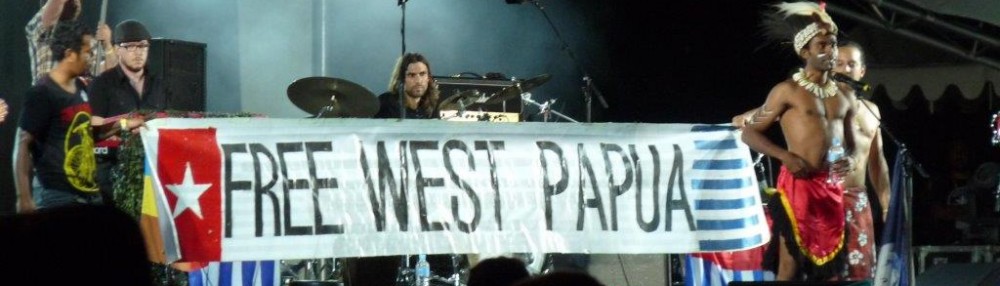
How UN betrayal of West Papua led to genocide, step by step

by Julie Wark 24th October 2025

The United Nations has recently come under attack from the Trump Administration and, much as it goes against the grain, it’s difficult to argue with real-estate-developer-cum-ambassador-representative for UN Management and Reform [sic], Jeff Bartos:

“Over 80 years, the UN has grown bloated, unfocused, too often ineffective, and sometimes even part of the problem. The UN’s failure to deliver on its core mandates is alarming and undeniable.”

Yet the problem isn’t really the UN. One notable symptom of its malaise is the Security Council and its five veto-playing permanent members — the US, UK, France, China and Russia — representing the world system that assist and cover up for their allies who commit human rights violations, war crimes and genocide, and that also outsource such crimes. But lèse-humanité is the crime par excellence of the international system. It’s a basic principle of colonial “development”. So what follows isn’t about kicking the UN when it’s down, but about how the rulers of this system use any institution, democratic or otherwise, to achieve their own diabolical and white supremacist ends.

I’m sorry — in more ways than one — that this article is long.

It’s long because the list of UN (when I refer to the UN, I’m basically referring to the world system) offences against the people of West Papua is hideously long. Sadly, my list is by no means complete because there’s lots of “classified” material I don’t know about and many, many secrets, but I hope it gives a glimpse of how the international system works when it wants to get whole encumbering peoples out of its way.

I’m taking it as given that Indonesia is committing genocide in West Papua. It’s done stealthily but there’s plenty of evidence (for example, see here, here, and here) for it. However, the facts show that, in this six-decade-plus crime against humanity, Indonesia has been the tool of other interests, that the role of the United Nations (by which I mean some of its dominant powers and personalities) has been particularly egregious, and this is surely one of the reasons why the West Papua genocide has continued sub rosa, deliberately silenced, for more than 60 years. There are many aspects of the UN betrayal because they belong to big-power politics and they’re convoluted because of the secrecy that surrounds them.

This isn’t about an isolated instance of genocidal violence. It fits into a world system where white supremacist brutality, going back at least to the period of early modern European overseas expansion from the 15th century, the so-called Age of Discovery (a quintessentially Eurocentric concept), turned into a “scientifically-based” system with the Enlightenment and didn’t end with decolonisation. I’d suggest, after reading documents from the time when West Papua was gifted to Indonesia, that the latter was less the West’s darling than a mere instrument unscrupulously used to favour the economic and geopolitical interests of white supremacy and its destructive notions of “progress and development”. It’s not only the various Indonesian regimes that are responsible for mass murder in West Papua, but also and especially their enablers in the international political system represented by the UN and the big powers.

I can only partially list the crimes committed against West Papua (and, here, I’m indebted to painstaking research by Julian McKinlay King, John Saltford, Greg Poulgrain, and others). But even an incomplete list gives an idea of the magnitude of this lèse-humanité, this core crime of international law. I’m not interested in “speaking truth to power” because I agree with Pankaj Mishra that this is a naïve exercise. Those in power know and control the truth. I studied politics and am not an expert in international law so I hope I don’t misinterpret some aspects of it. In any case, the hard facts are enraging for any decent human being. Experts in international law are often too invested in, or too occupied with, other aspects of the corrupt system to inquire into the evidence of Indonesia’s daily genocidal actions in West Papua, and too demoralised to try to stop them through the shoddy institutions at their disposal. Yet any non-expert person who cares to look at the documents can see quite plainly that, in the last almost 65 years of West Papua’s history, the UN has played a shameful role, not only allowing this to happen but deliberately colluding with it. The very forum that has the power to stop the genocide is complicit in it.

It was only recently that the UN finally acknowledged that Israel is committing genocide in Palestine, and I can’t help wondering whether all this fudging about the word is somehow related with fear of disclosure of the UN’s active role in abetting and silencing the West Papua genocide. I list 43 aspects of this below.

For the full article please see below.

The article in CounterPunch does list 43 separate paragraphs which are a real work of research and worthwhile reading editors note

Republished from CounterPunch, 24 October 2025

The views expressed in this article may or may not reflect those of Pearls and Irritations.
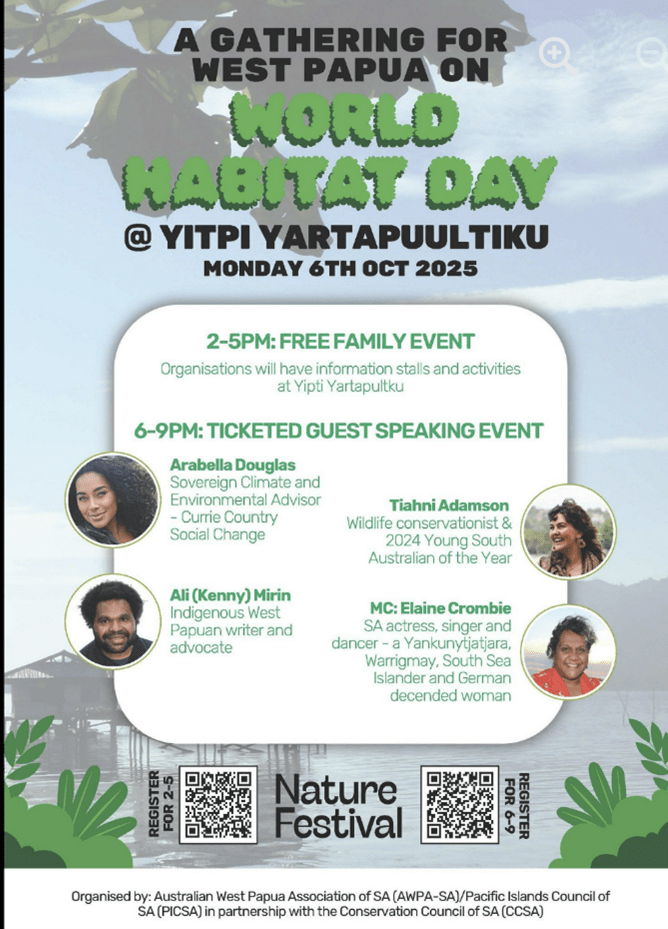
Summary notes on speakers at World Habitat Day at Yitpi Yartapuultiku Port Adelaide, 6 October 2025

STRONG FOCUS ON COP, CLIMATE and UNIFIED STRENGTH OF INDIGENOUS PEOPLES

This event was organised by The Australian West Papua Association (SA) (AWPA) supported by Conservation Council of SA and Pacific Islands Council of SA PICSA

The Free Family Event was a community fair – a number of organisations had stalls and presences including:

  • Asian Australians for Climate Solutions
  • AWPA – environment and political info
  • XRSA – flyers, free badges, write climate solutions on our whiteboard – about 8 XR members assisted
  • Face painting
  • Kid’s activities – focusing on tree kangaroos
  • Fijian and Papua New guinea dancers – organised by Tukini Tavui (Fiji) CEO PICSA
  • Hindmarsh Greens
  • Fusion Party
  • Sea Shepherd
  • Food trucks

 Channel 9 came to film the dancers

The evening event had about 120 people attending (including more XR members and friends joining) – a good showing in the auditorium. Uncle Moogy welcomed us to country with stories about water sources and connections across country through groundwater.

Chairing the session: Koteka Wenda … the advertised chair was not available but young West Papuan activist-in-exile Koteka Wenda stood in: setting a unifying and gracious tone of welcome, and speaking of her own upbringing and connection to country.

Speakers: all were intensely political and focused on indigenous justice and justice for country. There was a strong focus on the Pacific peoples and on COP31, and the wider interests of millions of first nations peoples.

Arabella Douglas – from Currie Country South-East Queensland/ northern NSW .

Topics:

  • Recent appeals to the International Court of Justice on compensation for climate damage, and on recognition of Palestine.
  • Strong interest by (so-called) Pacific nations in Aust bid to hold COP31 in Adelaide,
  • The stance of Pacific nations in leading the approach on climate.
  • History of the greater land mass of SAHUL (New Guinea and Australia were once joined and still share bird and animal and plant species, long history of connection and trading,
  • Severe impact of climate – and moves to create unified climate solutions: examples: plant mangroves as sea-protection, and to close down the many extractive industries
  • Impacts of climate risk on indigenous people here – opportunities to join with Pacifika peoples. Examples of injustice – poor management of northern rivers.
  • Drawbacks – Fed monies received for Native Title compensations and restitutions have conditions so that they cannot be used to sue the Fed Govt.
  • Opportunities for appeals to the ICJ (Int Court of Justice) over climate crisis impacts as a violation of human rights. Want to get problems such as Algal Bloom and damage to Murray-Darling basin onto the COP agenda.
  • Opportunity for Australia to have a seat on the UN Security Council (although the 5 permanent-seat nations have rights of veto)

Note on ICJ: https://www.crikey.com.au/2025/07/30/international-court-justice-australia-pabai-pabai-torrest-strait-climate-change/

  1. Uncles Pabai and Paul of Torres Strait raised a case in the Aust courts, alleging the government had failed to meaningfully address climate change.
  2. Students from the University of the South Pacific took a case to the ICJ in 2019 to advise on the obligations of governments to address climate change under international law

Ali (Kenny) Mirin – West Papuan writer and advocate … topics:

  • West Papua is arguably the world’s most biodiverse and most threatened region
  • Illegal logging, multi-national corporations, military protection … impacts for people: restrict access to forests and food sources – + hunting, medicine
  • Destruction of place-identification markers such as large trees – these mark boundaries between tribes and overstepping boundaries leads to inter-tribal conflicts – there are no written records – instead a story-telling system and a land-place/moiety system
  • Major corp: MIFEE (Merauke Integrated Food and Energy Estate)  – land grab … https://www.etan.org/news/2011/mifee.htm  world’s largest deforestation for sugar cane .. clearing of native mangrove, sago, paperbark, wetland destruction, incursion of roads, multi species of frogs, high elevations, fragmented habitats … add climate impacts increased temp and rainfall.
  • 50,000 – 60,000 internally displaced people due to Indonesian Military
  • Media censorship and communication difficulties – PNG has more than 800 languages.

Rowena – Samoan woman   now living in Adelaide … topics

  • Pacifika peoples have contributed least to climate change but have the most serious impacts – example – nuclear waste dump flooded by rising sea levels
  • Repressions with all the usual methods – forbidden to use language, students confined to dormitories.
  • Climate justice is indistinguishable from land justice.
  • The Australian government claims to protect pacific “family” but at the same time rewards and supports “those who would destroy us”.
  • Habitat protection needed
  • Solution to climate catastrophe is to Speak the Truth
  • People in Aust do not know where Samoa is
  • People in the Pacific do not know where Adelaide is “is it near Perth?” … but they know it when you say “It’s the place with the Santos HQ”.

Tiani Adamson (Wildlife Conservationist and Young South Australian of the Year 2024)

  • Tiani came from the northern Cape York peninsula – her people were forcibly relocated to Darwin. She is now based in Adelaide.
  • Focuses research on islands – 5% of landmass, > 20% of biodiversity, extreme speciation due to isolation, but vulnerability to introduced ferals.
  • Island and indigenous decision making is more community based, long term and not based on a 4 year election cycle.
  • Australian native food businesses are less than 5% owned by indigenous people
  • Need to nourish land and sea  – and at the same time each other.

AWPA Statement – Indonesian military kill 15 West Papuans, the majority civilians during military operation

During the military operation the security forces  conducted house to house searches and opened fire in an  indiscriminate fashion resulting in 15 deaths. According to community sources  soldiers buried most of the bodies  with some still to be found. 

      Human Rights Monitor

Joe Collins of AWPA said, “as with previous military operations  local people fled in fear of their lives. In this case up to 145 residents fled from Soanggama, Janamba, and Kulapa. There are now over 100,000 displaced people in West Papua. Many are malnourished and children are missing out on their education”.

The security forces claimed that  the dead were  members of the West Papua National Liberation Army (TPNPB) and they were killed  in a firefight.

However, TPNPB Spokesperson Sebby Sambom  reported only  three of the dead were  TPNPB members. 

Local church leaders and civil society groups also disputed the official narrative. The Intan Jaya Conflict Mediation Team stated that not all 15 victims were affiliated with the TPNPB, identifying at least nine civilians, including a deaf man and a housewife who died while fleeing. 

The Head of the Intan Jaya Conflict Mediation Team, Yoakim Mujizau, said  that his team had visited Soanggama Village and identified the victims and gathered information from residents who witnessed the incident. The team also received information from members of the Indonesian National Armed Forces (TNI) stationed there.

The latest information is that all the victims have been buried by the Task Force in different locations. Two victims were buried in Soanggama Hamlet in front of the Protestant Church. Six people were buried in Dusandigi Hamlet, Soanggama Village, and one woman was buried in Jembatan Hamlet, on the Wuisiga River.

Meanwhile, the bodies of the other six victims have not yet been found.

“The security forces are still unwilling to provide information. Where are the shooting victims? And where are they buried? So we are still investigating the whereabouts of the bodies, and we have not yet identified them,” he said.

Collins said, “we have statements from the Indonesia  military  saying it reclaimed/ liberated  a village from the TPNPB when  the only liberation that needs to be done is the liberation of West Papuans from the oppression of the Indonesian security forces”.

Joe Collins said,” we have a massacre of Papuan civilians on our doorstep and there is no comment from Canberra on the incident. No concern about the ongoing human rights abuses, the military operations or the death of civilians in the territory”. 

All Canberra does “is to train and exercise with the Indonesian military. Sign a  defence treaty  with PNG and build up bases for US forces in the north. All to prepare for some imaginary invasion from China. Australia has always been concerned about stability in the region to our north, but the West Papua issue is the one issue that could cause the very instability the Canberra fears.

The West Papuan issue is not going away. Time for Canberra to become involved and put pressure on Jakarta to control its military in West Papua, as a first small step.

Ends

Sources

Jubi, Human Rights Monitor and Civil society reports 

Arbitrary arrests and restriction of peaceful assembly in Jayapura

15 October 2025 / 2 minutes of reading

On 23 September 2025, police officers from the Jayapura Police arbitrarily detained thirteen members of the West Papua National Committee (KNPB) in the Sentani area while they were distributing leaflets to announce an upcoming peaceful demonstration marking International Farmers’ Day (24 September 2025). According to local reports, at 10:08 am, police officers stopped the activists at the old Sentani Market (Pasar Lama) and detained them after 20 minutes of tense negotiations. The police seized the leaflets and transported the KNPB activists to the local police station for questioning. They were allowed to leave later that day.

In the afternoon, around 3:30 pm, KNPB members in Abepura and Kamkey, Jayapura City, continued distributing the same leaflets at strategic public points. The police again intervened, seizing the leaflets and detaining several individuals in police vehicles. In response, other KNPB members and residents marched to the Abepura Police Station to protest the arbitrary detention and demand an explanation.

Human rights analysis

This incident demonstrates a continuing pattern of repression of peaceful political expression in West Papua. The arrests of non-violent activists for merely distributing informational materials represent a violation of the rights to freedom of expression, peaceful assembly, and association, as guaranteed under Articles 19 and 21 of the International Covenant on Civil and Political Rights (ICCPR), to which Indonesia is a State Party. The use of police force to silence non-violent activists highlights the shrinking democratic space in West Papua and perpetuates an atmosphere of fear among civil society organisations. The events underscore the urgent need for systemic reform of policing practices in West Papua to prevent and reduce human rights violations.

Detailed Case Data
Location: CGJ4+W2W, Jln.mahkal;),;Pasar Lama, Hinekombe, Kec. Sentani, Kabupaten Jayapura, Papua 99352, Indonesia (-2.567648, 140.5050644) pasar Lama Sentani (Old Sentani Market)
Region: Indonesia, Papua, Jayapura Regency, Sentani
Total number of victims: 13

#Number of VictimsName, DetailsGenderAgeGroup AffiliationViolations
1.13 

maleunknown Activist, Indigenous Peoples

Period of incident: 23/09/2025 – 23/09/2025
Perpetrator: , POLRES

Perpetrator details: Polres and Polresta Jayapura

Issues: indigenous peoples

Indigenous community faces criminalization and land seizures as Merauke Food Estate Project advances

16 October 2025 / 4 minutes of reading

The Indonesian government’s ambitious National Strategic Project (PSN) in Merauke has entered a critical phase marked by escalating conflict between indigenous landowners and corporations backed by state authority, with customary land seizures now accompanied by police criminalization of community members resisting plantation development on their ancestral territories. On 29 September 2025, Coordinating Minister for Food Zulkifli Hasan announced plans to convert 481,000 hectares of Papuan forest in Wanam, Merauke Regency, for rice, oil palm, sugarcane, and cassava production, alongside renewable energy facilities, including bioethanol and biodiesel processing industries. The government claims the forest area has already been “released” from protected status, with Minister of Agrarian Affairs, Nusron Wahid, stating the land “does not belong to the community because it was previously state forest,” allocating 263,000 hectares for rice fields in Wanam, 41,000 hectares in Merauke City, 146,000 hectares for oil palm, and 1,140 hectares for ports and settlements. This massive land conversion contradicts the lived reality of indigenous Yei communities like the Kwipalo clan, whose ancestral territories are being forcibly seized by PT Murni Nusantara Mandiri (MNM). The company is part of the PT Global Papua Abadi consortium holding a 52,700-hectare concession for sugar cane plantation development.

The conflict reached a new level on 15 September 2025, when Mr Vincen Kwipalo and his relatives physically stopped PT MNM employees operating excavators and bulldozers clearing their customary forest to build road access through Kwipalo clan territory in Jagebob District. Following this confrontation, PT MNM used one of its employees to file a police report against Mr Kwipalo at the Merauke Resort Police Station. Following the police report, Mr Kwipalo was summoned for clarification on 2 October 2025. On 17 September 2025, Mr Kwipalo and three relatives erected traditional barriers named “Sasi“ using tree trunks across the cleared land, painting them orange and posting warning signs reading “No entry to the Kwipalo customary area,” to protect the 2,308 hectares of ancestral land threatened by corporate encroachment. As of August 2025, PT MNM had already cleared 4,912 hectares of the concession area, with periodic monitoring by Pusaka Bentala Rakyat Foundation documenting ongoing deforestation.

The Kwipalo clan’s resistance reflects systematic violations of indigenous land rights under Indonesian law, particularly Article 43(3) of Law No. 2/2021, requiring that provision of customary and individual land “for any purpose” must be “carried out through deliberation with the customary law community and residents concerned to reach an agreement on the transfer of required land and compensation.”

The Kwipalo Clan has manifested its rejection through multiple channels: planting red crosses on customary territory as traditional symbols of prohibition, openly declaring rejection through the national media, staging demonstrations in both Merauke and Jakarta, and filing an ongoing lawsuit with Indonesia’s Constitutional Court challenging the project’s legality. His position is reinforced by Article 21 of Merauke Regency Regulation No. 5/2013. The article obligates the South Papua Governor and Merauke Regent to immediately order PT. MNM to stop the criminal act of seizing and embezzling the customary land of the Kwipalo clan and protect Mr. Vinsen Kwipalo from the threat of criminalisation. State institutions, including the police, have become enforcement mechanisms for corporate land acquisition. Ín addition, the military has established the 817th Territorial Development Infantry Battalion within PT MNM’s concession area on Kwipalo customary land in July 2025, without clan permission or consent. The developments support growing concerns of deliberate militarization for the purpose of securing corporate business interests.

The Merauke PSN represents a broader pattern documented across Indonesia, where National Strategic Projects systematically dispossess indigenous communities under the legal framework established by the Job Creation Law. Civil society organizations argue that the law provides “facilitation and acceleration” mechanisms that bypass normal consultation and compensation requirements. The case parallels the displacement of 75 families from Soa Village in Tanah Miring District by PT Global Papua Abadi for road and bridge construction, and other conflicts at other PSN sites, including Rempang Island (Riau Islands), Indonesian Green Industrial Zone (North Kalimantan), and the National Capital (East Kalimantan), where communities face forced evictions for development projects. Greenpeace Indonesia Forest Campaigner, Mrs Sekar Banjaran Aji, notedthat “PSN Merauke has deprived indigenous peoples of their rights, destroyed natural forests, and threatened the biodiversity of the landscape,” while emphasizing that “the involvement of the army and police in the project has also caused terror among the community and indigenous Papuans.” 

Indonesia’s National Human Rights Commission has documented violations in PSN Merauke activities. Yet the government continues advancing the project as part of President Prabowo Subianto’s vision referenced at the UN General Assembly, positioning Indonesia as a “candidate for the world’s food barn.” The Papua Law Enforcement and Human Rights Coalition has called on the President to “immediately revoke the National Strategic Project policy that legalizes PT. MNM’s seizure and misappropriation of the customary land of the Kwipalo clan. The criminalization of Mr Vincen Kwipalo represents an “early example” of tactics that will be deployed against indigenous land rights holders resisting investment projects throughout the South Papua Province and in other PSN sites across Indonesia.

Mr Vinsen Kwipalo stops PT MNM excavators from destroying the Kwipalo clan’s customary forest, 17 September 2025

Mr Vinsen Kwipalo and supporters in front of the Merauke District Police Station, 2 October 2025

Detailed Case Data
Location: Jagebob, Merauke Regency, South Papua, Indonesia (-7.9103659, 140.7624493)Kwipalo customary land in Jagebob District
Region: Indonesia, South Papua, Merauke, Jagebob
Total number of victims: dozens

#Number of VictimsName, DetailsGenderAgeGroup AffiliationViolations
1.Vincent Kipalo

maleelderly Human Rights Defender (HRD), Indigenous Peoples
2.dozens 

mixedunknown Indigenous Peoples

Period of incident: 15/09/2025 – 15/10/2025
Perpetrator: Private Company, Government
Issues: business, human rights and FPIC, human rights defenders, indigenous peoples