Coalition Suspects Yasinta Moiwend Controversy Is Linked to Ongoing Court Proceedings

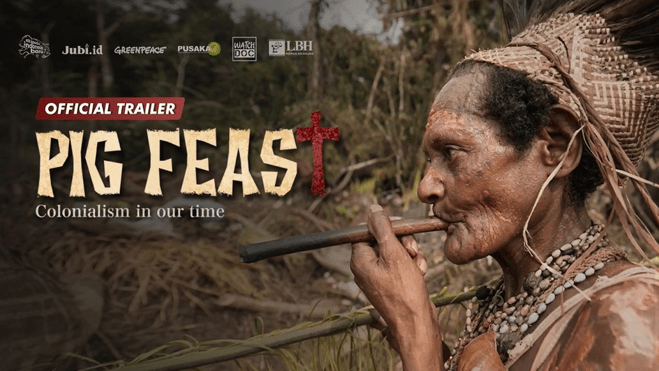
Jayapura, Jubi – The Papua Coalition for Law Enforcement and Human Rights has suggested that Yasinta Moiwend’s recent objections to her inclusion in the documentary film Pig Feast: Colonialism in Our Time may be connected to an ongoing legal case before the Jayapura Administrative Court (PTUN).

Previously, five representatives of the Malind Indigenous community, including Yasinta Moiwend, filed a lawsuit challenging Merauke Regent Decree No. 100.3.3.2/1105/2025.
The decree concerns the environmental feasibility approval for the construction of a 135-kilometer access road as part of a food security project initiated by Indonesia’s Ministry of Defense.

The case was registered with the Jayapura Administrative Court under Case Number 9/G/LH/2026/PTUN Jayapura on March 5, 2026.

The Papua Coalition for Law Enforcement and Human Rights, which is part of the legal team assisting the plaintiffs, stated that lawyers serving on the Merauke Solidarity Advocacy Team, acting as legal counsel for Yasinta Moiwend, cannot be subjected to criminal or civil liability for carrying out their professional duties.

“Yasinta Moiwend is a client of the Merauke Solidarity Advocacy Team, which is currently representing her in proceedings before the Jayapura Administrative Court,” the coalition said in a written press release issued on Wednesday (June 3, 2026).

According to the coalition, the advocacy team has been assisting Moiwend and four other Indigenous representatives in their lawsuit against the Regent of Merauke.

During the proceedings, Indonesia’s Minister of Defense entered the case as an intervening defendant. This was marked by the submission of the intervening defendant’s response to the panel of judges overseeing Case Number 9/G/LH/2026/PTUN JPR, which was filed on May 18, 2026.

The Ministry of Defense’s involvement came after the Merauke Solidarity Advocacy Team and the legal team representing the Merauke Regent had reached the rejoinder stage of proceedings.

The coalition stated that while the advocacy team was preparing its response to the Ministry of Defense’s submission, the public was surprised by the circulation of a video in which Yasinta Moiwend questioned the use of footage featuring her in the documentary Pig Feast: Colonialism in Our Time.

In the same video, Moiwend also stated that she would not travel to Jayapura to attend court hearings in the case.

“Taken together, these developments indicate that those who recorded and disseminated the video were clearly targeting the legal proceedings currently underway at the Jayapura Administrative Court,” the coalition stated.

The coalition further argued that because one of the statements in the video directly referred to the PTUN proceedings, the individuals who recorded and publicized the video had violated professional ethics by failing to coordinate with the Merauke Solidarity Advocacy Team, which remains Yasinta Moiwend’s legal representative.

“What is even more unusual is that, without any revocation of the power of attorney, the Director of LBH Papua Merauke was later reported to the Metro Jaya Police. In fact, the Merauke Solidarity Advocacy Team continues to hold legal authority as Yasinta Moiwend’s counsel in Case Number 9/G/LH/2026/PTUN JPR,” the coalition wrote.

The coalition argued that the police report against one of the leaders of an advocacy institution that is part of the Merauke Solidarity Advocacy Team contradicts Article 16 of Law No. 18 of 2003 on Advocates, which provides that advocates cannot be prosecuted civilly or criminally while carrying out their professional duties in good faith on behalf of their clients in court proceedings.

Based on that provision, the coalition stated that allegations made by Yasinta Moiwend against a member of the advocacy team, as well as actions taken by lawyers assisting her in filing reports with police authorities, should be reviewed by Indonesia’s advocate organizations in accordance with professional ethics procedures outlined in Article 8 of the Advocates Law.

The coalition also invoked Article 100 of Law No. 39 of 1999 on Human Rights in calling on the Papua representative office of Indonesia’s Judicial Commission to monitor the professionalism of the panel of judges handling Case Number 9/G/LH/2026/PTUN JPR.

The coalition urged the panel of judges at the Jayapura Administrative Court to conduct the proceedings professionally and impartially. It also reminded the Regent of Merauke and Indonesia’s Minister of Defense, who are defendants in the case, not to use the Yasinta Moiwend controversy to influence or gain an advantage in the ongoing legal proceedings.

In addition, the coalition called on the National Police Chief to instruct the Metro Jaya Regional Police to observe legal protections afforded to advocates and legal aid providers under Article 16 of Law No. 18 of 2003 on Advocates and Article 11 of Law No. 16 of 2011 on Legal Aid in relation to the Yasinta Moiwend case.

The coalition further urged the Honorary Council of Indonesia’s advocate organizations to immediately investigate alleged violations of the legal profession’s code of ethics related to the case.

The Papua Coalition for Law Enforcement and Human Rights, which provides legal assistance to the Malind Indigenous community, includes LBH Papua, PAHAM Papua, ALDP, KPKC Synod of the Land of Papua, JPIC OFM Papua, Elsham Papua, Yadupa, the Indonesian Legal Aid Foundation, LBH Papua Merauke, LBH Papua Sorong Office, KontraS Papua, and Tong Pu Ruang Aman. (*)

Nuevaterra Mambor 
Military officers behind acid attack on Indonesian activist sentenced to jail

https://www.abc.net.au/news/2026-06-10/four-military-officers-sentenced-over-acid-attack/106780486

Four military intelligence officers have been sentenced to up to three years in jail, after they threw sulphuric acid over a human rights activist in a brazen attack in Central Jakarta.

Warning: This story contains details of an assault.

CCTV captured the assault on Andrie Yunus, 27, with two of the officers throwing acid on him while he was riding his motorcycle home late at night in March.

The footage showed Andrie dropping his bike and screaming as he clawed at his clothes while onlookers ran to help.

Andrie, who has been a vocal critic of the military’s growing influence in Indonesia, is still recovering in hospital after receiving second- and third-degree burns across a quarter of his body.

Four officers — Second Sergeant Edi Sudarko, First Lieutenant Budhi Hariyanto Widhi Cahyono, Captain Nandala Dwi Prasetya and First Lieutenant Sami Lakka — were found guilty of premeditated assault resulting in serious injury.

It was the lesser of the three charges brought against them.

Each of the officers received separate sentences for their role in the incident: three years, 2.5 years, two years and 1.5 years respectively.

The two officers who threw the acid on Andrie have been dishonourably discharged from the military.

Impact of the case

Prosecutors told the court they believed the officers did not intend to cause permanent injury to Andrie.

Prosecutors and the judges also took a swipe at Andrie for not participating in the trial.

A witness protection agency gave a report to the court that Andrie was not medically fit to participate.

Andrie’s legal team, the Advocacy Team for Democracy (TAUD), said the activist had still been recovering from surgeries and severe burns when military prosecutors wanted to see him in hospital.

The team also effectively boycotted the military court process, describing it as a “sham”.

Judges said they took Andrie’s behaviour into account in sentencing.

“[Andrie] has not only neglected his legal obligations, but has acted to the prejudice of the trial process,” chief judge Colonel Fredy Ferdian Isnartanto said.

“By casting a negative stigma and demonstrating a complete lack of confidence in the military justice system, his conduct amounts to an abuse of the lawful processes established by the state.

“The panel finds that Mr Andrie Yunus’s attitude has undermined the authority of the court.”

The military court judges have ordered that key evidence be destroyed.

They also ordered the destruction of a USB drive with the CCTV footage, a used car battery and a bottle of rust remover used to source the acid, and the tumbler that held the acid.

“In order to prevent the evidence from being reused for undesirable purposes, said pieces of evidence are confiscated to be destroyed so that they cannot be used again,” the judgement read.

The court heard the men carried out the attack because of a grudge they held against Andrie for his role in crashing a closed-door meeting of politicians at a hotel in March 2025.

Prosecutors said the four men admitted to the crime after two of them skipped a mandatory roll call, concealing burns they suffered when some of the acid splashed back at them.The brazen acid attack that left a man disfigured

Andrie Yunus Profile

Four military officers are facing trial over an acid attack on an Indonesian human rights campaigner that left him seriously disfigured. But some lawyers say the legal process is a “sham”.

Andrie works as the deputy head of human rights GO, KontraS — the Commission for Missing Persons and Victims of Violence.

Its coordinator, Dimas Bagus Arya, said his colleague had become a “victim of violence from the very institution that he wanted to improve”.

Civil society organisations have been critical of the military handling the case, given it involved officers attacking a civilian who had been vocal about the military’s growing influence.

In a statement, Amnesty International Indonesia’s executive director Usman Hamid said the verdict and sentencing “downplays the severity and impact of the life-threatening attack on Andrie”.

“It fails to duly consider the involvement of other actors, or the chain of command, despite independent investigations recently [alleging] that at least 14 individuals had been involved,” he said.

“The verdict protects the institutional integrity of the military and shields the full chain of command and other actors potentially linked to this incident from scrutiny.”

Human Rights Minister Natalius Pigai has previously told the ABC the government had demanded a transparent and objective trial in Andrie’s case.

“The president has emphasised that this attack is an act of terror against civilians, particularly human rights defenders, and has urged authorities to seriously uncover the masterminds and their motives,” he said.

A court recently ordered police to continue investigating the attack

‘Pig Feast’: a test case for alternative media, Papua, and Indonesian democracy 

BY HELLENA SOUISA

11 JUNE 2026 

This may be the most controversial film in Indonesia right now.

After being screened offline at nearly 2,000 locations across Indonesia and abroad, the documentary Pig Feast: Colonialism in Our Time (Pesta Babi: Kolonialisme di Zaman Kita) was officially released online on May 22.

Within just 14 days of release, Pig Feast had already been viewed more than 13 million times on the YouTube channel JubiTV.

Jubi is a West Papua-based media outlet and one of the documentary’s production collaborators, alongside Greenpeace Indonesia, Watchdoc, Koperasi Indonesia Baru, Pusaka Bentala Rakyat, and LBH Papua Merauke.

The title Pig Feast (Pesta Babi) is taken from a tradition of the Muyu people in West Papua known as Awon Atatbon. This is a customary ritual involving pigs as social and cultural symbols used to mark the continuity and preservation of Papua’s forests and natural environment.

The 90-minute film, directed by Dandhy Dwi Laksono and Cypri Jehan Paju Dale, is set in South Papua. It follows Indigenous communities resisting the loss of their land and livelihoods due to a government-backed National Strategic Project (Proyek Strategis Nasional, or PSN).

The documentary argues that Indonesia’s food estate project is merely a cover for a large-scale bioethanol venture benefiting particular groups, while exposing the broader web of political and economic interests behind it, including alleged military involvement.

Filling the information drought on Papua

There are several reasons that may explain the widespread public enthusiasm for independently organised community screenings and discussions of Pig Feast at thousands of locations across Indonesia and abroad, as well as its millions of YouTube views.

First and foremost is the information and content the film offers about what is happening in Papua. It describes it as the world’s largest ongoing deforestation project carried out in the name of a PSN, the clearing of 2.5 million hectares of tropical rainforest, and the displacement of 107,000 people, all taking place amid continuing armed conflict in the region.

Second, it is no secret that the ownership structure of Indonesia’s mainstream media, particularly broadcast media, which is controlled by a small group of conglomerates, has affected the diversity of its content.

Because of this ownership structure and the entanglement of political and economic interests behind it, the content of Indonesia’s mainstream television media, as I have previously written, tends to be uniform, elite-centric, Jakarta-centric, Java-centric, and urban-centric.

As a result, there is little or no space for the voices of marginalised groups, communities outside Java, or critical issues that do not generate significant advertising revenue, such as environmental conservation, human rights abuses, and attacks on environmental defenders.

This means that information from and about Papua is rarely seen on mainstream national broadcast media screens. Meanwhile, in the digital sphere, we also know there have previously been attempts to shut down internet access in Papua.

Against this backdrop, Pig Feast, which offers in-depth and comprehensive information about the issues faced by Papuans, emerges to fill the void and address the drought of crucial information about Papua.

Even in an era when media consumption and distribution patterns are increasingly governed by algorithms, Pig Feast’s grassroots community screening model has managed to overcome the dominance of those algorithms.

It is therefore important to view Pig Feast as a success story for alternative media, which Downing, and Hackett and Carroll, define as media that are ‘progressive, explicitly opposed to particular axes of domination (corporate capitalism, heterosexism, racism, state authoritarianism) and openly assume a stance of advocacy rather than pseudo-objectivity, experiment with new aesthetic styles, and address issues marginalised in hegemonic media.’

Pig Feast, like most of Laksono’s documentaries, rarely includes interviews with authorities.

The aim is to balance narratives in the public sphere by giving a platform to communities whose voices are nearly absent from mainstream media.

By doing so, the filmmaker rejects the notion of giving equal voice to those who perpetuate injustice, and critiques the idea of journalistic ‘objectivity,’ which is often seen as serving entrenched commercial or political interests that maintain relations of domination.

This is both a reminder and a reaffirmation of the role and principles of alternative media.

Screenings disrupted, branded ‘foreign agents,’ and reported to police

Because of the issues raised in Pig Feast, including the names and institutions mentioned in the film, the documentary has been met with intense backlash.

Ekspedisi Indonesia Baru, one of the documentary’s production collaborators, reported that of more than 2,000 screenings held so far, at least 50 had been dispersed, cancelled, or subjected to intimidation.

The reasons varied, ranging from claims that the ‘title is provocative,’ and the need to ‘maintain public order’ and ‘anticipate security concerns,’ to allegations of ‘failure to coordinate permits.’

Some screenings were also accused of ‘not possessing a Film Censorship Pass Certificate (STLS) from the Indonesian Film Censorship Board,’ even though Pig Feast, as a film with a ‘non-commercial purpose’, falls into an exempt category.

Off-screen, director Dandhy Laksono has also become the target of black campaigns on social media, where he has been labelled a ‘foreign agent’ and ‘provocateur’.

Most recently, Laksono and LBH Papua Merauke director John Teddy Wakum were reported to the Jakarta Metropolitan Police by one of the figures featured in the documentary, Yasinta Moiwend.

Before filing the report, Moiwend, who in Pig Feast firmly rejected the PSN and criticised the government, later appeared to reverse her stance and express support for the project through social media posts.

Moiwend said she objected to her face being shown in the documentary and subsequently, while also demanding that screenings of the film be stopped.

However, members of Moiwend’s family viewed her sudden change of attitude and police report as suspicious, suspecting that she acted under pressure and intimidation from certain parties.

A new chapter for Pig Feast: a test for Papua, alternative media, and democracy

Efforts to drag the film’s director and one of its collaborators into legal proceedings, following waves of intimidation, repression, screening dispersals, disinformation, and accusations of being ‘foreign agents’, amount to a test on three fronts at once.

First, this is a test for future information and reporting about Papua. What Pig Feast is experiencing recalls the case of Indonesian human rights defenders Fatia Maulidyanti and Haris Azhar in 2023 and 2024.

Both were charged after being reported for defamation by then Coordinating Minister for Maritime Affairs and Investment Luhut Binsar Panjaitan over a video in which Azhar and Maulidyanti discussed research by nine civil society organisations alleging Panjaitan’s involvement in mining businesses and military operations in Papua.

Although the court eventually acquitted Azhar and Maulidyanti, the recurring pattern of criminalising the messengers of Papua-related information, while leaving the substance of the information itself untouched, represents an attempt to obscure problems in Papua that deserve national attention.

Second, this is also a test for future collaborative work between alternative media and civil society. What Laksono and Wakum are experiencing, like Azhar and Maulidyanti, creates a chilling effect not only for those who amplify marginalised voices, but also for the marginalised voices themselves and for issues neglected by mainstream media, particularly civil society perspectives confronting elite dominance.

Third, this new chapter in the story of Pig Feast is ultimately also a test for democracy itself. Can Indonesia be a democracy where freedom of expression and opinion are guaranteed, and where diversity of information, sustained in part by alternative media, remains a crucial pillar of its society?

Pesta Babi film showing in Adelaide 20th June 2026

The Australia West Papua Association SA

 cordially invite you to a free screening of the new Environmental film

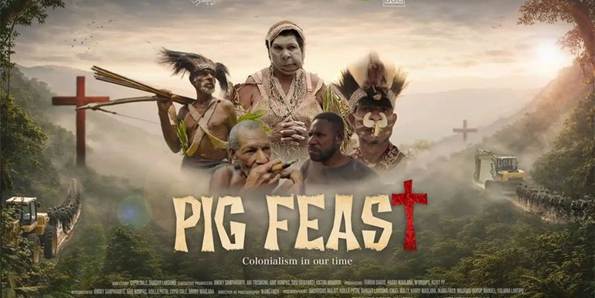
PESTA BABI : Colonialism in our time

to be held on Saturday 20th June at 6p.m. at the Conservation Council SA  

The Exchange  55 exchange Place Adelaide.

It is a full length film of 90 minutes to be followed by  Q& A time after for a further 30 minutes  

Pesta Babi : Colonialism in our time   has become so popular in Indonesia and abroad that

On May 14 alone, organizers recorded around 130 simultaneous viewing locations.

There were over 30 attempts by then Indonesia security forces  to close it down.

Rather than relying on commercial cinemas or subscription platforms, the documentary is circulated free of charge. Any community able to gather at least 10 people can organize a screening and receive the film directly from its producers. Since its release in March, screenings have spread rapidly across the country.

It had become so popular that some enterprising ( thieving ) people in Indonesia cloned the internet address of the film and sold it for $10 for a viewing.

To maximize the films viewing audience  on 22nd May the film was made free to view on You tube and it went viral with over 2,459,508 downloads on that day.  

We expect that as the film is free and highly popular that we will need to have several showings of the film .

The Event Cinema at The Exchange has seating for 155 .

If that books out we will release details  of additional showings   

Pesta Babi – Colonialism in our time, by Dandhy Laksono:

Synopsis of the film:

Yasinta Moiwend, a Marind Anim woman in Merauke, was startled when, on a quiet morning, a massive ship docked at her village pier. The vessel carried hundreds of excavators under escort by military forces, sent to Papua for a National Strategic Project for food production, palm-based biodiesel, and sugarcane bioethanol.

Vincen Kwipalo, from the Yei community, was likewise shocked when his clan’s land was suddenly marked with a sign reading: ‘Property of the Indonesian Army’. Only later did he learn that the land had been seized for the construction of a military battalion headquarters, at the very moment when sugarcane, a plantation company, was also encroaching on his ancestral forest.

‘Pig Feast’ combines detailed field recordings with in-depth research to examine the power structures behind the operation. It exposes how government and corporate entities—collaborating with military and religious groups—advance international and national goals of ‘food security’ and ‘energy transition’ at the expense of Indigenous communities and landscapes.

The documentary illustrates the networks of Indonesian elites, oligarchs, and multinational corporations that benefit from the project, providing a vivid depiction of the political ecology of Indonesian governance in Papua. ‘Pig Feast’ serves as a record of colonialism that remains intact today.

About the director: 

Dandhy Dwi Laksono is an Indonesian activist, investigative journalist, and filmmaker. He is known for his critical documentaries which look at how political and business interests collude to undermine democracy, infringe on human rights and destroy vulnerable natural and social environments in Indonesia. Born in East Java, Dandhy Laksono majored in International Relations at Padjadjaran University in Bandung, West Java, before founding the research-based documentary and audio-visual production house Watchdoc.


To book ticket click on

https://events.humanitix.com/pesta-babi-colonialism-in-our-time?_

link to the official trailer   3mins  https://www.youtube.com/watch?v=A-pPemC8m_