Indonesian Imperialism Is Alive – And Brutal – in West PapuaIn the restive eastern province, Cold War realpolitik continues to reverberate.


By David Hutt
April 26, 2024

ASEAN BEAT | SECURITY | SOUTHEAST ASIA
Indonesian Imperialism Is Alive – And Brutal – in West Papua
In the restive eastern province, Cold War realpolitik continues to reverberate.

David Hutt
By David Hutt
April 26, 2024
Indonesian Imperialism Is Alive – And Brutal – in West Papua
Supporters of the independence of the West Papua shout slogans during a rally
commemorating the 59th anniversary of the failed efforts by Papuan tribal
chiefs to declare independence from Dutch colonial rule in 1961, in Jakarta,
Indonesia, Tuesday, Dec. 1, 2020.

Credit: AP Photo/Achmad Ibrahim
Last month, videos emerged of 13 soldiers from an elite Indonesian battalion in
West Java torturing a Papuan man, Definus Kogoya. According to Human Rights
Watch, Kogoya “had his hands tied behind him and been placed inside a drum
filled with water. The soldiers taunted Kogoya with racist slurs, kicking and
hitting him. In another video, a man used a bayonet to cut his back. The water
turned red.” The military, while apologizing for the incident, insisted that
Kogoya was a member of the West Papua National Liberation Army and that he and
two comrades – one of whom “died when he jumped from a military vehicle after
arrest” – had burned down a clinic. Later, the police released the two alive
men without charge.

At least 10 Papuan teenagers were killed by Indonesia’s military last September
alone, while the implications of the 2019 Papuan uprising, the largest
pro-independence mobilization in decades, are still being felt. Douglas Gerrard
produced an excellent article on the conflict (“Indonesia Is Stepping Up Its
Repression of West Papua’s Freedom Movement”) last year.

When the rest of Indonesia won independence in the 1950s, West Papua remained
part of Dutch New Guinea. Jakarta wanted the entire territory. Sukarno’s first
foreign minister demanded that Jakarta and its forces “get them down from the
trees,” a racist notion of West Papuans that aped the racism of the European
colonizers and which continues today. In the 1950s, Indonesian troops led some
incursions into the Dutch colonial holdout but they were rebuffed, in part
because Washington was unsure of which side to take, not least because Sukarno
was still flirting with the communists.

But by the end of the 1950s, as the Cold War became more intense and Indonesia
was seen as a country that had to become an ally, by hook or crook, the
Americans made it known to the Dutch that they could no longer count on U.S.
support for the status quo. Knowing that its empire would soon end and motivated
to maintain some influence in Southeast Asia once it did, the Dutch cautiously
favored independence for the West Papuans and supported the formation in 1961
of the New Guinea Council, which drafted a manifesto for Independence and
Self-Government and declared the territory Papua Barat – “West Papua.”

Still, Washington wouldn’t support the effort. Instead, it orchestrated talks
that led to the August 1962 New York Agreement. Jakarta gained control of West
Papua (renamed West Irian), and after a brief transitional period overseen by
the U.N., things were supposed to climax in (and Indonesia was obligated to
hold) a referendum on self-determination.

Starting in July 1969, U.N. officials oversaw the so-called “Act of Free
Choice,” an Orwellian term if there ever was one. The U.N. claimed it would be
a fair election conducted under international scrutiny and by international
norms. And all adults from West Papua were supposed to have a vote, per the
U.N.’s rules. However, that wasn’t the case. Jakarta upped its attacks on West
Papuan separatists, especially after Suharto became dictator in 1965. Having
already decimated much of the separatist movement, Jakarta then handpicked
1,022 West Papuans to vote on behalf of the region’s 800,000 people in the
plebiscite, despite committing to a universal ballot. Naturally, they voted
unanimously in favor of integration with Indonesia.

In July 2004, on the 35th anniversary of this Act of Free Choice, the U.S.
National Security Archive released declassified documents on U.S. policy
deliberations, which I quote liberally from below. The violation of the Act of
Free Choice was obvious long before the 1,000 or so Jakarta patsies were led
forcibly into the polling booths. In 1968, U.S. embassy officials visiting the
region noted that “Indonesia could not win an open election.”  The U.S.
ambassador, Marshall Green, fretted at the time that U.N. officials might “hold
out for free and direct elections,” while Green stressed that all U.S. and
Western officials should make known to their U.N. counterparts the “political
realities,” meaning that Washington needed the vote to go Jakarta’s way because
it was a committed anti-communist ally at the time.

By October 1968, months before the election, the U.S. Embassy wrote back to
Washington in relief that U.N. officials had conceded “that it would be
inconceivable from the point of view of the interest of the U.N., as well as
the [Government of Indonesia], that a result other than the continuance of West
Irian within Indonesian sovereignty should emerge.” Even still, Green’s
successor as U.S. ambassador, Frank Galbraith, noted in 1969, the year of the
“referendum,” that “possibly 85 to 90%” of the West Papuan population “are in
sympathy with the Free Papua cause.”

Nonetheless, Nixon and Kissinger visited Jakarta in July 1969 while the
referendum was underway. Kissinger instructed his boss, “You should not raise
this issue” of West Papua, and advised that “we should avoid any U.S.
identification with” the matter of independence or integration. This was from a
man who described Suharto as a “moderate military man … committed to progress
and reform.” (Or was that said by U.S. officials of Prabowo today?) In any
case, Indonesia’s control over the region was accepted by the international
community, West Papua became a formal part of Indonesia, and six years later
Kissinger masterminded, shadowing another U.S. president, America’s support for
Indonesia’s colonization and occupation of Timor-Leste.

Why do I write all this? For starters, it’s a story often forgotten. How many
people have heard of West Irian or West Papua or know that there remains a
separatist movement? And there remains the notion that Indonesian imperialism
ended in the 1990s with the death of the Suharto regime. That’s true for Timor-Leste,
though Indonesians traipsed off only through pools of blood. Indonesia’s
imperialism is also back in the news as Prabowo Subianto, the incoming
Indonesian president, is accused of war crimes during his time in occupied
Timor-Leste as head of the Kopassus special forces. As I argued some months
ago, it’s not always healthy to pick at history’s healing wounds, and
Indonesia’s relations with Timor-Leste, despite its barbaric past, had been
healing for several years. But it’s quite another thing for the majority of
Indonesians to elect an alleged war criminal, which must surely re-open those
wounds.

But, also, this history serves as a reminder that American foreign policy is at
its most heinous and brutally hypocritical when it wants to appease dictators
and tyrants for a greater cause. A few months ago, after the death of Henry
Kissinger, I was asked by a newspaper to write an obituary. A family emergency
meant I hadn’t the time. But, for research and pleasure, which aren’t mutually
exclusive, I did re-read a number of biographies, including Niall Ferguson’s
sonorous first volume “Kissinger: 1923-1968: The Idealist,” and its polar
opposite, Christopher Hitchens’ “The Trial of Henry Kissinger,” a short
pamphlet that dedicates a chapter to how Washington (and Kissinger) sold out
East Timorese independence and permitted an Indonesian invasion in order to
appease Suharto and to keep stoking anti-communism in Southeast Asia. Hitchens
had no space, though, for West Papua. Yet he did write: “Those who willed the
means and wished the ends are not absolved from guilt by the refusal of reality
to match their schemes.”

Realpolitik didn’t die with Kissinger last November. It is found – although not
to the same extremity as in the 1960s and 1970s – in U.S. policy in Southeast
Asia today. It’s quite obvious that Washington doesn’t just tolerate but
provokes the worst excesses of the Communist Party of Vietnam because of
China’s hostilities with Hanoi. Equally, Washington is now seeking to make
friends with Phnom Penh because it has realized that it cannot condemn
Cambodian authoritarianism at the same time as deterring Cambodia’s friendship
with Beijing, so support for Cambodian democracy has been ditched. Elsewhere,
all effort is now on rivaling China. Liberation and liberty, not least in
Myanmar, are the casualties.

Contributing Author

David Hutt is a journalist and commentator. He is a research fellow at the
Central European Institute of Asian Studies (CEIAS), and a columnist at The
Diplomat and Radio Free Asia.

-- 

Amnesty International Report 2023/24

I

INDONESIA

Peaceful demonstrators were arrested and excessive force was used to break up protests. Military operations in Papua resulted in unlawful killings and torture and other ill-treatment. Pro-independence activists were imprisoned. Torture and other ill-treatment by security forces of criminal suspects was commonplace, in some cases resulting in deaths. Non-state armed groups in Papua were also responsible for unlawful killings. The government failed to conduct meaningful consultations with populations affected by controversial development projects. Indonesia remained heavily reliant on coal for energy generation and plans to phase out fossil fuels were inadequate.

Background
Tensions in Papua increased following the taking hostage in February of a pilot, a New Zealand national, by members of the National Liberation Army of Free Papua Organization (TPNPB-OPM) at Paro Airport in the remote highlands of Nduga regency, Papua Pegunungan province. In response the Indonesian military raised the operational status in Nduga to “combat alert” and deployed additional troops to the area, raising fears for the safety of civilians there and in surrounding areas.

Freedom of assembly
Security forces arrested peaceful demonstrators and used excessive force to disperse protests, often resulting in injuries.

On 5 August, police arrested 18 people who were resting in West Sumatra Grand Mosque in the provincial capital Padang during protests against plans for an oil and petrochemical refinery in Nagari Air Bangis village in Barat regency. Police removed other protesters from the building, some of whom were praying at the time, including women who were dragged from the mosque. At least five journalists who were live-streaming or reporting on the event were physically assaulted and threatened by police officers. All of those arrested, including community leaders and activists, students and lawyers, were subsequently released without charge. These events followed a six-day protest in Nagari Air Bangis by residents concerned about the risk posed by the construction of the refinery to their livelihoods and the local environment.

On 14 August, security forces arrested seven people and used tear gas to disperse protesters who were blocking a road in the city of Bandung, West Java, to protest against the planned eviction of around 300 residents of Dago Elos, a suburb of the city. Those arrested included Dago Elos residents and a lawyer who was supporting them in the land dispute. All were released on 16 August but three were charged with committing violent acts. Several people were reportedly injured as a result of excessive use of force by the police.1

Freedom of expression
Authorities continued to prosecute people for crimes against the security of the state for exercising their right to freedom of expression, including those calling for independence of Papua. At least three Papuan activists were imprisoned during the year for expressing their opinions.

On 8 August, Jayapura District Court found Yoseph Ernesto Matuan, Devio Tekege and Ambrosius Fransiskus Elopere guilty of treason under Articles 55 and 106 of the Criminal Code and sentenced them to 10 months’ imprisonment each. The three students were arrested in November 2022 while participating in a vigil at Jayapura University of Technology and Science to commemorate the 21st anniversary of the abduction and killing of pro-independence leader Theys Eluay, at which the Morning Star flag, a symbol of Papuan independence, was raised. All three were released in September having served their sentences.2

Unlawful killings
At least 26 incidents resulting in unlawful killings by security forces were reported in Papua, involving a total of 58 victims.

In September, security forces shot and killed five Indigenous Papuans in Dekai, the capital of Yahukimo regency, Papua Pegunungan province. The security forces claimed that the five, who were aged between 15 and 18, were killed in a firefight with the TPNPB-OPM. Other sources denied that the youths were members of the armed group but rather were returning to their village having bought food in Dekai. Anyone leaving Dekai was required to report to a security post on the outskirts of the city and if they failed to do so they were automatically considered to be members of the TPNPB-OPM. The authorities had not initiated investigations into the alleged killings by the end of the year.

Torture and other ill-treatment
Security forces subjected detainees to torture and other ill-treatment to extract information or confessions.

Torture and other ill-treatment remained commonplace in Papua, where incidents of arbitrary detention and torture also occurred in the context of military operations in and around Nduga regency. On 6 April, the military detained and tortured six Indigenous Papuans from Kwiyawagi village in Lanny Jaya regency, Papua Pegunungan province. The six, who included four boys, were transported by helicopter to the military headquarters in Timika, where 17-year-old Wity Unue died, reportedly as a result of injuries sustained from torture. The five others were released without charge on 20 April, but were reported to be in poor health. No one had been brought to justice by the end of the year.

In September, eight members of the narcotics division of Jakarta Metropolitan Police were named as suspects in the beating to death of a suspected drug dealer during interrogation in July. None of the eight had been charged by the end of the year.

In August, the body of Imam Masykur was found more than three weeks after he was abducted and tortured by three soldiers from the Presidential Security Force and the Indonesian military. According to the Asian Human Rights Commission, the three detained the 25-year-old in the capital, Jakarta, after accusing him of selling illegal drugs and demanded a ransom for his release. Imam Masykur’s body was found in a reservoir in West Java. In December, the three perpetrators were sentenced to life imprisonment and dismissed from the military.

Abuses by armed groups
Eleven incidents resulting in the unlawful killings of 24 victims by the TPNPB-OPM in Papua were documented during the year.

On 28 August, a spokesperson for the armed group claimed that it had killed Michelle Kurisi Doga in Kolawa, Lanny Jaya regency, Papua Pegunungan province. At the time of her death, Michelle Kurisi Doga was travelling to gather data on displacement resulting from military operations in Nduga, but according to the spokesman they suspected her of being a member of military intelligence.3

The New Zealand national taken hostage by the TPNPB-OPM in February had not been released by the end of the year.

Economic, social and cultural rights
The government failed to carry out meaningful consultations and effective human rights due diligence processes before allowing work to start on the Rempang Eco-City project, a multibillion-dollar industrial and tourism development project on Rempang Island. The project involves the relocation of around 7,500 residents from 16 villages primarily inhabited by the Tempatan Indigenous Peoples that would result in loss of access to their ancestral lands. The national development project met with strong opposition from Tempatan Peoples and other local communities. Consultations on the project were held with affected communities in August, but security at some of the meetings was reportedly heavy and observers described the meetings as a one-way dissemination of information from the government and the company to residents.

A series of protests against the acquisition of land for the Rempang Eco-City project were held in August and September, culminating in clashes with security forces on 7 September during which some protesters threw stones and water bottles and security forces responded with water cannon, tear gas and rubber bullets. At least 20 protesters were injured and approximately 25 pupils from two schools located near the site of the protests required hospital treatment from the effects of tear gas. Following the events of 7 September, new joint police/military security posts were established on the island. According to the local branch of the NGO Legal Aid Institute, at least 35 people were charged with using or threatening to use violence against officials carrying out their duties, which carries a maximum prison sentence of one year and four months.4

Right to a healthy environment
Although Indonesia generated an increasing amount of its electricity from renewables, it remained heavily reliant on coal for electricity generation. Coal was also Indonesia’s biggest export product. Plans to phase out the use of fossil fuels in energy production, set out in Presidential Regulation No. 112 of 2022 on the Acceleration of Renewable Energy Development for Power Supply, were inadequate because, among other factors, although the regulation banned new coal-fired energy plants, it permits the development of those already planned. As such, the government proceeded with a planned 35 thousand-megawatt power generation project, agreed in 2015, involving the construction of 109 mainly coal-fired power plants across the country

NDONESIA 2023

Pacific churches urges MSG to expel Indonesia if it doesn’t allow UN visit to Papua

Suara Papua – April 16, 2024

Elisa Sekenyap, Jayapura — The Pacific Conference of Churches (PCC) says it deplores the recent sadistic torture of indigenous peoples of Melanesia in West Papua committed by the Indonesian government through members of the TNI (Indonesian military).

“Unfortunately this horrifying incident is only the latest in the six decades of Indonesian oppression of the people of West Papua”, PCC General Secretary Reverend James Bhagwan told Suara Papua on Sunday April 14 via email from Suva, Fiji.

The PCC’s statement was conveyed in connection with three Papuan civilians who were tortured by TNI officers in Puncak regency, Central Papua province, a video of which spread widely on social media not long ago.

Bhagwan said that the Indonesian government is a signatory to a number of United Nations conventions, which should guarantee the civil and political rights of its citizens, including West Papuans, regardless of their political ideology or religious beliefs.

“The Indonesian government should also do the same thing under what is called the Special Autonomy Law. However, people who express their rights as indigenous people, express voices that are different from the government, are routinely harassed and tortured brutally”, he said.

Bhagwan said it should be noted that Indonesia, which tries to be seen as a respected member of the international community, has been re-elected for another term as a member of the UN Human Rights Council (2024-2026).

“Do countries that supported Indonesia’s nomination as members of the UN Human Rights Council say they feel comfortable with these human rights violations?”

“With the end of the meeting of Melanesian Spearhead Group foreign officials and in anticipation of the next meeting of MSG leaders, the question is, how is it that the MSG is able to continue to allow Indonesia, which has policies and practices that demean dignity, weaken and eliminate women’s rights, children, Melanesian men and fellow MSG members, remain a member [of the MSG]?”

“Therefore in the name of justice, which is an expression of divine love, and when much of the Pacific people are reflecting on the betrayal, arbitrarily arrest, torture, fake trial and execution of our God and Savior, Jesus Christ, we call for the suspension, or even the expulsion of Indonesia from the MSG if they do not agree to facilitate a visit by the UN Human Rights [Commissioner] to West Papua”, concluded Bhagwan.

[Translated by James Balowski. The original title of the article was “Gereja Pasifik Desak MSG Keluarkan Indonesia Jika Tidak Memfasilitasi Komisi HAM PBB Ke Papua”.]

Source:

—————————————————————

Indonesia’s claims that West Papua was never colonised false’ 

By Doddy Morris  23 hrs ago

It has been 60 years since Indonesia has refused humanitarian agencies and international media access to enter West Papua.

According to Benny Wenda, the President of the United Liberation Movement for West Papua (ULMWP), Indonesia is comparable to North Korea in terms of media access. North Korea does not allow international media visits, and the situation in West Papua is similar.

Speaking with the Vanuatu Daily Post yesterday, Mr. Wenda said organisations such as the Red Cross, International Peace Brigades, Human Rights Agencies, and even the British Broadcasting Corporation (BBC) have been completely banned from West Papua for 60 years.

“Indonesia claims to be a democratic country. Then why does Indonesia refuse to allow, in line with calls from the Pacific Islands Forum (PIF) and the Melanesian Spearhead Group (MSG), a visit from the United Nations (UN) Commissioner to examine the human rights situation? It has been 60 years, yet Indonesia has not heeded this call, while the killings continue,” he said.

“If Indonesia truly upholds democracy, then it should allow a visit by the UN Commissioner. This is why we, as Melanesians and Pacific Islanders, are demanding such a visit. Even 85 countries have called for the UN Commissioner’s visit, and Indonesia must respect this as it is a member of the UN.”

The ULMWP also issued a statement, stating that over 100,000 West Papuans were internally displaced between December 2018 and March 2022, as a result of an escalation in Indonesian militarisation.

They reported that as of October 2023, 76,228 Papuans remained internally displaced, and over 1,300 Papuans were killed between 2018 and 2023, and a video of Indonesian soldiers torturing a West Papuan in Puncak has made international news.

In response to the disturbing video footage about incident in Papua, Indonesia stated that the 13 Tentara Nasional Indonesia (TNI) personnel (National Armed Forces of Indonesia) involved have been detained.

“The Embassy emphasised that torture is not the policy of the Government of Indonesia nor its National Armed Forces or Indonesian National Police,” the statement relayed.

“Therefore, such actions cannot be tolerated. Indonesia reaffirms its unwavering commitment to upholding human rights, including in Papua, in accordance with international standards.”

The ULMWP said Indonesian is lobbying in Vanuatu and the Pacific, presenting themselves as friends, while allegedly murdering and torturing Melanesians.

“For instance, in the Vanuatu Daily Post interview published on Thursday this week, the Indonesian Ambassador to Vanuatu claimed that West Papua was never colonised. This claim is flatly untrue: for one thing, the Ambassador claimed that ‘West Papua has never been on the UN Special Committee on Decolonisation (C-24)’ – but in fact, West Papua was added to the list of ‘Non-Self Governing Territories’ as the Dutch decolonised in the 1960s,” the Movement stated.

“According to the 1962 New York Agreement, West Papua was transferred to Indonesia on the condition of a free and fair vote on independence. However, in 1969, a handpicked group of 1,022 West Papuans (of an estimated population of 800,000) was forced to vote for integration with Indonesia, under conditions of widespread coercion, military violence and intimidation.

“Therefore, the right to self-determination in West Papua remains unfulfilled and decolonisation in West Papua is incomplete under international law. The facts could not be clearer: West Papua is a colonised territory.”

The Vanuatu Daily Post also asked some similar questions that had been posed to Indonesia on March 28, 2024, to which Mr. Wenda responded adeptly. Additionally, he provided insightful commentary on the current geopolitical landscape.

What do you believe Indonesia’s intention is in seeking membership in the MSG?

Indonesia’s intention to join MSG is to prevent West Papua from becoming a full member. Their aim is to obstruct West Papua’s membership because Indonesia, being Asian, does not belong to Melanesia. While they have their own forum called the Association of Southeast Asian Nations (ASEAN), we, as Melanesians, have the PIF, representing our regional bloc. Indonesia’s attempt to become an associate member is not in line with our Melanesian identity. Melanesians span from Fiji to West Papua, and we are linguistically, geographically, and culturally distinct. We are entitled to our Melanesian identity.

Currently, West Papua is not represented in MSG; only Indonesia is recognised. We have long been denied representation, and Indonesia’s intention to become an associate member solely to impede West Papua’s inclusion is evident.

Is Indonesia supporting West Papua’s efforts to become a full member of the MSG?

I don’t think their intention is to support; rather, they seek to exert influence within Melanesia to obstruct and prevent it. This explains their significant investment over the last ten years. Previously, they showed no interest in Melanesian affairs, so why the sudden change?

What aid is Indonesia offering Vanuatu and for what purpose? What are Indonesia’s intentions and goals in its foreign relations with Vanuatu?

I understand that Indonesia is an associate member of the MSG and contributes to its annual budget, which is acceptable. However, if Indonesia is investing heavily here, why aren’t they focusing on addressing the needs of their own people? I haven’t observed any Ni-Vanuatu begging on the streets from the airport to here (Golden Port). In contrast, in Jakarta, there are people sleeping under bridges begging for assistance. Why not invest in improving the lives of your own citizens? People in Jakarta endure hardships, living in slum settlements and under bridges, whereas I have never witnessed any Melanesians from West Papua to Fiji begging. So, why the sudden heavy investment here, and why now? —

In West Papua, the Birth of a ‘Lost Generation’

As the world closely watches Gaza and Ukraine, a source reaches out from another enclosed area of prolonged armed conflict: West Papua.

By Klas Lundström April 06, 2024

https://thediplomat.com/2024/04/in-west-papua-the-birth-of-a-lost-generation

I know what you think,” the source tells me. “That it’s fake. It’s not fake. It’s our life.”

It is a video of an act of torture in Gome, in central West Papua. It shows a man with his hands tied inside a water-filled drum. Men take turns beating and kicking the man, screaming racist slurs that have been an ominous ingredient of the Indonesian occupation of West Papua since the 1960s. 

The tied man is incapable of any form of resistance. He is alone, the perpetrators are plenty. A bayonet cuts the man’s back and the water turns red. There is no way out of the entrapment without the assistance of his surroundings. But no one in the beating party is there to assist him – nor is Indonesia present in West Papua to assist its people.

The man’s name is Definus Kogoya. He was arrested on February 3, 2024, suspected of arson – a suspicion that was swiftly written off by the police. By then, however, another suspect, Warinus Kogoya, had perished when he “jumped” from a police truck, trying to escape.

Collective Punishment

In the hands of the military, Definus Kogoya was subjected to the collective frustration of the Indonesian army, which despite its dominance in terms of military and technological equipment has proved incapable of breaking down a popular rebellion in West Papua, consisting of both armed and non-violent resistance

The torture video is a testament to the everyday violence, discrimination, and humiliation that Indonesian army personnel subject the West Papuan population to. Had the soldiers never eternalized their bestial act on video, it remains highly uncertain that any legal consequences would have eventuated – as is the case now. 

Thirteen soldiers from the 300 Infantry Raider Battalion, stationed in conflict-ridden central West Papua, have been arrested, accused of torture. In the wake of the video’s wide circulation, the Indonesian military openly apologized to “all Papuan people” for the event. Benny Wenda, a prominent West Papuan political leader in exile in London, stated in a video comment that “torture is such a widespread military practice that it has been described as a ‘mode of governance’ in West Papua.”

Severe and Rampant Deforestation

The act of torture is a haunting mirroring image of Indonesia’s colonial policy in West Papua. It is about beating the soil free of natural resources. Large-scale deforestation to pave the way for palm oil operations and mining sites is so severe and rampant that significant parts of West Papua’s virgin forests have been turned into “pockets,” like oases in a desert. 

“People are leaving their lands,” a source tells me. Where do they go? I ask. “Anywhere,” is the answer, another way of saying nowhere.

The controversial “Omnibus Law,” pushed through by outgoing Indonesian President Joko Widodo as a “policy of development,” includes the establishment of large-scale food estates to secure food availability for Indonesia, while also providing large areas of West Papua’s “unused areas” to mining, forestry, and infrastructure projects. All of these operations have been linked to continued deforestation, according to various environmental watchdogs who have also reported on a “significant underreporting” of methane emissions from Indonesia’s coal mines. 

“A lot of land use and land-based investment permits have already been given to businesses, and a lot of these areas are already prone to disasters,” Arie Rompas, a forestry expert at Greenpeace, told The Associated Press.

A New “Blood-stained” President

President-elect and long-time military potentate Prabowo Subianto, controversial due to his tainted human rights record, has not only promised to continue his predecessor’s development policy in places like West Papua; he inherits an armed conflict that since late 2018 has shown Jakarta (and the rest of the world) that large portions of West Papuans simply won’t accept being treated as second-class citizens anymore.

What’s clearer – and worse from Jakarta’s perspective – is that their claim and request for a U.N.-observed referendum on independence from Indonesia, to make up for the “Act of Free Choice” in 1969, when a thousand “chosen” Papuans voted for “integration with Indonesia” at gunpoint, simply won’t go away despite Indonesia’s brutal military response. In Sentani, in northern West Papua on April 2, 77 people were sprayed with teargas and arrested for participating in a peaceful demonstration against the militarization of West Papua. Many were severely beaten, reported Human Rights Monitor.

The New Zealand pilot kidnapped last year and still in the hands of armed rebel forces is another political hand grenade for the president-elect. In February, the rebels said Phillip Mehrtens would be released, but did not specify when. Prabowo has proven more than capable of launching large-scale military operations in West Papua. In 1984, he ordered Indonesian special forces, the notorious Kopassus, to “clean up” outspoken independence advocates. Among the operations were various border crossings into Papua New Guinea in search of rebels. In the no-man’s land between PNG and West Papua, along Fly River, I interviewed displaced West Papuans who still recall the brutality and lack of mercy that Indonesian forces showed civilians during these mid-1980s military operations.

The IDPs Crisis Persists

The systematic brutality directed at West Papuans while in custody is mirrored by a total lack of presence when it comes to the more than 60,000 internally displaced people (IDPs) in the Central Highlands. The Secretariat of Justice and Peace of the Catholic Church stated in a November 2023 report that the “IDP crisis persists” and that people have perished in poorly functioning refugee camps due to the lack of the most basic access to food and healthcare. Many of the dead are minors, who lived their entire short lives on the run, after seeing their lands bombed by Indonesian forces (allegedly using chemical weapons) or becoming victims of land grabs. Land is not infrequently confiscated by mining, logging, and palm oil interests, or integrated as “available lands” for Indonesian transmigrants from Java and Sulawesi. 

The existing infrastructure in the abandoned villages in the highlands has often either been demolished or damaged. Schools, churches, and health clinics are no longer places of education, collectiveness, and care, but instead turned into military headquarters, according to a 2023 Human Rights Monitor report. Humanitarian law is not respected, instead thousands of men, women, children, and elderly have been cast into a life “in subhuman conditions, without access to food, healthcare services, or education.” 

A Stand Against “Settler Colonialism”

Esther Haluk, a West Papuan democratic rights activist who was among those arrested in a May 2022 military sweep, looks to the future with fear. The conflict, she underlined in a speech, “is not about color television or 3G internet, it’s about indigenous dignity and a stand against militarism.”

“This is a real form of settler colonialism, a form of colonization that aims to replace the indigenous people of the colonized area with settlers from colonial society,” she added. “In this type of colonialism, indigenous people are not only threatened with losing their territory but also their way of life and identity that’s been passed down to them from generation to generation.”

The situation in the highlands resembles that which has lasted for decades along the border between West Papua and Papua New Guinea. Along Fly River, in a political and socioeconomic no-man’s-land, entire generations have been sacrificed due to the lack of schools, proper healthcare, and long-term-sustainable job opportunities. PNG authorities were – and remain – less than interested in facilitating social service for the refugees, let alone being a spokesperson for a just and secure reintegration of the displaced back into West Papuan society. The same goes for the world community.

“They kill the future by displacing the young,” one source tells me. “It’s a slow genocide that will pick up speed with time.”

The birth of a “lost generation” in the highlands, left to be cared for by local churches while Indonesia keeps the door shut for U.N. and independent reporters to document the short- and long-term conditions for IDPs, takes place in a world occupied with Ukraine and Gaza. To make matters worse, leaked lists of personal information and telephone numbers of local independent reporters and human rights activists underlines an eagerness to pester anyone who sets out to document the reality in West Papua with threatening calls and messages.

“The people of West Papua are constantly hit by the forces of Indonesian colonial weapons,” a source tells me. “But we will never back down, we have no choice but to keep fighting for our right to live.”

* Note on sources: All sources are anonymous due to safety concerns. To minimize the risk of exposure their individual expertise, geographical domicile, and job titles are not presented, but they include human rights workers, environmental activists, and politicians.

GUEST AUTHOR

 Klas Lundström  Klas Lundström is an investigative reporter and writer, based in Stockholm, who has reported from Indonesia, Mongolia, Tajikistan, Solomon Islands, Timor-Leste, and West Papua for various media outlets

Indonesian military probes viral video allegedly showing Papuan’s brutal torture by soldiers

Victor Mambor and Dandy Koswaraputra

Indonesian military probes viral video allegedly showing Papuan’s brutal torture by soldiers

Victor Mambor and Dandy Koswaraputra
2024.03.22
Jayapura, Indonesia, and Jakarta

Share on Facebook

Share

A

 2024.03.22 Jayapura, Indonesia, and Jakarta

Military officials in Indonesia’s restive Papua region said Friday they were verifying the authenticity of a video that has gone viral and appears to show Indonesian servicemen beating and cutting with a bayonet a man believed to be an indigenous Papuan. 

Human rights activists demanded a swift inquiry to determine if soldiers were involved in what would be yet another case of torture and abuse, which is a longstanding accusation against Indonesian military and security forces in Papua.

The location and time of the alleged incident are unclear.

“We are verifying its authenticity,” Col. Gusti Nyoman Suriastawa, a military spokesman in Papua, told BenarNews. “If it is genuine, we need to determine where and when it occurred.”

The graphic video footage, viewed by BenarNews, shows men in trousers that resemble Indonesian military uniform fatigues, taunting the victim who is seen inside a water-filled drum.

“How does that feel? Head up! Head up,” the men say as they hit him and make incisions on his back with a bayonet.

As the men continue to inflict the wounds, the water in the drum can be seen turning red.

In a statement issued after the video was widely circulated, PAHAM Papua, a local human rights organization, issued a statement that makes the assumption that the abusers in the footage are members of the Indonesian Armed Forces [TNI].

“If the individual was suspected of criminal activity, the TNI should not have resorted to such brutal and sadistic torture as shown in the video,” PAHAM chairman Gustaf Kawer said.

“The act of torture inflicted on [the] civilian was extremely cruel, carried out by TNI [personnel without adhering to the principle of presumption of innocence.”

PAHAM urged the National Commission on Human Rights (Komnas HAM) and the Indonesian military to conduct a “comprehensive investigation.”

Theo Hesegem, executive director of the Papua Human Justice and Integrity Foundation, urged authorities “to ensure that the perpetrators of the torture are processed swiftly.”

“It is clear that the individual subjected to torture is a native Papuan,” he said in a statement.

Komnas HAM, meanwhile, indicated that initial findings point to the incident taking place in the Puncak regency of Central Papua province. 

“This compounds the toll of violence from the ongoing conflict in Papua, with suspicions pointing to torture by authorities,” Komnas HAM chairwoman Atnike Nova Sigiro Atnika said in a statement. 

Rights groups have long accused Indonesian security forces of abuses in Papua, including arbitrary arrests, torture, and extrajudicial killings. 

Papua, at the far-eastern end of the Indonesian archipelago, has seen an escalation in violence following an insurgent attack that resulted in the deaths of 19 road construction workers and a soldier in 2018.

The heavy military presence and ongoing violence have stifled development in the region.

On Friday, Rumadi Ahmad, a deputy chief of the Indonesian presidential staff, said that President Joko “Jokowi” Widodo had committed to accelerating development in Papua, but these efforts would be hampered if the military was responsible for the violence in the video.

“While we hold a strong hope that our soldiers are not involved in such reprehensible acts, if proven true, the individuals responsible must be held accountable in accordance with the applicable rules and regulations,” Rumadi said in a statement.

He said the military played a strategic role “in bringing about a sense of security” in Papua.

“If the video is proven to be true, the actions by a few irresponsible individuals could be very disruptive to the development that has been planned and implemented so well,” Rumadi said.

Insurgents have also been responsible for civilian fatalities, targeting those they suspect of espionage for the authorities. In 2022, rebels killed eight employees of Telkomsel, the nation’s leading telecommunications provider, who were constructing cellular towers in the Puncak regency.

However, one armed separatist group, the West Papua National Liberation Army, quickly distanced itself from the incident in the video and condemned the acts therein, which spokesman Sebby Sambom attributed to the TNI.

“The actions of the Indonesian military and police are akin to [those of] ISIS terrorists,” Sambom said, referring to the Islamic State militant group.

Papua, a mineral-rich and underdeveloped region, has been grappling with a separatist insurgency for decades. The mineral extraction and alleged discrimination against indigenous Papuans by the Indonesian government have fueled the conflict. 

Papuans have long felt marginalized economically and politically, despite the immense wealth their land generates.

The territory was incorporated into Indonesia in the 1960s after a controversial United Nations-backed plebiscite. 

Many Papuans allege the vote was rigged and have since fought for independence.

Acquitted rights defenders Fatia-Haris credit public support, solidarity for court win

Republika – January 8, 2024

Teguh Firmansyah, Jakarta — Lokataru Foundation for Human Rights Executive Director Haris Azhar and former Commission for Missing Persons and Victims of Violence (Kontras) Coordinator Fatia Maulidiyanti have spoken out after being found not guilty in a defamation case brought against them by Coordinating Minister for Maritime Affairs and Investment Luhut Binsar Pandjaitan.

As a result of the court’s verdict, Azhar and Maulidiyanti have escaped long prison sentences.

Azhar specifically expressed his appreciation for the work of their lawyers saying he felt they were able to be acquitted thanks to the help of the legal team throughout the trial.

“They worked with knowledge, with skill, dedication, energy and an extraordinary amount of time … once again I say the team of lawyers worked ceaselessly, [they were] exceptional”, Azhar told reporters after the verdict was read out at the East Jakarta District Court on Monday January 8.

Haris views their acquittal as being inseparable from the role played by public support and is convicted this support was their strength in the trial.

“This was a social movement that was manifested very very well in the courtroom. This is what we call court activism that sides with human rights and the environment”, said Azhar.

Maulidiyanti meanwhile also praised the legal team for the dedication provided during the legal proceedings but warned that the verdict is not the end, but part of a democratic journey in Indonesia.

“Our acquittal is not the end of a long journey of democracy in Indonesia, which I think must still need consistency”, she said.

Maulidiyanti also said she hopes that the case which ensnared them can be a lesson for other activists. She hopes that this unceasing public support not be just for them, but for all human rights defenders and wants the sense of solidarity that flowed throughout their trial to be maintained for the sake of upholding human rights.

“To all social movements that are out there now that have made such a great effort, always stand in solidarity and I hope that this solidarity does not just stop with both of us but also in many other moments for democratic independence, human rights, justice, and an environment that is clean and healthy and also anti-corruption”, said Maulidiyanti.

Previously, the prosecution had demanded a sentence of four years in prison and a fine of 1 million rupiah or an additional six months in prison for Azhar and 3 years six months in prison and a fine of 500 thousand rupiah or an additional for three months in prison for Maulidiyanti.

In the prosecution’s view, the pair were proven legally and convincingly guilty of defamation as regulated by Article 27 Paragraph 3 in conjunction with Article 45 Paragraph 3 of the Information and Electronic Transaction (ITE) Law in conjunction with Article 55 Paragraph 1 of the 1st Criminal Code (KUHP).

But the panel of judges considered that the charges against Azhar and Maulidiyanti did not fulfilling the legal elements necessary for a conviction and acquitted both of them.

The case began with a discussion between Azhar and Maulidiyanti in a video uploaded on Azhar’s YouTube account titled “There is Lord Luhut behind the Economic Relations-Military Operations in Intan Jaya!! There are also State Intelligence Agency Generals!! NgeHAMtam”.

[Translated by James Balowski. The original title of the article was “Ini Respons Haris dan Fatia Seusai Divonis Bebas”.]

Source:

https://news.republika.co.id/berita/s6xopp377/ini-respons-haris-dan-fatia-seusai-divonis-bebas

Indonesia is one of the world’s largest democracies, but it’s weaponising defamation laws to smother dissent

This article is from The Conversation and was published 9/1/24 The author is Tim Mann, Association Director , Centre for Indonesian Law, Islam and Society University of Melbourne

Two former coordinators of one of Indonesia’s most prominent human rights organisations have escaped conviction in a defamation case brought by a powerful government minister. While their astonishing acquittal is welcome, the case marked a bleak new low for freedom of expression in one of the world’s largest democracies.

Haris Azhar and Fatia Maulidiyanti, who had coordinated the Commission for the Disappeared and Victims of Violence (KontraS), were accused of defamation by Coordinating Minister for Maritime Affairs and Investment, Luhut Binsar Pandjaitan.

Luhut’s statements made it clear the case was expressly intended to create a chilling effect and smother civil society criticism of the government.

So what is the case about, and why is it so important?

Make better decisions – find out what the experts think.

Read more: Is Joko Widodo paving the way for a political dynasty in Indonesia?


A messy web of mining interests

The case related to a 2021 YouTube video in which Haris and Fatia discussed a report published jointly by a group of Indonesian civil society organisations. In the video, the pair mentioned that Luhut was “implicated” or “involved” (bermain) in mining in Wabu Block, in the Intan Jaya district of what is now Central Papua Province.

The details are a bit complicated, but a key part of the dispute centred on this point about mining.

In 2016, Australian mining firm West Wits Mining reported to the Australian Stock Exchange (ASX) that its Indonesian subsidiary Madinah Quarataa’in had entered into an agreement with another company, Tobacom Del Mandiri. They wanted to develop the Derewo River Gold Project in Intan Jaya.

Tobacom Del Mandiri is owned by another major Indonesian firm, Toba Sejahtra. Luhut has acknowledged he holds 99% of shares in Toba Sejahtra.

Representatives from both Indonesian companies have since said the partnership did not go ahead. But given his stock portfolio, the activists had a relatively firm basis for implying Luhut was “involved” in mining in Papua.

Luhut objected to this.

He also objected to Haris and Fatia referring to him as a “villain” (penjahat) and “Lord Luhut”, a favourite moniker of Indonesians online. He got the nickname because President Joko “Jokowi” Widodo has entrusted him to oversee a seemingly endless list of strategic projects.

Haris and Fatia were charged with defamation under the Law on Electronic Information and Transactions (commonly known as the ITE law). Unlike in Australia, defamation is a criminal offence in Indonesia. They also faced secondary fake news charges and defamation charges under the Criminal Code.


Read more: A twist in Indonesia’s presidential election does not bode well for the country’s fragile democracy


Making an example of activism

Under Jokowi, there has been a dramatic escalation in abuse of the Electronic Information and Transactions Law to target activists, human rights defenders, journalists, and ordinary citizens.

According to Indonesian digital rights organisation SAFEnet, 89 people were reported under the law between January and October 2023.

Public anger over the arbitrary way the law has been applied led the government to publish guidelines for law enforcers on its implementation.

According to the guidelines, defamation charges should not be brought when assertions are based on analysis, opinion or facts.

Luhut reported Haris and Fatia to police just three months after these guidelines were published.

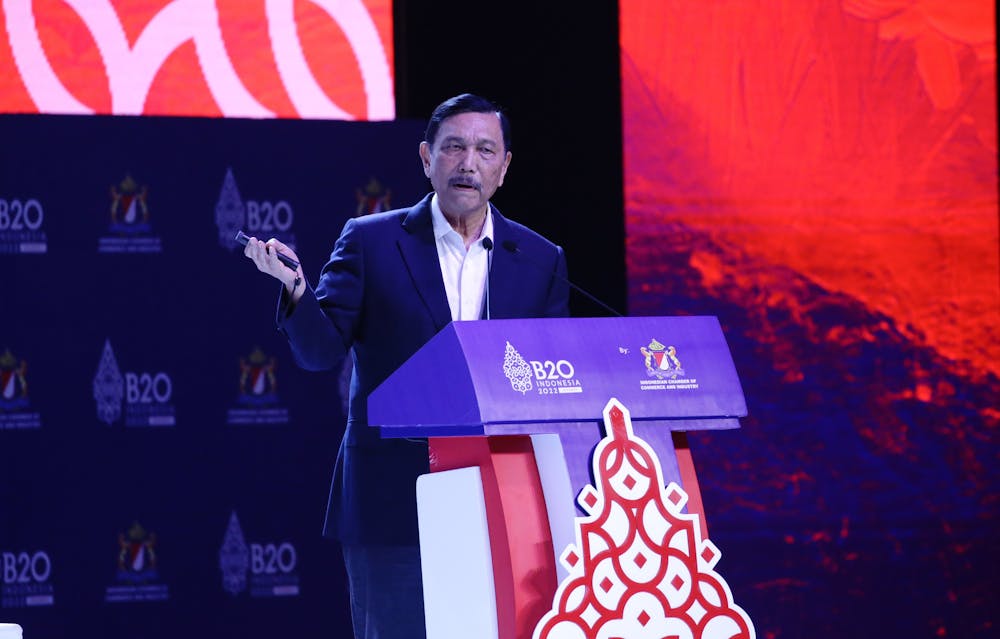
An Indonesian man in a suit delivers a speech behind a lectern
Indonesian government minister Luhut Binsar Pandjaitan has alleged he was defamed by two activists. Adi Weda/EPA

The trial ran from April 2023 through to January 8 2024. During the trial, Luhut complained that being called names was “deeply hurtful”.

Delivering the court’s decision, Judge Muhammad Djohan Arifin said the YouTube conversation between Haris and Fatia constituted opinion and analysis of a civil society study and their use of the word “lord” was not defamatory.

Prosecutors have said they will consider appealing the decision.

Luhut claimed he reported the activists to defend his reputation. Other statements he made during the trial left no doubt as to his real motivations.

Luhut said he wants the case to serve as a “lesson”.

The prosecution concluded its sentencing demand with a quote from a minor politician, Teddy Gusnaidi, stating:

If using the label ‘activist’ means you are immune from prosecution, criminals will form NGOs (non-government organisations) to avoid consequences for their crimes.

Luhut also claimed that he wanted to conduct an “audit” of all non-government organisations in Indonesia to determine where they get their funding.

This is disingenuous.

Indonesian civil society organisations already need government approval to receive donor funds, and most openly publish their list of donors in their public annual reports.

The government also regularly subjects foreign donors to interrogation from everyone from police to intelligence agencies, about their planned activities.

Increasingly authoritarian tactics

Appealing to nationalistic sensibilities and raising questions about civil society organisations like this is a classic technique of authoritarian governments. It undermines organisations critical of government and redirects focus from the issues at hand.

Legal attacks like the one against Haris and Fatia are designed to wear civil society down. Fronting up in court every week is time consuming, emotionally draining, and takes activists away from their work.

Further, the use of judicial harassment to target activists, in contrast to cruder tactics such as cyberattacks or physical violence, is designed to lend an air of legitimacy to government repression.

Luhut has made it clear that the goal of the case against Haris and Fatia is to silence dissent. He appears to be succeeding.

There is already evidence that abuse of the Electronic Information and Transactions Law is having a chilling effect in Indonesian society, with a 2022 survey finding 62.9% of Indonesians were afraid of openly expressing their opinions.

Indonesian pro-democracy groups have long been willing to speak out against the state, even under the most challenging conditions. Yet repeated charges and arrests will eventually result in self-censorship and behavioural change.

In the face of mounting pressure, the government finally passed a revised version of the law on December 5 2023.


Read more: Myanmar crisis highlights limits of Indonesia’s ‘quiet diplomacy’ as it sets sights on becoming a ‘great regional power’


Activists have complained that, like other regressive laws enacted in Indonesia over recent years, deliberations on the revision were conducted largely behind closed doors.

The revised law does include some improvements, including that statements made in the public interest or to defend oneself cannot be prosecuted. The maximum sentence for defamation has also been decreased to two years, yet it remains longer than provisions on defamation in the new Criminal Code, which will come into force in 2026.

Activists have argued for a complete dropping of criminal charges for online defamation. Given they have proven such an effective tool for smothering dissent, there was never any chance legislators were going to simply give up this weapon.

Haris and Fatia may be the highest profile Indonesians charged under the Electronic Information and Transactions Law, but they will not be the last.

.

Amnesty slams intimidating against student leader for criticising state policy

Republika – November 10, 2023

Erdy Nasrul, Jakarta — Amnesty International Indonesia Executive Director Usman Hamid is monitoring a case of alleged intimidation by security forces against University of Indonesia Student Executive Council (BEM UI) Chairperson Melki Sedek Huang.

Hamid feels that this kinds of thing should not happen in a democratic country and has condemned the intimidation directed at Huang along with this parents and teachers.

“We know Melki as a student who articulates his views on state policy.

He is critical of the Constitutional Court’s decision on the age limit for presidential and vice presidential candidates. This is Melki’s constitutional right”, Hamid told reporters on Friday October 10.

Hamid emphasised that intimidation against citizens who criticise the state is a serious threat to freedom of expression and warned that this adds to the list of cases of threats to civil liberties in Indonesia.

“Everyone has the right to state their thoughts without being afraid of threats and punishment”, said Hamid.

Hamid is therefore urging the authorities to investigate the intimidation against Huang, his family and teachers, as well as fellow students, which was allegedly carried out by state security forces.

Hamid is asking that the perpetrators be prosecuted through a fair and transparent legal process.

“The state is obliged to prevent intimidation against individuals who express their thoughts peacefully. The state must also ensure that the duties of the security apparatus are to provide guidance, service and protection. Not suppress criticism”, said Hamid.

Earlier on Tuesday November 7, Huang claimed that he had been intimidated directly and through his parents and teachers in Pontianak, West Kalimantan.

“My mother was visited by security personnel at home. Officers from the TNI [Indonesian military] and the Polri [national police] asked my mother, ‘When does Melki usually come home? What are Melki’s activities at home'”, said Melki in a video recording obtained by Amnesty International on Wednesday November 8.

Melki also claimed that he had received threats since becoming the BEM UI chairperson in early 2023. The threats increased leading up to and after demonstrations rejecting the Constitutional Court’s decision on the age limit for presidential and vice presidential candidates on October 16 2023.

Amnesty International data as of October 2023 has recorded that since the beginning of this year there has been at least 78 cases of physical attacks against human rights defenders with at least 226 victims. These attacks include intimidation and physical attacks, being reported to the police, attempted murder, criminalisation, arrest and attacks against human rights institutions.

[Translated by James Balowski. The original title of the article was

“Amnesty: Usut Intimidasi terhadap Ketua BEM UI”.]

General Assembly Elects 15 Members to Human Rights Council includes Indonesia

The General Assembly today elected 15 Member States to the Human Rights Council, the United Nations body responsible for promoting and protecting all human rights around the globe.

By secret ballot, the Assembly elected Albania, Brazil, Bulgaria, Burundi, China, Côte d’Ivoire, Cuba, Dominican Republic, France, Ghana, Indonesia, Japan, Kuwait, Malawi and the Netherlands.  All 15 members will serve three-year terms beginning on 1 January 2024.

China, Côte d’Ivoire, Cuba, France, Malawi are currently serving three year terms set to expire on 31 December 2023.  The other 10 newly elected States will replace the following outgoing members:  Bolivia, Czech Republic, Gabon, Mexico, Nepal, Pakistan, Senegal, Ukraine, United Kingdom and Uzbekistan.

The 15 new members were elected according to the following pattern:  four seats for the African States; four seats for the Asia-Pacific States; two seats for the Eastern European States; three seats for the Latin American and Caribbean States; and two seats for Western European and other States.

Dennis Francis (Trinidad and Tobago), President of the General Assembly, announced that the following States will continue as members of the Council: Algeria, Argentina, Bangladesh, Belgium, Benin, Cameroon, Chile, Costa Rica, Eritrea, Finland, Gambia, Georgia, Germany, Honduras, India, Kazakhstan, Kyrgyzstan, Lithuania, Luxembourg, Malaysia, Maldives, Montenegro, Morocco, Paraguay, Qatar, Romania, Somalia, South Africa, Sudan, United Arab Emirates, United States and Viet Nam.

Created by the General Assembly in March 2006 as the principal United Nations entity dealing with human rights, the Human Rights Council comprises 47 elected Member States.  On the basis of equitable geographical distribution, Council seats are allocated to the five regional groups as follows:  African States, 13 seats; Asia-Pacific States, 13 seats; Eastern European States, 6 seats; Latin American and Caribbean States, 8 seats; and Western European and other States, 7 seats.

The Assembly President opened the meeting by expressing his deep concern over the deteriorating security situation in the Middle East that has left hundreds dead and scores more wounded in Israel and in the State of Palestine.  He called for an immediate cessation of violence and for all stakeholders to help de-escalate the situation and to render humanitarian aid and support.

HUMAN RIGHTS —