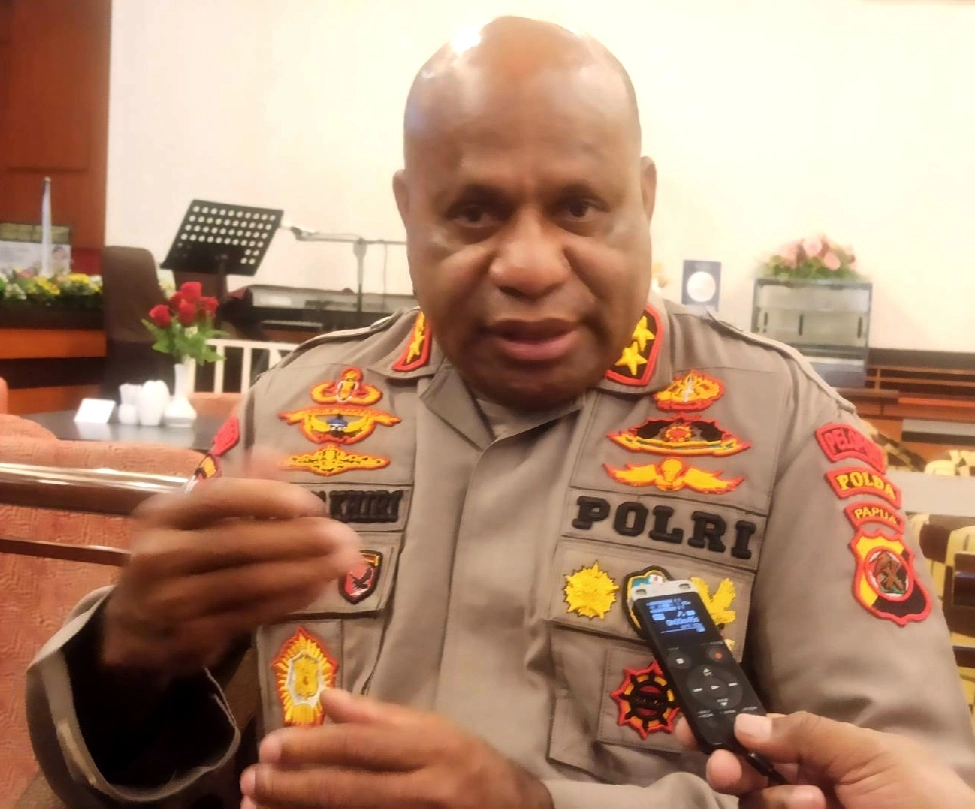
Papua Regional Police Chief Inspector General Mathius D Fakhiri – Jubi/Dok
Jayapura, Jubi – The Papua Police said the presence of the West Papua National Liberation Army (TPNPB) remained a frightening threat to residents, especially non-Papuan communities. “It is still a prominent case in Papua, which needs to be the concern of all parties,” said Papua Police chief inspector Gen. Mathius Fakhiri in Jayapura City on Wednesday, December 28, 2022.
Fakhiri said that throughout 2022, there were at least 90 acts of violence allegedly committed by the TPNPB. The figure is less than the number of cases in 2021, which was 106.
“This year there were 90 cases that occurred in Yahukimo Regency, Intan Jaya Regency, Puncak Regency, Puncak Jaya Regency, Nduga Regency, Bintang Mountains Regency, Yalimo Regency, Jayawijaya Regency, and Yapen Islands Regency,” Fakhiri said.
According to Fakhiri, the various acts of violence took casualties on the Indonesian Military (TNI) and police and civilians. Throughout 2022, ten TNI soldiers died allegedly due to TPNPB violence, and 14 other TNI soldiers were injured. In the same period, four police officers died allegedly due to TPNPB violence, while three others were injured.
Fakhiri said the number of civilians who died in various acts of violence was even higher. As many as 39 people died due to the violence, and ten people were injured. “While the victims from the TPNPB were five people,” he said.
Fakhiri asked the local government, especially the regents, the Regional Government Work Unit, and the Regional People’s Council to lead and be an example for the communities to involve in activities with the police. “The Papua Police optimize the efforts of a more humanist approach, which is expected to answer various problems that have often been a trigger for security disturbances in the community,” he said. (*)
2022 saw a continued decline in deforestation in Indonesia, as well as financing deals for forest conservation and phasing out fossil fuels, and a scramble to keep up with changing EU timber regulations.
The year also saw the passage of controversial amendments to Indonesia’s criminal code, friction between the government and researchers, and increasing concerns about the environmental cost of the country’s nickel boom for electric vehicle batteries.
Here are some of the top environment stories and trends of 2022 from one of the world’s most important tropical forest countries.
Home to the world’s third-largest expanse of tropical forest, the world’s fourth-biggest population, and frequently ranked among the world’s top 10 greenhouse gas emitters, Indonesia is a country where what happens has a vast effect on global biodiversity and environmental health.
Here, assembled by Mongabay staff, are some of the top news and trends from Indonesia in 2022.
Deforestation continues to slow
Between 2001 and 2021, Indonesia lost more than 28 million hectares (69 million acres) of forest, an area larger than New Zealand, according to Global Forest Watch. However, since peaking in 2016, forest loss in Indonesia has continued to decline. According to GFW, the country lost 841,000 hectares (2.08 million acres) of tree cover in 2021, including 203,000 hectares (502,000 acres) of primary forest, both the lowest levels recorded since 2003. Deforestation linked to oil palm expansion, for years a primary driver of forest loss, has also shown a marked decline. An analysis by palm oil supply chain mapping initiative Trase found that deforestation in Indonesia associated with palm oil dropped by 82% in the past decade. The trend also appears to hold across the region, with palm oil-linked deforestation across Indonesia, Malaysia and Papua New Guinea dropping for the second year in a row in 2021, according to a study by sustainability risk analysis organization Chain Reaction Research. The declines, which occurred even as palm oil prices rebounded in the wake of the COVID-19 pandemic, have been described as “huge huge news” and a signal that sustainability pledges are having a real impact on deforestation.
While the numbers have generally been met with optimism, activists note that there is still cause for concern. “Indonesia’s forests are not yet out of danger: 2.4 million hectares [5.9 million acres] of intact forest remain in existing palm oil concessions,” Timer Manurung, director of Indonesian environmental NGO Auriga Nusantara, told Mongabay. “Legally speaking, companies could clear [these] forests. Right now, there’s no legal protection.” Forests in Indonesian Borneo and Papua are particularly in danger, Timer said.
This echoes broader concerns about deforestation in the country: a 2021 report by a coalition of Indonesia NGOs found that while Indonesia’s overall annual deforestation rate fell, forest loss in the regions with the most remaining forest, concentrated in the country’s eastern islands like Papua, actually increased. Environment activists also point to recent government policies as potential threats to forests, including a push to expand large-scale food estates, plans to build a new capital city in Borneo, major infrastructure projects, and a program to promote palm oil-based biofuel.
Between 2001 and 2021, Indonesia lost more than 28 million hectares (69 million acres) of forest. However, since peaking in 2016, forest loss in Indonesia has continued to decline. Image by Rhett A. Butler/Mongabay.
EU deforestation law prompts a regulatory upgrade
In December, the European Union finalized a law banning the trade of timber and other forest products associated with deforestation and forest degradation, even if the products are sourced and exported legally. Once the law is fully enacted, companies will be required to issue due diligence statements verifying that any goods they import into the EU are deforestation- and forest degradation-free. Conservation groups like Greenpeace and WWF have lauded the law as “groundbreaking” and a “major breakthrough for forests.”
Indonesian officials, however, have slammed the law, saying it negates more than a decade of progress by the country in complying with existing EU sustainability codes. Since 2011, Indonesia has worked with the EU to develop a system, known as the SVLK, to verify the legality of its exported timber. The SVLK is supposed to favor Indonesian timber products, granting them a “green lane” that exempts them from stringent checks on arrival. The new law, officials and industry insiders say, shifts the goalposts after the arduous process of bringing exporters into compliance with SVLK requirements.
Nduga refugee children receiving aid from one of the educational foundations in Papua at the refugee general post in Wamena, Jayawijaya Regency. – Jubi/Imma Pelle
Wamena, Jubi – Thousands of Nduga residents who since 2018 have been displaced in Wamena and several other areas, admit that they are still crying during Christmas and do not feel the peace of Christmas.
One of the human rights observers from Nduga, Benny Murip, said that as a result of the ongoing armed conflict between the Indonesian Military (TNI) and Police and the West Papua National Liberation Army (TPNPB), people have not been able to gather with their families and celebrate or enjoy Christmas in peace.
“The people of Nduga are still living in tears and grief because they cannot gather with their families, friends, brothers and sisters. All of them have been separated in several places, some have even died in refugee camps,” he said in Wamena on Monday, December 26, 2022.
He also explained that in the Nduga Regency, which consists of 11 districts, houses and churches are currently still controlled by the TNI and police. Residents have fled to several places that are considered safe.
“Some even ran to the forest, it has been five years now,” said Murip.
Nduga children living in refugee camps in Muliama District Jayawijaya as a result of armed conflict in the central highlands of Papua 8211 JubiYuliana Lantipo
Murip asked people outside Papua not to think that Papua was safe and peaceful. Papua are still haunted with terrors, shootings of civilians such as in Tolikara, and military operations against Papuan civilians.
Murip said some time ago, he had been to the capital of Nduga Regency, Kenyam, and witnessed how the people there lived like prisoners.
;
“Gardening or other activities is very difficult to do. Residents’ activities are only limited to 9 p.m., they can no longer roam outside the house past curfew because they are always watched by the authorities with weapons,” he explained.
Murip further said that even though the Nduga residents who have been displaced for five years wanted to return to their hometown, it was very difficult to realize because the war continues between the security forces and the TPNPB. Neither TPNPB leader Egianus Kogoya nor President Joko Widodo have issued a statement to stop the conflict. (*)
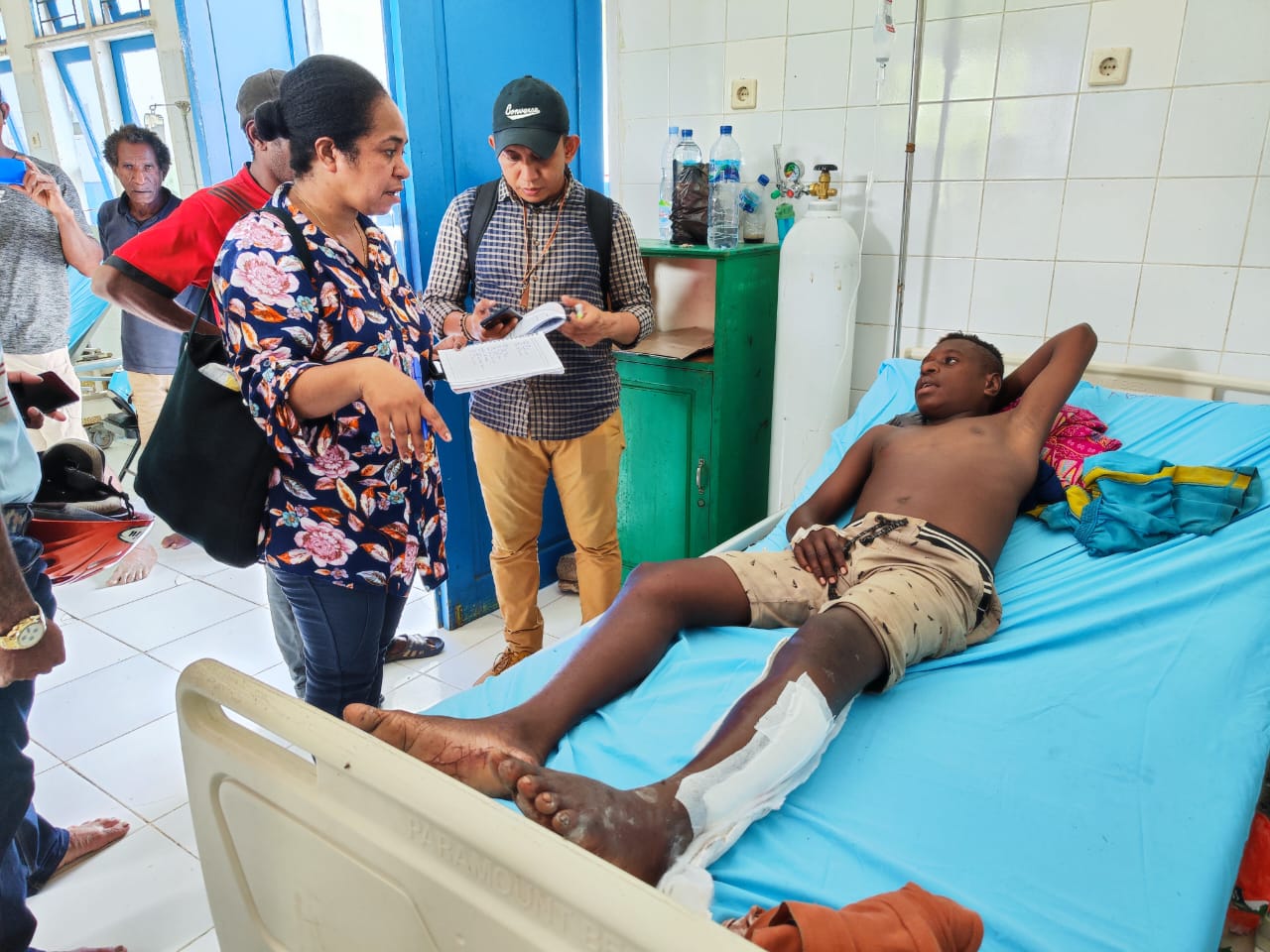
The Papua Law Enforcement and Human Rights Coalition team visits one of the shooting victims at Mappi Hospital. – Doc. Papua Law Enforcement and Human Rights Coalition.
Jayapura, Jubi – The Papua Law Enforcement and Human Rights Coalition revealed that of the nine residents who were victims of shootings by security forces in Kepi, the capital of Mappi Regency on December 14, 2022, six of them were students. The six victims are still undergoing treatment for their gunshot wounds.
Helmi, a member of the Coalition said there were elementary, junior high and high school students among the victims, namely Kaspar Khani Yebo (Inpres Kabe Elementary School), Wilhemus Jeji Samogi (Menyamur 1 Junior High School), Fredirandus Boy (YPPK Yohanis Paulus 1 Kepi Junior High), Sabinus Sokmi Sedap (Obaa 1 High School), Rexon Ya A Pasim (Obaa 1 High School), and Yohanis T Sedap (Obaa 2 Vocational School).
Helmi said that the six students were currently being treated as outpatients. According to Helmi, the victims refused to be hospitalized because they were always visited by the police.
“Every week they go to the hospital to treat their wounds and take medicine. They are also still in shock and traumatized,” he said.
The results of the Coalition’s investigation, which was carried out from December 17-20, concluded there was a stabbing incident by a resident against another resident named Martinus. However, the Coalition denied that there was a clash between residents that followed the stabbing.
With these findings, the Coalition denied the Papua Police’s version that the shooting of civilians occurred because security forces were attacked while breaking up clashes between residents.
The Coalition’s findings differed from the information conveyed by the Liaison Officer of the South Papua Police, Sr. Comr. Erick K Sully, who said the shooting was triggered by an attack on security forces who broke up a clash between two groups of residents under the influence of alcoholic beverages.
;
Helmi said the Coalition had been authorized by the victim to take legal action over the shooting incident in Mappi. The Coalition has assisted Kosmas Yameap, brother of the dead victim Moses Erro, to make a police report at the Mappi Police over the incident. The Coalition also accompanied the victim Rexon Ya A Pasim to report the incident to the Mappi Police.
“This is so that the police investigate who the perpetrators were in the shooting and whether the situation at the time was under control or not. Was there a dangerous incident before the shooting or not,” he said.
In a written press statement on Friday, the Papua Law Enforcement and Human Rights Coalition urged the National Human Rights Commission (Komnas HAM) to conduct an investigation into the shooting of Mappi civilians on December 14, 2022. Komnas HAM RI was also asked to investigate the alleged involvement of Indonesian Military (TNI) and Police in the shooting that killed one and injured eight Mappi residents including students.
The Coalition also suggested that peace efforts made between the victims of the stabbing and the perpetrators be separated from the investigation of the shooting of nine civilians as the two are different cases.
The Coalition urged that the legal process related to Mappi shooting must be carried out professionally in order to ensure a fair trial against the perpetrator and prevent impunity. They hoped that any assistance provided to the shooting victims was not a strategy to silence the victims who demand justice. (*)
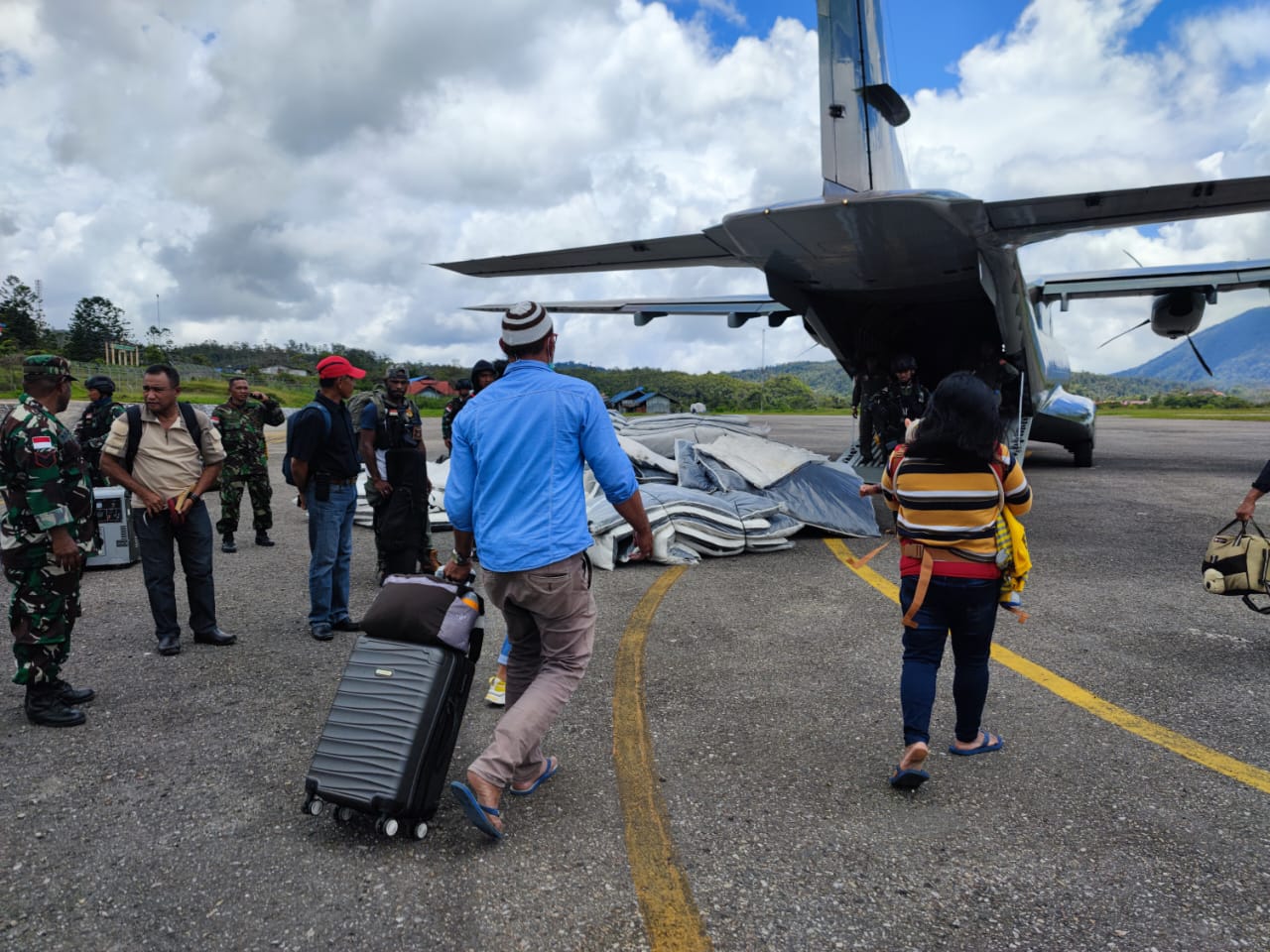
Jayapura, Jubi – About dozens of migrant residents in Oksibil, Mountains Bintang District, Papua Mountains Province chose to flee to Jayapura City, after successively experiencing terror from the West Papua Liberation Army or TPNB group.
Dozens of residents went to Jayapura by using a Cassa aircraft type CN 235 A-2307 belonging to the Indonesian Air Force, Friday (13/1/2023) morning.
“It’s true that today residents who live and are on vacation in Oksibil have chosen to secure themselves in Jayapura,” said the Chief of the Gunung Bintang Police, AKBP Moh. Dafi Bastomi.
Bastomi said his party was working with the Indonesian Air Force to fly people to Jayapura.
Meanwhile, for people who wish to remain in Oksibil City, he said, the TNI/Polri Security and all stakeholders guarantee their security.
“With the security disturbance, we (TNI/Polri) continue to provide services and facilitate people who wish to go to Jayapura,”.
“We also continue to coordinate with the Regional Government to maintain security and order in the Bintant Mountains to remain conducive.” he said.
For public services, said Bastomi, everything was running normally both health, banking and the economy were running as usual. (*)
——————————-
Puluhan warga pendatang di Oksibil mengungsi ke Jayapura
Enembe is only the latest West Papuan to be criminalised in this way: Eltinus Omaleng, the head of Mimika Regency, was arrested last year on spurious corruption charges. Corruption is what they claim when West Papuans try to better their people’s condition.
As West Papuan protesters took to the streets to call for Enembe’s release, armed Indonesian police beat, shot, and arrested them in large numbers. So far, one protester has been killed by police while calling for Governor Enembe’s release. This is what the Papua police chief calls a ‘small incident’ – killing a West Papuan civilian is nothing to Indonesia’s occupation forces.
Enembe’s treatment cannot be separated from his increasingly vocal stance against Indonesia’s colonial policies in West Papua. He opposed Indonesia’s division of West Papua into new provinces, a divide and rule tactic designed to steal our natural resources and allow further militarisation of our villages. The provincial division is part of the package for the renewal of colonial ‘Special Autonomy’, which has only brought twenty years of destruction in the name of ‘development’. Special Autonomy means the murder and mutilation of four West Papuan civilians by Indonesian soldiers. It means the devastation of our mountain and forest for new plantations and mines the size of Jakarta. Over 600,000 West Papuans have signed a petition rejecting the fake ‘Special Autonomy’ programme. When he speaks out against new provincial division, Enembe speaks for the people.
Enembe’s arrest shows how Indonesia responds to any dissent, even from figures who accept their illegal presence in our land. We cannot forget that Enembe is being targeted despite working within Indonesian institutions. We also must not forget the many Papuan leaders who have died in mysterious circumstances over the past three years. At least sixteen have passed away since 2020, many of them on their own, in hospitals or hotels. There is strong and justified suspicion that they were poisoned. This is why Governor Enembe must be immediately released: no West Papuan is ever safe in Indonesian custody, especially not one who is already in such poor health.
These events remind us of what happened last year, when Zode Hilapok died ten months after his arrest for raising the Morning Star flag on December 1st 2021. Hilapok was already ill when he was arrested, but Indonesia refused to treat him in a civilian hospital. Instead, they took him to Bhayangkara military hospital, where his treatment was kept secret.
Indonesia does not want peace in West Papua. They want tension and violence, they want West Papua to remain a war zone in order to justify the deployment of more and more troops. Over 25,000 additional troops have been deployed to West Papua since the uprising in 2019. This dramatic increase in militarisation has created mass displacement, with up to 100,000 people displaced by four years of military operations. And as Indonesia cleanses West Papua of its Indigenous people, they build big highways and ecologically disastrous plantations in their place. In West Papua, business and military interests are one and the same.
This arrest comes as Indonesia are ramping up their campaign to whitewash their occupation. The new ‘Rainforest OPEC’ they are forming with Brazil and the DRC is pure PR, a smokscreen they are erecting as they continue to destroy our rainforest. President Joko Widodo also recently announced that he “strongly regrets” the gross human rights violations that have taken place in Indonesia’s past. But the genocide in West Papua is not a past crime to be waved away or apologised for – it is happening right now.
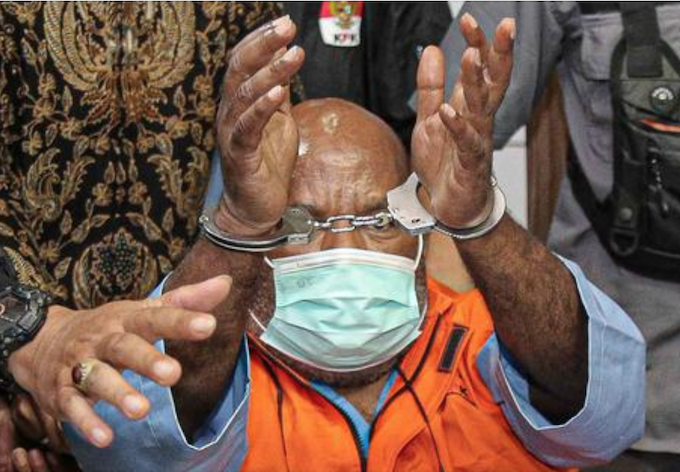
Papuan Governor Lukas Enembe . . . arrest in handcuffs widely regarded as the “humiliation” of an elected Papuan leader by Indonesian authorities. Image: Liputan 6
ANALYSIS:By Yamin Kogoya
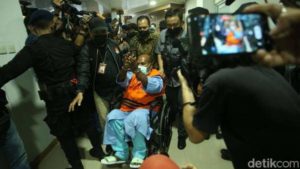
Following months of legal limbo and a health crisis, Papua Governor Lukas Enembe was arrested this week by the country’s Corruption Eradication Commission (KPK) in a dramatic move condemned by critics as a “kidnapping”.
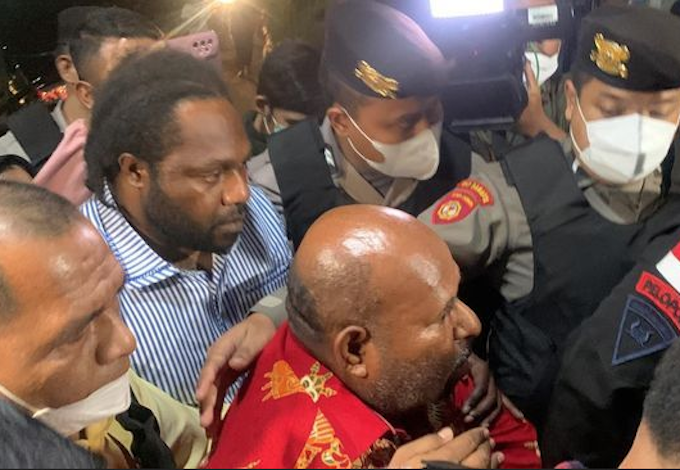
At noon on Tuesday, January 10, Governor Enembe was dining in a local restaurant near the headquarters of Indonesia’s Mobile Brigade Corps, known as Brimob.
After the arrest the Brimob transported him directly to Sentani Theys Eluay airport — an airport named in honour of another prominent Papuan leader who was callously murdered by the same security forces in 2002, not far from where the governor was arrested.
Governor Enembe was immediately flown to Jakarta to arrive at the Army Central Hospital (RSPAD), Gatot Soebroto, Central Jakarta, reports Kompas.com.
In what seems to be a cautiously premeditated arrest, Jakarta targeted Governor Enembe while he was alone and without the support of thousands of Papuans who had barricaded his residence since September last year.
Once the news of his arrest was leaked, supporters attempted to gather in Sentani at the airport, but they were outnumbered by heavy security forces. A few protesters were shot, and several were injured, with one protester dying from his injuries.
1 shot dead, several wounded Papua Police Public Relations Officer Kombes Ignatius Benny Prabowo said when contacted by Tribunnews.com in Jakarta: “Yes, it is true that someone was shot dead on Tuesday.”
Among those who were shot were Hemanus Kobari Enembe (dead), Neiron Enembe, Kano Enembe, and Segira Enembe.
Surprisingly, they share the same clan names of the governor himself, indicating that only his immediate family were informed of his arrest.
Hemanus Kobari Enembe paid the ultimate price at the hand of Jakarta’s calculated planning and arrest of Papua’s governor.
The crisis began in September 2022, when Governor Enembe was named a suspect by the KPK and summoned by Brimob after it accused him of receiving bribes worth 1 million rupiah (NZ$112,000). This amount was then escalated into a rush of accusations against the governor, including a new allegation that the governor had paid US$39 million to overseas casinos, disclosing details of his private assets such as cars, houses, and properties.
Governor Lukas Enembe . . . ill, but heavily guarded by the BRIMOD police after his arrest. Image: CNN/APR
Voices of prominent Papuan figures A prominent Papuan, Natalius Pigai, Indonesia’s former human rights commissioner, was interviewed on January 11 by an INews TV news presenter regarding these extra allegations.
“If that’s the case,” Pigai replied, “then why don’t we use these wild extra allegations to investigate all the crimes committed in this country by the country’s top ministerial level, including the children of the president, as a conduit for investigating some of the crimes committed by his office in this country?
“Are we interested in that? Why just target Governor Lukas?”
Papuan Dr Benny Giay . . . his view is that the arrest of Governor Lukas Enembe serves the “interests of the political elite” in Jakarta. Image: Jubi screenshot APR
Papuan public intellectual Dr Benny Giay was seen in a video saying that the arrest of Governor Enembe by the KPK in Jayapura was to serve the interests of Jakarta’s political elite, whom he described as “hardliners” in relation to the power struggle to become number one in Papua’s province.
According to him, Governor Lukas Enembe was a victim of this power struggle.
Dr Socrates Yoman, president of the West Papua Fellowship of Baptist Churches, described the arrest as a “kidnapping”. He said the governor had been arrested illegally, without following any legal procedures — and neither the governor nor legal counsel was informed of his arrest.
According to Dr Yoman, Governor Enembe is ill and in the process of recovering from his illness. Thus, this pressure exerted by the state through the military and police violated Governor Enembe’s basic rights to health and humanity.
The behaviour of the state through BRIMOB constituted a crime against humanity or a gross violation of human rights because the governor was arrested during lunchtime without an arrest warrant and while he was unwell, he said.
“The governor is not a terrorist — he was elected Governor of Papua by the Papuan people.
“This kidnapping shows that the nation or country has no law. The country is controlled by people who have lost their humanity, opting instead for animalistic rage and a senseless lust for violence.
“Our goal is to restore their humanity so that they can see other human beings as human beings and become whole human beings,” said Dr Yoman.
The governor’s health The governor’s health has deteriorated since he was banned from traveling to Singapore for regular medical aid since September last year.
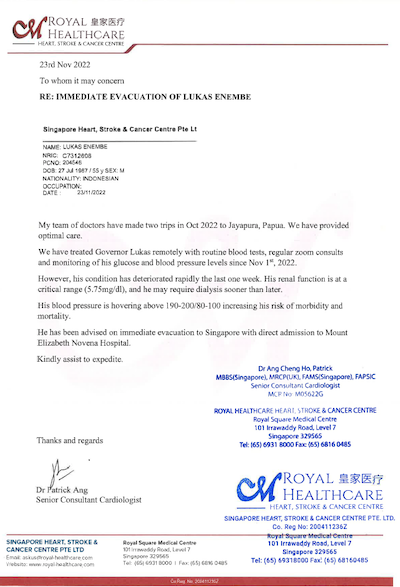
The 23 November 2022 letter from the Singaporean doctors appealing for Governor Enembe’s medical evacuation . . . ignored by the Indonesian authorities. Image: APR screenshot
Last October, Governor Enembe received two visits from Singapore medical specialists who have been treating him for a number of years.
Despite these visits, his health has continued to deteriorate, which led Singapore’s medical specialists to send a letter in November to authorities in Indonesia requesting that the governor be airlifted to Mount Elizabeth hospital.
The letter from Royal Healthcare in Singapore said:
“We have treated Governor Lukas remotely with routine blood tests, regular zoom consults and monitoring of his glucose and blood pressure levels since November 1, 2022. However, his condition has deteriorated rapidly the last week. His renal function is at a critical range (5.75mg/dl), and he may require dialysis sooner than later. His blood pressure is hovering 190-200/80-100 increasing his risk of morbidity and mortality. He has been advised on immediate evacuation to Singapore with direct admission to Mount Elizabeth Novena Hospital.”
The letters were ignored, and the sick governor was arrested and taken to a hospital in Jakarta, where he had previously refused to go.
Governor Enembe had previously written to KPK requesting that he receive urgent medical treatment in Singapore. Papuan police chiefs and KPK members were asked to accompany him, but this did not happen.
On November 30, 2022, Firli Bahuri, Chairman of KPK, visited the governor at his barricaded residence in Koya Jayapura, Papua, in what appeared to be a humane approach.
But what happened on Tuesday indicates that KPK had already decided to arrest him and take him to the Indonesian capital of Jakarta — almost 4500 km from his home town.
Many Papuan figures who go to Jakarta return home in coffins. Papuan protesters did not want their leader to be taken out of Papua, partly due to this fear.
Despite these protests, letters, and requests, Jakarta completely disregarded the will of the people and of the governor himself.
The plot to kidnap Governor Enembe appears to have been well planned over a period of four months since September, providing enough space for the situation in Papua to calm down and allowing the governor to leave his barricaded house alone without his Papuan “special forces”.
It was during the lunch hour of noon on Tuesday that KPK targeted him in a cunningly calculated manner.
Governor’s image in social media Governor Enembe is portrayed in the Indonesia’s national narrative as a representative of the so-called “poor and backward” majority of Papuans, while portraying him as a man of a lavish lifestyle, owning properties and cars, and with great wealth.
Comments on social media are flooded with a common theme — portraying Papua’s governor as a “criminal”, with some even calling for his “execution”.
Some social media comments emerging from those fighting for West Papua’s liberation are echoing these themes by claiming that Governor Enembe’s case has nothing to do with the Free Papua Movement– his problem is with Jakarta only as he is a “colonial puppet ruler”.
It is true that Lukas Enembe is governor of Indonesian settler colonial provinces. However, Papuans have failed to understand the big picture — the ultimate fate of West Papua itself.
What would happen if West Papua remains part of Indonesia for the next 20-50 years?
Our failure to see the big picture by both Papuans and Indonesians, as well as the international community, is a result of Jakarta fabrication that West Papua is merely a national sovereignty issue for Indonesia. That is the crux of that fatal error.
The isolation of the governor from the rest of the Papuans as a “corruptor” and other dehumanising labels are designed to destroy Papuans’ self-esteem, stripping them of their pride, dignity, and self-respect.
The images and videos of the governor’s arrest, deportation, handcuffing in Jakarta in KPK uniform, and his admission to the military hospital while surrounded by heavily armed security forces are psychologically intimidating to Papuans.
Through brutal silence, politically loaded imagery has been used to convey a certain message:
“See what has happened to your respected leader, the big chief of the Papuan tribes; he is no longer a person. Jakarta still has the final say in what happens to all of you.”
Papuans are facing a highly choreographed state-sponsored terror campaign that shows no signs of abating.
For Papuans, the new year of 2023 should be a time of hope, new dreams, and new lives, but this has been marred once again by the arrest and kidnapping of a well-known and popular Papuan figure, as well as the death of a member of the governor’s family on Tuesday.
As human miseries continue to unfold in the Papuan homeland, Jakarta continues to conduct business as usual, pretending nothing is happening in West Papua while beating the drum of “development, prosperity, and progress” for the betterment of the backward Papuans.
With such prolonged tragedies, it is imperative that the old theories, terminologies, and paradigms that govern this brutal state of affairs be challenged.
A new paradigm is needed The very foundation of our thinking between West Papua and Indonesia must be re-examined within the framework of what Tunisian writer, Albert Memmie, described as “coloniser and colonised”, when examining French treatment of colonised Tunisians, who emerged concurrent with Franz Fanon, the leading thinker of black experience in white, colonised Algeria.
The works of these thinkers provide insight into how the world of colonisers and colonised operates with its psychopathological manipulations in an unjust racially divided system of coloniser control.
These great decolonisation literature treasures will help Papuans to connect the dots of this last frontier to a bigger picture of centuries of war against colonised original peoples around the world, some of which were obliterated (Tasmania), able to escape (Algeria), or escaped but are still trying to reorganise themselves (Haiti).
Therefore, the coloniser and colonised paradigm is a useful mental framework to view Jakarta’s settler colonial activities and how Papuans (colonised) are continuously being lied to, manipulated, dissected, remade and destroyed — from all sides — in order to prevent them from uniting against the entity that threatens their very existence.
The real culprits in West Papua and proper Papuan justice Most ordinary Papuans are unable to gain access to information regarding who exploits their natural resources, how much they are making, who receives the most benefits and how or why.
But Jakarta is too busy displaying Governor Enembe’s personal affairs and wild allegations in headline news — his entire existence is placed on public display, as an object of humiliation, just as the messianic Jesus was crucified on a Roman cross in order to convince Galilean followers that their beloved leader failed.
Let us not forget, however, that it was this publicly humiliated and crucified Jesus who forever changed the imperial world order and human history.
If true justice is to be delivered to colonised Papuans, then Papuans must put the Dutch on trial for abandoning them 60 years ago, and then hold the United Nations and the United States responsible for selling them, to Indonesia, 60 years ago.
In addition to arresting all international capitalist bandits that are exploiting West Papua under the disguise of multinational corporations, Indonesia should also be arrested for its crimes against Papuans, dating back over 61 years.
However, the question remains… who will deliver this proper justice for the colonised Papuans? Jakarta has certainly set itself on a pathological path of arresting, imprisoning, and executing any figure that appears to be a messianic figure to unite these dislocated original tribes for its final war for survival.
Yamin Kogoya is a West Papuan academic/activist who has a Master of Applied Anthropology and Participatory Development from the Australian National University and who contributes to Asia Pacific Report. From the Lani tribe in the Papuan Highlands, he is currently living in Brisbane, Queensland, Australia.
Papua Police chief Insp. Gen. Mathias D. Fakhiri said of the 19 people secured, one person died, 16 people detained at Jayapura Regency Police Station, and two people at Jayapura City Police Station.
“The clash between police and sympathizers of Governor Lukas Enembe occurred after the KPK and the Governor had left. One person died of a gunshot wound, while 16 others underwent medical treatment for injuries,” Fakhiri said in Jayapura City on Wednesday.
Given the death toll, Fakhiri has ordered the head of Internal Affair Division and director of Criminal Investigation of the Papua Police to immediately investigate the actions taken by members of the police, especially in Sentani whether according to procedures or not.
“I ask for the report today. If there is indeed a wrong handling, I ensure there will be law enforcement against members who do not comply with the standard operating procedures,” he said.
To keep Papua conducive, Fakhiri asked his staff to approach families, religious leaders, community leaders, and traditional leaders so that the arrest of Governor Lukas Enembe would not start a fuss.
“I urge all parties not to spread hoaxes or information that does not match the facts,” he said.
Fakhiri said that Lukas Enembe was a statesman who obeyed and complied with the legal process. “Let us provide moral support so that the legal process runs as it is,” he continued.
“Clearly, the KPK will always pay attention to the humanitarian side, therefore, please do not add further unfounded assumptions,” he said. (*)
Aryo Putranto Saptohutomo, Jakarta — Transparency International Indonesia (TII) Secretary General Danang Widoyoko says that Indonesia’s poor Corruption Perception Index (CPI) is not caused by frequent Corruption Eradication Commission’s (KPK) sting operations (OTT).
Widoyoko conveyed this in response to remarks by Coordinating Minister for Maritime Affairs and Investment Luhut Binsar Pandjaitan who proposed that the KPK not be excessive in conducting frequent sting operations because it impacts upon the country’s image.
“The low corruption perception in Indonesia is not because of OTT”, said Widoyoko when contacted by Kompas.com on Wednesday December 21.
“What make Indonesia’s corruption perception index low is primarily the practices of political corruption and judicial corruption. So if the main agenda is fixing political funding and improving the effectiveness of judicial supervision”, continued Widoyoko.
Widoyoko said that based on the results of TII’s research it is corruption practices in public services which have caused a poor corruption perception index. “So what must be fixed is public services, not OTT”, said Widoyoko.
According to TII, Indonesia achieved its best CPI score of 40 in 2019.
But at the end of that year the House of Representatives (DPR) ratified the revisions to the KPK Law and in 2020 Indonesia’s CPI fell to 37.
Then in 2021 the index rose by one point to 38.
Speaking separately, Indonesia Corruption Watch (ICW) Coordinator Agus Sunaryanto shrugged off Pandjaitan’s statements about the KPK’s OTT giving the country a bad image.
According to Sunaryanto, efforts to eradicate corruption must be continued in an integrated manner and there cannot be a separation between prevention and law enforcement such as OTTs.
“The eradication of corruption must be comprehensive, [running] parallel between prevention and enforcement”, said Sunaryanto when contacted by Kompas.com.
Sunaryanto said he agrees with efforts to digitalise systems as one of the ways to close off opportunities for corruption. But he is convinced that law enforcement through OTTs cannot be avoided if violations are still occurring.
“If a system is already digital or electronic does that then mean corruption disappears? What’s referred to as openings always exist, right, that it must be fixed is of course is a must”, said Sunaryanto.
“But if after being fixed there are still illegal activities, yes well it must be acted on. I can be through OTTs or via other strategies”, said Sunaryanto.
Earlier, Pandjaitan made a statement which was seen as controversial during an event titled The 2023-2024 Launch of Corruption Prevention Actions that was organised by the KPK and several other government ministries and institutions at the Thamrin Nine Ballroom in Central Jakarta on Tuesday December 20.
Panjaitan took the opportunity to say that moves to digitalise port operating systems is the best way to fight corruption in the maritime sector.
According to Pandjaitan, digitalization is one of the measures need to prevent corruption in order to improve Indonesia. In addition to this, he said that OTTs also have an impact on the country’s image.
“Because this has changed the country, we don’t need to talk all high and mighty, we’re OTT-OTT [crazy], that’s not actually good, it’s really bad for the country”, said Pandjaitan.
Pandjaitan asked the KPK not conduct such frequent sting operations saying that if digital systems are in place then there won’t be any corruptors brave enough to commit corruption.
“Yes, if you can live a little okay. If we want it to be totally clean then you should just go to heaven”, said Pandjaitan.
“So the KPK should also not make small arrests here small arrests there, like that. Yes, look around, but if this digitalisation is already running, I don’t think that (corruptors) will be able to play around”, said Pandjaitan.
When questioned after the event at the Thamrin Nine Ballroom, Pandjaitan said that what he meant by bad was when the government created opportunities for corruption so sting operations had to take place.
According to Pandjaitan, with digitalisation it will no longer be possible for officials to commit corruption so there won’t be any need for sting operations.
“It’s not ugly, it’s only ugly for us because we create opportunities for there to be OTT, if everything has been digitalised right, it won’t be possible for there to be any more OTT, that would be great, right”, said Pandjaitan.
[Translated by James Balowski. The original title of the article was “Respons Luhut, Aktivis Sebut OTT Bukan Penyebab Indeks Korupsi Indonesia Buruk”.]
JAKARTA, Dec 23 (Reuters) – Indonesia has extended by 20 years a production sharing contract (PSC) with BP and its partners for Berau, Muturi, and Wiriagar working areas in West Papua, government officials and the company said on Friday.
The extension would allow BP and its partners to operate on the fields until 2055, BP said in a statement. The working areas supply to Tangguh liquefied natural gas (LNG) plant.
BP is trying to increase Tangguh’s production capacity from the current 7.6 million tonnes per annum (MTPA) to around 11.4 MTPA by adding a new, Train-3 plant which is expected to come onstream in March 2023, SKK Migas said earlier this year.
Indonesia usually extends a PSC two to 10 years before it expires, but BP needed to secure a longer contract to guarantee its long-term investment plan, according to Dwi Soetjipto, chairman of Indonesia’s upstream regulator SKK Migas.
“In order to maintain production for LNG Train-3, BP is committed to conducting further exploration activities at several sites … BP also committed to preparing a 2×90 MMSCFD gas pipe to support industry development in Papua,” said Dwi
Output from LNG Tangguh plant is estimated to drop before 2030 if there is no new exploration.
Energy minister Arifin Tasrif said Tangguh gas production is needed to supply Indonesia’s increasing energy demand as the country will rely on gas while transitioning to cleaner energy.
Separately, Indonesia also said on Friday that development of BP’s Ubadari field, also in West Papua, and its carbon capture, utilisation and storage (CCUS) project would be included in the country’s list of National Strategic Projects.
Wahyu Utomo of the Acceleration of Priority Infrastructure Committee told reporters that such CCUS projects are needed for the country’s energy industry to become cleaner and that Indonesia would benefit from the technology.
Indonesia usually puts important projects in the National Strategic Projects to accelerate their realisation, Wahyu said.
Projects in the list sometimes get special treatment such as tax breaks.
Reporting by Bernadette Christina, Fransiska Nangoy, and Ananda Teresia; Writing by Gayatri Suroyo; Editing by Kanupriya Kapoor







 Australia West Papua Association Adelaide