Indonesian Police seize public buses

Indonesian police seize public buses for 328 arrested at ‘free Papua’ demo

By PMC Editor

December 2, 2016


Indonesian police fire water cannon on Papuan demonstrators in Jakarta yesterday. Image: SuaraPapua.com

By Yudhistira Amran Saleh in Jakarta

Hundreds of Papuan demonstrators from the Papuan Student Alliance (AMP) demanding independence for West Papua have been arrested and taken to the Metro Jaya regional police headquarters in Jakarta.

The transport of the activists had to be done in stages because the Indonesian police did not have enough vehicles to accommodate all of them. Some public buses were seized to take the activists away.

“The number of demonstrators was 328 people. The first load was 127 people, the second 201 people,” said Central Jakarta District police chief Senior Commissioner Hendro Pandowo at the Hotel Indonesia traffic circle on Jl. MH Thamrin in Central Jakarta.

The first load of demonstrators were transported using police cars and trucks. Meanwhile, the rest were taken by Metro Mini public buses.

Police officers escorting the December 1 “independence day” protesters were also transported by Metro Mini buses that had by chance passed by.

“There weren’t enough vehicles. So we used Metro Mini [buses],” said Pandowo.

According to Pandowo, the student protest was illegal because they did not have a permit to demonstrate. They also attempted to break through a police barricade in order to march to the nearby State Palace.

Teargas fired
The police then fired teargas to disperse the demonstrators who ran in the direction of Jl. MH Thamrin in the direction of Sudirman.

The demonstrators managed to cause a traffic jam between Jl. Sudirman and Jl. MH Thamrin. The situation is now calm but the weather cloudy.

Earlier, Arnold Belau reported for Suara Papua from Jayapura that Indonesian colonial police had arrested 221 people in three different cities at December 1 “independence” rallies with 203 people arrested in Jakarta, four in Sentani, West Papua and 14 people in the Central Java city of Yogyakarta.

In Jakarta, a peaceful demonstration commemorating the anniversary of the birth of the Nation of West Papua which was led by the Indonesian People’s Front for West Papua (FRI-West Papua) and the Papuan Student Alliance (AMP) ended with brutal arrests by the Metro Jaya regional police.


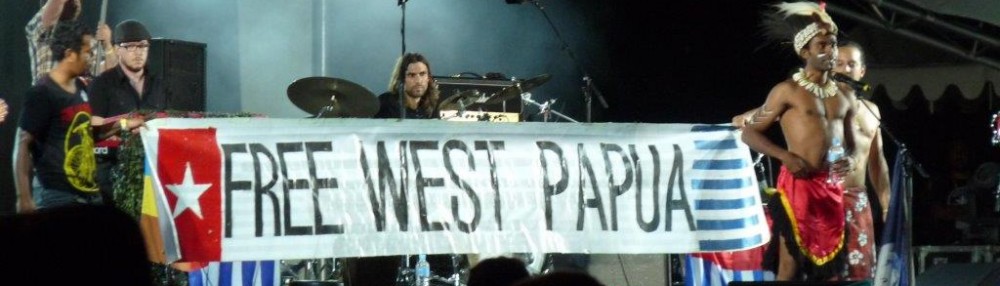
Papuan protesters demanding independence. The headbands with the West Papuan flag are banned by the Indonesian authorities. Image: Maubere

Before being arrested, the protesters from the AMP and FRI-West Papua said they were “roughed up” and protest materials seized.

“We hadn’t even reached the Hotel Indonesia traffic circle [in Central Jakarta] when we were blocked by security personnel. They (the security personnel) tore the Morning Star head bands off our heads, our command line was cut.

“Then we were sprayed with water from a water cannon. After this we were taken in four trucks to the Metro Jaya police headquarters,” one of the protesters Roberta Muyapa told Suara Papua.

He said that after being taken to the Metro Jaya police headquarters the protesters were left to “dry out” in an open area for around four hours.

All 203 of them, he said, were arrested by fully equipped Indonesian colonial police along with hundreds of officers from the Metro Jaya regional police and Mobile Brigade paramilitary police.

Translated by James Balowski for the Indoleft News Service. The original title of the report was Pendemo Asal Papua Diangkut ke Polda dengan Mobil Polisi dan Metro Mini.

106 Papuans arrested at Rally

 Police ordered Papuan praying congregation to disperse, accusing them of separatism

Nethy Dharma Somba and Evi Mariani The Jakarta Post

Jakarta | Mon, November 21, 2016 | 07:23 am

demo-maokwari3


Papuans hold a self-determination rally on Wednesday in Sentani, Papua, demanding that the government conducts an independence referendum for the eastern province. (KNPB/Exclusive)


Sorong Police in West Papua province confirmed they ordered a group of people praying on SPG Sorong field on Saturday to disperse and accused the congregation of separatism because the police claim the congregation yelled, demanding independence.

The event was organized by West Papua National Committee (KNPB) to celebrate their eighth anniversary by organizing an event to pray together.

KNPB said the police took all 106 people at the event to Sorong Police office for questioning. Later, they released 99 people and detained the other seven: Agustinus Kossay, Arnoldus Kocu, Jack Badii, Kantius Heselo, Mika Giban, Oskar Solossa and Yance Assem.

KNPB said the police accused the seven of treason and provocation.

Sorong Police chief Adj. Sr. Comr. Edfrie Maith said they only detained seven of them for 24 hours, in compliance with the procedure.

“It’s our duty to question them within 24 hours. After we questioned them, we released them,” Edfrie said.

Veronica Koman, a public interest lawyer with Papua Itu Kita, who often helped KNPB with legal advocacy, said the seven were released on Sunday, but they had to report to the police daily.

Edfrie said the police ordered the event to disperse because in the event notification letter from KNPB, the organization used a symbol that is not an Indonesian symbol. “Of course we didn’t let them organize it, they refuse to acknowledge the Republic of Indonesia,” he said on Sunday.

Veronica said KNPB produced a notification letter about the event using the KNPB logo, which was the usual procedure for any other organization. “The stamp resembles the Morning Star flag, but I think that’s beside the point. This is an attempt to muffle freedom of expression in Papua,” she said.

Gema Demokrasi, a Jakarta-based network of 75 civil society organizations, criticized Edfrie’s statement in which he made a deal with Sorong journalists not to publish the story. “Sorong journalists and I have agreed not to make news of the event. They intentionally made such an event to get some outside exposure to be acknowledged,” Edfrie said as quoted in tabloidjubi.com.

Gema Demokrasi said Edfrie’s attempt was a violation of the 1945 Constitution on freedom of expression.

KNPB is an organization promoting self-determination for Papuan people.


ariknpb-manokwari-2

The $100bn gold mine and the West Papuans who say they are counting the cost

The $100bn gold mine and the West Papuans who say they are counting the cost

Grasberg mine in the Indonesian province has been a source of untold wealth for its owners, but local communities say it has brought poverty and oppression


The delta of West Papua’s Aikwa river, on Kamoro tribe land. Papuans claim tailing sediment from the mine has suffocated the fish and shrimp on which their diet and economy are based. All photographs: Susan Schulman

Global development is supported by About this content

Susan Schulman in Timika

Wednesday 2 November 2016 11.05 AEDT Last modified on Wednesday 2 November 2016 11.15 AEDT

In 1936, Dutch geologist Jean Jacques Dozy climbed the world’s highest island peak: the forbidding Mount Carstensz, a snow-covered silver crag on what was then known as Dutch New Guinea. During the 4,800-metre ascent, Dozy noticed an unusual rock outcrop veined with green streaks. Samples he brought back confirmed exceptionally rich gold and copper deposits.

Today, these remote, sharp-edged mountains are part of West Papua, Indonesia’s largest province, and home to the Grasberg mine, one of the biggest gold mines – and third largest copper mine – in the world. Majority-owned by the American mining firm Freeport McMoRan, Grasberg is now Indonesia’s biggest taxpayer, with reserves worth an estimated $100bn (£80bn).

But a recent fact-finding mission (by the Brisbane Archdiocese’s Catholic Justice and Peace Commission) described a “slow-motion genocide” (pdf) taking place in West Papua, warning that its indigenous population is at risk of becoming “an anthropological museum exhibit of a bygone culture”.
Since the Suharto dictatorship annexed the region in a 1969 UN referendum largely seen as a fixed land grab, an estimated 500,000 West Papuans have been killed in their fight for self-rule. Decades of military and police oppression, kidnapping and torture have created a long-standing culture of fear. Local and foreign journalists are routinely banned, detained, beaten and forced to face trial on trumped-up charges. Undercover police regularly trail indigenous religious, social and political leaders. And children still in primary school have been jailed for taking part in demonstrations calling for independence from Indonesia.

“There is no justice in this country,” whispered one indigenous villager on condition of anonymity, looking over his shoulder fearfully. “It is an island without law.”

****

Dozy had not set out to find gold in 1936; his goal was to scale the region’s highest glacial peak. But his discovery sparked the interest of Freeport Sulphur – later to become Freeport Minerals Company and then, through a 1981 merger with the McMoRan Oil and Gas Company, Freeport McMoRan – whose board of directors included the well-connected Godfrey Rockefeller (serving from 1931 until the early 1980s) and Henry Kissinger (1988-1995).

Today, indigenous tribes such as the Kamoro and the Amungme claim their communities have been racked with poverty, disease, oppression and environmental degradation since the mine began operations in 1973.

To read the full article click on the link below

guardian-article-2

Referendum demand grows as govt’s Papua resolve wanes

Referendum demand grows as govt’s Papua resolve wanes

  • Margareth S. AritonangThe Jakarta Post


While government teams are working to identify fatal incidents that have led to human rights abuses in Papua to gain the trust of its people, former political prisoner Filep Karma said on Tuesday that a referendum should take place to determine the future of the restive region.

Filep, who was released after being granted clemency by President Joko “Jokowi” Widodo last year, said the process would reveal the aspirations of Papuans.

“Let us see whether the majority of Papuans want to stay with Indonesia or leave,” he said during an event held by Setara Institute.

Filep had spent 11 years behind bars for raising the Morning Star Flag, a West Papua independence symbol.

As part of Jokowi’s commitment to improve welfare for Papuans, 70 percent of whom voted for him during the 2014 election, the President has prioritized the region in development programs as well as taken bold moves to mend ties with Papuans, who have been victims of discrimination and violent incidents with security officers.

After releasing five political prisoners, including Filep, last year, Jokowi has been more aggressive in his efforts to accelerate development in the region.

In his last visit to Papua last week, he announced a “one fuel, one price” policy for the region, ordering relevant institutions to ensure a consistent fuel supply, the lack of which has often been a hurdle hindering economic activities.

The government also established a taskforce under the supervision of the Coordinating Political, Legal and Security Affairs Ministry that it assigned to identify rights abuses connected to all violent incidents that have occurred in Papua, but questions linger over the fate of the team’s assessment. Following the deadline of its term on Oct. 25, the team has yet to announce its findings.

A copy of the team’s temporary report obtained by The Jakarta Post cites four incidents that involved human rights abuses: the 1996 military operation to rescue 12 foreign and Indonesian scientists abducted by the Free Papua Movement (OPM) in Papua’s hinterland of Mapenduma; the 1998 Bloody Biak, a tragedy that claimed the lives of more than 100 Papuans following a hoisting of the Morning Star Flag, a symbol of resistance, in the coastal town of Biak Numfor; the killings of civilians by military and police personnel in Wasior in 2001; and the 2004 tragedy in Wasior where a joint police and military operation tortured and killed civilians from 25 villages following a break-in at a military arsenal.

The report said that two of the incidents, the 1996 Mapenduma operation and the 1998 Biak tragedy, would require a political decision from the House of Representatives for resolution because they occurred before the implementation of a 2000 law on establishing a human rights tribunal.

The report said that the fate of the 2001 Wasior incident and the 2004 Wamena tragedy should wait for a final conclusion by the National Commission for Human Rights (Komnas HAM) and the Attorney General’s Office (AGO), which have adopted different stances on the cases.

Komnas HAM has declared the two cases to be gross violations of human rights, while the AGO has demanded more evidence. The AGO’s requirement for evidence has also extended to another five abuses that occurred in other parts of the country that Komnas HAM has already declared to be historic human rights abuse cases. This has delayed settlement of all cases, including the killings in Wasior and Wamena.

Separately, Komnas HAM has conducted independent investigations and identified 14 cases of rights violations. The chairman of Komnas HAM, M. Imdadun Rahmat, included the unresolved shootings of civilians in Paniai on the list of rights abuses that needed immediate resolution, in addition to the Wasior and Wamena incidents.

“We must revise all laws on human rights, including the 1999 law on Komnas HAM, to give the rights body the power to prosecute. Otherwise we will never see any cases solved because of political obstacles,” said Bonar Tigor Naipospos from the human rights watchdog, the Setara Institute. “We are also in dire need of prosecutors with adequate human rights knowledge at the AGO.”

Government still lacks in protection of rights activists

—————————————————————————

http://www.thejakartapost.com/news/2016/10/25/government-still-lacks-protection-rights-activists.html

 Government still lacks in protection of rights activists

Jakarta | Tue, October 25 2016 | 08:40 am


Rights activists have urged the government to increase the protection of rights defenders amid mounting violence against them.

Activists of the Indonesian Forum for Environment (Walhi), Protection International (PI) and Arus Pelangi said their fellow activists across the country had experienced various abuses when fighting for people’s rights.

“Activists are always abused because they are at the forefront of human rights conflicts, so the opposing side always wants to shut them down,” PI activist Cahyadi told The Jakarta Post, adding the government should protect activists.

However, according to a survey from the Centre for Applied Human Rights at the UK-based University of York, the government is the most common violator against human rights activists. The survey stated that the “government” included the police, the military and regional government officers.

Companies, particularly those related to environment and labor rights issues, come second, while fundamental religious organizations rank third, according to the survey.

The survey was conducted earlier this year on 87 human rights activists of various issues like the environment, LGBTs, women’s rights and religious freedom. The activists originated from Jakarta, Surabaya, Ambon, Aceh, Palu and Manokwari.

The survey also found that activists received various types of abuse, most commonly threats through phone calls and text messages. They also experienced assault, became subject to investigations and criminal charges and faced defamation in the media. As many as 90 percent of the respondents said they were worried about their safety.

Protection of activists is recognized in the United Nation’s 1998 Declaration on Human Rights Defenders. The protection of privacy rights also appears in several laws, including Article 32 of Law No. 39/1999 on human rights.

The laws recognize the legitimacy of human rights activities and that those who carry it out have to be protected.

Many expected President Joko “Jokowi” Widodo to suppress violence in his two years of rule, but activists recently said that he had failed to do so, highlighting the growing violence that the President had been unable to manage.

Kontras coordinator Haris Azhar said human rights could not be enforced in Indonesia if Jokowi still gave strategic positions to people who had been involved in human rights violations.

“The violations against human rights increased in Jokowi’s era,” he said earlier this year as quoted by tribunnews.com.

Haris said that Kontras recorded at least 300 human rights violations in 2015, higher than the previous year, or when former president Susilo Bambang Yudhoyono was still in office.

Walhi activist Khalisah Khalid cited two human rights defenders, Salim Kancil and Yanes Balubun, who were allegedly assassinated in the past year.

In September last year, Salim was beaten to death by a group of people in Selok Awar-Awar subdistrict, Pasirian district, East Java. Salim had co-arranged a protest against invasive sand-mining in his village, which was conducted by companies.

Meanwhile, Yanes was a coordinator for the Ambon-based environmental group Humanum and the Indigenous Peoples Alliance. He passed away in April after a vehicle accident, but fellow activists argued that Yanes’ death was premeditated by parties that opposed his stance in Maluku. (adt)

__._,_.___

Anticipation Builds as Pacific CSOs Await Indonesia Response

Anticipation Builds as Pacific CSOs Await Indonesia Response

Saturday, 15 October 2016, 9:45 pm
Press Release: PIANGO

Anticipation Builds as Pacific CSOs Await Indonesia Response to UN

Date: 14 October 2016
Suva – The request made by the UN Committee on the Elimination of Racial Discrimination (CERD) to Indonesia to formally respond to allegations of racial violence and discrimination against Papuans by November is a sign that the attitude of the UN to West Papua’s case is beginning to change.

Pacific Islands Association of NGOs executive director, Emele Duituturaga expressed these sentiments following UN CERD chair, Anastasia Crickley’s notification to Indonesia’s UN Permanent Representative, Triyono Wibowo that the committee’s recent session had considered allegations of killings and violence of indigenous Papuans in West Papua.

“I write to inform you that in the course of its 90th session, the Committee on the Elimination of Racial Discrimination has considered, under its early warning and urgent action procedure, allegations of excessive use of force, arrests, killings and torture of persons belonging to the Papuan indigenous people in West Papua, Indonesia, and allegations of discrimination against this people, that have been brought to its attention by a non-governmental organization,” Ms Crickley stated in the October 3rd dated correspondence.

“Reportedly, between April 2013 and December 2014, security forces killed 22 persons during demonstrations and a number of persons have also been killed or injured since January 2016. It is alleged that, in May 2014, more than 470 persons belonging to the Papuan indigenous people were arrested in cities of West Papua during demonstrations against extraction and plantation activities.”

The letter stated, “… Such arrests have reportedly increased since the beginning of 2016 amounting to 4000 between April and June 2016 and have included human rights activists and journalists. Such acts have reportedly never been investigated and those responsible have gone unpunished.”

“The submission claims that repression of persons belonging to the Papuan indigenous people is the result of a misinterpretation and lack of a correct implementation of the Special Autonomy Law by local and national authorities of Indonesia. The submission also claims that actions by security forces constitute violations of the rights of freedom of assembly and association.”

Duituturaga said the committee’s specific requests for information indicates how seriously it is treating the allegations made by civil societies to the UN about the treatment of indigenous West Papuans by the Indonesian government.

“CERD has given Indonesia until 14 November to provide information on its response to the allegations, the status of implementation of the Special Autonomy Law in West Papua, measures taken to ensure the effective protection of indigenous people in West Papua from arbitrary arrests and detentions as well as deprivation of life,” she said.

Indonesia has also been requested to report on measures taken to ensure that indigenous people from West Papua effectively enjoy their rights to freedom of assembly and association including persons with dissenting opinions, measures taken to investigate allegations of excessive use of force by security forces including killings and steps taken to improve access to education of Papuan children in West Papua in particular those living in very remote areas by the UN CERD.

“Indonesia is not only the third largest democracy in the world, they are an emerging economic powerhouse but their inability to apply democratic principles in West Papua threatens their credibility with the international community.”

“The ball is in their court now and Pacific civil societies are eagerly awaitingNovember 14 alongside UN CERD to read their response,” Duituturaga said.
ENDS

A Historic Choice: West Papua, Human Rights and Pacific Diplomacy at the Pacific Island Forum and Melanesian Spearhead Group

A Historic Choice: West Papua, Human Rights and Pacific Diplomacy at the Pacific Island Forum and Melanesian Spearhead Group


This report analyses political developments and human rights violations in West Papua by the Indonesian state in response to the West Papuan people’s aspirations for self-determination. It covers the period between January 2014, when a delegation of Melanesian Spearhead Group Foreign Ministers’ visited the territory, and 15 July 2016, the day after Melanesian Spearhead Group Special Leaders meet in Honiara and decided to defer a decision on the United Liberation Movement for West Papua’s application for full membership. That decision will now be made by MSG leaders in Port Vila, Vanuatu before September. The purpose of the report is to provide political decision makers in the Pacific – both at the Melanesian Spearhead Group and the Pacific Island Forum as well as civil society leaders in the Pacific, Non-Government Organisations, the Churches and solidarity groups in particular – with accurate, detailed and timely information about political developments and the human rights situation inside the country, a region that few manage to visit, let alone for any extended period. The authors hope that this information will assist them in their deliberations over the ULMWP’s application for full membership of the Melanesian Spearhead Group as well as the request before the Pacific Island Forum for an international human rights fact finding mission. In light of the worsening human rights situation, a rapidly approaching demographic catastrophe and the Indonesian government’s failure to protect West Papuans this report underscores the need for international remedies. The most obvious and powerful is to take the issue to the United Nations, including to re-list West Papua on the United Nations Committee for Decolonisation and to formally include the ULMWP in regional and sub-regional fora. As a priority the ULMWP should be granted full membership of the Melanesian Spearhead Group. West Papuans need to have a seat at the table, to be the ones making decisions about their own future. Amongst other things, West Papuans need sub-regional and regional leaders to demand that the territory to be opened up to foreign media and international human rights observers. What emerges from the findings is a detailed picture of human rights violations, carried out largely, but not exclusively, by the Indonesian police. Abuses are both systemic and systematic,

please click on link below for full report


wp_pif_msg_report_online_rlr

Pacific Island Forum Assessment

http://dailypost.vu/opinion/pif-fle/article_9b8fca02-2707-55f4-aeb4-325bcbe5d91b.html


By Dan McGarry  5 hrs ago


Photo Alex Zuccarelli

At least the Kave was good.


The Pacific Islands Forum has come and gone, and people here in Vanuatu could not care less. There are few Pacific conclaves that generate less interest than this meeting.

In principle, nobody particularly disapproves of getting all Pacific leaders together once a year for a bit of a chat and maybe some minor course correction.

In practice, it seems clear that not all leaders are equal in the eyes of the Forum.

This year more than ever, the final communiqué simply side-stepped any views that didn’t suit the developed nation members.

The event might more accurately be described as the McCully/Bishop Forum.

The region-wide movement to disown PACER Plus was simply ignored in the final language. If Vanuatu needed any other excuse to walk away from this one-sided deal, their treatment in Pohnpei provided one. Scuttlebutt from the venue has it that France’s inclusion in the Forum was anything but a unanimous decision. Prime Minister Charlot Salwai exercised characteristic tact and diplomacy when asked about it, but it doesn’t take a crystal ball to imagine how Vanuatu, one of the staunchest supporters of decolonisation in the Pacific, felt about bringing France into the Forum fold.

France was excluded from the Forum specifically because of its refusal to discuss issues of decolonialisation when the organisation was formed in the 1970s.

West Papua is perhaps the only topic that could dampen Vanuatu’s joy following its under-20 football team winning their way to a World Cup berth. And once again, the Forum has gone to excruciating lengths to make least possible effort to stop the ‘slow motion genocide’ under way in PNG’s eastern neighbour.

In their wrap-up of the Forum, Tess Newton Cain and Matt Dornan write, “of the 48 regional policy public submissions that were received, 13 concerned West Papua.”

With admirable restraint, they continue: “last year’s measured statement announcing the establishment of an independent fact-finding mission looks positively assertive when compared to this year’s communiqué, which simply states that leaders ‘recognised the political sensitivities of the issue of West Papua (Papua) and agreed the issue of alleged human rights violations in West Papua (Papua) should remain on their agenda’ (while also agreeing ‘on the importance of an open and constructive dialogue with Indonesia’). The influence of the larger Forum members was likely at play here, including that of Australia, New Zealand, PNG and Fiji.”

But the silence was even more deafening—if such a thing were possible—where climate change is concerned.

One would think that a post-Paris meeting of the most at-risk countries in the world might feature some meaningful language concerning the single greatest existential threat the globe faces today.

One would be wrong.

If last year’s betrayal of the 1.5 degree global temperature rise limit wasn’t enough, this year we saw effectively no effort to slow the now-inevitable rise in global temperatures.

The closest we came to progress was to kick the Strategy for Resilient Development—an attempt to integrate climate change mitigation and disaster risk management—down the road.

An earlier version of the plan was rejected last year because it failed to cut the mustard last year, largely because of tepid Loss and Damage commitments.

This year, Cain and Dornan tell us the plan is back. The “voluntary nature of the framework agreed this year was no doubt helpful in securing leaders’ agreement.”

No doubt, indeed.

Some day, the bigger global fish are going to realise that they aren’t so big, and the small fry aren’t so small. We are all minnows in an increasingly crowded pond.

And when the sun begins to dry it, there’s no use in pretending the water’s only evaporating from someone else’s part of the pool.

Of course, the PIF wasn’t piffle for everyone concerned. Indonesia can take comfort that Australia, Fiji, PNG and New Zealand are still willing to carry their water, even in the face of a rising groundswell of protest over their continued occupation of West Papua.

Australia’s mining sector can hold their heads high at their ability to hold back a rising tide.

Fiji’s ruling regime danced through the meeting with characteristic aplomb, even as rumours of state-sponsored execution attempts circulate, and Opposition leaders are carted off to the clink.

If nothing else, the Vanuatu delegation got to visit the country with the second-most potent kava in the world. On an island so nice it looks like one of ours. That’s not nothing.

Sort of.

The online version of this article has been slightly edited from the print version.

Wiranto and low trust in Papua

http://www.thejakartapost.com/news/2016/08/18/wiranto-and-low-trust-papua.html

 Wiranto and low trust in Papua

Hipolitus Yolisandry Ringgi Wangge

Jakarta | Thu, August 18 2016 | 07:34 am


Trust is the most crucial factor for a state dealing with regional dissatisfactions that turn to conflict. And the absence of this vital prerequisite for constructive engagement is clear to see when there have been no truly genuine and consistent efforts to build it.

Trust, or the lack thereof, is a significant challenge faced by the newly appointed coordinating political,
legal and security affairs minister, Wiranto.

Since President Joko “Jokowi” Widodo selected the former New Order general Wiranto to replace another retired general, Luhut B. Pandjaitan, as chief security minister, one long overdue matter to
be immediately addressed is the Papua problem.

Two prominent issues so far are the internationalization of the Papua issue across the South Pacific under the Melanesian Spearhead Group (MSG); and the unresolved human rights issues and serious underdevelopment in Papua.

Those two issues were addressed by Luhut during the past two years, but there are no obvious signs that results have been forthcoming. A key concern is that Wiranto will take the same stance as his predecessor. Continue reading

Indonesia shows off peaceful Papua

Indonesia shows off peaceful Papua

Indonesia shows off peaceful Papua

Nethy Dharma Somba | The Jakarta Post | Jayapura
Fri, August 12 2016 | 07:18 am

For Indonesia: Coordinating Political, Legal and Security Affairs Minister Wiranto hands over a Red-and-White flag to Kampung Mosso head Stenly Tanfa Chilong at the Indonesia-Papua New Guinea border on Thursday. People at the border area received 1,945 flags as a token of their pledged commitment to defend Indonesia.(Antara/Indrayadi)

Having been accused of frequent abuses of human rights in Papua, the Indonesian government took a couple of senior Australian officials on a tour of the easternmost region on Thursday to see the peaceful state of the region.

Australia’s Attorney General George Brandis and Ambassador to Indonesia Paul Grigson joined Indonesia’s Coordinating Political, Legal and Security Affairs Minister Wiranto and Coordinating Maritime Affairs Minister Luhut Pandjaitan on a trip to observe the construction of the Skouw-Wutung border post on the border between Indonesia and Papua New Guinea (PNG) and other developments. The entourage left together from Nusa Dua, Bali, where they participated in a counterterrorism seminar.

Wiranto said he had invited the high-ranking Australian officials to Papua to see conditions in Papua firsthand, to counter what he called misleading information about the region’s security situation. “They will personally see the condition of the region and people of Papua. A lot of information from outside does not match reality. They can also see firsthand that Indonesia is serious about paying special attention to Papua,” he added.

Indonesia has been accused of neglecting development and security in the resource-rich region, leaving it mired in conflict and human rights abuses.

A separatist group, the Free Papua Movement (OPM), has a degree of popular support and is occasionally involved in armed exchanges with members of the security forces.

Protests demanding freedom for the region have also occurred in other parts of the country. The latest was a demonstration in Yogyakarta by students who staged a rally to show support for the United Liberation Movement for West Papua’s (ULMWP) bid for membership in the Melanesian Spearhead Group (MSG) last month.

The police detained seven students and raided the Papuan students’ dormitory.

There has also been a number of human rights violations recorded in the region over the decades.

Human Rights Watch (HRW) recorded that among the cases is the Biak massacre in 1998 during which civilians were tortured and killed in West Papua.

The Indonesian government has previously said it is examining 22 human rights violations in Papua, of which it hopes to complete three by the end of this year.

Thursday’s trip also saw the officials visiting local administration offices and meeting local bureaucrats and community leaders.

Brandis said it was the first time he had visited Papua. “I see pride in the people in their country Indonesia. The government is also focusing on infrastructure development in Papua, especially at the Indonesian-Papua New Guinean border,” he said.

While talking to Papuan residents, Wiranto called on the people of Papua and local administrations to create a peaceful situation in the province because no development would ever bear fruit if people lived in conflict.

“President [Joko “Jokowi” Widodo] really wants to build Papua in order for it to catch up with other regions. The President wishes to have heart-to-heart dialogue, listen to complaints and seek solutions, so with these good intentions it is expected that the Papuan people will build peace in Papua. How can we progress if there is no peace and live in constant conflict and disharmony with each other?” said Wiranto, who, as a former military commander, has also been accused of human rights abuses during the conflict leading to the independence of Timor Leste.

Jayapura’s Cenderawasih University Students’ Executive Body chairman Goni Gobay said development, sought by the Indonesian government in Papua, would not be achieved if it failed to resolve the many cases of human rights violations.

“How can we accept development while there are still wounds that have not healed? Papuans will not open their hearts to development if cases of human rights violations have not been resolved,” he said.

Goni agreed that peace was important in building Papua, so the government should also invite the brothers in the forests and strive to build Papua together.

Papuan religious leader Rev. Herman Saud acknowledged that the central government was open to Papua and had carried out many progressive development projects in Papua.

“President Jokowi has paid very close attention to advancing Papua. This is an opportunity that should be taken advantage of by local authorities to carry out large-scale development to boost the prosperity of the people,” he said.