April 18, 2024 18:03 GMT+700 Denpasar, Bali (ANTARA) – Central Papua’s Puncak Jaya has lost most of its glaciers, whose thickness had been recorded at only 0.23 square kilometers by April 2022, according to the Meteorology, Climatology, and Geophysics Agency (BMKG).
“The probable cause is the 2022-2023 El Nino phenomenon,” BMKG’s research and development department coordinator, Donaldi Permana, stated at a webinar on the 74th World Meteorology Day observed here on Thursday.
Permana remarked that the agency conducted a long-term observation of the glacier coverage in Indonesia’s highest peak from 2009 to 2023.
The agency found the snow thickness, which by December 2022 was recorded at six meters, had reduced to two meters on December 2023. Meanwhile, the average reduction in ice area from 2016 to 2022 was recorded at 0.07 kilometers annually.
Permana pointed out that climate change-induced global warming was the primary cause of the gradual disappearance of Indonesia’s only eternal snow.
The department chief stated that by 1850, Puncak Jaya’s snow coverage was 19 square kilometers. However, by 2020, the ice cap shrank to an estimated 0.34 square kilometers.
He said that such glacial thinning had not solely occurred in Puncak Jaya, as glaciers in other mountains in tropical regions, such as Mount Kilimanjaro in Tanzania, Quelccaya in Peru, and Naimona’nyi in Tibet, China, had also been affected by climate change.
The climate change made 2023 the hottest year recorded, and the average global temperature in 2014-2023 had increased by 1.20 plus-minus 0.12 degrees Celsius, Permana remarked.
The department head accentuated the need to reduce carbon emissions through mitigation and adaptive measures to reduce climate change effects and ensure the longevity of ice caps in tropical areas, such as Puncak Jaya.
Planting more trees, reducing plastic use, and using green energy will be simple steps to mitigate climate change, Permana stressed.
“If not mitigated or reduced, carbon dioxide will stay in the atmosphere, and even after 100 years, the concentration will remain at 33 percent,” he stated.
It’s unfortunate timing. In the same week that Prime Minister Anthony Albanese announced a $2 billion facility to encourage investment in South-East Asia, a Canadian pension fund investor hit pause on a much-touted push into Indonesia.
In recent years, South-East Asia’s largest economy has made some big strides in welcoming institutional investors – including Australia’s Macquarie Asset Management – by dealing with concerns about political, economic and regulatory risks.
The three-year-old Indonesian Investment Authority (INA), protected by its own legislation and a reporting line straight to the president, has done much to smoothen the way.
INA chief executive Ridha Wirakusumah has briefed fund managers across the globe on its mission to bring world-class investors to Indonesia. He has made several visits to Australia and was back again this week as Albanese launched the $2 billion Southeast Asia Investment Financing Facility in the presence of regional leaders and executives at the ASEAN Summit in Melbourne.
INA has done a good job of insulating investors from Indonesia’s always complex and often piecemeal regulatory framework. However, a recent development shows the path is not straightforward, even for seasoned investors who have done years of due diligence.
One of the INA’s early triumphs, a $US3.75 billion investment platform formed with three international partners, has taken an unexpected turn. Canada’s Caisse de dépôt et placement du Québec (CDPQ) was left off the list when the INA announced that the platform had become a shareholder in a major tollway project this year. This week, an INA spokeswoman confirmed that CDPQ was no longer involved in the platform “for the time being”. The target investment had consequently been reduced to $US2.75 billion.
A spokesman said CDPQ would not go into the details regarding its engagement with INA “but active discussions are ongoing”.
The diminished size of the investment platform demonstrates Indonesia’s continuing battle to diversify its financial backers. Although foreign direct investment has reached record levels recently, much of this has been concentrated in huge new industrial parks centred on nickel mining. The country’s ambitious goals for clean energy and its pressing need for more infrastructure require billions more.
In November, Indonesian President Joko Widodo inaugurated a floating solar farm in West Java province. It’s the third largest such structure in the world, but just one small step in what the president, commonly known as Jokowi, estimates is a $US1 trillion task to get South-East Asia’s largest economy to zero emissions.
The Albanese government views the green transition as a chance to both strengthen a crucial bilateral relationship and help turn the dream for Australia to become a renewables superpower into reality. Hence, the $2 billion promise to help tempt Australian investors into South-East Asia, which was announced at the ASEAN Summit.
The initiative will provide loans, guarantees, equity and insurance to help bolster what the government describes as the “underweight” and “stagnant” two-way trade and investment with ASEAN member countries. Renewable energy and infrastructure development are the priority areas.
The $2 billion could be “catalytic in Indonesia,” says Andrew Hudson who leads the Melbourne-based Centre for Policy Development, which also has a presence in Jakarta. “We’ve seen investment in South-East Asia drop off drastically over the last decade and the big question is how do we encourage the private sector. I think this new facility will help derisk and provide higher return rates – and it really should be focused on Indonesia, the giant of South-East Asia.”
It’s a good time to be looking around, he notes. The Indonesian government is increasingly frustrated by delays in the $US20 billion promised by G7 countries in 2022 to help shift its developing economy. The country is still powered almost entirely by coal-fired electricity that is heavily subsidised – as is the gasoline used by the vast majority of cars and motorbikes across the archipelago.
Indonesia is at the point of what the OECD refers to as the country’s “reform journey” where more institutional investors are becoming increasingly comfortable they won’t be caught out by political or economic crises. The INA’s two other partners in the investment platform launched in 2021 have stuck with the initiative under which the acquisition of a stake in a Trans-Java toll road was announced in January. However, CDPQ’s actions show the country remains complex for international investors – even those whose due diligence goes back years.
ugboats and barges transporting coal are moored on the Mahakam River in Samarinda, East Kalimantan, Indonesia. Bloomberg
Shrinking involvement
Although these considerations are not incompatible with the Albanese government’s strategy for the region, they will be top of mind for Export Finance Australia, which will run the $2 billion South-East Asia Investment Financing Facility. The goal is to reverse our shrinking involvement with a region that is tipped to be the fourth largest in the world by 2040, after the US, China and India.
Macquarie Asset Management is one of the few Australian institutions to have invested directly in Indonesia, where it has a minority stake in Bersama Digital Infrastructure. Singapore-based King & Wood Mallesons partner Nicola Yeomans advised MAM’s co-investor in that deal, Canada’s Public Sector Pension Investment Board. Yeomans was also in Melbourne this week. She praises the government for acting so quickly on the recommendations made in the South-East Asia strategy that was led by former Macquarie boss Nicholas Moore.
“The issue is there are not enough big, bankable projects. This will provide finance for ventures at an earlier stage than private capital,” Yeomans says.
Advertisement
“My view is we need to normalise the risk. Yes, it’s a different legal system and yes, you need to understand your partner. The risks are real and people have been in trouble in the past. But there are many investors from elsewhere in the world that have done the work and who understand the nature of those risks.”
Shifting Indonesia to green energy is an immense task – sobering not only in terms of its size but also its social impact, with a lot of workers engaged in fossil fuel-related industries and many consumers being used to heavily subsidised purchases.
The 192-megawatt peak solar farm on the Cirata reservoir in West Java is expected to generate 245 gigawatt-hours of electricity a year. That’s enough to power 50,000 households, though this could increase with plans to expand the project to 500MWp and perhaps as high as 1000MWp.
A view of the Cirata Floating Photovoltaic Power Plant in Purwakarta, Indonesia. Bloomberg
Renewables account for just 12 per cent of Indonesia’s power generation and the country is likely to miss its target of increasing that to 23 per cent by next year. The government has estimated it needs $US600 billion to retire 15 gigawatts of coal power generation over the next three decades.
At the end of 2022, developed nations agreed to help fund the transition from coal to clean power. The $US20 billion Indonesia Just Energy Transition Partnership is led by the United States and Japan and supported by the UK, Germany, France, the EU, Canada, Italy, Norway and Denmark. The plan is for public sector agencies to pledge $US10 billion, and the same amount would be put up by the private sector.
The JETP for Indonesia – and others agreed with South Africa, Vietnam and Senegal – are an acknowledgement the world is moving too slowly on climate action, and too unevenly. More than 90 per cent of all increased spending on renewables is going into developed countries and China, according to the Rockefeller Foundation.
But so far, those good intentions have failed to translate into cash. A JETP Secretariat opened in Jakarta a year ago and 400 priority projects have been whittled down to just under 50. However, Jokowi expressed frustration when he told the Financial Times last year there was “tremendous” concern over the lack of action in funding. “Don’t question Indonesia’s commitment towards the energy transition. What I’m questioning is the commitment of the developed states.”
In a report on the overall JETP approach released last month, the Rockefeller Foundation concluded that “healthy scepticism and continued scrutiny are warranted given how long the process is taking and how slowly the money has flowed so far”.
When the Indonesian JETP was announced, some observers felt Australia should have been involved. One well-informed observer said the Indonesian government suggested informally that Canberra should jump in only if it were willing to commit a substantial sum.
The $2 billion facility directed squarely at the region shows serious intent. But it remains to be seen if institutional investors will turn into active players and team up with fund managers operating in the region, and also follow the lead of the newly appointed regional business champions by backing companies keen to do more with our northern neighbours.
T
Emma ConnorsSenior editor and writerEmma Connors was South-east Asia correspondent from October 2019 until mid-2023, based in Jakarta and Singapore. She has previously edited Perspective, Review and op-ed, and has written extensively across the AFR and related titles. Connect with Emma on Twitter. Email Emma at emma.connors@nine.com.au
News Desk – PT Freeport Indonesia 14 February 2024
Jayapura, Jubi – John Magal, the chairman of the Amungme Community Institution (LEMASA) or Amungme Nagawan, expressed regret over the visit of a team from the Indonesian Ministry of Environment and Forestry (KLHK) and the National Development Planning Agency (Bappenas) failing to meet and observe residents directly affected by tailings from PT Freeport Indonesia‘s mining activities.
“They should have also seen the conditions of residents around the mining area, such as those living in Banti, Tsinga, and Arwanop. It is the duty of the state to observe the conditions of every Indonesian citizen,” said John Magal via WhatsApp to Jubi on Thursday (8/2/2024).
He added that as a citizen and leader of LEMASA, he deeply regrets that the visit was only to Freeport’s reclamation area in Tembagapura District, Mimika Regency, Central Papua Province.
“They should have directly observed the conditions of the people at locations directly affected by tailings and also residents around the mining area,” he added.
John Magal mentioned having sent a letter to the Ministry of Environment and Forestry, the Directorate General of Forestry and Environmental Planning, the Directorate of Environmental Impact Prevention of Business and Activities in Jakarta in June 2023.
“The ministry has responded to the letter because our request was for the Environmental Impact Analysis (AMDAL) to be suspended temporarily as it did not involve representatives of affected communities,” said Magal.
He personally wrote to the Minister of Environment and Forestry in Jakarta and until now, their request to meet with KLHK officials in Jakarta has not been fulfilled.
“Yes, I wrote to KLHK in Jakarta, and someone else met with them,” he said.
He stated that for nearly 50 years, their community as landowners has remained spectators, witnessing the wealth extracted from the bowels of Amungsa in Nemangkawi.
“Yes, we have been mere spectators for a long time,” he said.
Meanwhile, through its release, the Secretary of the Directorate General of Forestry and Environmental Planning, Herban Hendrayana, explained that Freeport has made various efforts in environmental management, and they hope this will continue and improve.
“The team planted Dechampsia Klossii, an endemic grass species found in Grasberg. Planting was done at Batu Bersih Grasberg at an altitude of 4,300 meters above sea level,” said Herban.
The KLHK and Bappenas team visited Mimika from Saturday, February 3 to Monday, February 5, 2024, to get a closer look at environmental management in mining areas and review community empowerment programs at PT Freeport Indonesia. (*) ——————–
Sabrina Asril, Jakarta — The Indonesian Legal Aid Foundation (YLBHI) has condemned the arrest of nine palm oil farmers in the area of the new capital city Nusantara (IKN) who were opposing the construction of the VVIP Airport in North Penajam Paser, East Kalimantan, on Monday February 26.
“The YLBHI condemns the actions of the East Kalimantan regional police who carried out the inhuman and arbitrary arrests, because it was done without showing an arrest warrant and did not clearly notify them of the reason they were arrested”, said YLBHI Chairperson Muhammad Isnur said in a written statement on Monday.
Isnur said that the arrests can be categorised as a systematic act against communities defending their right to life. According to Isnur, the arrest of nine farmers by the police as a case of using the law to coerce the community.
“The police for the umpteenth time have used this method, in securing national strategic projects (PSN)”, said Isnur.
Isnur said that the same thing had happened at the Rempang Eco-City project in the Riau Islands and in the case of a land dispute in Seruyan, Central Kalimantan.
“The actions of the East Kalimantan regional police violated the law and human rights, where any person who is arrested has the right to be told the reason why they were arrested and the police are required to show an arrest warrant”, said Isnur.
Earlier, nine members of the Saloloang farmers group in North Penajam Paser (PPU) were arrested by the police on Saturday evening, February 24. The arrests were related a land dispute between a group of farmers and the IKN VVIP Airport national strategic project.
East Kalimantan regional police public relations head Senior Commissioner Artanto said that the nine farmers were arrested because it was said that they had threatened the IKN VVIP Airport construction project.
Artanto explained that on Friday February 23, a group of people approached VVIP project workers and threatened them so they would stop working.
The next day, on Saturday at around 8.30 am, the group returned to stop the construction of the VVIP Airport. The incident occurred on the northern side of Zone 2 when they brought Mandau (a kind of sword made in Borneo) and the operators immediately stopped work.
“On the basis of the incident, field supervisors at the location of the planned VVIP Airport made an official police report with the PPU regional police on that day as well”, Artanto said on Monday.
[Translated by James Balowski. The original title of the article was “YLBHI Kecam Penangkapan 9 Petani Sawit di Wilayah IKN”.]
Indonesia invites Turkish investors to develop tuna farms in Papua
by Basten Gokkon on 30 January 2024
Indonesia has invited Turkish investors to participate in offshore tuna farming in the Papua region’s Biak Numfor district, aiming to make it a hub for tuna exports.
The Indonesian fisheries ministry said Turkish fisheries operators can bring innovation to enhance productivity and ensure sustainability of the tuna fishery.
Indonesia, a significant contributor to global tuna production, faces sustainability challenges due to excessive harvesting of wild tuna.
The outreach to Türkiye is the latest in efforts to get foreign investors to help develop Indonesia’s various fisheries, including a similar offer earlier in January for Vietnam to invest in lobster farms.
JAKARTA — The Indonesian government has invited Turkish investors to help develop an offshore tuna farm in the country’s eastern Papua region, which it aims to turn into a major tuna export hub.
The move is the latest outreach by Indonesia’s fisheries ministry to other countries to invest in and develop its fisheries potential. Earlier in January, the minister made a similar offer to Vietnam to invest in lobster farming.
On a recent visit to Türkiye, the Indonesian fisheries minister, Sakti Wahyu Trenggono, said Turkish investment and aquaculture technology could help kick-start tuna farming in the waters of Biak Numfor district in Papua province. The minister spoke at a fish-fattening farm in the Türkiye’s Gulf of İzmir, where various marine fish species, including Atlantic bluefin tuna (Thunnus thynnus), are held in pens after being captured from the wild and fed to increase their weight.
“Some of our territorial waters are habitat for tuna, so we need innovation to increase the productivity of this commodity and ensure its sustainability,” Trenggono said in a statement published Jan. 24.
At the start of his second term in office, in 2019, President Joko Widodo ordered the fisheries ministry to boost the country’s aquaculture productivity. Indonesia’s tuna fishery is an important source of livelihood for coastal communities in the Southeast Asian nation and a key source of food for consumers around the world, contributing about 16% to the total global tuna production.
However, the excessive harvesting of wild tuna in Indonesian waters has rendered the fishery unsustainable. A substantial portion of the country’s fishing areas in the Pacific and Indian oceans has been fully utilized, leading to overfishing of numerous tuna species.
Trenggono said Turkish investors were specifically interested in Biak Numfor, located within the biodiverse Cenderawasih Bay and part of the Pacific Coral Triangle, the leading hotspot for marine biodiversity.
“This is the most suitable area because it borders the northern Pacific waters, so the most suitable location is Biak [and] Kupang which is very close to the Indian [Ocean] waters,” Trenggono told Mongabay on the sidelines of an event in Jakarta.
The Papuan district last November opened its first so-called modern fishing village with key infrastructure for tuna fisheries, such as ice factories, cold storage, catch-landing shelters and docking yards, all built by the central government. Other supporting facilities include a training center, clean water installation, drainage, street lighting, waste water management installation, and management office.
The tuna fishery in Biak Numfor is a rich source of yellowfin tuna (Thunnus albacares), with officials estimating it could produce up to 1 million metric tons annually. There are also plans to expand direct export by air from Papua to Japan, one of Indonesia’s top tuna buyers. Currently, there’s only one flight a week flying that route. There were 29 freight shipments between January and August 2023, with a total of 140.4 metric tons of tuna sent to Japan from Biak Numfor, according to the district fisheries agency.
Indonesia’s waters are also home to several other species of commercially valuable tuna, including longfin or albacore (T. alalunga), bigeye (T. obesus) and southern bluefin (T. maccoyii).
In 2021, Indonesia caught 791,000 metric tons of tuna, with a total value of about $1.4 billion. About a fifth of this catch was exported, primarily to United States, Japan, Thailand, Saudi Arabia, the European Union, Australia, Vietnam, the United Kingdom, and the Philippines.
The growth of Indonesia’s fisheries is part of a global trend in aquaculture, which expanded by 527% between 1990 and 2018, with Indonesia one of the top contributors. In the third quarter of 2021, Indonesia’s aquaculture output reached 12.25 million metric tons, reflecting a 6% rise from the same period in 2020. The aquaculture sector has also grown in economic importance, generating revenue in excess of government targets, according to the fisheries ministry.
The ministry has implemented various initiatives to maintain sustainable levels of tuna production. These include implementing harvest controls, monitoring specific species in selected fisheries areas, regulating the use of fish-aggregating devices, and pushing for international-standard sustainability certification among fishers. Developing tuna farms is the latest in efforts to ease the pressure on wild stocks.
The government is also pushing for more tuna fisheries in Indonesia to achieve sustainability certification and eco-labeling. Numerous programs are available to ensure the certification of sustainable fish stocks, minimize environmental impacts, uphold labor rights, establish transparency and traceability in the supply chain, and govern management according to best practices.
Basten Gokkon is a senior staff writer for Indonesia at Mongabay. Find him on 𝕏@bgokkon.
ayapura, Jubi – Jhon Magal, the Director of the Indigenous People’s Institution of the Amungme Tribe (LEMASA), has requested President Joko Widodo to conduct a reevaluation of the second Environmental Impact Assessment (AMDAL) concerning underground mining and tailings of PT Freeport Indonesia. It is worth noting that the reassessment did not involve the indigenous people in the vicinity of the mining area and those affected.
In a brief message to Jubi on January 24, 2024, Magal conveyed the aspirations of the Amungme Tribe, particularly those in the Nemangkawi Region, specifically in the Waa, Tsinga, and Arwanop valleys. He highlighted the direct impact of Freeport’s operations, expressing a sense of injustice, deception, poverty, and powerlessness experienced by the local community.
Magal stated that ever since Freeport entered the ancestral land of Bumi Amungsa Nemangkawi through the First Contract of Work signed by the Indonesian government and Freeport on April 7, 1967, based on Law No. 1/1967 on Foreign Capital Investment, the sacred land of the Amungme Tribe was then destroyed, contaminated, and their sacred mountain has suffered damage.
“The damage, ranging from the highest peak to the sea, has had a significant impact on our environment as a result of mining activities,” he said.
He pointed out that since the presence of Freeport, the lives of the Amungme Tribe have been significantly affected. Though in 2018, the 51% share divestment made the Indonesian government the majority shareholder, the implications for justice and the welfare of the community remain concerning.
From 2018 to 2021, PT Freeport Indonesia conducted an AMDAL study without the participation of the directly affected community in the company’s activities. Magal criticized the management of Freeport for choosing to interact with community groups that support their business sustainability but do not represent the comprehensive layers directly impacted.
Magal emphasized that since the company’s presence in their ancestral land, the basic rights of the indigenous people have been ignored. He called on President Joko Widodo to intervene in the Freeport’s AMDAL process, ensuring a transparent reevaluation involving those directly affected.
Furthermore, Magal requested the President to consider the aspirations of the Amungme Tribe in light of the recent changes in the law regarding Special Autonomy for the Province of Papua. He urged that the social department’s aspirations of Freeport be handed over to the indigenous landowners directly affected.
In the third and final request, Magal highlighted the economic significance of the ancestral land and sacred mountain of the Amungme Tribe, which has contributed significantly to the national economy. (*)
Jakarta — Greenpeace Indonesia says it regrets that the vice presidential debate on Sunday January 21 did not show any commitment on the part of the three presidential tickets running in the 2024 elections to overcome the climate crisis.
According to Greenpeace, the vice presidential candidates (cawapres) failed to identify the main cause of the climate crisis, namely the conversion of land and the energy sector through the massive use of coal.
“From the debate last night, we witnessed that the extractive economy still characterises the vision of the presidential and vice presidential candidate tickets”, said Greenpeace Indonesia head Leonard Simanjuntak as quoted in a press release on Monday January 22.
Simanjuntak is of the view that vice presidential candidate Gibran Rakabuming Raka — who is President Joko “Jokowi” Widodo’s eldest son — echoed the government’s extractive economy policy through nickel and downstream issues, while the other two candidates, National Awakening Party (PKB) Chairperson Muhaimin Iskandar and Security Minister Mahfud MD, also did not firmly declare a commitment to exit this pattern.
Simanjuntak said that the government’s extractive economy has triggered many problems ranging from an imbalance of control and land utilisation, which that has gave birth to agrarian conflicts by expropriating the rights of indigenous, local and coastal peoples, to damaging forests and peatlands, polluting the environment and worsening the climate crisis.
On the issue of agrarian reform, said Simanjuntak, the vice presidential candidates did not discuss a resolution to agrarian conflicts due to investments being designated as National Strategic Project (PSN).
Rakabuming Raka and Mahfud for example, limited their discussion to certification plans and land redistribution without touching the root of the problem.
Simanjuntak quoted from Agrarian Reform Consortium (KPA) data which revealed that there had been 42 agrarian conflicts in 2023 due to PSN, a steep rise compared with the previous year. These conflicts covered some
516,409 hectares of land and impacted on more than 85 thousand families.
“The three cawapres also promised to protect indigenous communities and indigenous areas, including by ratifying the Draft Law on Indigenous Communities. These kinds of promises are always delivered from election to election, but political reluctance by the elected president and the political parties supporting him has so far illustrated that recognising and protecting indigenous communities is nothing more than rhetoric”, he said.
“Without revoking the Job Creation Law and stopping PSNs that appropriate indigenous communities’ land, this pledge is just empty talk”, he added.
Simanjuntak added that indigenous communities’ living space continues to be eroded by land clearing and deforestation. According to Simanjuntak, Iskandar’s statement on reforestation to overcome deforestation does not answer the problem.
Forest damage due to deforestation, including what happened at the Mount Mas food estate in Central Kalimantan, cannot be all of a sudden taken care of by replanting.
“The restoration of forests that are damaged through reforestation must indeed be done. However, the most crucial thing is actually to stop the deforestation”, said Simanjuntak.
Referring to data from the Ministry of Environment and Forestry (KLHK), between 2015 and 2022 the deforestation rate reached 3.1 million hectares. Planned deforestation also threatens the 34 million hectares of remaining natural forest in Papua (as of 2022).
Between 1992 and 2019, continued Simanjuntak, there were 72 directives on the release of forest areas in Papua issued by the KLHK. The total release of forest areas referred to cover an area of 1.5 million hectares and 1.1 million hectares including areas that are still in the form of natural forest and peatland.
In addition to this, forest and peatlands fires still occur every year.
In 2023, the figure for land and forest fires reached 1.16 million hectares. “But unfortunately this was left out in the cawapres debate discussion”, he said.
“They did indeed touch on coastal and fisher communities, but they did not spell out the agenda for mitigation and climate adaptation or how residents living in coastal areas and small islands are being increasingly squeezed by the impact of the climate crisis”, he said.
(ryn/tsa)
[Translated by James Balowski. The original title of the article was “Greenpeace Nilai Debat Cawapres Nihil Komitmen atasi Krisis Iklim”.]
January 22, 2024 in National & International, Environment
0
Author: CR-9 – Editor: Dewi Wulandari
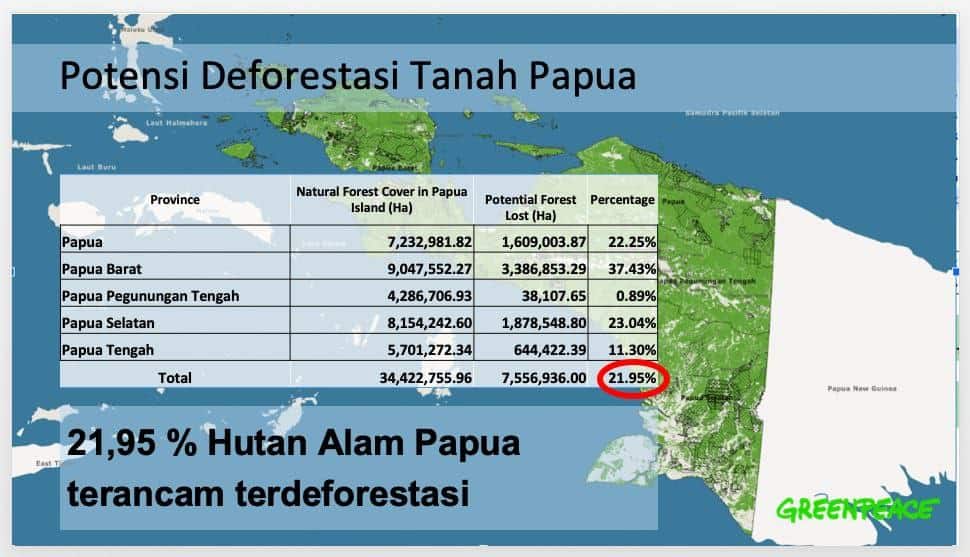
Data on potential deforestation in Tanah Papua. – Jubi/Greenpeace Indonesia
Jayapura, Jubi – Greenpeace Indonesia estimates that around 7.5 million hectares of natural forest in Tanah Papua has the potential to be lost, along with other natural resources, which will be sacrificed to spur economic growth and regional governance in four new provinces, namely Southwest Papua, Central Papua, and Mountain Papua. , and South Papua.
This was conveyed by Greenpeace Indonesia forest campaigner, Nicodemus Wamafma, when met by Jubi in Jayapura City, Papua Province on Saturday (20/1/2024).
“With weak and limited fiscal support as a new autonomous region in order to finance government and regional development, the new province will focus on encouraging the presence of land-based investment in the hope that it will contribute to economic growth and regional development,” he said.
Wamafma said the four new provinces needed land for offices, development of supporting infrastructure and economic growth to strengthen regional fiscal.
“If it is not carried out with a wise and good development approach, the expansion of provinces and districts and cities will have an impact on environmental damage, including deforestation of natural forests in the Land of Papua,” he said.
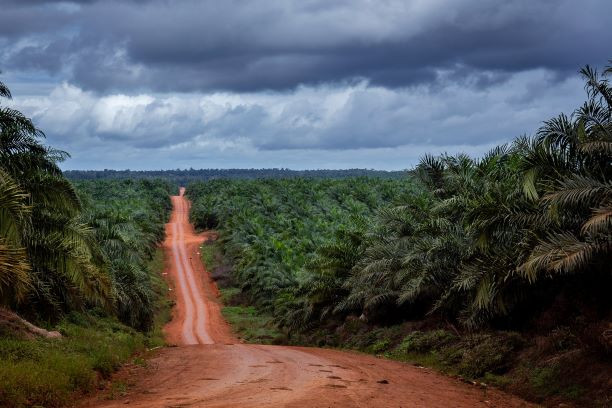
Data on the area of oil palm plantations in Tanah Papua. – Jubi/Greenpeace Indonesia
Learning from Papua’s journey during 1963-2021, continued Wamafma, development and investment in the Land of Papua had more of an exploitative impact on forests and natural resources belonging to the indigenous Papuan community rather than having an impact on improving the quality of life such as improving the quality of education, health and the economy, but there were more rights conflicts. -rights to land, forests and natural resources as well as human rights violations.
“[The conflict] between the state and corporations or companies against the Papuan indigenous people has not been resolved properly until now and is still a hidden ember. “This situation will get worse after the expansion of provinces continues to be forced in the Land of Papua,” he said.
The government in the four new provinces, he said, must learn from the process that Papua and West Papua Provinces have gone through and look at the living conditions of the Papuan indigenous people where extractive and exploitative development approaches have resulted in deforestation of Papua’s natural forests, environmental damage and loss of important biodiversity. as well as the violation or loss of the rights of indigenous Papuan people to land, forests and other natural resources.
“If not, the same approach and process will be repeated and more and more of Papua’s natural forests will be sacrificed or eliminated. This results in wider environmental damage and marginalization of the rights and lives of Papuan indigenous peoples in their traditional territories. “The Papuan indigenous people will stand as silent witnesses to the loss of rights and destruction of their areas of life, identity and future,” he said.
According to Wamafma, in the last two decades Greenpeace Indonesia recorded that more than 641,400 hectares of natural forest in Tanah Papua were lost with the main focus in Merauke, Boven Digoel, Nabire, Mimika, Mappi, Fakfak, Teluk Bintuni, Sorong, Manokwari and Kaimana.
Meanwhile, in the era of the Jokowi administration, from 2014 to the present, the Ministry of Environment and Forestry under the leadership of Siti Nurbaya has released more than 296,378 hectares of natural forest for various licensing purposes including allocation for the National Strategic Food Estate Project and the Trans Papua road and bridge infrastructure project. along more than 4,600 km from Sorong to Merauke. (*)
Jayapura, Papua (ANTARA) – The Central Papua provincial government has continued to distribute food assistance to communities in Agandugume and Lambewi in Puncak district, which are experiencing drought due to hail.
In a press release issued here on Friday, Central Papua acting governor Ribka Haluk said the food assistance includes rice, instant noodles, mineral water, sugar, coffee, tea, and other staple commodities.
“On Thursday (January 4, 2024), we distributed food using a Caravan aircraft so that it could arrive faster than through land routes,” she said.
She informed that her side has been distributing food assistance since December 26, 2023.
The provincial government, she said, is also hoping to get assistance from other parties that want to help Puncak residents.
“We have prepared a special plane that can carry foodstuffs and arrive faster,” Haluk added.
She explained that the residents’ condition in the two sub-districts of Puncak has gradually improved, although they have not resumed their normal daily activities.
“In August 2023, we formed a team to overcome the drought due to hail,” she said.
Extreme weather, including hail, has led to starvation in Agandugume and Lambewi, Puncak.
Earlier, the provincial government distributed social assistance worth Rp12.1 billion to empower people’s economy in eight districts.
The province also formed a task force to handle stunting, control inflation, and erase extreme poverty in the region.
The government has committed to handling the drought and famine in Agandugume, Lambewi, and Oneri in Puncak district, Central Papua.
The dry winter season in the region has led to crop failure as well as shortages of food and clean water.
News Desk (The Jakarta Post) Jakarta ● Wed, December 13, 2023
President Joko “Jokowi” Widodo recently bragged to other world leaders about Indonesia’s achievements in significantly reducing deforestation, which is helping the country reach its carbon emissions reduction target to tackle the climate crisis. But environmentalists refuted the claim, saying that Indonesia is actually behind in realizing its deforestation targets and urged the government to develop a more robust forest protection policy. During the World Climate Action Summit segment of COP28 in Dubai on Dec. 2, Jokowi boasted Indonesia’s work in curbing the deforestation rate by 75 percent, and claimed that the current rate was the lowest in the last two decades.
The President referred to data from the Environment and Forestry Ministry that showed a reduction in deforestated land from 462,000 hectares in the 2018-2019 period to 115,000 ha in 2019-2020, according to a statement the ministry issued on Dec. 5.
Jokowi reiterated one of Indonesia’s climate targets in Dubai, saying
that deforestation reduction was part of the country’s goal of achieving a forest and other land use (FOLU) net carbon sink – a condition in which the carbon absorbed is higher than the carbon emitted each year. Under the net sink plan, Indonesia plans for the FOLU sector to contribute to the country’s emissions reduction by absorbing 140 million tonnes of carbon dioxide equivalent (CO2e) of greenhouse gases. To achieve the FOLU net sink target, Indonesia must limit deforestation by up to 4.2 million ha between 2013 and 2030, according to the environment ministry’s estimate.
Read also: Indonesia’s call for support in COP28 shows ‘no new’ commitment
However, Greenpeace Indonesia’s analysis of government data revealed that the country had exceeded the deforestation quota to reach the net sink condition by 500,000 ha, as Indonesia saw 4.8 million ha of deforestation of forests and peatlands between 2013 and 2019. “There [should] be no more deforestation after 2019 […] but in fact it is still happening to date,” said Greenpeace Indonesia researcher Sapta A. Proklamasi during a public discussion in Jakarta on Friday.
The ongoing deforestation was not surprising for Sapta, as he blamed the government for not “intending to completely halt deforestation from the beginning” by not setting clear annual deforestation reduction targets. In 2021, Environment and Forestry Minister Siti Nurbaya Bakar asserted that the 2030 net sink target did not mean that deforestation would stop, as Indonesian forests and other natural resources should be sustainably used for the country’s development. She added that the development during Jokowi’s tenure “should not stop in the name of carbon emissions or because of deforestation.”
Sapta acknowledged the downward trend in deforestation since 2018, but the annual loss of 100,000 ha of forest and peatland, which is 1.5 times bigger than Jakarta, is still alarming. Agus P. Sari, CEO of environmental consultancy firm Landscape Indonesia, concurred with Sapta on the government’s deforestation reduction claim, saying authorities should carefully check the data from every region. “Maybe in many places, deforestation is decreasing. But in some other areas, [the deforestation rate] is rising,” Agus said, citing a rise in deforestation in Papua in recent years. To cut the deforestation rate even more, Sapta urged the government to make permanent a moratorium on primary forest clearing for timber and oil palm plantations, which many researchers believe to be the main driver of deforestation. The moratorium on oil palm plantation permits, first issued through a Presidential Instruction (Inpres) in 2018, requires government agencies to stop granting new licenses for oil palm concessions and to review existing plantations. But the policy expired in September 2021.
Read also: World far off track on pledges to end deforestation by 2030 – report
Sapta also called for the government to focus on completely stopping deforestation, instead of just lowering the deforestation rate every year. “The downward trend shouldn’t be regarded as an achievement as the forests are still being cut down, just at a different rate,” he continued. Sapta also voiced concerns that the reduction in deforestation might not be sustainable if Jokowi’s successor decides to increase the deforestation quota and allow more forests to be cut down to other uses after being elected next year. The government should also have a more comprehensive policy that details the role of civil society and the private sector in the country’s forest management, said forest policy professor Hariadi Kartodihardjo at the Bogor Agricultural University (IPB). “The key is to not maximize profits,” Hariadi said, adding that the government should use market and non-market instruments to push for better forest management. (alf)








 Australia West Papua Association Adelaide