Papuan indigenous peoples struggle has become much harder after court ruling: Walhi

Suara Papua – November 4, 2024

Jayapura – The struggle by Papuan indigenous people to save their customary forests from the invasion by corporations and the government has become harder after legal efforts reached a dead end with the Supreme Court’s (MA) rejection of the Awyu tribe’s appeal which challenged the environmental feasibility permit issued to the company PT Indo Asiana Lestari (IAL) by the Papua provincial government.

The court’s decision, as per Supreme Court document number 458 K/TUN/LH/2024, was taken at a deliberation meeting of the panel of judges on September 18. The full document was only able to be accessed on November 1.

Following the Supreme Court’s ruling, Hendrikus Franky Woro, an environmental activist from the Awyu tribe with the Coalition to Save Papua’s Customary Forests, expressed his deep disappointment because the Supreme Court appeal by the Awyu indigenous people, which was an effort to defend their customary forests from the expansion of palm oil corporations in Boven Digoel district, South Papua, now seemed to have been vain.

Woro and the Awyu tribe took their appeal to the Supreme Court after the Jayapura State Administrative Court (PTUN) and the Makassar State Administrative High Court (PTTUN) rejected their lawsuit and appeal.

The legal challenge was reasonable considering that the environmental feasibility permit issued by the provincial government for PT IAL was considered illegal and has a huge impact on the customary landowners and their future generations. This is because the palm oil company is operating on 36,094 hectares of land owned by the Woro clan, part of the Awyu tribe.

In a press release on Monday November 4, Indonesian Forum for the Environment (Walhi) Regional Executive Director Maikel Primus Peuki said that the verdict adds to the list of bad news for indigenous peoples and local communities who are fighting in courts against the threat of companies damaging the environment.

Woro’s disappointment, according to Peuki, was also felt by the Coalition to Save Papua’s Customary Forests. Peuki also felt the same because the court’s decision to reject the cassation appeal will make indigenous people’s struggle more difficult.

That is why Peuki regrets the Supreme Court’s ruling which seems to give false power to the company.

“The island of Papua is a customary land owned by more than 200 clans living in the land of Papua. This Supreme Court decision seems to give false power to the company. However, the Awyu indigenous people still have the right to their customary forests that have been with them for generations since they first lived in this customary area”, he said.

Walhi Papua hopes that the permit owned by the company will not eliminate the rights of indigenous peoples to their land, because it is clear that the owners of the customary rights have not relinquished their customary rights to anyone.

“We hope that the public will continue to support the struggle of the Awyu tribe and indigenous peoples throughout Papua who are fighting to defend their customary lands and forests”, said Peuki.

It turns out that one of the three judges who tried the case, Yodi Martono Wahyunadi, issued a dissenting opinion.

One of the important points in the dissenting opinion concerns the 90-day lawsuit deadline, which was previously used as a pretext by the Makassar PTTUN to reject Woro’s appeal. In his considerations, Judge Wahyunadi referred to Article 5 Paragraph (1) of Supreme Court Regulation Number 6/2018 which states that the calculation of the deadline only refers to working days. The deadline calculation should also have included local holidays in Papua province.

But considering substantive justice rather than formal justice, Judge Wahyunadi was of the opinion that the court needed to set aside the deadline provision by carrying out a practical invalidation.

Tigor Gemdita Hutapea, a member of the Save Papua’s Customary Forests advocacy team stated, “From the considerations in the dissenting opinion regarding this deadline, we consider the Supreme Court to be inconsistent in applying the rules they make. Even though the Supreme Court regulation is a guide used by the judiciary internally”.

“This Supreme Court’s ruling does not mean that the object of the lawsuit is correct because two judges did not examine the substance. But one [member of the] panel of judges in their dissenting opinion stated that the issuance the AMDAL [Environmental Impact Analysis] was proven not to have accommodated losses in areas where indigenous peoples live, which have been managed and utilised for generations”, said Hutapea.

In the dissenting opinion Wahyunadi said that the object of the lawsuit, the environmental permit for PT IAL, is clearly contrary the principles in Law Number 32/2009 on Environmental Protection and Management, so it must be annulled. Unfortunately, Judge Wahyunadi lost the vote.

[Translated by James Balowski. The original title of the article was “WALHI Papua Sebut Perjuangan Masyarakat Adat Kian Berat Pasca Putusan MA”.]

Source: https://suarapapua.com/2024/11/04/walhi-papua-sebut-perjuangan-masyarakat-adat-kian-berat-pasca-putusan-ma/

————————–

The population of Indonesian Papua opposes the new “Transmigrasi”

ASIA/INDONESIA – The population of Indonesian Papua opposes the new “Transmigrasi”

Information service of the Pontifical Mission Societies since 1927

Wednesday, 6 November 2024

Jayapura (Agenzia Fides) – The indigenous population of West Papua rejects the plan of the new Indonesian government to resume the program of internal migration of people from Indonesian islands (mainly Java) to Papua. The planned resettlement program (“Transmigrasi”) aims to encourage internal migration of people from densely populated regions to less densely populated regions of Indonesia. The program was conceived and initiated by the Dutch colonial government, but was taken up and continued again in the last century by the Indonesian government of Sukarno and then from the mid-1980s by the dictator Suharto, only to be suspended in early 2000. 


The Indonesian government of newly elected President Prabowo Subianto has now announced that it wants to “revitalize” ten areas in Papua with a new population “to strengthen unity and provide social support to the local population.” “We want Papua to be fully unified as part of Indonesia in terms of welfare, national unity and beyond,” said Minister of Transmigration Muhammad Iftitah Sulaiman Suryanagara. 


The announcement, meanwhile, sparked concern and protests from Papua’s indigenous inhabitants, who fear social and economic problems. West Papua, the western part of the large island of New Guinea, is Indonesian territory and a resource-rich region, but has long been a source of conflict: the indigenous population has denounced abuses and human rights violations by the military for decades. Indigenous groups and student associations in West Papua recall the negative impact of the program under dictator Suharto’s “New Order” in the 1960s: to make room for “settlers,” indigenous land was confiscated, forests were cut down, and cultural traditions were destroyed (so much so that several indigenous groups now speak the Javanese dialect better than their mother tongue). 

The government’s announcement has also raised doubts among local Christian communities, who have called on the government to focus on the needs of the people rather than on a new “colonization.” The Papuan Council of Churches, an ecumenical body that includes leaders of the various Christian denominations, has stressed that the people of Papua are “in dire need of services” and that they “can do without further ‘transmigration.'” “Papuans need education, health care, social welfare and development,” the Council stressed.

 Local religious leaders pointed out that the program perpetuates inequalities rather than promotes prosperity. The phenomenon exacerbates social problems, such as tensions arising from cultural and linguistic differences between the various groups: native Papuans suffer from marginalization and exclusion, and feel resentment towards “foreigners,” who are Indonesian citizens from other islands, as well as a “distance” from the central government in Jakarta. According to official statistics, between 1964 and 1999, 78,000 families moved to and settled in the Papua region thanks to the incentives offered by the government: the program was suspended to respect the principle of administrative autonomy of the various regions of the vast Indonesian archipelago. 

According to the Indonesian Central Bureau of Statistics, about 6.2 million people now live in the Indonesian region of West Papua. Persistent tensions that have never abated in Indonesian Papua have created an underlying state of crisis due to conflicts between the Indonesian army and armed separatist groups such as the Organisasi Papua Merdeka (OPM) or the Free Papua Movement (which emerged in the early 1960s): today there are still about 80,000 internally displaced Papuans in the conflict areas. The fighting groups claim injustices against the local population. (PA) (Agenzia Fides, 6/11/2024)

Food Estate in Papua Echoes Colonial Exploitation: Economist 

Reporter Han Revanda Putra October 25, 2024 | 09:12 am

TEMPO.COJakarta – An economist from the Universitas Pembangunan Nasional (UPN) Veteran Jakarta, Achmad Nur Hidayat, criticized the Indonesian government’s food estate plan that has been conveyed by the Coordinating Minister for Food Zulkifli Hasan. The food estate in Papua, he said, perpetuates colonial extractivism—the exploitation of natural resources by foreign companies that occurred in the past.

“Papua is once again exploited for the sake of national development without weighing the potential significant impact on local communities and the environment,” the founder and CEO of the Narasi Institute told Tempo on Wednesday, October 23, 2024.

The food estate project has been running since former President Jokowi’s reign, established in Central Kalimantan, Central Sumba, Gresik, Garut, Temanggung, and Merauke. It’s also included in the 2020-2024 National Strategic Project (PSN) list.

Achmad warned that the exploitation of natural resources often offers no significant benefit to local communities. Papua, with its rich biodiversity and culture, becomes an apparent target of exploitation. Turning 2 million hectares of land into an agricultural field will alter the landscape carefully preserved by Indigenous communities. 

“The history of colonialism in Papua shows that the management of resources by outsiders often overlooks the interests of local communities,” said Achmad, who is now a lecturer at Universitas Indonesia. 

Aside from being minimally involved in decision-making, the indigenous people of Papua are worried about losing their land, as these assets are also crucial for cultural and spiritual values.

“Without clear protection, the food estate in Papua has the potential to exacerbate the existing social and economic inequalities there,” Achmad added.

Achmad suggested a more inclusive and sustainable approach instead of food estate. According to Achmad, agricultural projects should be followed by empowering local farmers and sustainable land management without neglecting transparent supervision.

“Food self-sufficiency can be achieved without repeating the mistakes of our colonial history,” he said. “Papua is not an object but an integral part of Indonesia that must be preserved and respected.”

Minister Zulkifli Hasan previously mentioned the potential of a 2 million-hectare field in Papua, planted with various food crops such as rice, corn, and sugar cane. “Our future lies in Papua,” he said on Monday, October 21, as quoted from Antara.

—————————————

Zulkifli Hasan targets food self-sufficiency by 2029, plans to utilize Papua’s land

October 22, 2024 Reading Time: 2 minutes

 Julian Isaac Journalist

Coordinating Minister for Food Affairs, Zulkifli Hasan, has set a target to achieve national food self-sufficiency by 2029 and utilize idle land in Papua to meet the growing demand for food production.

Zulkifli cited that the idea of using land in Papua for agriculture has been proposed since 2014, highlighting the diminishing agricultural capacity in Java.

“Land in Java continues to decrease, and living conditions are becoming unsustainable due to pollution and sinking coastal areas,” he told a media conference at the Ministry of Trade on Monday, October 21, 2024.

He sees Papua as the future of Indonesia’s agricultural industry and has programmed the cultivation of 600,000 to 2 million hectares of land in the region. The main crops to be planted include sugarcane, rice, and corn.

“We have vast land in Papua that has not been optimized. With everyone’s support and prayers, we aim to achieve food self-sufficiency,” Zulkifli said.

Indonesia’s food demand is projected to rise alongside its growing population. Statistics Indonesia (BPS) estimates that by 2050, the population will reach 328 million, driving demand for key food commodities, including 40-50 million tons of rice.

However, this year’s rice production is expected to reach only 30.34 million tons, a 2.43 percent decline from the previous year, with harvested land shrinking by 1.64 percent.

This underscores the country’s food vulnerability, as local production remains insufficient to meet domestic needs.

According to the Global Food Security Index, Indonesia’s food security score stands at 60.2, slightly below the global average of 62.2.

President Prabowo Subianto has expressed confidence that his administration can achieve national food self-sufficiency within four years. He is optimistic that Indonesia can even become a global food hub.

Prabowo stressed the importance of reducing food imports, particularly in light of potential global crises where countries prioritize their own food needs over exports.

“We must aim for food self-sufficiency as soon as possible. We cannot rely on food sources from abroad,” Prabowo stated in his inauguration address on Sunday, October 20, 2024.

————————————

Transmigration not a solution to Papua problems: Activist

https://indonesiabusinesspost.com/insider/transmigration-not-a-solution-to-papua-problems-activist/

October 31, 2024 

  Gusty da Costa Journalist

An indigenous human rights activist has asked Jakarta to reconsider the transmigration program in Papua region as bringing in non-Papuans to the country’s easternmost region will only create new problems and challenges for the native inhabitants.

“My question is very simple, will President and Vice President guarantee the safety and living rights of the transmigrants in conflict area? When they are brought from Java, the Presiden will say that he guarantees their security as the president will deploy military personnel to Papua in huge number,” Papuan human rights activist, Theo Hasegem, spoke to Indonesia Business Post on Wednesday, October 30, 2024.

In reality, there have been a lot of non-Papuan businessmen, ojek (motorcycle taxi) drivers, teachers, and healthcare officials killed or shot by members of the West Papua National Liberation Army (TNPB) despite the presence of thousands of non-organic security personnel in Papua.

“As a human rights defender, I hope the (central) government will seriously consider the security issue in Papua,” Theo noted.

He was of the opinion that transmigration is not what native Papuans need.

“Papuans need justice, honesty, and the government’s readiness to solve the alleged human rights violations through dignified and authoritative dialog facilitated by a neutral third party,” he said.

Theo underlined that the main problem in Papua is human rights violations that have become an international issue.

He said the Indonesian government should be embarrassed that they used to be put under spotlight and criticized in United Nations (UN) meetings.

“The President and Vice President of the Republic of Indonesia know that there is a threat of humanitarian crisis in Papua that is difficult to overcome, such as murder, torture, extrajudicial arrests, and arbitrary detention allegedly carried out by Indonesian military and police personnel against indigenous Papuans,” he cited.

At the same time, the West Papua National Army continues to assassinate non-Papuan Indonesians, whom they suspect of being spies or intelligence agents deployed in Papua.

“Without solution of the humanitarian crisis, violent armed conflicts will continue to happen in Papua,” Theo said.

Upon his inauguration as President on October 20, 2024, Prabowo Subianto told the Minister of Transmigration that he is willing to send transmigrants to the eastern part of Indonesia, including Papua, saying that transmigration program is a solution to Papuan issues.

Tensions escalate between Me and Kamoro tribes over gold mining in Central Papua – PT Zoomlion continues with illegal operation

 Cases Human Right 22 August 2024 

Some of the conflicts in Papua stem from illegal operations by companies that have failed to involve the customary land rights owners. A prominent example is the operation of PT Zoomlion in Kapiraya District, Central Papua Province. This issue urgently requires intervention from the Central Papua Provincial Government.

On 18 July 2024, the dispute over gold panning land in Kapiraya District escalated tensions between the Mee and Kamoro tribes. This dispute threatens the peaceful coexistence that has long been maintained between the two tribes. Historically, the Me and Kamoro tribes have lived in harmony, engaging in activities such as hunting, cooking, and bartering together. However, tensions have risen recently when residents of Wakiya Village, armed with weapons, threatened to sweep away the Me tribe residents in Mogodagi Village. This threat arose due to a scramble for control over the gold mining land in the region.

The Dogiyai Regency House of Representatives has taken steps concerning the illegal gold mining activities carried out by PT Zoomlion Indonesia Heavy Industry in Mogodagi Village, Kapiraya District, Deiyai Regency. Since January 2023, PT. Zoomlion has been conducting manual gold mining operations. In May 2024, they expanded their activities by bringing in two excavators and two Hilux vehicles without obtaining permission from the local community. This operation has resulted in severe environmental damage and a blatant disregard for the rights of the indigenous peoples who hold customary rights to the land.

In response to the increasingly volatile situation, the Dogiyai Regency House of Representatives conducted field monitoring (which was announced in May 2024) to Mogodagi Village. Their findings were compiled into official recommendations submitted to the Central Papua Provincial Government, specifically to the Acting Governor, and other relevant parties. The Dogiyai representatives urged that immediate and concrete steps be taken to resolve the situation before lives are lost. The presence of this illegal gold mine has intensified tensions within the local community, particularly between the Kamoro and Kei communities, who have threatened violence against the Me community in Mogodagi Village. Following the DPR’s visit, the situation worsened with the arrival of additional heavy equipment to support the illegal mining activities and the blockade of the Kapiraya airport runway by the Kamoro and Kei people, along with the company. The situation is extremely tense, putting the Me community under serious threat.

It is crucial that the Kamoro and Me tribes engage in dialogue to determine the boundaries of their respective customary lands. This mediation meeting should be facilitated by the Central Papua Provincial Government, given that this region lies at the intersection of three districts: Deiyai, Mimika, and Dogiyai. The community is urging the Acting Governor of Central Papua to promptly take concrete steps based on the recommendations of the Dogiyai Regional People’s Representative Council (DPRD), which reflect the people’s aspirations. This action is vital to prevent casualties and bloodshed. We seek a solution that promptly delineates territorial boundaries and issues a Governor’s Regulation (Pergub) and a Special Regional Regulation (Perdasus) on people’s mining.

Immediate actions that need to be taken include shutting down the illegal gold mining operations carried out by PT. Zoomlion Indonesia Heavy Industry in Mogodagi Village, conducting a transparent investigation into how PT. Zoomlion began its operations without the consent of customary rights owners, restoring the rights of indigenous peoples, protecting the environment by implementing measures to repair the damage caused, and ensuring transparency and accountability in all mining operations permits and other economic activities.

This call must be urgently addressed by the relevant parties before the situation deteriorates further and casualties occur. Let us work together to maintain the peace and well-being of the people of Central Papua.

YLBHI condemns arrest of 9 farmers over land dispute in new capital Nusantara

Kompas.com – February 26, 2024

Sabrina Asril, Jakarta — The Indonesian Legal Aid Foundation (YLBHI) has condemned the arrest of nine palm oil farmers in the area of the new capital city Nusantara (IKN) who were opposing the construction of the VVIP Airport in North Penajam Paser, East Kalimantan, on Monday February 26.

“The YLBHI condemns the actions of the East Kalimantan regional police who carried out the inhuman and arbitrary arrests, because it was done without showing an arrest warrant and did not clearly notify them of the reason they were arrested”, said YLBHI Chairperson Muhammad Isnur said in a written statement on Monday.

Isnur said that the arrests can be categorised as a systematic act against communities defending their right to life. According to Isnur, the arrest of nine farmers by the police as a case of using the law to coerce the community.

“The police for the umpteenth time have used this method, in securing national strategic projects (PSN)”, said Isnur.

Isnur said that the same thing had happened at the Rempang Eco-City project in the Riau Islands and in the case of a land dispute in Seruyan, Central Kalimantan.

“The actions of the East Kalimantan regional police violated the law and human rights, where any person who is arrested has the right to be told the reason why they were arrested and the police are required to show an arrest warrant”, said Isnur.

Earlier, nine members of the Saloloang farmers group in North Penajam Paser (PPU) were arrested by the police on Saturday evening, February 24. The arrests were related a land dispute between a group of farmers and the IKN VVIP Airport national strategic project.

East Kalimantan regional police public relations head Senior Commissioner Artanto said that the nine farmers were arrested because it was said that they had threatened the IKN VVIP Airport construction project.

Artanto explained that on Friday February 23, a group of people approached VVIP project workers and threatened them so they would stop working.

The next day, on Saturday at around 8.30 am, the group returned to stop the construction of the VVIP Airport. The incident occurred on the northern side of Zone 2 when they brought Mandau (a kind of sword made in Borneo) and the operators immediately stopped work.

“On the basis of the incident, field supervisors at the location of the planned VVIP Airport made an official police report with the PPU regional police on that day as well”, Artanto said on Monday.

[Translated by James Balowski. The original title of the article was “YLBHI Kecam Penangkapan 9 Petani Sawit di Wilayah IKN”.]

Rights activist Victor Yeimo says Haris-Fatia acquittal a win for Papuan people

Suara Papua – January 9, 2024

Jayapura — The Papuan people and the West Papua National Committee

(KNPB) in the Meepago area have welcomed the acquittal of Haris Azhar and Fatia Maulidiyanti who were found not guilty by the East Jakarta District Court on Monday January 8.

Azhar and Maulidiyanti are human rights activists who were found not guilty in a case of defamation brought against them by Coordinating Minister for Maritime Affairs (Menko Marves) and Investment Luhut Binsar Pandjaitan.

The case began when Azhar and Maulidiyanti appeared in a YouTube podcast titled “There is Lord Luhut behind the Economic Relations-Military Operations in Intan Jaya!! There are also State Intelligence Agency Generals!! NgeHAMtam”.

“Myself along with the Papuan people in Meepago and Dogiaya, we welcome the news of the release of Haris and Fatia by the [East] Jakarta District Court which today decided to free them. We welcome this and we say this is a victory for the Papuan people, that what Haris and Fatia fought for in the conflict in Papua was something that was true”.

“Therefore this truth will continue to win anywhere and the people are together with Haris and Fatia”, said KNPB international spokesperson Victor Yeimo on Monday in South Kamu, Dogiya regency, Central Papua province.

“We convey to the government of the Republic of Indonesia, especially to Luhut Binsar Pandjaitan (Menko Marves). Stop the military businesses in Papua, especially in the Wabu Block. We convey that the people of Meepago, the people of Intan Jaya, Dogiaya and Deiyai firmly reject the Wabu Block project being developed in Papua, especially in Intan Jaya”.

Yeimo said that the Papuan people have suffered since the gold-and-copper mine PT Freeport was established in Papua.

“We, the people of Papua, have experienced suffering along with the presence of PT Freeport. Don’t let there be any more companies in the Wabu Block with military businesses that conduct massive exploitation of Meepago land”.

“We, the people of Meepago, firmly reject military projects, projects of the Oligarchic elite from Jakarta. We [stand] together with Haris and Fatia. The truth will always win out!”, Yeimo concluded.

[Translated by James Balowski. The original title of the article was “Vonis Bebas Haris dan Fatia Disambut Rakyat Meepago dan KNPB, Victor:

Hentikan Bisnis Militer di Papua”.]

Internally Displaced Peoples IDP’s humanitarian crisis in Papua: Catholic Church calls for immediate government action

Human Rights News / IndonesiaWest Papua / 17 November 2023 

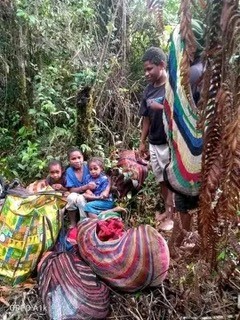
The Secretariat of Justice and Peace (SKP in Indonesian) of the Catholic Church throughout Papua says 46,926 civilians were displaced from their villages due to armed conflict and urges the government to return the refugees to their hometowns. The urge was conveyed through the Pastoral Appeal of the SKP of the Catholic Church throughout Papua issued in Sorong, West Papua Province, on 12 October 2023. The pastoral call was signed by the Director of SKPKC Fransiscan Papua Yuliana Langowuyo, Director of SKP Diocese of Agats RD Linus Dumatubun, Head of SKP Diocese of Timika Saul Wanimbo, Director of SKPKC OSA Christus Totus Papua RP Heribertus Lobya OSA, Head of SKP Diocese of Manokwari Sorong RD Izaak Bame, and Secretary of the KPKC Commission of Jayapura Diocese Elias Gobay. The urge came after visiting refugees from Maybrat in Sorong Regency. (see photo/ SKP-Papua).

Moreover, the Cenderawasih Papua Catholic Student Association (MKC Papua) has called upon the Papuan Government, the Indonesian Bishops Conference (KWI/Konferensi Waligereja Indonesia), and bishops across Papua to take proactive measures to address the dire situation of refugees in Papua. The appeal was made following a discussion regarding the evolving situation in Papua, held in Tomohon, North Sulawesi, on 17 October 2023.

Nicolaus Huby, the Chairman of MKC Papua, emphasised the need for the Catholic church leadership to acknowledge and respond to the critical conditions in Papua. Huby expressed concerns that the current situation, marked by escalating violence and armed conflicts between the Indonesian National Army/Indonesian National Police (TNI/Polri) and the West Papua National Liberation Army/Free Papua Organization (TPNPB/OPM)  from 2018 to 2023, requires urgent attention.

According to reports by humanitarian activists, a significant number of residents have been displaced from their homes. For instance, approximately 674 residents from Muara Bontoh (Yahukimo) were forced to flee to Dekai, while 2,252 people in Kiwirok and surrounding areas sought refuge in the Oksibil and neighbouring Papua New Guinea. Furthermore, over 37,000 Nduga residents from various districts had to leave their homes and relocate to Asmat Regency, Mimika Regency, and Jayawijaya Regency. Additionally, around 1,000 residents of Intan Jaya fled to Nabire Regency, Paniai Regency, and Mimika Regency, while approximately 6,000 Maybrat residents sought refuge in Kmurkek, Sorong Regency, and Sorong City.

The issue of refugees has been compounded by instances of violence, including the shooting of a Catholic catechist in October 2020 by the Indonesian military. Despite claims by the government and security forces that refugees have returned to their hometowns, reports from SKP in Papua and Komnas HAM suggest that many are still displaced. For example, there are still 5,296 people residing in refugee camps in Maybrat.

These refugees have been enduring difficult living conditions in overcrowded settings. They have called for assistance in providing health and education for their children, as their current resources are insufficient. Above all, they express their desire to return to their hometowns, provided that the military presence in East Aifat is reduced to ensure peace and safety.

The plight of these refugees has been compared to that of Joseph and Mary, who were forced to leave their hometown. Pope Francis has drawn parallels between the present-day refugees and the biblical narrative, highlighting the need for empathy and assistance.

Cenderawasih Papua Catholic Students have urged the Catholic church, the Indonesian government, and relevant authorities to take immediate action by:

  1. Facilitating the repatriation of refugees to their hometowns through meaningful consultations with internally displaced Papuans.
  2. Ensuring the safety of returning refugees and preventing intimidation.
  3. Providing reparations or compensation for all losses suffered by internally displaced persons, including physical, property, psychological, and mental losses.
  4. Guaranteeing basic rights for refugees before their return, including temporary shelters, food, healthcare, and access to education.
  5. Allowing humanitarian assistance from other organizations to reach internally displaced people.
  6. Halting military operations in Papua.
  7. Ending the dispossession of customary land rights of the Papuan people.
  8. Taking responsibility for resolving human rights violations in Papua.

————————————————————

2) Jayapura court rejects lawsuit by Awyu tribe over palm oil permit, advocates prepare to appeal

Human Rights News / IndonesiaWest Papua / 17 November 2023 

On 2 November 2023, the Jayapura State Administrative Court (PTUN Jayapura) rejected a lawsuit filed by the indigenous Awyu Tribe in Papua Province (see photo, credit Gusti Tanati/ Greenpeace). The lawsuit was related to an environmental feasibility permit issued by the Investment and One-Stop Integrated Service Office (DPMPTSP) for PT Indo Asiana Lestari (PT IAL) to develop oil palm plantations covering 36,096.4 hectares in the Mandobo and Fofi Districts in Boven Digoel Regency, South Papua Province. The Awyu Tribe argued that the permit was issued without their knowledge or consent.

The panel of judges, led by Merna Cinthia SH MH, along with member judges Yusup Klemen SH and Donny Poja SH, declared the lawsuit unreasonable and rejected it. They argued that the procedure and substance of the Environmental Impact Analysis (AMDAL) issuance did not contradict laws and regulations or the principles of good governance. As a result, PT IAL’s environmental feasibility permit was declared valid.

Emanuel Gobay, a lawyer for the Awyu Tribe, expressed dissatisfaction with the judge’s decision, stating that it did not align with environmental law principles. Mr Gobay pointed out that the judges did not adequately consider the substance of the problematic AMDAL document and rejected requests for field inspections. The legal team also intended to evaluate the judge’s attitude in deciding the case.

Furthermore, Tigor Hutapea, a member of the Papuan Customary Law Enforcement Coalition, argued that the judges erred by accepting an investment support letter from the Indigenous Peoples’ Agency (LMA) of Boven Digoel as meaningful participation. He emphasised that LMA had an unclear legal status and did not represent the indigenous Awyu people and the Woro clan. According to Hutapea, LMA had no authority to approve the release of forests belonging to indigenous peoples, disregarding the principle of free, prior, and informed consent from affected communities.

The lawsuit received significant support from various communities and organisations. A petition compiled by the Solidarity Movement to Save Papua’s Customary Forests garnered signatures from 73 institutions and 94 individuals, demonstrating widespread backing for the Awyu Tribe’s cause.

Dr Totok Dwi Diantoro, an expert witness for the Awyu Tribe, emphasised that indigenous peoples’ consent is a fundamental requirement for permits related to business activities in their customary areas. This requirement is in line with the United Nations Declaration on the Rights of Indigenous Peoples, which enshrines the principle of Free, Prior, and Informed Consent (FPIC) as a right of Indigenous peoples when dealing with new activities in their territories.

Related case information: https://humanrightsmonitor.org/news/awyu-indigenous-community-sue-papua-dpmptsp-office-over-right-to-information-about-palm-oil-companys-permit/ and https://humanrightsmonitor.org/news/leader-of-woro-clan-awyu-people-files-lawsuit-concerning-palm-oil-company-pt-ial-permits/

Police arrest 20 protesters supporting indigenous rights in Papua, sparking criticism

News Desk 21 November 2023

Protesters who were secured at the Merauke Police Station on Saturday (18/11/2023) during a peaceful demonstration in support of the Awyu indigenous people.-Dok AMPERA PS.

Jayapura, Jubi – Several civil coalitions expressed dismay over the apprehension of 20 individuals associated with the South Papua People’s Student Alliance (AMPERA PS) by Merauke Police on November 18, 2023.

The arrests occurred during a peaceful demonstration aimed at extending support to the Awyu indigenous community’s struggle for their ancestral lands against corporate encroachment in the Boven Digoel district.

Ayub Paa, an environmental activist from Greater Sorong, lamented the heavy-handed approach of the police in detaining demonstrators who sought to exercise their freedom of speech supporting Hendrikus Woro’s legal challenge against the Decree issued by the Head of the One-Stop Integrated Investment and Service Office (DPMPTSP) of Papua Province No. 82/2021, pertaining to environmental feasibility permits.

“We deeply regret the disruption of the peaceful protest intended to convey support for Hendrikus Woro. This could potentially lead to Hendrikus Woro’s ancestral lands and forests falling into the hands of a corporation, despite their lack of involvement in relinquishing customary rights or accepting funds for the acquisition of Woro clan’s ancestral lands,” expressed Ayub Paa in a press release received by Jubi on Sunday (11/19/2023).

Tasya Manong, spokesperson for the Alliance of Youth Students Caring for Forests and Indigenous Peoples’ Rights (AMPERAMADA) Papua, criticized the security forces for dispersing the protest and detaining individuals.

“Our fellow demonstrators sought a peaceful demonstration, yet they were dispersed and taken into custody at the Merauke Police station. Despite our rights as citizens being safeguarded by the constitution and other legal frameworks, they were subjected to this treatment. Did they cause any disruption? No. This severely undermines democracy and human rights,” said Tasya Manong. (*)

——————-

) Police disperse peaceful protest advocating indigenous rights in South Papua  

News Desk – Freedom Of Expression In Papua 

21 November 2023

Jayapura, Jubi – In Merauke Regency of South Papua Province, the local police disbanded a peaceful rally on Saturday (18/12/2023), detaining 20 demonstrators who were advocating for the Awyu indigenous people who embroiled in a legal dispute at the Jayapura State Administrative Court.

The protest, organized by the South Papua Student, Youth, and Advocates for the Traditional Lands Alliance (Ampera PS), aimed to highlight the Awyu indigenous people’s plight,

The dispersal of the rally and subsequent arrests faced opposition from the Legal Aid Institute of Papua (LBH Papua). According to LBH Papua Director Emanuel Gobay, Ampera PS had notified the Merauke Police about the demonstration in advance, suggesting that the police should not have intervened.

“LBH Papua views the police’s actions as a breach of Law Number 9 of 1998 regarding freedom of expression,” said Gobay, highlighting the discrepancy between the police’s duties as law enforcers and their handling of the situation.

Gobay, in a press release on Saturday (18/11/2023), condemned the arrests as an abuse of authority, citing Government Regulation Number 2 of 2003 on Disciplinary Regulations for Members of the Indonesian National Police. He further accused the Merauke Police Chief and staff of stifling democratic space, violating National Police Chief Regulation No. 8 of 2009 that outlines human rights principles in police duties.

LBH Papua urged the Papua Police Chief and the Governor of South Papua to instruct the Merauke Police Chief to release the detained Ampera PS protesters. Gobay emphasized the legitimacy of the rally under democratic mechanisms guaranteed by the Freedom of Expression Law, urging swift action for their release. (*)