Jokowi’s strategic projects creating injustice and repression: YLBHI

CNN Indonesia – September 25, 2023

Jakarta — The Indonesian Legal Aid Foundation (YLBHI) has found that national strategic projects (PSN) and the management of natural resources (SDA) under the administration of President Joko “Jokowi”

Widodo has crfeated injustice and oppression for the ordinary people.

In addition to this, these national strategic projects and natural resource industries have caused environmental destruction and land conflicts.

“The YLBHI found that PSN and the management of SDA produced multiple effects in the form of injustice and the oppression of ordinary people”, wrote the YLBHI in a written release on Sunday September 25.

There has yet to be a response or comment from the government on the YLBHI’s statement.

“In fulfilling these ambitious projects, the state has committed a series of repressive acts and used excessive force (excessive use of

force) against residents who are defending their land, water and living space through state security forces, namely the TNI [Indonesian military] and the Polri [Indonesian police]”, they continued.

The YLBHI found that farmers, traditional communities, human rights defenders and environmental activist suffered physical violence, non-physical violence and criminalisation.

Over the period 2017-2023, the YLBHI recorded a number of incidents of violence against farmers in cases being handled by its 18 regional Legal Aid Foundation (LBH) offices. This seven-year period was determined based on the start of national strategic projects in 2016.

The explanatory data on criminalisation covers areas of natural resource conflict, especially in areas where there were national strategic projects. The data is divided into several variables, including the number of conflicts, the area of conflict and number of victims, the perpetrators of violence and criminalisation, patterns of violence, the laws that were frequently used, the causes and the structural impacts of conflict.

The YLBHI data

As many as 106 agrarian conflicts and cases involving national strategic projects were handled by the YLBHI and its regional LBH offices throughout Indonesia. The land area where there were conflicts covered around 800,000 hectares and resulted in more than 1 million ordinary people falling victim.

The plantation sector was dominant with 42 cases, followed by the mining sector with 37 cases, then conflicts involving national strategic projects with 35 cases.

The YLBHI said that there were a variety of perpetrators in these conflicts. Private companies were involved in 100 conflicts, regional governments in 74 conflicts and the police in 50 conflicts.

A many as 123 acts of violence were recorded, which broadly speaking fell into three types of patterns.

First, patterns of violence in the form of verbal violence such as intimidation in the form of physical violence ranging from physical abuse to torture. This pattern was recorded in 48 cases (40 cases of intimidation and eight cases of physical violence).

Second, 43 cases split between these two patterns, and third, criminalisation with 43 cases.

“Usually, these three patterns were applied in stages, for example beginning with the threat of forced eviction and the threat of criminalisation, then increasing to the level of violence and criminalisation”, wrote the YLBHI.

Furthermore, said the YLBHI, local people that were criminalised were used as negotiation tools causing divisions between those who supported and opposed a given project within the community.

The YLBHI recorded that out of the 43 cases, some 212 farmers were criminalised. The majority of cases of criminalisation used articles under the Criminal Code (KUHP) with 29 cases.

This was followed by the Mineral and Coal Mining Law (UU Minerba) with seven cases, Law Number 39/2014 on Plantations with four cases, Law Number 18/2013 on the Prevention of Forest Clearing and Destruction with three cases, the Information and Electronic Transaction Law (UU ITE) with two cases and the anti-communism law in one case.

The YLBHI also highlighted attempts to criminalise farmers involving strategic national projects in the 18 regions where there are LBH offices. There were some 35 national strategic projects in which 35 farmers became victims of criminalisation. The victims came from five different provinces or municipalities, namely Central Java, West Java, Padang, Makassar and Manado.

The largest number of cases of criminalisation in national strategic projects occurred in Central Java (10 cases) and Padang (10 cases).

If viewed from the legal basis for the criminalisation, the YLBHI noted that almost all of them were based on Article 362 of the KUHP on theft.

Second, Article 333 that contains criminal offices on depriving a person of their freedom. Third, Article 170 that contains offences on crimes of violence against persons or materials.

Fourth, Article 154a that contains offences on insulting state symbols.

Fifth, Article 406 that regulates damage to another person’s property.

And finally, Article 27 of the ITE Law that contains offences on defamation.

The YLBHI and its 18 regional LBH offices are urging the government and the House of Representatives (DPR), as well as related ministries and government institutions, to cancel all strategic national projects that are considered to harm the ordinary people or trigger practices of violence and human rights violations by the state though its apparatus.

The YLBHI is also asking the government to stop appropriating the people’s land in the name of management rights and state land claims.

The other demand is asking the government to withdraw all security forces from agrarian conflict areas and national strategic projects, as well as revoking the Omnibus Law on Job Creation and its derivative regulations, which are seen as triggers for the increase in land grabs and state violence against the ordinary people.

The YLBHI is also asking that national programs disguised as agrarian reform or fake agrarian reform programs to be stopped.

In addition to this, the government is being asked to stop the criminalisation of those fighting for land rights and the environment, as well as their unconditional release from all charges and criminal indictments.

“Ensure that the state implements the constitutional mandate, especially Article 33 Paragraph (3) of the 1945 Constitution, [which states] that the earth, water and natural resources contained therein are controlled by the state for the greatest prosperity of the people, not for investors and/or those in power or entrepreneurs”, wrote the YLBHI.

(yoa/tsa)

[Translated by James Balowski. The original title of the article was

“YLBHI: PSN Era Jokowi Hasilkan Penindasan Terhadap Rakyat”.]

Jokowi’s ‘land hungry’ projects have triggered 73 agrarian conflicts since 2020: KPA

Kompas.com – September 24, 2023

Vitorio Mantalean, Jessi Carina, Jakarta — The Agrarian Reform Consortium (KPA) has recorded at least 73 agrarian conflicts that have broken out in different parts of the country since 2020 as a result of national strategic projects (PSN).

The KPA believes that the development model and PSN policy is “land hungry”, moreover it is being supported by the Omnibus Law on Job Creation, which is seen as leading to industrial liberalisation.

KPA Secretary General Dewi Kartika highlighted how the government continues to form new agencies in order to support these national strategic projects.

“These new institutions are becoming a state within the state that are given extremely wide authority and powers to control and regulate land on a massive scale”, said Kartika during a virtual discussion organised by the KPA to mark Farmers Day 2023.

She cited several of these agencies, such as the Land Bank, the new Capital City Authority, the Lake Toba Executive Body, the Labuan Bajo Authority and similar institutions that are given various powers including control, utilisation and management of land and capital, through to authority over business development and ease of transactions.

“The authority and state assets that are given to these kinds of new agencies are like creating mini states and kingdoms within the state, where the abuse of power and agrarian corruption can flourish and is structured”, explained Kartika.

The latest case of a large scale agrarian conflict that has attracted public attention is on Rempang Island, Batam, resulting from an order to clear local residents off their land in a repressive manner to make way for the Rempang Eco City national strategic project.

In this case, the Batam Free Trade Zone Authority (BP Batam) was given special authority in the form of regulations and supporting infrastructure, which was then reinforced by a memorandum of understanding on the use of land by the Xinyi Group in order to accelerate the project.

“We can see, that the Labuan Bajo Authority was also given the authority to acquire local [people’s] land for the construction of the imagined New Bali on Komodo Island”, said Kartika.

All of these policies are applied on the basis of “domain verklaring” — the principle that if a person cannot prove the ownership of their land then it belongs to the state and they are not entitled to occupy it.

This principle is problematic because it ignores communal land rights over land that has been cleared, cultivated and occupied by generation after generation.

Kartika gave another example of a traditional community in East Nusa Tenggara (NTT) who were forced to surrender their customary land in order to make way for the Lambo Dam strategic national project.

“This is the practice of domain verklaring over our land, over land and local people’s settlements that ends in eviction and forced land pegging by the government”, she said.

Aside from the examples above, the KPA also citied many other strategic national projects that have given rise to agrarian conflicts around the country since 2020, ranging from infrastructure projects, property development, agribusiness, coastal development and mining.

These include, among others, the Mandalika MotoGP project in Lombok, West Nusa Tenggara (NTB), the Gresik Special Economic Zone in East Java, the Bener Dam project in Wades, East Java, the MNC multiland project in Sukabumi, West Java, the food estate project in North Sumatra and the new irrigated rice field project in the forests of Kalimantan.

Never mind the construction of various kinds of infrastructure to support the new capital city Nusantara in East Kalimantan, the Air Bangis oil refinery in West Sumatra, the hydroelectric power plant

(PLTA) in Pinrang, South Sulawesi, the North Kayong Airport in West Kalimantan, the Karalloe Dam in Gowa, the Serang-Panimbang, Balikpapan and Samarinda toll roads, the construction of the Muna coal-fired power plant (PLTU) in South-East Sulawesi and the Royal Boskalis sand mining project in South Sulawesi.

[Translated by James Balowski. The original title of the article was

“KPA: Proyek Strategis Nasional Jokowi “Lapar Tanah”, Picu 73 Konflik Agraria sejak 2020″.]

Investigation by rights groups finds numerous rights violations in Rempang

Inilah.com – September 18, 2023

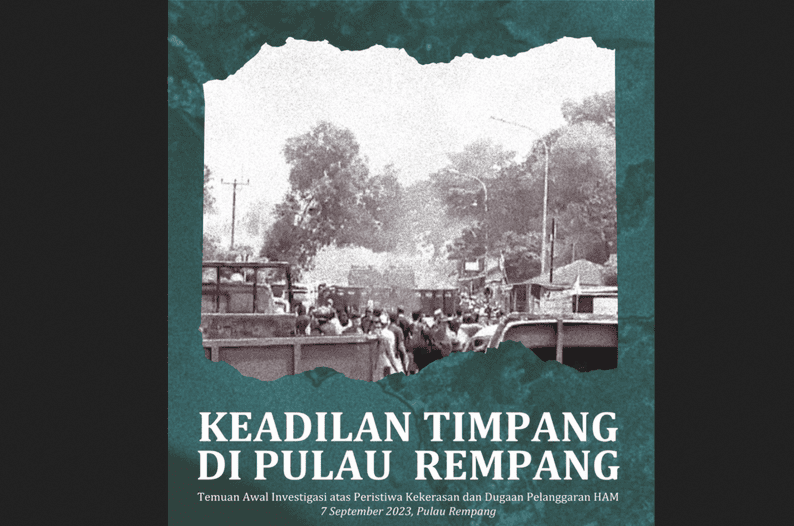
Vonita Betalia — Nine human rights organisations calling themselves the “National Solidarity for Rempang” have published the results of a preliminary investigation into the September 7 riots on Rempang Island in Batam, Riau Islands. The investigation found a number of human rights volitions.

The publication, titled “Flawed Justice on Rempang Island”, is the result of a joint investigation by the Indonesian Legal Aid Foundation (YLBHI), the Pekanbaru Legal Aid Foundation (LBH Pekanbaru), the Indonesian Forum for the Environment (Walhi) National Executive, Walhi Riau, the Commission for Missing Persons and Victims of Violence (Kontras), Amnesty International Indonesia, the Agrarian Reform Consortium (KPA), the Nusantara Indigenous Peoples Alliance (AMAN) and Trend Asia.

“We concluded that alleged human rights violations occurred during the violent incident in Rempang on September 7, 2023 and therefore it must be declared as a human rights violations as stipulated under Law Number

39/1999 on Human Rights”, read a section from the report published on Monday September 18.

In the report it said that these rights violations can be seen from a number of things such as the excessive deployment of security forces, the use of violence and minimum participation and access to information on the Eco City project on Rempang Island.

This included arbitrary arrests by the Barelang municipal police

(Polresta) following protests by residents, the violation of the rights of women and children related to the social conflict, the loss of a sense of security and widespread fear among Rempang residents.

In addition, the series of violations that occurred in Rempang were violations of national and international human rights instruments including Law Number 39/199 and the International Convention on Civil and Political Rights which Indonesia has ratified through Law Number 12/2005.

“Thus, this is enough for the National Human Rights Commission (Komnas

HAM) to declare the tragedy in Rempang on September 7, 2023 as a human rights violation”, read the report.

As reported earlier, residents on Rempang Island opposing the Rempang Eco City project held a protest that ended in a clash with joint units of the TNI (Indonesian military) and police on September 7.

The Coalition is asking security forces to end the repressive actions against Rempang Island resident and stop the development of the Rempang Eco City.

The act of violence, according to the Coalition, resulted in the local indigenous people falling victim to the ambitions of the national strategic project.

“The Indonesian military and the police were used as a tool by the state to facilitate the development of the Rempang Eco City area requiring the eviction of people from 16 ancient Malayu [traditional Malay communities] villages which have existed since 1834”, read the Coalition’s report.

The clash between the local peoples and the authorities occurred at around 10 am. The joint force of TNI and police using tactical vehicles attempted to force their way onto Rempang Island to install boundary markers and conduct land measurements.

At the time, residents were gathered at the entry point onto Rempang Island at the Barelang IV Bridge. A clash was inevitable and during the incident police arrested at least six people. Scores of other suffered injuries, several children were traumatised and one child was injured after police fired tear gas into their school.

The Rempang Eco City will an industrial area resulting from investment commitments by a glass and solar panel company from China, namely the Xinyi Group. Later, Batam will have the second largest glass and solar panel factory in the world after China.

[Translated by James Balowski. The original title of the article was “Laporan Investigasi 9 Lembaga HAM: Peristiwa di Pulau Rempang Adalah Pelanggaran HAM”.]

Source:

29 people killed fighting for their right to land under Jokowi’s watch:

Kompas.com – September 24, 2023

Vitorio Mantalean, Ambaranie Nadia Kemala Movanita, Jakarta — The Agrarian Reform Consortium (KPA) has recorded 2,710 incidents of agrarian conflicts between 2015 and 2022 or during the nearly nine years of administration of President Joko “Jokowi” Widodo.

KPA Secretary General Dewi Kartika said that these agrarian conflicts have broken out in many parts of the country and involve some 5.8 million hectares of land which are the source of livelihood for 1.7 million families.

“Meanwhile there are 1,687,000 hectares or more structural agrarian conflict areas that have been occupied, guarded and fought by KPA members in various regions that are continuously being safeguarded and defended from the threat of deprivation or eviction by private sector and state bodies as well as development projects that are anti-agrarian reform”, explained Kartika during a virtual discussion on Sunday September 24 organised by the KPA to mark National Farmers Day 2023.

The KPK has recorded that over the same time period, at least 1,615 local residents have been arrested by police and criminalised for defending their rights to their land.

“As many as 77 people have been victims of shootings because security forces are still being mobilised in regions where there are agrarian conflicts”, said Kartika.

As a result of this repressive approach, some 842 residents have been indicted by the courts.

Not stopping there, the agrarian conflicts that have broken out during the Widodo era have also resulted in the loss of life. “There were 29 people who had to lose their lives in areas of agrarian conflicts because they defended their rights”, she said.

Kartika added that these agrarian conflicts continue to take place across all sectors ranging from plantations, corporate agriculture, mining, infrastructure development and property developments, to coastal areas and small islands.

Some of these have been triggered by national strategic projects (PSN) which are considered to be “land hungry” and lead to the liberalisation of the industrial sector and sacrificing local communities.

Many national strategic projects use the “domain verklarin” approach which is based on the principle that if a person cannot prove the ownership of their land then it belongs to the state and they are not entitled to occupy it.

This principle is problematic because it ignores communal rights over land that has been cleared, cultivated and occupied by generation after generation.

As a consequence, the KPA has recorded that national strategic projects during the Widodo era have triggered at least 73 agrarian conflicts over the last three years.

Kartika also disagrees that these projects bring prosperity to the communities that are evicted.

“The theft of ordinary people’s land in rural areas has resulted in rural communities being discarded and becoming poorly paid labourers, informal workers or migrating to the cities or overseas”, she said.

The KPA also highlighted the performance of the National Agrarian Reform Team and the Agrarian Reform Task Force (GTRA), both of which have stalled despite being formed especially to resolve the problem of agrarian reform.

According to Kartika, this poor performance has resulted in the agrarian problems over the last nine years of the Widodo regime never being properly addressed.

[Translated by James Balowski. The original title of the article was “Konflik Agraria Era Jokowi, KPA: 29 Warga Tewas Perjuangkan Hak atas Tanah”.]

Source:

https://nasional.kompas.com/read/2023/09/24/21395241/konflik-agraria-era-jokowi-kpa-29-warga-tewas-perjuangkan-hak-atas-tanah

Indigenous rights group highlights increase in land grabs under Jokowi’s watch

CNN Indonesia – September 18, 2023

Jakarta — The Nusantara Traditional Community Alliance (AMAN) and the Nusantara Traditional Community Defense Association (PPMAN) have highlighted the polemic over the forced relocation of residents from Rempang Island, Batam, in the Riau Islands, to make way for the Eco City national strategic project (PSN).

AMAN Deputy Secretary General for political and legal affairs Erasmus Cahyadi believes that safety and identity of Malayu (Malay) traditional communities who have lived for generations in 16 ancient villages on Rempang is currently under serious threat.

“This is because the state is more pro-foreign investment, which takes refuge in the name of national strategic projects and is backed by [government] policies and oppressive state officials”, Cahyadi said in a written statement on Monday September 18.

According to Cahyadi, the government through the Batam Free Port Agency (BP Batam) has arrogantly mobilised the armed forces and is attempting to forcibly remove the indigenous peoples on Rempang Island Batam from their land and cultural roots that they have inherited from their ancestors for hundreds of years or at least since the beginning of the 18th century.

Cahyadi believes that this incident adds to the black list of cruelty by the state towards indigenous peoples, particularly over the last 10 years of President Joko “Jokowi” Widodo’s rule.

Under the administration of president Widodo, said Cahyadi, incidents of land grabs of traditional community lands has increased in concert with the implementation of national strategic projects and other investments.

“In the name of investment, the government does not hesitate to seize, displace and commit violence against indigenous peoples who have lived for hundreds of years on customary lands”, he said.

The National Human Rights Commission (Komnas HAM) has reported that 692 agrarian conflicts occurred over the last eight months of 2023.

Meanwhile, said Cahyadi, AMAN has also noted that there had been 301 cases related to the deprivation of customary land in 2019-2023.

“The various cases that have occurred show that the government has been playing with its power, is arrogant and shameless because it violates the basic principles of the country and does not meet the aims of Indonesia’s independence”, he said.

Cahyadi believes that the current government has forgotten that the state is obliged to advance public’s welfare and protect every drop of Indonesia’s blood as aspired to in the country’s struggle for independence.

“Meaning, all of the administration’s actions should refer to the aims of the country. That is also the reason why an independent country should be different from its colonisers”, he said.

Cahyadi said that AMAN condemns, opposes and is urging both the government and investors to stop the seizure of indigenous communities’

land and all acts of violence against the residents and indigenous peoples of Rempang Island.

“We also urge the government, especially BP Batam to avoid escalating the conflict that will result in even more casualties by not continuing to pursue the relocation target of September 28, 2023”, said Cahyadi.

President Widodo has spoken out about residents’ opposition to being relocated to make way for the Eco City project on Rempang Island.

According to Widodo, the opposition that ended in a clash between residents and police occurred because of a lack of communication.

He said that the residents that will be affected have already been provided with compensation in the form of land and houses. In relation to the location however, there was a lack of good communication.

“This is just a miscommunication, there’s been a miscommunication.

They’ve been given compensation, given land, given houses but maybe the location is not right yet, that should be resolved”, said Widodo during an event in Jakarta titled “Eight Years of National Strategic Projects”

on Wednesday September 13.

Thousands of Rempang Island residents are threatened with having to leave their villages to make way for the Eco City strategic national project.

The project, which is being worked on by the company PT Makmur Elok Graha (MEG), will use 7,572 hectares of land or around 45.89 percent of a total of 16 hectares of land on Rempang Island for the project.

The thousands of residents however do not accept that they had to leave the land they have lived on long before Indonesia proclaimed independence. They are determined to defend their land even though TNI (Indonesian military) and police have been deployed so that they will agree to be relocated.

A clash was inevitable. On September 7 and 11 clashes broke out. Police fired teargas, some of which landed in a school, and children had to be rushed to hospital. So far, 43 people opposing the relocation have been arrested and accused of being provocateurs. (yla/pmg)

[Translated by James Balowski. The original title of the article was “AMAN Soroti Rempang dan Lonjakan Perampasan Wilayah Adat Era Jokowi”.]