Collaboration key to rediscovery of egg-laying mammal in Papua’s Cyclops Mountains

5) Mongabay Series: Indonesian Forests

Collaboration key to rediscovery of egg-laying mammal in Papua’s Cyclops Mountains

by Basten Gokkon on 28 November 2023

  • Collaboration between international and local researchers, conservation authorities, NGOs and Indigenous groups was key to the success of an expedition in Indonesia’s Cyclops Mountains that uncovered new sightings of a rare egg-laying mammal and multiple unidentified species.
  • “I think the trust between the expedition team and the community was important in the success of the expedition, and a lack of trust may have contributed to former searches being less successful,” said University of Oxford researcher James Kempton who proposed the expedition in 2019.
  • The highlight of the expedition was camera-trap images of Attenborough’s long-beaked echidna, distantly related to the platypus, which scientists hadn’t seen since 1961 and which they’d long feared was extinct.
  • The expedition also found the Mayr’s honeyeater, a bird scientists haven’t seen since 2008; an entirely new genus of tree-dwelling shrimp; countless new species of insects; and a previously unknown cave system.

JAKARTA — Researchers have credited a strong spirit of collaboration for the success of an expedition in Indonesia’s Cyclops Mountains that uncovered new sightings of a rare egg-laying mammal and multiple unidentified species.

The highlight of the recently published findings was camera-trap images of Attenborough’s long-beaked echidna (Zaglossus attenboroughi), which, like the distantly related but better-known platypus, is one of just a handful of egg-laying mammals in existence. The species hadn’t been sighted by scientists since an initial specimen collected in 1961, and for decades was thought to have gone extinct.

Much of the success of the four-week-long Expedition Cyclops has been attributed to the collaboration between international and local researchers, conservation authorities, NGOs, and the Indigenous groups who have persistently protected the region’s biodiversity against external threats.

“We built a strong relationship with the community of Yongsu Sapari, who own part of the northern Cyclops, over three years,” James Kempton, a postdoctoral researcher at the University of Oxford who first proposed the expedition in 2019, told Mongabay in an email.

“I think the trust between the expedition team and the community was important in the success of the expedition, and a lack of trust may have contributed to former searches being less successful,” he said.

The headline finding was undoubtedly that of the long-beaked echidna, named after celebrated British nature broadcaster David Attenborough. Echidnas, of which there are four species, all endemic to the island of New Guinea, are tricky to spot because they’re active at night, hide in burrows, and are usually pretty shy. This particular long-beaked echidna has only been seen in the Cyclops Mountains and since its description has been categorized as critically endangered on the IUCN Red List.

In addition to the producing new records of the echidna, the expedition also found other rare and potentially new-to-science species, including Mayr’s honeyeater (Ptiloprora mayri), a bird scientists haven’t seen since 2008; an entirely new genus of tree-dwelling shrimp; countless new species of insects; and a previously unknown cave system.

The team also collected more than 75 kilograms (165 pounds) of rock samples for geological analysis, which they say should give them further insight into the creation of the Cyclops Mountains.

“It represents one of the earliest explored mountain ranges in Indonesian New Guinea, and lies next to the major urban centers of Papua, and yet Expedition Cyclops still rediscovered Attenborough’s long-beaked echidna there, and discovered many new species of insect, two new species of frog, and a new genus of shrimp that lives on land,” Kempton noted.

Covering some 31,400 hectares (77,600 acres) in northeastern Papua, Indonesia’s easternmost region, the Cyclops Mountains encompass primary and secondary dryland forests and provide water to inhabitants of the surrounding region. The coastal range has been designated as a nature reserve and is dominated by two main peaks, Rara and Dafonsoro.

The nature and biodiversity of the Cyclops Mountains also have cultural significance for the community of Yongsu Sapari that has lived in the region for 18 generations and holds the land as sacred. Community beliefs hold that the mountains are stewarded by a female spirit who can take the form of a tree-kangaroo.

The region’s wildlife has also inspired a unique conflict-resolution mechanism in the community: when there’s a disagreement, the rival parties split up into groups, one setting off to search for an echidna up in the mountains, and the other heading out to sea to find a marlin. Because both creatures are so elusive that it can take years or even a whole generation to spot one, the conflict effectively remains on hold for that time. And once they’ve spotted the animals, that marks the end of the conflict and a return to peaceful relationships in the community.

Malcolm Kobak, a co-founder of the Indonesian NGO Yayasan Pelayanan Papua Nenda (YAPPENDA), said the expedition team first visited the Yongsu Sapari in 2020 and continued to regularly visit the community and the forest to understand their culture, their concerns for the Cyclops, and their desires.

“This has resulted in us collaborating with the community not just for the expedition but for ongoing conservation efforts,” Kobak told Mongabay. “The village are even helping us by propagating tree seedlings for our tree nursery, eventually to be planted in deforested areas on the southern slopes of the cyclops.

“We simply could not have done the expedition without their support and blessing. They were excellent guides who helped determine where to place cameras, build camps, find clean water, etc.,” he added.

The researchers say they hope the expedition’s recent findings will boost existing efforts to protect the Cyclops from encroaching environmental damages, such as poaching and deforestation, and social challenges, like internal migration.

The rapid growth in the Papua region’s urban centers, including the cities of Jayapura, Weana and Abepura, has attracted highlanders from a neighboring mountain range seeking economic opportunities. In 2015, for instance, nearly half the population of Jayapura, the capital of Papua province, were permanent migrants from elsewhere in Papua, according to the Indonesian government’s statistics agency. These outsiders have been blamed for logging the forest and using fire to clear land for agriculture, encroaching on terrain that communities like the Yongsu Sapari consider sacred.

“The Cyclops Mountains symbolize the extraordinary biodiversity of New Guinea, the world’s most biodiverse island, and suggest what is yet to be discovered there, let alone rediscovered,” Kempton said.

“They represent what must be protected in the provinces of Tanah Papua, provinces over which 83% of old growth rainforest is still intact and which we must protect before disasters like those in the Amazon and the Congo,” he added.

Basten Gokkon is a senior staff writer for Indonesia at Mongabay. Find him on 𝕏 @bgokkon.

See related:

PMKRI St Thomas Aquina representing students voices support for humanitarian pause in Papua 

News Desk – Armed Conflict In Papua

 29 November 2023

Jayapura, Jubi – The PMKRI St. Thomas Aquinas, representing the Indonesian Catholic Student Association, voiced solidarity with the call for a humanitarian pause to alleviate the ongoing armed conflict in Papua.

During the National Study Conference in Denpasar, Bali, activists from 46 PMKRI branches across Indonesia joined in supporting this crucial initiative.

Tri Natalia Urada, Chairperson of the PMKRI ST Thomas Aquinas Central Board, affirmed the organization’s commitment to social justice and solidarity.

“We support the humanitarian pause as an effort to prevent more casualties in the Land of Papua,” she said, highlighting the dire need for peace efforts amidst escalating conflicts.

Tri also highlighted the distressing impact of law enforcement and military operations on civilians caught in conflict zones, specifying regions affected by armed conflicts.

“Armed conflicts in Papua are spread across Nduga Regency, Intan Jaya Regency, Bintang Mountains Regency, Yahukimo Regency, Puncak Regency, and Maybrat Regency,” Tri emphasized.

The plea for a humanitarian pause aims to mitigate the ongoing turmoil and pave the way for constructive dialogue towards a lasting resolution. PMKRI condemned all acts of armed conflict, urging an immediate halt and advocating for neutral mediation to address the core issues in Papua.

Meanwhile, Thalia Ohoitimur, Chairperson of the PMKRI St. Efrem of Jayapura Branch, reiterated the urgency of a Humanitarian Pause to address pressing humanitarian crises.

“We of the PMKRI Jayapura Branch have acted by sending books, clothes, stationery, milk, and baby food to the displaced people in Bintang Mountains Regency,” she said. (*)

Candidate profile: Prabowo Subianto 

Published in The Jakarta Post 24/11/23

Prabowo Subianto Djojohadikusumo, 72, is a retired Army lieutenant general, a businessman and the incumbent Defense Minister (2019-present). Due to his proximity to power throughout his military career, he entered politics in 2004 to pursue his dream of becoming the nation’s president.

He cofounded the Gerindra Party in 2008 and as its chairman (2014-present), he made two unsuccessful bids for the presidency in 2014 and 2019. Prabowo accepted his party’s nomination on Aug. 12, 2022 to run for a third time.

 He registered as a presidential candidate on Oct. 25, 2023, with the backing of the Gerindra-led Onward Indonesia Coalition (KIM), which groups several pro-government parties of the ruling coalition. What is his background? Prabowo was born in Jakarta on Oct. 17, 1951, the third of four children to one of the most powerful families in Indonesia. His father, Soemitro Djojohadikusumo, was a prominent economist and politician who held several ministerial posts under presidents Sukarno and Soeharto. His mother, Dona Marie Siregar, was a housewife who studied surgical nursing in the Netherlands.

His grandfather, Margono Djojohadikusumo, was the founder of Bank Negara Indonesia (BNI) and the first head of the Supreme Advisory Council, which was disbanded in 2003. Prabowo spent most of his childhood overseas due to his father’s involvement in the Revolutionary Government of the Republic of Indonesia (PRRI), which was set up in 1958 in opposition to the Sukarno administration. As a result, Prabowo is fluent in French, German, English and Dutch.

 Prabowo joined the military, then called the Indonesian Armed Forces (ABRI), shortly after he graduated from the Armed Forces Academy (AKABRI) in 1974. He served with ABRI for 28 years before he was dishonorably discharged following the collapse of Soeharto’s New Order regime in 1998. He married Soeharto’s daughter Siti Hediati Hariyadi in 1983, but they separated soon after the autocratic president’s ouster. 

The couple have a son, Ragowo “Didit” Hediprasetyo Djojohadikusumo, a fashion designer based in Paris, France. He returned to Indonesia in 2001 from self-exile in Jordan and followed in the footsteps of his businessman brother, Hashim Djojohadikusumo. Prabowo set up pulp and paper company Nusantara Energy and later founded the Nusantara Group, a conglomerate with businesses in the palm oil, coal and gas, mining, agriculture and fishery industries. 

He tried his luck but failed at the Golkar Party national convention in 2004 to select a presidential nominee. Four years later, he cofounded Gerindra and was nominated as the running mate of Indonesian Democratic Party of Struggle (PDI-P) chair Megawati Soekarnoputri’s presidential bid in 2009, but also lost. He was elected as Gerindra chairman in 2014. What does he stand for? As a member of the ruling class, Prabowo was in a privileged position to pursue his dreams.

 He had an illustrious military career before it came to an abrupt end in 1998. Just two years after he joined the Army, Prabowo was recruited into the Sandhi Yudha division of Kopassandha (Special Forces Command), the precursor to the Army’s Special Forces (Kopassus). He was sent to then-East Timor in 1976 to quell the secessionist movement there. Prabowo became commander to the airborne infantry battalion of the Army Strategic Reserves Command (Kostrad) in 1987 after completing a Special Forces Officer Course at Fort Benning in the United States. 

He returned to the Army’s special forces in 1993 to lead a unit running clandestine operations and eventually became Kopassus general commander in 1996. In March 1998, Prabowo was appointed as Kostrad commander, a position previously held by Soeharto, his former father-in-law.

Prabowo was removed from this position soon after Soeharto stepped down in May 1998 and vice president BJ Habibie was elevated to the presidency, due to an alleged attempt to launch a coup without the knowledge of ABRI chief Wiranto. In July 1998, ABRI formed an Officers Ethics Council (DKP) to investigate Prabowo. 

The DKP eventually decided to dishonorably discharge Prabowo due to a number of actions he carried out, which the council deemed demonstrated his insubordination and disregard for the military code. He and other members of Kopassus were banned from traveling to the US over the alleged human rights abuses they committed against the people of Timor-Leste. 

This ban lasted until 2022, when it was effectively lifted so Prabowo could visit the US as Indonesia’s defense minister. During his 2019 presidential campaign, Prabowo courted the support of some hard-line Muslim groups against the reelection bid of President Joko “Jokowi” Widodo, who was seen as a pluralist leader. 

The strategy resulted in a highly polarizing election that divided the Indonesian public and led to the post-election riots in Jakarta, in which at least eight people were killed and hundreds injured in clashes with police. What does he bring to the table? Prabowo is the wealthiest of all the 2024 presidential candidates. As of March 31, 2023, he is valued at over Rp 2 trillion (US$ 128 million). Prabowo has proven his resilience in national politics. After losing in the last round of the 2004 Golkar convention to his former commander Wiranto, 

Prabowo set up Gerindra with his brother, former student activist Fadli Zon and former State Intelligence Agency (BIN) deputy Muchdi Purwoprandjono. As running mate to former president Megawati in her 2009 election bid, the pair lost to incumbent Susilo Bambang Yudhoyono, who was on the DKP when it issued Prabowo’s dishonorable discharge. Despite the loss in 2009, Prabowo’s rising popularity helped propel Gerinda’s electability within a relatively short time. 

The party secured 11.81 percent of total votes in the 2014 general election to come in third, behind the PDI-P and Golkar. In the 2014 election, Prabowo lost to then-Jakarta governor Jokowi with a margin of 6.35 percentage points. He filed an unsuccessful lawsuit with the Constitutional Court alleging “massive and systemic” election fraud, which was dismissed. He tried to make another bid for the presidency in 2019, with then-Jakarta deputy governor Sandiaga Uno as his running mate, and lost with a margin of 11 points. Prabowo supporters took to the city’s streets to protest the election result, which turned violent. He again filed a lawsuit with the court alleging widespread vote rigging, but his claim was again rejected.

 Following the bitterly contested election, Jokowi offered Prabowo the post of defense minister in an effort to bring Gerindra into the cabinet: The party had secured 12.5 percent of votes to become the second largest party in the country. Prabowo took the offer and subsequently buried the hatchet with Jokowi, reinventing himself and basking in the coattail-effect of supporting the President. But he still cuts a polarizing figure because of his military record.

 Prabowo was reportedly sent back to East Timor in 1983, during which he was allegedly involved in the Kraras massacre, although he has repeatedly denied this. As Kopassus commander, Prabowo was allegedly involved in the forced disappearances of pro-democracy activists between 1997 and 1998 amid growing resistance to the Soeharto regime. 

He has denied the allegations, but his subordinates at the time were convicted and sentenced to prison. Prabowo also has been accused of engineering the May 1998 riots in Jakarta and several other large cities, allegedly in an attempt to urge the Soeharto regime to declare martial law. No legal actions have been taken against Prabowo over this allegation.

Bodies of four fallen soldiers sent home for burial: TNI  

Jakarta (ANTARA) – Coffins of four soldiers killed in a gunfight with Papuan rebels in Paro Sub-district, Nduga District, Papua Province, on November 25, were sent home for burial, Indonesian Military (TNI) Commander General Agus Subiyanto stated.

Speaking to journalists after attending a meeting on integrated law enforcement here, Monday, Subiyanto remarked that the fallen heroes’ heirs had also received compensation.

The heirs of fallen heroes received more than Rp500 million each. The compensation funds were given by state insurer Asuransi Sosial Angkatan Bersenjata Republik Indonesia (Asabri), Indonesian Army (TNI-AD), Bank BRI, and Bank BJB, he noted.

Chief Private Yipsan Ladou, Chief Private Dwi Bekti Probo Siniwoko, First Private Miftahul Firdaus, and Second Private Darmawan got killed in the gunfight during their mission to hunt down the armed rebels who had assaulted and slain civilians in the Paro area.

The fallen soldiers belong to the Army Strategic Reserved Command’s (Kostrad’s) Mechanized Infantry Battalion Task Force, he stated, adding that Siniwoko, 28, had been buried in a military procession at Madiun City’s Heroes Cemetery in East Java on Monday.

“We all are deeply saddened by this incident,” he remarked, adding that the state conferred the fallen soldiers a posthumous promotion to one rank higher than they had held at the time of their death.

ANTARA reported earlier that over the past few years, armed Papuan groups have often employed hit-and-run tactics against Indonesian security personnel and mounted acts of terror against civilians in the districts of Intan Jaya, Nduga, and Puncak to instill fear among the people.

The targets of such acts of terror have included construction workers, motorcycle taxi (ojek) drivers, teachers, students, street food vendors, and also civilian aircraft.

On December 2, 2018, a group of armed Papuan separatists brutally killed 31 workers from PT Istaka Karya engaged in the Trans Papua project in Kali Yigi and Kali Aurak in Yigi Sub-district, Nduga District.

On March 2, 2022, several members of an armed Papuan group operating in Beoga Sub-district, Puncak District, killed eight Palaparing Timur Telematika (PTT) workers, who were repairing a base transceiver station (BTS) tower belonging to state-owned telecommunications operator Telkomsel.

The workers were identified as B, R, BN, BT, J, E, S, and PD, while another worker, identified by his initials as NS, survived the assault, according to Papua Police spokesperson, Police Chief Commissioner Ahmad Kamal.

On February 7, 2023, New Zealander pilot Phillip Mark Mehrtens was held hostage by the Egianus Kogoya-led armed group whose members set his aircraft on fire in Nduga District.

Mehrtens was piloting an aircraft belonging to Indonesian airline Susi Air when he was captured by the Kogoya-led armed group.

On October 16, 2023, Papuan separatists assaulted several traditional gold miners in Yahukimo District, Papua Pegunungan Province, killing seven of them. 


Thanks to Jobs Law, thousands of illegal palm oil companies let off the hook

CNN Indonesia – November 22, 2023

Jakarta — The Ministry of Environment and Forestry (KLHK) has ensured that thousands of illegal oil palm companies operating in forest area have been exonerated or legalised thanks to the Omnibus Law on Job Creation.

“More than 1,000 companies according to national data [have been included in the legalisation list]”, said the Director General of Forestry and Environmental Plantology (PKTL), Hanif Faisol Nurofiq, when speaking to reporters in South Jakarta on Wednesday November 22.

Nurofiq explained that thousands of companies had been given time to meet administrative requirements as stipulated under Article 110A of the law. The government gave companies until November 3 to complete or fix the administrative requirements.

Under Article 110A of the Jobs Law it states that, “Companies that are already operating in forest areas, but have a business license, can continue their activities as long as they complete all requirements within a maximum period of three years”.

Nurofiq said that if palm oil companies do not complete the administrative requirements, then they will be subject to fines.

He said that the fines are stipulated under a derivative regulation namely Government Regulation Number 24/2021 on Procedures for the Imposition of Administrative Sanctions and Non-Tax State Revenue from Administrative Fines in the Forestry Sector.

Nevertheless, Nurofiq emphasised that the legalisation process does not apply to companies in conservation forest area.

“So if everything is resolved, there is [legal] certainty, except in conservation areas that are not allowed, they must leave”, he said.

Earlier, Coordinating Minister for Maritime Affairs and Investment Luhut Binsar Panjaitan said the government had been forced to legalise 3.3 million hectares of oil palm plantations operating in forest area as stipulated under the Jobs Law.

“Yeah, what else could we do, should we have revoked [their licenses], no, use your logic, yeah, we legalised them. We were forced to”, said Pandjaitan during a press conference in Jakarta on Friday June 23.

The articles used under the Jobs Law referred to by Pandjaitan are Articles 110A and 110B. Under this policy, companies who have already established business activities in forest areas can apply for release or legalisation. (yla/pmg)

Notes

Despite a 2013 law on forest degradation that prohibits activities such as palm oil cultivation and mining in forest areas, thousands of companies have illegally cleared forests and established palm oil plantations. Illegal plantations are estimated to cover some 3.37 million hectares — an area the size of the Netherlands — and account for a significant portion of palm oil production in Indonesia. Instead of requiring that the companies cease operations and restore the cleared forest, the amnesty scheme introduced through the Jobs Law in 2020 gave illegal plantations a grace period of three years to obtain the proper permits, have the area officially rezoned as a non-forest, and after paying the requisite fine resume operations.

[Translated by James Balowski. The original title of the article was “Ribuan Perusahaan Sawit Ilegal Diputihkan Berkat UU Cipta Kerja”.]

PRABOWO SUBIANTO standing for President Background briefing


Background briefing
Pat Walsh1
, November 2023
This briefing offers an international human rights perspective on Prabowo Subianto, a
leading candidate in Indonesia’s 2024 presidential campaign.
The briefing draws particularly on evidence in East Timor’s CAVR truth commission
report, Chega! regarding Prabowo Subianto’s practice of unconventional warfare
during Indonesia’s occupation of East Timor. Based on this evidence, the briefing
asks Indonesian voters to consider whether Prabowo Subianto is fit and proper to lead
their important country at this point in its history.
East Timor was a Portuguese, not a Dutch, colony. Under President Suharto, the
Indonesian military invaded, occupied and waged war against this Portuguese
territory 1975-1999. This intervention was forced, violent, and a violation of
international law and UN resolutions, including the right of the Timorese people to
freely decide their status.
Prabowo served in East Timor at least four times during the occupation. As an officer,
and later commander, in Indonesia’s elite and secretive special forces (Kopassus), his
role was unconventional and made use of his close family connection to Suharto to
operate independently of the regular military. He was once removed from East Timor
for not following orders.
Prabowo was active in East Timor in 1976 soon after the invasion; he commanded the
unit that killed East Timor’s legendary leader, Nicolau Lobato, in 1978; in 1983, he
bypassed a superior officer and undermined a peace process and is accused of
massacres in Kraras the same year; in 1986-7 he developed an anti-Resistance
strategy that was used to foster covert proxy war by pitting locals against locals; he
was associated with stealing Timorese children; he groomed a number of East
Timor’s most violent offenders such as Eurico Guterres; and in the 1990s used
Kopassus to train and direct militias and create ‘ninja’ gangs to terrorise Timorese.
These violations not only failed to deliver East Timor to Indonesia but were counterproductive.
The proxy warfare concept and shadowy role of Kopassus allowed Prabowo to
plausibly deny responsibility for deaths and violations. It enabled him to attribute
these crimes to local in-fighting, or what he called ‘civil conflict’. By accepting
Indonesia’s illegal annexation of East Timor as Indonesia’s 27th province, he could
also claim that he was repressing an ‘insurgency’.
1 The author was an adviser to CAVR (Comissão de Acolhimento, Verdade e Reconciliação), East
Timor’s internationally funded truth commission 2001-2005 and its successor body. He is currently
adviser emeritus to Centro Nacional Chega! (CNC) whose mandate is to facilitate implementation of
CAVR recommendations. He was a pioneer of Indonesian in the Victorian school system, co-founder
of Inside Indonesia magazine and facilitator of extensive NGO and people-to-people relations with
Indonesia. He was awarded an Ordem de Timor-Leste in 2009 and an AM by Australia in 2012.
2
CAVR and several other inquiries, including one by Indonesia’s Human Rights
Commission, found that violations committed by the Indonesian military were crimes
against humanity, war crimes and violations of Indonesian law for which perpetrators
should be held responsible. Kopassus was the worst offender.
Prabowo denies responsibility and has not been tried for these crimes. But as an active
participant, planner and officer with command responsibility, he clearly shares
responsibility in international law for such excesses. They are the reason he was
banned from the US by three presidents, though he has been permitted access since
his appointment as Minister for Defence. Until cleared by an independent tribunal, his
suitability to serve as president of Indonesia must remain in serious doubt.
This paper also references allegations of human rights abuses by Prabowo that were
committed in Jakarta during the tumultuous transition away from the Suharto era in
the late 1990s.
Does post-Joko Widodo Indonesia need to recycle a damaged product of the Suharto
era? In view of his deeply compromised narrative, what is the point of Prabowo and
what principles would underpin a Prabowo presidency? Will not his past dog his
international performance and damage Indonesia’s good name? Is it fair for East
Timorese victims of war crimes and crimes against humanity to have to accommodate
their tormenter as leader of the important neighbour their country needs to work with?
What would his presidency mean for West Papuans?
3
Annex 1
PRABOWO: PERSONAL AND PROFESSIONAL PROFILE
Prabowo Subianto is a 72 year old, wealthy, former Indonesian military commander
in East Timor, son-in-law of Indonesia’s President Suharto, and a leading candidate in
Indonesia’s 2024 presidential elections.
Born in 1951, he belongs to one of Indonesia’s most powerful families. He is the son
of Sumitro Djojohadikusumo (1917-2001), a noted Indonesian economist. His
mother, Dora Maria Sigar, was a Protestant Christian from Sulawesi (Celebes).
Prabowo married Titiek Suharto, Suharto’s second daughter, in 1983. They divorced
in 1998 during the Indonesian political crisis following Suharto’s resignation. Their
son, Didit Hediprasetyo, is a Paris-based women’s fashion designer and socialite.
Prabowo’s younger brother, Hashim Djojohadikusumo, is one of Indonesia’s
wealthiest entrepreneurs, a philanthropist and Christian. European educated, he has a
wide diversity of interests in forestry, plantations, coal mines, oil and gas from Aceh
to Papua and international interests in Russia and Canada. Hashim is a member of
Prabowo’s Gerindra (Great Indonesia Movement) party, backs Prabowo’s presidential
campaign publically and financially, and argues that his brother is the best qualified
and experienced of the three candidates.
Prabowo has extensive experience in the West and is said to be ‘solidly secular’. He
was educated in London, married in the Netherlands, has had military training in
Germany and the US, and has interests in Jordan.
Wealth
Prabowo is wealthy in his own right. His Nusantara Group has extensive holdings,
particularly in Kalimantan, and is reported to control 27 companies in Indonesia and
abroad. His business interests include palm oil, forestry, fishing, paper, and energy
(coal, gas, oil). He heads a number of national associations, including Indonesia’s
martial arts organisation. Prabowo has a well-guarded 24 hectare ranch near Bogor
that includes a mansion, swimming pool, helipad, library, stable of at least 18
thoroughbred polo horses, vet, exercise track and staff. To launch his 2014 election
bid, he rode a white stallion (estimated worth $300,000) into the stadium.
Military career
Prabowo Subianto has spent most of his professional life in the military viz. 1974-
1998, and in business. He has never served in the legislature or in government. For
most of his time in the military, Prabowo was a member of Kopassus, including as its
commander for three years (1995-1998).
Also known as the Red Berets and Ghost of the Jungle (Hantu Rimba), Kopassus is
the Indonesian military’s secretive ‘special operations’ force. It specialises in
unconventional warfare, counter-insurgency, intelligence gathering and anti-terrorism.
Its basic concept is to use locals against locals in order to gather intelligence, infiltrate
and foster covert, proxy warfare. The strategy gives officials the option of plausible
denial of responsibility for deaths and violations and the additional option of
attributing these to local in-fighting and grievances that Kopassus can even claim to
4
be trying to settle. In plain English, locals are recruited and bribed to do Kopassus’s
dirty work and, if necessary, to take the blame.
The strategy owes a lot to the West. The British employed a version in Malaya and
the French in Indochina in the 1940s. The US, which had used it, inter alia, in its
support of the Contras in Nicaragua, trained the Indonesian military in its use against
communism in the 1960s. As a creation of the Cold War, it depicted communism as a
threat to civilisation so evil that the full spectrum of responses was justified, including
the dark arts of unconventional warfare..
Following tours in East Timor, Prabowo is believed to have used a military study
course in Bandung 1986-1987 to develop a version of the model for use in East Timor
where communism was also used to justify illegal acts.2
Prabowo is known to be quick-tempered and independent-minded. His military
graduation in 1974, for example, was delayed for a year due to disciplinary offences.3
Later, he was removed from East Timor by General Benny Moerdani for failing to
follow orders 4 and in 1999 was dismissed from the military.
In 1996 in West Papua, Prabowo led a Kopassus operation to free a group of WWF
(World Wildlife Fund) researchers who had been taken hostage by the West Papuan
resistance in a bid for independence. Following the release of most of the captives,
Prabowo is alleged to have led his troops in reprisal raids against villages believed to
have supported the guerrillas. Allegations that he used a helicopter with International
Red Cross (ICRC) markings have been denied by the ICRC.
In 1998, Prabowo was appointed chief of Kostrad (Strategic Reserve Command) at
the behest of Suharto, his father-in-law. Shortly after his appointment, and in defiance
of Wiranto, the head of the army, Prabowo had hundreds of Kopassus brought to
Jakarta from East Timor to quell demonstrators who were demanding the resignation
of his father-in-law. Prabowo called them ‘traitors to the nation’.
Prior to that Prabowo organised the kidnapping of 23 student protesters. Some were
released but 13, including the well-known poet Wiji Thukul, are still missing. During
the same period Prabowo demanded to replace Wiranto as head of the army but was
demoted by President Habibie instead. A military council found Prabowo guilty of
2 Based on its examination of violations committed in East Timor in 1999, the joint Indonesia/TimorLeste Commission for Truth and Friendship concluded that there was a ‘structural interconnection
between the TNI (Indonesian military) and militia’ that went back to ‘long before 1999’ and that the
‘evidence showed unequivocally that these groups (militia and other paramilitary) regularly employed
violence to achieve their goals that resulted in gross human rights violations’. Per Memoriam Ad Spem,
Final Report of the Commission of Truth and Friendship (CTF) Indonesia-Timor-Leste. 2008, p. xvi.
The CAVR Chega! report arrived at similar conclusions. See Chega! Vol. IV Responsibility and
Accountability, #444-493 (pp. 2367-2378). 3
Dr Ingo Wandelt, Prabowo, Kopassus and East Timor, On the Hidden History of Modern
Indonesian Unconventional Warfare. regiospectra, 2007, p. 123. Dr Wandelt is a German Malaysia and
Indonesia specialist and author of several Indonesian language dictionaries.
4 ‘I sent Prabowo to East Timor to set up long-range patrols,’ Moerdani told Adam Schwarz. ‘He
became obsessed with catching Xanana. He had gone out of control. I heard reports that Prabowo was
beating patrol leaders when they came back empty-handed. I had no choice but to bring him back to
Java.’ Quoted Wandelt, op.cit. p. 132
5
kidnapping the anti-Suharto activists; he was dismissed from the military and went
into voluntary exile in Jordan.
These violations and alleged crimes in East Timor led three US presidents from both
sides of politics (Clinton, Bush and Obama) to ban Prabowo from visiting the US.
However, after President Joko Widodo appointed him Indonesia’s defence minister in
2019, the Trump administration lifted the ban, a decision denounced by some in
Congress and numerous Indonesian and US human rights organisations.
Electoral record
Prabowo is the chair of Gerindra (Great Indonesia Movement Party), a right-wing
populist political party, which he set up in 2008 to serve as a vehicle for his political
ambitions. The party has branches in youth, women, Muslim, Christian, HinduBuddhist, and Chinese sectors.
Prabowo has run for high office in all four of Indonesia’s direct presidential elections.
He failed to secure a party nomination in 2004 and lost as the vice-presidential
nominee in 2009. He has since lost presidential bids twice. His first attempt, in 2014,
was challenged by Indonesian lawyers who called for him to stand trial over
allegations of human rights abuses. It failed. Many NGOs also called for him to step
down, possibly contributing to his loss. Prabowo, however, blamed the loss on
‘massive cheating that is structured and systematic’. Experts, world leaders and
Indonesia’s Constitutional Court all rejected that claim. He also blamed cheating for
his second loss in 2019; again his appeal was rejected by the Constitutional Court.
The claims sparked riots that left eight people dead and hundreds injured.
In addition to his Trump style rejections of election results, Prabowo has also made
outrageous claims such as that studies showed Indonesia would fall apart in 2030 and
that Indonesian terrorists were not Muslims but foreign controlled infiltrators. He has
also been accused of pandering to hard-line Islamists.
Prabowo is also prone to broad, messianic type commitments. According to his
Facebook page, he is promising that, if elected in 2024, he will free Indonesia from
poverty, hunger and malnutrition so that its children will grow up happy, strong and
smart.
Current legal challenges
In response to legal challenges, Indonesia’s Constitutional Court headed by President
Joko Widodo’s brother-in-law, handed down two critical judgements in October. The
first was that, though legally too young at 36, President Joko Widodo’s son, Gibran
Rakabuming Raka, could campaign as Prabowo’s vice-presidential running mate
because of his experience as governor of Solo. The decision was only made after
Gibran’s uncle, the chief justice, attended to vote. Professor Tim Lindsey, Indonesian
law expert at the University of Melbourne, thinks it ‘reeks of political manipulation
and interference’.5
The ruling is currently being challenged on grounds of conflict of
interest.
5 https://johnmenadue.com/a-twist-in-indonesias-presidential-election-does-notbode-well-for-the-countrys-fragile-democracy/
6
The Court also over-ruled a challenge that Prabowo was in breach of Article 169 of
the election law that disqualifies candidates who have betrayed the State, been corrupt
or committed other serious criminal acts. Petitioners argued this disqualified Prabowo
because he had been guilty of kidnapping students in 1997-1998. Their request that
the article be clarified to include human rights violations was rejected. The petition
did not mention Prabowo’s record in East Timor.
Both court decisions favour Prabowo whom President Joko Widodo supports over
Ganjar Pranowo, his own Democratic Party (PDI-P) candidate6
. Why Widodo favours
Prabowo is not clear. Some suggest it is because Prabowo has pledged to continue
Widodo’s signature project of re-locating the capital from Jakarta to Kalimantan.
Prominent Indonesians such as the popular musician Iwan Fals and writer Goenawan
Mohamad, who previously supported Widodo, are publicly condemning the president
for pushing his son to be Prabowo’s running mate.
Conclusion
The picture that emerges from this profile is of a man who has been definitively
shaped by his military and privileged background. The narrative also portrays a hardline, failed, disgraced, ambitious and deeply unconventional individual who is prone
to bending the rules and has been prepared to use military, high-level and far-right
connections to advance his interests and career at the cost of the lives and human
rights of others. Violence has been a feature of much of his professional life. He
continues to face allegations of grave human rights violations committed over many
years in East Timor and in Indonesia. The recent Constitutional Court cases strongly
suggest judicial favouritism and possible corruption on Prabowo’s behalf and do not
bode well for the rule of law if he is elected president. Overall, the picture that
emerges is anything but the image of someone who understands, respects and
complies with the rule of law that is so badly needed in Indonesia and internationally
at this time.
Annex II
PRABOWO SUBIANTO AND EAST TIMOR7
Indonesia invaded, occupied and waged war against East Timor, a former Portuguese
colony, 1975-1999, in violation of international law. Following military and popular
resistance, international advocacy, and the fall of Suharto, East Timor gained its
independence in 1999 through a UN-facilitated referendum.
6 Ganjar, 54, is from the Javanese heartland of Central Java. Though university educated, his
background is far humbler than Prabowo’s. His father was a police officer, his mother a small vendor.
He is described as populist-left. During his time as a PDI-P opposition member of the national
parliament and his two terms as governor of Central Java, the photogenic Ganjar, a user of social
media, has earned a reputation as an anti-corruption campaigner and a pro-people social reformer. 7 Chega! p. 2415 has a summary of Prabowo’s appointments.
7
East Timor’s internationally funded truth commission, CAVR8, concluded that
Indonesia committed crimes against humanity and war crimes during its 24 year
military occupation. Kopassus9
, said CAVR, was the military unit associated with
most human rights violations. A second truth commission that focussed on 1999 and
was conducted jointly with Indonesia (CTF)10 arrived at the same conclusion for the
final year of the occupation. No Indonesian military commanders, including
Prabowo, have been punished or sanctioned for these violations. As he was not in
East Timor in 1999, Prabowo was not indicted by the UN Serious Crimes Unit. Like
other Indonesian senior officers, he has been rewarded with appointments or
honours. His cv includes a long list of awards.
The years of Prabowo’s military service (1974-1998) coincide closely with the years
of Indonesia’s illegal war against East Timor (1975-1999). He served in East Timor at
least four times, most of it with the Kopassus Special Forces.
Prabowo is believed to have arrived in East Timor in March 1976, and to have been a
lieutenant during the height of the war and the devastating famine of 1977-1978.
CAVR reports that Prabowo led the Kopassus Nanggala Unit 28 that located and
fatally wounded Nicolau Lobato, then President of East Timor, on 31 December 1978.
(Chega! pp. 228, 2708n) Lobato is Timor-Leste’s revered hero whose statue stands at
the western entrance to the capital of Dili.
Along with a number of surrenders by Resistance leaders, the death of Lobato was a
triumph for the Indonesian military and Prabowo. It also occurred at a time of mass
surrender of civilians forced out of Resistance control by military-induced starvation.
Undertaken to separate ‘the fish from the water’ (i.e. to isolate the Timorese guerrilla
resistance from the people by forcing them out of the interior), this humanitarian
disaster accounts for most of Timor’s war-related deaths. (Chega! Forced
displacement and famine, pp. 1165-1363). CAVR does not directly associate Prabowo
with the famine, but he was active in the war zone at the time and the strategy has all
the hallmarks of the unconventional warfare in which he and Kopassus specialised.
In 1983, the Timorese governor Mario Carrascalão joined with Indonesia’s military
commander, Colonel Purwanto, to negotiate a ceasefire and talks with the Resistance
leader Xanana Gusmäo. CAVR believes that Prabowo undermined the ceasefire.
Chega! attests that Prabowo, then deputy-commander of a Special Forces unit, was in
the general area at the time and that, following the breakdown of the ceasefire,
Kopassus troops under his command committed massacres in the Kraras area.
(Chega! passim, including pp.250-255, 1288-1290, 1996-1998).
8 CAVR (Comissão de Acolhimento, Verdade e Reconciliação), the Timor-Leste truth and
reconciliation commission, functioned 2001-2005. Its 5-volume report, entitled Chega! (no more!),
documents and attributes responsibility for human rights violations committed on all sides 1974-1999.
Visit TiSA CAVR report (Bishop’s University, Canada) for the full report in English (including index).
9 Kopassus has been known by different names but has had the same role throughout its history. 10 CTF (Commission for Truth and Friendship) was a joint Timor-Leste/Indonesia commission that
functioned 2005-2008. Its report entitled Per Memoriam Ad Spem (through memory towards hope)
focussed on institutional, not individual, responsibility. See Bishop’s University TiSA archive.
8
Denial of responsibility
Prabowo denies responsibility for these killings. In a letter to the Jakarta Post, dated
28 December 2013, he wrote, ‘I was nowhere near the site’.11 Being somewhere else
and denying personally shooting those who had surrendered, however, does not
excuse an officer of responsibility. ‘Under international law it is not only the person
who directly carries out a crime that is responsible, but also that person’s superiors,
especially in the military or government’ (Chega! op.cit. p.119)

  1. This obligation was
    ignored by Prabowo’s commanding officers. Late in 1983, he was promoted from
    captain to major, a high rank for a 32 year old.
    Proxy warfare
    As reported by Dr Wandelt above, Prabowo spent 1986-7 taking courses at a military
    institution in Bandung where he worked on the proxy militia concept explained
    above. The concept was based on framing the Timor issue as an ‘internal conflict’.13
    It shows Prabowo the problem-solver and ambitious careerist at work. He believed the
    model would seal Indonesia’s victory in East Timor, enhance his status and absolve
    the Indonesian military like him from blame. He implemented the plan on his return
    to East Timor in 1989.
    14
    Chega! highlights the central role of the militia and paramilitary organisations during
    the last two decades of the Indonesian occupation. These groups were responsible for
    widespread abuse in violation of both international and Indonesian law.15 Prabowo
    and Kopassus, records Chega!, engaged in a form of psywar to intimidate and
    terrorise the Timor-Leste population, increased military training of civil servants and
    university students, expanded the paramilitary teams, and established new militia
    organisations.
    One of these was a Timorese youth organisation called Gadapaksi16. Prabowo
    personally funded its creation in 1995. Initially intended to showcase Indonesian
    welfare for youth on the fringes of society, Gadapaksi ‘quickly developed a host of
    11 This letter was a reply to the Amsterdam-based Indonesian journalist Aboeprijadi Santoso. In a
    letter to Jakarta Post dated 20 December 2013 (in the run-up to Indonesian elections in 2014), Santoso
    asked, ‘What ever happened in Kraras, Timor-Leste, ‘Pak’ Prabowo?’
    12 See Professor Gerry van Klinken’s detailed account of the Kraras killings entitled Prabowo and
    human rights in Inside Indonesia magazine #116, April-June 2014. The article is based on the CAVR
    report which devoted 27 pages to these killings. At the time of writing, van Klinken was professor of
    Southeast Asian history at the University of Amsterdam. The article is also available in Bahasa
    Indonesia.
    13 Prabowo’s letter to the Jakarta Post, op.cit. 14 ‘As soon as he arrived, signs of unconventional warfare began to appear in East Timor’s capital,
    Dili: In July 1989 […] new covert operations were unleashed in Dili and the urban centres. During this
    period hooded gangsters, referred to locally as buffo (clowns), terrorized Dili at night. [… They were, I.
    W.] East Timorese collaborators given special training by the Special Forces for intelligence,
    interrogation, and assassination work.’ Kammen, Douglas (2001) The Trouble with Normal: The
    Indonesian Military, Paramilitaries, and the Final Solution in East Timor. In: Anderson, Benedict R.
    O’G., ed., Violence and the State in Suharto’s Indonesia. Ithaca, New York, Cornell University, 160-
  2. Quoted Wandelt, op.cit. p. 137
    15 See Chega! op.cit. pp. 121-123 16 Gadapaksi is short for Garda Muda Penegak Integrasi (Young Guards Upholding Integration).
    Wandelt believes the organisation represented the institutional realisation of Prabowo’s 1986 study,
    that it was a model organisation of East Timorese ‘contras’ for unconventional warfare. Op.cit. pp.
    139-140.
    9
    illegal or semi-legal smuggling, gambling, and protection rackets’.17 It grew rapidly
    and sent hundreds of its members to Indonesia for training by Kopassus. Dressed as
    black-clad ‘ninjas’, members roamed the streets of Dili at night terrorising the local
    community. The activity, notes Chega!, was similar to the state-sponsored Petrus
    killings of some 5000 petty criminals – described by Suharto as ‘shock therapy’ – that
    General Benny Moerdani initiated in Java in the early 80s. It also evokes Prabowo’s
    abduction of student activists in Jakarta in 1998.
    Stolen children
    Chega! and other sources18 associate Prabowo with the transfer (also referred to as
    ‘stealing’) of Timorese children from their families and country. High-level civilian
    and military officials, including Suharto, his wife Tien Suharto and their daughter,
    Titiek, Prabowo’s wife, were also involved in the practice. Transfers of this nature are
    a grave breach of international law. Occupying powers are prohibited from deporting
    protected persons.19
    One of the roughly 4000 stolen generation was Rozario Marcal, better known as
    Hercules, the code name he was given by Kopassus. Hercules, a feared underworld
    figure in Jakarta (preman in Indonesian), is unwaveringly loyal to Prabowo. Preindependence, Prabowo bribed Hercules to intimidate nationalist Timorese students
    and during Prabowo’s presidential bids in 2014 and 2019, Hercules mobilised his
    network of strongmen and vigilantes in support of his patron.
    Indicted protégés
    East Timor also found itself saddled with a number of other Timorese who could be
    described as Prabowo clones. Four examples taken from Chega! follow.
    One is Prabowo’s protégé Joanico Cesario Belo, also a Kopassus officer, who headed
    up the Team Saka militia in Baucau. (Chega! p. 2657) In 1999, the Saka militia was
    responsible for the deaths of 43 Timorese, the destruction of property and
    displacement of hundreds of families. Belo was indicted by the UN Serious Crimes
    Unit, but not his dalang (puppeteer) Prabowo.
    Martinho Fernandes, the district head (bupati) of Viqueque was another. Fernandes, a
    former associate of Prabowo and honorary member of Kopassus, strongly supported
    the local militias. (Chega! p. 2803)
    A third Prabowo clone was Abilio Osorio Soares, the governor of East Timor from
    1992 till the end of the Indonesian occupation. Chega! reports that Prabowo was
    instrumental in the appointment of Soares to the top job. In 1999, Soares fully backed
    the formation of the Sakunar (Scorpion) militias and used his position to secure
    funding for militias. (Chega! pp. 295, 2800) A large pro-Indonesia rally held outside
    17 Kammen 2001: 168-169. Quoted by Wandelt, op.cit. p. 140. For more on the proxy-organisations
    see Greenlees, Don and Robert Garran (2002) Deliverance. The Inside Story of East Timor’s Fight for
    Freedom. Crows Nest, Allen&Unwin, 129-136. 18 See Asia Justice and Rights (AJAR) https://stolenchildren.asia-ajar.org/ Also Helene van Klinken
    Making them Indonesian, Child Transfers out of East Timor, Monash University Asia Series, 2012. For
    a discussion of motives (largely assimilationist), see van Klinken pp. 39-44. 19 See UN Convention on the Rights of the Child. International Criminal Court (2016). CAVR
    recommendation on separated children, 11.2 (Chega! p. 2611)
    10
    Soares office in April 1999 preceded a violent rampage through the capital that
    resulted in 13 killings. Soares was indicted by the UN Serious Crimes Unit and found
    guilty by the Indonesian Ad Hoc Human Rights Tribunal. It is not known if Prabowo
    spoke up for him.
    A fourth protégé is Eurico Guterres, whom Prabowo recruited into Gadapaksi. The
    most violent and notorious of the militia leaders, Guterres personifies Prabowo’s
    impact on East Timor. In 1999, Guterres established his own militia called Aitarak
    (thorn). Both prior to and following the UN-facilitated referendum of 30 August
    1999, the fire-brand Guterres terrorised the Timorese community and was responsible
    for several massacres. These included murders at the home of Manuel Carrascalão
    and a massacre at the church in Liquica. As Wandelt notes, ‘He (Guterres) was the
    ultimate ‘product’ of Prabowo’s UW (unconventional warfare)’.
    20
    Having failed in East Timor, Guterres exported his experience in unconventional
    warfare to West Papua, where he set up a pro-Indonesia militia group to combat the
    Papuan resistance. It also failed. In keeping with the proxy character of Prabowo’s
    unconventional warfare model, Guterres, not Prabowo his creator, was found guilty
    and sentenced to prison by an Indonesian court for crimes in East Timor.
    Conclusion
    Prabowo Subianto’s fingerprints are all over East Timor, from the beginning to the
    end of the occupation, even – thanks to the Timorese militia he co-created – when he
    wasn’t there. Using Kopassus’s specialist function and his family connection to
    Suharto, Prabowo could operate independently of local Indonesian commanders. His
    shadowy movements have also has made it difficult to attribute particular violations
    or events directly to him.
    Binding UN Security Council resolutions in 1975 called on Indonesia ‘to withdraw
    without delay all its forces from the Territory’.21 Prabowo defied this ruling, and more
    generally the rule of law, by fighting and commanding a range of military operations
    in East Timor after that time.
    Prabowo does not deny that he waged war against East Timor, nor that he agreed with
    Indonesia’s illegal annexation in 1976 that the UN rejected. He denies, however, that
    this makes him accountable for the crimes against humanity and war crimes
    committed during his tours of combat in East Timor that have been documented by
    two truth commissions22, several independent inquiries23 and academic studies.
    20 Wandelt, op.cit. p. 141 21 UN Security Council Resolution 384 (1975) # 2 22 The two commissions are the Timor-Leste Commission for Reception, Truth and Reconciliation
    (CAVR) and the bi-lateral Commission of Truth and Friendship (CTF). In 2008, Indonesia’s then
    president, Susilo Bambang Yudhoyono (SBY), endorsed CTF’s findings.
    23 Two UN-authorised investigations, conducted in late 1999, and Indonesia’s Human Rights
    Commission concluded that crimes against humanity were committed in 1999, that Indonesian
    authorities bore prime responsibility, and that an international criminal tribunal should be established to
    investigate and punish those responsible. This tribunal did not eventuate. Indonesia was given the
    benefit of the doubt and allowed to conduct its own trials. All those charged were acquitted except for
    the notorious Timorese militia leader, Eurico Guterres. The trials were widely condemned as a travesty
    of justice.
    11
    There are four reasons behind this denial.
    First, Prabowo maintains that the East Timor issue was an ‘internal conflict’ that
    Timorese on one side asked Indonesia to help resolve.24
    Second, after Indonesia declared East Timor its 27th province in July 197625, the
    conflict could be construed as an insurgency against Indonesia that was Prabowo’s
    responsibility as a counter-insurgency specialist to deal with.
    Third, Prabowo maintains that Timorese leaders do not hold him responsible. ‘I have
    been accepted’, he wrote in 2013, ‘and even photographed in meetings and friendly
    conversation with former Timor-Leste president Xanana Gusmão (April 20, 2001),
    Lere Anan Timur (November 21, 2008) and Mari Alkatiri (June 20, 2013)….Would
    Xanana and other Timorese freedom fighters, our nation’s former enemies, have
    befriended an Indonesian officer truly guilty of such despicable crimes against
    civilians?’26
    Fourth, in his Jakarta Post letter, Prabowo states that the UN has charged him with
    human rights violations either. It is true that the UN Serious Crimes process that
    functioned in East Timor before full independence in 2002 did not indict Prabowo.
    However, its indictments only related to crimes committed between January and
    October 1999 and, as mentioned previously, Prabowo was not in East Timor at that
    time. As someone with command responsibility in East Timor during the war,
    however, Prabowo cannot hide from the principal findings of the CAVR truth
    commission on the State of Indonesia and the Indonesian security forces. The 19
    paragraphs in question are a profoundly disturbing litany of injustice that demand
    accountability. The illegal use of force – against a state, its civilians, culture, property,
    women and children – is the feature common to the executions, massacres27,
    24 Following Fretilin’s declaration of independence on 28 November 1975, the Timorese parties that
    had fled to Indonesian Timor after a civil war petitioned Indonesia (under Indonesian pressure it is
    claimed) to support them with personnel and weapons to defeat Fretilin which was depicted as
    communist. The latter label was only partly true but, given the Cold War milieu of the time and
    Suharto’s positive reputation in the West for his liquidation of communism, the claim affected the
    judgement of many, including Suharto, and sealed East Timor’s fate. Though East Timor never
    attacked Indonesia proper, Fretilin-led East Timor could easily be depicted as a threat to Indonesia. It
    was only when resistance continued in East Timor after the end of the Cold War that the falsity of this
    propaganda became clear. Though covert to begin with, Indonesia’s military intervention on 7
    December 1975 was overt and a full-scale invasion by air, land and sea by regular troops. 25 Suharto’s attempt to legitimise Indonesia’s integration of East Timor followed a petition from an
    Indonesian convened Popular Assembly of some 30 selected East Timorese held in Dili in May 1976.
    Most countries declined to send observers to the event and the UN rejected it in Resolution 31/53 (1
    December 1976) and called for a genuine act of self-determination. That Assembly closely resembled
    the engineered ‘Act of Free Choice’ that Indonesia had held in West Papua only seven years before.
    This time, however, most countries would have nothing to do with its Timor iteration.
    26 As already mentioned (fn 8) Prabowo’s letter was in response to a letter in the Jakarta Post by the
    Indonesian journalist Aboeprijadi Santoso. In a second letter, not published by the Post, Santoso points
    out that, as politicians and diplomats, Timorese leaders have had to deal with Prabowo differently to
    when he was their sworn enemy. 27 See list of at least 101 massacre sites, Chega! pp. 3104-3105.
    12
    bombings28, torture, imprisonment, starvation, sham trials, sexual abuse and other
    forms of violence that were perpetrated at various points throughout the war.
    There is no denying that Prabowo enjoys a teflon quality and Trump-like self-belief.
    These attributes have allowed him to deny all allegations arising from his
    responsibility as a soldier and commander in East Timor. He is running for the
    presidency of Indonesia in the hope that amnesia, the passing of time, an ignorant
    electorate (that ironically includes millions of tech-addicted millennials prepared to
    live in an alternative universe), are on his side. Prabowo will also find comfort in the
    knowledge that a compliant international community is prepared to favour
    pragmatism over principle and excuse him from the much trumpeted rule of law.
    But as a US Ambassador to Indonesia observed during one of Prabowo’s previous
    failed election campaigns, the final arbiter of the claims and counter-claims
    surrounding him has to be an independent, properly constituted inquiry or judicial
    court, not the court of public opinion. The onus, said the Ambassador, is on Prabowo
    to allow the claims and evidence to be tested. The Jakarta Post recently carried a
    piece calling on Prabowo to apologise for his human rights ‘mistakes’.29
    Until he is cleared of allegations of wrong-doing, Prabowo is not fit and proper to
    serve as the president of this great nation. Surely a country of 280 million has other
    options.
    If Prabowo is elected a dark cloud will settle over Indonesia. Indonesia will be
    perceived as regressive, prepared to forget rather than remember and learn, and to
    tolerate impunity when, in fact, it could be a beacon of democracy and champion of
    the rule of law in a much troubled region and world.
    28 Late in 1978, Indonesian bombing of Mt Matebian nearly wiped out the remaining Resistance.
    Chega! suggests this bombing included napalm. (p. 227) Research by the Swiss historian, Dr Regula
    Bochsler, demonstrates that this napalm was a Swiss product. (See Nylon and Napalm. 2022) 29 Kornelius Purba, Jakarta Post, 6 July 2023.
The Indictment of Haris Azhar and Fatia Maulidiyanti Denounces the Right to Freedom of Expression and Opinion

A Statement by the Asian Human Rights Commission

INDONESIA: The Indictment of Haris Azhar and Fatia Maulidiyanti Denounces the Right to Freedom of Expression and Opinion

The trial process of Ms. Fatia Maulidiyanti, a Coordinator of the Commission for Disappearances and Victims of Violence / KontraS 2020-2023 and Mr. Haris Azhar,the Founder of the Lokataru Foundation, finally entered the stage of reading the prosecution by the Public Prosecutor (Jaksa Penuntut Umum/JPU). However, before the Prosecutor submitted the prosecution, the legal team of Fatia and Haris also submitted documentary evidence which we had presented previously in the process of examining witnesses and experts. This documentary evidence aims to strengthen the evidence that Fatia and Haris are innocent and must be declared free from all charges.

In the opening of the prosecution letter, the Prosecutor was very tendentious in stating to stop using human rights (National Commission on Human Rights/Komnas HAM), anti-corruption and environmental issues in the Papua as an excuse to escape from criminal responsibility. Apart from that, we also highlighted the Prosecutor’s narrative that attacks the way that the legal counsel and the audience are perceived as making a fuss. This is very problematic because the Prosecutor does not just drop it. It however undermined the sense of solidarity that had built up in them between civil society groups.

The Prosecutor also created an issue of the witness and expert evidence session because they thought that it was not objective and not based on the oath. These allegations are serious, as well as dubious. The capacity of the witnesses and experts that we present, this also is an allegation that the witnesses’ statements and the experts that we present are manipulative and that they lie. In fact, the attitude of the witnesses and experts those we have presented so far have been very cooperative and they answered all the questions. The questions that were not answered were responses from our witnesses and experts to stupid and unnecessary questions asked by the Prosecutor.

In our opinion, the prosecution letter presented by the Prosecutor is dismissive of the evidentiary process at the trial. The Prosecutor did not mention the issue at all about the freedom of expression, the conflicts of interest of the officials and the anti-Strategic Lawsuit Against Public Participation (SLAPP) narrative that has been submitted during the evidentiary process at the trial. The Prosecutor also ignored the facts of the podcast based on research in the form of a rapid study of the civil society.

The prosecution letter increasingly emphasised that the Prosecutor is really defending Mr. Luhut’s interests, and not the public’s interests. The Prosecutor said that Mr. Luhut is not involved in mining practices in Papua at all. Whereas, in the process of proving the witness presented by the Prosecutor himself, namely Mr. Paulus Prananto admitted that the company owned by Luhut had explored business deals mining in Intan Jaya with West Wits Mining and PT Qurrota Madinah Ain.

As human rights defenders, the Prosecutor stated in the prosecution letter that labelling a human rights defender is not a justification for the actions taken by Fatia and Haris. The Prosecutor actually directed that Mr. Luhut’s rights, dignity and good name are the ones violated by Mr. Haris and Ms. Fatia. This paradigm is again wrong, because of the criticism that it conveys on these two human rights defenders in Luhut’s capacity as a public official, not an individual. The Prosecutor’s argument about insulting public officials once again confirms his bias of the Prosecutor in prosecuting this case. As stated in the joint decree, the Minister of Communication and Information, the Attorney General and the National Police Chief stated that the victim was the reporter who is an individual with a specific identity and not a profession, institution, corporation and position.

Furthermore, in the prosecution letter, the Public Prosecutor also raised an argument about the boundaries between criticism and humiliation. In the letter, the Prosecutor quoted several experts, who stated that criticism should be delivered politely and constructively. The legal team does believe that what Fatia and Haris did was purely guaranteed public criticism and not insulting in a democratic country.

We consider the contents of the indictment to be more about ‘Luhut’, because on several occasions it mentions Luhut’s offended feelings, tarnished good name and inner attitude. This is very excessive if you look at Luhut’s track record as a former military general who had a decades-long career in military institutions. Things what the Prosecutor read regarding Luhut’s feelings were exaggerated and seemed eager to ensnare Fatia and Haris based on the victims’ feelings and interests.

The Executive Director of the Asian Human Rights Commission, Prakash Mohara stated: “The case again extends the series of measures to silence critical voices of the civil society. Apart from that, the Prosecutor seems to want to convey the message that anyone who is critical against officials must be prosecuted before the courts. Furthermore, there is a very strong message, namely spreading fear  and not to try to excuse it from the freedom of expression and human rights. Finally, this trial process once again proves that the Prosecutor is a tool of power to silence those who are different and shows the increasingly strong phenomenon of democratic regression.”

The indictment is far-fetched, because there are many facts and arguments that have been compiled in an arbitrary manner, haphazardly. For example, the Prosecutor stated that Fatia was actively involved in the preparation of content and this is evident from the act of compiling notes containing the names of those to be mentioned at the time before the podcast was conducted. This proposition is of course not true because in fact, when the video was recorded, Fatia only brought nine quick studies of the civil society.

Based on the indictment read by the Public Prosecutor, Haris’ actions were essentially declared to have fulfilled the criminal elements as stipulated under Article 27 Paragraph (3) and Article 45 Paragraph (3) of the Electronic Information and Transaction Law (EITE Law) as well as Article 55 (2) (1) of the Criminal Code. 

The Prosecutor prosecuted Mr. Haris for four years and a fine of 1 million Rupiah, subsidiary to 6 months confinement. Apart from that, the Prosecutor also requested that Haris Azhar’s YouTube link be removed from the Internet Network. Meanwhile, Fatia was found guilty of violating Article 1. Same with Haris. The charges requested by the Prosecutor against Fatia are three term years and six months.

# # #

The Asian Human Rights Commission (AHRC) works towards the radical rethinking and fundamental redesigning of justice institutions in order to protect and promote human rights in Asia. Established in 1984, the Hong Kong based organisation is a Laureate of the Right Livelihood Award, 2014. 

Internally Displaced Peoples IDP’s humanitarian crisis in Papua: Catholic Church calls for immediate government action

Human Rights News / IndonesiaWest Papua / 17 November 2023 

The Secretariat of Justice and Peace (SKP in Indonesian) of the Catholic Church throughout Papua says 46,926 civilians were displaced from their villages due to armed conflict and urges the government to return the refugees to their hometowns. The urge was conveyed through the Pastoral Appeal of the SKP of the Catholic Church throughout Papua issued in Sorong, West Papua Province, on 12 October 2023. The pastoral call was signed by the Director of SKPKC Fransiscan Papua Yuliana Langowuyo, Director of SKP Diocese of Agats RD Linus Dumatubun, Head of SKP Diocese of Timika Saul Wanimbo, Director of SKPKC OSA Christus Totus Papua RP Heribertus Lobya OSA, Head of SKP Diocese of Manokwari Sorong RD Izaak Bame, and Secretary of the KPKC Commission of Jayapura Diocese Elias Gobay. The urge came after visiting refugees from Maybrat in Sorong Regency. (see photo/ SKP-Papua).

Moreover, the Cenderawasih Papua Catholic Student Association (MKC Papua) has called upon the Papuan Government, the Indonesian Bishops Conference (KWI/Konferensi Waligereja Indonesia), and bishops across Papua to take proactive measures to address the dire situation of refugees in Papua. The appeal was made following a discussion regarding the evolving situation in Papua, held in Tomohon, North Sulawesi, on 17 October 2023.

Nicolaus Huby, the Chairman of MKC Papua, emphasised the need for the Catholic church leadership to acknowledge and respond to the critical conditions in Papua. Huby expressed concerns that the current situation, marked by escalating violence and armed conflicts between the Indonesian National Army/Indonesian National Police (TNI/Polri) and the West Papua National Liberation Army/Free Papua Organization (TPNPB/OPM)  from 2018 to 2023, requires urgent attention.

According to reports by humanitarian activists, a significant number of residents have been displaced from their homes. For instance, approximately 674 residents from Muara Bontoh (Yahukimo) were forced to flee to Dekai, while 2,252 people in Kiwirok and surrounding areas sought refuge in the Oksibil and neighbouring Papua New Guinea. Furthermore, over 37,000 Nduga residents from various districts had to leave their homes and relocate to Asmat Regency, Mimika Regency, and Jayawijaya Regency. Additionally, around 1,000 residents of Intan Jaya fled to Nabire Regency, Paniai Regency, and Mimika Regency, while approximately 6,000 Maybrat residents sought refuge in Kmurkek, Sorong Regency, and Sorong City.

The issue of refugees has been compounded by instances of violence, including the shooting of a Catholic catechist in October 2020 by the Indonesian military. Despite claims by the government and security forces that refugees have returned to their hometowns, reports from SKP in Papua and Komnas HAM suggest that many are still displaced. For example, there are still 5,296 people residing in refugee camps in Maybrat.

These refugees have been enduring difficult living conditions in overcrowded settings. They have called for assistance in providing health and education for their children, as their current resources are insufficient. Above all, they express their desire to return to their hometowns, provided that the military presence in East Aifat is reduced to ensure peace and safety.

The plight of these refugees has been compared to that of Joseph and Mary, who were forced to leave their hometown. Pope Francis has drawn parallels between the present-day refugees and the biblical narrative, highlighting the need for empathy and assistance.

Cenderawasih Papua Catholic Students have urged the Catholic church, the Indonesian government, and relevant authorities to take immediate action by:

  1. Facilitating the repatriation of refugees to their hometowns through meaningful consultations with internally displaced Papuans.
  2. Ensuring the safety of returning refugees and preventing intimidation.
  3. Providing reparations or compensation for all losses suffered by internally displaced persons, including physical, property, psychological, and mental losses.
  4. Guaranteeing basic rights for refugees before their return, including temporary shelters, food, healthcare, and access to education.
  5. Allowing humanitarian assistance from other organizations to reach internally displaced people.
  6. Halting military operations in Papua.
  7. Ending the dispossession of customary land rights of the Papuan people.
  8. Taking responsibility for resolving human rights violations in Papua.

————————————————————

2) Jayapura court rejects lawsuit by Awyu tribe over palm oil permit, advocates prepare to appeal

Human Rights News / IndonesiaWest Papua / 17 November 2023 

On 2 November 2023, the Jayapura State Administrative Court (PTUN Jayapura) rejected a lawsuit filed by the indigenous Awyu Tribe in Papua Province (see photo, credit Gusti Tanati/ Greenpeace). The lawsuit was related to an environmental feasibility permit issued by the Investment and One-Stop Integrated Service Office (DPMPTSP) for PT Indo Asiana Lestari (PT IAL) to develop oil palm plantations covering 36,096.4 hectares in the Mandobo and Fofi Districts in Boven Digoel Regency, South Papua Province. The Awyu Tribe argued that the permit was issued without their knowledge or consent.

The panel of judges, led by Merna Cinthia SH MH, along with member judges Yusup Klemen SH and Donny Poja SH, declared the lawsuit unreasonable and rejected it. They argued that the procedure and substance of the Environmental Impact Analysis (AMDAL) issuance did not contradict laws and regulations or the principles of good governance. As a result, PT IAL’s environmental feasibility permit was declared valid.

Emanuel Gobay, a lawyer for the Awyu Tribe, expressed dissatisfaction with the judge’s decision, stating that it did not align with environmental law principles. Mr Gobay pointed out that the judges did not adequately consider the substance of the problematic AMDAL document and rejected requests for field inspections. The legal team also intended to evaluate the judge’s attitude in deciding the case.

Furthermore, Tigor Hutapea, a member of the Papuan Customary Law Enforcement Coalition, argued that the judges erred by accepting an investment support letter from the Indigenous Peoples’ Agency (LMA) of Boven Digoel as meaningful participation. He emphasised that LMA had an unclear legal status and did not represent the indigenous Awyu people and the Woro clan. According to Hutapea, LMA had no authority to approve the release of forests belonging to indigenous peoples, disregarding the principle of free, prior, and informed consent from affected communities.

The lawsuit received significant support from various communities and organisations. A petition compiled by the Solidarity Movement to Save Papua’s Customary Forests garnered signatures from 73 institutions and 94 individuals, demonstrating widespread backing for the Awyu Tribe’s cause.

Dr Totok Dwi Diantoro, an expert witness for the Awyu Tribe, emphasised that indigenous peoples’ consent is a fundamental requirement for permits related to business activities in their customary areas. This requirement is in line with the United Nations Declaration on the Rights of Indigenous Peoples, which enshrines the principle of Free, Prior, and Informed Consent (FPIC) as a right of Indigenous peoples when dealing with new activities in their territories.

Related case information: https://humanrightsmonitor.org/news/awyu-indigenous-community-sue-papua-dpmptsp-office-over-right-to-information-about-palm-oil-companys-permit/ and https://humanrightsmonitor.org/news/leader-of-woro-clan-awyu-people-files-lawsuit-concerning-palm-oil-company-pt-ial-permits/

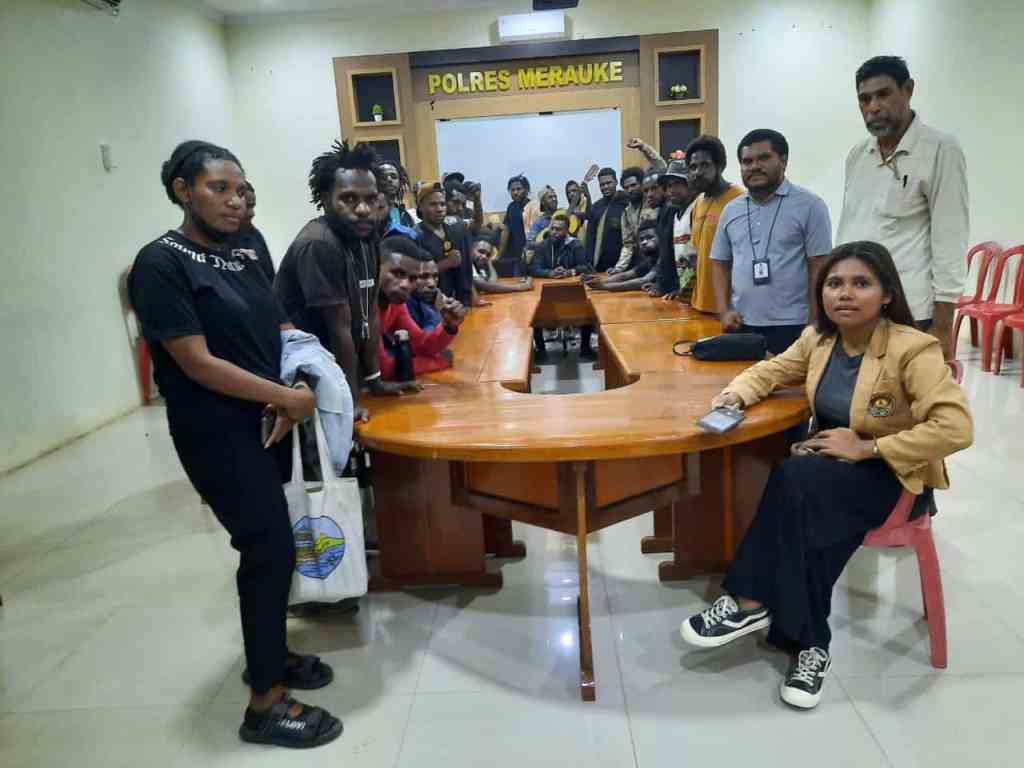
Police arrest 20 protesters supporting indigenous rights in Papua, sparking criticism

News Desk 21 November 2023

Protesters who were secured at the Merauke Police Station on Saturday (18/11/2023) during a peaceful demonstration in support of the Awyu indigenous people.-Dok AMPERA PS.

Jayapura, Jubi – Several civil coalitions expressed dismay over the apprehension of 20 individuals associated with the South Papua People’s Student Alliance (AMPERA PS) by Merauke Police on November 18, 2023.

The arrests occurred during a peaceful demonstration aimed at extending support to the Awyu indigenous community’s struggle for their ancestral lands against corporate encroachment in the Boven Digoel district.

Ayub Paa, an environmental activist from Greater Sorong, lamented the heavy-handed approach of the police in detaining demonstrators who sought to exercise their freedom of speech supporting Hendrikus Woro’s legal challenge against the Decree issued by the Head of the One-Stop Integrated Investment and Service Office (DPMPTSP) of Papua Province No. 82/2021, pertaining to environmental feasibility permits.

“We deeply regret the disruption of the peaceful protest intended to convey support for Hendrikus Woro. This could potentially lead to Hendrikus Woro’s ancestral lands and forests falling into the hands of a corporation, despite their lack of involvement in relinquishing customary rights or accepting funds for the acquisition of Woro clan’s ancestral lands,” expressed Ayub Paa in a press release received by Jubi on Sunday (11/19/2023).

Tasya Manong, spokesperson for the Alliance of Youth Students Caring for Forests and Indigenous Peoples’ Rights (AMPERAMADA) Papua, criticized the security forces for dispersing the protest and detaining individuals.

“Our fellow demonstrators sought a peaceful demonstration, yet they were dispersed and taken into custody at the Merauke Police station. Despite our rights as citizens being safeguarded by the constitution and other legal frameworks, they were subjected to this treatment. Did they cause any disruption? No. This severely undermines democracy and human rights,” said Tasya Manong. (*)

——————-

) Police disperse peaceful protest advocating indigenous rights in South Papua  

News Desk – Freedom Of Expression In Papua 

21 November 2023

Jayapura, Jubi – In Merauke Regency of South Papua Province, the local police disbanded a peaceful rally on Saturday (18/12/2023), detaining 20 demonstrators who were advocating for the Awyu indigenous people who embroiled in a legal dispute at the Jayapura State Administrative Court.

The protest, organized by the South Papua Student, Youth, and Advocates for the Traditional Lands Alliance (Ampera PS), aimed to highlight the Awyu indigenous people’s plight,

The dispersal of the rally and subsequent arrests faced opposition from the Legal Aid Institute of Papua (LBH Papua). According to LBH Papua Director Emanuel Gobay, Ampera PS had notified the Merauke Police about the demonstration in advance, suggesting that the police should not have intervened.

“LBH Papua views the police’s actions as a breach of Law Number 9 of 1998 regarding freedom of expression,” said Gobay, highlighting the discrepancy between the police’s duties as law enforcers and their handling of the situation.

Gobay, in a press release on Saturday (18/11/2023), condemned the arrests as an abuse of authority, citing Government Regulation Number 2 of 2003 on Disciplinary Regulations for Members of the Indonesian National Police. He further accused the Merauke Police Chief and staff of stifling democratic space, violating National Police Chief Regulation No. 8 of 2009 that outlines human rights principles in police duties.

LBH Papua urged the Papua Police Chief and the Governor of South Papua to instruct the Merauke Police Chief to release the detained Ampera PS protesters. Gobay emphasized the legitimacy of the rally under democratic mechanisms guaranteed by the Freedom of Expression Law, urging swift action for their release. (*)

Free West Papua campaigners convene for inaugural meeting in Jayapura 

The United Liberation Movement for West Papua (ULMWP) is holding its first ever congress in Jayapura.

The Congress has been held according to the demand of the people of West Papua, following a People’s Forum held on 6-7 November. Photo: ULMWP

Five thousand West Papuans from all seven regions are in Port Numbay, Jayapura, for the three day gathering.

The congress was called in response to the ULMWP leaders’ summit in Vanuatu, where the leaders announced that they had unilaterally dissolved the ULMWP provisional government, angering many.

Two groups within the ULMWP, the People’s Forum and Congress Committee have issued a rejection of the decision, saying it was undertaken outside of the ULMWP constitution.

“The people consider that the leaders have violated the Constitution where leadership and constitutional bodies must be appointed and born through Congress, not the Summit,” ULMWP Congress Committee said in a statement.

The ULMWP Congress chairman Bazooka Logo said “today (Monday) is the day when the momentum of the West Papuan people will determine who their leader will be who will lead the struggle for the independence of the West Papuan people [and] as well as the agenda of the Papuan people’s struggle for independence.”

“To all the participants [West Papuan people], this is an important moment that will really determine your future. For this reason, use your sovereign rights which are guaranteed constitutionally by the ULMWP in the ULMWP Constitution properly until the Congress is finished.”

Both group also demand the right to elect their own leaders, as provided for by its provisional constitution, not have them rotated in and out of power.

The Congress will end with the announcement of the results of the ULMWP leadership election.

—————————