Unknown's avatar

About AWPA Adelaide administrator

AWPA Adelaide site manager

IPWP Statement: West Papua at COP30

As COP30 begins in Belém, Brazil, we the undersigned express our profound concern over the intensifying deforestation currently occurring in West Papua, Indonesia. 

West Papua has been under Indonesian control since a controversial 1969 process, “the Act of Free Choice”, which saw 1026 West Papuans vote for integration into Indonesia under conditions of intimidation and violence. In 2019, the Act of Free Choice was described by the UK Government as “utterly flawed”. The number of West Papuans killed since Indonesian rule began has been estimated at between 100,000 and 540,000, while a state-backed ‘transmigration’ policy which has relocated more than 800,000 Indonesians to West Papua has likely made the indigenous population a minority.

Indonesian governance in West Papua is characterised by corruption, violation of Indigenous land rights, and widespread deforestation. 71% of the decrease in West Papua’s forest cover has occurred since 2011. Given that the territory contains over half of the world’s third largest rainforest, protecting this unique environment is critical to the preservation of a habitable planet. West Papua is also home to a number of extremely destructive industrial projects. Since 1988, US company Freeport McMoran has operated the world’s largest and most toxic gold mine in the Mimika Regency, which dumps over 200,000 tonnes of toxic tailings into the local Aikwa river system daily. 

More recent deforestation in West Papua has concentrated in agribusiness initiatives as well as mining. In 2024, a government-designated National Strategic Project (PSN) was launched in the southeastern Regency of Merauke, dedicated to sugarcane and rice production. Spanning more than three million hectares in total, the Merauke PSN has been described by conservation news service Mongabay as the largest deforestation project in human history. Upon completion, the PSN will release 782.45 million additional tonnes of CO2, more than doubling Indonesia’s existing yearly CO2 emissions. Much of the Merauke landscape is covered by Melaleuca paperbark trees, which store up to 381 tons of carbon per hectare. This makes the Merauke rainforest a denser CO2 sink than the Amazon rainforest.

As is often the case in West Papua, the Merauke mega-project appears to have been launched without consultation with indigenous West Papuans, deepening an already widespread sense of disenfranchisement and marginalisation. Industrial policy in West Papua is marked by a consistent violation of Free, Prior, and Informed Consent (FPIC). In another example of this trend, a 2018 investigation into the Tanah Merah mega-plantation in Boven Digoel revealed that all seven of the permits for oil palm concessions had been falsified.

We observe that industrial development is one of the major drivers of violence and internal displacement in West Papua. According to data compiled by human rights defenders on the ground, a total of 102,966 West Papuans were currently displaced as of October 2025. 

This interplay between deforestation and displacement is perhaps clearest in Intan Jaya Regency, where an area of forest the size of Jakarta is currently being cleared for the development of the Wabu Block gold mine. A 2022 Amnesty International report described construction at Wabu Block as having resulted in a ‘clear escalation’ in militarisation, including beatings, restrictions on free movement, extrajudicial killings, and a greatly increased number of military checkpoints. 

Intan Jaya has been a site of intense conflict and multiple human rights abuses in 2025, as construction on the Wabu Block has accelerated. On October 15th, fifteen civilians were massacred during an Indonesian military raid on Soanggama Village. A similar atrocity was committed in May 2025, when up to fifteen West Papuans were killed or disappeared in Sugapa district. The victims of this massacre included a minor, a 75-year-old, and two women, one of whom was buried by Indonesian soldiers in a shallow grave. In March, a series of aerial military bombardments destroyed a number of villages in Intan Jaya, prompting hundreds of civilians to flee.

We express our deep concern that Indonesia’s programme of deforestation in West Papua, is incompatible with UN’s sustainable development goals, as well as the Tropical Forest Forever Facility set to be launched at COP30. 

We urge leaders at COP to protect the natural environment of the unique rainforest of West Papua. Specifically, we urge leaders to support the Green State Vision developed by the United Liberation Movement for West Papua (ULMWP) for an environmentally just and sustainable West Papua. 

Alex Sobel, MP, UK, Labour Party, IPWP Chair
Carles Puigdemont, MEP, Catalonia (Spanish State), Junts, IPWP Vice-Chair
Gorka Elejabarrieta, Senator, Basque Country (Spanish State), EH Bildu, IPWP Vice-Chair

Matthew Wale MP, Leader of the Opposition, Solomon Islands, IPWP Vice-Chair
Lord Lexden OBE, UK, Conservative
Rt. Reverend Lord Harries of Pentregarth, UK, Crossbench
Maggie Chapman MSP, Scotland (UK), Scottish Greens
Ross Greer MSP, Scotland (UK), Scottish Greens 
Jeremy Corbyn, MP, UK, Your Party

Baroness Nathalie Bennett of Manor Castle, UK, Green Party
Nadia Whittome, MP, UK, Labour Party
Fatal free lunch

November 20, 2025

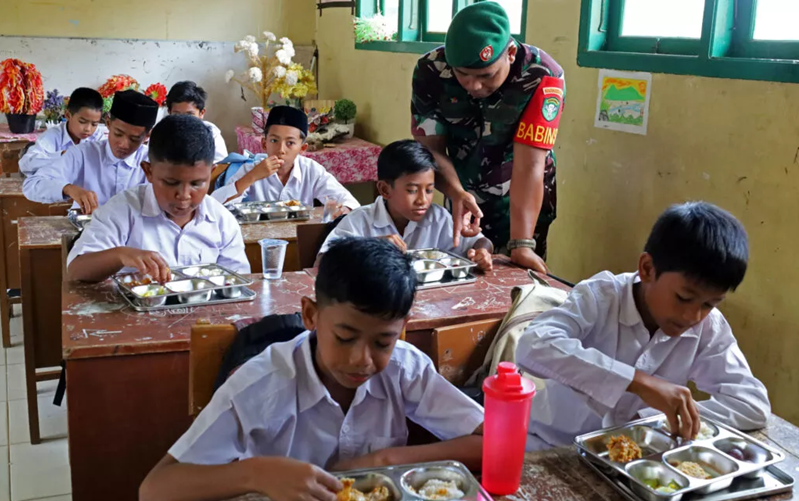
Indonesia’s free meals for kids program has left thousands of youngsters with food poisoning, and returned the country to the bad old days of military influence.

“All power flows from the barrel of a gun,” said Mao Zedong. His aphorism may have been right a century ago in China, but not in modern Indonesia. In the nation next door, power comes subtly via unarmed brigadiers in boardrooms. The riflemen are there, but out of sight.

Professional corporations with genuine jobs to fill normally advertise for the best certified and experienced applicants to stay innovative and competitive. Patronage appointments kill such management essentials.

Meat and veggie buyers, cooks, hygiene inspectors, nutritionists, quality controllers, agricultural advisors – there are scores of positions with Makan Bergizi Gratis (MBG) the free meals for kiddies’ programme.

The venture is to stop stunting through malnutrition – a most worthwhile goal – so standards should be high.

They’re not. Much of the work is being done by young guys hired to kill but employed to care. No surprise that more than 10,000 children have reportedly been gripped by food poisoning,

Dirty kitchens, food left to the flies, delivery delays, and hands and workbenches unwashed – the list is extensive and the blame clear: kitchens are no place for enlistees.

Video grabs of screaming students on classroom floors, fouled by vomit and diarrhoea, have ensured widespread coverage and demands that the program be shut until fixed.

That won’t happen, because the initiator of this stench is President Prabowo Subianto, 74, who swept into power last year on the promise of free tucker. It remains his flagship policy, and to stall would show defeat – difficult for an ageing authoritarian who knows he knows best.

The goal is 75 million meals a week through 1,400 kitchens by the end of this year – the cost A$10 billion.

Next year, the budget is expected to blow out threefold. Economists fear health and education money boxes will get raided and services suffer, though not the military, which is on an international weapons-buying spree.

By 2027, the MBG could gallop past A$27 billion, overtaking the defence allocation of A$18 billion.

It shows what goes wrong when a voter-grabbing policy first scribbled on a restaurant receipt isn’t backed by thought-throughs on infrastructure and planning. The public gets fed up with delays in implementing promised change – but here’s a good reason why patience is prudent.

When Prabowo won the election last year and flaunted his pledge, the applause was worthy of a footy win, though players knew there were too few cooks and bottle washers and a dearth of commercial kitchens.

The solution? Conscript the army.

Soldiers who joined for adventure, a uniform, a haircut and the chance to shoot dissidents in Papua found themselves scrubbing food trays.

Corruption has reportedly flooded the fractured system as a tsunami of unchecked government cash swirls around the dishes of cold soup and burned rice. The service is a continuous rush; no time for audits.

The policy of employing the military in civic affairs was refined by the Republic’s second president, former army general Soeharto. When he was overthrown in 1998 by students preaching democracy, dwifungsi (two functions) was also ditched. Now it’s back with Prabowo, also a former general and Soeharto’s former son-in-law.

There are already ten departments and industries where the military rules. They’ve also seized 3.7 million hectares of private palm-oil plantations and handed them to a state-owned company.

The Kuala Lumpur-based youth NGO World Order Lab voiced its concerns: “Partisan loyalty has increasingly dictated appointments, often sidelining professional qualifications in leadership. This is no accident but a calculated strategy of power consolidation, which signals that loyalty and political stability outweigh technocratic competence.

Patronage appointments undermine the crucial link between responsibility and expertise, leaving critical programs in the hands of those unprepared to manage them.”

The military is getting bigger, spreading wider and digging deeper. Orwell’s Big Brother was a wimp when measured against the Indonesian military’s ambitions.

Expect uniforms everywhere. Regional commands will be doubled to cover most of the archipelago’s 38 provinces. One hundred ’territorial development’ battalions will deploy units in 7,285 kecamatan (districts) within five years.

This isn’t secret stuff – the Defence Ministry published a full-page explanatory ad in the Kompas newspaper. The headline read Bukan Lagi Sekadar Militer: Pertahanan Rakyat Gaya Indonesia (No longer just the military: Indonesian-style people’s defence). No need for a catchy title – it’s an order.

It listed plans to enlarge battalions specialising in health and agriculture between now and 2030, claiming these have expanded and transformed “people’s defence based on prosperity and cross-sector collaboration”. The reasoning here is impenetrable.

The ad was published  “to counter public perception that these actions represent militarisation.” The public’s perception has been clear – so have the commentators.

Veteran Bloomberg Asian affairs columnist Karishma Vaswani warned: “The military’s increased influence (is) potentially enabling human rights violations and corruption.

“(The Kompas ad) was an attempt to normalise the presence of soldiers and generals in everyday life, potentially giving them the kind of influence they had during the Soeharto era…. an outsized role in politics and governance.

“A rejuvenation of the military’s power will reinforce (Prabowo’s) image as a leader who cannot rule without the assistance of the army.”

The Tentara Nasional Indonesia (TNI – Indonesian armed forces) has embedded itself in the national legend for almost eight decades, starting with guerrilla heroes routing the returning Dutch colonialists in the late 1940s.

Through its untouchable status, the TNI has boosted incomes and officers’ salaries by running foundations, factories and co-ops. Men in khaki moved off parade grounds onto the boards of banks, insurance companies, and even big retailers.

Soldiers are supposedly prohibited from business activities, though this is widely overlooked. The TNI is proposing a law change so Army wives can run village kiosks, though the real reason is to legitimise jobs for officers in civil businesses.

Perceptive readers of Pearls and Irritations would have foreseen that Indonesia was sliding into the black pit of military control when a story was published of MPs in fatigues at a post-election boot camp.

The few who still uphold democracy were dismayed; others saw it as a chance for selfies of giggling pols flashing thumbs-up. They should have been down.

The views expressed in this article may or may not reflect those of Pearls and Irritations.

Duncan Graham

Duncan Graham has been a journalist for more than 40 years in print, radio and TV. He is the author of People Next Door (UWA Press). He is now writing for the English language media in Indonesia from within Indonesia. Duncan Graham has an MPhil degree, a Walkley Award, two Human Rights Commission awards and other prizes for his radio, TV and print journalism in Australia. He lives in East Java.

President Wenda: December 1st a celebration of West Papuan unity

NOVEMBER 4, 2025

On behalf of the ULMWP, I declare this December 1st to be a celebration of West Papuan unity.

In that spirit, I acknowledge and welcome the statement of support for me as President of West Papua from West Papua National Liberation Army (TPNPB) spokesperson Sebby Sambom and Chief of Staff Terianus Satto. This is a major step forward for our movement and I thank Sebby and Terianus for their important message. We know our enemy always seeks to divide us. We must all move toward the same mission: one people, one soul.

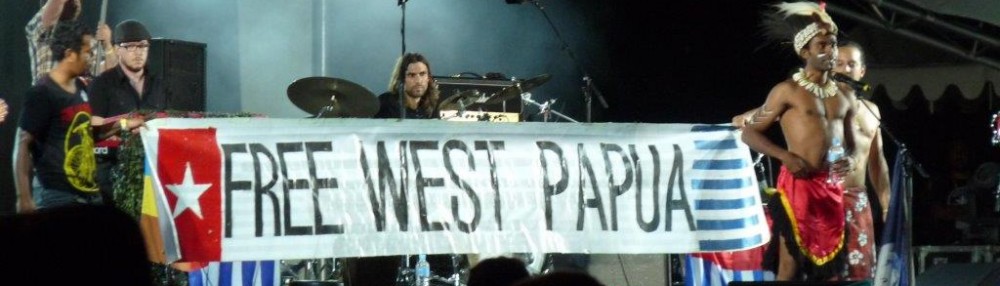
This December 1st I call on all West Papuans, wherever you are, to honour the Morning Star by wearing its colours on your clothes. We must show the Indonesian colonisers that the spirit of the struggle is as much a part of West Papua as the clothes we wear.  

Every December 1st, West Papuans celebrate our Independence Day in 1961, when our nation announced itself to the world as the first liberated Melanesian state. In a ceremony witnessed by six countries, including the UK, France, the Netherlands, and our neighbour Papua New Guinea, the New Guinea Council raised the Morning Star and sang our national anthem for the first time. Our freedom may have been stolen from us by Indonesia’s invasion two year later, but we still honour 1961 as our national day.  

The situation on the ground is worse than it has been since 2019. Every day brings a new massacre, a new killing, a new incident of torture or rape. In the past three months, we have seen the murder of fifteen Papuans in Intan Jaya, the relentless bombardment of the Star Mountain, the killing of children and mothers, and riots triggered by racist abuse of Papuan students in Yalimo. 

At the same time, Indonesia’s war criminal President Prabowo is continuing with the destruction of the Papuan rainforest. The National Strategic Project (PSN) in Merauke is the biggest plantation in human history: it is a planet killer.  

These events show how urgent the need for unity among West Papuans is. We know that all West Papuans support Merdeka, whether in the bush, the village, the refugee camps or the cities. But we cannot have any hope of saving our people or protecting our forest if we don’t stand together. I therefore urge my people, continue to rally behind the ULMWP. This is your government and your constitution. We have thousands of representatives across our land. 

We know our enemy will exploit any division between us. By unifying, we honour our ancestors and all those who have fought against Indonesian colonial rule. They joined the struggle because they believed that one day, the Morning Star would fly freely in every village and town across West Papua.  

To our supporters around the world, please raise the Morning Star on November 1st. Our national flag is illegal in our own country. If we raise it, paint it on our faces, or shout for freedom in the streets, we can be imprisoned for twenty-five years. We can also be shot dead, as 18-year-old Obert Mirip was in July. This is why we need our allies to fly the flag for us. 

Benny Wenda
President 
ULMWP

Indonesian President Prabowo visits Australia. Will PM Albanese raise West Papua?

AWPA Statement 11 November  2025

Indonesian President Prabowo visits Australia. Will PM Albanese raise West Papua?

Barring any last minute changes, the Indonesian President Prabowo Subianto, will visit Australia on Wednesday 12 November. His first visit to Australia since taking office. His last visit was in August 2024 as Defence Minister.

 2024 visit  (Photo Jakarta Post) President-elect Prabowo Subianto meets with Australia’s Prime Minister Anthony Albanese at Parliament House in Canberra, Australia, August 20, 2024. (Reuters/AAP Image/Mick Tsikas )

Joe Collins of AWPA said, “we are going to hear the usual statements about how our relationship/friendship with Indonesian is one of our most important”.

From PM Albanese media release (11 November 2025)

“Australia and Indonesia share a deep trust and unbreakable bond as neighbours, partners and friends. Together we are committed to working for a secure, stable and prosperous Indo‑Pacific.

“I look forward to building on our previous discussions about how we can develop the strength and depth of our bilateral relationship.”

https://www.pm.gov.au/media/visit-australia-president-republic-indonesia


Collins said, “Although improving trade will be the number one topic in the talks, we can be sure the usual issues of defence ties, terrorism and security in the region will also be on the agenda”.

“The one issue that won’t be discussed will be the human rights situation in West Papua”.

There will be no mention of the massacre of 15 West Papuans  on the 15 October 2025 during  a security force operation in Soanggama Village in the Intan Jaya Regency, Central Papua. During the military operation the security forces conducted house to house searches and opened fire in an indiscriminate fashion resulting in 15 deaths. The massacre was condemned by civil society, church groups throughout the region 

and by Sen Lida Thorpe (Victoria). 

https://www.aph.gov.au/Parliamentary_Business/Hansard/Hansard_Display?bid=chamber/hansards/28876/&sid=0126

There will be no mention that there are more than 102,966 Internally displaced people in West Papua due to Indonesian security force operations or that there are ongoing human rights abuses committed by the security forces in the terrority.

No mention of the fact that the TNI arrest and torture  West Papuans”.  No mention of the fact that there are regular crackdowns on peaceful demonstrations with West Papuan activists arrested and intimidated” 

And

no mention of the fact that Prabowo  was  dismissed from the Indonesian army in 1998 for kidnapping student activists or that he  has  been accused  of involvement in  human rights abuses in East Timor  and West Papua, accusations that Prabowo has denied.


Joe Collins said, “we have been told in replies to our letters (to DFAT) that the Australia Government does raise the human rights situation in West Papua with Indonesia, however, we have yet to see any public statements from the Government on the issue. 

As West Papuan National Flag day approaches, 1st December, supporters around the world will be raising the unfree flag of West Papua in a show of solidarity with the West Papuan people. A reminder to governments and in particular to the Australia Government the issue is not going away.

How UN betrayal of West Papua led to genocide, step by step

by Julie Wark 24th October 2025

The United Nations has recently come under attack from the Trump Administration and, much as it goes against the grain, it’s difficult to argue with real-estate-developer-cum-ambassador-representative for UN Management and Reform [sic], Jeff Bartos:

“Over 80 years, the UN has grown bloated, unfocused, too often ineffective, and sometimes even part of the problem. The UN’s failure to deliver on its core mandates is alarming and undeniable.”

Yet the problem isn’t really the UN. One notable symptom of its malaise is the Security Council and its five veto-playing permanent members — the US, UK, France, China and Russia — representing the world system that assist and cover up for their allies who commit human rights violations, war crimes and genocide, and that also outsource such crimes. But lèse-humanité is the crime par excellence of the international system. It’s a basic principle of colonial “development”. So what follows isn’t about kicking the UN when it’s down, but about how the rulers of this system use any institution, democratic or otherwise, to achieve their own diabolical and white supremacist ends.

I’m sorry — in more ways than one — that this article is long.

It’s long because the list of UN (when I refer to the UN, I’m basically referring to the world system) offences against the people of West Papua is hideously long. Sadly, my list is by no means complete because there’s lots of “classified” material I don’t know about and many, many secrets, but I hope it gives a glimpse of how the international system works when it wants to get whole encumbering peoples out of its way.

I’m taking it as given that Indonesia is committing genocide in West Papua. It’s done stealthily but there’s plenty of evidence (for example, see here, here, and here) for it. However, the facts show that, in this six-decade-plus crime against humanity, Indonesia has been the tool of other interests, that the role of the United Nations (by which I mean some of its dominant powers and personalities) has been particularly egregious, and this is surely one of the reasons why the West Papua genocide has continued sub rosa, deliberately silenced, for more than 60 years. There are many aspects of the UN betrayal because they belong to big-power politics and they’re convoluted because of the secrecy that surrounds them.

This isn’t about an isolated instance of genocidal violence. It fits into a world system where white supremacist brutality, going back at least to the period of early modern European overseas expansion from the 15th century, the so-called Age of Discovery (a quintessentially Eurocentric concept), turned into a “scientifically-based” system with the Enlightenment and didn’t end with decolonisation. I’d suggest, after reading documents from the time when West Papua was gifted to Indonesia, that the latter was less the West’s darling than a mere instrument unscrupulously used to favour the economic and geopolitical interests of white supremacy and its destructive notions of “progress and development”. It’s not only the various Indonesian regimes that are responsible for mass murder in West Papua, but also and especially their enablers in the international political system represented by the UN and the big powers.

I can only partially list the crimes committed against West Papua (and, here, I’m indebted to painstaking research by Julian McKinlay King, John Saltford, Greg Poulgrain, and others). But even an incomplete list gives an idea of the magnitude of this lèse-humanité, this core crime of international law. I’m not interested in “speaking truth to power” because I agree with Pankaj Mishra that this is a naïve exercise. Those in power know and control the truth. I studied politics and am not an expert in international law so I hope I don’t misinterpret some aspects of it. In any case, the hard facts are enraging for any decent human being. Experts in international law are often too invested in, or too occupied with, other aspects of the corrupt system to inquire into the evidence of Indonesia’s daily genocidal actions in West Papua, and too demoralised to try to stop them through the shoddy institutions at their disposal. Yet any non-expert person who cares to look at the documents can see quite plainly that, in the last almost 65 years of West Papua’s history, the UN has played a shameful role, not only allowing this to happen but deliberately colluding with it. The very forum that has the power to stop the genocide is complicit in it.

It was only recently that the UN finally acknowledged that Israel is committing genocide in Palestine, and I can’t help wondering whether all this fudging about the word is somehow related with fear of disclosure of the UN’s active role in abetting and silencing the West Papua genocide. I list 43 aspects of this below.

For the full article please see below.

The article in CounterPunch does list 43 separate paragraphs which are a real work of research and worthwhile reading editors note

Republished from CounterPunch, 24 October 2025

The views expressed in this article may or may not reflect those of Pearls and Irritations.

Summary notes on speakers at World Habitat Day at Yitpi Yartapuultiku Port Adelaide, 6 October 2025

STRONG FOCUS ON COP, CLIMATE and UNIFIED STRENGTH OF INDIGENOUS PEOPLES

This event was organised by The Australian West Papua Association (SA) (AWPA) supported by Conservation Council of SA and Pacific Islands Council of SA PICSA

The Free Family Event was a community fair – a number of organisations had stalls and presences including:

  • Asian Australians for Climate Solutions
  • AWPA – environment and political info
  • XRSA – flyers, free badges, write climate solutions on our whiteboard – about 8 XR members assisted
  • Face painting
  • Kid’s activities – focusing on tree kangaroos
  • Fijian and Papua New guinea dancers – organised by Tukini Tavui (Fiji) CEO PICSA
  • Hindmarsh Greens
  • Fusion Party
  • Sea Shepherd
  • Food trucks

 Channel 9 came to film the dancers

The evening event had about 120 people attending (including more XR members and friends joining) – a good showing in the auditorium. Uncle Moogy welcomed us to country with stories about water sources and connections across country through groundwater.

Chairing the session: Koteka Wenda … the advertised chair was not available but young West Papuan activist-in-exile Koteka Wenda stood in: setting a unifying and gracious tone of welcome, and speaking of her own upbringing and connection to country.

Speakers: all were intensely political and focused on indigenous justice and justice for country. There was a strong focus on the Pacific peoples and on COP31, and the wider interests of millions of first nations peoples.

Arabella Douglas – from Currie Country South-East Queensland/ northern NSW .

Topics:

  • Recent appeals to the International Court of Justice on compensation for climate damage, and on recognition of Palestine.
  • Strong interest by (so-called) Pacific nations in Aust bid to hold COP31 in Adelaide,
  • The stance of Pacific nations in leading the approach on climate.
  • History of the greater land mass of SAHUL (New Guinea and Australia were once joined and still share bird and animal and plant species, long history of connection and trading,
  • Severe impact of climate – and moves to create unified climate solutions: examples: plant mangroves as sea-protection, and to close down the many extractive industries
  • Impacts of climate risk on indigenous people here – opportunities to join with Pacifika peoples. Examples of injustice – poor management of northern rivers.
  • Drawbacks – Fed monies received for Native Title compensations and restitutions have conditions so that they cannot be used to sue the Fed Govt.
  • Opportunities for appeals to the ICJ (Int Court of Justice) over climate crisis impacts as a violation of human rights. Want to get problems such as Algal Bloom and damage to Murray-Darling basin onto the COP agenda.
  • Opportunity for Australia to have a seat on the UN Security Council (although the 5 permanent-seat nations have rights of veto)

Note on ICJ: https://www.crikey.com.au/2025/07/30/international-court-justice-australia-pabai-pabai-torrest-strait-climate-change/

  1. Uncles Pabai and Paul of Torres Strait raised a case in the Aust courts, alleging the government had failed to meaningfully address climate change.
  2. Students from the University of the South Pacific took a case to the ICJ in 2019 to advise on the obligations of governments to address climate change under international law

Ali (Kenny) Mirin – West Papuan writer and advocate … topics:

  • West Papua is arguably the world’s most biodiverse and most threatened region
  • Illegal logging, multi-national corporations, military protection … impacts for people: restrict access to forests and food sources – + hunting, medicine
  • Destruction of place-identification markers such as large trees – these mark boundaries between tribes and overstepping boundaries leads to inter-tribal conflicts – there are no written records – instead a story-telling system and a land-place/moiety system
  • Major corp: MIFEE (Merauke Integrated Food and Energy Estate)  – land grab … https://www.etan.org/news/2011/mifee.htm  world’s largest deforestation for sugar cane .. clearing of native mangrove, sago, paperbark, wetland destruction, incursion of roads, multi species of frogs, high elevations, fragmented habitats … add climate impacts increased temp and rainfall.
  • 50,000 – 60,000 internally displaced people due to Indonesian Military
  • Media censorship and communication difficulties – PNG has more than 800 languages.

Rowena – Samoan woman   now living in Adelaide … topics

  • Pacifika peoples have contributed least to climate change but have the most serious impacts – example – nuclear waste dump flooded by rising sea levels
  • Repressions with all the usual methods – forbidden to use language, students confined to dormitories.
  • Climate justice is indistinguishable from land justice.
  • The Australian government claims to protect pacific “family” but at the same time rewards and supports “those who would destroy us”.
  • Habitat protection needed
  • Solution to climate catastrophe is to Speak the Truth
  • People in Aust do not know where Samoa is
  • People in the Pacific do not know where Adelaide is “is it near Perth?” … but they know it when you say “It’s the place with the Santos HQ”.

Tiani Adamson (Wildlife Conservationist and Young South Australian of the Year 2024)

  • Tiani came from the northern Cape York peninsula – her people were forcibly relocated to Darwin. She is now based in Adelaide.
  • Focuses research on islands – 5% of landmass, > 20% of biodiversity, extreme speciation due to isolation, but vulnerability to introduced ferals.
  • Island and indigenous decision making is more community based, long term and not based on a 4 year election cycle.
  • Australian native food businesses are less than 5% owned by indigenous people
  • Need to nourish land and sea  – and at the same time each other.

AWPA Statement – Indonesian military kill 15 West Papuans, the majority civilians during military operation

During the military operation the security forces  conducted house to house searches and opened fire in an  indiscriminate fashion resulting in 15 deaths. According to community sources  soldiers buried most of the bodies  with some still to be found. 

      Human Rights Monitor

Joe Collins of AWPA said, “as with previous military operations  local people fled in fear of their lives. In this case up to 145 residents fled from Soanggama, Janamba, and Kulapa. There are now over 100,000 displaced people in West Papua. Many are malnourished and children are missing out on their education”.

The security forces claimed that  the dead were  members of the West Papua National Liberation Army (TPNPB) and they were killed  in a firefight.

However, TPNPB Spokesperson Sebby Sambom  reported only  three of the dead were  TPNPB members. 

Local church leaders and civil society groups also disputed the official narrative. The Intan Jaya Conflict Mediation Team stated that not all 15 victims were affiliated with the TPNPB, identifying at least nine civilians, including a deaf man and a housewife who died while fleeing. 

The Head of the Intan Jaya Conflict Mediation Team, Yoakim Mujizau, said  that his team had visited Soanggama Village and identified the victims and gathered information from residents who witnessed the incident. The team also received information from members of the Indonesian National Armed Forces (TNI) stationed there.

The latest information is that all the victims have been buried by the Task Force in different locations. Two victims were buried in Soanggama Hamlet in front of the Protestant Church. Six people were buried in Dusandigi Hamlet, Soanggama Village, and one woman was buried in Jembatan Hamlet, on the Wuisiga River.

Meanwhile, the bodies of the other six victims have not yet been found.

“The security forces are still unwilling to provide information. Where are the shooting victims? And where are they buried? So we are still investigating the whereabouts of the bodies, and we have not yet identified them,” he said.

Collins said, “we have statements from the Indonesia  military  saying it reclaimed/ liberated  a village from the TPNPB when  the only liberation that needs to be done is the liberation of West Papuans from the oppression of the Indonesian security forces”.

Joe Collins said,” we have a massacre of Papuan civilians on our doorstep and there is no comment from Canberra on the incident. No concern about the ongoing human rights abuses, the military operations or the death of civilians in the territory”. 

All Canberra does “is to train and exercise with the Indonesian military. Sign a  defence treaty  with PNG and build up bases for US forces in the north. All to prepare for some imaginary invasion from China. Australia has always been concerned about stability in the region to our north, but the West Papua issue is the one issue that could cause the very instability the Canberra fears.

The West Papuan issue is not going away. Time for Canberra to become involved and put pressure on Jakarta to control its military in West Papua, as a first small step.

Ends

Sources

Jubi, Human Rights Monitor and Civil society reports 

Arbitrary arrests and restriction of peaceful assembly in Jayapura

15 October 2025 / 2 minutes of reading

On 23 September 2025, police officers from the Jayapura Police arbitrarily detained thirteen members of the West Papua National Committee (KNPB) in the Sentani area while they were distributing leaflets to announce an upcoming peaceful demonstration marking International Farmers’ Day (24 September 2025). According to local reports, at 10:08 am, police officers stopped the activists at the old Sentani Market (Pasar Lama) and detained them after 20 minutes of tense negotiations. The police seized the leaflets and transported the KNPB activists to the local police station for questioning. They were allowed to leave later that day.

In the afternoon, around 3:30 pm, KNPB members in Abepura and Kamkey, Jayapura City, continued distributing the same leaflets at strategic public points. The police again intervened, seizing the leaflets and detaining several individuals in police vehicles. In response, other KNPB members and residents marched to the Abepura Police Station to protest the arbitrary detention and demand an explanation.

Human rights analysis

This incident demonstrates a continuing pattern of repression of peaceful political expression in West Papua. The arrests of non-violent activists for merely distributing informational materials represent a violation of the rights to freedom of expression, peaceful assembly, and association, as guaranteed under Articles 19 and 21 of the International Covenant on Civil and Political Rights (ICCPR), to which Indonesia is a State Party. The use of police force to silence non-violent activists highlights the shrinking democratic space in West Papua and perpetuates an atmosphere of fear among civil society organisations. The events underscore the urgent need for systemic reform of policing practices in West Papua to prevent and reduce human rights violations.

Detailed Case Data
Location: CGJ4+W2W, Jln.mahkal;),;Pasar Lama, Hinekombe, Kec. Sentani, Kabupaten Jayapura, Papua 99352, Indonesia (-2.567648, 140.5050644) pasar Lama Sentani (Old Sentani Market)
Region: Indonesia, Papua, Jayapura Regency, Sentani
Total number of victims: 13

#Number of VictimsName, DetailsGenderAgeGroup AffiliationViolations
1.13 

maleunknown Activist, Indigenous Peoples

Period of incident: 23/09/2025 – 23/09/2025
Perpetrator: , POLRES

Perpetrator details: Polres and Polresta Jayapura

Issues: indigenous peoples

Indigenous community faces criminalization and land seizures as Merauke Food Estate Project advances

16 October 2025 / 4 minutes of reading

The Indonesian government’s ambitious National Strategic Project (PSN) in Merauke has entered a critical phase marked by escalating conflict between indigenous landowners and corporations backed by state authority, with customary land seizures now accompanied by police criminalization of community members resisting plantation development on their ancestral territories. On 29 September 2025, Coordinating Minister for Food Zulkifli Hasan announced plans to convert 481,000 hectares of Papuan forest in Wanam, Merauke Regency, for rice, oil palm, sugarcane, and cassava production, alongside renewable energy facilities, including bioethanol and biodiesel processing industries. The government claims the forest area has already been “released” from protected status, with Minister of Agrarian Affairs, Nusron Wahid, stating the land “does not belong to the community because it was previously state forest,” allocating 263,000 hectares for rice fields in Wanam, 41,000 hectares in Merauke City, 146,000 hectares for oil palm, and 1,140 hectares for ports and settlements. This massive land conversion contradicts the lived reality of indigenous Yei communities like the Kwipalo clan, whose ancestral territories are being forcibly seized by PT Murni Nusantara Mandiri (MNM). The company is part of the PT Global Papua Abadi consortium holding a 52,700-hectare concession for sugar cane plantation development.

The conflict reached a new level on 15 September 2025, when Mr Vincen Kwipalo and his relatives physically stopped PT MNM employees operating excavators and bulldozers clearing their customary forest to build road access through Kwipalo clan territory in Jagebob District. Following this confrontation, PT MNM used one of its employees to file a police report against Mr Kwipalo at the Merauke Resort Police Station. Following the police report, Mr Kwipalo was summoned for clarification on 2 October 2025. On 17 September 2025, Mr Kwipalo and three relatives erected traditional barriers named “Sasi“ using tree trunks across the cleared land, painting them orange and posting warning signs reading “No entry to the Kwipalo customary area,” to protect the 2,308 hectares of ancestral land threatened by corporate encroachment. As of August 2025, PT MNM had already cleared 4,912 hectares of the concession area, with periodic monitoring by Pusaka Bentala Rakyat Foundation documenting ongoing deforestation.

The Kwipalo clan’s resistance reflects systematic violations of indigenous land rights under Indonesian law, particularly Article 43(3) of Law No. 2/2021, requiring that provision of customary and individual land “for any purpose” must be “carried out through deliberation with the customary law community and residents concerned to reach an agreement on the transfer of required land and compensation.”

The Kwipalo Clan has manifested its rejection through multiple channels: planting red crosses on customary territory as traditional symbols of prohibition, openly declaring rejection through the national media, staging demonstrations in both Merauke and Jakarta, and filing an ongoing lawsuit with Indonesia’s Constitutional Court challenging the project’s legality. His position is reinforced by Article 21 of Merauke Regency Regulation No. 5/2013. The article obligates the South Papua Governor and Merauke Regent to immediately order PT. MNM to stop the criminal act of seizing and embezzling the customary land of the Kwipalo clan and protect Mr. Vinsen Kwipalo from the threat of criminalisation. State institutions, including the police, have become enforcement mechanisms for corporate land acquisition. Ín addition, the military has established the 817th Territorial Development Infantry Battalion within PT MNM’s concession area on Kwipalo customary land in July 2025, without clan permission or consent. The developments support growing concerns of deliberate militarization for the purpose of securing corporate business interests.

The Merauke PSN represents a broader pattern documented across Indonesia, where National Strategic Projects systematically dispossess indigenous communities under the legal framework established by the Job Creation Law. Civil society organizations argue that the law provides “facilitation and acceleration” mechanisms that bypass normal consultation and compensation requirements. The case parallels the displacement of 75 families from Soa Village in Tanah Miring District by PT Global Papua Abadi for road and bridge construction, and other conflicts at other PSN sites, including Rempang Island (Riau Islands), Indonesian Green Industrial Zone (North Kalimantan), and the National Capital (East Kalimantan), where communities face forced evictions for development projects. Greenpeace Indonesia Forest Campaigner, Mrs Sekar Banjaran Aji, notedthat “PSN Merauke has deprived indigenous peoples of their rights, destroyed natural forests, and threatened the biodiversity of the landscape,” while emphasizing that “the involvement of the army and police in the project has also caused terror among the community and indigenous Papuans.” 

Indonesia’s National Human Rights Commission has documented violations in PSN Merauke activities. Yet the government continues advancing the project as part of President Prabowo Subianto’s vision referenced at the UN General Assembly, positioning Indonesia as a “candidate for the world’s food barn.” The Papua Law Enforcement and Human Rights Coalition has called on the President to “immediately revoke the National Strategic Project policy that legalizes PT. MNM’s seizure and misappropriation of the customary land of the Kwipalo clan. The criminalization of Mr Vincen Kwipalo represents an “early example” of tactics that will be deployed against indigenous land rights holders resisting investment projects throughout the South Papua Province and in other PSN sites across Indonesia.

Mr Vinsen Kwipalo stops PT MNM excavators from destroying the Kwipalo clan’s customary forest, 17 September 2025

Mr Vinsen Kwipalo and supporters in front of the Merauke District Police Station, 2 October 2025

Detailed Case Data
Location: Jagebob, Merauke Regency, South Papua, Indonesia (-7.9103659, 140.7624493)Kwipalo customary land in Jagebob District
Region: Indonesia, South Papua, Merauke, Jagebob
Total number of victims: dozens

#Number of VictimsName, DetailsGenderAgeGroup AffiliationViolations
1.Vincent Kipalo

maleelderly Human Rights Defender (HRD), Indigenous Peoples
2.dozens 

mixedunknown Indigenous Peoples

Period of incident: 15/09/2025 – 15/10/2025
Perpetrator: Private Company, Government
Issues: business, human rights and FPIC, human rights defenders, indigenous peoples

Rising militarism 

In the wake of looting and rioting in late August, President Prabowo Subianto deployed more than 75,000 Indonesian Military (TNI) soldiers to secure areas in and around Jakarta.

Editorial board (The Jakarta Post) Jakarta Fri, September 19, 2025 

Political developments in the past few weeks have not been very kind to the concept of civilian supremacy in the country. In the wake of looting and rioting that took place in late August, President Prabowo Subianto agreed to the deployment of more than 75,000 soldiers from the Indonesian Military (TNI) to secure areas within and around Jakarta.  It could have been a bigger display of military might, as security authorities proposed the deployment of more than 100,000 troops in the city. The troops’ deployment may have been the largest in the capital city since 1998, when soldiers in armored vehicles patrolled the streets following civil unrest that ended with the resignation of then-president Soeharto. 

Also in response to the unrest in August, President Prabowo sacked coordinating minister for political and security affairs Budi Gunawan after serving only 10 months in office, convinced that the former police general had failed to coordinate a proper response to handle the protests and street violence.

To replace Budi, on Wednesday President Prabowo inaugurated Djamari Chaniago, his senior at the military academy who in the late 1990s served as commander of the Army Strategic Reserves Command (Kostrad). 

The appointment of Djamari is only the latest in a series of decisions allowing both active and retired military generals to take charge of civilian institutions.  In May this year, then-finance minister Sri Mulyani Indrawati appointed Djaka Budhi Utama, a retired lieutenant general who was once found guilty of kidnapping human rights activists, as head of the Customs and Excise Directorate General.  Later in July, another Army officer Maj. Gen. Ahmad Rizal Ramdhani was appointed as president director of the State Logistics Agency (Bulog), in charge of one of the most crucial agencies involved in food security.

Other than packing civilian institutions with military generals, President Prabowo has also designed policies that allow military officers to have leading positions in their execution. In the food security program, the plan is to have thousands of soldiers deployed in the country’s remote regions to work on lands that will produce rice and other staple foods.  Currently, TNI soldiers are taking leading roles in a forestry task force that is expected to seize lands illegally occupied or used by palm oil companies.  Plans are also afoot to expand the military presence outside of Java, including the deployment of the Army’s Special Forces (Kopassus) to far-flung regions. 

This certainly looks like an aberration in a civilian-led democracy like Indonesia. But the reality today is that this expansion of the military’s role in politics could find its legal justification in the revised TNI Law, which was passed without much fanfare in March this year.


The revised law increases the number of state institutions to which military officers can be appointed without having to retire early from the service from 10 to 14. The new legislation also expands the TNI’s non-combat operations and extends sitting officers’ retirement age. When the Constitutional Court (MK) read its ruling on Wednesday to uphold the legality of the revised TNI Law, the court’s judges were up against insurmountable odds.  It was difficult for them to turn the tide in a political atmosphere that was already welcoming the increased presence of the military in civilian affairs. And with soldiers still patrolling the streets as the court was hearing the case, it was as if the panel of judges was staring down the barrel.

But it is unfair to pin our hopes on the court to save this nation from rising militarism. 

 The job of ensuring civilian supremacy should be in the hands of politicians both in the executive and legislative branches of the government, it is they who should devise rules mandating that the primary role of the military is national defense.