Military members shot two Papuans during electoral activity in Titigi Village, Intan Jaya

Cases, Human Rights News / Indonesia, West Papua / 1 March 2024

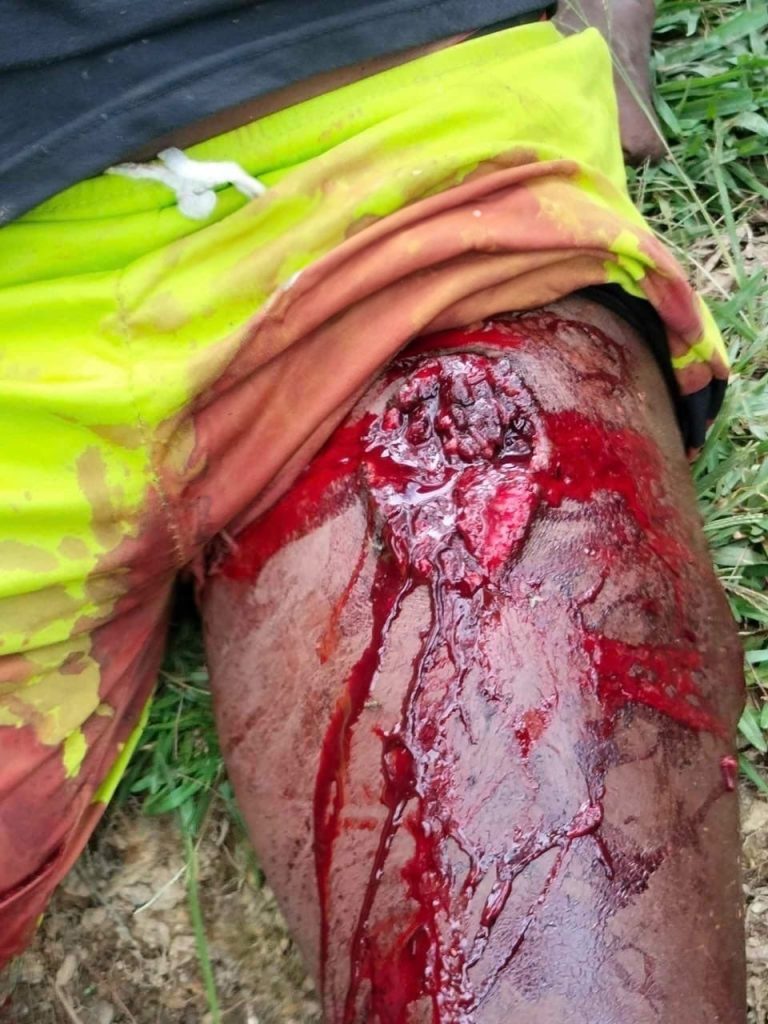
On 28 February 2024, around 10:30 pm, members of the Indonesian National Army (TNI) command Yonif 330 reportedly shot down the two indigenous Papuans, Selli Maiseni, 16, and Mr Mikalon Yoani, 18, in Titigi Village (see satellite image on top, source: European Space Imaging), Sugapa District, Intan Jaya Regency, Papua Tengah Province. Selli Maiseni sustained a gunshot wound on the arm, while Mr Yoani was shot in the thigh (see photos below, source: WPCC). The incident occurred during the vote count for the Indonesian Legislative and Presidential elections. The circumstances of the shooting are currently being investigated and verified. The XVII/Cenderawasih military command spokesperson, Colonel Candra Kurniawan, denied the allegations, saying there was no shooting in Suagapa on 28 February 2024 .

The case highlights a disturbing pattern of violence perpetrated by the TNI in Intan Jaya, citing many instances of shootings resulting in extrajudicial killings or injuries among civilians, including school children. The armed conflict in West Papua is a driver of internal displacement and prompted not only the indigenous population. but also teachers and health workers to leave the conflict areas. Accordingly, military members have become more involved in providing fundamental government health services, teaching in schools, and engaging in public activities such as burials and joint garden work. This is also part of the new Government strategy to tackle the armed conflict in West Papua with ‘Smart Power,’ a combination of soft approach, hard approach, and military diplomacy.

Many indigenous Papuans are traumatized by the presence of the military in their communities. Many are concerned that this exposes the community to increased potential risk of armed attacks by the West Papua National Liberation Army (TPNPB) near indigenous settlements and human rights violations. Human rights observers call for immediate action, demanding the withdrawal of all TNI Yonif 330 members operating there.

Mr Mikalon Yoani (left) and Selli Maiseni (right) sustained bullet injuries after military members bullet injuries opened fire in Titigi on 28 February 2024

Security forces raid villages Manggume, Aminggaru, Yenggernok, and Agiyome, Puncak Regency

CasesHuman Rights News / IndonesiaWest Papua / 13 February 2024 

Security forces raided the villages Manggume and Aminggaru, Omukia District, as well as in the villages Yenggernok and Agiyome in the Gome District, following the theft of an automatic firearm by members of the West Papua National Liberation Army (TPNPB) on 1 February 2024. According to information received, on 3 and 4 February 2024, security force members burnt houses in various villages to the ground (see images, source independent HRDs) and arbitrarily tortured villagers.

One Papuan villager reportedly died because of the injuries he sustained due to the torture. At least three other civilians were injured after being tortured, including one pastor named Rev Eriak Waker. The torture occurred during his interrogation in the Yenggernok Village. The other two victims sustained more severe injuries and were hospitalised. The Military later claimed that all victims were associated with the TPNPB. The relatives and the victims themselves underlined that they were civilians and not affiliated with the armed resistance.   

According to information received, security force members carried out a raid in the Manggume Village, Omukia District, on 4 February 2024, around 10.00 am. Mr Andinus Murib, 21, and Mr Devius Wanikbo, 19, were fixing the roof of a house when the security forces came to the villages. Villagers panicked and fled to the forest while Mr Murib and Mr Wandikbo were trapped on the roof. Security force members were temporarily detained and beaten.

Mr Murib and Mr Wandikbo were admitted to the public hospital after losing consciousness due to the pain they experienced during the torture. On 5 February 2024, military members suggested transferring both patients to Timika, where the hospital was better equipped. However, the relatives rejected the offer. Instead, they brought Mr Murib and Mr Wandikbo back to the village and treated them with traditional medicine because they feared further violence or criminalisation by the authorities.

During the raid in Manggume on 4 February 2024, security forces encountered Mr Werinus Murib, 20, in the forest near the village around 11.15 am while collecting firewood. After being arrested, security force members reportedly tortured Mr Murib until he succumbed to the injuries he sustained. The pattern of injuries indicated that the security force member beat and kicked the victim’s head and body using bare hands and blunt objects. The body also had stabbing and slashing injuries. Witnesses saw joint security forces tying Mr Murib’s feet to a car and dragging him for a distance of 1 kilometre. Mr Murib died on the way to the hospital as a result of the injuries he sustained.

Background

The pattern of attacks involving killings, torture, the destruction of houses, and the killing of livestock was also observed in the regencies Intan Jaya, Nduga, and Pegunungan Bintang, all located in the central highlands. This pattern indicates that these procedures are part of the security forces’ counterinsurgency strategy against guerrilla fighters. Armed resistance members hide among civilians and need the villages to supply their members with food and other essentials. The fighters are indigenous locals. Many are related to civilians living in the conflict areas. However, the presence of combatants among civilians is not sufficient reason to justify indiscriminate attacks directed against civilian settlements. Particularly in the case of air raids against small villages, a clear separation between civilians and targets can no longer be guaranteed. Strategies involving the deliberate destruction of civilian settlements and livestock cannot be justified under international law.

The use of extra-judicial execution, torture, and forced displacements during such raids amount to crimes against humanity as defined under the Rome Statue. While Indonesia has not yet been willing to become a party to the Rome Statute, the definitions provided in it are internationally recognised legal norms. An investigation by the National Human Rights Commission (Komnas HAM) into allegations of crimes against humanity is necessary and mandated by Indonesian law to reveal command structures, determine who authorised the attacks, and what security force units carried out the raids. Houses burnt to the ground during the raid in Puncak Regency, Papua Pegunungan Province, on 3 a

Amungme leader criticizes official visit amidst Freeport Indonesia environmental concerns

News Desk – PT Freeport Indonesia 14 February 2024

Jayapura, Jubi – John Magal, the chairman of the Amungme Community Institution (LEMASA) or Amungme Nagawan, expressed regret over the visit of a team from the Indonesian Ministry of Environment and Forestry (KLHK) and the National Development Planning Agency (Bappenas) failing to meet and observe residents directly affected by tailings from PT Freeport Indonesia‘s mining activities.

“They should have also seen the conditions of residents around the mining area, such as those living in Banti, Tsinga, and Arwanop. It is the duty of the state to observe the conditions of every Indonesian citizen,” said John Magal via WhatsApp to Jubi on Thursday (8/2/2024).

He added that as a citizen and leader of LEMASA, he deeply regrets that the visit was only to Freeport’s reclamation area in Tembagapura District, Mimika Regency, Central Papua Province.

“They should have directly observed the conditions of the people at locations directly affected by tailings and also residents around the mining area,” he added.

John Magal mentioned having sent a letter to the Ministry of Environment and Forestry, the Directorate General of Forestry and Environmental Planning, the Directorate of Environmental Impact Prevention of Business and Activities in Jakarta in June 2023.

“The ministry has responded to the letter because our request was for the Environmental Impact Analysis (AMDAL) to be suspended temporarily as it did not involve representatives of affected communities,” said Magal.

He personally wrote to the Minister of Environment and Forestry in Jakarta and until now, their request to meet with KLHK officials in Jakarta has not been fulfilled.

“Yes, I wrote to KLHK in Jakarta, and someone else met with them,” he said.

He stated that for nearly 50 years, their community as landowners has remained spectators, witnessing the wealth extracted from the bowels of Amungsa in Nemangkawi.

“Yes, we have been mere spectators for a long time,” he said.

Meanwhile, through its release, the Secretary of the Directorate General of Forestry and Environmental Planning, Herban Hendrayana, explained that Freeport has made various efforts in environmental management, and they hope this will continue and improve.

“The team planted Dechampsia Klossii, an endemic grass species found in Grasberg. Planting was done at Batu Bersih Grasberg at an altitude of 4,300 meters above sea level,” said Herban.

The KLHK and Bappenas team visited Mimika from Saturday, February 3 to Monday, February 5, 2024, to get a closer look at environmental management in mining areas and review community empowerment programs at PT Freeport Indonesia. (*) ——————–

Police to recruit 10 thousand personnel to be assigned in Papua  

March 3, 2024 21:29 GMT+700 Jayapura, Papua (ANTARA) – Assistant to the National Police (Polri) Chief, Inspector General Dedi Prasetyo, stated that his side will recruit 10 thousand people to be assigned in the four provinces in Papua.

The recruitment of 10 thousand personnel will be carried out from 2024 to 2028, Prasetyo said here on Sunday.

According to him, the Polri will recruit two thousand people in April this year. The new recruits will be educated at the State Police School (SPN) in Java.

Prasetyo hoped that the regional police chiefs in Papua could be active in disseminating information for the new recruits.

He said that those who will be recruited are Indigenous Papuans and those who were born and raised in Papua.

They will be educated for five months in SPNs in Java, and after their education, they will be temporarily assigned to the regions for adjustment before being returned for duty in Papua.

Prasetyo said he is committed to accepting indigenous Papuans to minimize the transfer of Polri members from outside Papua to Papua.

He explained that the two thousand personnel will include 150 paramedics, especially doctors. The medical personnel recruitment will be carried out in collaboration with Cenderawasih University (Uncen).

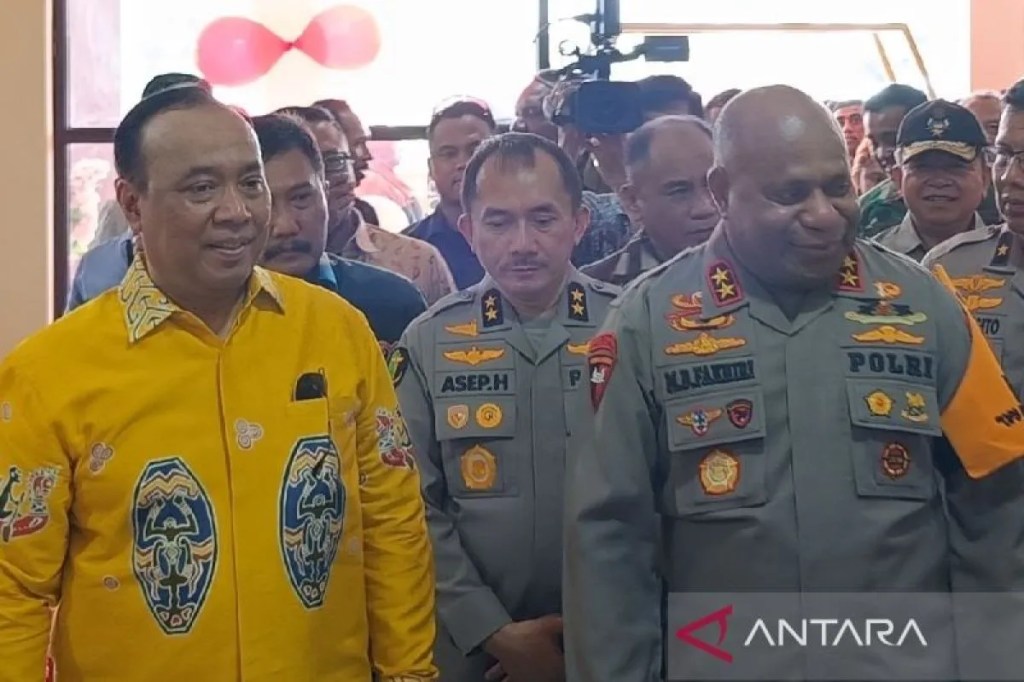
Papua Police Chief, Inspector General Mathius Fakhiri, said that due to the expansive region, the number of local police stations is limited. Some areas even only have two stations, such as the Nduga Police and the Puncak Police.

“Hopefully, the increasing number of police members can expand services to the community,” Fakhiri said.

The territory of the Papua Regional Police includes Papua, Highland Papua, Central Papua, and South Papua.

President lauds RSPPN facilities built by Defense Ministry

Jakarta (ANTARA) – Indonesian President Joko Widodo commended the completeness of facilities at the National Defense Central Hospital (RSPPN) Panglima Besar Soedirman in Bintaro, Jakarta, which was built by the Ministry of Defense.

“The COVID-19 pandemic has taught us the importance of having adequate health facilities, including hospital, with human resources readiness, equipped with adequate facilities to deal with health emergencies like the ones we have experienced,” the president stated at the RSPPN inauguration in Jakarta on Monday.

During his visit, Widodo was accompanied by Defense Minister Prabowo Subianto to check the number of facilities at the hospital that he considers modern.

These facilities include an MRI machine with the highest spec Tesla 3 that can capture detailed views from all angles, a CT scan device that can scan from all sides to create cross-sectional images of the body, and a sophisticated and integrated modular operating room.

The head of state also highlighted the construction of hospitals for the Indonesian Navy, Army, and Air Force that have a domestic component level reaching an average of 70 percent.

Related news: Pandemic impels hospitals to improve quality of health services: VP

“This is a very good step to support the development of our national industry to accelerate our national economic recovery,” he remarked.

Apart from the RSPPN, Jokowi also inaugurated 20 hospitals for the Indonesian Army, Navy, and Air Force, as well as five other hospitals that had earlier been inaugurated and were fully operational.

With its complete facilities, he expressed hope that the RSPPN can become a reference hospital for employees of the Ministry of Defense, Indonesian Defense Forces (TNI), and their families as well as the public to access the best health services.

In addition, RSPPN is a teaching hospital for the Faculty of Medicine of the Defense University and is ready to become a disaster response hospital when needed.

Australian Ambassador Pays Working Visit to Papua 

Translator Ririe Ranggasari

 Editor Laila Afifa

 28 February 2024 22:21 WIB

TEMPO.COJakarta – Australian Ambassador to Indonesia Penny Williams PSM visited Jayapura in Papua province on February 26 and 27. While in Jayapura, Ambassador Williams met with the chairman of DPR Papua Jhony Banua Rouw, Papua Province Acting Governor Dr. M. Ridwan Rumasukun, and the Papua Chief of Police, Insp. Gen. Mathius D. Fakhiri.

Ambassador Williams also visited the Regional Development Planning Agency in Jayapura to see in person how Australia and Indonesia are working together for better development planning in Papua.

“I am very pleased to visit Jayapura and to see firsthand the cooperation between the province of Papua and Australia,” Ambassador Williams said.

One of the highlights of Ambassador Williams’ visit to Jayapura was a dinner with prominent Australian Alumni women leaders in Papua. Ambassador Williams also met with the Rector of Cenderawasih University, Dr. Oscar Oswald O. Wambrauw.

Ambassador Williams is a senior official in the Australian Department of Foreign Affairs and Trade (DFAT). Prior to her appointment as the Australian Ambassador to Indonesia, Williams served as the Deputy Secretary of DFAT. She has also served as the Australian Ambassador to Malaysia and was Australia’s first Ambassador for Women and Girls. Williams is the first female Australian Ambassador to Indonesia.

Williams is fluent in Indonesian due to her educational background in Bachelor of Asian Studies (Honors) with a focus on: He holds a Bachelor of Asian Studies (Honors) with a focus on Indonesia, as well as a Masters in Applied Anthropology and Participatory Development.

Suci Sekarwati

Survey finds drastic decline in people who think elections were honest and fair

Kompas.com – February 25, 2024

Novianti Setuningsih, Jakarta — The Indonesian Survey Institute (LSI) says that the level of public trust in the honesty and fairness (jurdil) of the 2024 general elections has plummeted a week after the vote on February 14.

This was one of the findings of a post-election survey conducted by the LSI on February 19-21.

In the post-election survey, the number of respondents who believe that the 2024 elections proceeded in an honest and fair manner was only 76.4 percent. Yet on voting day, the figure stood at 94.3 percent.

LSI Executive Director Djayadi Hanan said this sharp decline can be regarded as severe.

“There has been a decline in the level of public confidence in the jurdil (honesty, fairness) of the election process when seen from this data”, said Hanan during an online release of the LSI’s findings on Sunday February 24.

“The decline is almost 20 percent. A decline that is very significant”, he continued.

Broken down, the number of respondents who considered the implementation of the 2024 elections to be “very honest and fair” plummeted from 45.5 percent to 17.6 percent.

This difference does not compensate for the number of respondents who consider the implementation of the elections to be quite honest and fair, which only rose to 58.8 percent from the previous 48.8 percent.

Of the remainder, an additional 8.1 percent of respondents consider the

2024 elections to be less than honest and fair, as well as 4.8 percent of respondents who considered it to be not honest and fair at all.

Furthermore, Hanan revealed that the declining trend was also seen in public satisfaction with the implementation of the 2024 elections.

In the post-election survey, the level of public satisfaction in the elections reached 83.6 percent. Yet on polling day, the level of satisfaction was as high as 94.5 percent.

Hanan believes that this decline is significant because the change in the figures was quite wide in a short space of time.

“So for example, if we did a survey in another 10 days, maybe the level of satisfaction will go down again”, he said.

Hanan is of the view that one of the reasons for the decline was because the public was been informed about the various controversies that accompanied the organisation of the 2024 elections through a variety of news reports.

This includes the controversy over tabulation errors in the General Elections Commission’s (KPU) Recapitulation Information System (Sirekap). Then, there have also been a number of reports doing the rounds about elections being rerun in several regions.

For example, the Election Supervisory Board (Bawaslu) has recommended that 780 polling stations (TPS) must organise a revote, and the KPU has already scheduled 686 of these.

Over the same time span, the number of respondents who answered they were “less than satisfied” with the elections rose from 4.4 to 8.3 percent, and those who were “not satisfied at all” also increased sharply from 0.5 to 5.5 percent.

The LSI said that the survey target population was Indonesian citizens who are 17 years and over or who are married and have a telephone or cellphone. This represents around 83 percent of the total national population.

The sample was selected through a Random Digit Dialing (RDD) method or the technique of selecting a sample through a random telephone number generation process.

Using the RDD technique, a sample of 1,211 respondents was selected through a random telephone number generation process, validation and screening. The survey’s margin of error is estimated to be around 2.9 percent with a 95 percent level of confidence.

The LSI claims that the interviews with respondents that were conducted by telephone were done by trained interviewers.

Politically, the narrative about the lack of honesty and fairness that has irreparably damaged the credibility of the 2024 election is getting stronger.

And this is not just coming from civil society groups. The political parties that supported the loosing presidential tickets of Anies Baswedan-Muhaimin Iskandar and Ganjar Pranowo-Mahfud MD have begun to be of one voice in the discourse about initiating a parliamentary right of inquiry to raise the issue.

Former Central Java governor Pranowo is already pushing the two political parties that supported him in the election  — the ruling Indonesian Democratic Party of Struggle (PDI-P) and the United Development Party (PPP) — to use the House of Representative’s (DPR) right of inquiry.

According to Pranowo, the DPR cannot remain silent over the alleged election fraud that was so blatant.

“In this case, the DPR can summon state officials who know about these fraudulent practices, including asking for accountability from the KPU and Bawaslu as the election organisers”, Pranowo said in a statement on February 19.

Meanwhile, the three political parties supporting Baswedan and Iskandar, the National Democrats (Nasdem), the National Awakening Party (PKB) and the Justice and Prosperity Party (PKS) are ready to support a right of inquiry in the DPR.

“We have met and discussed the steps and we are solid, because of this I want to convey, when the right of inquiry initiative is carried out these three parties are ready to participate”, said former Jakarta Governor Baswedan at the Anies-Muhaimin national legal team office in Mampang Prapatan, South Jakarta, on February 20.

[Translated by James Balowski. The original title of the article was “Survei LSI: Tingkat Keyakinan Masyarakat Pemilu 2024 Jurdil Turun Drastis Sepekan sejak Pencoblosan”.]

Source: https://nasional.kompas.com/read/2024/02/25/15415871/survei-lsi-tingkat-keyakinan-masyarakat-pemilu-2024-jurdil-turun-drastis

YLBHI condemns arrest of 9 farmers over land dispute in new capital Nusantara

Kompas.com – February 26, 2024

Sabrina Asril, Jakarta — The Indonesian Legal Aid Foundation (YLBHI) has condemned the arrest of nine palm oil farmers in the area of the new capital city Nusantara (IKN) who were opposing the construction of the VVIP Airport in North Penajam Paser, East Kalimantan, on Monday February 26.

“The YLBHI condemns the actions of the East Kalimantan regional police who carried out the inhuman and arbitrary arrests, because it was done without showing an arrest warrant and did not clearly notify them of the reason they were arrested”, said YLBHI Chairperson Muhammad Isnur said in a written statement on Monday.

Isnur said that the arrests can be categorised as a systematic act against communities defending their right to life. According to Isnur, the arrest of nine farmers by the police as a case of using the law to coerce the community.

“The police for the umpteenth time have used this method, in securing national strategic projects (PSN)”, said Isnur.

Isnur said that the same thing had happened at the Rempang Eco-City project in the Riau Islands and in the case of a land dispute in Seruyan, Central Kalimantan.

“The actions of the East Kalimantan regional police violated the law and human rights, where any person who is arrested has the right to be told the reason why they were arrested and the police are required to show an arrest warrant”, said Isnur.

Earlier, nine members of the Saloloang farmers group in North Penajam Paser (PPU) were arrested by the police on Saturday evening, February 24. The arrests were related a land dispute between a group of farmers and the IKN VVIP Airport national strategic project.

East Kalimantan regional police public relations head Senior Commissioner Artanto said that the nine farmers were arrested because it was said that they had threatened the IKN VVIP Airport construction project.

Artanto explained that on Friday February 23, a group of people approached VVIP project workers and threatened them so they would stop working.

The next day, on Saturday at around 8.30 am, the group returned to stop the construction of the VVIP Airport. The incident occurred on the northern side of Zone 2 when they brought Mandau (a kind of sword made in Borneo) and the operators immediately stopped work.

“On the basis of the incident, field supervisors at the location of the planned VVIP Airport made an official police report with the PPU regional police on that day as well”, Artanto said on Monday.

[Translated by James Balowski. The original title of the article was “YLBHI Kecam Penangkapan 9 Petani Sawit di Wilayah IKN”.]

Jokowi’s misuse of social aid during election can be categorised as corruption

Kompas.com – February 27, 2024

Ihsanuddin, Jakarta — It is believed that the misuse of social aid

(bansos) from the government during the 2024 elections can be categorised as corruption.

Indonesian Legal Aid and Human Rights Association (PBHI) Chairperson Julius Ibrani conveyed this during a discussion titled “A Fair and Democratic Indonesia Movement” with the theme “An Election Right of

Inquiry: A Release of 30 Names of DPR Members Being Encouraged to Submit a Right of Inquiry” in Jakarta on Tuesday February 27.

“Including bansos. It must be included in the category of corruption.

Why? Because it benefits certain parties, either personally or as corporate institutions and others”, said Ibrani in his presentation.

He is of the view that the government’s social aid program was a tool to raise the votes for a certain presidential and vice presidential candidate ticket.

As is known, President Joko “Jokowi” Widodo eldest son Gibran Rakabuming Raka ran as a vice presidential candidate in the 2024 presidential election under ticket number 2 as presidential candidate Prabowo Subianto’s running mate.

Ibrani said that the distribution of social aid ahead of voting day in the presidential election (Pilpres) also influenced survey results and the electability of the Prabowo-Gibran ticket.

“This was systemic, indeed the system that was seen was wherever there was a lack of vote for the beloved child he would pour water there”, said Ibrani.

“Until it then affected the results of electoral surveys, surveys, exit polls, why? People didn’t want to answer if they don’t choose Gibran, [they were] afraid of not getting social aid. That’s systemic”, he added.

Not only that, he also believes there are suspicions of the use of the state apparatus in the process to ensure a victory for presidential candidate pair number 2.

Moreover, he also considers that this year’s election process was systematically rotten.

“Also the use of state officials, just to mention a few, the TNI [Indonesian military], the Polri [Indonesian police], village officials, ministries and all kinds of facilities within this which should be categorised as corruption. Because it was used for the benefit of one or two particular parties”, he said.

The disbursement of social aid during the election campaign period this year has been in the public spotlight and was seen to be politically charged.

But despite being in the spotlight, the government still boosted the distribution of social aid and even promised it would continue to distribute social aid until June 2024.

In the realisation of the social aid program, President Widodo even “came from the mountain” to check the distribution of social aid in the Central Java city of Salatiga on Monday January 22.

Widodo said the government would try to continue the distribution of rice social assistance until June 2024 and that he hoped that the state budget (APBN) would remain strong so that social aid could continue.

Aside from Widodo, Coordinating Minister for the Economy Airlangga Hartarto also went into the field to distribute social aid directly and distributed assistance from government rice reserves in Indramayu, West Java, on Wednesday January 24.

Airlangga said that food assistance was intended to accelerate the elimination of extreme poverty in Indonesia. He also gave assurances that the government would continue the El Nino Direct Cash Assistance Program (BLT) which is now still in the disbursement stage.

“Direct cash assistance [to compensate] for El Nino amounting to 200,000 rupiah per month is now in process and it is hoped that at the end of the month or at the beginning of next month it can be launched”, he said.

However Presidential Special Staff Coordinator Ari Dwipayana said that the social aid distributed by the government was not related to the general election process.

Dwipayana asserted that the social aid was assistance for small communities that had already been mutually agreed upon by the government and the House of Representatives (DPR).

“It must be remembered that social aid is an affirmation program from the government for the ordinary people and poor families, the funding for which is sourced from the APBN”, said Dwipayana in a written statement given to journalists on Thursday January 4.

“And it was already agreed to jointly between the government and DPR.

So, it has nothing to do with the election process”, he said.

[Translated by James Balowski. The original title of the article was “Penyalahgunaan Bansos Saat Pemilu Dinilai Bisa Masuk Kategori Korupsi”.]

Source:

https://nasional.kompas.com/read/2024/02/27/17091111/penyalahgunaan-bansos-saat-pemilu-dinilai-bisa-masuk-kategori-korupsi

Fresh doubt cast on Prabowo’€™s suitability to rule

A leaked document circulating on the Internet detailing the reasons behind the dismissal of presidential candidate Prabowo Subianto from military service on Aug. 21, 1998, has cast doubts on the former general’€™s suitability to serve as president, if elected on July 9.The document, which was a scanned copy of the official letter signed by members of the Indonesian Military’€™s (TNI) Officer’€™s Honorary Council (DKP) tasked with hearing the cases of Prabowo’€™s complicity in the kidnapping of pro-democracy activists in 1998, revealed that the former Army’€™s Special Forces (Kopassus) commander was also fired from his position due to insubordination.Signatories in the document include then Lt. Gen. Susilo Bambang Yudhoyono, the current President; then Army chief of staff Gen. Soebagyo Hadi Siswoyo; Lt. Gen. Fachrul Razi; and Lt. Gen. Agum Gumelar.If the authenticity of the document is verified, it could deal a blow to Prabowo’€™s credibility as a military man and presidential candidate.The document states Prabowo, as Kopassus commander, overstepped his authority by ordering the Mawar and Melati units to ‘€œarrest and detain’€ the activists of the radical People’€™s Democratic Party (PRD).Mawar and Melati are military units under the command of Kopassus, which answer to the commander of the TNI.However, the document reveals the Mawar unit did not act on its own initiative, like Prabowo’€™s campaign team have repeatedly claimed.The document suggests the Mawar unit carried out the kidnappings after Prabowo reassured them that it ‘€œhad been reported’€ and that the operation was based on ‘€œa direct order from on high’€, when in fact a report was never made by Prabowo to then Indonesian Armed Forces (or ABRI, as the TNI was then known) commander Gen. Wiranto.The kidnapping was only reported in April 1998 after pressure from then head of the Armed Forces Intelligence Body (BIA) Maj. Gen. Zacky Anwar Makarim.The document, which was uploaded on the website indonesia-2014.com, is the first document made public that details how Prabowo was dismissed from the military.The document states the DKP not only dismissed Prabowo on charges of human rights violations in relation to the abductions, but also on a number of other actions that demonstrated his insubordination and disregard for the military code.Among the other charges brought against him in the DKP hearing were that Prabowo had carried out or had taken over several operations that were under the authority of the ABRI commander, including the involvement of military forces in East Timor (now Timor Leste) and Aceh; the release of hostages in Wamena in then-Irian Jaya; and Kopassus’€™ involvement in securing president Soeharto’€™s visit to Vancouver, Canada in 1997, shortly before the strongman was ousted from power.In conclusion, the DKP said Prabowo had disgraced and disregarded the military system and committed a criminal offense.In response to the circulating document, the leader of the Prabowo-Hatta Rajasa election campaign team, Mahfud MD, reiterated that Prabowo was honorably discharged from the military.’€œPak Prabowo did receive his marching orders, but take note that he was discharged with respect,’€ Mahfud told reporters at Polonia House in East Jakarta.’€œThere is no problem with this document circulating, I want to emphasize it [the dismissal] was done with respect. It would only be a problem if he were dishonorably discharged,’€ the former Constitutional Court chief justice said. (tjs)

This article was published in thejakartapost.com with the title “”. Click to read: https://www.thejakartapost.com/news/2014/06/09/fresh-doubt-cast-prabowo-s-suitability-rule.html.

Download The Jakarta Post app for easier and faster news access:
Android: http://bit.ly/tjp-android
iOS: http://bit.ly/tjp-ios